Tag: PLOS

Head Impacts Associated with Altered Gut Microbiome in Football Players

Non-concussive head impacts correlated with changes to the gut microbiome on following days, in pilot study tracking six US collegiate football players over one season

Image credit: Rich Barnes / Colgate Athletics, CC-BY 4.0 (https://creativecommons.org/licenses/by/4.0/)

Non-concussive head impacts – hits to the head that don’t cause clinically detectable symptomsare correlated with subsequent changes to the gut microbiome in a small sample of US collegiate football players, according to a new study published May 6, 2026, in the open-access journal PLOS One by Ahmet Ay and Kenneth Douglas Belanger of Colgate University, USA, and colleagues.

Non-concussive head impacts are common in American football, with players experiencing between 100 and 1000 across a season. While research has shown that full concussions can disrupt the gut microbiome – which regulates inflammation and the neuroimmune system – whether sub-concussive hits might produce similar effects had not been investigated.

In the new study, researchers tracked six NCAA Division I American football players across a competition season, beginning during preseason training. Their on-field activity profiles were monitored using GPS units and head impacts were tracked using a helmet-based sensor system; 226 faecal samples were analysed for their microbiome composition; and participants completed lifestyle questionnaires after each sample collection.

The researchers found that microbial diversity changed within two to three days after a substantial head impact. Specifically, certain bacteria – including the order Coriobacteriales, the family Prevotellaceae, and the genus Prevotella – tended to decrease in abundance while the genus Ruminococcus increased. In previous studies, these changes have correlated with brain injury and inflammation.

The athletes’ gut microbiomes also changed significantly over the course of the season, with mathematical modelling suggesting that the cumulative effects of non-concussive head impacts was likely associated with this shift, even after accounting for 15 potentially confounding factors including diet changes, exercise intensity, sleep, and stress.

The study is limited by its small sample size and lack of a control group, with its design meaning findings could only establish correlation but not causation. However, the authors conclude that even sub-symptomatic head impacts might affect the gut microbiome, both in the immediate aftermath of injury and over a longer time course in athletes who experience multiple impacts. 

Ken Belanger adds: “As far as we are aware, this is the first study to examine connections between head impacts and the composition of the gut microbiome – the complex community of bacteria and other organisms within the digestive system.”

“Our results provide evidence that even head impacts that do not result in a concussion or other reported symptoms may influence the microbes present within the gut, both in the short- and longer-term. Determining what causes these changes and whether they have a positive or negative influence on recovery from head injury will require further investigation.”

“Our research highlights the importance of thinking integratively about the interactions between the gut and the brain. We are only beginning to scratch the surface in our understanding of how these complex organs and organ systems communicate with and affect each other.”

Aziz Zafar adds: “After having only heard of the complicated interplay between neuronal inflammation and the gut microbiome, I found it to be such an exciting scientific experience to explore that interplay in the context of head impacts.”

Zachary Pelland adds: “It has been an amazing privilege to work so deeply on a personally and scientifically meaningful project which could not have happened without immeasurable support across academic departments, athletics, administration, and alumni at Colgate University.” 

Provided by PLOS

People with Poor Mental Health Have Worse Healthcare Experiences

Poorer mental health was associated with worse reported care and less trust in the healthcare system

Photo by Alex Green on Pexels

People with self-reported poorer mental health also report worse quality of care and lower confidence in healthcare systems, according to a study published May 5th in the open-access journal PLOS Medicine by Margaret E. Kruk from Washington University in St. Louis, U.S., and colleagues.

Rates of depression and anxiety have increased worldwide since the COVID-19 pandemic, and more people are pursuing mental health treatment as a result. However, there is limited up-to-date data describing how these individuals seek out and receive care. Detailed, population-level information can help healthcare systems meet this growing population’s needs.

To make a start on gathering this data, Kruk and her colleagues surveyed 32 419 adults in 18 high-, low-, and medium-income countries. More than 1000 people from each country responded. Participants self-reported data via the People’s Voice Survey in 2022 and 2023.

First, survey respondents self-assessed their physical and mental health (the latter including “poor,” “fair,” “good,” “very good,” and “excellent”). Then, they quantified their overall confidence in the healthcare system, their own use of healthcare services, the typical quality of care received, and their ability to manage their own mental health (a metric called patient activation).

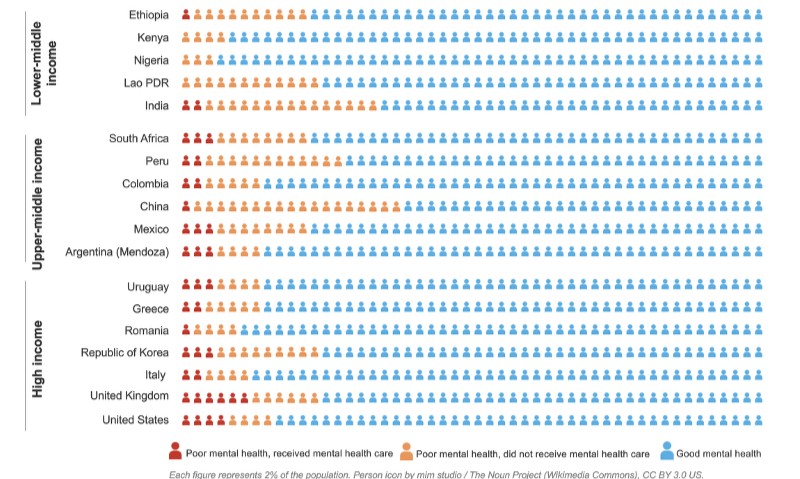
Mental healthcare receipt among people with poor mental health. Infographic displaying the weighted distribution of mental health status and care receipt. Each figure icon represents 2% of the population. Dark orange = respondents with poor/fair mental health who received mental healthcare in the past 12 months; light orange = those with poor/fair mental health who did not receive care; blue = those with good/very good/excellent mental health.

Image credit: Kruk ME, et al., 2026, PLOS Medicine, CC-BY 4.0 (https://creativecommons.org/licenses/by/4.0/)

Across all countries, respondents reporting poor mental health were more likely to report chronic illness, poorer overall health, lower patient activation, worse care quality and lower confidence in the healthcare system. Between 0.9% (Lao PDR) and 52.4% (UK) of these respondents reported receiving mental health care in the last year. Respondents in Nigeria reported the best overall mental health (4.7% people reported the lowest proportion of “poor” or “fair” mental health (4.7%), while respondents in China had the highest proportion (39.6%).

The researchers hope these results can help the countries in question – and individual healthcare systems – better serve the needs of those with poor mental health. While this is a descriptive study, the researchers posit patient activation as a potential target for elevating overall health and wellness.

The authors acknowledge that big-picture data doesn’t describe individuals’ specific experiences within the healthcare system. They suggest comparison across similar health systems and tracking system performance over time to continuously improve health services.

The authors add, “What stands out from this study is that poor mental health doesn’t exist in isolation. People reporting poor mental health were nearly twice as likely to have a chronic illness and far less likely to feel empowered to manage their own health. Health systems need to stop treating mental health in a silo and recognise that these patients are showing up across all areas of care – and often with more complex needs.”

Kruk adds, “As a research consortium working across very different health systems, we expected to find variation, and we did, in treatment access. But the experience gap was remarkably consistent: people with poor mental health had worse care, more unmet needs, and less trust in the system, regardless of where they lived. Health systems globally need to rethink how they serve this growing group, not just whether they can reach them.”

Provided by PLOS

Age, Sex, and Cancer Type Influence Risk of Subsequent Cancers Among Survivors

Findings may have implications for long-term cancer survivorship surveillance

Researchers assess the risk of developing a subsequent primary cancer based on demographic factors and cancer characteristics. Tara Winstead, Pexels (CC0, https://creativecommons.org/publicdomain/zero/1.0/)

Risk of developing a subsequent primary cancer varied significantly by age at initial diagnosis, sex, and type of first cancer, according to a study by Oxana Palesh and Susan Hong and colleagues at Virginia Commonwealth University, U.S., published April 28th in the open-access journal PLOS Medicine.

Advances in cancer detection and treatment have led to a growing population of cancer survivors. In the U.S., the number of cancer survivors is expected to grow by 22% over the next decade – from 18 million in 2025 to more than 22 million by 2035. Survivors remain at higher risk for developing new primary cancers distinct from their original diagnosis. This risk may be influenced by factors such as older age, exposure to radiation and/or chemotherapy and ongoing lifestyle factors like smoking, obesity and poor diet. Understanding who is at greater risk and how this risk changes over time can help to inform prevention and monitoring strategies.

Using retrospective data from more than 3 million cancer survivors in the U.S., researchers examined how demographic factors and cancer characteristics correlate with subsequent cancer risk. Several factors were associated with developing a subsequent cancer, including older age at initial diagnosis and male sex. In addition, survivors of lung, bladder, and skin melanoma were at higher risk of developing new cancer.

These findings reinforce the importance of long‑term survivorship care and risk‑based monitoring. By identifying survivor groups at heightened risk, studies like this can help to inform tailored prevention strategies, surveillance guidelines, and survivorship care planning as the cancer survivor population continues to grow.

First author Hui Cheng adds, “By examining nearly five decades of national data, we found population-level shifts in subsequent primary cancer risk, with several survivor groups experiencing rising risks. These findings can help design more tailored surveillance and prevention strategies.”

Provided by PLOS

Genetic Study in Indians Finds New Pathways Involved in Cardiometabolic Disease

Study of 3000 Punjabi Sikhs may yield new targets for treating Type 2 diabetes and other disorders

Photo by Sangharsh Lohakare on Unsplash

A study conducted in an Indian population has identified new molecular pathways that contribute to cardiovascular disease, which had not been reported previously in studies of Europeans. Dharambir Sanghera of the University of Oklahoma Health Sciences Center, US, led the new study, which was published April 23rd in the open access journal PLOS Medicine.

Worldwide, rates of cardiometabolic disease, which includes obesity, Type 2 diabetes and heart disease, are on the rise, and South Asian people living abroad appear to be especially susceptible. Previous studies have looked for genes that influence the levels of various breakdown products of lipids in the blood and their connection to different diseases, but most of this research has been conducted in people of European ancestry.

In the new study, researchers looked at how genetics influenced the levels of 516 lipid metabolites in the blood of 3000 Punjabi Sikh individuals, in an effort to better understand how these genetic pathways contribute to disease in different ethnic groups. They compared their findings to previous results from more than 1 million Europeans and 15 000 individuals with Indian ancestry. The team identified new genetic pathways that link specific lipid metabolites to disease. Notably, they confirmed that one metabolite, LPC O-16:0, which is known to be involved with immune cell signaling and inflammation, influences Type 2 diabetes risk. They also identified a genetic variant that may protect Indians from developing heart disease by modulating levels of the metabolite PC 38:4.

These findings offer new insights into the diverse molecular origins of cardiometabolic disease and provide potential pathways to be explored for designing innovative therapies. The researchers conclude that including more non-European participants in this type of research would help in identifying distinct disease subtypes linked to different genetic pathways. These advances would likely be beneficial in clinical practice by enabling more personalised therapies and preventive strategies for people from different backgrounds.

The authors add, “This study reveals new genetic pathways and lipid markers that contribute to type 2 diabetes and heart disease, specifically emphasising how immune system signaling affects metabolic health. By identifying unique genetic signatures in Asian Indians, the research advocates for ancestry-specific medical approaches to address chronic immuno-vascular conditions in cardiometabolic disease.”

Provided by PLOS

Neanderthals May Have Used Birch Tar for Its Anti-bacterial Properties

Experiments confirm anti-biotic properties of birch bark extract

The bark of birch trees has been used to produce tar for more than 150 000 years. The centre photo shows birch bark tar condensed onto a rock that borders a hearth. When scraped off the rocks, the viscous tar can be used as both an adhesive and antibiotic.

Neanderthals probably used birch tar for multiple functions, including treating their wounds, according to a study published March 18, 2026 in the open-access journal PLOS One by a team of researchers led by Tjaark Siemssen of the University of Cologne, Germany, and the University of Oxford, UK.

Birch tar is commonly found at Neanderthal archaeological sites, and in some cases this tar is known to have been used as an adhesive to assemble tools. Recently, some researchers have raised the question of whether Neanderthals had multiple uses for this substance. For instance, Indigenous communities in northern Europe and Canada use birch tar to treat wounds, and there is growing evidence that Neanderthals also employed a variety of medical practices.

To investigate the medicinal potential of birch tar, Siemssen and colleagues extracted tar from modern birch tree bark, specifically targeting species known from Neanderthal sites. They used multiple extraction methods, including distillation of tar in a clay pit and condensation of tar against a stone surface, both of which would have been methods available to Neanderthals. When exposed to different strains of bacteria, all of the tar samples were found to be effective at hindering the growth of Staphylococcus bacteria known to cause wound infections.

These experiments not only support the efficacy of Indigenous medicinal practices, but also reinforce the possibility that Neanderthals used birch tar to treat wounds. The authors note that there are other potential uses of birch tar, such as insect repellent, as well as other plants to which Neanderthals had access. Further exploration of the multiple potential uses of these natural ingredients will enable a more thorough understanding of Neanderthal culture.

The authors add: “We found that the birch tar produced by Neanderthals and early humans had antibacterial properties. This has important implications for how Neanderthals may have mitigated disease burden during the last Ice Ages, and adds to a growing set of evidence on healthcare in these early human communities.”

“By bringing together research on indigenous pharmacology and experimental archaeology, we begin to understand the medicinal practices of our distant human ancestors and their closest cousins. Additionally, this study of ‘palaeopharmacology’ can contribute to the rediscovery of antibiotic remedies whilst we face an ever more pressing antimicrobial resistance crisis.”

“The messiness of birch tar production deserves a special mention. Every step of the production is a sensory experience in itself, and getting the tar off our hands after spending hours at the fire has been a challenge every time.”

Provided by PLOS

Press preview: https://plos.io/3P6QrS5

In your coverage, please use this URL to provide access to the freely available article in PLOS Onehttps://plos.io/4le9beh

Contact: Tjaark Siemssen, tjaark.siemssen@arch.ox.ac.uk

Image caption: The bark of birch trees has been used to produce tar for more than 150,000 years. The centre photo shows birch bark tar condensed onto a rock that borders a hearth. When scraped off the rocks, the viscous tar can be used as both an adhesive and antibiotic.

Image credit: Tjaark Siemssen, CC-BY 4.0 (https://creativecommons.org/licenses/by/4.0/)

High-resolution image link: https://plos.io/4cteLHD

Citation: Siemssen T, Oludare A, Schemmel M, Puschmann J, Bierenstiel M (2026) Antibacterial properties of experimentally produced birch tar and its medicinal affordances in the Pleistocene. PLoS One 21(3): e0343618. https://doi.org/10.1371/journal.pone.0343618

Author countries: U.K., Canada, Belgium, Germany

Funding: Tjaark Siemssen is funded by the Boise Trust of the University of Oxford and the German Academic Scholarship Foundation (Studienstiftung). Aderonke Oludare was funded by Canadian Institutes of Health Research (CIHR) Project Grant 420598 awarded to Matthias Bierenstiel. The funders had no role in study design, data collection and analysis, decision to publish, or preparation of the manuscript.

Competing interests: The authors have declared that no competing interests exist.

Urban and Rural Residents Engage in Different Kinds of Physical Activity

In new study, rural and urban residents differed in the types of physical activity they do the most

Photo by Azat Satlykov on Unsplash

In a study of US adults, walking was, by far, the most popular leisure-time physical activity, while rural residents also enjoyed gardening, hunting and fishing, and urban residents more commonly reported running, weightlifting and dance. Urban residents were more likely than rural residents to meet physical activity guidelines. Christiaan Abildso of West Virginia University, US, and colleagues present these findings in the open-access journal PLOS One on April 1, 2026.

The US Department of Health and Human Services publishes guidelines on recommended amounts of aerobic and muscle-strengthening physical activity for adults. While the overall proportion of U.S. adults meeting these guidelines has increased in recent decades, certain populations are less likely to meet them, including adults living in rural areas. Understanding differences in preferred recreational physical activities could help inform efforts to reduce such disparities.

However, few studies have examined urban versus rural preferences for leisure-time physical activities, and how they relate to meeting guidelines. To address that gap, Abildso and colleagues analysed telephone survey data collected from a national sample of 396 261 U.S. adults in 2019.

Out of 75 survey options for leisure-time physical activities, walking was the most popular among both urban and rural adults, with 44.1% reporting walking as the activity they spent the most time doing. This finding echoes a similar study of U.S. data collected in 2011, which also found walking to be the top activity. However, further analysis of the 2019 data showed that even among walkers, only 25% met combined guidelines for aerobic and muscle-strengthening physical activity, and about 22% did not meet either guideline.

The popularity of other activities varied. For instance, rural residents reported higher rates of gardening, hunting, fishing, and farm work, while urban residents had higher participation in running, weightlifting, bicycling, and dance. However, in general, rural adults were more likely to be inactive and less likely to meet guidelines for aerobic or muscle-strengthening physical activity.

These findings could help inform efforts to boost physical activity by tailoring solutions to be more culturally and demographically appropriate. The researchers also call for a similar analysis of more recently collected data, as habits may have shifted during the COVID-19 pandemic.

Christiaan Abildso adds: “We expected to see that walking would continue to be the most common physical activity. However, it was surprising to see that nearly 1 in 4 adults who walk as their main activity did not meet either of the physical activity guidelines. That is, they reported less than the recommended 150 minutes per week of moderate-intensity aerobic activity and less than the recommended 2 days per week of muscle strengthening activity, such as yoga or exercises with resistance bands.”

“What we might be seeing in these rural-urban differences in preferences may just reflect what people have access to or what is culturally supported. In our work, we see a need to continue to support our partners in small towns and rural places by creating physical, social, and cultural conditions that support physical activity. This could mean creating a wide shoulder on a country road for running and cycling, helping a senior centre with their chair exercise programming, creating or improving park spaces, expanding the national network of rail-trails, renovating abandoned and dilapidated structures (Brownfields) into viable activity centres, keeping school facilities open to the public, and many other strategies. Everyone needs to ask, ‘how does what we’re doing affect physical activity,’ in order to help get people more active, more often, in more places.”

Provided by PLOS

Sugary Drink Taxes May Not Be Effective in Fast-food Settings

Analysis of nearly 7 billion Taco Bell transactions finds sugary drink taxes not linked to lower beverage calorie purchases

Photo by Breakingpic on Pexels

Taxes on sugary drinks had no effect on beverage calorie purchases from fast-food chain restaurants in the U.S., according to a new study by Brian Elbel and Pasquale Rummo from NYU Grossman School of Medicine and colleagues publishing April 2nd in the open-access journal PLOS Medicine.

Sugary drink taxes have been adopted in several U.S. jurisdictions as a public health strategy to curb sugar consumption and improve dietary behaviors. Research on the impact of these taxes on grocery stores purchases attribute sugary drink taxes to an estimated 15% decrease in sales. However, whether this translates to an impact in restaurant sales has not been well studied.

Researchers analyzed six years of sales data (2015–2020) from more than 7,300 Taco Bell locations nationwide, focusing on drive‑through purchases. The study compared beverage calories per transaction at 60 restaurants across five jurisdictions with sugary drink taxes—Albany, California; Cook County, Illinois; Oakland, California; Philadelphia, Pennsylvania; and Seattle, Washington—with a matched group of similar restaurants in areas without such taxes.

Overall, the analysis found no significant association between sugary drink taxes and beverage calories per transaction, suggesting that sugary drink taxes of this size or alone may not substantially reduce beverage calorie consumption in fast food restaurant settings.

The authors note that consumer behaviour in restaurants—such as choosing combo meals or prioritising convenience—may limit the effectiveness of these policies.

Elbel adds, “Using millions of transactions from six years of sales data, we found that sugary beverage taxes did not influence beverage calories when implemented in five cities in the U.S.”

Rummo notes, “These results suggest that sugary drink taxes may not be effective in reducing beverage calorie consumption in fast food restaurants, as compared to supermarkets. This could be because the sizes of sugary drink taxes in the U.S. are too small for consumers or that they just aren’t responsive to price changes in these settings, among other reasons.”

Provided by PLOS

Yawns in Healthy Foetuses Might Indicate Mild Distress

Foetuses yawn in the womb, with more yawns associated with a lower weight at birth

Photo by Mart Production on Pexels

Even in the womb, where all oxygen is provided by the parental placenta, foetuses can – and do – yawn. More yawns during observation were associated with a lower weight at birth – potentially indicating mild foetal stress in the womb, according to a study published February 25, 2026 in the open-access journal PLOS One by Damiano Menin, of the Università degli Studi di Ferrara in Italy, and colleagues.

Yawning is a behaviour found across vertebrates – and no one quite knows why. In humans, foetuses yawn in the womb from about 11 weeks. Even though there is no air to breathe, they slowly open their mouths, make motions similar to inhalation and exhalation, and close their mouths again. To understand more about foetal yawns, the authors of this study used ultrasound to observe 32 healthy foetuses (56% female, 44% male) between 23 and 31 weeks. Each foetus was observed for 22.5 minutes.

The authors found that the foetuses yawned between zero and six times during the observation period, with an average of 3.63 yawns per hour. They also showed that foetuses that yawned more during their observations were more likely to have a low weight at birth, which is considered as an indicator of mild distress – though all foetuses in the study were born healthy.

The researchers did not perform any manipulations to see if they could affect foetal yawning and also did not record measures such as foetal heart rate or maternal temperature which might potentially be associated with the behaviour. Additionally, no high-risk pregnancies were observed. Based on their research, the authors suggest that frequent foetal yawning might be a sign of mild distress in the healthy foetus.

The authors add: “We found that yawning frequencies in the womb are negatively related to birth weight, potentially indicating a stress-related response in healthy fetuses. This suggests that even before birth, yawning may serve as an indicator of a foetus’s well-being.”

Provided by PLOS

Shorter Treatment Regimens are Safe Options for Preventing Active Tuberculosis

One- and three-month regimens both had few adverse reactions and high rates of completion

Tuberculosis bacteria. Credit: CDC

A study comparing one- and three-month antibiotic treatments to prevent active tuberculosis (TB) finds that a high percentage of patients successfully completed both regimens and suffered few adverse side effects. A team led by Richard Chaisson, of the Johns Hopkins School of Medicine, reports these findings February 10th in the open access journal PLOS Medicine.

Following TB exposure, the World Health Organization has traditionally recommended six to nine months of antibiotic treatment to prevent an active infection from developing, but many individuals fail to complete the long course of medication. Studies have shown that shorter regimens lasting one and three months are effective at preventing TB, but the one-month treatment had only been tested in people living with HIV, and the safety of the two regimens had not been compared in a head-to-head trial.

Researchers performed a clinical trial in 500 people residing in Brazil, who were not living with HIV and had been exposed to TB. They randomly assigned participants to take two antibiotics, isoniazid and rifapentine, daily for one month, or weekly for three months. Both the one- and three-month regimens had similarly high rates of completion, at 89.6% and 84.1%, respectively. Adverse reactions were typically mild or moderate, and occurred at comparable rates in both groups. Both regimens were deemed successful and neither proved superior to the other.

Expanding the number of people who receive preventive therapy is essential for reducing TB infections globally, but these efforts have been hampered by several factors, including the length of the treatments. The new findings provide evidence that a one-month course of antibiotics is safe for patients, regardless of HIV status, and will help clinicians, public health programs, and patients to make informed choices about which regimens to use. Experts hope the success of shorter treatments, combined with the availability of newer generic formulations of the medications, which can be taken at home, will facilitate broader use of preventive therapy for TB.

The authors add, “Prevention of tuberculosis in people at the greatest risk is essential for global control of the disease, and shorter preventive treatment regimens will be instrumental in catalyzing uptake in high-burden countries.”

“Tuberculosis preventive treatment regimens have now been shortened from 6-9 months of daily medication to 1 month of daily treatment or 12 once-weekly doses, a transformational advance. Our study shows that both of the ultra-short regimens are well-tolerated and have high rates of completion.”

“The high rates of treatment completion and excellent safety profile of the short-course regimens will help Brazil and other high-burden countries achieve TB control by facilitating widespread uptake of TB preventive treatment,” states coauthor Betina Durovni.

“Preventing TB with short courses of well-tolerated medicines ensures that millions more people around the world can be protected from the devastating consequences of TB disease,” says coauthor Marcelo Cordeiro-Santos.

Provided by PLOS

Removing Fallopian Tubes during Other Abdominal Surgeries may Lower Ovarian Cancer Risk

Mathematical modelling study suggests this approach could also reduce total healthcare costs in Germany

Female reproductive system. Credit: Scientific Animations CC4.0 BY-SA

A mathematical modelling study conducted in Germany suggests that ovarian cancer incidence could be reduced and healthcare savings boosted if women who have already completed their families were offered fallopian tube removal during any other suitable abdominal surgeries. Angela Kather and Ingo Runnebaum of Jena University Hospital, Germany, and colleagues present these findings on January 30th in the open-access journal PLOS Medicine.

Some of the most widespread and serious forms of ovarian cancer begin in the fallopian tubes, and removing them may reduce ovarian cancer risk. While women at average risk of ovarian cancer are not recommended to have surgery solely to remove their fallopian tubes, many surgeons offer “opportunistic” tube removal during other gynaecologic surgeries such as hysterectomy or tubal sterilisation. Opportunistic removal may also be feasible during other abdominal surgeries, such as gallbladder removal.

However, the overall potential benefits of opportunistic fallopian tube removal have been unclear. To help clarify, Kather and colleagues developed a mathematical model that incorporates real-world patient statistics to predict population-level risks of ovarian cancer after opportunistic fallopian tube removal, as well as the potential healthcare cost savings.

By applying the model to statistics from Germany, the researchers predicted that opportunistic fallopian tube removal during every hysterectomy and tubal sterilisation could reduce ovarian cancer cases by 5% across the female population of Germany. Removal during every suitable abdominal surgery for women who are done having children could reduce nationwide cancer cases by 15%, the analysis suggests, and it could save more than €10 million in healthcare costs annually.

Ovarian cancer is the third most common gynaecologic cancer in the world and has a mortality rate of 66%. Overall, these findings suggest that opportunistic fallopian tube removal during appropriate abdominal surgeries could not only lower population-level ovarian cancer risks and prevent ovarian cancer deaths, but also provide economic benefits. This study could help inform health policy and insurance costs for the procedure.

The authors add, “We developed a mathematical model to estimate the likelihood of women undergoing surgeries that offer an opportunity for fallopian tube removal and the potential for reducing their ovarian cancer risk. Applying this model to the entire female population of Germany revealed that 15% of ovarian cancer cases could be prevented if fallopian tubes were removed during every suitable abdominal surgery in women who have completed their families. This approach has the potential to extend healthy years of life and significantly save healthcare costs.”

Provided by PLOS