Tag: 26/2/26

Method Spots Early Signs of Infection in Post-mastectomy Reconstruction

Rapid detection, treatment of infections could avoid complications, additional surgeries after mastectomy

Many of those women opt to have their breasts surgically reconstructed, most commonly with implants, but a relatively high percentage develop infections after implant surgery, requiring intravenous antibiotics and often removal of the implant. This can lead to additional surgeries, delays in cancer care and increased costs, as well as added emotional distress for women already under strain from cancer diagnosis and treatment.

To address this problem, researchers at Washington University School of Medicine in St. Louis have developed a new tool to detect reconstruction-related infections early, before they cause symptoms. This method, reported in the Journal of Clinical Investigation, could allow for preemptive treatment that preserves implants, improves patient outcomes and reduces the psychological and financial burden on patients.

Led by Jeffrey P. Henderson, MD, PhD, a WashU Medicine professor, the study identified biomarkers of infection in fluid drained from reconstruction patients’ breasts days or even weeks before symptoms appeared. This represents a major opportunity for improvement over existing diagnostic methods, which rely heavily on clinical symptoms, such as redness and inflammation, that take time to appear and can overlap with normal reactions to surgery.

The findings are available online and will publish in print Feb. 16 in the Journal of Clinical Investigation.

“The ability to identify with a molecular signature early on that a patient will go on to have an infection opens up the possibility of surveillance as part of standard care,” Henderson said. “This has the potential to enable earlier treatment that would be far more effective – and potentially curative – in patients who would otherwise progress to prolonged courses of treatment and surgery, or even implant removal and reconstructive failure.”

Small molecules, big impact

The study originated when Henderson’s WashU Medicine colleague Margaret A. Olsen, PhD, a retired professor of medicine in the Division of Infectious Diseases who studies hospital infections, noticed high rates of infection among US patients who had reconstruction with implants after mastectomy. The discovery prompted Henderson and Olsen, a co-author on the study, to ask WashU Medicine plastic surgeons who performed breast reconstruction what they would need to improve outcomes in these patients. Their answer was simple: a clear yes/no test for infection.

To develop such a test, Henderson and lead author John A. Wildenthal, an MD/PhD student, leveraged their expertise in metabolomics, the study of metabolites that are created or broken down during cellular processes in the body. Metabolites can indicate the presence of an infection because they include byproducts of both the body’s response to pathogens and the metabolic activity of the pathogens themselves. By analysing changes in metabolite levels, scientists can identify patterns that are characteristic of infections, enabling early diagnosis.

Henderson and colleagues coordinated with WashU Medicine plastic surgeons to obtain fluid samples from 50 patient volunteers during several routine follow-up visits after surgery. The patients included women who later developed infections after post-mastectomy reconstruction and those who did not.

The researchers analysed the samples for differences between the two groups and identified metabolites that were significantly associated with infection and that appeared days to weeks before clinical signs and symptoms of infection. Further, they found that the presence of certain metabolites indicated more serious infections that might require more aggressive treatment.

“Originating from clinical intuition and validated through a clinical study, the evidence in this paper now supports proactive, targeted interventions to predict and address infections before they become clinically significant,” said Justin M. Sacks, MD, a co-author on the paper. “Such interventions can substantially reduce the burden of complications, implant loss and reconstructive failures in these patients.”

For instance, the findings could lead to the development of a point-of-care test that could be provided during a woman’s routine post-operative visits, noted co-author Terence M. Myckatyn, MD, a professor of surgery at WashU Medicine, who performs plastic and reconstructive surgery for breast cancer patients.

“If the test is positive, antibiotics can be started preemptively in these select patients to thwart infection,” Myckatyn said. “And perhaps just as important, we would not give antibiotics to those with a negative test, thereby adhering to a thoughtful approach for antibiotic stewardship.” Such careful use of antibiotics is important for preventing antibiotic resistance, he said.

In the near term, the team is planning additional studies to validate the results. Then a diagnostic tool could be developed and tested in clinical practice. In the future, the broader metabolomic findings about the development of tissue infection in humans could allow physicians to more selectively target a variety of post-surgical infections, for example, by revealing new drug targets.

“While better techniques are always being sought, the reality is that infections still occur despite a meticulous surgical approach,” said Myckatyn. “To be able to identify biomarkers that can portend an infection days before it develops is huge.”

Source: Washington University
Scientists Discover a Form of Constipation Caused by Gut-drying Bacteria

Two bacteria working together to break down intestinal mucus are identified as a contributing factor to chronic constipation

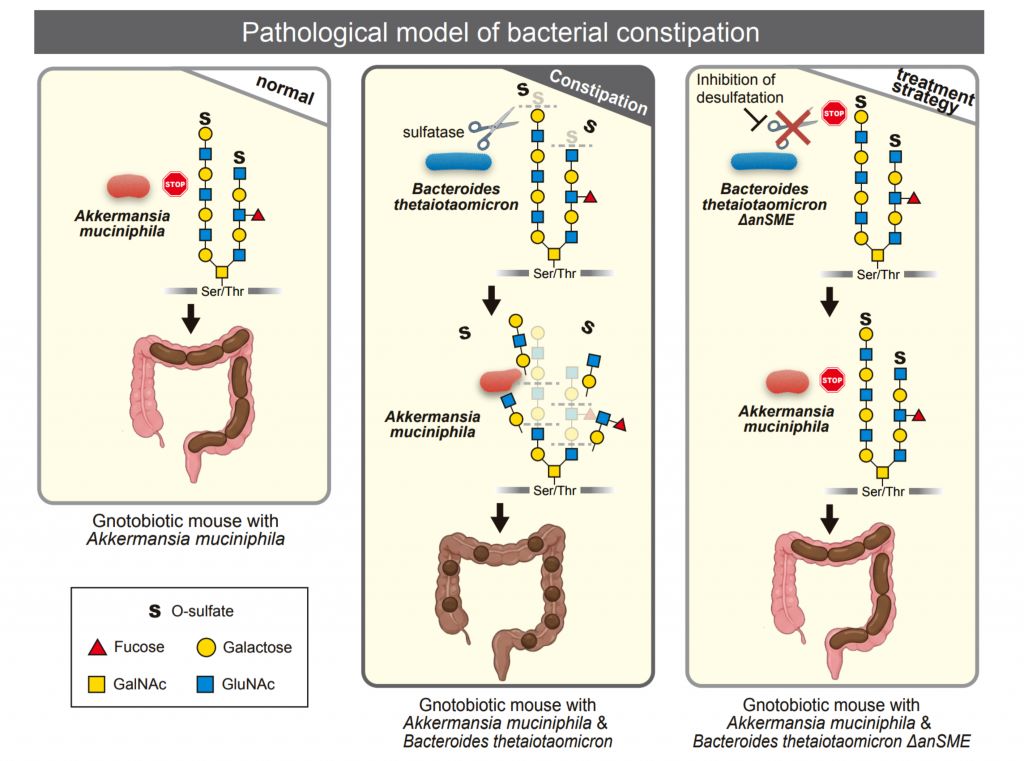
Scientists at Nagoya University in Japan have found two gut bacteria working together that contribute to chronic constipation. The duo, Akkermansia muciniphila and Bacteroides thetaiotaomicron, destroy the intestinal mucus coating essential for keeping the colon lubricated and faeces hydrated. Their excess degradation leaves patients with dry, immobile stool. This discovery, published in Gut Microbes, finally explains why standard treatments often fail for millions of people with chronic constipation.

Notably, the study shows that Parkinson’s disease patients, who suffer from constipation decades before developing tremors, have higher levels of these mucus-degrading bacteria. While constipation in Parkinson’s disease has traditionally been attributed to nerve degradation, these findings suggest that bacterial activity also plays a crucial role in the development of their symptoms.

Why mucin matters for digestion

Constipation is a very common digestive problem. Doctors have assumed it happens because of slow gut movement when our intestines are not moving food along fast enough. However, this explanation does not work for everyone.

Some people have constipation with no identifiable cause, referred to as chronic idiopathic constipation (CIC). Parkinson’s disease patients also face severe, treatment-resistant constipation, though it is clinically categorized separately from CIC. Many struggle with severe constipation for 20 or 30 years before they develop tremors and movement problems, but researchers did not know why until now.

Instead of focusing on nerve and muscle movement in the gut, the researchers examined the protective gel-like coating called colonic mucin, a substance in the large intestine that lines the intestinal walls and is found within stool. Colonic mucin keeps stool moist, helps it move smoothly through our digestive tract, and protects the intestinal wall from bacteria.

They found that two gut bacteria work in sequence to break down this mucin. B. thetaiotaomicron uses enzymes to remove protective sulfate groups from the mucin, and A. muciniphila then breaks down and consumes the exposed mucin.

Sulfate groups attached to colonic mucin molecules normally prevent bacteria from degrading them. When too much mucin is destroyed, stool loses moisture and becomes hard and dry, causing constipation. Because the problem is mucin loss, not slow gut movement, standard laxatives and gut motility drugs are often ineffective.

Researchers have identified a two-step bacterial process driving a new type of constipation: one bacterium removes protective sulfate groups while another consumes the exposed colonic mucin. Credit: Tomonari Hamaguchi, Nagoya University

A new frontier for gut health treatment

“We genetically modified B. thetaiotaomicron so it could no longer activate the enzyme sulfatase that removes sulfate groups from mucin,” Tomonari Hamaguchi, lead author and lecturer from the Academic Research & Industry-Academia-Government Collaboration Office at Nagoya University explained.

“We put these modified bacteria into germ-free mice together with Akkermansia muciniphila, and surprisingly the mice did not develop constipation; the mucin stayed protected and intact.”

The experiment proved that blocking the sulfatase enzyme prevents the bacteria from degrading mucin. Therefore, drugs that block sulfatase could treat bacterial constipation in humans.

For millions of patients with treatment-resistant constipation, including those with Parkinson’s disease, this discovery offers hope for new therapies that address the root microbial causes of their condition.

Source: Nagoya University

Aspirin not a Quick Fix for Preventing Colorectal Cancer

Photo by cottonbro studio

Daily aspirin use does not offer a quick or reliable way to prevent colorectal cancer in the general population and carries immediate risks of serious bleeding, a new Cochrane review finds. 

Colorectal cancer is one of the most common types of cancer worldwide. Prevention typically involves following a healthy lifestyle and periodically undergoing routine screening tests. In recent years, researchers have also explored the role of off-the-shelf medications, such as nonsteroidal anti-inflammatory drugs (NSAIDs), in reducing the incidence of colorectal cancer.

NSAIDs, which include ibuprofen and aspirin, are commonly used to reduce inflammation, fever, and pain. However, their role in the primary prevention of colorectal cancer remains uncertain and controversial.

Researchers from West China Hospital of Sichuan University in China analysed 10 randomised controlled trials including 124 837 participants, assessing whether aspirin or other NSAIDs could prevent colorectal cancer or precancerous polyps (adenomas) in people at average risk. The team found no suitable trials for non-aspirin NSAIDs, so their conclusions focus exclusively on aspirin.

Little to no short-term benefit and uncertain long-term effects

The review found that aspirin probably does not reduce the risk of colorectal cancer in the first 5 to 15 years of use. Possible protective effects after more than 10–15 years of follow-up were observed in some studies, but the certainty of this evidence is very low.

These potential long-term benefits come from observational follow-up phases of trials, in which participants may have stopped aspirin, started it independently, or begun other treatments, making the findings vulnerable to bias.

“While the idea of aspirin preventing bowel cancer in the long run is intriguing, our analysis shows that this benefit is not guaranteed and comes with immediate risks.”

— Dr Zhaolun Cai, lead author 

Immediate and well-established risks

The findings also show clear evidence that daily use of aspirin increases the risk of serious extracranial haemorrhage and probably increases the risk of haemorrhagic stroke. 

Although higher doses carry the greatest risk, low-dose (“baby”) aspirin also raises bleeding risk. Older adults and those with a history of ulcers or bleeding disorders may be particularly vulnerable.

The authors therefore caution that any potential long-term benefit must be weighed against the immediate and well-established risk of bleeding.
 

“My biggest worry is that people might assume that taking an aspirin today will protect them from cancer tomorrow. In reality, any potential preventive effect takes over a decade to appear, if it appears at all, while the bleeding risk begins immediately.”

— Dr Bo Zhang, senior author

Not a ‘one-size-fits-all’ solution

Previous evidence has shown potential benefits for people at high genetic risk of colorectal cancer, such as those with Lynch syndrome. However, this review focuses strictly on people at average risk, and the long-term evidence for them proved highly uncertain.

The authors urge that patients should not start taking aspirin for cancer prevention without a careful conversation with their healthcare professional about their personal risk of bleeding.
 

“This review reinforces that we must move away from a one-size-fits-all approach. Widespread aspirin use in the general population simply isn’t supported by the evidence. The future lies in precision prevention – using molecular markers and individual risk profiles to identify who might benefit most and who is most at risk.”

— Dr Dan Cao, senior author

The research team concludes that the story of aspirin for cancer prevention is far more complex than previously believed and that the balance of benefits and harms changes over time.

Dr Zhang adds:

“As scientists, we must follow the evidence where it leads. Our rigorous analysis of the highest-quality trials reveals that the ‘aspirin for cancer prevention’ story is more complex than a simple ‘yes or no.’ The current evidence does not support a blanket recommendation for aspirin use purely to prevent bowel cancer.” 

Read the review here.

Source: Cochrane

Yawns in Healthy Foetuses Might Indicate Mild Distress

Foetuses yawn in the womb, with more yawns associated with a lower weight at birth

Photo by Mart Production on Pexels

Even in the womb, where all oxygen is provided by the parental placenta, foetuses can – and do – yawn. More yawns during observation were associated with a lower weight at birth – potentially indicating mild foetal stress in the womb, according to a study published February 25, 2026 in the open-access journal PLOS One by Damiano Menin, of the Università degli Studi di Ferrara in Italy, and colleagues.

Yawning is a behaviour found across vertebrates – and no one quite knows why. In humans, foetuses yawn in the womb from about 11 weeks. Even though there is no air to breathe, they slowly open their mouths, make motions similar to inhalation and exhalation, and close their mouths again. To understand more about foetal yawns, the authors of this study used ultrasound to observe 32 healthy foetuses (56% female, 44% male) between 23 and 31 weeks. Each foetus was observed for 22.5 minutes.

The authors found that the foetuses yawned between zero and six times during the observation period, with an average of 3.63 yawns per hour. They also showed that foetuses that yawned more during their observations were more likely to have a low weight at birth, which is considered as an indicator of mild distress – though all foetuses in the study were born healthy.

The researchers did not perform any manipulations to see if they could affect foetal yawning and also did not record measures such as foetal heart rate or maternal temperature which might potentially be associated with the behaviour. Additionally, no high-risk pregnancies were observed. Based on their research, the authors suggest that frequent foetal yawning might be a sign of mild distress in the healthy foetus.

The authors add: “We found that yawning frequencies in the womb are negatively related to birth weight, potentially indicating a stress-related response in healthy fetuses. This suggests that even before birth, yawning may serve as an indicator of a foetus’s well-being.”

Provided by PLOS

‘What’s Your Epic?’ Gathers Momentum as Amputee Riders Prepare for the 2026 Cape Epic

Movement is a Right, not a Privilege

Since launching late last year, Össur South Africa’s ‘What’s Your Epic?’ campaign has gained strong traction, with six amputee athletes now deep into training for the 2026 Cape Epic (15–22 March). As preparations intensify, the campaign continues to rally South Africans around a powerful belief: that access to mobility is fundamental to dignity, independence, and opportunity.

Three amputee teams will line up at one of the world’s most demanding mountain biking events, not only to test their physical limits, but to raise awareness and funds for three South African non-profit organisations restoring mobility and independence to people living with limb loss or disability: Jumping Kids, Rejuvenate SA, and Zimele.

Over the past few weeks, the riders have been balancing rigorous training schedules with advocacy, fundraising, and community engagement, using the build-up to the Cape Epic to shine a spotlight on the everyday barriers faced by thousands of South Africans who lack access to basic mobility solutions.

“Since launching ‘What’s Your Epic?’, the response has been incredibly encouraging,” says Blignaut Knoetze, Managing Director of Össur South Africa. “What’s been most powerful is seeing how this campaign has resonated beyond sport. It’s sparked conversations about access, inclusion, and what mobility truly means in people’s lives.”

For the six riders, the road to the Cape Epic is as much mental as it is physical. Long training rides, strength work, and recovery sessions are all undertaken with a deeper purpose in mind.

“Training for the Cape Epic is intense, but every ride reminds me why this matters,” says Rentia Retief, artist and amputee athlete. “With the right prosthetic and support, I’ve been able to reclaim the life I knew before losing my leg. Through this campaign, we’re trying to help make that same freedom possible for others.”

Mhlengi Gwala, international para-triathlete and African champion, adds, “This race is about more than endurance. It’s about representation and showing what’s possible when people are given the tools and support to move forward.”

Representing the third team, Brian Style, a passionate cyclist who rebuilt his life through mountain biking, says, “Preparing for the Cape Epic is both challenging and incredibly rewarding. Being part of this campaign gives real meaning to the training, knowing that every kilometre ridden helps create opportunities for others to regain their independence and confidence.”

Funds raised through the campaign will support:

  • Jumping Kids, which provides prosthetic limbs, education access, and sport opportunities to children with limb loss.
  • Rejuvenate SA, which supplies mobility aids to adults who cannot afford them, restoring dignity and independence.
  • Zimele, which supports adults with physical disabilities to regain independence, reintegrate into society, and build economic self-sufficiency.

Together, these organisations are changing lives every day, from helping a child take their first steps to enabling adults to return to work and participate fully in their communities.

“The riders may be the face of the campaign, but the real heroes are the organisations working on the ground,” says Knoetze. “Our role is to amplify their impact and encourage South Africans to get involved in any way they can.”

As race day draws closer, Össur South Africa is calling on individuals, corporates, and communities to support the campaign through donations, fundraising initiatives, partnerships, or simply by sharing the message.

“‘What’s Your Epic?’ asks a simple but powerful question,” says Knoetze. “How can each of us help remove barriers and create access? When we support mobility, we support inclusion, opportunity, and futures.”

Donate, fundraise, or get involved as an individual or company. Your support can help someone stand, walk, work, play, or believe in possibility again.

Donations: Össur Donations, ABSA Bank, Account number: 4123 215 542, Branch code: 632005, Reference: Company name and contact number. For more information or Section 18A certificates, please contact Amelda Potgieter at apotgieter@ossur.com.

This is more than a race. It’s a movement.
What’s your Epic?