Study from Japan finds rising rates, especially after breast cancer treatment
Photo by Tima Miroshnichenko on Pexels
Some therapies used to treat cancer may increase the risk of later developing cancers that affect the blood. A population-based study in Japan has revealed a gradual increase in the rates of therapy-related acute myeloid leukaemia (tAML) in recent years, especially after breast cancer treatment. The findings are published by Wiley online in CANCER, a peer-reviewed journal of the American Cancer Society.
tAML is an aggressive cancer of the blood and bone marrow that develops after prior chemotherapy or radiation for an earlier, primary cancer, likely arising in part due to DNA damage from these treatments. To assess whether tAML is increasing as a post-cancer therapy complication as the number of cancer survivors increases, investigators analysed data from the Osaka Cancer Registry pertaining to patients in Japan who were diagnosed with AML between 1990 and 2020.
Among 9,841 patients with AML, 636 (6.5%) had tAML. The annual tAML incidence increased from 0.13 per 100,000 population in 1990 to 0.36 per 100,000 population in 2020. The proportion of tAML cases in overall AML cases almost doubled.
The most common primary cancer that was treated before tAML developed was another form of blood cancer (23.1%), followed by breast cancer (14.6%), colorectal cancer (11.5%), and gastric cancer (8.7%). The distribution of primary cancers changed over time, with a prominent increase in breast cancer and a decrease in gastric cancer.
“The study provides an important step towards better understanding how the nature of tAML is changing with the increasing number of cancer survivors,” said lead author Kenji Kishimoto, MD, PhD, of the Osaka International Cancer Institute.
Anxiety itself is not a mental illness. It’s a normal, adaptive emotion that helps us respond to perceived threats.
Anxiety is the automatic reaction that makes you jump back when you think you’ve seen a snake while bushwalking – before realising it’s a stick.
It’s also (inconveniently) the sweaty palms and shaky voice you notice before a presentation or a first date, or the circling thoughts that keep you awake at 3am.
Most of us have ways to cope with anxious thoughts and feelings that can give us more of a sense of control. This could be checking and double-checking we’ve got the room right for our presentation, or seeking reassurance from someone we love.
But when might these behaviours fit a diagnosis of an anxiety disorder? And when could they actually be a sign of obsessive compulsive disorder (OCD)?
As clinical psychologists, we find these questions come up a lot, perhaps spurred by a recent surge of interest in OCD on social media. So what’s the difference between anxiety and OCD? And how are they treated?
Social media is full of content ‘diagnosing’ OCD and explaining how it’s different to anxiety. TikTok
When is anxiety something more serious?
“Normal” anxiety can become an anxiety disorder when fears or worry are persistent, intense and start interfering with everyday life.
About one in three people will experience an anxiety disorder at some point in their lifetime.
These disorders have slightly different symptoms. But all share excessive and persistent fear or worry that causes distress or leads people to avoid important parts of life including work, study or social activities.
So, what about OCD?
Although OCD involves anxiety, it is actually considered a separate disorder in the diagnostic manual used by mental health professionals.
It is possible to have both – around half to three-quarters of individuals with OCD also meet criteria for one or more anxiety disorders as well.
OCD involves obsessions, compulsions, or both. These cause significant distress or interfere with daily functioning.
Obsessions are intrusive, unwanted thoughts, images or urges. This could mean an intense fear your food is contaminated, suddenly visualising hurting someone, or a feeling that keeps entering your mind that you’ve made a serious mistake.
Compulsions are the repetitive behaviours (or mental rituals) people feel driven to perform to ease that distress, such as checking, repeating phrases, excessive hand-washing or seeking reassurance.
Many of us will occasionally experience unwanted thoughts or go back to check the oven is actually off. Keeping things tidy or being particular about routines can simply be habits that don’t cause distress.
But what makes OCD different is its severity and impact.
If obsessions or compulsions take up large amounts of time, cause you significant distress, or interfere with daily life, it may be a sign of OCD.
You can’t “spot” OCD from behaviour alone. OCD can also be invisible because many compulsions happen mentally, such as repeating phrases or counting. People with OCD may also try to hide their symptoms out of shame.
Are OCD and anxiety treated differently?
While anxiety disorders and OCD share some similarities, including repetitive distressing thoughts, the patterns and beliefs driving them are different. This means the way they’re treated will also differ.
Cognitive behavioural therapy (CBT) is one of the most effective treatments for both anxiety disorders and OCD.
For OCD, treatment often involves a specialised form of CBT called exposure and response prevention (ERP). It involves gradually facing situations that trigger distressing thoughts while resisting the urge to perform compulsions.
For example, someone with contamination fears might gradually reduce the number of times they wash their hands before eating. Over time, people learn the feared outcome does not occur, that they can tolerate their discomfort without the ritual, and that the anxiety passes on its own.
Treatment for anxiety disorders focuses on the specific fear. For generalised anxiety, for example, it involves understanding patterns of worry, challenging beliefs that keep worries going, and developing more helpful ways to respond to problems, such as brainstorming solutions and taking small actions.
Antidepressant medication (particularly selective serotonin re-uptake inhibitors, or SSRIs) can be an effective component of treatment for both anxiety disorders and OCD. A combined treatment approach of medication (SSRIs) and therapy (CBT) often leads to the best treatment outcomes, especially for severe OCD.
A final note
While it’s great mental health is being discussed more openly online and stigma is reducing, social media can also blur the line between personal experience and evidence-based information.
If something you’ve seen online has sparked curiosity about your mental health, the best next step is to talk with a qualified professional who can help you understand what you’re experiencing and what support might help.
There are lots of evidence-based online treatment programs for anxiety disorders and OCD you can access for free or low-cost, such as This Way Up, MyNewWay or Mindspot.
There are also online treatments for kids and teens with OCD and anxiety.
You can also ask your GP about a Mental Health Care Plan for Medicare-rebated psychology sessions.
Poorer mental health was associated with worse reported care and less trust in the healthcare system
Photo by Alex Green on Pexels
People with self-reported poorer mental health also report worse quality of care and lower confidence in healthcare systems, according to a study published May 5th in the open-access journal PLOS Medicine by Margaret E. Kruk from Washington University in St. Louis, U.S., and colleagues.
Rates of depression and anxiety have increased worldwide since the COVID-19 pandemic, and more people are pursuing mental health treatment as a result. However, there is limited up-to-date data describing how these individuals seek out and receive care. Detailed, population-level information can help healthcare systems meet this growing population’s needs.
To make a start on gathering this data, Kruk and her colleagues surveyed 32 419 adults in 18 high-, low-, and medium-income countries. More than 1000 people from each country responded. Participants self-reported data via the People’s Voice Survey in 2022 and 2023.
First, survey respondents self-assessed their physical and mental health (the latter including “poor,” “fair,” “good,” “very good,” and “excellent”). Then, they quantified their overall confidence in the healthcare system, their own use of healthcare services, the typical quality of care received, and their ability to manage their own mental health (a metric called patient activation).
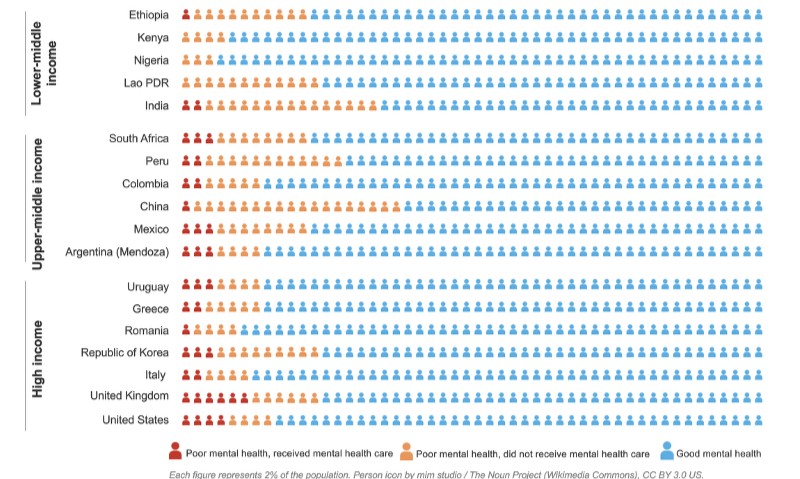
Mental healthcare receipt among people with poor mental health. Infographic displaying the weighted distribution of mental health status and care receipt. Each figure icon represents 2% of the population. Dark orange = respondents with poor/fair mental health who received mental healthcare in the past 12 months; light orange = those with poor/fair mental health who did not receive care; blue = those with good/very good/excellent mental health.
Across all countries, respondents reporting poor mental health were more likely to report chronic illness, poorer overall health, lower patient activation, worse care quality and lower confidence in the healthcare system. Between 0.9% (Lao PDR) and 52.4% (UK) of these respondents reported receiving mental health care in the last year. Respondents in Nigeria reported the best overall mental health (4.7% people reported the lowest proportion of “poor” or “fair” mental health (4.7%), while respondents in China had the highest proportion (39.6%).
The researchers hope these results can help the countries in question – and individual healthcare systems – better serve the needs of those with poor mental health. While this is a descriptive study, the researchers posit patient activation as a potential target for elevating overall health and wellness.
The authors acknowledge that big-picture data doesn’t describe individuals’ specific experiences within the healthcare system. They suggest comparison across similar health systems and tracking system performance over time to continuously improve health services.
The authors add, “What stands out from this study is that poor mental health doesn’t exist in isolation. People reporting poor mental health were nearly twice as likely to have a chronic illness and far less likely to feel empowered to manage their own health. Health systems need to stop treating mental health in a silo and recognise that these patients are showing up across all areas of care – and often with more complex needs.”
Kruk adds, “As a research consortium working across very different health systems, we expected to find variation, and we did, in treatment access. But the experience gap was remarkably consistent: people with poor mental health had worse care, more unmet needs, and less trust in the system, regardless of where they lived. Health systems globally need to rethink how they serve this growing group, not just whether they can reach them.”
New clues from genetic research may help explain what causes the most common heart defect present at birth. Researchers in Sweden have identified rare DNA changes during foetal development that can lead to a condition known as bicuspid aortic valve (BAV).
Pelin Sahlén
Publishing in Nature Communications, a team of researchers from KTH Royal Institute of Technology and Karolinska Institutet identified nearly 30 times more potential genes linked to BAV than previously known. The aortic valve has three cusps; a bicuspid aortic valve is a valve with only two cusps.
The study offers a clearer picture of how heart valves form, says Pelin Sahlén, an associate professor at KTH Royal Institute of Technology whose former student Artemy Zhigulev led the study as his PhD project.
“These findings expand our understanding of the genetic complexity of BAV and raise hope for new ways to improve how genetic risk is assessed,” Sahlén says.
People born with BAV often go on to develop complications, such as a narrowing of the valve or enlargement of the aorta. More than half will undergo surgery at some point in their lives.
But the underlying causes have long remained unclear. Earlier research showed a small number of cases are caused by changes in genes that contain the instructions for making proteins – the molecules that carry out most of the work in a cell. This explained only about 10% of all cases, says the study’s co-author Hanna Björck, associate professor at Karolinska Institutet.
“Most patients had no known genetic cause,” she says.
The new study shifted attention to a different part of the DNA – the regulatory regions of the genome that act like switches, turning important genes on or off during early development. The researchers studied tissues close to heart valves from eight people with BAV and eight people with normal valves.
Rather than focus on genes themselves, Sahlén says they used a technique called HiCap, for targeted 3D genome mapping to examine how the DNA is arranged inside the cell and how regulatory regions connect to key developmental genes.
They found that rare mutations in the regulatory parts of DNA are likely to play a major role in causing BAV. Each patient in the study had different mutations, but many of these mutations disrupted the same important genes that shape the aortic valve in the foetus, Zhigulev says.
“This suggests that even though the mutations vary, they interfere with the same developmental processes,” he says.
One of the surprising discoveries is that adult tissues retain traces of what went wrong during foetal development, Sahlén says. Harmful changes that happened before birth can be detected decades later. The finding indicates adult tissue samples can be used to study problems that originally occurred in the early stages of life.