Tag: hysterectomy

Innovative Surgery Cuts Ovarian Cancer Risk by Nearly 80% 

New research shows that Canadian-developed surgical procedure dramatically reduces rates of the most lethal gynaecological cancer
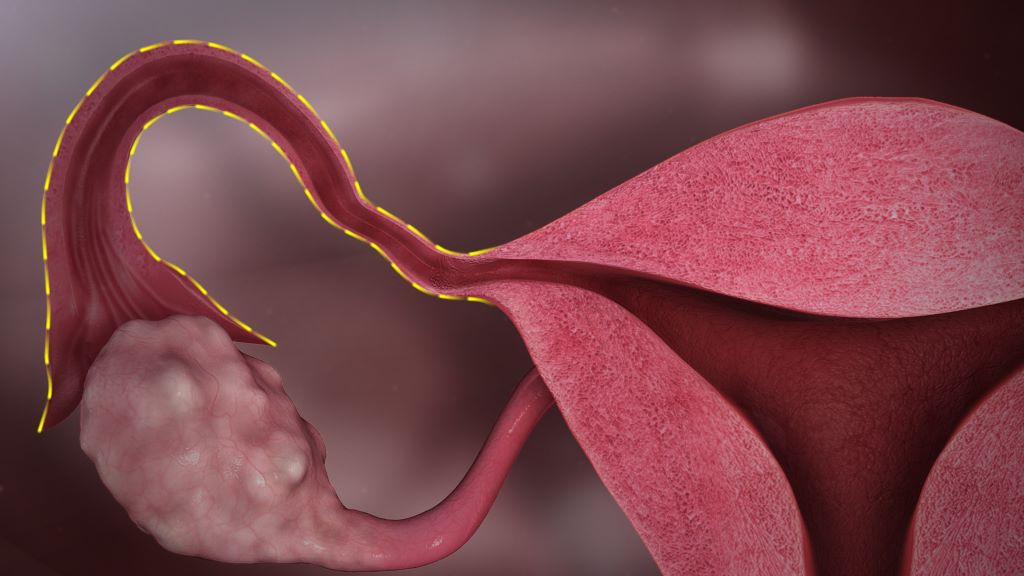
Fallopian Tubes. Credit: Scientific Animations CC4.0 BY-SA

A prevention strategy developed by Canadian researchers reduces the risk of the most common and deadly form of ovarian cancer by nearly 80%, according to a new study published today in JAMA Network Open.

The strategy, known as opportunistic salpingectomy (OS), involves proactively removing a person’s fallopian tubes when they are already undergoing a routine gynaecological surgery such as hysterectomy or tubal ligation, commonly called “having one’s tubes tied”.

British Columbia in Canada became the first jurisdiction in the world to offer OS in 2010, after a team of researchers from UBC, BC Cancer and Vancouver Coastal Health designed the approach when it was discovered that most ovarian cancers originate in the fallopian tubes rather than the ovaries. OS leaves a person’s ovaries intact, preserving important hormone production so there are minimal side effects from the added procedure.

The new study, led by a B.C.-based international collaboration called the Ovarian Cancer Observatory, provides the clearest evidence yet that the Canadian innovation saves lives.

“This study clearly demonstrates that removing the fallopian tubes as an add-on during routine surgery can help prevent the most lethal type of ovarian cancer,” said co-senior author Dr Gillian Hanley, an associate professor of obstetrics and gynaecology at UBC. “It shows how this relatively simple change in surgical practice can have a profound and life-saving impact.”

New hope against a deadly cancer

Ovarian cancer is the most lethal gynaecological cancer. Approximately 3100 Canadians are diagnosed with the disease each year and about 2000 will die from it.

There is currently no reliable screening test for ovarian cancer, meaning that most cases are diagnosed at advanced stages when treatment options are limited and survival rates are low.

The OS approach was initially developed and named by Dr Dianne Miller, an associate professor emerita at UBC and gynaecologic oncologist with Vancouver Coastal Health and BC Cancer. She co-founded B.C.’s multidisciplinary ovarian cancer research team, OVCARE.

“If there is one thing better than curing cancer it’s never getting the cancer in the first place,” said Dr. Miller.

The new study is the first to quantify how much OS reduces the risk of serous ovarian cancer – the most common and deadly subtype of the disease. It builds on previous research demonstrating that OS is safe, does not reduce the age of menopause onset, and is cost-effective for health systems.

The study analysed population-based health data for more than 85 000 people who underwent gynaecological surgeries in B.C. between 2008 and 2020. The researchers compared rates of serous ovarian cancer between those who had OS and those who had similar surgeries but did not undergo the procedure.

Overall, people who had OS were 78% less likely to develop serous ovarian cancer. In the rare cases where ovarian cancer occurred after OS, those cancers were found to be less biologically aggressive. The findings were validated by data collected from pathology laboratories from around the world, which suggested a similar effect.

From B.C. innovation to global impact

Since its introduction in B.C. in 2010, OS has been widely adopted, with approximately 80 per cent of hysterectomies and tubal ligation procedures in the province now including fallopian tube removal.

Globally, professional medical organizations in 24 countries now recommended OS as an ovarian cancer prevention strategy, including the Society of Obstetrics and Gynaecology of Canada, which issued guidance in 2015.

“This is the culmination of more than a decade of work that started here in B.C.,” said co- senior author Dr. David Huntsman, professor of pathology and laboratory medicine and obstetrics and gynaecology at UBC and a distinguished scientist at BC Cancer. “The impact of OS that we report is even greater than we expected.”

The researchers say expanding global adoption of OS could prevent thousands of ovarian cancer cases worldwide each year.

“This is a powerful example of how UBC research is changing clinical practice worldwide and saving lives,” said Dr Sharmila Anandasabapathy, dean of the faculty of medicine and vice-president, health, at UBC. “It speaks to the strength of our researchers and clinicians working together to translate discovery into real-world impact for patients here at home and around the world.”

Extending OS to other abdominal and pelvic surgeries where appropriate could further increase the number of people who could benefit from the prevention strategy. B.C. recently became the first province to expand OS to routine surgeries performed by general and urologic surgeons through a project supported by the Government of B.C. and Doctors of BC.

“Our hope is that more clinicians will adopt this proven approach, which has the potential to save countless lives,” said Dr Huntsman. “Not offering this surgical add-on may leave patients unnecessarily vulnerable to this cancer.”

Brett Goldhawk

Source: University of British Columbia
Removing Fallopian Tubes during Other Abdominal Surgeries may Lower Ovarian Cancer Risk

Mathematical modelling study suggests this approach could also reduce total healthcare costs in Germany

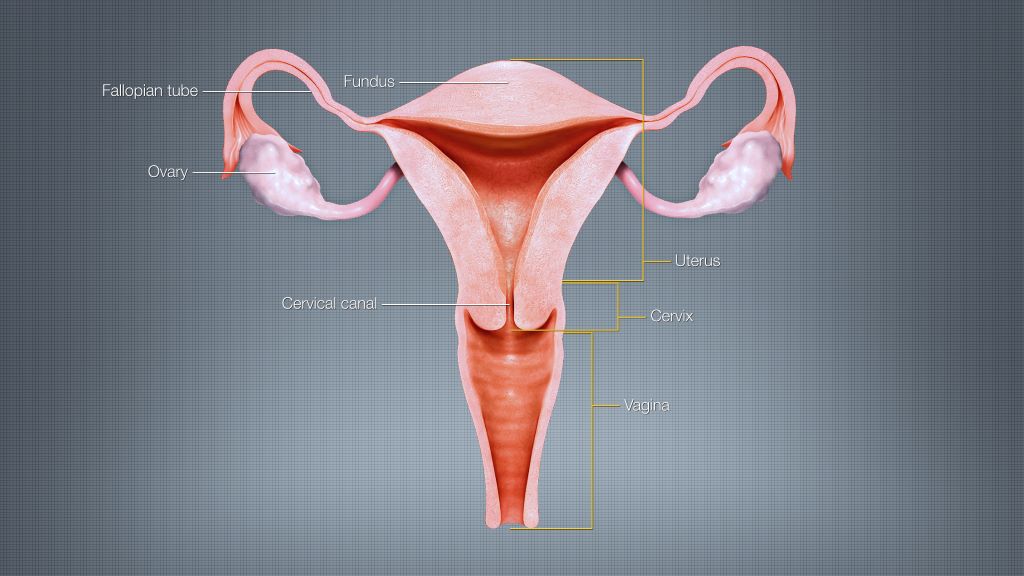
Female reproductive system. Credit: Scientific Animations CC4.0 BY-SA

A mathematical modelling study conducted in Germany suggests that ovarian cancer incidence could be reduced and healthcare savings boosted if women who have already completed their families were offered fallopian tube removal during any other suitable abdominal surgeries. Angela Kather and Ingo Runnebaum of Jena University Hospital, Germany, and colleagues present these findings on January 30th in the open-access journal PLOS Medicine.

Some of the most widespread and serious forms of ovarian cancer begin in the fallopian tubes, and removing them may reduce ovarian cancer risk. While women at average risk of ovarian cancer are not recommended to have surgery solely to remove their fallopian tubes, many surgeons offer “opportunistic” tube removal during other gynaecologic surgeries such as hysterectomy or tubal sterilisation. Opportunistic removal may also be feasible during other abdominal surgeries, such as gallbladder removal.

However, the overall potential benefits of opportunistic fallopian tube removal have been unclear. To help clarify, Kather and colleagues developed a mathematical model that incorporates real-world patient statistics to predict population-level risks of ovarian cancer after opportunistic fallopian tube removal, as well as the potential healthcare cost savings.

By applying the model to statistics from Germany, the researchers predicted that opportunistic fallopian tube removal during every hysterectomy and tubal sterilisation could reduce ovarian cancer cases by 5% across the female population of Germany. Removal during every suitable abdominal surgery for women who are done having children could reduce nationwide cancer cases by 15%, the analysis suggests, and it could save more than €10 million in healthcare costs annually.

Ovarian cancer is the third most common gynaecologic cancer in the world and has a mortality rate of 66%. Overall, these findings suggest that opportunistic fallopian tube removal during appropriate abdominal surgeries could not only lower population-level ovarian cancer risks and prevent ovarian cancer deaths, but also provide economic benefits. This study could help inform health policy and insurance costs for the procedure.

The authors add, “We developed a mathematical model to estimate the likelihood of women undergoing surgeries that offer an opportunity for fallopian tube removal and the potential for reducing their ovarian cancer risk. Applying this model to the entire female population of Germany revealed that 15% of ovarian cancer cases could be prevented if fallopian tubes were removed during every suitable abdominal surgery in women who have completed their families. This approach has the potential to extend healthy years of life and significantly save healthcare costs.”

Provided by PLOS

Many Hysterectomies Could be Avoided

Photo by Andrea Piacquadio on Pexels

Adenomyosis, a cause of painful menstrual cramps and heavy bleeding, is more common than generally appreciated, and many hysterectomies could be avoided with alternative treatment, suggests a review of the literature published in JAMA Network.

Adenomyosis is a gynaecologic condition characterised by ectopic endometrial tissue within the uterine myometrium. Up to a third of all women have adenomyosis, which should be considered in the differential diagnosis of abnormal uterine bleeding and/or pelvic pain, the researchers noted. It is considered a common uterine condition, but often goes undiagnosed until it results in a hysterectomy.

However, the findings suggest that surgery may be preventable for some women. The researchers identified a range of medical therapies and uterine-sparing procedures that can alleviate symptoms without resorting to hysterectomy.

“Many women come to me and say the only solution they’ve ever been offered is a hysterectomy. Other low-cost, low-risk options such as medical management or less invasive options have existed for more than 20 years,” said lead author Kimberly A Kho, MD.

Modern ultrasound and MRI imaging, combined with a pelvic examination, can often spot the condition, she added. Dr Kho and colleagues encouraged greater awareness of this condition – along with endometriosis – including among school nurses, who are frequently the first contact for young women who begin menstruating. Society may inaccurately teach women that heavy bleeding and pain during periods are normal, but these symptoms can worsen if left untreated, leading to lower quality of life, pain in sexual intercourse, and fertility problems.
“Physicians often consider adenomyosis to be a condition of women in their 40s and 50s because that’s when they have their uteruses removed and receive a diagnosis, but it develops much earlier,” said Dr Kho. “Improved clinical awareness is needed to ensure appropriate patient care and encourage additional studies to improve the understanding of adenomyosis.”

Though there are no FDA-approved therapies specifically indicated for treating adenomyosis, the condition can still be managed by using medications developed for contraception, or for symptoms such as fibroids or endometriosis. The authors noted the need for further research, including what ages and ethnicities are most commonly affected, and what could be learned from the condition about uterine cancers.

Source: UT Southwestern Medical Center