Day: April 2, 2026

Urban and Rural Residents Engage in Different Kinds of Physical Activity

In new study, rural and urban residents differed in the types of physical activity they do the most

Photo by Azat Satlykov on Unsplash

In a study of US adults, walking was, by far, the most popular leisure-time physical activity, while rural residents also enjoyed gardening, hunting and fishing, and urban residents more commonly reported running, weightlifting and dance. Urban residents were more likely than rural residents to meet physical activity guidelines. Christiaan Abildso of West Virginia University, US, and colleagues present these findings in the open-access journal PLOS One on April 1, 2026.

The US Department of Health and Human Services publishes guidelines on recommended amounts of aerobic and muscle-strengthening physical activity for adults. While the overall proportion of U.S. adults meeting these guidelines has increased in recent decades, certain populations are less likely to meet them, including adults living in rural areas. Understanding differences in preferred recreational physical activities could help inform efforts to reduce such disparities.

However, few studies have examined urban versus rural preferences for leisure-time physical activities, and how they relate to meeting guidelines. To address that gap, Abildso and colleagues analysed telephone survey data collected from a national sample of 396 261 U.S. adults in 2019.

Out of 75 survey options for leisure-time physical activities, walking was the most popular among both urban and rural adults, with 44.1% reporting walking as the activity they spent the most time doing. This finding echoes a similar study of U.S. data collected in 2011, which also found walking to be the top activity. However, further analysis of the 2019 data showed that even among walkers, only 25% met combined guidelines for aerobic and muscle-strengthening physical activity, and about 22% did not meet either guideline.

The popularity of other activities varied. For instance, rural residents reported higher rates of gardening, hunting, fishing, and farm work, while urban residents had higher participation in running, weightlifting, bicycling, and dance. However, in general, rural adults were more likely to be inactive and less likely to meet guidelines for aerobic or muscle-strengthening physical activity.

These findings could help inform efforts to boost physical activity by tailoring solutions to be more culturally and demographically appropriate. The researchers also call for a similar analysis of more recently collected data, as habits may have shifted during the COVID-19 pandemic.

Christiaan Abildso adds: “We expected to see that walking would continue to be the most common physical activity. However, it was surprising to see that nearly 1 in 4 adults who walk as their main activity did not meet either of the physical activity guidelines. That is, they reported less than the recommended 150 minutes per week of moderate-intensity aerobic activity and less than the recommended 2 days per week of muscle strengthening activity, such as yoga or exercises with resistance bands.”

“What we might be seeing in these rural-urban differences in preferences may just reflect what people have access to or what is culturally supported. In our work, we see a need to continue to support our partners in small towns and rural places by creating physical, social, and cultural conditions that support physical activity. This could mean creating a wide shoulder on a country road for running and cycling, helping a senior centre with their chair exercise programming, creating or improving park spaces, expanding the national network of rail-trails, renovating abandoned and dilapidated structures (Brownfields) into viable activity centres, keeping school facilities open to the public, and many other strategies. Everyone needs to ask, ‘how does what we’re doing affect physical activity,’ in order to help get people more active, more often, in more places.”

Provided by PLOS

Sugary Drink Taxes May Not Be Effective in Fast-food Settings

Analysis of nearly 7 billion Taco Bell transactions finds sugary drink taxes not linked to lower beverage calorie purchases

Photo by Breakingpic on Pexels

Taxes on sugary drinks had no effect on beverage calorie purchases from fast-food chain restaurants in the U.S., according to a new study by Brian Elbel and Pasquale Rummo from NYU Grossman School of Medicine and colleagues publishing April 2nd in the open-access journal PLOS Medicine.

Sugary drink taxes have been adopted in several U.S. jurisdictions as a public health strategy to curb sugar consumption and improve dietary behaviors. Research on the impact of these taxes on grocery stores purchases attribute sugary drink taxes to an estimated 15% decrease in sales. However, whether this translates to an impact in restaurant sales has not been well studied.

Researchers analyzed six years of sales data (2015–2020) from more than 7,300 Taco Bell locations nationwide, focusing on drive‑through purchases. The study compared beverage calories per transaction at 60 restaurants across five jurisdictions with sugary drink taxes—Albany, California; Cook County, Illinois; Oakland, California; Philadelphia, Pennsylvania; and Seattle, Washington—with a matched group of similar restaurants in areas without such taxes.

Overall, the analysis found no significant association between sugary drink taxes and beverage calories per transaction, suggesting that sugary drink taxes of this size or alone may not substantially reduce beverage calorie consumption in fast food restaurant settings.

The authors note that consumer behaviour in restaurants—such as choosing combo meals or prioritising convenience—may limit the effectiveness of these policies.

Elbel adds, “Using millions of transactions from six years of sales data, we found that sugary beverage taxes did not influence beverage calories when implemented in five cities in the U.S.”

Rummo notes, “These results suggest that sugary drink taxes may not be effective in reducing beverage calorie consumption in fast food restaurants, as compared to supermarkets. This could be because the sizes of sugary drink taxes in the U.S. are too small for consumers or that they just aren’t responsive to price changes in these settings, among other reasons.”

Provided by PLOS

The Gut’s Connection to Healing Traumatic Brain Injuries

Houston Methodist researchers find antibiotics aid recovery from traumatic brain injury

Coup and contrecoup brain injury. Credit: Scientific Animations CC4.0

In a new study published in Nature Communications BiologyHouston Methodist researchers led by Sonia Villapol, PhD, found that short-term antibiotic treatment significantly reduced neuroinflammation and neurodegeneration following traumatic brain injury (TBI) by altering the gut microbiome in animal models. 

“We found that antibiotic treatment following TBI can reduce harmful gut bacteria, decrease lesion size and limit cell death,” said Villapol, an associate professor in the Department of Neurosurgery at Houston Methodist. “Our results support a gut–brain mechanism in which microbiome changes influence peripheral immunity and, in turn, neuroinflammation after TBI.”

Administering antibiotics cleans the gut of harmful bacteria, allowing beneficial bacteria to flourish. The study found that two helpful bacteria, Parasutterella excrementihominis and Lactobacillus johnsonii, are key to driving cell repair. According to Villapol, they could also be major regulators for peripheral inflammation in the body.

Notably, 70% of immune system regulation is generated by the gut microbiome. During gut imbalance, the bidirectional nature of the brain-gut axis can wreak havoc throughout the entire body. 

“Our brains are constantly sending signals to the rest of our bodies. Following a traumatic brain event, those signals can get scrambled and disrupt other organs, including our digestive system,” Villapol said. “If the gut stays out of balance, the brain may have a harder time healing.”

There are an estimated 4 million traumatic brain injuries a year in the U.S. Recent studies indicate that TBI-induced gut microbiome imbalance may even contribute to the development of neurodegenerative diseases like Parkinson’s, Alzheimer’s and dementia. 

Villapol’s lab is focused on investigating and developing new neuroprotective treatments to fight inflammation linked with neurodegenerative disease. “If we can break neuroinflammation in the acute or chronic stage, we can reduce the risk of developing Alzheimer’s or dementia,” said Villapol. 

The next phase of the research will focus on bioengineering Parasutterella excrementihominis and Lactobacillus johnsonii to further develop precision therapies to reduce neuroinflammation.

Source: Houston Methodist

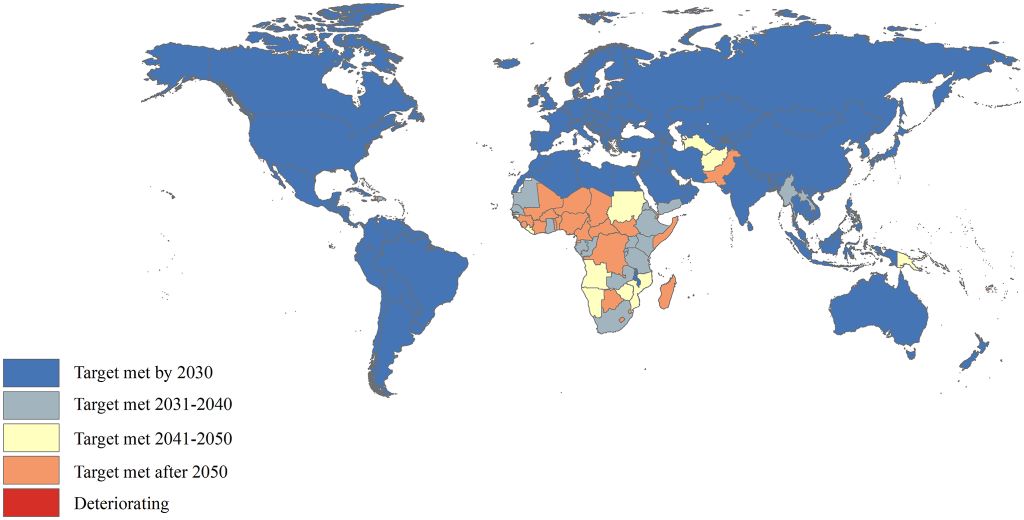
World is Falling Behind on UN’s Child Mortality Sustainable Development Goal

Despite a 63% drop in under-five deaths since 1990, more than a quarter of countries won’t reach the UN’s 2030 child mortality target on time, with sub-Saharan Africa lagging the most

Years in which the U5MR reduction target is expected to be achieved. U5MR: under-5 mortality rate. 
Image credit: Cao et al., 2026, PLOS One, CC-BY 4.0

A new study tracking global progress on child mortality finds that the world will miss a key United Nations (UN) health target by at least five years at current rates, with the burden falling heavily on Sub-Saharan Africa. The findings are published on April 1, 2026, in the open-access journal PLOS One by Min Liu of Peking University, Beijing, China, and colleagues.

The UN’s Sustainable Development Goal 3.2 calls for all countries to reduce the mortality rate for children under five to fewer than 25 deaths per 1000 live births by 2030. As that deadline approaches, there has been no comprehensive assessment of where countries stand.

In the new study, researchers used data from the UN to analyse annual under-five death counts and mortality rates from 1990 to 2023 across 200 countries and territories. They calculated the rate of change in mortality over time and used those trends to project when those countries still above the target threshold would be expected to reach it.

The researchers found that globally, under-five deaths fell by 63% over the study period – from nearly 13 million in 1990 to 4.78 million in 2023 – and the mortality rate dropped by an average of 3.18% per year. However, the global rate still stands at 36.72 deaths per 1000 live births, well above the SDG target, and is not projected to reach the target until 2035. 133 countries have already met the target and nine more are on track to do so by 2030. However, 58 countries will miss the deadline, including 25 that are not projected to reach the target until after 2050, and Dominica, where under-five deaths have risen. More than four-fifths of all under-five deaths worldwide are concentrated in just two regions: Sub-Saharan Africa, where the mortality rate remains at 68.82 deaths per 1000 live births and is not projected to meet the SDG target until 2055, and Central and Southern Asia.

The study is limited by the assumption that trends over the last two decades will continue unchanged. Data quality was also poor in some conflict-affected regions and low-income countries, the very places where child mortality is highest. 

The authors conclude that to meet UN targets, policymakers must focus on scaling up proven interventions – including skilled birth attendance, postnatal care, vaccination, improved nutrition, and treatment for common childhood illnesses – in every community, and especially in Sub-Saharan Africa.

Provided by PLOS

Will the NHI Cover the Full Cost of Saving a Life?

The public health sector serves roughly 84% of South Africans, yet per-person spending in private healthcare is around five times higher. The National Health Insurance (NHI) is designed to change that equation. As President Ramaphosa stated, the right to healthcare “cannot depend on where you were born, how much you earn or where you live.”

For patients with blood cancer and blood disorders, that promise could not be more urgent. On World Health Day 2026, Palesa Mokomele, Head of Community Engagement and Communication at DKMS Africa, says this is an opportunity to ask whether the NHI is being designed to reach them. “Blood cancer and blood disorder patients depend on highly specialised treatment pathways – exactly the kind the NHI has an opportunity to strengthen. They cannot be an afterthought in the benefit package conversation.”

The NHI Act was signed into law in May 2024 but has not yet commenced, with key constitutional challenges set to be heard in May 2026. Despite legal uncertainty, the government has been clear that foundational work will continue.

The Reality on the Ground

Stem cell transplantation is one of the most effective treatments for blood cancers and blood disorders, and among the most resource-intensive, requiring specialist physicians, trained nurses, dedicated infrastructure, and in 70% of cases, a matched unrelated donor (MUD).

The capacity to deliver these treatments is already under severe strain. Just 25% of South Africa’s oncologists serve more than 75% of the population. Long treatment delays, limited resources, high patient volumes, and advanced disease at presentation make for a deeply challenging environment.

“What we see is a system doing its best under enormous pressure,” says Mokomele. “The NHI has a real opportunity to address those structural gaps, but it requires deliberate investment where the need is greatest.”

What Universal Coverage Must Include

The NHI benefit packages for the treatment of blood cancer and disorders have yet to be finalised. With South Africa projected to see a 78% increase in cancer incidence by 2030, whether those packages cover the full cost of finding, matching, and transplanting an unrelated donor will be a test of whether universal health coverage means what it says.

“We are not here to debate the merits of the NHI,” shares Mokomele. “We are here to make sure that when it is implemented, it works for every patient. The full treatment pathway must be funded, and the clinical infrastructure to deliver it must be in place.”

President Ramaphosa has called for genuine partnerships between the public and private health sectors, academic institutions, NGOs, and communities. “That vision of cross-sector collaboration reflects exactly how we believe this challenge must be met,” notes Mokomele.

A Blueprint for Access

DKMS Africa’s Access to Transplant programme offers a practical example of barrier-free access in the public sector. Working across six provinces, it aims to invest in infrastructure upgrades at public hospitals, training for specialist nurses and mobilises its global network to collaborate with physicians, and patient support services addressing practical barriers, such as transport and housing, that often cause patients to abandon treatment.

“When you remove barriers systematically, outcomes improve,” points out Mokomele. “Each barrier removed is a patient who makes it to transplant. That is the model the NHI needs to learn from and scale.”

The organisation is also preparing for a more centralised system, ensuring its programmes can integrate into national frameworks while maintaining global standards – through early diagnosis education, donor registry diversification, stronger referral pathways, and local research capacity.

Your Health System, Your Voice

The decisions being made about the NHI benefit package today will shape healthcare for decades. Young South Africans will inherit both the growing burden of disease and the system designed to address it.

“World Health Day is a reminder that universal means everyone,” concludes Mokomele. “We are asking young South Africans to support us in uniting towards a healthcare system that works for everyone.”