Study strongly suggests that most persistent cases of viral detection, despite ideal HIV drug therapy, are not due to virus transmission or a rebound of active disease
Colourised transmission electron micrograph of an HIV-1 virus particle (yellow/gold) budding from the plasma membrane of an infected H9 T cell (purple/green).
Antiretroviral drugs for HIV infection have enabled most people living with the virus to live long and healthy lives. However, a small portion of people experience detectable – and worrisome – traces of the virus that causes AIDS despite strict adherence to long-term treatment regimens and the absence of symptoms. New findings published in Nature Communications suggest that most cases of this phenomenon, which is called non-suppressible viraemia, are explained by defective and noninfectious copies of the virus. The research was partially supported by grants from the National Institutes of Health (NIH).
The study, which involved more than 50 people, found that while traces of HIV-1 RNA can persist in blood after optimal therapy, cases of non-suppressible viraemia are driven by HIV-1 RNA with defects in a piece of the RNA known as 5’-leader.
“From a clinical perspective, this is important because people with HIV are taught that the absolute goal of their medication is to achieve undetectable viral load and they worry,” says Francesco R. Simonetti, MBChBD, PhD, the senior study author and an assistant professor of medicine in the Division of Infectious Diseases at Johns Hopkins University School of Medicine. The new findings, says Simonetti and his team, should provide relief to many people living with HIV who fear a viral rebound or who are concerned about transmitting the virus to partners despite taking effective treatment.
For the study, the investigators examined blood samples from 52 people living with HIV who had detectable loads of the virus despite taking long-term antiretroviral drug therapy.
These samples, which were assessed from 32 people and compared to an additional 20 samples, were collected between 2021 and 2025. The majority of participants were white men, between ages 58 and 68, and received care in the U.S., Canada and Denmark. The researchers found that most detectable forms of the virus, around 95%, were due to defective copies, and most defects were due to mutations or deletions in the 5’-leader region of HIV-1 RNA. This region is known to orchestrate the production of copies of the virus, but in this case the defects prevented the generation of infectious virus.
Modern antiretroviral therapies, which date back to 1996, prevent HIV from infecting new populations of immune system cells, but aren’t able to retroactively prevent previously infected cells from releasing HIV viral particles. Since those cells usually represent a small portion of infected cells after a person is on stable therapy, most people who take antiretroviral therapies are able to bring their viral loads to clinically undetectable levels in their blood.
However, in some cases, which are estimated to occur less than 1% of the time, people may experience clinically detectable levels after taking long-term antiretroviral drug therapy. This could happen years later, or, in less frequent cases, they may have never achieved undetectable levels.
This new study offers evidence that clinicians can now study the virus in blood plasma and confirm if clinically detectable levels are due to defective copies released from one or a few T-cell clones, says Simonetti. If so, he adds, this could eliminate the need for extra medications and could prevent related complications. It could also help people living with HIV have access to surgeries or other procedures, such as hip or knee replacements or organ transplants, and participate in clinical studies if they know they have HIV under control.
The assay taht the researchers created and used to confirm the defective copies of the virus for this study is cost-effective and can be broadly used in HIV clinics and research settings. Similar to using a liquid biopsy to detect cancer mutations in DNA, the assay, which is called CLAWS (Capturing 5′ Leader Anomalies Without Sequencing), uses advanced technology to identify detectable viral loads that are due to defective copies.
“We know that these defective proviruses cannot infect new cells, but they are still clinically relevant,” says Simonetti. “Think of how many extra visits, extra drugs, extra costs and tests they’ve been causing.”
“It’s also clear from the new study that, over time on treatment, intact proviruses that make virus are pruned away, while defective ones escape the immune system,” he says. “Now we want to understand these differences in immune recognition to uncover HIV’s vulnerabilities.”
In South Africa, where the burden of HIV remains high, women living with HIV face a disproportionately increased risk of cervical cancer, around six times higher than women without HIV. This heightened risk is driven by persistent infection with high‑risk strains of human papillomavirus (HPV). In settings where access to HPV vaccination, cervical screening and treatment is uneven, the impact on women’s health and lives is profound.
New research published in The Lancet Global Health provides the first population‑level evidence globally that a national HPV vaccination programme can be highly effective in a high HIV‑prevalence setting. The study was led by researchers from Wits RHI at the University of the Witwatersrand in partnership with the Kirby Institute (University of New South Wales).
The study evaluated South Africa’s free, school‑based national HPV vaccination programme, introduced in 2014, which offers HPV vaccination to girls in Grade 4 (aged nine years and older) attending public schools across the country. Crucially, the research assessed vaccine impact among adolescent girls and young women both living with HIV and without HIV, reflecting the realities of South Africa’s dual HIV and cervical cancer burden.
Until now, most evidence on HPV vaccine effectiveness in people living with HIV has come from studies where vaccination occurred after HIV infection, often after exposure to HPV and in the presence of immune suppression. This South African study, led by Professor Sinead Delany-Moretlwe at Wits RHI, Director of Research, is the first to demonstrate the real‑world impact of vaccination delivered early, before most girls are exposed to HPV, within a national public‑health programme in a high HIV‑burden context.
The findings show that the HPV vaccine provides excellent protection, including among girls living with HIV. Researchers observed substantial reductions in vaccine‑type HPV infections, demonstrating that high‑coverage HPV vaccination programmes can deliver strong population‑level benefits, even in settings with widespread HIV.
“For the first time, we can demonstrate at a population level that HPV vaccination delivered early, through a national public programme, provides excellent protection in a high HIV‑prevalence setting. This is a major public‑health success for South Africa and sends a clear message globally: investing in early, school‑based HPV vaccination can dramatically reduce future cervical cancer risk, including among girls living with HIV,” said Professor Sinead Delany-Moretlwe.
These results have major global implications. They reinforce the critical importance of early, school‑based HPV vaccination and provide compelling evidence for countries, particularly those with high HIV prevalence, to implement and sustain national HPV vaccination programmes. Such programmes have the potential to dramatically reduce cervical cancer risk, improve women’s health outcomes, and ultimately save lives worldwide.
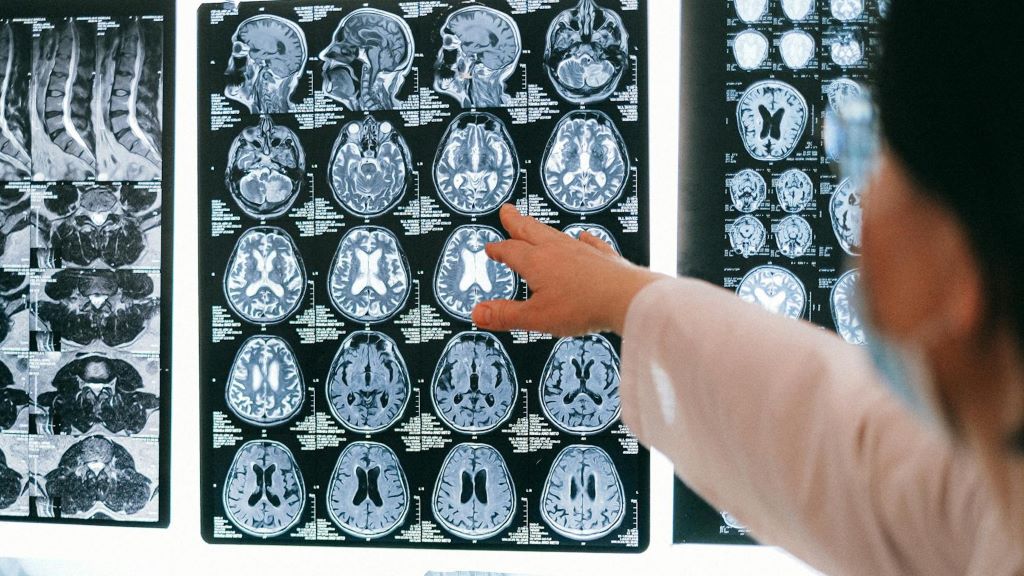
If someone living with HIV is not on antiretroviral therapy, the virus can cause inflammation in, among other places, the brain. Photo by Anna Shvets
By Biénne Huisman
Antiretroviral therapy has shifted HIV from a fatal to a chronic condition. But neuropsychiatrists say it is imperative for people living with the virus to start treatment immediately as the “duration of untreated exposure” may cause irreversible brain damage and impact long-term cognitive health.
It has been recognised for decades that cognitive impairment is a potential complication of HIV infection. Questions over how likely and how serious this potential complication is have become more urgent over time as the population of people living with HIV ages – ageing after all also increases the risk of cognitive decline.
There were around 1.75 million people over the age of 50 living with HIV in South Africa in 2024, according to Thembisa, the leading mathematical model of HIV in the country. This is just over 20% of the estimated eight million HIV positive people in the country. A study published in the Lancet medical journal also has the number at around 20% in sub-Saharan Africa.
This is a delicate field of enquiry as researchers walk a tightrope to avoid “the burden of double stigma”, while conceptualising the necessary tools to best diagnose brain problems and suitable interventions.
Within as little as two weeks
At Groote Schuur Hospital’s Neuroscience Institute, Professor John Joska, director of the University of Cape Town’s (UCT’s) HIV Mental Health Research Unit, explains that HIV can enter the brain within as little as two weeks after the initial infection – primarily through infected white blood cells, such as lymphocytes. If a person is not on antiretroviral therapy, the virus can cause inflammation in the brain and possibly also tissue damage.
“The brain is a protected compartment,” says Joska. “A theory as to how the virus, which is a protein particle, gets into the brain is through infected lymphocytes. This doesn’t directly infect nerve cells, what we call neurons. It infects other supporting tissues and cells in the brain, causing an inflammation which damages typically the white matter of the brain. Over time, that inflammation can cause loss of neurons, but indirectly.”
While antiretroviral therapy is crucial for clearing and suppressing HIV in all body compartments, including in the brain, he says that it does not reverse damage that occurred before the treatment was started.
“Today, people with HIV are living near normal lifespans,” he says. “The question is, will the fact that they’ve had HIV, with some duration of untreated exposure and potential loss of brain tissue, cause them to be at higher risk than the average person for developing dementias of old age – which really are mainly Alzheimer’s disease or vascular dementia.” It is these longer-term effects that are the main concern when it comes to the impact of HIV on the brain.
Part of the problem is that South Africa not only has an ageing population of people living with HIV, but many of these people would only have started treatment quite long after they contracted the virus. One key reason for this is the South African government’s reluctance to make antiretroviral treatment available in the early 2000s. It has been estimated that those delays resulted in over 300 000 avoidable deaths – they may also be contributing to brain health issues now and in the future.
From efavirenz to dolutegravir
Apart from HIV itself, some of the medicines used to treat the infection have also had an impact on the brain.
In 2019, the standard HIV treatment in South Africa changed from a three-drug combination containing an antiretroviral drug called efavirenz, to a combination containing the drug dolutegravir. This shift had mental health benefits, as evidenced in research lead by Joska’s fellow UCT Neuro-HIV researcher, Associate Professor Sam Nightingale.
Joska says: “The study looked at the period from 2017 to 2020 and the switch from efavirenz to dolutegravir based treatment. It was well known that efavirenz caused, certainly for the first two months, a bunch of psychotropic or psychological issues like nightmares or anxiety, even psychosis for some people. But our findings showed people who switched to dolutegravir actually do very well. They look more like people without HIV after eight months. So dolutegravir has been a huge advantage, not only because it’s robust, but because it’s neuro-protective.”
New models for HIV and cognitive impairment
A shift is underway in how experts are thinking about cognitive impairment in people with HIV. Some neuropsychiatrists, including Joska, are recommending a shift away from the 2007 HIV-Associated Neurocognitive Disorders model, arguing that its cognitive test scores do not adequately account for variables such as education and socioeconomic background, and that it can overdiagnose impairment. The argument is set out in an article, lead-authored by Nightingale, that was published in the journal Nature Reviews Neurology in 2023.
The authors argue that a label of cognitive impairment might cause a “double burden of stigma” for people living with HIV – affecting self-esteem, inciting fear and prompting further discrimination against persons already subject to stigma as it stands. To illustrate the point, they point out how, up until recently, people with HIV in the United Kingdom could not become airline pilots due to concerns over cognitive impairment. However, following a campaign by a pilot living with HIV, the United Kingdom’s Civil Aviation Authority removed the ban in 2022.
Nightingale and his colleagues argue that traditional test scores be used in conjunction with real-life symptoms and medical evidence of brain problems. It introduces the conceptual model of HIV-Associated Brain Injury, which refers specifically to damage caused by the virus. This distinguishes it from other causes of cognitive impairment such as depression, substance abuse, diabetes and cardiovascular disease. As Spotlight previously reported, HIV is also associated with an increased risk of depression, though this is at least partially driven by social factors.
Lower cognitive function associated with late diagnosis
At the 2026 Conference on Retroviruses and Opportunistic Infections hosted in Denver in the United States in late February, these issues were tabled at a discussion titled “When I’m 64: Neurodegeneration, Epigenetic Aging, and Cognition in Older People With HIV.”
Professor John Joska is the director of the University of Cape Town’s HIV Mental Health Research Unit. (Photo: Biénne Huisman/Spotlight)
In his presentation, Professor Alan Winston of Imperial College London, also a member of the International HIV-Cognition Working Group, and a frequent co-author alongside Joska and Nightingale, relayed existing research findings that on average, people living with HIV have lower cognitive function – including memory, attention span and executive function like planning – compared to people who don’t have HIV of the same age. He said that this manifests as an increased risk of lower grade early dementia.
Like Joska, Winston stressed that the most deteriorated cognitive function in people living with HIV is associated with untreated HIV and late HIV diagnosis. He reiterated that starting HIV treatment soon after diagnosis is protective, and that viral suppression is associated with better cognition. In groups of patients with HIV well controlled on dolutegravir-based HIV treatment, cognition appears similar to HIV negative groups, he said.
HIV clinicians need to pay better attention to the brain
In an impassioned presentation, Dr Shibani Mukerji, Associate Professor of Neurology at Harvard Medical School, argued that protecting the brain is an overlooked frontier in effective HIV treatment, and that clinicians need to pay more attention to it.
“By the time patients and clinicians notice cognitive decline – generally and in HIV – the damage to the brain is done and lives are affected negatively. People don’t raise cognitive concerns early enough due to stigma, fear, [and] lack of recognition of the issues. It is seen as ‘just getting old’,” she said.
Mukerji emphasised the need to prioritise brain health. “HIV doctors and treatment programmes are focused, almost exclusively, on viral load as the marker of successful treatment. They may be thinking laterally and consider TB and other infections, maybe cardiovascular disease – but they are definitely not paying enough attention to brain health. HIV doctors aren’t aware enough of brain health issues in people living with HIV, and even when they are, they often don’t feel comfortable diagnosing or managing it, so it is under recognised and under diagnosed.”
The perception that there is no way to manage or treat cognitive decline –generally and in people living with HIV – is wrong, she said, adding that optimising physical, mental and social health is critical for brain health.
“Almost half of dementia risk [in people in general] is linked to preventable causes,” she told conference delegates, along with a slide listing preventable causes including loss of hearing, social isolation, cardiovascular disease and depression.
She explained: “If someone has cognitive decline and for example you improve their hearing – if they have hearing issues – and you work on their social isolation, and treat their vascular disease, and treat their depression, you can see a marked improvement in their cognition.”
Ending her presentation with a twist of humour, Mukerji’s last slide referred to the session’s title, a reference to the Beatles song on aging “When I am 64”. She printed the song’s lyrics: “When I get older, losing my hair, many years from now…”, closing her talk by saying: “It’s okay to stand up and sing, in fact your doctor might prescribe it.”
Mycobacterium tuberculosis drug susceptibility test. Photo by CDC on Unsplash
A University of Virginia-led team of researchers has made a discovery that may change sepsis treatment for patients in Africa.
Over the course of five years, the researchers studied patients with HIV-related sepsis in eastern Africa, discovering that the most common cause of sepsis was tuberculosis and that treating it immediately, even before a tuberculosis diagnosis was made, significantly improved survival rates.
Sepsis, or critical illness due to infection, is the leading global cause of death, responsible for an estimated one-fifth of deaths worldwide.
“We designed a trial with colleagues in Tanzania and Uganda to look specifically at people living with HIV, who suffer higher rates of sepsis and are more likely to die when they contract it,” said Dr Scott Heysell, director of the UVA Center for Global Health Equity and the co-lead investigator of the study. “Over half of the people enrolled in this trial were ultimately found to have tuberculosis and, if they immediately received tuberculosis treatment, they were significantly more likely to survive.”
Funded by a grant from the National Institutes of Health, the research, dubbed the “ATLAS study,” was done by a team of nearly 30 doctors, nurses, pharmacists, study coordinators and statisticians, including leading HIV and tuberculosis physician-scientists, Dr Stellah Mpagama from Kibong’oto Infectious Diseases Hospital in Tanzania, and Dr Conrad Muzoora, from the Mbarara University of Science and Technology in Uganda.
“The trial is the culmination of almost 20 years of collaborative work with colleagues in Uganda and Tanzania to better understand, diagnose and manage sepsis,” said co-lead investigator Dr Christopher Moore, professor of medicine and global health equity at the UVA School of Medicine. “The results of ATLAS have broad and significant implications for the treatment of sepsis in Africa, an all too common and deadly illness, which sadly is likely to become even more common with the advent of global public health funding cuts.”
It is often difficult to diagnose tuberculosis, so the team had to use newer and more exhaustive testing, according to Heysell.
“It is a tragedy to be on the front lines and witness the excessive mortality and morbidity from sepsis and tuberculosis, particularly among people with HIV,” said Dr Tania Thomas, a contributing researcher and associate professor of infectious diseases and international health at UVA. “These are treatable conditions, but time is rarely on our side. Until we have more accurate rapid diagnostic tests for tuberculosis, we are pleased to demonstrate that the strategy of immediate tuberculosis treatment can improve survival.”
The team has received additional NIH funding this year to continue its work through a new trial at four hospitals in Tanzania and Uganda to test whether the use of hydrocortisone to reduce inflammation and improve blood pressure, and/or an immediate treatment for tuberculosis and other bacterial pathogens, will improve 28-day mortality from HIV-related sepsis.
“In programmatic settings, tuberculosis treatment was mostly the same as for people without HIV, even though their health needs are more complex,” said Dr Mpagama. “Many of these patients have multiple infections at the same time, which makes their care more challenging.”
The research is part of UVA’s Center for Global Health Equity’s effort to establish meaningful, two-sided research partnerships in Eastern Africa, according to Heysell, who is working to increase educational and research opportunities outside of the US for UVA students. This includes coordinating clinical electives for medical students and other health science students in hospitals and clinics abroad.
To that end, emergency medicine professor Dr Amita Sudhir has been promoted to inaugural director for global health training within the center. Her goal will be to increase abroad opportunities for medical students within existing partnering organisations.
Facing off a dual burden of high disease risk and low service access
Photo by Sydney Sims on Unsplash
CAPE TOWN, 08 OCTOBER 2025: South African and international leaders in public health will gather on Friday, 10 October 2025 at the University of Cape Town to convene an in-person scientific seminar: Agents of change and women who use drugs. Women who use drugs (WWUD) in South Africa face compounded health and social vulnerabilities that leave them disproportionately excluded from essential health services. Compared to men, women experience heightened stigma, intimate partner violence, reproductive health challenges, and structural barriers such as childcare responsibilities and lack of women-centred care.1,2 Scientific discussions among academics will focus on how women can be supported through access to harm reduction programming and drug policy reform.
Seminar: Agents of change and women who use drugs
· Date : 10 October 2025
· Time : 13:30 – 15:30 (SAST)
· Venue : Neurosciences Institute Auditorium, UCT/Groote Schuur Hospital, Cape Town
Recent evidence highlights both the scale of drug use and the urgent need for tailored harm reduction. National estimates suggest there are approximately 82 500 people who inject drugs (PWID) in South Africa, with women comprising between 16% and 27% of this population.3 Led by TB HIV Care, a 2023 bio-behavioural survey across four South African sites documented extremely high HIV prevalence among PWID: 72.1% in Tshwane, 49.3% in eThekwini, 45.4% in Mashishing, and 30.3% in Mbombela. Hepatitis C (HCV) prevalence was similarly alarming, reaching 89% in Tshwane and over 75% in multiple sites.3
“The evidence consistently shows that harm reduction works,” says Dr Andrew Scheibe, medical doctor and technical advisor with TB HIV Care in Cape Town, INHSU board member, and fellow co-convener of the upcoming INHSU 2025 conference. “Harm reduction reduces infections, prevents overdose, and connects people to healthcare, yet access across Africa remains the exception rather than the rule.”
Sex-based disparities are stark. While HIV prevalence among PWID overall has ranged from 14% to over 70%, women consistently show higher prevalence rates than men. One multi-city study found 18% HIV prevalence among female PWID, compared to 13% among males.4 More recent research in Durban confirmed that women face greater barriers to accessing sexual and reproductive health, harm reduction, and HIV services, often due to fear of arrest, intimate partner control, and lack of programming designed for women.5
“Everyone in our communities deserve health, dignity, and care,” says Mfezi Mcingana, Programme Director: Key Populations at TB HIV Care. “People who use drugs are part of our communities and supporting their access to healthcare, not punishment, builds a safer, healthier society for all”, Mcingana concludes.
Despite the magnitude of risk, women remain underrepresented in harm reduction programmes. In opioid agonist therapy (OAT), fewer than 10% of participants are women.6 Needle and syringe programmes (NSPs) and OAT are limited in coverage, mostly urban-based, and not designed with women’s needs in mind. The absence of services aimed at women perpetuates cycles of preventable morbidity, mortality, and infectious disease transmission.
“While the scale of the challenge is undeniable, pioneering efforts by a few African governments show what harm reduction leadership can look like,” says Angela McBride, Executive Director of the South African Network of People Who Use Drugs (SANPUD), INHSU board member, and co-convener of INHSU 2025. “Harm reduction means putting health and human rights before punishment, shifting away from criminalisation and towards evidence-based, rights-affirming policies.”
To address this gap, investment in women-centred harm reduction is essential. Priorities include scaling up OAT and NSPs with women-specific entry points, integrating sexual and reproductive health services into harm reduction sites, providing childcare support, and ensuring protection from intimate partner violence. Without these interventions, WWUD in South Africa will continue to be excluded from public health progress and national HIV/HCV response goals.
References:
Shirley-Beavan, S., Roig, A., Burke-Shyne, N., Daniels, C. and Csak, R. (2020). Women and barriers to harm reduction services: a literature review. Harm Reduction Journal, 17(74). Available here.
Harm Reduction International & South African Network of People Who Use Drugs (SANPUD) (2020). Barriers to harm reduction for women who use drugs in South Africa. London: Harm Reduction International. Available here.
SANPUD (2023). South African bio-behavioural survey and population size estimation among people who inject drugs. Johannesburg: South African Network of People Who Use Drugs. Available here.
Scheibe, A., Young, K., Moses, L., Basson, R., Versfeld, A., Spearman, C.W. and Sonderup, M.W. (2016). HIV prevalence and risk among people who inject drugs in South Africa. International Journal of Drug Policy, 30, pp.107–113. Available here.
Milford, C., Cavanagh, T., Bosman, S., Chetty, T. and Rambally, G. (2024). Access to and acceptability of sexual and reproductive health, harm reduction and other essential health services among people who inject drugs in Durban, South Africa. Harm Reduction Journal, 21(123). Available here.
INHSU (2021). Gender and opioid substitution therapy access in Tshwane, South Africa. International Network on Health and Hepatitis in Substance Users. Available here.
Supported by robust advocacy initiatives to achieve policy reform, AHF ensures equitable access to HIV and public health services globally
Dr Penninah Iutung, Executive Vice President of AHF
The AIDS Healthcare Foundation (AHF) (www.AIDSHealth.org) proudly announces a transformative milestone: delivering life-saving HIV prevention, care, and treatment to 2.5 million people across 49 countries, with 1.3 million in 15 African nations (https://apo-opa.co/45zIVFg). This achievement transcends numbers, embodying restored hope, preserved families, and a bold vision for a healthier, equitable world.
AHF’s contribution to the HIV response that has enabled countries like Malawi to see a remarkable increase in life expectancy from 46 to 67 years over a 25-year period is profound. Children who may have been orphaned due to HIV can now grow up with their parents present, and communities are thriving through access to quality care. This story can be told in several countries, and it reflects AHF’s unwavering commitment to transforming lives and achieving global HIV control.
Founded in 1987 in Los Angeles as the AIDS Hospice Foundation, AHF has grown into the world’s largest HIV/AIDS service organisation. With over 8000 dedicated staff, AHF delivers expert, compassionate, and non-judgmental care to all, regardless of ability to pay. Supported by robust advocacy initiatives to achieve policy reform, AHF ensures equitable access to HIV and public health services globally.
AHF President Michael Weinstein shared, “When we began, I never imagined we’d touch 2.5 million lives. This milestone, born of our staff’s courage and our patients’ trust, demands recognition. As George Bernard Shaw said, ‘You see things; and say, Why? But I dream of things that never were and I say, Why not?’ Our dream – delivering exceptional care to all – has become reality. We’ve stayed true to our principles, proving hope can shine in a challenging world. Yet, our journey continues. AHF is tackling STIs, hunger, homelessness, and the global HIV epidemic with relentless resolve. I’m deeply honoured to serve alongside our extraordinary team.”
“When we launched our first global programs in South Africa and Uganda in 2002, serving 100 clients in each country, we could never have fathomed expanding to 13 more African countries and caring for 1.3 million lives across the continent,” said Dr Penninah Iutung, AHF’s Executive Vice President . “Building on years of advocacy and innovation, AHF Africa now delivers programs that go beyond clinical care to include community-led prevention, equitable access strategies, and pandemic preparedness. These successes reflect the deep collaboration with government and civil society partners that has enabled us to reach the most marginalized, advance equity, and ensure no one is left behind.”
Dr. Nombuso Madonsela, who leads AHF’s largest country program as AHF South Africa Country Program Director, adds, “Being part of this historic milestone is a privilege. AHF South Africa remains steadfast in championing combination prevention, reducing new infections, and ensuring quality service delivery and support for all in our care. Through our Community Power Voices (CPV), we amplify the stories and triumphs of those living with HIV. Ending HIV is not just a dream, it’s a promise we are determined to keep.”
Looking forward, AHF is resolute in expanding access, dismantling barriers, and ensuring no one is left behind in the global fight against HIV. This milestone fuels AHF’s mission to push boundaries, innovate solutions, and build a future where HIV is no longer a threat.
Distributed by APO Group on behalf of AIDS Healthcare Foundation.
In response to US funding cuts for South African health services and research projects, National Treasury has provided the National Department of Health with hundreds of millions of rands in emergency funds. Spotlight and GroundUp look at how precisely the government intends to spend this money.
Health Minister Dr Aaron Motsoaledi recently announced that National Treasury had released roughly R753 million to help plug the gap left by US funding cuts to South Africa’s health system. Another R268 million is also being released in the following two years for researchers that lost their US grants.
But this may only constitute the first round of emergency funds from government, according to sources we spoke to. The health department is planning on submitting a bid for an additional allocation later on, which will be considered by Treasury. But this will likely only be approved if the first tranche of funding is properly used.
So how is the money supposed to be used? To find out, we spoke with officials from the National Treasury, the National Department of Health and the South African Medical Research Council (SAMRC).
Money for provinces is for saving jobs at government clinics
The current tranche of money comes from Treasury’s contingency reserve, which exists partially to deal with unforeseen funding shortfalls. It was released in terms of Section 16 of the Public Finance Management Act.
Of the R753 million that’s been announced for this year, Motsoaledi stated that R590 million would be going to provincial health departments via the District Health Programme Grant – a conditional grant for funding the country’s public health efforts, particularly HIV, TB, and other communicable diseases. Such conditional grants typically give the health department more say over how provincial departments spend money than is the case with most other health funding in provinces.
To explain how government officials arrived at this figure, it’s worth recapping what services the US previously supported within provinces.
Prior to Donald Trump becoming US president on 20 January, the US Agency for International Development (USAID) had financed health programmes in specific districts with high rates of HIV. These districts were scattered across all South Africa’s provinces, save for the Northern Cape.
The funds were typically channelled by USAID to non-governmental organisations (NGOs), which used the money to assist the districts in two ways.
The first is that NGOs would hire and deploy health workers at government clinics. The second is that the NGOs would run independent mobile clinics and drop-in centres, which assisted so-called key populations, such as men who have sex with men, sex workers, transgender people, and people who inject drugs.
In response, the health department began negotiations with Treasury to get emergency funding to restore some of these services. As part of its application, the health department submitted proposals for each province, which specified how much money was needed and how it would be used. (Though this only took place after significant delay and confusion).
Since Treasury couldn’t afford to plug the entire gap left by the US funding cuts, the provincial-level proposals only requested money for some of the services that had been terminated. For instance, funding was not requested for the key populations health centres. Instead, the priority was to secure the jobs that had been lost at government health facilities.
As such, the total amount that was requested from Treasury for each province was largely calculated by taking the total number of health workers that NGOs had hired at clinics and working out how much it would cost to rehire them for 12 months.
Rather than paying the NGOs a grant to deploy these workers as was done by USAID, the health department proposed hiring them directly. This meant that they calculated their wages according to standard government pay scales, which is less than what these workers would have earned from the NGOs.
The total came to just under R1.2 billion for all the provinces combined.
Treasury awarded roughly half of this on the basis that the money would be used to finance these wages for six months, rather than 12. This amounts to the R590 million for provinces that was announced by Motsoaledi.
If all goes smoothly and this money is used effectively to hire these staff over the next six months, then a new tranche of Section 16 funding could be released in order to continue hiring them. Funds might also be released to fund the key populations health sites.
A concern, however, is that the money may just be used by provinces to augment their ordinary budgets. If the funds aren’t actually used to respond to the US cuts, then it is much less likely that more emergency funding will be released.
At this stage, it is too early to tell how provinces will use the money, particularly given that it appears that at least some of them haven’t gotten it yet.
Spotlight and GroundUp sent questions to several provincial health departments. Only the Western Cape responded. The province’s MEC for Health and Wellness, Mireille Wenger, said that the funds have not yet been received by her department, but that once they were, they would be directed to several key priority areas, including digitisation of health records, and the strengthening of the primary healthcare system.
It’s thus not clear whether the province will be using any of the funds to employ health staff axed by US-funded NGOs. In response to a question about this, Wenger stated that “further clarity is still required from the National Department of Health and National Treasury regarding the precise provincial allocations and conditions tied to the additional funding”.
What about research?
Of the R753 million that’s been released for this year, R132 million has been allocated to mitigate the funding cuts for research by US federal institutions, primarily the National Institutes for Health (NIH). Unlike USAID, the NIH is not an aid body. It provides grants to researchers who are testing new treatments and medical interventions that ultimately benefit everyone. These grants can be awarded to researchers in the US or abroad as part of a highly competitive application process.
Researchers in South Africa are awarded a few billion rands worth of grants from the NIH each year, largely due to their expertise in HIV and TB. But over the last few months, much of this funding has been terminated or left in limbo. (See a detailed explanation of the situation here).
The R132 million issued by Treasury is supposed to assist some of these researchers. It will be followed by another R268 million over the following two years. The Gates Foundation and Wellcome Trust are chipping in an additional R100 million each – though in their case, the funds are being provided upfront.
All of this money – R600 million in total – is being channelled to the SAMRC, which will release it to researchers via a competitive grant allocation system.
According to SAMRC spokesperson Tendani Tsedu, they have already received the R132 million from Treasury, though they are still “finalizing the processes with the Gates Foundation and Wellcome Trust for receipt of [their donations]”.
The SAMRC is also in negotiation with a French research body about securing more funds, though these talks are ongoing.
In the meantime, the SAMRC has sent out a request for grant applications from researchers who have lost their US money. The memo states: “Applicants may apply for funding support for up to 12 months to continue, wind down or complete critical research activities and sustain the projects until U.S. funding is resumed or alternative funds are sourced.”
“The plan,” Tsedu said, “is to award these grants as soon as possible this year.”
Professor Linda-Gail Bekker, CEO of the Desmond Tutu Health Foundation, told us that the hope is that the grants could fill some of the gaps. “This is a bridge and it is certainly going to save some people’s jobs, and some research,” she said, but “it isn’t going to completely fill the gap”.
Indeed, the SAMRC has made clear that its grants aren’t intended to replace the US funding awards entirely. This is unsurprising given that the money that’s being made available is a tiny fraction of the total grant funding awarded by the NIH.
It’s unlikely that research projects will continue to operate as before, and will instead be pared down, said Bekker.
“It’s going to be about getting the absolute minimum done so you either save the outcome, or get an outcome rather than no outcome,” she said.
In other cases, the funds may simply “allow you to more ethically close [the research project] down,” Bekker added.
For some, this funding may also have come too late. Many researchers have already had to lay off staff. Additionally, patients who had been on experimental treatments may have already been transitioned back into routine care. It’s unclear how such projects could be resumed months later.
In response, Tsedu stated: “For projects that have already closed as a result of the funding cuts, the principal investigator will need to motivate whether the study can be appropriately resurrected if new funds are secured.”
The SAMRC has established a steering committee which will adjudicate bids. They will be considering a range of criteria, Tsedu said, including how beneficial the research might be for the South African health system, and how heavily the project was impacted by the US funding cuts. They will also consider how an SAMRC grant could “be leveraged for future sustainability of the project, personnel or unit”, added Tsedu.
An endless back and forth
The job of the SAMRC steering committee will likely be made a lot more complicated by the erratic policy changes within the NIH. On 25 March, the body sent a memo to staff – leaked to Nature and Bhekisisa – instructing them to hold all funding awards to researchers in South Africa. After this, numerous researchers in the country said they couldn’t renew their grants.
However, last month, Science reported that a new memo had been sent to NIH staff which said that while South African researchers still couldn’t get new grants, active awards could be resumed.
Since then, some funds appear to be trickling back into the country, but certainly not all. For instance, Spotlight and GroundUp spoke to one researcher who had two active NIH awards before the cuts. He stated that one of these was resumed last month, while the other is still paused.
Bekker also told us that she had heard of one or two research grants being resumed in the last week, though she said the bulk of active awards to South Africa are still pending.
“Where people are the prime recipients [of an NIH grant] without a sub awardee, there seems to be a queue and backlog but some [of those awards] are coming through,” said Bekker. “But how long this is going to take and when it might come through, we’re waiting to hear.” She said a strategy might be to apply for the SAMRC bridging funding and “if by some miracle the [NIH funding is resumed]” then researchers could then presumably retract their SAMRC application.
In the meantime, health researchers will have to continue spending their time working out how to respond to the abrupt and increasingly confusing changes to funding guidelines that have dogged them since Trump assumed office.
“It’s such a dreadful waste of energy,” said Bekker. “If we were just getting on with the research, it would be so much better.”
A new handheld tuberculosis testing device by Tulane University is the size of a credit card, requires no electricity and significantly improves detection of the disease in those with HIV. (Vincent Postle/Tulane University)
Current tuberculosis infection tests struggle to detect the disease in those with HIV. A common co-infection, HIV can hide TB from traditional tests by eliminating the immune cells relied upon to sound the alarm.
While more than 90% of the 2 billion TB cases worldwide are latent – symptom-free and not contagious – the weakening of the immune system in those with HIV can allow latent TB to turn active, increasing the potential for new infections to spread and often resulting in fatal outcomes. Tuberculosis is the leading cause of death among those with HIV worldwide.
Now, Tulane University researchers have developed a new handheld TB test that significantly improves detection in people with HIV, according to a new study in Nature Biomedical Engineering. Powered by a beetle-inspired chemical reaction, the device requires no electricity and addresses a critical gap in TB infection detection that has long hobbled efforts to eliminate the world’s deadliest infectious disease.
“The goal was to develop a TB test that could be taken anywhere and provide quicker, more accurate results for anybody.”
Tony Hu, PhD
Dubbed the ASTRA (Antigen-Specific T-cell Response Assay), the credit card-sized device requires only a drop of blood to provide same day diagnoses without need for a laboratory or trained staff. When tested against the traditional IGRA blood test (Interferon-Gamma Release Assay), the ASTRA detected TB in HIV-infected individuals with 87% specificity compared to IGRA’s 60%, while also outperforming in detection of TB without HIV co-infection.
“The goal was to develop a TB test that could be taken anywhere and provide quicker, more accurate results for anybody,” said senior author Tony Hu, PhD, Chair in Biotechnology Innovation at Tulane University and director of the Tulane Center for Cellular & Molecular Diagnostics. “Current tests such as the IGRA are cost-prohibitive or require access to facilities that resource-limited communities don’t have. If we are going to eliminate TB, we have to diagnose and treat as many infection cases as possible.”
Added Bo Ning, lead author and assistant professor of biochemistry at Tulane University School of Medicine: “If your community has an immunocompromised population, someone may have latent TB. This can help block the spread of TB and ensure that no one slips through the cracks.”
To create a test that would not be stymied by HIV, the researchers identified two new biomarkers that could detect TB without relying on the immune cells susceptible to the virus.
After adding a drop of blood to the device, it must incubate for 4 hours to allow a preloaded reagent to stimulate a response from the immune cells. The reagent acts as a “wanted poster” asking if they’ve seen tuberculosis bacteria before.
To avoid the use of electricity, the researchers looked to an unlikely source for inspiration: the bombardier beetle. When threatened, these large insects combine two chemicals, and the resulting reaction produces a forceful spray. Similarly, two chemicals in the ASTRA are combined to propel the sample across a chip for final analysis and diagnosis.
The new device delivers results in about 4 hours, compared to the IGRA, which takes 24 hours, and a common TB skin test, which can take between two and three days for a diagnosis.
The ASTRA’s performance was validated using samples collected from a cohort in Eswatini, a country with high TB incidence and the highest reported HIV prevalence (27.3%) worldwide.
Increasing testing accuracy, access and speed is even more vital as TB resistance to drugs grows more robust, Hu said.
“The sooner you have a diagnosis, the sooner you can begin the process of determining proper treatment,” Hu said. “TB is the No. 1 pathogen HIV patients worry about globally. If treatment is available, we should be working to kill these bacteria, latent or not.”
By delivering an HIV vaccine candidate along with two adjuvants, researchers showed they could generate many more HIV-targeting B cells in mice.
Anne Trafton | MIT News
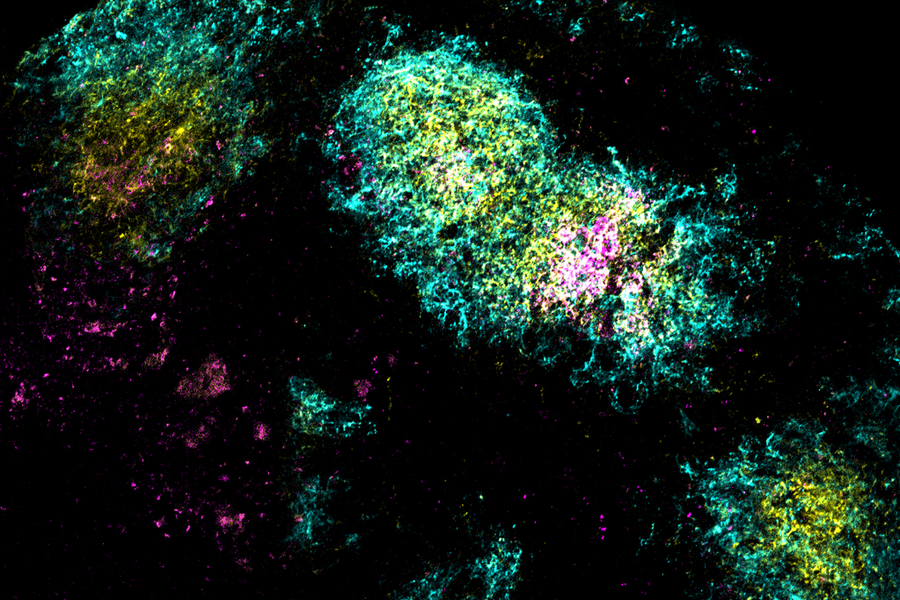
Image shows the vaccine antigen (pink) being concentrated in a germinal center (yellow) within B cell follicles (cyan), triggered by the researchers’ combination adjuvant vaccine.
Credits: Image: Courtesy of the researchers
Researchers at MIT and the Scripps Research Institute have shown that they can generate a strong immune response to HIV with just one vaccine dose, by adding two powerful adjuvants — materials that help stimulate the immune system.
In a study of mice, the researchers showed that this approach produced a much wider diversity of antibodies against an HIV antigen, compared to the vaccine given on its own or with just one of the adjuvants. The dual-adjuvant vaccine accumulated in the lymph nodes and remained there for up to a month, allowing the immune system to build up a much greater number of antibodies against the HIV protein.
This strategy could lead to the development of vaccines that only need to be given once, for infectious diseases including HIV or SARS-CoV-2, the researchers say.
“This approach is compatible with many protein-based vaccines, so it offers the opportunity to engineer new formulations for these types of vaccines across a wide range of different diseases, such as influenza, SARS-CoV-2, or other pandemic outbreaks,” says J. Christopher Love, the Raymond A. and Helen E. St. Laurent Professor of Chemical Engineering at MIT, and a member of the Koch Institute for Integrative Cancer Research and the Ragon Institute of MGH, MIT, and Harvard.
Love and Darrell Irvine, a professor of immunology and microbiology at the Scripps Research Institute, are the senior authors of the study, which appears today in Science Translational Medicine. Kristen Rodrigues PhD ’23 and Yiming Zhang PhD ’25 are the lead authors of the paper.
More powerful vaccines
Most vaccines are delivered along with adjuvants, which help to stimulate a stronger immune response to the antigen. One adjuvant commonly used with protein-based vaccines, including those for hepatitis A and B, is aluminum hydroxide, also known as alum. This adjuvant works by activating the innate immune response, helping the body to form a stronger memory of the vaccine antigen.
Several years ago, Irvine developed another adjuvant based on saponin, an FDA-approved adjuvant derived from the bark of the Chilean soapbark tree. His work showed that nanoparticles containing both saponin and a molecule called MPLA, which promotes inflammation, worked better than saponin on its own. That nanoparticle, known as SMNP, is now being used as an adjuvant for an HIV vaccine that is currently in clinical trials.
Irvine and Love then tried combining alum and SMNP and showed that vaccines containing both of those adjuvants could generate even more powerful immune responses against either HIV or SARS-CoV-2.
In the new paper, the researchers wanted to explore why these two adjuvants work so well together to boost the immune response, specifically the B cell response. B cells produce antibodies that can circulate in the bloodstream and recognise a pathogen if the body is exposed to it again.
For this study, the researchers used an HIV protein called MD39 as their vaccine antigen, and anchored dozens of these proteins to each alum particle, along with SMNP.
After vaccinating mice with these particles, the researchers found that the vaccine accumulated in the lymph nodes — structures where B cells encounter antigens and undergo rapid mutations that generate antibodies with high affinity for a particular antigen. This process takes place within clusters of cells known as germinal centers.
The researchers showed that SMNP and alum helped the HIV antigen to penetrate through the protective layer of cells surrounding the lymph nodes without being broken down into fragments. The adjuvants also helped the antigens to remain intact in the lymph nodes for up to 28 days.
“As a result, the B cells that are cycling in the lymph nodes are constantly being exposed to the antigen over that time period, and they get the chance to refine their solution to the antigen,” Love says.
This approach may mimic what occurs during a natural infection, when antigens can remain in the lymph nodes for weeks, giving the body time to build up an immune response.
Antibody diversity
Single-cell RNA sequencing of B cells from the vaccinated mice revealed that the vaccine containing both adjuvants generated a much more diverse repertoire of B cells and antibodies. Mice that received the dual-adjuvant vaccine produced two to three times more unique B cells than mice that received just one of the adjuvants.
That increase in B cell number and diversity boosts the chances that the vaccine could generate broadly neutralizing antibodies — antibodies that can recognize a variety of strains of a given virus, such as HIV.
“When you think about the immune system sampling all of the possible solutions, the more chances we give it to identify an effective solution, the better,” Love says. “Generating broadly neutralizing antibodies is something that likely requires both the kind of approach that we showed here, to get that strong and diversified response, as well as antigen design to get the right part of the immunogen shown.”
Using these two adjuvants together could also contribute to the development of more potent vaccines against other infectious diseases, with just a single dose.
“What’s potentially powerful about this approach is that you can achieve long-term exposures based on a combination of adjuvants that are already reasonably well-understood, so it doesn’t require a different technology. It’s just combining features of these adjuvants to enable low-dose or potentially even single-dose treatments,” Love says.
The research was funded by the National Institutes of Health; the Koch Institute Support (core) Grant from the National Cancer Institute; the Ragon Institute of MGH, MIT, and Harvard; and the Howard Hughes Medical Institute.
This story is republished courtesy of MIT News (web.mit.edu/newsoffice/), a popular site that covers news about MIT research, innovation and teaching.
Minister of Health Dr Aaron Motsoaledi. Source: GCIS
By Anna Grimsrud and Sibongile Tshabalala-Madhlala
Minister of Health Dr Aaron Motsoaledi’s recent claim that over half a million people have been newly started on HIV treatment in less than six months has raised eyebrows in health circles. In this open letter, Anna Grimsrud and Sibongile Tshabalala-Madhlala, associated with CHANGE – South Africa, ask the Minister to explain numbers that, on the face of it, seem contradictory.
Dear Minister Motsoaledi,
We write to you in response to your 15 May 2025 press statement and subsequent remarks in Parliament on the current status of the national HIV, AIDS, and TB campaign.
You stated that since the launch of the Close the Gap campaign, 520 700 people have been initiated on HIV treatment, reaching “more than 50% of the target”. You also stated that 5.9 million people are currently on antiretroviral therapy (ART). However, at the campaign’s launch on 25 February 2025, you reported the same number on HIV treatment — 5.9 million. This raises a critical question: if over half a million people have started or restarted treatment, why has the total number of people on treatment not increased?
If both figures are accurate, this would mean that approximately 520 000 people have been lost from care over the past few months — a deeply concerning and unprecedented level of attrition. We respectfully request that you provide the underlying data and clarify the current total number of people remaining on HIV treatment.
There are several reasons why we are concerned:
Static treatment numbers: As noted, the number on treatment was reported as 5.9 million in both February and May 2025. If 520 700 people have been initiated or re-initiated during this period, the same number must have exited care — a scenario that requires urgent explanation.
Slow growth in the number of people on treatment: According to official statements, the total number of people on HIV treatment increased by only 100 000 between March and December 2023 — from over 5.7 million to 5.8 million. The claim that the cohort has now grown by over 500 000 in a matter of months contradicts recent trends.
Declining lab numbers: National Health Laboratory Service data reported by the Daily Maverick and Reuters, show notable declines in viral load testing and early infant diagnosis in March and April 2025 compared to the same months in 2024. These indicators should increase alongside meaningful growth in treatment uptake — not decrease.
In light of these concerns, we believe it is essential that you provide a transparent accounting of the current number of people on treatment and the metrics being used to assess progress under the Close the Gap campaign. Specifically, we request data demonstrating that the programme is on track to meet its stated goal: increasing the number of people on treatment from 5.9 million to 7 million.
We share your commitment to a strong and effective HIV response, especially in this period of financial and operational strain. Like you, we believe it is vital that accurate and complete information is shared with the public and Parliament at this critical moment.
*Anna Grimsrud is an epidemiologist with a PhD in Public Health and writes in her personal capacity. Sibongile Tshabalala-Madhlala is openly living with HIV and currently serves as the National Chairperson of the Treatment Action Campaign (TAC).” CHANGE is a coalition of more than 1 500 people from civil society organizations in South Africa and around the work — people living with HIV, activists, community health workers, researchers, programme members, epidemiologists, clinicians, economists, and others. CHANGE stands for Community Health & HIV Advocate Navigating Global Emergencies.
Note: Spotlight aims to deepen public understanding of important health issues by publishing a variety of views on its opinion pages. The views expressed in this article are not necessarily shared by the Spotlight editors.
Republished from Spotlight under a Creative Commons licence. Views expressed in the original article are not necessarily shared by Quicknews.