A therapy showing promise to help control tuberculosis (TB) does not interfere with combined antiretroviral therapy (cART), according to research by Texas Biomedical Research Institute (Texas Biomed) which was recently published in JCI Insight.
“This is an important hurdle that this host-directed therapy had to clear in order to help patients battling both HIV and TB,” said study leader Professor Smriti Mehra, PhD of Texas Biomed.
TB is responsible for more than 1.3 million deaths worldwide every year. Dr. Mehra and her team have been investigating a therapy currently used in cancer as a potential treatment for patients with drug-resistant TB and/or comorbid HIV. While many cases of TB can be controlled with months of antibiotics, the infection can return in people who are immunocompromised as a result of HIV. Now that cART is so effective at controlling HIV, a resurging TB infection can often be deadly to those individuals.
Dr Mehra is studying a host-directed therapy that blocks or inhibits an immune system protein naturally found in the body. The protein, called IDO (short for Indoleamine-2,3-dioxygenase), normally suppresses the immune system, preventing it from causing excessive inflammation and organ damage. Inhibiting IDO for short intervals of time has led to more successful cancer treatments. Dr. Mehra’s team has previously shown the same approach improves control of TB in conjunction with antibiotics.
This current study in nonhuman primates with both TB and simian immunodeficiency virus, the nonhuman primate version of HIV, showed the IDO inhibitor does not interfere with cART.
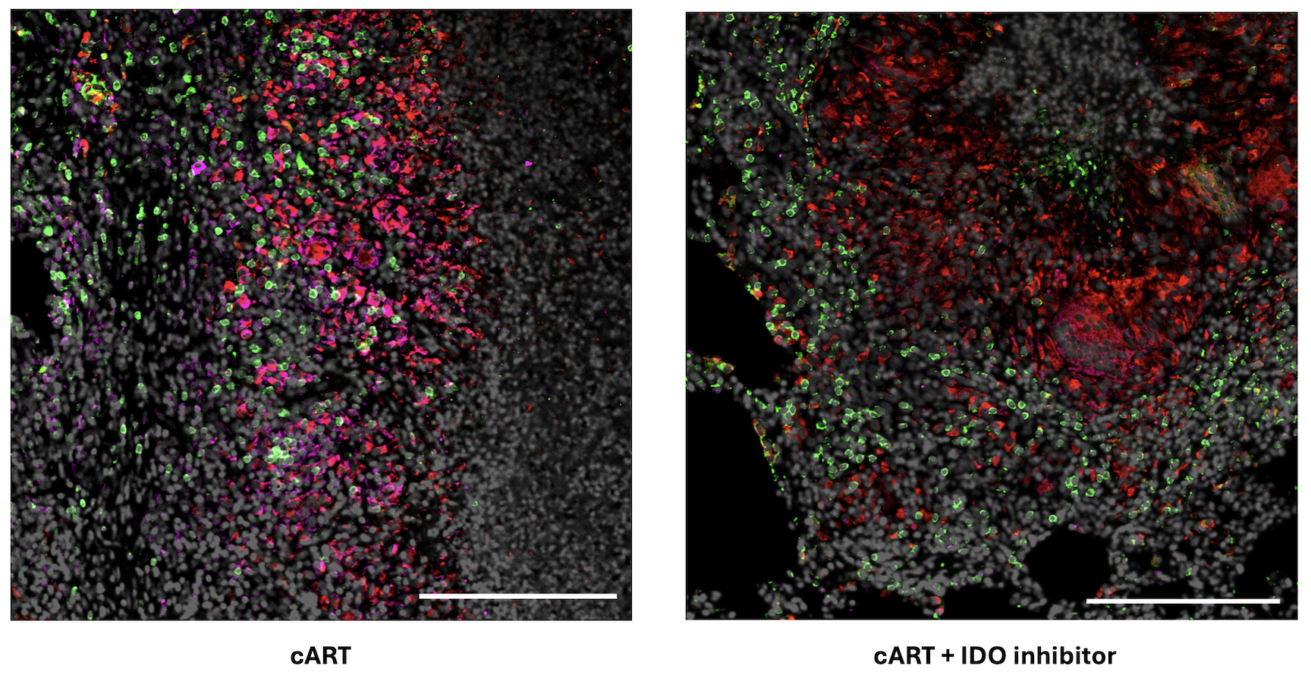
Researchers compare the impacts of cART by itself versus cART plus the IDO inhibitor in lung tissue of nonhuman primates with both TB and SIV. Left: Following just cART, significantly more IDO is detected in pink. Right: With the IDO inhibitor and cART, immune cells recruited to fight bacteria are observed inside the granuloma, a hallmark structure of TB. Specifically, CD4+ T cells are in green and CD68 proteins expressed by macrophages are in red.
“There was no increase in viral load in animals given cART and the IDO inhibitor, compared with animals only given cART, proving the inhibitor is safe to give to patients with HIV,” Dr. Mehra said.
Now that the researchers have shown the inhibitor works well in conjunction with TB antibiotics and with cART separately, they plan to study how it performs when given in conjunction with both antibiotics and cART together. This treatment regimen is standard for patients with both HIV and active TB. Dr. Mehra said that longer-term studies are also needed to confirm there are no unintended side effects.
The IDO inhibitor is already FDA-approved for use in patients with cancer, which shortens the path to potential approval for patients with TB/HIV when compared with developing a brand-new drug.
A small University at Buffalo clinical trial has found that at low doses, lithium aspartate is ineffective in treating the fatigue and brain fog that is often a persistent feature of long COVID; however, a supplemental dose-finding study found some evidence that higher doses may be effective.
Published in JAMA Network Open, the study was led by Thomas J. Guttuso, Jr., MD, professor of neurology in the Jacobs School of Medicine and Biomedical Sciences at UB and a physician with UBMD Neurology.
“It’s a negative study with a positive twist,” Guttuso concludes.
Because long COVID is believed to stem from chronic inflammation and lithium has known anti-inflammatory actions, Guttuso had recommended that a patient of his try low-dose lithium for persistent long COVID symptoms. He was surprised when this patient reported a near full resolution of fatigue and brain fog within a few days of initiating lithium aspartate at 5mg a day.
Relief from symptoms
Based on this single case, Guttuso became interested in lithium aspartate as a potential treatment for long COVID and recommended it to other such patients.
According to Guttuso, 9 of 10 long COVID patients he treated with lithium aspartate 5-15mg a day saw very good benefit in terms of improvements to their fatigue and brain fog symptoms.
“Based on those nine patients, I had high hopes that we would see an effect from this randomized controlled trial,” says Guttuso. “But that’s the nature of research. Sometimes you are unpleasantly surprised.”
The randomised controlled trial showed no benefit from 10-15mg a day of lithium aspartate compared to patients receiving a placebo.
After one patient from the study subsequently increased the lithium aspartate dosage to 40mg a day and experienced a marked reduction in fatigue and brain fog symptoms, Guttuso decided to then conduct a dose-finding study designed to explore if a higher dose of lithium aspartate may be effective.
The three participants who completed the dose-finding study reported greater declines in fatigue and brain fog with the higher dose of 40-45mg per day. This was especially true in the two patients with blood lithium concentrations of 0.18 and 0.49mmol/L compared to one patient with a level of 0.10mmol/L who saw partial improvements.
“This is a very small number of patients, so these findings can only be seen as preliminary,” says Guttuso. “Perhaps achieving higher blood levels of lithium may provide improvements to fatigue and brain fog in long COVID.”
Dosage may be too low
He notes that it is possible the randomized controlled trial was ineffective because the dose of lithium aspartate that was used was too low.
“The take-home message is that very low dose lithium aspartate, 10-15 milligrams a day, is ineffective in treating the fatigue and brain fog of long COVID,” says Guttuso. “Perhaps we need to do another randomised controlled trial that uses higher lithium aspartate dosages that achieve blood lithium levels of 0.18-0.50mmol/L to determine if they could be effective.”
An estimated 17 million people have long COVID in the US, and worldwide the number is estimated at 65 million.
“There currently are no evidence-based therapies for long COVID,” says Guttuso. He hopes that the National Institutes of Health will view lithium as worth studying through a trial with higher dosages; the NIH is allocating an additional $500 million to study long COVID therapies that appear to be promising.
Guttuso adds that if a subsequent randomised controlled trial finds that higher dosages of lithium aspartate are effective, long COVID patients would still need to discuss taking it with their health care providers; in addition, he says, if they do begin taking it at higher dosages, blood lithium levels should be monitored.
Oestrogen, the major female ovarian hormone, can trigger nerve impulses within milliseconds to regulate a variety of physiological processes. At Baylor College of Medicine, Louisiana State University and collaborating institutions, researchers discovered that oestrogen’s fast actions are mediated by the coupling of the oestrogen receptor-alpha (ER-alpha) with an ion channel protein called Clic1.
Clic1 controls the fast flux of electrically charged chloride ions through the cell membrane, which neurons use for receiving, conducting and transmitting signals. The researchers propose that interacting with the ER-alpha-Clic1 complex enables oestrogen to trigger fast neuronal responses through Clic1 ion currents. The study appeared in Science Advances.
“Oestrogen can act in the brain to regulate a variety of physiological processes, including female fertility, sexual behaviours, mood, reward, stress response, cognition, cardiovascular activities and body weight balance. Many of these functions are mediated by oestrogen binding to one of its receptors, ER-alpha,” said co-corresponding author Dr Yong Xu, professor of pediatrics – nutrition and associate director for basic sciences at the USDA/ARS Children’s Nutrition Research Center at Baylor.
Fast and slow
It is well known that, upon stimulation by oestrogen, ER-alpha enters the cell nucleus where it mediates the transcription of genes. This classical mode of action as a nuclear receptor takes minutes to hours.
“Oestrogen also can change the firing activity of neurons in a manner of milliseconds, but it was not clear how this happens,” Xu said. “In this case, it did not make sense to us that the minutes-long nuclear receptor function of ER-alpha was involved in such a rapid action. We explored the possibility that ion channels, proteins in the cell membrane that regulate the fast flux of ions, mediated oestrogen’s quick actions.”
In the current study, working with cell lines and animal models, the team searched for cell membrane proteins that interact with ER-alpha. They found that protein Clic1, for chloride intracellular channel protein-1, can physically interact with ER-alpha. Clic1has been implicated in the regulation of neuronal excitability, so the researchers considered it a candidate to mediate oestrogen-triggered fast actions.
“We discovered that oestrogen enhances Clic1-mediated ion currents, and eliminating oestrogen reduced such currents,” Xu said. “In addition, Clic1 currents are required for oestrogen to induce rapid responses in neurons. Also, disrupting the Clic1 gene in animal models blunted oestrogen regulation of female body weight balance.”
The findings suggest that other nuclear receptors could also interact with ion channels, a possibility the researchers look forward to studying in the future.
“This study was conducted with female mice. However, Clic1 is also present in males. We are interested in investigating its role in male physiology,” Xu said.
Chloride channels are not as well studied as other ion channels, such as potassium, sodium or calcium channels. “We are among the first to study the role Clic1 plays in female physiology,” Xu said. “We hope that our findings will inspire other groups in the field to expand these promising investigations.”
Photo by Wendy Wei: https://www.pexels.com/photo/mother-breastfeeding-her-child-3074935/
A study led by researchers at the found that breast milk provides protection against rotavirus, a common gastrointestinal disease in infants. Babies whose mothers had high levels of specific antibodies in their breast milk were able to fend off the infection for a longer period than infants whose mothers had lower levels. The researchers also uncovered an unexpected relationship between BMI and antibody levels.
Published in the Journal of Clinical Investigation, the University of Rochester Medical Center-led study also found significant differences in antibody profiles in breast milk between mothers in high-income countries (HICs) and low- and middle-income countries (LMICs). Researchers analysed human milk samples from 695 women in Finland, the US, Pakistan, Peru, and Bangladesh, and measured specific IgA and IgG antibodies, which are common antibodies produced in breast milk, against 1607 proteins from 30 pathogens.
The research, led by Dr Kirsi Jarvinen-Seppo, MD, PhD, professor at UR Medicine Golisano Children’s Hospital (GCH), tracked antibody levels and kinetics over time to analyse antibody responses to a wide range of respiratory, diarrhoeal and sepsis pathogens in human milk. The primary aim of the study, funded by the Bill and Melinda Gates Foundation, was to understand the protective properties of these antibodies and how they vary across different geographic and economic regions.
“We would expect to find differences in antibody levels in different countries, due to different diseases circulating among areas of the world, but this is one of the first times that there’s been a head-to-head comparison for dozens of pathogens across several continents,” said Jarvinen-Seppo. “It was encouraging to see such a clear link between higher antibody levels and a delay to rotavirus infection, and this was consistently observed among an independent validation cohort.”
Other notable findings from the study:
Milk from women in LMICs had higher levels of IgA and IgG antibodies against various intestinal and respiratory pathogens compared to milk from HICs. This difference was particularly notable for pathogens such as Shigella and pneumococcus, which are major contributors to morbidity and mortality in young children.
Higher body mass index (BMI) was associated with lower antibody levels, which went against expectations.
“The variation in antibody profiles between regions highlights the impact of economic and environmental factors on maternal immunity,” said Jarvinen-Seppo.
In addition to Rotavirus findings, the discovery that a higher BMI was associated with lower antibody counts in breast milk was also unexpected.
“We had anticipated that underweight mothers might have lower antibody levels due to poorer nutritional status,” said Jarvinen-Seppo. “Due to rising obesity rates worldwide, this could be a significant finding, but this is preliminary and additional research is needed since this is the first time this has been measured.”
“While the data on rotavirus protection is compelling, the geographical and BMI-related variations highlight areas where further research is essential. The study sets the stage for additional investigations that could lead to better understanding and interventions for improving infant health globally,” said Jarvinen-Seppo.
A new study from the University of Turku showed that reducing daily sitting prevented back pain from worsening over six months. The results, published in BMJ Open, strengthen the current understanding of the link between activity and back pain as well as the mechanisms related to back pain.
Intuitively, it is easy to think that reducing sitting would help with back pain, but previous research data is surprisingly scarce. The study from the Turku PET Centre and UKK Institute in Finland investigated whether reducing daily sitting could prevent or relieve back pain among overweight or obese adults who spend the majority of their days sitting. The participants were able to reduce their sitting by 40 min/day, on average, during the six-month study.
“Our participants were quite normal middle-aged adults, who sat a great deal, exercised little, and had gained some extra weight. These factors not only increase the risk for cardiovascular disease but also for back pain,” says Doctoral Researcher and Physiotherapist Jooa Norha from the University of Turku in Finland.
Previous results from the same and other research groups have suggested that sitting may be detrimental for back health but the data has been preliminary.
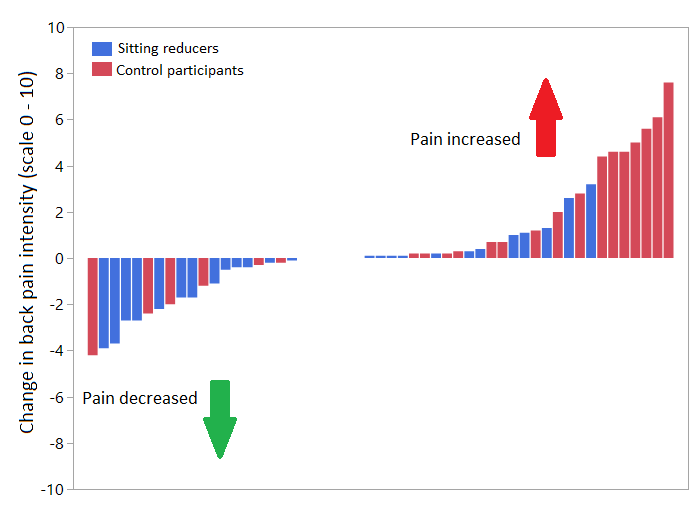
The figure presents the change in back pain intensity on a scale from 0 to 10. The blue bars represent individuals in the intervention group that reduced sitting and the red bars represent the control participants who did not change their sitting habits. Most of the participants in the intervention group decreased their back pain whereas the back pain in the control participants tended to increase.
Robust methods for studying the mechanisms behind back pain
The researchers also examined potential mechanisms behind the prevention of back pain.
”However, we did not observe that the changes in back pain were related to changes in the fattiness or glucose metabolism of the back muscles,” Norha says.
Individuals with back pain have excessive fat deposits within the back muscles, and impaired glucose metabolism, or insulin sensitivity, can predispose to pain. Nevertheless, back pain can be prevented or relieved even if no improvements in the muscle composition or metabolism take place. The researchers used magnetic resonance imaging (MRI) and PET imaging that is based on a radioactive tracer to measure the back muscles.
“If you have a tendency for back pain or excessive sitting and are concerned for your back health, you can try to figure out ways for reducing sitting at work or during leisure time. However, it is important to note that physical activity, such as walking or more brisk exercise, is better than simply standing up,” Norha points out.
The researchers wish to remind that switching between postures is more important than only looking for the perfect posture.
An ultrasound test that detected 96% of ovarian cancers in postmenopausal women should replace current standard of care test in the UK according to a new study.
In a paper published in Lancet Oncology, research led by Professor Sudha Sundar from the University of Birmingham compared all currently available tests to diagnose ovarian cancer in postmenopausal women head-to-head in a high-quality diagnostic test accuracy study.
Of the six diagnostic tests investigated, the IOTA ADNEX model which looks at ultrasound features (how the lump looked like on ultrasound) had the best accuracy of all and could detect up to 96% of women with ovarian cancer.
The ultrasound test outperforms the current standard of care in the UK significantly and so the researchers recommend that the IOTA ultrasound ADNEX model should replace the current standard of care test called risk of malignancy (RMI1) test in the UK which identifies 83% of ovarian cancers.
Sudha Sundar, Professor of Gynaecological Cancer at the University of Birmingham and consultant in gynaecological cancer surgery at Sandwell and West Birmingham NHS Trust said:
“This is the first time that a head-to-head study of all available ovarian cancer tests have been done in the same population. Here we studied their use with symptomatic, postmenopausal women who are most at risk of this cancer. Our trial found that the IOTA ADNEX ultrasound protocol had highest sensitivity for detecting ovarian cancer compared to the standard of care and other test.
“The ultrasound test also performs well when delivered by a trained sonographer who have received specific training and certification and quality assurance, and as the vast majority of ultrasound scans are performed by sonographers it is important that a new standard is able to be delivered by as many clinical professionals as possible.
“We found that the higher sensitivity of the IOTA ADNEX model is likely to lead to some women who don’t have cancer also being flagged up as having a higher risk of cancer. We however did discuss this extensively with patients, cancer charity Target ovarian cancer and NHS experts who all agreed that in postmenopausal women who are at higher risk of ovarian cancer, picking up more women with cancer would benefit women overall.”
The research team note that the IOTA ADNEX model achieved 96% accuracy when delivered by NHS sonographers who were appropriately trained and received quality assurance. As most scans worldwide are carried out by sonographers rather than gynaecologists, introductory free online resources have been created by the researchers for NHS staff to undergo the specialist ultrasound training and get certification and quality assurance.
A UCLA research team has created the Comorbid Operative Risk Evaluation (CORE) score to better account for the role chronic illness plays in patient’s risk of mortality after operation, allowing surgeons to adjust to patients’ pre-existing conditions and more easily determine mortality risk.
For almost 40 years, researchers have used two tools, the Charlson Comorbidity Index (CCI) and Elixhauser Comorbidity Index (ECI), to measure the impact of existing health conditions on patient outcomes. These tools use ICD codes that are input by medical professionals and billers to account for patient illness. These tools, however, were not designed for patients undergoing surgery and often address chronic illnesses that are not relevant to surgical populations. They often capture data from medical billing records and lack nuanced information regarding pre-existing health conditions.
A total of 699 155 patients were used to develop the model, of which 139 831 (20%) comprised the testing cohort. The researchers queried adults undergoing 62 operations across 14 specialties from the 2019 National Inpatient Sample (NIS) using International Classification of Diseases, 10th Revision (ICD-10) codes. They sorted ICD-10 codes for chronic diseases into Clinical Classifications Software Refined (CCSR) groups. They used logistic regression on CCSR with non-zero feature importance across four machine learning algorithms predicting in-hospital mortality, and used the resultant coefficients to calculate the Comorbid Operative Risk Evaluation (CORE) score based on previously validated methodology. The final score ranges from zero, representing lowest risk, to 100, which represents highest risk.
Impact
Health services and outcomes research using retrospective databases continues to represent a growing proportion of surgical research. Researchers highlighting quality issues and disparities are well-intentioned. However, without appropriate tools, it can be unclear if poor outcomes are independent of pre-existing conditions.
“The advent of novel statistical software and methodology have enabled researchers to exploit large databases to answer questions of healthcare quality, disparities, and outcomes,” said Dr Nikhil Chervu, a resident physician in the UCLA Department of Surgery and the study’s lead author. “These databases, however, often capture data from medical billing records and lack nuanced information regarding pre-existing health conditions. Without addressing differences in patients’ chronic illnesses, population comparisons may fall flat. Incorporation of this score in additional research will further validate its use and help improve analysis of surgical outcomes using large databases.”
Mycobacterium tuberculosis drug susceptibility test. Photo by CDC on Unsplash
A compound found in African wormwood – a plant used medicinally for thousands of years to treat many types of illness – could be effective against tuberculosis, according to a new study available online in the Journal of Ethnopharmacology.
The team, co-led by Penn State researchers, found that the chemical compound, an O-methylflavone, can kill Mycobacterium tuberculosis, or Mtb, that causes tuberculosis in both its active state and its slower, hypoxic state, which the mycobacteria enters when it is stressed.
Bacteria in this state are much harder to destroy and make infections more difficult to clear, according to co-corresponding author Joshua Kellogg, assistant professor of veterinary and biomedical sciences in the College of Agricultural Sciences.
While the findings are preliminary, Kellogg said the work is a promising first step in finding new therapies against tuberculosis.
“Now that we’ve isolated this compound, we can move forward with examining and experimenting with its structure to see if we can improve its activity and make it even more effective against tuberculosis,” he said. “We’re also still studying the plant itself to see if we can identify additional molecules that might be able to kill this mycobacterium.”
Tuberculosis is one of the world’s leading killers among infectious diseases, according to the Centers for Disease Control and Prevention. There are about 10 million cases a year globally, with approximately 1.5 million of those being fatal.
While effective therapies exist for TB, the researchers said there are several factors that make the disease difficult to treat. A standard course of antibiotics lasts six months, and if a patient contracts a drug-resistant strain of the bacteria, it stretches to two years, making treatment costly and time consuming.
Additionally, the bacteria can take two forms in the body, including one that is significantly harder to kill.
“There’s a ‘normal’ microbial bacterial form, in which it’s replicating and growing, but when it gets stressed – when drugs or the immune system is attacking it – it goes into a pseudo-hibernation state, where it shuts down a lot of its cellular processes until it perceives that the threat has passed,” Kellogg said. “This makes it really hard to kill those hibernating cells, so we were really keen to look at potential new chemicals or molecules that are capable of attacking this hibernation state.”
Multiple species of the Artemisia plant have been used in traditional medicine for centuries, the researchers said, including African wormwood, which has been used to treat cough and fever. Recent studies in Africa have suggested that the plant also has clinical benefits in treating TB.
“When we look at the raw plant extract that has hundreds of molecules in it, it’s pretty good at killing TB,” Kellogg said. “Our question was: There seems to be something in the plant that’s really effective – what is it?”
For their study, the researchers took raw extract of the African wormwood plant and separated it into “fractions” – versions of the extract that have been separated into simpler chemical profiles. They then tested each of the fractions against Mtb, noting whether they were effective or ineffective against the bacteria. At the same time, they created a chemical profile of all of the tested fractions.
“We also used machine learning to model how the changes in chemistry correlated with the changes in activity that we saw,” Kellogg said. “This allowed us to narrow our focus to two fractions that were really active.”
From these, the researchers identified and tested a compound that effectively killed the bacteria in the pathogen’s active and inactive states, which the researchers said is significant and rare to see in TB treatments. Further testing in a human cell model showed that it had minimal toxicity.
Kellogg said the findings have the potential to open new avenues for developing new, improved therapeutics.
“While the potency of this compound is too low to use directly as an anti-Mtb treatment, it may still be able to serve as the foundation for designing more potent drugs,” he said. “Furthermore, there appear to be other, similar chemicals in African wormwood that may also have the same type of properties.”
The researchers said that in the future, more studies are needed to continue exploring the potential for using African wormwood for treating TB.
As we celebrate Carer’s Week, an annual campaign recognising the invaluable work of caregivers, it’s essential to highlight the critical role they play in supporting the elderly and their families. In South Africa, the growing number of elderly individuals has created a pressing need for qualified caregivers.
Given the deep-rooted relationships between many domestic helpers and their employers, formally training these helpers to become specialised caregivers presents a promising solution. This approach not only ensures consistent care but also respects the deep connection between employer and helper, facilitating a smooth transition into a new phase of support and companionship.
Through specialised training, domestic workers can acquire the necessary qualification to provide professional elderly care within a three-month timeframe, while also enhancing their long-term career prospects.
Setting the stage for specialised care In South Africa, the Older Persons Act is clear that caregivers for the elderly must possess formal qualifications to ensure the provision of quality care. Temporary Employment Services (TES) offer a practical solution to this growing need, providing training and up-skilling of helpers to become qualified caregivers. Through focused instruction and hands-on learning, helpers gain formal proficiency in addressing the unique needs of the elderly, including wound care, palliative care, medication management, and mental health support.
The benefits of training domestic helpers Investing in training toward a formal qualification for domestic helpers has broader implications beyond immediate caregiving. For the helpers, it enhances their job prospects and ensures their continued employment security. Importantly, it equips them with the skills needed to navigate the changing terrain of elder care with assurance and proficiency.
In this way, empowering domestic helpers with specialised skills addresses the growing demand for quality elder care while contributing to the professional development and well-being of a dedicated workforce capable of caring for society’s most vulnerable.
The importance of trust and training The combination of trust and training serves as a cornerstone in elder care. The deep-rooted relationships between domestic helpers and their employers provide a foundation of trust and understanding, facilitating effective communication and collaboration.
When coupled with specialised training, these relationships become even more valuable, ensuring that the elderly receive personalised and compassionate care from individuals who genuinely care about their well-being.
TES providers can play a vital role in facilitating this transition, providing the necessary training and support to equip domestic helpers with the skills and knowledge required to become competent caregivers. Accredited training programs ensure that helpers are equipped to handle the challenges and responsibilities associated with elder care.
Benefits for the elderly and their families Beyond the immediate benefits, investing in training for domestic helpers can also contribute to the overall well-being of the elderly population. When the elderly receive care from trusted individuals who are familiar with meeting their specific needs, they are more likely to experience improved quality of life, reduced stress, and increased feelings of security and belonging. This can have a positive impact on their physical and mental health, leading to better overall outcomes.
As the elderly population grows, demand for quality elder care services will only increase. By empowering domestic helpers to take on caregiver roles, it is possible to meet this demand and reduce the strain on families who may be struggling to balance their own responsibilities with the needs of caring for their elderly loved ones.
Benefits for the caregiver and community In addition to the benefits for the elderly and their families, training domestic helpers for specialised elderly care can also have a positive impact on the broader community. Investing in the professional development of domestic helpers contributes to the growth and development of a skilled workforce. This can have long-term economic benefits for the country, as it can help to create jobs and boost the economy.
Training as a caregiver and receiving a formal qualification offers numerous benefits for domestic workers. This training enhances their job security, increases their earning potential, develops new skills, and helps to provide a sense of personal satisfaction and fulfilment. A caregiver qualification can open doors to a wider range of job opportunities, improve career prospects, and provide extensive opportunities for overseas employment.
A care transition that makes sense for everyone Empowering domestic helpers for specialised elderly care is a win-win situation. It addresses the growing demand for quality elder care, ensures continuity of care for the elderly, and provides opportunities for professional advancement for domestic helpers. As South Africa’s population ages, training domestic helpers to become specialised caregivers is a practical and effective approach to addressing the growing need for quality elder care.
This initiative not only benefits the elderly and their families but also empowers domestic workers and contributes to the development of a skilled and qualified caregiving workforce. By recognising the value of caregivers during Carer’s Week, we can highlight the importance of investing in their training and support.
Lee Callakoppen, Principal Officer, Bonitas Medical Fund
Lee Callakoppen, Principal Officer of Bonitas Medical Fund, talks about the year ahead for Bonitas Medical Aid and its members.
The medical scheme industry has faced turbulent conditions over the past 12 months with the debate over NHI, economic pressures and reserves coming under pressure.
Despite this, our value creation model stood us in good stead with over R1.4 billion in reserves given back to members through benefit enhancements and low and deferred increases in 2022 and 2023.
The Fund, which has a proud heritage spanning over four decades, today (October 2) announced its pricing and benefits strategy for 2025. These announcements are traditionally seen as ‘price hikes’ but our strategy also considered benefit hikes in response to member needs.
Calculating the changes
The percentage increases are meticulously calculated by our actuaries, balancing the financial sustainability of the Scheme, while adhering to regulatory guidelines and requirements outlined by the Council for Medical (CMS). And, while Bonitas has seen a positive performance, we’ve had to take measures to prevent instability in our environment in arriving at our weighted increase of 10.2% as of January 1, 2025.
Over the past few years, we kept our contribution increases well below the industry average, while maintaining a healthy financial position while ensuring benefits are not eroded.
The contribution increases range from 8.7% to 14.9% per plan, with the latter impacting only 1% of members. The increases and new benefits have been submitted to the CMS and are subject to their approval.
The Bonitas Board and Executive’s input considered: Market trends, including international healthcare protocols, industry analysis, benchmarking reports and benefit utilisation patterns. Integral to this process was independently commissioned research across core stakeholder groups including brokers, HR representatives, corporates and local government.
Membership profile
Our members are from across a diverse range of backgrounds – with corporate membership spanning over 65 industries and profiles varying from students and singles to families, established professionals and those enjoying their golden years.
A quintet of awards
One way of measuring and gaining insights on whether a brand is getting it right, is through independent surveys and audits from industry bodies and consumers themselves. Recently Bonitas was announced the winner of the ‘Medical Aid Category’ in the Ask Afrika Orange Index® Awards for 2024/2025. It is the 4th category win over the past seven years. Principles such as trust, sustainability, reputation and care feature strongly in top customer need attributes.
It is also the 5th accolade for the Scheme this year, others include: Two BHF Titanium Awards for’ Best Integrated Report’ and ‘Best Operational Performance’, Top 500’s ‘Leader for medical aid’ and a gold in the Daily Sun Reader’s Choice Awards.
The life stage model
Our new model is designed to revitalise our approach based on industry, life stage and various psychographic and behavioural science elements. This is supported by a diverse product range, tailored wellness and screening benefits, access to healthcare services and optimised member communication to drive education and improve benefit access.
We continue to make health risk assessments and preventative care screenings a core enabler for managed healthcare initiatives. After all, early detection and speedy intervention is critical to enhancing our member’s quality of life. For example, roughly half of our population have high blood pressure. The latest international treatment protocols, recommend self-monitoring to help individuals manage their blood pressure more effectively. In keeping with this, a blood pressure monitor will be funded over a two-year cycle per family.
So, what’s new?
Integrated chronic care family practitioner network
There is a direct correlation between chronic diseases and mental health. For 2025, we have added a mental health component into our GP network, to facilitate early disease detection, diagnosis and multi-disciplinary care-coordination, through the high-quality network of doctors. In addition, we will provide more personalised engagement and support through the enhanced maternity programme, to treat antenatal and postnatal depression.
Hearing Loss Management (Audiology)
This includes free online hearing screening for all South Africans. Members on selected plans will receive hearing aids, audiology services and hearing aid acoustic services of the highest quality by using a network provider.
Weight Management Programme
Obesity or being overweight, substantially increases the risk of morbidity from at least fifteen conditions, including: Hypertension, coronary artery disease, diabetes, strokes, sleep apnoea and respiratory problems and cancer.
The programme, led by a biokineticist registered with Biokinetic Association of South Africa, provides a holistic approach to weight loss that includes access to a dietician and psychologist for support on exercise, nutrition and mental health.
Female Health Programme
We’re making a renewed commitment to the health and wellbeing of women and toddlers through the Mother and Child Care Benefit, including the Maternity Programme. Launched earlier this year in collaboration with CareWorks, the programme has an emphasis on preventative care and early detection of female-specific health issues, based on life stages.
Our enhanced Maternity Programme includes support for expecting mothers, including early identification and weekly engagement for high-risk pregnancies, post-childbirth care and associated mother mental health follow-up calls, given the prevalence of pre and postnatal depression.
It includes milestone reminders for children under three, immunisation reminders and online screenings for infant and toddler health and screening by an ophthalmologist for premature neonates, on all options except BonCap. This allows for early intervention and, where possible, prevents blindness. We’ve also opted to cover antenatal vitamins on all plans through savings or the Benefit Booster.
Bonitas Geriatric Care
This is a personalised range of screening, prevention and wellness benefits which can be performed in the comfort of their own homes and includes: Wellness screenings, vaccines for flu and pneumonia, age-appropriate screening for prostate, breast and cervical cancer, osteoarthritis screenings, coordination of care with a nominated GP, chronic care management and support and fall-risk assessments to allow seniors to live independently. All covered from Risk.
Diabetic retinopathy screenings
In partnership with PPN, our members can access cutting edge, AI driven diabetic retinopathy screenings. The screening also detects several other conditions that could affect the eyes.
Benefit Booster
The Benefit Booster remains the only benefit in the market which provides members with access to up to R5 000 as an additional benefit to use for out-of-hospital expenses, at no extra cost. For 2025, we’ve opted to bolster the Benefit Booster on seven plans, to offer even more value for money while providing access to additional benefits.
Despite the challenges in the healthcare industry, we continue to run a tight ship, staying on course to meet the diverse needs of our members with innovative benefits, a life stage model and a commitment to quality care.
Because we know health is not just a plan, it’s a lifelong journey.’