A small clinical trial published in Pediatrics has shown that intranasal flu vaccine is just as safe for children with asthma as the intramuscular vaccine. According to the researchers, within 42 days of vaccination, 10.8% of children who received the intranasal quadrivalent live attenuated influenza vaccine (LAIV4) had an asthma exacerbation compared with 14.7% of those who received the intramuscular quadrivalent inactivated influenza vaccine (IIV4).
According to the researchers, regardless of asthma severity, LAIV4 remained noninferior to IIV4. Among those with mild asthma, one of 25 kids who received the LAIV4 experienced an asthma exacerbation versus three of 16 in the IIV4 group, the researchers reported. In children with moderate to severe asthma, exacerbations occurred in seven of 49 in the LAIV4 group and seven of 52 in the IIV4 group.
“These data add to the compelling safety record of LAIV in children, including those with persistent asthma,” the researchers wrote.
The two groups also did not differ significantly in the frequency of asthma-related symptoms, including nighttime awakening, unscheduled albuterol use, cough, wheezing, or chest tightness, within 14 days of administration. Similarly, no differences were seen in peak expiratory flow rate, or changes in childhood asthma control test or asthma control test scores from baseline through 42 days.
At present, the CDC recommends against the nasal spray vaccine for children and people with asthma, citing an increased risk of exacerbations.
A previous study had suggested that the LAIV was linked increased asthma risk and reactive airway disease in children under 36 months of age, but more recent research has found no difference in risk between the LAIV and IIV, the researchers explained.
“Building off these previous studies, our prospective study suggests that LAIV may be appropriate for some children with asthma,” they noted.
“These data support reexamining precautions to using LAIV4 in children with asthma, which could be particularly important during influenza pandemics, at times when IIV4 supplies are limited, in situations of public/school mass vaccination clinics using LAIV, or for children with significant needle aversions,” they added.
The study was conducted over the 2018 and 2019 flu seasons with children aged five to 11 but expanded to include children ages 5 to 17 in its second year. The primary outcome of asthma exacerbation after 42 days was defined as an episode for which the participant sought medical care or a new prescription for corticosteroids.
The median age of the 151 enrolled participants was 9 years, and 58% were boys.
Systemic reactogenicity events in the 14 days after vaccination were not different between the LAIV4 and IIV4 groups, with the exceptions of myalgia and sore throat, which were more common in the IIV4 group.
Briefly blocking interleukin-10 (IL-10) when administering the BCG vaccine for tuberculosis vastly improves long-term protection in mice, researchers reported in the Journal of Immunology. The finding, if it continues to hold true in nonhuman primates and clinical trials, has the potential to save millions of lives.
“We are very excited that we can reverse BCG’s waning effectiveness by combining it with a host-directed therapy into one dose, which makes it very practical for the clinic,” said senior author Joanne Turner, PhD.
The study builds on research showing the effect of IL-10 on TB, which normally helps dampen excessive inflammation during infection, but Dr Turner’s previous work showed that IL-10 overall actually drives infection.
The researchers combined the BCG vaccine with an antibody that blocks IL-10 activity for about one week. Since the antibody targets the host, not the pathogen, that makes it a “host-directed therapy.” They gave the mixture to mice in one shot, waited six weeks to ensure the IL-10 blocker was no longer present and the BCG protection had been generated, and then exposed the mice to TB. Those mice controlled TB infection for nearly a year, which is significant for mice with normal lifespans of about two years. In contrast, mice given only the BCG vaccine lost control of TB infection within two months and had significant inflammation and damage in the lungs. Notably, the mice given the vaccine/IL-10 blocker had higher levels of various long-term memory immune cells, which are critical for ongoing TB control.
“This shows that the early development of an immune response is key for controlling TB infection in the long run, and that IL-10 inhibits the development of that long-term immunity,” Dr Turner said. “But by briefly blocking IL-10 at the same time as giving the vaccine, it allows the vaccine and immune system to do their jobs, creating those long-lasting memory immune cells.”
The researchers plan to move to nonhuman primates and then human clinical trials if those are successful. The team is optimistic, especially since the BCG vaccine is already in widespread use and the IL-10 blocker is being tested against other diseases.
Researchers have found that a 90 minute bout of mild- to moderate-intensity exercise directly after a receiving a flu or COVID vaccine may provide an extra immune boost.
In the paper, published in Brain, Behavior, and Immunity, participants who cycled on a stationary bike or took a brisk walk for an hour-and-a-half after receiving a vaccine injection produced more antibodies in the following four weeks compared to participants who sat or continued with their daily routine post-immunisation. When the researchers ran the experiment with mice and treadmills, similar results were observed.
“Our preliminary results are the first to demonstrate a specific amount of time can enhance the body’s antibody response to the Pfizer-BioNtech COVID vaccine and two vaccines for influenza,” said Kinesiology Professor Marian Kohut, lead author of the study.
The vaccine recipients would be able to benefit people who could not cope with such exercise. Nearly half of the participants in the experiment had a BMI in the overweight or obese category. During 90 minutes of exercise, they focused on maintaining a pace that kept their heart rate around 120–140 beats per minute rather than distance.
However, the exercise duration appeared to be important: the researchers also ran the experiment with just 45-minutes of exercising. The shorter workout did not increase the participants’ antibody levels. Prof Kohut said a follow-up study might test whether 60 minutes is sufficient.
As to why prolonged, mild- to moderate-intensity exercise could improve the body’s immune response, Prof Kohut said there may be multiple reasons. Exercise increases blood and lymph flow, which helps circulate immune cells. As these cells move around the body, they’re more likely to detect antigens. The mouse experiment data also suggested that interferon alpha produced during exercise helps generate virus-specific antibodies and T- cells.
“A lot more research is needed to answer the why and how,” said Prof Kohut. “There are so many changes that take place when we exercise – metabolic, biochemical, neuroendocrine, circulatory. So, there’s probably a combination of factors that contribute to the antibody response we found in our study.”
The researchers are continuing to track the antibody response in the participants six months post-immunisation and have launched another study that focuses on exercise’s effects on people who receive booster shots.
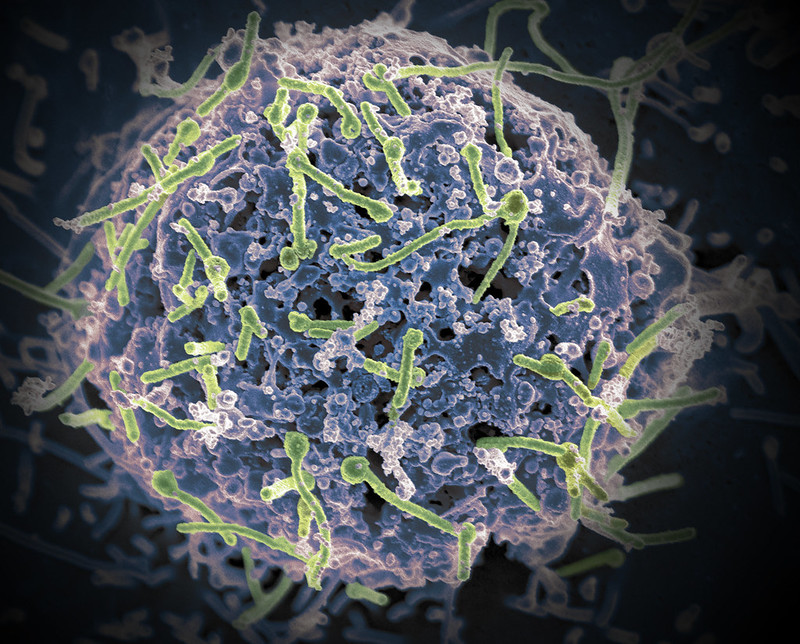
Ebola virus (green) is shown on cell surface. Credit: National Institutes of Allergy and Infectious Diseases, NIH
A new study has shown that the Ebola vaccine known as rVSVΔG-ZEBOV-GP instils a robust and enduring antibody response among vaccinated individuals in areas of the Democratic Republic of Congo that are experiencing outbreaks of the disease.
The study, published in PNAS, is the first to examine post–Ebola-vaccination antibody response in the DRC, a nation of nearly 90 million. Long-term analyses of the study cohort will continue, but in the meantime, the findings will help inform health officials’ approach to vaccine use for outbreak control, the researchers said.
Ebola, one of the world’s deadliest viral diseases known to infect humans, was first identified in 1976 following an outbreak near the Ebola River in then Zaire (now DRC). Since then, outbreaks have occurred intermittently in sub-Saharan Africa, including 12 outbreaks in the DRC, where the disease remains endemic.
The single-dose rVSVΔG-ZEBOV-GP vaccine was administered to more than 300 000 individuals in the DRC during outbreaks between 2018 and 2020. However, studies examining the antibody response of vaccinated Congolese populations had been lacking.
US and DRC researchers studied individuals who received the vaccine during an Ebola outbreak in the DRC’s North Kivu Province. Between August and September 2018, 608 eligible individuals were vaccinated. In an approach known as “ring vaccination”, these participants were contacts of people infected with Ebola or contacts of those contacts as well as health care and frontline workers in affected or potentially affected areas. Blood samples were taken at the time of vaccination, 21 days later and again after six months. They found that after 21 days, 87.2% of the study participants showed an antibody response and antibody persistence was seen in 95.6% after six months.
Afrigen Biologics and Vaccines, a South African biotechnology company, has nearly created a copy of Moderna’s COVID mRNA vaccine, without Moderna’s involvement, Nature reports.
The Cape Town-based company has so far made only microlitres of the vaccine, based on Moderna’s publicly available development data. This nevertheless is a success for a major initiative launched by the World Health Organization (WHO): a technology transfer hub meant to build vaccine manufacturing capacity in low- and middle-income countries.
During the COVID pandemic, the developers of mRNA vaccines, Moderna and Pfizer/BioNTech have sent more than 70% of their doses to wealthy nations. Meanwhile, millions of vaccine orders for southern hemisphere countries have been delayed. “Moderna and Pfizer-BioNTech’s vaccines are mainly still going to just the richest countries,” says Martin Friede, the WHO official coordinating the hub. “Our objective is to empower other countries to make their own.”
Much work needs to be done before Afrigen’s mRNA vaccine mimic can be distributed. But the WHO hopes that the process of creating it will lay the foundation for a more globally distributed mRNA vaccine industry in the future.
Gerhardt Boukes, chief scientist at Afrigen is proud to have helped complete this first step of the plan. Afrigen and its collaborators completed the process, beginning with mRNA encoding a modified portion of the SARS-CoV-2 coronavirus, and finishing by encapsulating it in a lipid nanoparticle that delivers the vaccine to cells. “We didn’t have help from the major COVID vaccine producers,” he says, “so we did it ourselves to show the world that it can be done, and be done here, on the African continent.”
When the mRNA hub was launched by the WHO in June 2021, Moderna, Pfizer and BioNTech did not respond to requests to help make their vaccines, so the WHO proceeded without their help. The Moderna vaccine was chosen to copy because there is more freely available data on it, and it has not vowed to enforce its patents.
The project started in late September, with a Wits University team spearheading the first step: making a DNA molecule that would serve as a template to synthesise the mRNA needed in the vaccine. While Moderna controversially patented this sequence, Stanford University researchers had deposited it into the online database Virological.org in March last year.
Patrick Arbuthnot, director of gene therapy research at Wits says, “We were not intimidated, because mRNA synthesis is a fairly generic procedure.” Despite delays in the shipment of raw materials, the team completed this process in ten weeks and sent vials of mRNA to Afrigen in early December.
Around this time, scientists worldwide emailed offers of assistance. Some were researchers at the US National Institutes of Health who had conducted foundational work on mRNA vaccines. Petro Terblanche, Afrigen’s managing director, said that it was “extraordinary”. “I think a lot of scientists were disillusioned with what had happened with vaccine distribution, and they wanted to help get the world out of this dilemma.”
On 5 January, Afrigen’s researchers accomplished another tricky part of the process: They encapsulated the mRNA in a fatty nanoparticle made of a mixture of lipids. Boukes says they haven’t yet used Moderna’s specific lipid mixture, but rather another one that was immediately available from the manufacturer of the machine that the laboratory uses to create lipid nanoparticles. They plan to use Moderna’s lipid mixture in the coming days, as soon as one last analytical instrument arrives. After that, the team will analyse the formulation to ensure that it is truly a near copy of Moderna’s vaccine.
Once a reliable copy is made, the next step is increasing production. Jason McLellan, a structural biologist at the University of Texas at Austin whose work was foundational to the development of several COVID vaccines, says he is not surprised that SA scientists seem to have copied Moderna’s vaccine, but he adds that scaling up production of that original shot required a lot of additional innovation by manufacturers.
For the next phase of the project, several southern hemisphere companies will learn from Afrigen and attempt to create batches of vaccines themselves, in preparation for animal testing. By end November, the WHO expects a Moderna clone to be ready for phase I trials in humans.
What happens beyond that is unclear. Moderna might choose to license its patent (lab research is usually not subject to patent rules), or alternatives may become available, such as next-generation mRNA vaccines that do not require ultracold storage.
US researchers have shown that a Zika virus vaccine candidate is effective at preventing the Zika virus passing from mother to foetus in preclinical animal studies, according to a new study published in npj Vaccines.
“The vaccine has been shown to be safe for non-pregnant humans, but of course we need to know if it is safe and effective for the people at greatest risk: pregnant women and their fetuses,” said first author In-Jeong Kim, PhD, a viral immunologist at Trudeau Institute. “Our proof-of-concept studies conducted at Trudeau and Texas Biomed show very promising results that the vaccine given before pregnancy will provide high levels of protection for mothers and babies.”
The 2015–2016 Zika outbreak in Brazil and other countries in the Americas caused a surge in miscarriages and a constellation of birth defects, called Congenital Zika Syndrome, including abnormally small heads and neuro-developmental disorders.
“It’s important to test vaccines before the next large outbreak, because there will be another,” said senior author Jean Patterson, PhD, a virologist at Texas Biomed. “Zika is part of a family of viruses known to go through cycles. These viruses tend to spread rapidly through naïve populations that have never been exposed to the virus before, then infections drop down for years because most people have been exposed. As more and more people are born, there is a new group of naïve individuals in which the virus can once again wreak havoc. We want to help break that cycle.”
The purified, inactivated Zika vaccine (ZPIV) candidate was been tested in non-pregnant animals, showing it effectively clears the virus from blood. In Phase 1 human trials, it has been shown to be safe and elicit a protective immune response.
However for ethical and safety reasons, it is not possible to test whether the vaccine protects women and their foetuses from both infection and severe malformations, so animal models are used as a substitute.
Researchers tested the vaccine in pregnant mice and marmosets, respectively. The mouse studies, led by Dr Kim and Marcia Blackman, PhD, a viral immunologist at Trudeau, showed the vaccine prevented around 80% of foetal malformations, and neutralising antibodies were detected in foetal blood samples eight days after infection.
“We were able to detect maternal antibodies in the fetus during pregnancy and the results suggest the antibodies play a critical role in protecting fetuses from Zika virus,” Dr Kim said.
Marmosets are more sensitive to Zika infection than other nonhuman primates; previous research showed foetuses were aborted within two weeks of maternal infection.
In this study, four marmosets were immunised with the ZPIV vaccine and then exposed to Zika virus after they became pregnant. Only 1 of 12 offspring tested positive for Zika virus, demonstrating more than 90% effectiveness.
“Because the animals became pregnant at different times, our study was able to show the vaccine confers protection for at least 18 months after vaccination, which is important for showing long-lasting immunity,” Dr Patterson said.
The researchers are already testing what happens when the vaccine is administered during pregnancy.
“These studies add evidence that the Zika vaccine WRAIR developed not only protects animals against Zika virus infection, but also the congenital defects that mimic what has been observed in people,” says Kayvon Modjarrad, MD, PhD, who leads the US Army Zika vaccine programme. “Together with the early phase clinical trials, we believe these data lend even more support that this vaccine platform is a viable approach for countering the persistent threat of Zika.”
A cloud of platelet factor 4 proteins interacting with the electrostatic surface of the Oxford vaccine, as seen through the computational microscope. Credit: Chun Kit Chan, Arizona State University
An international team of scientists believe they may have found a molecular mechanism behind the extremely rare blood clots linked to adenovirus vaccines.
Scientists led by a team from Arizona State University, Cardiff University and others worked with AstraZeneca to investigate vaccine-induced immune thrombotic thrombocytopenia (VITT), also known as thrombosis with thrombocytopenia syndrome (TTS), a life-threatening condition seen in a very small number of people after receiving the Oxford-AstraZeneca or Johnson & Johnson vaccines.
“The mechanism which results in this condition, termed vaccine-induced immune thrombotic thrombocytopenia (VITT), was unknown,” said Abhishek Singharoy, an Arizona State University scientist and corresponding author of the study who teamed up to lead an international effort to tease out the details.
Together, the team worked to solve the structural biology of the vaccine, and see the molecular details that may be at play, utilising state-of-the cryo-EM technology to analyse the AstraZeneca vaccine in minute detail. They sought to understand whether the ultra-rare side effect could be linked to the viral vector which is used in many vaccines, including those from Oxford/AstraZeneca and Johnson & Johnson.
Their findings suggest it is the viral vector – in this case, an adenovirus used to shuttle the coronavirus’ genetic material into cells – and the way it binds to platelet factor 4 (PF4) once injected that could be the potential mechanism.
In very rare cases, the scientists suggest, the viral vector may enter the bloodstream and bind to PF4, where the immune system then views this complex as foreign. They believe this misplaced immunity could result in the release of antibodies against PF4, which bind to and activate platelets, leading to clustering and blood clotting.
“It’s really critical to fully investigate the vector-host interactions of the vaccine at a mechanistic level,” said Singharoy. “This will assist in understanding both how the vaccine generates immunity, and how it may lead to any rare adverse events, such as VITT.”
Adenovirus expert Professor Alan Parker said: “VITT only happens in extremely rare cases because a chain of complex events needs to take place to trigger this ultra-rare side effect. Our data confirms PF4 can bind to adenoviruses, an important step in unravelling the mechanism underlying VITT. Establishing a mechanism could help to prevent and treat this disorder.”
“We hope our findings can be used to better understand the rare side effects of these new vaccines – and potentially to design new and improved vaccines to turn the tide on this global pandemic.”
The AstraZeneca and Johnson & Johnson vaccines both use an adenovirus to carry SARS-CoV-2 Spike proteins to trigger an immune response.
Since VITT was seen in both vaccines, scientists wondered whether the viral vector was involved. Additionally, neither the Moderna nor Pfizer vaccines, both mRNA vaccines, showed this effect.
Using cryo-EM technology to flash-freeze preparations of ChAdOx1, the adenovirus used in the AstraZeneca vaccine, they produce microscopic images of the vaccine components.
They were then able to view the viral capsid structure and other critical proteins that allow entry of the virus into the cell.
In particular, the team outlined the details for the structure and receptor of ChAdOx1, which is adapted from chimpanzee adenovirus Y25 – and how it interacts with PF4. They believe it is this specific interaction – and how it is then presented to the immune system – that could cuase the immune system to see it as foreign and release antibodies against this self-protein.
The research team also used computational models to show that one of the ways the two molecules tightly bind is via electrostatic interactions. The group showed that ChAdOx1 is mostly electronegative, attracting other positively charged molecules to its surface.
First author Dr Alexander Baker said: “We found that ChAdOx1 has a strong negative charge. This means the viral vector can act like a magnet and attract proteins with the opposite, positive charge, like PF4.” Baker is a member of ASU’s Biodesign Center for Applied Structural Discovery and an Honorary Research Fellow at Cardiff University School of Medicine.
“We then found that PF4 is just the right size and shape that when it gets close to ChAdOx1 it could bind in between the negatively charged parts of ChAdOx1’s surface, called hexons.”
The research team are hopeful that armed with a better understanding of what may be causing rare VITT they can provide further insights into how vaccines and other therapies, which rely on the same technology, might be altered in the development of the next generation vaccines and therapies.
“With a better understanding of the mechanism by which PF4 and adenoviruses interact there is an opportunity to engineer the shell of the vaccine, the capsid, to prevent this interaction with PF4. Modifying ChAdOx1 to reduce the negative charge may reduce the chance of causing thrombosis with thrombocytopenia syndrome,” said Baker.
The team likened it to the ‘two birds, one stone’ effect. The key contacts of individual amino acids that are essential to the capsid protein’s proteins interaction with PF4 can removed or substituted.
“The modification of the ChAdOx1 hexons to reduce their electronegativity may solve two problems simultaneously: reduce the propensity to cause VITT to even lower levels, and reduce the levels of pre-existing immunity, thus helping to maximize the opportunity to induce robust immune responses, said Singharoy.”
The World Health Organization has said that with the goal of two COVID vaccine doses for seven billion people between now and 2023, a shortage of at least one billion syringes “could occur”, if manufacturing does not increase. This could endanger other immunisation programmes.
Lisa Hedman, WHO Senior Advisor, from the Access to Medicines and Health Products division, warned that there could be a generation of children who miss scheduled immunisation jabs unless manufacturers come up with a way to make more single-use disposable syringes.
“When you think about the magnitude of the number of injections being given to respond to the pandemic, this is not a place where we can afford shortcuts, shortages or anything short of full safety for patients and healthcare staff,” said the WHO expert.
She told media that more than 6.8 billion doses of COVID vaccines are being administered globally per year – nearly twice the yearly number for routine inoculations.
“A shortage of syringes is unfortunately a real possibility and here’s some more numbers. That [given] the global manufacturing capacity of around six billion a year for immunisation syringes it’s pretty clear that a deficit in 2022 of over a billion could happen if we continue with business as usual.”
Reuse of syringes was inadvisable, also noting that syringes were particularly prone to transport delays because they took up 10 times the space of a vaccine.
Meanwhile, the heads of the International Monetary Fund (IMF), World Bank Group, WHO and the World Trade Organization (WTO) held a follow up session of High-Level Consultations with the CEOs of leading COVID vaccine manufacturing companies on Tuesday.
All participants at the meeting agreed on the urgency of increased vaccine dose delivery to low-income countries, where less than 2.5% of the population has been fully vaccinated.
The meeting’s aim was to identify how to ensure more equitable distribution of vaccines and all participants pledged to continue working together to clarify donations, vaccine swaps and delivery schedules, so that distribution of the life-saving vaccines can be more effectively targeted towards needy countries.
The meeting of the Multilateral Leaders Task Force on COVID-19 built on technical work undertaken by multidisciplinary teams during the months of September and October.
During the consultations, the leaders of the four organisations and the CEOs also examined how best to tackle trade-related bottlenecks; how to improve the donation process; what additional steps are needed to reach the vaccination target of 40% of people in all countries by the end of the year; and how to improve transparency and data sharing with the IMF-WHO Vaccine Supply Forecast Dashboard and the Multilateral Leaders Task Force.
The effort will require close collaboration between manufacturers, governments and the international COVAX initiative, on enhanced delivery schedules, especially for doses that are being donated.
There is an urgent need for vaccines against Group B streptococcus, a major cause of preterm births, disability and infant mortality worldwide, according to a UN-backed report published on Wednesday.
Group B streptococcus (GBS) is a gram-positive bacteria that colonises the gastrointestinal and genitourinary tract. It can be transmitted in utero, is linked to around 150 000 infant deaths each year, more than half a million preterm births and significant long-term disability.
The report by the World Health Organization (WHO) and the London School of Hygiene & Tropical Medicine (LSHTM) updates 2017 estimates, and reveals that the global burden of GBS is far higher than was previously recognised.
“This new research shows that Group B strep is a major and underappreciated threat to newborn survival and wellbeing, bringing devastating impacts for so many families globally,” said Dr Phillipp Lambach, Medical Officer from WHO’s Immunization, Vaccines and Biologicals department.
The report is the first to quantify the major contribution of GBS to preterm births, and to neurological impairments such as cerebral palsy, hearing and vision loss, that can occur following infection.
Around 15% of all pregnant women worldwide, nearly 20 million annually, carry the GBS bacterium in their vagina, which can then spread to a foetus, or to newborns during labour. At present, GBS disease prevention in newborns is by administering antibiotic prophylaxis to women during labour, if the bacterium is detected during pregnancy.
However, significant health risks remain, as this intervention is unlikely to prevent most GBS-associated stillbirths, preterm births, or GBS disease that occurs later after birth.
“It is difficult to describe the breadth or depth of the grief when your child dies, or the accompanying guilt, and how it changes you, your family, and your relationships forever,” said Debbie Forwood, whose daughter Ada was stillborn after she developed a GBS infection.
Vaccine development urged GBS burden is highest in low and middle-income countries, where screening and treatment are most challenging to implement, with regions such as sub-Saharan Africa having the highest rates of maternal GBS. Now is the time for action, said Joy Lawn, an LSHTM Professor who contributed to the report. While several candidate GBS vaccines are in development, none are yet available despite decades in the pipeline. The report calls for stepping up development of an effective GBS vaccine that could be administered to expectant mothers during routine pregnancy checkups.
The partners estimate more than 50 000 GBS-related deaths, and over 170 000 pre-term births, could be avoided if over 70 per cent of pregnant women were vaccinated.
Such protection could also be highly cost-effective, they added. Net benefits from a year of maternal vaccinations could reach as high as $17 billion, accruing over several years, provided doses are affordably priced. For Ms. Forwood, this would be a bittersweet development.
“Only a GBS vaccine could have saved Ada. When a vaccine can be widely rolled out, I will weep and scream with the unfairness that it came too late for her, and for all the other babies who are needlessly suffering and dying every year that it is delayed,” she said.
“But I will also weep with joy that in the future, many more will live, and their families will be saved from the living hell that is the death of a child.”
There’s been a significant breakthrough in the development of a vaccine to prevent hookworm infection – a parasite which causes serious disease in tens of millions of people globally.
Mouse trials of the vaccine candidate in mice indicate that it is more than twice as effective than current alternatives. The results were published in Vaccines.
Professor Istvan Toth from UQ’s School of Chemistry and Molecular Biology said the easy oral administration would be a gamechanger for developing countries.
“Our vaccine candidate can be orally self-administered, bypassing the need for trained medical staff, and means there’s no requirement for special storage, enabling it to reach large, isolated populations,” Professor Toth said, noting that costs can be significantly reduced.
A serious healthcare challenge About 500 million people worldwide are infected with hookworm, which lives within the human intestine, feeding on the host’s blood, digested through a special set of enzymes.
It’s often found in regions with poor water quality, sanitation, and hygiene – greatly impacting on the physical and cognitive development of children and increasing the risk of mortality and miscarriage.
UQ’s trials in mice showed significant improvements on an alternative vaccine candidate which only achieved a 30 to 50 per cent reduction in the number of worms.
“The UQ-developed vaccine resulted in an impressive 94% worm reduction in mice,” Professor Toth said, noting that besides being easier to deliver, it “triggers a staggeringly good immune response.”
Hookworms lose their appetite Paper co-author Dr Mariusz Skwarczynski said the hookworm’s digestion enzyme (APR 1) was the target.
“When the function of these enzymes is blocked, the parasite starves,” Dr Skwarczynski said.
“Our vaccine produces antibodies against the hookworm enzymes responsible for the digestion of blood – they simply stop being able to eat properly.”
The researchers plan to continue working on and refining the vaccine candidate in preclinical development settings, to ensure its safety and efficacy, before beginning human clinical trials.