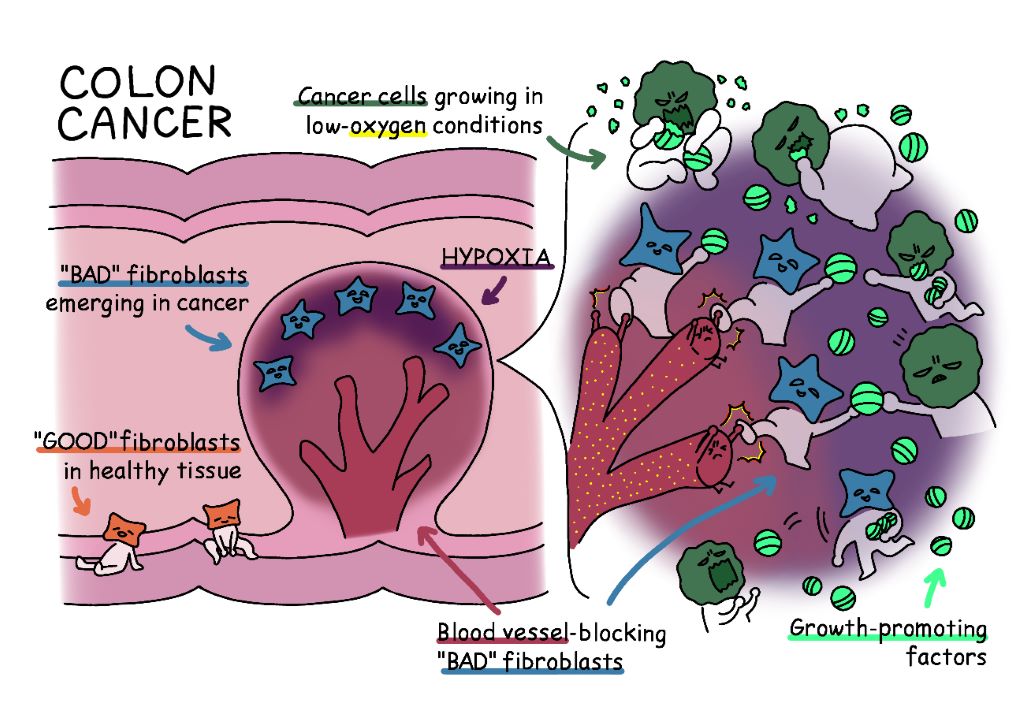
Fig. 1. In healthy colon tissue, “good” fibroblasts help support tissue architecture. However, in colon cancer, these fibroblasts transform into “bad” fibroblasts in low-oxygen areas near the tumour surface. These “bad” fibroblasts block the formation of blood vessels, keeping their surroundings in an oxygen-deprived state, which supports their own survival. At the same time, they release growth-promoting factors that act like supplements for cancer cells. While it may seem unexpected that hypoxia supports tumour growth, this study reveals that localised hypoxic environments can accelerate cancer progression.
To effectively battle cancer, scientists must study the battlefield. Now, in a recent study published in Nature Communications, a multi-institutional research team including The University of Osaka has discovered some crucial intel: localised hypoxia in the colon cancer microenvironment can promote tumour growth.
Until recently hypoxia was thought to suppress tumour progression. Consequently, drugs that block the supply of oxygen to tumours were being used to treat cancers. But these treatments had mixed results; sometimes even accelerating tumour growth. Understanding why this happens has become an urgent question in cancer research.
“We uncovered a surprising mechanism by which hypoxia may promote tumour growth, and it involves the formation of cells called inflammatory fibroblasts,” explains lead author of the study, Akikazu Harada.
The research team found that when oxygen becomes scarce in certain areas of a colon tumour, the surrounding fibroblasts (normally ‘good’ cells that support tissue structure) transform into harmful inflammatory fibroblasts. The altered cells release factors that help tumours grow, such as epiregulin. In addition, they release Wnt5a protein, which helps maintain a low-oxygen state by inhibiting new blood-vessel formation at the site of its release, thereby maintaining hypoxia.
To validate the findings from the mouse model in human samples, the researchers pooled data from human samples obtained from patients with a healthy colon, colon cancer, and those with inflammatory bowel disease. Later, they analysed the data and compared their findings with data from mice.
“We found that the malignant transformation of fibroblasts and the induction of Wnt5a-secreting fibroblasts are commonly observed in both mouse models and human samples,” says Akira Kikuchi, senior author of the study.
This insight into the potential pathology of colon cancer and inflammation can provide the blueprints for a new cancer battle strategy: drug therapies that target Wnt5a-producing fibroblasts. As a result, fibroblasts are now being recognised as a key ‘third’ therapeutic target, complementing traditional treatments targeting cancer cells and immune cells.
This finding holds special importance for colon cancer, which is the leading type of cancer in Japan. Additionally, the observed pathological changes of fibroblasts could also apply to chronic inflammatory disorders like inflammatory bowel disease, offering fresh insights into their mechanisms and potential new treatment strategies for these challenging conditions.
Johannesburg, 26 May 2025: Despite national guidelines and access to essential medicines, severe asthma remains under-recognised and inconsistently managed within South Africa’s healthcare system. It is therefore critical to address ongoing patient challenges, particularly regarding access to diagnostic tools, limited use of phenotyping, and the imperative to align clinical practice with international best practice recommendations.
The Severe Asthma Index 2025 found that South Africa scored below the global average in four out of five domains, revealing persistent gaps in policy coordination, equitable access, diagnostic capacity, and environmental health.¹ᵃ Of concern is the continued reliance on oral corticosteroids (OCS) without proper assessment or referral, especially where evidence-based, targeted biologics remain inaccessible or unfunded.1b+2a
Understanding asthma in South Africa
South Africa has robust asthma guidelines, but the absence of a national asthma strategy and lack of participation in global severe asthma registries limit insight into outcomes and weaken care coordination. Specialist care and phenotyping are largely confined to urban centres, and national data on hospitalisations and treatment outcomes is scarce. Although reported asthma-related societal costs and disability adjusted life years (DALYs) are relatively low, this likely masks the true burden among patients with severe, underdiagnosed, or poorly controlled disease.¹ᵇ Traditionally, asthma mortality in Southern Africa has been considered as relatively high due in large part to short-acting beta-agonists (SABAs) overuse.3
Environmental factors compound these challenges. High levels of particulate matter (PM2.5) and poor indoor air quality contribute significantly to disease severity, particularly in low-income areas. Meanwhile, access to advanced diagnostics and therapies remains limited. Biologic add-on therapies and fractional exhaled nitric oxide (FeNO) testing are not routinely available in the public sector, leaving most patients dependent on standard treatments with few options for escalation if the disease remains uncontrolled.¹ᵇ
Rethinking corticosteroid use
The Severe Asthma Index 2025 highlights the widespread use of oral corticosteroids (OCS) in South Africa as a persistent pattern that may pose long-term health risks if not carefully managed or replaced by more targeted therapies. While OCS play a critical role in treating acute exacerbations, frequent or prolonged use is linked to serious side effects, including osteoporosis, adrenal suppression, diabetes, and infections.²ᶜ
“There’s growing awareness that long-term OCS use can lead to significant health risks,” says Dwayne Koot, Medical Manager at Sanofi South Africa. “For severe asthma, the shift is towards biologic therapies that specifically target the underlying inflammation, not just the symptoms.1c As a simple regimen (where available), inhaled corticosteroid–formoterol combinations are now recommended as the preferred reliever across all severity levels.3 If high-dose ICS-LABA is needed, its use should be limited to 3 – 6 months, prompting phenotyping and biologic therapy add-on if asthma is not controlled. Low-dose maintenance OCS should only be considered as a last resort if no other options are available.”
Improving diagnosis and referral
Access to diagnostic tools remains uneven across South Africa, particularly in the public sector. Spirometry is not routinely available at primary care level, while FeNO testing, oscillometry, and biomarker analysis are largely limited to research centres or private practices.¹ᵇ
“This makes it difficult to accurately diagnose, phenotype, and manage asthma, potentially leading to suboptimal treatment decisions and poorer patient outcomes,” says Koot.
“There’s an opportunity to enhance the referral pathway to specialists and expand access to advanced diagnostic tools by defining referral criteria and partnering with specialised centres,” Koot says. “Routine phenotyping at GINA step 5, crucial for tailoring treatment plans and identifying suitable candidates for biologic therapies, is currently limited in many healthcare settings. Expanding these capabilities would enable a more personalised approach to asthma management.”3
To help close these gaps, the Severe Asthma Index 2025 recommends piloting basic phenotyping tools such as eosinophil counts at regional hospitals, establishing asthma registries to monitor outcomes and access, and expanding clinician training in severe asthma diagnosis and escalation pathways.¹ᵇ “Better data and better training could transform how we identify and treat severe asthma,” says Koot.
Next steps for clinical practice
Healthcare professionals have a pivotal role to play in strengthening asthma care — from recognising poor control early to ensuring patients access the most appropriate treatment in a timely manner. This includes reassessing those with persistent symptoms, reinforcing correct inhaler technique, referring for further investigation when needed, and considering alternative therapies when conventional options are no longer sufficient.3
South Africa already has many of the essential components in place: national treatment guidelines, access to key medicines, and clinical expertise. The next step is to ensure that patients with severe asthma are consistently identified, supported, and offered the full range of available interventions.
“As the World Asthma Day 2025 theme reminds us, the goal is to ‘Make Inhaled Treatments Accessible for ALL’, because inhaled medications are vital not just for preventing attacks, but for controlling chronic inflammation,” says Koot. “We encourage healthcare practitioners and policy makers to help make appropriate, evidence-based asthma care a reality for every South African asthmatic .”
For more information about asthma management and Sanofi’s commitment to respiratory health, please visit www.sanofi.co.za
Minister of Health Dr Aaron Motsoaledi. Source: GCIS
By Anna Grimsrud and Sibongile Tshabalala-Madhlala
Minister of Health Dr Aaron Motsoaledi’s recent claim that over half a million people have been newly started on HIV treatment in less than six months has raised eyebrows in health circles. In this open letter, Anna Grimsrud and Sibongile Tshabalala-Madhlala, associated with CHANGE – South Africa, ask the Minister to explain numbers that, on the face of it, seem contradictory.
Dear Minister Motsoaledi,
We write to you in response to your 15 May 2025 press statement and subsequent remarks in Parliament on the current status of the national HIV, AIDS, and TB campaign.
You stated that since the launch of the Close the Gap campaign, 520 700 people have been initiated on HIV treatment, reaching “more than 50% of the target”. You also stated that 5.9 million people are currently on antiretroviral therapy (ART). However, at the campaign’s launch on 25 February 2025, you reported the same number on HIV treatment — 5.9 million. This raises a critical question: if over half a million people have started or restarted treatment, why has the total number of people on treatment not increased?
If both figures are accurate, this would mean that approximately 520 000 people have been lost from care over the past few months — a deeply concerning and unprecedented level of attrition. We respectfully request that you provide the underlying data and clarify the current total number of people remaining on HIV treatment.
There are several reasons why we are concerned:
Static treatment numbers: As noted, the number on treatment was reported as 5.9 million in both February and May 2025. If 520 700 people have been initiated or re-initiated during this period, the same number must have exited care — a scenario that requires urgent explanation.
Slow growth in the number of people on treatment: According to official statements, the total number of people on HIV treatment increased by only 100 000 between March and December 2023 — from over 5.7 million to 5.8 million. The claim that the cohort has now grown by over 500 000 in a matter of months contradicts recent trends.
Declining lab numbers: National Health Laboratory Service data reported by the Daily Maverick and Reuters, show notable declines in viral load testing and early infant diagnosis in March and April 2025 compared to the same months in 2024. These indicators should increase alongside meaningful growth in treatment uptake — not decrease.
In light of these concerns, we believe it is essential that you provide a transparent accounting of the current number of people on treatment and the metrics being used to assess progress under the Close the Gap campaign. Specifically, we request data demonstrating that the programme is on track to meet its stated goal: increasing the number of people on treatment from 5.9 million to 7 million.
We share your commitment to a strong and effective HIV response, especially in this period of financial and operational strain. Like you, we believe it is vital that accurate and complete information is shared with the public and Parliament at this critical moment.
*Anna Grimsrud is an epidemiologist with a PhD in Public Health and writes in her personal capacity. Sibongile Tshabalala-Madhlala is openly living with HIV and currently serves as the National Chairperson of the Treatment Action Campaign (TAC).” CHANGE is a coalition of more than 1 500 people from civil society organizations in South Africa and around the work — people living with HIV, activists, community health workers, researchers, programme members, epidemiologists, clinicians, economists, and others. CHANGE stands for Community Health & HIV Advocate Navigating Global Emergencies.
Note: Spotlight aims to deepen public understanding of important health issues by publishing a variety of views on its opinion pages. The views expressed in this article are not necessarily shared by the Spotlight editors.
Republished from Spotlight under a Creative Commons licence. Views expressed in the original article are not necessarily shared by Quicknews.
Research confirms that social isolation and loneliness significantly impact health and mortality, even if not listed on death certificates. Brigham Young University psychology and neuroscience professor, Julianne Holt-Lunstad, has published extensively on the topic, including a landmark 2010 meta-analysis and a 2023 framework on assessment and treatment. She also served as lead scientist on the 2023 Surgeon General Advisory and is advising the World Health Organization on an upcoming report that addresses the pressing health threat of loneliness and isolation and a global agenda on social connection.
Social connection is now a legitimate health factor, but Holt-Lunstad and doctoral student, Andrew Proctor, recently published two studies showing that most of us (the general population and medical providers) still don’t think social connection affects physical health. And even the professionals who recognise the importance report that they don’t have time or tools to help patients address social concerns.
Proctor, who authored a study recently published in Springer Nature, explained that before the study, they had been watching how the pandemic was influencing internet searches around the topics of isolation and loneliness.
“I have a marketing background, so I thought that maybe the public perception had changed since COVID. Social distancing, isolation and loneliness were huge buzzwords on the internet as seen through Google Trends and BuzzSumo (an online trend analyzer). Everything around these search terms was super viral during that time, and so we wondered if perceptions about social connection had changed,” said Proctor.
With loneliness and isolation trending on the internet, the researchers set up a study. In a nationally representative sample of US adults, as well as samples from the UK and Australia, they surveyed 2,392 people about their perceptions of health risks associated with isolation and loneliness. The data showed that, despite the pandemic and other campaigns, people still underestimate the importance of social connection for physical health. And the underestimation exists equally among the lonely and the socially connected.
“The study identified blind spots in medical care,” said Proctor. “Social connection is like a vital sign. What if we didn’t care about high blood pressure? Or what if we never knew smoking was bad for us? Social connection is like a key vital sign. We just don’t tend to recognize it.”
In a closely connected study, Holt-Lunstad and Proctor, along with coauthors from top research medical centers, surveyed 681 healthcare providers (primarily doctors) about perceptions of health risks associated with poor social connection. Similar to the general population from the first study, healthcare providers underestimated social connection as a medically relevant health factor.
The researchers gleaned some unexpected insights due to an unintentional time lag in data collection in the second study.
“We completed the data collection at two different time points because we were waiting for institutional approvals. Our first cohort was healthcare providers through the University of Utah Health System. Slightly later, we had a second major cohort of University of California San Francisco (UCSF) physicians,” said Holt-Lunstad. “What was interesting is that the perceived importance of social factors was a bit higher among the UCSF group.”
A Geisinger study provides new insight into height differences between adult men and women, demonstrating that Y chromosome genes contribute more to height than their X chromosome counterparts, independent of male sex determination. The results were published this week in the Proceedings of the National Academy of Sciences.
Typical females have two X chromosomes, while typical males have one X and one Y chromosome. The differences between the X and Y chromosomes cause hormonal differences between males and females, but these differences have been insufficient to explain the average 13cm height difference between the sexes.
“Because height shows a large and reproducible difference between sexes and is widely measured, it serves as a valuable model for investigating the genomic factors underlying sex differences,” said Matthew Oetjens, Ph.D., assistant professor in Geisinger’s Department of Developmental Medicine and one of the study leads.
The Geisinger research team sought to determine the effects of sex-related factors on human height by examining height in people with an abnormal number of X or Y chromosomes, a genetic condition known as sex chromosome aneuploidy.
The team analysed genetic and clinical data on nearly one million participants enrolled in Geisinger’s MyCode Community Health Initiative, the National Institutes of Health’s All of Us cohort and the UK Biobank. Of these participants, 1225 had a sex chromosome aneuploidy. By incorporating people with more or fewer than two sex chromosomes into a model of height, they found that exchanging an X for a Y chromosome increased height by 3.1cm, independent of other sex-related factors, including hormonal differences. This result suggests that an estimated 23% of the average difference in height between men and women is explained by increased expression of shared genes on the Y chromosome relative to the X chromosome.
“Beyond its implications for understanding human height, this study provides broader insights into how sex chromosome aneuploidy research can uncover the mechanisms behind observed sex differences in various medical conditions,” said Alexander Berry, PhD, bioinformatics scientist and study co-lead.
SHOX, a gene found on both the X and Y chromosomes, is a known contributor to human height, but because two copies are found in both men and women, it has not been considered a likely contributor to the sex difference in height. However, recent studies have shown that SHOX is partially silenced on the second X chromosome in individuals with two or more X chromosomes. The Geisinger study’s results are consistent with the hypothesis that reduced SHOX expression in females results in a net difference in height between the sexes.
Genetic mutations and cell maturity as key factors in acute myeloid leukaemia drug resistance
Photo by Tima Miroshnichenko on Pexels
An international study led by the University of Colorado Cancer Center has uncovered why a widely used treatment for acute myeloid leukaemia (AML) doesn’t work for everyone. The findings could help doctors better match patients with the therapies most likely to work for them.
Researchers analysed data from 678 AML patients, the largest group studied to date for this treatment, and found that both gene mutations and the maturity of leukaemia cells affect how patients respond to a drug combination of venetoclax and hypomethylating agents (HMA).
“Venetoclax-based therapies are now the most common treatment for newly diagnosed AML,” said Daniel Pollyea, MD, MS, professor of medicine at University of Colorado. “But not all patients respond the same way. Our goal was to figure out why and give doctors better tools to predict outcomes at the start.”
Mutations and maturity of leukaemia cells
AML is a fast-growing cancer of the blood and bone marrow, most often seen in older adults. Many patients can’t tolerate traditional chemotherapy, so doctors treat them with venetoclax plus HMA. This combination has improved survival for many, but some patients still relapse or don’t respond.
The study found that patients with a certain type of AML, called “monocytic,” had worse outcomes especially if they did not have a helpful gene mutation known as NPM1. These patients were also more likely to carry other mutations, such as KRAS, that are linked to drug resistance.
“Patients with monocytic AML and no NPM1 mutation were nearly twice as likely to die from the disease,” said Pollyea. “So, it’s not just about the gene mutations. It’s also about how developed or mature the cancer cells are when treatment begins.”
Previous research often focused only on either genetic mutations or cell type. Pollyea’s team looked at both, giving them a clearer understanding of how these two factors work together to influence treatment response.
Designing therapies that shut down cancer cell escape routes
“We learned that some cancer cells basically find a back door to evade the treatment,” said Pollyea. “By identifying how and why that happens, we can begin designing therapies that shut down those escape routes.”
This is a powerful new way to classify AML patients by risk, enabling doctors to better predict who is likely to respond to venetoclax and who might need another approach.
“This is a major step toward personalised medicine in AML,” said Pollyea. “We’re moving closer to a world where we can look at a patient’s leukaemia on day one and know which therapy gives them the best chance and ultimately improve survival rates.”
Pollyea and his team are working to expand the study with even more patient data and hope to design a clinical trial that uses this model to guide treatment decisions.
Selective serotonin reuptake inhibitors (SSRIs) could help the immune system fight cancer, according to recent UCLA research. The study, published in Cell, found that SSRIs significantly enhanced the ability of T cells to fight cancer and suppressed tumour growth across a range of cancer types in both mouse and human tumour models.
“It turns out SSRIs don’t just make our brains happier; they also make our T cells happier – even while they’re fighting tumours,” said Lili Yang, PhD, senior author of the new study. “These drugs have been widely and safely used to treat depression for decades, so repurposing them for cancer would be a lot easier than developing an entirely new therapy.”
According to the CDC, one out of eight adults in the US takes an antidepressant, and SSRIs are the most commonly prescribed. These drugs increase levels of serotonin the brain’s “happiness hormone” by blocking the activity of a protein called serotonin transporter, or SERT.
While serotonin is best known for the role it plays in the brain, it’s also a critical player in processes that occur throughout the body, including digestion, metabolism and immune activity.
Dr Yang and her team first began investigating serotonin’s role in fighting cancer after noticing that immune cells isolated from tumours had higher levels of serotonin-regulating molecules. At first, they focused on MAO-A, an enzyme that breaks down serotonin and other neurotransmitters, including norepinephrine and dopamine.
In 2021, they reported that T cells produce MAO-A when they recognise tumours, which makes it harder for them to fight cancer. They found that treating mice with melanoma and colon cancer using MAO inhibitors, also called MAOIs – the first class of antidepressant drugs to be invented – helped T cells attack tumours more effectively.
However, because MAOIs have safety concerns, including serious side effects and interactions with certain foods and medications, the team turned its attention to a different serotonin-regulating molecule: SERT.
“Unlike MAO-A, which breaks down multiple neurotransmitters, SERT has one job – to transport serotonin,” explained Bo Li, PhD, first author of the study and a senior research scientist in the Yang lab. “SERT made for an especially attractive target because the drugs that act on it – SSRIs – are widely used with minimal side effects.”
The researchers tested SSRIs in mouse and human tumour models representing melanoma, breast, prostate, colon and bladder cancer. They found that SSRI treatment reduced average tumour size by over 50% and made the cancer-fighting T cells, known as killer T cells, more effective at killing cancer cells.
“SSRIs made the killer T cells happier in the otherwise oppressive tumour environment by increasing their access to serotonin signals, reinvigorating them to fight and kill cancer cells,” said Dr Yang, who is also a professor of microbiology, immunology and molecular genetics and a member of the UCLA Health Jonsson Comprehensive Cancer Center.
How SSRIs could boost the effectiveness of cancer therapies
The team also investigated whether combining SSRIs with existing cancer therapies could improve treatment outcomes. They tested a combination of an SSRI and anti-PD-1 antibody – a common immune checkpoint blockade (ICB) therapy – in mouse models of melanoma and colon cancer. ICB therapies block immune checkpoint molecules that normally suppress immune cell activity, allowing T cells to attack tumours more effectively.
The results were striking: the combination significantly reduced tumour size in all treated mice and even achieved complete remission in some cases.
“Immune checkpoint blockades are effective in fewer than 25% of patients,” said James Elsten-Brown, a graduate student in the Yang lab and co-author of the study. “If a safe, widely available drug like an SSRI could make these therapies more effective, it would be hugely impactful.”
To confirm these findings, the team will investigate whether real-world cancer patients taking SSRIs have better outcomes, especially those receiving ICB therapies. About 20% of cancer patients are already taking the medication, Dr Yang said.
Dr Yang added that using existing FDA-approved drugs could speed up the process of bringing new cancer treatments to patients, making this research especially promising.
“Studies estimate the bench-to-bedside pipeline for new cancer therapies costs an average of $1.5 billion,” she said. “When you compare this to the estimated $300 million cost to repurpose FDA-approved drugs, it’s clear why this approach has so much potential.”
Trauma centres in the United States will begin to test a new approach for assessing traumatic brain injury (TBI) that is expected to lead to more accurate diagnoses and more appropriate treatment and follow-up for patients.
The new framework, which was developed by a coalition of experts and patients from 14 countries and spearheaded by the National Institutes of Health (NIH), expands the assessment beyond immediate clinical symptoms. Added criteria would include biomarkers, CT and MRI scans, and factors such as other medical conditions and how the trauma occurred.
For 51 years, trauma centres have used the Glasgow Coma Scale to assess patients with TBI, roughly dividing them into mild, moderate, and severe categories, based solely on their level of consciousness and a handful of other clinical symptoms.
That diagnosis determined the level of care patients received in the emergency department and afterward. For severe cases, it also influenced the guidance doctors gave the patients’ families, including recommendations around the removal of life support. Yet, doctors have long understood that those tests did not tell the whole story.
“There are patients diagnosed with concussion whose symptoms are dismissed and receive no follow-up because it’s ‘only’ concussion, and they go on to live with debilitating symptoms that destroy their quality of life,” said corresponding author Geoffrey Manley, MD, PhD, professor of neurosurgery at UC San Francisco and a member of the UCSF Weill Institute for Neurosciences. “On the other hand, there are patients diagnosed with ‘severe TBI’ who were eventually able to live full lives after their families were asked to consider removing life-sustaining treatment.”
In the US, TBI resulted in approximately 70 000 deaths in 2021 and accounts for about half-a-million permanent disabilities each year. Motor vehicle accidents, falls, and assault are the most common causes.
New system will better match patients to treatments
Known as CBI-M, the framework comprises four pillars – clinical, biomarker, imaging, and modifiers – that were developed by working groups of federal partners, TBI experts, scientists, and patients.
“The proposed framework marks a major step forward,” said co-senior author Michael McCrea, PhD, professor of neurosurgery and co-director of the Center for Neurotrauma Research at the Medical College of Wisconsin in Milwaukee. “We will be much better equipped to match patients to treatments that give them the best chance of survival, recovery, and return to normal life function.”
The framework was led by the NIH National Institute of Neurological Disorders and Stroke (NIH-NINDS), for which Manley, McCrea, and their co-first and co-senior authors are members of the steering committee on improving TBI characterisation.
The clinical pillar retains the Glasgow Coma Scale’s total score as a central element of the assessment, measuring consciousness and pupil reactivity as an indication of brain function. The framework recommends including the scale’s responses to eye, verbal, and motor commands or stimuli, presence of amnesia, and symptoms like headache, dizziness, and noise sensitivity.
“This pillar should be assessed as first priority in all patients,” said co-senior author Andrew Maas, MD, PhD, emeritus professor of neurosurgery at the Antwerp University Hospital and University of Antwerp, Belgium. “Research has shown that the elements of this pillar are highly predictive of injury severity and patient outcome.”
Biomarkers, imaging, modifiers offer critical clues to recovery
The second pillar uses biomarkers identified in blood tests to provide objective indicators of tissue damage, overcoming the limitations of clinical assessment that may inadvertently include symptoms unrelated to TBI.
Significantly, low levels of these biomarkers determine which patients do not require CT scans, reducing unnecessary radiation exposure and health care costs. These patients can then be discharged. In those with more severe injuries, CT and MRI imaging – the framework’s third pillar – are important in identifying blood clots, bleeding, and lesions that point to present and future symptoms.
There is no significant difference in the effectiveness of how autistic and non-autistic people communicate, according to a new study, challenging the stereotype that autistic people struggle to connect with others.
The findings, published in Nature Human Behaviour, suggest that social difficulties often faced by autistic people are more about differences in how autistic and non-autistic people communicate, rather than a lack of social ability in autistic individuals, experts say.
Researchers hope the results of the study will help reduce the stigma surrounding autism, and lead to more effective communication support for autistic people.
Direct communication
Autism is a lifelong neurodivergence and disability, and influences how people experience and interact with the world.
Autistic people often communicate more directly and may struggle with reading social cues and body language, leading to differences in how they engage in conversation compared to non-autistic people.
Story sharing
The study, led by experts from the University of Edinburgh, tested how effectively information was passed between 311 autistic and non-autistic people.
Participants were tested in groups where everyone was autistic, everyone was non-autistic, or a combination of both.
The first person in the group heard a story from the researcher, then passed it along to the next person. Each person had to remember and repeat the story, and the last person in the chain recalled the story aloud.
The amount of information passed on at each point in the chain was scored to discern how effective participants were at sharing the story. Researchers found there were no differences between autistic, non-autistic, and mixed groups.
Increased awareness
After the task, participants rated how much they enjoyed the interaction with the other participants, based on how friendly, easy, or awkward the exchange was.
Researchers found that non-autistic people preferred interacting with others like themselves, and autistic people preferred learning from fellow autistic individuals. This is likely down to the different ways that autistic and non-autistic people communicate, experts say.
The findings confirm similar findings from a previous smaller study undertaken by the same researchers. They say the new evidence should lead to increased understanding of autistic communication styles as a difference, not a deficiency.
Autism has often been associated with social impairments, both colloquially and in clinical criteria. Researchers have spent a lot of time trying to ‘fix’ autistic communication, but this study shows that despite autistic and non-autistic people communicating differently it is just as successful. With opportunities for autistic people often limited by misconceptions and misunderstandings, this new research could lead the way to bridging the communication gap and create more inclusive spaces for all.
Dr Catherine Crompton, Chancellor’s Fellow at the University of Edinburgh’s Centre for Clinical Brain Sciences
Kris Jenner’s “new face” has everyone talking – and it’s widely speculated to be the result of a deep plane facelift, a procedure now dubbed the gold standard in facial rejuvenation. Let’s not even get into how Khanyi Mbau’s face broke the internet. The demand for natural-looking, sophisticated facial transformations has reached an all-time high, both globally and here in South Africa.
A global weight loss boom, fuelled by miracle diabetes drugs, has led to an unexpected side effect: the ‘O weight loss face’, marked by hollowed cheeks, sagging jowls, and prematurely aged skin. In turn, this phenomenon has sparked a significant rise in demand for advanced facial rejuvenation, and particularly the deep plane facelift – what experts term ‘the facelift that lifts where it matters most’.
“One of the most common complaints I hear from patients is, ‘I finally have the body I wanted, but my face looks 10 years older,’” says Professor Chrysis Sofianos, one of South Africa’s leading plastic surgeons and experts in deep plane facelifts.
The Gauteng-based specialist notes that he has seen a meteoric increase in consultations from patients seeking to reverse the facial deflation and laxity caused by rapid weight loss.
“This is just one instance where the deep plane facelift truly shines, as it restores natural facial harmony by lifting and repositioning deep tissues, not just tightening the skin. By addressing the deeper structural changes caused by significant weight loss, this approach delivers far more natural outcomes and a timeless look.
The Facelift No One Can See
What sets the deep plane facelift apart? Unlike traditional facelifts that only address the skin’s surface, the deep plane technique lifts beneath the superficial musculoaponeurotic system (SMAS) layer of tissue to reposition and support the foundational structures of the face. This approach not only rejuvenates the face more effectively than other techniques, but also avoids the tell-tale ‘pulled’ look, offering a more subtle, organic-looking transformation.
Professor Sofianos further enhances his results with the Vertical Restore method, lifting facial tissues vertically – in harmony with the way gravity naturally impacts the face over time. This technique provides holistic rejuvenation of the midface, jawline, neck, and brow, with results that restore youthful contours and expressions.
“Only a handful of surgeons currently offer this breakthrough procedure, and I can confidently state that the deep plane facelift is the gold standard for natural, long-lasting revitalisation.”
According to Professor Sofianos, deep plane facelifts offer several major advantages compared to conventional facelifts:
Superior, long-lasting results: By repositioning deeper facial structures rather than merely tightening the skin, the deep plane facelift offers longer-lasting, more authentic outcomes.
Natural look and movement: The technique avoids excessive skin tension, ensuring the face remains expressive and vibrant – even in motion.
Comprehensive rejuvenation: From sagging jowls and hollow cheeks to neck laxity, the deep plane facelift addresses multiple problem areas in one single, unified procedure.
The Ultimate One-Stop Shop for Aesthetic Excellence and Care
Professor Sofianos’s practice is not only a leader in surgical innovation but also a complete one-stop destination for all aesthetic needs. His clinic offers a full suite of surgical and non-surgical procedures – from advanced facial surgeries to injectables, laser treatments, skin rejuvenation, and body contouring. Each treatment is bespoke and delivered with meticulous care to ensure natural, balanced, and long-lasting results.
What truly sets Professor Sofianos apart, however, is his absolute commitment to patient care. Every facelift is supported by a holistic pre- and post-operative care programme, designed to optimise recovery and results.
A signature component of this is the integration of hyperbaric oxygen therapy (HBOT), which is included as standard in his facelift packages. HBOT begins around 7–10 days after surgery, dramatically improving oxygen delivery to tissues, speeding up wound healing, reducing bruising and swelling, and significantly shortening overall healing time.
As a result of these additional post-surgical interventions, the typical recovery period is two to three weeks, with most patients able to resume social activities within a month. With comprehensive aftercare – including HBOT and nutrient therapies – patients benefit from accelerated healing and refined results that continue to improve for several months post-surgery.
“The success of a procedure isn’t just about the surgery itself, but about guiding patients through a complete journey from start to finish,” he explains. “My patients receive comprehensive, full-spectrum care – including pre-operative preparation, expert surgical techniques, post-operative hyperbaric therapy, scar management, and continuous follow-ups. It’s this level of commitment that ensures optimal outcomes, supporting patients through every step of their transformation and helping them feel comfortable and secure throughout.”
A Lasting Solution for Facial Rejuvenation in the Weight Loss Era
As weight loss medications continue to help patients address issues with weight management and obesity, experts predict that the demand for facial rejuvenation will only rise.
“This trend has created both challenges and opportunities for plastic surgeons, and in many ways is reshaping our field in real time. The good news for patients is that we’re at the beginning of a new chapter in aesthetic medicine – where a combination of sophisticated surgical techniques and aftercare procedures are helping people achieve what was once thought impossible: natural-looking transformations that truly turn back the clock.”
For those seeking to restore their youthful appearance with confidence and discretion, the deep plane facelift offers an unmatched, cutting-edge solution – delivered with precision, artistry, and unparalleled care by Professor Chrysis Sofianos and his dedicated team.