Researchers at The Ottawa Hospital and the University of Ottawa were able to reverse certain behavioural symptoms in a mouse model of autism by fixing a problem in the brain blood vessels. Their findings, published in Neuron, present a promising new treatment target for these symptoms.
Autism is a neurodevelopmental condition with widely varying characteristics. Some of the behavioural symptoms can make life more challenging. While many people with autism have found ways to manage these symptoms, no drug treatment exists.
“The road from discovery to clinical trials is long, but we’re excited by the possibility that our findings might one day improve the daily lives of people with autism,” said senior author Dr Baptiste Lacoste, senior scientist at The Ottawa Hospital and professor at the University of Ottawa.
Dr Lacoste’s team previously discovered that blood vessels in the brain don’t work properly in mouse models with a 16p11.2 deletion, one of the most common genetic mutations seen in autism. They were the first to look at what was happening in the blood vessels of the brain.
The researchers found the problem began in cells lining the blood vessels, called the endothelial cells. These cells make sure blood quickly gets to the parts of the brain that are active. This responsive blood supply is needed for proper brain function.
However, the endothelial cells in these mice don’t respond quickly enough. This happens early in brain development and causes behavioral symptoms later in life, including hyperactivity, repetitive movements, and motor learning impairment.
In this new study, driven by former PhD student Dr Julie Ouellette, the research team looked at what was wrong with these endothelial cells and whether it could be fixed.
The team led by Dr Lacoste found that the endothelial cells had half the normal level of a molecule called ATP. ATP is usually considered an energy molecule, but in this case the cell was missing its target, called a P2Y2 receptor, on its surface.
By activating this P2Y2 receptor, the researchers could restore the cell’s function, increase blood flow in the brain and reverse the behavioral symptoms in adult mice. This was achieved using a drug known to activate P2Y2 and currently approved for humans in Japan and South Korea to treat dry eye syndrome.
“It’s as if these cells are asleep, and now we can wake them up,” says Dr Lacoste. “And we may only need to treat them once to wake them up permanently. We will test that further, but it’s an encouraging feature for a future treatment.”
This study only looked at adult mice. This means targeting P2Y2 could reverse behavioural symptoms that were already well established. Next, the team plans to treat mice earlier in life to see if early treatment has additional benefits.
The team has also filed a patent application for using P2Y2 activation in the blood vessels to treat autism symptoms. They are interested in exploring drug development with the aim of eventual clinical trials.
Infections that, in rare cases, can be transmitted from the pregnant woman to the foetus are linked to an increased risk of autism and intellectual disability in the child. This is shown by a study from the Karolinska Institute published in JAMA Pediatrics.
”It is important to emphasise that it is unusual for these infections to be transmitted from mother to child. They account for a very small proportion of all cases of autism in the population, but for those children who are actually affected, we see a clearly elevated risk of both autism and intellectual disability,” says Reneé Gardner, a researcher at the Department of Global Public Health at Karolinska Institutet, who contributed to the study.
The researchers have investigated how so-called TORCH infections affect children’s later development. TORCH is a group of infections that can be transmitted from a pregnant woman to the foetus and includes, amongst others, cytomegalovirus, rubella, toxoplasma and herpesvirus. Unlike many common infections, these pathogens can sometimes cross the placenta and directly infect the foetus.
Were followed for three decades
The study included 3.7 million people born in Sweden between 1987 and 2021. Of these, 975 had been diagnosed with a congenital TORCH infection. The researchers followed the participants for up to three decades to investigate whether the infections were linked to later diagnoses and educational outcomes.
The results show that children with a congenital TORCH infection were approximately three times more likely to be diagnosed with autism later in life and more than seven times more likely to be diagnosed with an intellectual disability compared with children without the infection. The risk of severe to profound intellectual disability was up to 30 times higher.
However, despite the high relative risks, the significance of these infections at a population level is limited, as they are rare in newborns. The researchers estimate that congenital TORCH infections may be linked to approximately 1.2 per cent of all cases of severe intellectual disability, whilst around 0.034 per cent of all cases of autism in Sweden can be explained by these infections. They also estimate that approximately one in five children born with a TORCH infection may later develop autism.
”It has long been known that these infections can cause intellectual disability. However, the link to autism has been less clear in previous research, which has often been based on small patient groups. This study is the largest to date in this field and is based on national register data covering almost the entire population of Sweden,” says Hugo Sjöqvist, a PhD student and lead author of the study.
To better determine whether the associations were due to the infections themselves, the researchers also compared children who had had a TORCH infection with their own siblings who had not had the infection. The results were similar in the sibling comparisons, which suggests that the associations cannot be explained solely by factors shared within families.
The researchers found no clear links between TORCH infections and other neuropsychiatric conditions, such as ADHD or obsessive-compulsive disorder. However, an impact on academic performance was observed. Even children who had not been diagnosed with autism or an intellectual disability had, on average, lower grades than their peers without the infection.
“Our results suggest that certain infections transmitted to the foetus during pregnancy may have long-term effects on brain development. Although these congenital infections are rare, some of them can be prevented, which makes them important from a public health perspective,” says Reneé Gardner.
The researchers particularly emphasise the importance of preventive measures. For example, the study points out that rubella has virtually disappeared in Sweden following the introduction of national vaccination programmes. According to the researchers, the results underline the importance of maintaining vaccination programmes and other strategies to prevent infections that can be transmitted from the pregnant woman to the foetus.
The research was funded by the Swedish Research Council. Co-author David Mataix-Cols states that he has received author’s fees from UpToDate Inc and that he is a partner in Scandinavian E-Health AB, which is unrelated to the publication.
• T = Toxoplasma: Avoid raw or undercooked meat, wash vegetables, and take care when handling cat faeces.
• O = Other (including infections such as syphilis): Screening during pregnancy and antibiotic treatment.
• R = Rubella: Vaccination before pregnancy (MMR vaccine).
• C = Cytomegalovirus (CMV): Good hand hygiene; avoid contact with young children’s saliva and urine.
• H = Herpes simplex (HSV): Identification and treatment of infection during pregnancy; sometimes a caesarean section is performed in the event of active genital herpes prior to delivery.
A summer intervention programme for autistic children ages 4-6 with no intellectual disability significantly improved their social performance, according to a study by researchers at the Institute for Autism Research (IAR) at the University at Buffalo. It was published in Advances in Neurodevelopmental Disorders.
“Completion of our 5-week summerMAXyc programme was associated with significant social, behavioral and autism symptom benefits for the children,” says Christopher J. Lopata, PsyD, co-author on the study and co-founder/co-director of the IAR with Marcus L. Thomeer, PhD; both are professors of pediatrics in the Jacobs School of Medicine and Biomedical Sciences at UB. “Developing such foundational skills early in development sets the stage for development of more advanced skills later in childhood, adolescence and adulthood, thus leading to better long-term outcomes.”
Thomeer notes that while programmes for autistic children with no intellectual disability ages 4-6 do exist, few provide intensive social programming. This population also tends to engage in significantly fewer group recreational activities in general than their peers without autism, further limiting social development opportunities.
“This constitutes a significant gap in social intervention development and service provision, which prompted our interest in developing such a programme for this population,” he says.
Five weeks, five days a week
The intensive summerMAXyc programme was conducted five-days-a-week over five weeks in the summer. The programme follows a similar model to that of the IAR’s successful, evidence-based summerMAX programme for older children, which has helped improve the social skills of hundreds of children since it began 23 years ago.
In the summerMAXyc programme, each 6-hour day included 8 cycles of 30 minutes each, which began with 10 minutes of instruction in particular skills, such as having a conversation or accepting consequences, followed by a 20-minute cooperative activity.
According to the study, the children found that the programme was fun and helped them learn skills and make new friends. Average child satisfaction was 14.9 out of a possible 15 with parent satisfaction at 69.8 out of a possible 70. Parents reported significant improvement in the children’s social skills, behaviors and autism symptoms.
There is broad consensus that earlier intervention is associated with better outcomes for autistic children. And parents are often the first to recognize the need.
“Parents reach out to us because their child has difficulty navigating the social world,” says Thomeer. “They describe their autistic children as wanting to have friends but not knowing what to do in social situations.”
Families noticed the difference
Over the course of their child’s participation in summerMAXyc, Thomeer says, parents reported that other family members began to notice the child playing with others, not just playing alone. They also noticed that the child now makes eye contact, asks about others, plays games without getting upset and can recognise and understand different emotions.
According to Thomeer, a mother of one of the participants reported that her child not only noticed that she was frustrated about something, but also told her to “squeeze the orange,” a technique the children are taught where they squeeze an imaginary orange and take a deep breath in order to calm themselves down.
One of the study’s major strengths involved the use of objective observers to assess the children’s social performance. According to Lopata, parents are a critical source of information, however there is a risk of bias because they know that their children are in the intervention. Most social skills intervention studies for autistic children rely on parent ratings alone and therefore suffer from this limitation, he adds.
“Our use of masked observers – trained individuals – eliminated that risk because they were unaware that the children received an intervention,” says Lopata.
The authors also note that the intervention was similarly successful in improving the children’s social performance and autism features regardless of the child’s age, IQ level, communication ability or level of diagnostic symptoms.
“There is widespread recognition in the field that no intervention will be effective for all autistic children and there is a significant need to determine which children are most likely to benefit from a specific intervention,” says Lopata. “Answering this question can help ensure that scarce resources are efficiently allocated and that children receiving a given intervention are most likely to benefit.”
The next step is to test the intervention in a large-scale randomised clinical trial with a control group, which would be a first for such a social intervention in this population.
Research suggests that more than half of children with autism spectrum disorder, a neurodevelopmental condition, experience motor impairments. An analysis in Developmental Medicine & Child Neurology indicates that sports-based interventions may improve motor skills in children with autism spectrum disorder, with martial arts and aquatic training demonstrating the most consistent benefits.
The analysis was based on data from 11 clinical trials of various sports. Martial arts demonstrated consistently large improvements in balance, total motor skills, and object control skills, with especially strong effects in Tai Chi Chuan and kata programs. Aquatic training demonstrated large improvements across balance, locomotor skills, and object control skills. Gymnastics and trampoline interventions demonstrated large improvements in balance and bilateral coordination, with additional effects on total motor scores in trampoline studies. Table tennis produced broad gross motor improvements, and Australian football had a large effect on object control skills and had a medium effect on balance and total motor skills. Across all sports categories, balance was the most consistently improved motor domain.
The authors noted that many of the studies had significant limitations, however, and higher-quality studies are needed.
“Organized sports-based interventions may offer benefits beyond recreation for children with autism by supporting motor skill development,” said corresponding author Sonia Khurana, PT, PhD, of Old Dominion University. “While our review identified promising effects, particularly for martial arts and aquatic training, larger and more rigorous studies are needed to confirm these benefits and guide evidence-based recommendations.”
Increased brain ageing was associated with dementia, addiction and psychiatric disorders like schizophrenia
Generated with Gencraft AI
People with dementia, mild cognitive impairment, alcohol addiction, or psychiatric disorders such as schizophrenia show increased brain ageing, each in specific patterns within the brain, according to a study published July 21st in the open access journal PLOS Medicine by Shile Qi from the Nanjing University of Aeronautics and Astronautics, China, and colleagues.
Some conditions can make the brain age faster. Scientists calculate how old the brain is relative to the body using the predictive age difference (PAD), the difference between chronological age and the age predicted by brain imaging, where a positive PAD indicates that ageing is accentuated or increased. To better understand how brain disorders and divergences might affect brain ageing, the authors of this study collected structure magnetic resonance imaging (MRI) data from 45 900 controls across several brain imaging banks, and compared them with those of 2698 patients with different brain conditions and differences, including attention-deficit/hyperactivity disorder (ADHD), autism spectrum disorder (ASD), alcohol or tobacco addiction, Alzheimer’s disease (AD), mild cognitive impairment (MCI), schizophrenia, bipolar disorder or major depressive disorder.
The authors found that neurodegenerative disorders of AD and MCI had the largest association with a high PAD. Addiction and psychiatric disorders were also associated with increased PAD. In contrast, there were no differences in PAD between people with ADHD or ASD and controls.
The researchers also looked at PAD values in specific areas of the brain, and examined which genes showed increased expression in people with different brain conditions. The prefrontal cortex showed higher PAD across brain disorders. Higher PAD in the frontal and temporal lobes was associated with psychiatric disorders, while high PAD in the frontal and occipital cortex was associated with dementia. Addiction was connected with high PAD in the default mode network, and in the salience network and the putamen and thalamus. There were also differences in gene transcription that associated with specific conditions and divergences. While the results are correlational, and not causal, and while some conditions such as psychiatric disorders and addiction have high co-occurrence, the author suggest that understanding more about PAD could help provide biomarkers for commonly occurring brain disorders.
The authors add, “Different neurological disorders appear to leave different signatures on the brain ageing clock, which may help researchers better understand the neural and biological pathways involved in these conditions.”
When it comes to autism, few questions spark as much debate as how best to support autistic people with the greatest needs.
This prompted The Lancet medical journal to commission a group of international experts to propose a new category of “profound autism”.
This category describes autistic people who have little or no language (spoken, written, signed or via a communication device), who have an IQ of less than 50, and who require 24-hour supervision and support.
It would only apply to children aged eight and over, when their cognitive and communication abilities are considered more stable.
In our new study, we considered how the category could impact autism assessments. We found 24% of autistic children met, or were at risk of meeting, the criteria for profound autism.
Why the debate?
The category is intended to help governments and service providers plan and deliver supports, so autistic people with the highest needs aren’t overlooked. It also aims to re-balance their under-representation in mainstream autism research.
This new category may be helpful for advocating for a greater level of support, research and evidence for this group.
But some have raised concerns that autistic people who don’t fit into this category could be perceived as less in need and excluded from services and funding supports.
Others argue the category doesn’t sufficiently emphasise autistic people’s strengths and capabilities, and places too much emphasis on the challenges that are experienced.
What did we do?
We conducted the first Australian study to examine how the “profound autism” category might apply to children attending publicly funded diagnostic services for developmental conditions.
Drawing on the Australian Child Neurodevelopment Registry, we examined data from 513 autistic children assessed between 2019 and 2024. We asked:
how many children met the criteria for profound autism?
were there behavioural features that set this group apart?
Because we focused on children at the time of diagnosis, most (91%) were aged under eight years. We described these children as being “at risk of profound autism”.
What did we find?
Around 24% of autistic children in our study met, or were at risk of meeting, the criteria for profound autism. This is similar to the proportion of children internationally.
Almost half (49.6%) showed behaviours that were a safety risk, such as attempting to run away from carers, compared with one-third (31.2%) of other autistic children.
These challenges weren’t limited to children who met criteria for profound autism. Around one in five autistic children (22.5%) engaged in self-injury, and more than one-third (38.2%) showed aggression toward others.
So, while the category identified many children with very high needs, other children who didn’t meet these criteria also had significant needs.
Importantly, we found the definition of “profound autism” doesn’t always line up with the official diagnostic levels which determine the level of support and NDIS funding children receive.
In our study, 8% of children at risk of profound autism were classified as level 2, rather than level 3 (the highest level of support). Meanwhile, 17% of children classified as level 3 did not meet criteria for profound autism.
Our concern
We looked at children when they first received an autism diagnosis. Children were aged 18 months to 16 years, with more than 90% under the age of eight years.
This aligns with our earlier research, showing the average age of diagnosis in public settings is 6.6 years.
From a practical perspective, our biggest concern about the profound autism category is the age threshold of eight years.
Because most children are already assessed before age eight, introducing this category into assessment services would mean many families would need repeat assessments, placing additional strain on already stretched developmental services.
Second, modifications will be needed if this criteria is going to be used to inform funding decisions as it didn’t map perfectly onto level 3 support criteria.
On balance, however, our results suggest the profound autism category may provide a clear, measurable way to describe the needs of autistic people with the highest support requirements.
Every autistic child has individual strengths and needs. The term “profound autism” would need to be promoted with inclusive and supportive language, so as to not replace or diminish individual needs, but to help clinicians tailor supports and obtain additional resources when needed.
If you’re concerned your child requires substantial support, here are some practical steps you can take to ensure their needs are recognised and addressed:
Explain your concerns
Not all clinicians have experience working with children with high support needs. Be as clear as possible about behaviours that affect your child’s safety or daily life, including self-injury, aggression or attempts to run away. These details, while difficult to share, help give a clearer picture of your child’s support needs.
It can also be a challenge to find and access clinicians with appropriate expertise. Another potential benefit of having a defined category is that it can better help families navigate care.
Ask about support for the whole family
Our studies show that many caregivers want more support for themselves but don’t always ask. Talk with clinicians about supports for yourself as well, including respite, or family support groups.
Reach out
Coming together with other carers and families can reduce your own isolation and normalise many of the unique challenges you face. Connecting with like-minded people can provide a supportive, empathetic and empowering community.
Plan for safety
For children with high support needs, prioritise safety planning with your child’s care team. This can include strategies to reduce risks, as well as planning how best to support your child’s interactions with health, education and disability services over time.
National study found use of the drug rose sharply following major media coverage and later White House promotion, despite limited large-scale evidence for autism treatment
Leucovorin prescriptions for children with autism rose more than 2000% by late 2025. Courtesy of UC San Diego Health Sciences.
Researchers from the University of California San Diego found that prescriptions for leucovorin, a drug sometimes used off-label for autism spectrum disorder (ASD), rose sharply among children after widespread media attention and public statements from White House officials. The study, published May 18, 2026 in JAMA Network Open, analysed national electronic health record data and found prescribing rates increased more than 2000% compared with prior years.
“Families of children with autism are often searching for therapies that might improve communication and quality of life, especially when treatment options are limited,” said Joshua Rothman, MD, clinical assistant professor of pediatrics at the UC San Diego School of Medicine and first author of the study. “What this study shows is how quickly information shared through news coverage, social media and public figures can influence real-world prescribing patterns, even before large clinical trials establish whether a treatment is truly safe and effective for broad use.”
Leucovorin, also known as folinic acid, is a biologically active form of folic acid. Small clinical trials have suggested that some children with autism and folate-related deficiencies may experience improvements in verbal communication after taking the medication. However, researchers note that large-scale studies confirming the drug’s effectiveness and long-term safety for children with ASD have not yet been completed.
To better understand prescribing trends, the researchers analysed records from the Epic Cosmos database, which includes more than 300 million patient records from over 1800 hospitals and 41 500 clinics across all 50 states and Washington, D.C. The study focused on 838 801 children with autism who accounted for more than 11.9 million outpatient encounters between January 2023 and January 2026.
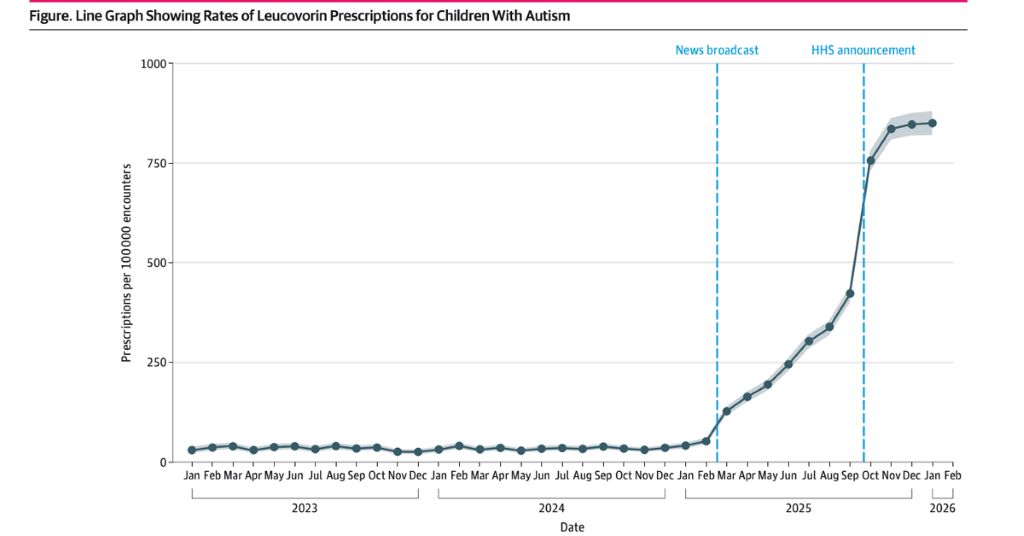
For roughly two years, leucovorin prescribing rates remained relatively stable, averaging about 34 prescriptions per 100 000 outpatient encounters among children with autism. Rates then began climbing steadily in early 2025 before surging later that year. By August 2025, prescribing rates had risen to 335 prescriptions per 100 000 encounters. In November 2025, rates climbed again to more than 835 prescriptions per 100,000 encounters.
The researchers observed that the initial rise in prescribing coincided with a February 2025 national television news segment featuring a family who reported dramatic language improvements in their child after treatment with leucovorin. Interest in the medication expanded further after White House officials publicly promoted leucovorin in September 2025 as part of broader autism-related initiatives.
“Families of children with autism are often searching for therapies that might improve communication and quality of life, especially when treatment options are limited. What this study shows is how quickly information shared through news coverage, social media and public figures can influence real-world prescribing patterns, even before large clinical trials establish whether a treatment is truly safe and effective for broad use.”
— Joshua Rothman, MD, clinical assistant professor of paediatrics at the UC San Diego School of Medicine and first author of the study
“The timing was striking,” Rothman said. “The increases began after a widely viewed media story and accelerated again after federal officials publicly discussed the medication. It highlights how rapidly clinical practice can shift when a treatment captures public attention.”
The study does not determine whether leucovorin improves symptoms of autism, nor does it evaluate patient outcomes after treatment. Researchers also cautioned that prescriptions recorded in the database could not always be linked to a confirmed medical indication.
Still, the authors say the rapid increase in use raises important questions for clinicians, policymakers and families. In March 2026, the US Food and Drug Administration approved leucovorin for cerebral folate transport deficiency, an ultra-rare genetic neurological disease associated with specific genetic changes, but the drug was not approved for autism spectrum disorder.
Researchers say the findings underscore the need for continued monitoring of prescribing trends and for larger randomised clinical trials evaluating whether leucovorin is beneficial for specific groups of children with autism.
“We now have a real-world example of how public attention can accelerate adoption of a therapy before the evidence fully catches up,” Rothman said. “The next step is making sure we generate the rigorous data needed to help families and clinicians make informed decisions.”
Children with epilepsy have a higher risk of also having autism spectrum disorder (ASD). A new study in Developmental Medicine & Child Neurology examined factors associated with the co-occurrence of autism and epilepsy in a large population-based group.
For the study, investigators at the Mayo Clinic compared the prevalence of autism spectrum disorder in children with and without epilepsy based on medical records, and they evaluated associated factors including sex, age at autism identification, and intellectual disability. The study included 30 490 children in the Olmsted County, Minnesota birth cohort, of whom 257 (0.84%) had epilepsy diagnosed before 19 years of age.
Autism prevalence was significantly higher among children with epilepsy as compared with children without across all three research and clinical definitions assessed (21.4% versus 3.2% using broad research criteria, 14.0% versus 1.6% using stricter research criteria, and 7.9% versus 0.7% for clinical diagnosis).
Children with epilepsy and autism were more likely to have intellectual disability (56.5% versus 15.4%), were more often female (38.2% versus 25.8%), and were identified with autism at a younger age (7.4 versus 8.7 years) compared with those without autism.
“These observations highlight clinically relevant differences within this group and underscore the importance of early recognition of developmental concerns,” said lead author Mariya Saify. MBBS.
Senior author Elaine C. Wirrell, MD added that although children with epilepsy are at an elevated risk of autism, recognition can be delayed. “Our findings emphasise the importance of screening for autism in this population to support earlier diagnosis and timely intervention, both of which are key to improving long-term outcomes.”
M-CHAT does not catch all children with autism in the neonatal high-risk group, shows a study from Karolinska Institutet published in JAMA Network Open. The researchers see a need to supplement the test with other assessment methods.
Children born very prematurely or with complications are screened at the age of two for early signs of autism using the M-CHAT questionnaire. In a new national study, researchers at Karolinska Institutet have investigated how well the test works in this high-risk group. The study includes 2178 children born in Sweden between 2013 and 2019 and compares M-CHAT results with later clinical diagnoses of autism.
The researchers found that the test was highly accurate in ruling out autism, but that many children with autism were still missed. The sensitivity was 62%, while the specificity – the ability to identify children without autism – was 91%. In total, 12% of the children received a positive M-CHAT result and 6% were later diagnosed with autism.
“The results show that M-CHAT works relatively well to rule out autism, but that it does not catch all children who later receive a diagnosis. In this high-risk group, more tools are therefore needed to detect children who need further investigation early,” says Ulrika Ådén, professor at the Department of Women’s and Children’s Health.
Children born extremely prematurely had both the highest proportion of positive test results and the most autism diagnoses. The researchers also saw that girls had fewer positive test results than boys, and that linguistic factors could affect the outcome – the test had higher specificity in families that spoke a Scandinavian language.
“Overall, the study shows that other developmental difficulties, such as motor or sensory problems, can affect how M-CHAT is interpreted. This needs to be taken into account when healthcare works with early screening,” says Ulrika Ådén.
Study raises questions around why female individuals are diagnosed later than males
Photo by Ben Wicks on Unsplash
Autism has long been viewed as a condition that predominantly affects male individuals, but a study from Sweden published by The BMJ shows that autism may actually occur at comparable rates among male and female individuals.
The results show a clear female catch-up effect during adolescence, which the researchers say highlights the need to investigate why female individuals receive diagnoses later than male individuals.
The prevalence of autism spectrum disorder (ASD) has increased over the past three decades, with a high male-to-female diagnosis ratio of around 4:1.
The increase in prevalence is thought to be linked to factors including wider diagnostic criteria and societal changes (eg, parental age), whilst the high male to female ratio has been attributed to better social and communication skills among girls, making autism more difficult to spot. However so far no large study has examined these trends over the life course.
To address this, researchers used national registers to analyse diagnosis rates of autism for 2.7 million individuals born in Sweden between 1985 and 2022 who were tracked from birth to a maximum of 37 years of age.
During this follow-up period of more than 35 years, autism was diagnosed in 78,522 (2.8%) of individuals at an average age of 14.3 years.
Diagnosis rates increased with each five year age interval throughout childhood, peaking at 645.5 per 100,000 person years for male individuals at age 10-14 years and 602.6 for female individuals at age 15-19 years.
However, while male individuals were more likely to have a diagnosis of autism in childhood, female individuals caught up during adolescence, giving a male to female ratio approaching 1:1 by age 20 years.
This is an observational study and the authors acknowledge that they did not consider other conditions associated with autism, such as ADHD and intellectual disability. Nor were they able to control for shared genetic and environmental conditions like parental mental health.
However, they say the study size and duration enabled them to link data for a whole population and disentangle the effects of three different time scales: age, calendar period and birth cohort.
As such, they write: “These findings indicate that the male to female ratio for autism has decreased over time and with increasing age at diagnosis. This male to female ratio may therefore be substantially lower than previously thought, to the extent that, in Sweden, it may no longer be distinguishable by adulthood.”
“These observations highlight the need to investigate why female individuals receive diagnoses later than male individuals,” they conclude.
These findings align with recent research and seem to support the argument that current practices may be failing to recognise autism in many women until later in life, if at all, says Anne Cary, patient and patient advocate, in a linked editorial.
She notes that studies like this are essential to changing the assumption that autism is more prevalent in male individuals than in female individuals, but points out that as autistic female individuals await proper diagnosis, “they are likely to be (mis)diagnosed with psychiatric conditions, especially mood and personality disorders, and they are forced to self-advocate to be seen and treated appropriately: as autistic patients, just as autistic as their male counterparts.”