Tag: South Africa

WHO Warns of African Third Wave
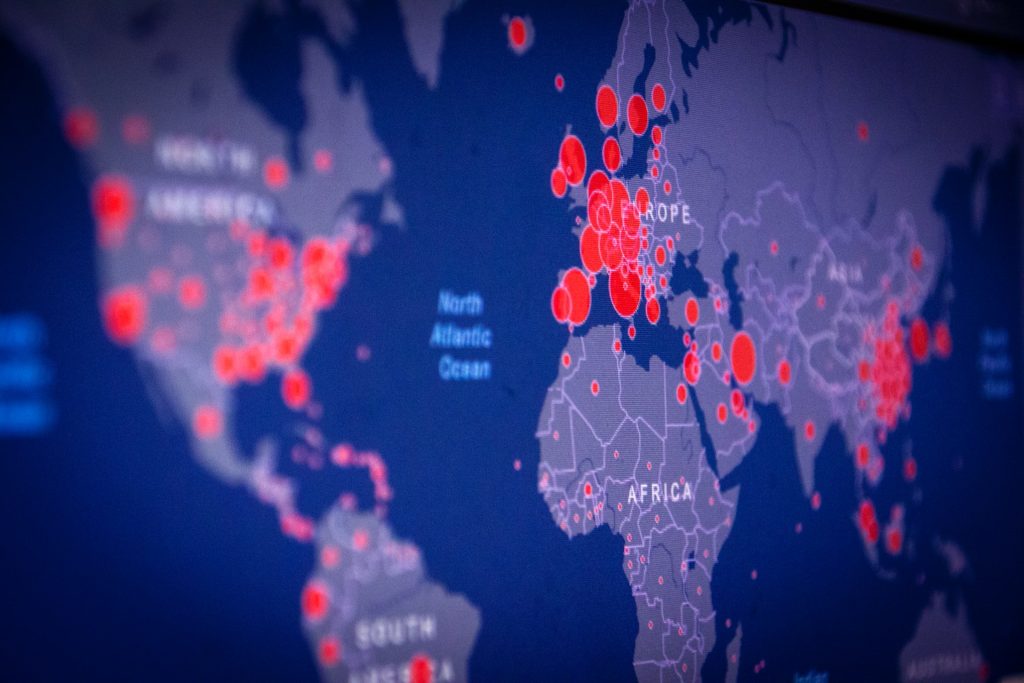
COVID cases map. Photo by Giacomo Carra on Unsplash

A surge in COVID cases in many parts of Africa could mean a continental third wave, the World Health Organization warned, posing a great threat for a continent where immunisation drives have been hamstrung by funding shortfalls and production delays for vaccine doses.

The WHO said that over the last week, test positivity had risen in 14 African countries, with eight reporting a surge of over 30% in new cases. Infections are steadily climbing in South Africa, where four of nine provinces are battling a third wave and the positivity rate was 14.2% as of Sunday. Uganda has also seen sharp increases, with hospitals overwhelmed with COVID patients and a lockdown being considered.

Weak compliance with social restrictions, increasing travel and the arrival of winter is behind the rise in cases, the WHO said. Experts also believe that new variants are also driving the numbers up.

Although Africa has reported less than 3 per cent of global coronavirus cases, the WHO said that the continent accounted for 3.7 percent of total deaths. This is likely an underestimate, given the lack of formal reporting for deaths.

“The threat of a third wave in Africa is real and rising,” said Dr Matshidiso Moeti, WHO regional director for Africa, in a statement. “It’s crucial that we swiftly get vaccines into the arms of Africans at high risk of falling seriously ill and dying of Covid-19.”

While many wealthier countries have vigorous vaccination campaigns and some are on track to fully reopen, many of Africa’s poorer countries face a huge challenge in accessing vaccines.

Out of 1.3 billion people on the continent, only 31 million have received at least one dose, Dr Moeti said, and only seven million are fully vaccinated. Just 1386 people in Kenya have received two doses of a vaccine, out of a population of 50 million.

Countries like Ghana and Rwanda have run through their first deliveries of vaccines through Covax, the global facility working to ensure the equitable distribution of vaccines.

In some countries, vaccine hesitancy has been so high that it even caused stocks of vaccines to expire. Possible contamination in Johnson & Johnson vaccine doses detected at a US manufacturing plant has resulted in yet another delay to South Africa’s immunisation programme.

Meanwhile, fake vaccines and PPE pose another problem; last November a police raid in South Africa found almost 2400 doses of fake vaccine.

The WHO warned that the surge of causes could swamp the limited capacities of healthcare systems. To stave off a full-blown crisis, Dr Moeti urged “countries that have reached a significant vaccination coverage to release doses and keep the most vulnerable Africans out of critical care.”

Only about two per cent of the population has received at least one vaccine dose, compared with the 24 per cent global figure.

“While many countries outside Africa have now vaccinated their high-priority groups and are able to even consider vaccinating their children, African countries are unable to even follow up with second doses for high-risk groups,” said Dr. Moeti. “I’m urging countries that have reached a significant vaccination coverage to release doses and keep the most vulnerable Africans out of critical care.”

Source: UN News

Gift of The Givers Rescues Hospital by Drilling for Water

Photo by Anandan Anandan on Unsplash

Three weeks into Johannesburg’s water crisis, which has put tremendous strain on hospitals amid the pandemic, Gift of the Givers have said they will drill for water at Rahima Moosa Mother and Child Hospital.

“Having delivered bottled water on 28 and 31 May, Gift of the Givers drilling teams will be arriving at the hospital shortly, having been granted permission by the management and infrastructure team to drill for water,” said Imtiaz Sooliman, founder of the non-governmental disaster response organisation, the largest African one on the continent.

According to the Daily Maverick, Johannesburg Water’s infrastructure woes are the consequence of years of chronic under-funding. In its business plan for the year, the entity has “has an infrastructure renewal backlog of approximately R19.9-billion as a result of underfunding, which has also led to having 25% of the asset base (reservoirs, towers, pipes, etc) that has a remaining useful life of less than 10 years.”

Amidst concerns about knock-on effects on facilities such as Helen Joseph and Rahima Moosa hospitals, Gauteng health department spokesperson Kwara Kekana said that since last week, the hospitals’ management were trying to ease the pressure on the two worst affected facilities by transferring some patients to other hospitals and performing some theatre operations at sister hospitals.

Hospital staff and management had approached Gift of the Givers, requesting bottled water, portable toilets and any means to augment the water tankers arriving daily.

Rahima Moosa is one of the feeder hospitals for the temporarily closed Charlotte Maxeke Hospital and healthcare workers trying to work through a backlog of non-COVID patients between the second and third waves. It couldn’t have come at a worse time, said Sooliman,

“Add to that a desperate community thronging to the hospital in search of drinking water, clearly worsening COVID risk,” he said.

Sooliman said a drilling site had been identified.

“Existing, defunct boreholes will be assessed with a view to resuscitating them while drilling for new boreholes then pumping water directly into the hospital infrastructure using booster pumps and setting up taps outside the hospital for community use once the water has been tested and approved for human consumption,” said Sooliman.

Bottled water from companies will be welcomed while they waited for the work to be completed, he added.

Source: Times Live

South Africa Moves to Level 2 Lockdown

Image by Quicknews

President Cyril Ramaphosa said on Sunday that he did not know “how long or how severe the third wave will be” as he tightened restrictions in response to rising COVID infections.

In a national address on Sunday, President Cyril Ramaphosa announced that Level 2 COVID restrictions would in place from Monday in response to rising cases, saying that he did not know “how long or how severe the third wave will be”.

The new restrictions mostly target social gatherings as well as moving the night-time curfew forward by one hour to 11pm.

No more than 100 people can attend indoor events, while the number for outside was halved to 250. However, to the relief of the liquor industry and many South Africans, no alcohol restrictions have been put in place. This demonstrates a less economically restrictive approach than the initial lockdowns, which caused the economy to shrink by 7% last year.

COVID hospitalisations increased 17% in recent days and the Free State, the Northern Cape, the North West and Gauteng are already seeing a third wave, Ramaphosa said.

A third wave is considered to be underway when the seven-day moving average of new cases exceeds 30% of the previous wave’s peak, according to the definition used by the SA Covid-19 Modelling Consortium.

“It is only a matter of time before the whole country enters a third wave … gatherings are the biggest source of transmission and we urge South Africans to social distance,” Ramaphosa said.

The daily infection rate is sharply higher than the averages of between 1000 and 1500 for most of the year. 

President Ramaphosa said cases averaged about 3700 in the past week, a 31% increase compared to the previous seven days, which he partly attributed to people’s increasing complacency over following health protocols.

“Because rates of infection have been low for some time, and because we are all suffering from pandemic fatigue, we have tended to become complacent.

“We have not been as vigilant about wearing our masks all the time, we have not been avoiding crowded places, and we have been socialising more,” the president said.

Due to the delay in infections and subsequent COVID testing, it may take several days for the new restrictions to have any noticeable impact on the daily number of new cases reported. The case positivity rate is now 11.9%, according to the most recent statistics for SA, now well above the 10% level which is considered acceptable.

Source: Business Day

French President Macron in SA for Talks on COVID

French President Emmanuel Macron arrived in South Africa today for talks with President Cyril Ramaphosa on a range of issues including possible technological assistance to aid South Africa’s response to the COVID pandemic.

On the agenda of the visit is the economic, health, research and manufacturing responses to the COVID pandemic.

Arriving from Rwanda, where he acknowledged France’s role in the 1994 genocide, Macron held talks in Pretoria with President Ramaphosa, whom he met last week in Paris at a summit on African economies.

The pair were also due to attend an event to support vaccine production on the continent, sponsored by the European Union, the United States and the World Bank. 

So far South Africa is the country worst hit by COVID on the continent as far available monitoring can determine, and has vaccinated just 1 percent of its population of 59 million people.

South Africa’s immunisation efforts have been hampered by delayed procurement, and then selling off its AstraZeneca vaccines obtained via Covax to other African countries after trial results showed drastically reduced effectiveness against the local B.1.351 variant. Rollout of the replacement Johnson & Johnson vaccine was paused for two weeks in April due to blood clot fears.

Now, along with India, South Africa is campaigning for a waiver of intellectual property rights on COVID vaccines, so that each country may produce its own doses. This effort has met with stiff resistance so far.

Macron has voiced support for a technology transfer to enable vaccine production sites to be set up in poorer countries.

Visit long delayed

Macron’s visit to South Africa has been long delayed due to the COVID pandemic.
The initial purpose for the trip had been to discuss multilateral cooperation with South Africa, an important G20 partner which is also a regular guest at G7 summits.

According to Foreign Policy, the French leader will also seek to establish greater influence in a region that is experiencing greater instability, marked by recent insurgencies in Mozambique.   

Jihadist attacks forced French energy giant Total to suspend work on a multi-billion euro gas project in Cabo Delgado province after a nearby town was targeted.

Before he returns to France, he will pay a visit to the Nelson Mandela Foundation, whose main missions are the fight against AIDS and education in rural areas.

Source: RFI

Vaccine Flops and Shortages Leave SA with no Covax Shots

Image by Quicknews

Nearly six months after South Africa’s first procurement deal was made with the Covid-19 Vaccines Global Access (Covax) programme, but vaccine flops and shortages in supply have left South Africa empty-handed, while Covax struggles to even meet its June delivery goal.

South Africa’s vaccine rollout has been anything but smooth. The first batch of vaccines, produced by the Serum Institute of India (SII), arrived in the country on 1 February but were abandoned a week later after a study found it was ineffective against the 501Y.V2 variant. That first batch of one million doses were sold onto the African Union (AU) and the remainder of the order refunded.

The health department switched to the Johnson & Johnson (J&J) single-dose shot and vaccinated nearly half a million healthcare workers until its use was also halted over blood clot concerns. Phase 2 of the rollout is using the Pfizer vaccine. Fortunately, it has been found that it can be stored at much higher temperatures than its previous ultracold requirements, making it easier to distribute.

However, the failure to join Covax by December 2020 was an early warning sign over the government’s handling of vaccine acquisition. The Covax iniative, led by the Vaccine Alliance (Gavi) and World Health Organization (WHO) to supply vaccines to poorer nations, were expected to kickstart South Africa’s rollout.

Missing that first deadline, the health department and Solidarity Fund confirmed, on 22 December 2020, that a down payment of R283 million had been made to secure doses through Covax.

Vaccine flip-flopping
At first, South Africa was to receive almost 2.5 million doses of AstraZeneca vaccine, but the country’s decision to abandon the use of AstraZeneca caused severe delays. The country’s allocated AstraZeneca doses were taken back into the Covax programme.

“South Africa was allocated 2 426 400 doses of the AstraZeneca vaccine… it has requested to be allocated another vaccine in place of AZ, and will receive allocations of alternative vaccines instead,” Gavi spokesperson Evan O’Connell told Business Insider South Africa.

“It has already been allocated, at this stage, 1,392,300 doses of the Pfizer vaccine, allocated for Q2 2021.”

According to Covax’s first-round schedule,  South Africa was due to receive 117 000 Pfizer doses before April. But Covax’s deliveries are falling behind, putting initiative’s ability to meet its second quarter target.

On 17 May UNICEF Executive Director, Henrietta Fore announced that the Covax facility would shortly have delivered 65 million doses, which should have been 170 million doses by that time.

“By the time G7 leaders gather in the UK next month, and as a deadly second wave of COVID will likely continue to sweep across India and many of its South Asian neighbours, the shortfall will near 190 million doses.”

Covax hamstrung by Indian COVID crisis

India’s COVID crisis has hamstrung Covax’s aim of delivering 237 million doses of AstraZeneca vaccine in the first half of 2021. With India having the world’s highest infection numbers and deaths since April, the SII, which produces AstraZeneca doses for Covax, announced that it would halt foreign supply until December at the earliest.

“We continue to scale up manufacturing and prioritise India,” said SII CEO Adar Poonawalla on 18 May. “We also hope to start delivering to Covax and other countries by the end of the year.”

At only 35% of its targeted vaccine deliveries, Covax is calling for renewed funding and donations from developed nations — who are also accused of hoarding vaccines. WHO director-general Tedros Adhanom Ghebreyesus, criticised wealthy nations for continuing a “scandalous inequity” on Monday.

“We need countries to donate tens of millions of doses of vaccines immediately through Covax, which is the agreed global mechanism for distributing vaccines,” stated Ghebreyesus.

“We need companies to help make donations happen fast, and to give Covax the first right of refusal on all uncommitted doses now, in 2021.”

It’s unclear whether the SII’s decision to halt its supply will result in reallocations of the Pfizer doses, on which SA is depending, and which therefore could result in further delays for its Covax-allocated doses.

Source: Business Insider

Case Positivity Rate in SA Breaches The Crucial 10% Mark

Although new COVID cases have not yet shown an upward surge, the fact that the test positivity rate had climbed past 10% is cause for concern.

According to health minister Dr Zweli Mkhize, the 2383 new infections recorded in the past 24 hours came from 23 352 tests at a positivity rate of 10.2%. Yesterday the positivity rate stood at 9.86%, and in the days beforehand had been gradually creeping upward.

The government has previously expressed concern when the positivity rate (the percentage of COVID tests that return positive) reaches the 10% and 12% marks. In late November, ahead of the second wave, the case positivity rate was 14.5%. Some provinces of South Africa are reporting rates well in excess of this, particularly the Northern Cape which last week had a reported positivity rate of 24.1%.

Dr Mkhize also reported that there were 72 Covid-19 related deaths in the past 24 hours. The health minister also reported that across SA there were now 171 860 people who had received their first shot of the two-dose Pfizer vaccine.

With these latest figures, there are now 1 637 848 cumulative cases and 55 874 cumulative fatalities since the outbreak of the coronavirus in SA in March last year. However, the true toll may be much higher, as South Africa’s ‘excess deaths’, those which are above the average rate of deaths from all causes, were up to 2.67 times higher than the official toll. A report from a team at the SA Medical Research Council and University of Cape Town believed that around 85% of those excess deaths were due to COVID.

Source: Times Live

Lockdowns Loom as COVID Spreads Again in SA Provinces

Image source: CDC/Unsplash

The Western Cape provincial government has said it is actively preparing for a resurgence of COVID cases while three other provinces have now declared they are in a third wave.

The province’s premier Alan Winde said in a statement on Sunday that based on current trajectories, the province is likely to officially enter its third wave two to three weeks from now.

Gauteng premier David Makhura confirmed that his province officially entered into a third wave more than a week ago. This was followed by similar declarations in the Free State and the Eastern Cape.

“The Western Cape is currently facing a resurgence as it has seen increases in its case numbers every day, over the past 12 days. While this is not yet a third wave, it is the first sign that we are moving towards one,” Winde said.

“Our guiding principle remains that no person will be denied access to life-saving medical treatment. We must make sure we have enough beds, staff and oxygen to respond effectively in the month ahead.”

He added that in the meantime South Africans should continue to follow the level 1 lockdown restrictions, adhering to social distancing and avoid social gatherings to help flatten this curve. But health experts have warned that the rise in cases could require further lockdown restrictions.

Head of the Western Cape Health Department Dr Keith Cloete told EWN that it is a national competency to put lockdown restrictions in place, but they are highly likely to appear given that the number of cases is on the increase countrywide.

Health minister Dr Zweli Mkhize has likewise warned of likely additional restrictions in South Africa due to rising COVID numbers.

He said that the government has discussed the rising numbers. “At some point we are going to have to start looking at additional restrictions,” he said.

“We are going to be recommending that there should be more focus on the size of gatherings, and look at the focus on some of the measures that were actually released when we thought the situation was much more improved.”

He highlighted the importance of trying to maintain a balance to ensure that people continue to be able to work. “We do need to send a strong message still, that people can’t be complacent.”

As of 23 May, there were 2894 new cases in South Africa and the COVID test positive rate stood at 9.86%. Data collected up to 15 May showed the highest positive rate was in the Northern Cape (24.1%), Free State (17.5%) and North West (15.1%) provinces. The percentage testing positive was <10% in all other provinces. (Source: NICD PDF, note this is a 10 MB size)

Source: BusinessTech

South Africa to Sign On to Digital ‘Vaccine Passport’

Photo by Blake Guidry on Unsplash

Transport minister Fikile Mbalula said that South Africa will seek to join a digital ‘vaccine passport’ scheme being tested by a number of airlines.

Presenting his departmental budget speech on Friday, Mbalula said that South Africa must ensure that it joins the growing number of countries that accepts the International Air Transport Association’s (IATA) mobile travel pass for COVID vaccination.

This particular initiative was tested successfully by Singapore Airlines, and more than 20 carriers, the minister said.

“In recent months, Singapore has announced that it will accept visitors who use a mobile travel passes containing digital certificates for Covid-19 tests and vaccines,” Mbalula said.

“This makes Singapore one of the first countries to adopt this initiative. Singapore will accept the IATA mobile travel pass for pre-departure checks, where travellers can get clearance to fly to and enter Singapore by showing a smartphone application containing their data from accredited laboratories.”

The IATA’s app allows travellers to store digital information from certified labs. It will be available for download later this month. IATA aims to bring in additional changes such as QR code scanning by immigration officers.

Vaccine passports have been the subjects of debates over equitability, access and potential for abuse. However, vaccine passports are not only permissible under international health regulations, they already exist. The World Health Organization endorses certificates confirming vaccination against yellow fever for entry into certain countries. They also incentivise vaccination, a public good.

Currently, South Africa has 62 ‘major restrictions’ from other countries in place, with suspended travel, stringent requirements for entry or outright bans. Meanwhile there are 92 moderate restrictions in place on South Africa, where travel is possible subject to measures such as COVID tests on arrival.

Source: BusinessTech

SA Medical Insurance Schemes in the Crosshairs

The Health Professions Council (HPCSA) said that South Africa’s new National Health Insurance (NHI) should be the sole funding mechanism for health in South Africa.

Addressing parliament on Tuesday, the president of HPCSA, Professor Simon Nemutandani, said that while the organisation accepts that the existence of private medical aid schemes in South Africa can continue, they should funded separately — over and above tax paid for the NHI.

The NHI itself should be funded through taxes paid by all employed South Africans, he said.

“For the NHI to succeed, health must be an exclusive national competence – and any sections of the Constitution that militate against this view must be amended,” the HPCSA stated.

“The Medical Schemes Act must also be amended to ensure alignment with the NHI. NHI should be about funding and contracting, while service provision is left to other entities — public and private.”

Prof Nemutandani said that the NHI Bill should repeal the Medical Schemes Act in its entirety, as the nationalised, centralised health funding system would have no place for it.

For those seeking additional insurance for health cover, they could apply for it under the Insurance Act. Medical schemes should also offer only complementary coverage for services that would not be covered by the NHI, he said.

Additionally, the current reserves of medical schemes — some R90 billion — and all other assets under their control should be transferred to the NHI, said Prof Nemutandani.

“It should be clear that the (NHI) replaces all funding mechanisms for health,” Prof Nemutandani said. “It must also be clear that the NHI is taking over from the medical schemes, and that all assets under the control of the medical schemes must be taken by over the NHI.”

Problematic aspects

The Board of Health Care Funders (BHF) said in its submission that current medical cover providers should be allowed to continue as insurance products. They also pointed out that a number of the Bill’s aspects are problematic, including a provision in the Bill transferring powers and duties of provinces to national government.

The BHF also expected there would be challenges from healthcare service providers and from members of the public over restrictions of their choices. Duplication of services and waste was another concern.

The NHI Bill was presented to and approved by cabinet in July 2019, and has been presented to parliament’s health portfolio committee.

Since then, it has been through an extensive public consultation process through committee roadshows and is scheduled for further parliamentary debates before being presented to the president for promulgation.

However, the Council for Medical Schemes has acknowledged that South Africa’s current financial situation and the impact of the COVID lockdown will make the rollout of the new NHI more difficult.

Source: BusinessTech

More information: Summary of all submissions (PDF)

Second Gen COVID Vaccine Considered for Booster Shot in SA

Image source: Pexels/CC0

A second generation viral vector COVID vaccine candidate from ImmunityBio Inc is being considered as a booster shot in a study involving nearly 500 000 South African health workers already innoculated with the Johnson & Johnson vaccine.

The health workers, who are the first outside of much smaller studies to receive vaccinations in South Africa, will need a booster, Glenda Gray, the co-lead of the South African studies, said in an interview Wednesday.

“It could be the universal boost that we are looking for,” she said. “Hopefully we will start in a couple of weeks.”

ImmunityBio’s second generation COVID vaccine candidate uses an hAd5 virus as vector. It induces both short term and long term immunity, and besides targeting the coronavirus’ spike proteins like first generation vaccines, it also targets the nucleocapsid protein, which has a lower rate of mutations. Additionally, this hAd5 vector virus provokes an anti-SARS-CoV-2 response, even in individuals with adenovirus immunity.

The magnitude of this T cell response was equivalent to those seen for spike and nucleocapsid T cell responses from previously infected convalescent SARS-CoV-2 patients.

The robust T cell response to both proteins could make it more effective against strains such as the B.1.351 ‘South African’ variant , ImmunityBio said in a statement earlier this year.

The vaccine is also being assessed to determine the safety and effectiveness of oral, sublingual and subcutaneous administration routes.

ImmunityBio’s vaccine is currently in phase I trials in Cape Town, and the company has signed an agreement with South Africa’s BioVac Institute to produce the inoculation in the country should it win approval.

Source: BusinessTech