Tag: South Africa

Only Total Alcohol Bans Relieve Pressure on SA Hospitals

A new study found that alcohol bans could be a sensible policy to help South Africa through new health crises, according to a study published on Monday.

Based on local hospital admission data, the authors said that their work demonstrates that “alcohol prohibition correlates with a decrease in health seeking behaviour for injury”.

Several organisations in the liquor industry have started pre-emptive lobbying in the face of possible new alcohol bans as COVID infections are rising in a third wave. At the same time, The Southern African Alcohol Policy Alliance is pressuring the government to institute tougher alcohol controls to pre-empt the new wave of infections. 

The study was published in the journal Drug and Alcohol Review.

The authors, all associated with Stellenbosch University or the South African Medical Research Council, which helped fund their work, compared data from Worcester Regional Hospital for 2020 with the same from 2019, across trauma admissions, trauma operations, and stab wound admissions, “as a proxy for intentional injury”.

A pattern of decreased hospital use was observed in 2020 when there were bans and partial bans, and a resurgence following even the partial lifting of bans.

“Each time a complete ban was instituted, there was a significant drop in trauma volume which was lost by allowing alcohol (even partial sales),” the researchers wrote.

Specifically, there was a 59–69% decrease in trauma volume between pre-Covid-19 and the first complete ban period. When alcohol sales were partially rein-stated, trauma volume significantly increased by 83–90% then dropped again by 39–46% with the second alcohol ban.”

The study “demonstrates a clear trend of decreased trauma admissions and operations during complete alcohol prohibition compared to when alcohol sales were allowed or only partially restricted,” the authors wrote.

They concluded that an alcohol ban is an effective way to reduce strain on healthcare infrastructure.

“These findings suggest that temporary, complete bans on alcohol sales can be used to decrease health facility traffic during national emergencies.”

The authors considered the possibility other measures such as the curfew could have affected the result, but argued that it was unlikely.

Source: Business Insider

At Long Last, Phase 2 of Vaccinations Gets Under Way

Nurse administering a vaccine. Photo by National Cancer Institute on Unsplash

Coming just days after a third wave was officially declared in Gauteng, and months of delays, frustration and confusion, South Africa’s COVID vaccination programme is at last rolling out on Monday.

The vaccination programme will start off mostly on old age homes, at 87 sites across 9 provinces. 

Fanned out across nine provinces and 87 sites, healthcare workers and those licensed to administer vaccines will start the mammoth task, which will kick off mostly at old age homes.

Those who are registered and eligible will receive a vaccination date and site to visit where they will either receive the once-off Johnson and Johnson vaccination – or the first dose of the Pfizer vaccine with another to be taken a fortnight later.

A vaccine site such as a pharmacy may charge up to R354.75 per dose of Pfizer, and R330 for a dose of Johnson and Johnson, according to a memo released by the department of health.

Additionally, a R70 fee for administering the vaccine will be billed to the recipient’s health insurance company or the government if uninsured.

The programme will also cover the hundreds of thousands of healthcare workers who have not yet received their vaccinations.

Health Minister Zweli Mkhize, health MECs and other representatives described their plans for the nation on Sunday night.

Dr Mkhize is under no illusion about what lies ahead and what it will take to get it all done.

“Five million senior citizens are targeted to be completed by the end of June, provided that the supply of vaccines flow as anticipated.”

To put this into context, that’s just 44 days for this target to be met and given some of the setbacks experienced during the Sisonke implementation study, the government will face many sceptics.

“We know that everyone has been very anxious to know what will happen and how we will start to vaccinate our most vulnerable citizens and then move onto vaccinating the general population,” Dr Mkhize said.

According to the minister, over 1.2 million senior citizens have registered to be inoculated thus far. Officials are also hoping to vaccinate an additional 700 000 health workers during this time.

Text messages are being sent out to citizens aged 60 years and over, to get help them prepare.

As the campaign begins, there should be over 975 000 doses of Pfizer vaccines in stock, which have stringent, ultra-cold storage requirements.

Dr Mkhize emphasised that Monday or this week is not open to all senior citizens 60 year and above, rather that old age homes will be the priority.

“We recommend that as many people as possible register beforehand. We will not accommodate people walking into the vaccination sites, the program has been designed to avoid long queues, that’s why we want to keep people on going in based on the message inviting them for vaccination.”

However, some provinces with smaller populations,such as Mpumalanga and the North West, have stated they would try to accommodate senior citizens who would have travelled long distances to vaccination sites.

Dr Mkhize underscored the difficulty of conducting such a programme.

“This is just to know how many vaccines you will get out of a vial and how you draw out the requisite amount, to allow us a few days to iron out teething problems and we expect there will be many teething problems so we are expected to start slow.”

Source: Eyewitness News

Third Wave Hits Gauteng as Indian Variant Detected in Durban

Photo by Clodagh Da Paixao on Unsplash

Earlier today, Gauteng Premier David Makhura has announced that the third wave of COVID has hit the province, home to 15 million people.

The province had been recording over 1 000 positive cases for the past two days. In particular, there had been a spike in the number of new COVID cases over the last three weeksthe in the Vaal’s Emfuleni region.

“Having seen over 1000 cases a day we cannot afford to close down the provinces economy but definitely we want to see an increase in restrictions,” said Makhura. Businesses meanwhile had been warning of lockdowns ahead of a third wave.

He made the remarks during the official opening of a refurbished mining hospital in Carletonville, west of Johannesburg.

Test positivity rate had risen to 7.45% on Wednesday, the highest in five days and for a month the rate had hovered close to or above the 5% threshold of what is considered too high.

On Thursday, the health department reported that COVID cases had increased by 3 221 in the last 24 hours, further evidence that a third wave was imminent.

Health Minister Dr Zweli Mkhize said in a statement that the national tally of confirmed cases to date now stood at 1 605 252, with 29 362 of these being active cases. Meanwhile, the recovery rate now stands at 94.7% after 1.52 million patients beat COVID.

Meanwhile, eight new cases of B.1.617.2, known as the Indian variant, have been detected in South Africa.

Professor Tulio de Oliveira, the director of the KZN Research Innovation and Sequencing Platform, said that these were found in crew members of a commercial vessel that arrived in Durban Port from India.

De Oliveira tweeted: “The Network for Genomic Surveillance in South Africa, confirmed detection of eight more genomes B.1.617.2 (Indian variant) and two community transmission of B.1.1.7 (UK variant) in South Africa.”

Source: IOL News

SA on The Brink of Third Wave, Says Health Department

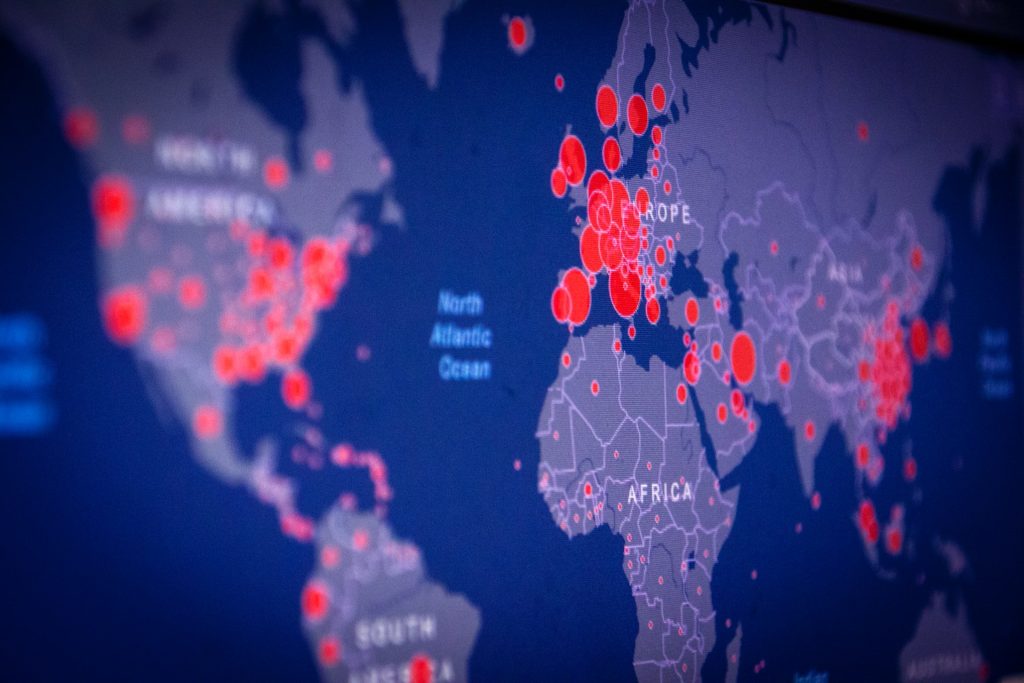
COVID heat map. Photo by Giacomo Carra on Unsplash

The health department called the increasing number of COVID cases across South Africa “worrying” on Wednesday night, adding that although close, the requirements had not yet been met for a third wave.

In a statement, the department said that it had observed an increase in the weekly number of new cases over the past seven and 14 days compared to the previous corresponding periods. Increases have been seen in all provinces — particularly the North West and Gauteng. There was also an increase in the number of COVID-related deaths over the past seven days.

However the department maintained that these increases had not yet met the requirements of the “resurgence threshold”. Dr Zweli Mkhize however said that numbers would not go down unless containment measures were put in place.

“There was an increase in new cases from 8593 cases in the preceding seven days (April 26-May 2) to 12 531 cases in the past seven days (May 3-9), constituting a 46% increase. The 14-day comparisons also showed that the cases increased from 17 017 in the preceding 14 days to 21 124 cases in the past 14 days, an overall 24% increase. All provinces showed a positive percentage increase, with Northern Cape 68% up in the past seven  days followed by Gauteng at 63%, Limpopo at 47%, North West at 42% and Western Cape at 39%.

“The new Covid-19 related deaths increased by 18.22% in the past seven days (May 3-9) to 318 from 269 in the preceding seven days (April 26-May 2). However, the 14-day comparison showed the deaths decreased by 28.93% to 587 in the past 14 days compared to 826 in the preceding 14 days. The cumulative case fatality ratio is 3.43% (54 735 of 1 596 595),” the department said.

Hospital admissions fortunately “have not shown an increase”. As of Wednesday, the detection rate for COVID tests was 7.45%. Adam Lowe, a member of the ASSA COVID working group, said that based on modelling and historical parallels, three scenarios are possible for a third wave: an early, less severe, wave in May driven by school holidays; a later, more severe third wave; or a sudden and severe, but unlikely, third wave.

“As much as these figures are worrying, our resurgence dashboard, which was developed by the South African Covid-19 Modelling Consortium, which is updated thrice a week, still shows that we have not as a country reached a resurgence threshold, though some districts in the country are fast approaching the threshold,” the department said.

The department of health added that it was working with provinces to update their resurgence plans, which mainly focus on case management, contract tracing, oxygen availability, bed capacity, respiratory support equipment and human resources.

It also said that the main drivers of the new wave will be one or both of the resurgence of new variants and growing fatigue to measures such as social distancing and masking. Genomic surveillance is being conducted to catch the emergence of new variants.

“So we want to assure South Africans that we have not yet hit the third wave, however we are at risk and we hence need to be on heightened vigilance,” the department said.

Source: Times Live

NICD Tracking Rise of COVID Cases

Following a steep rise in COVID cases in three provinces, The National Institute for Communicable Diseases (NICD) is working with teams in those areas to monitor the situation.

Increases in the Northern Cape, North West and Free State have been observed by the NICD. The Northern Cape has over 3000 active cases, the North West over 2600 and the Free State over 2200.

The NICD said that it was working with provinces to ascertain whether the rise in cases could be attributed to cluster outbreaks and has recommend increased testing and contact tracing to contain the situation.

Acting executive director of the NICD, Professor Adrian Puren, said: “We want to reassure South Africans that we are actively monitoring the situation in these provinces and will keep the community informed of any new developments.”

The NICD said that with the April school holiday season soon starting and many people making plans for travel and social gatherings, it was still vital to continue to comply with COVID preventative health measures.

Earlier this month, Discovery Health described possible scenarios for COVID in South Africa. Poor social distancing and masking behaviours, superspreader events and a lack of early vaccinations, a third wave could claim as many as 76 000 lives, the insurance company estimated. However, by maintaining good nonpharmaceutical interventions and engaging in a prompt vaccination rollout, deaths would fall to 9000 by the end of the year.

The NICD monitors the number of confirmed COVID-19 cases and tests performed on a daily basis and associated resurgence metrics.

Source: Eyewitness News

SA’s Phase 2 Vaccination Rollout to Commence Soon

South Africa’s Health Department said that it was preparing to vaccinate 5.5 million people over the age of 60 by October.

Phase two will commence from mid-May to the end of October, and Health Minister Zweli Mkhize visited hospitals in Mitchells Plain to assess its readiness for the expanded rollout. The Health Department is aiming to vaccinate as many people before a possible third wave.

Dr Mkhize said that plans to inoculate 16 million people during phase two remained on track.

“After that, after October of course everybody else who has not been vaccinated will have to come in, starting with those who will be in congregate settings and risk and so on.”

Dr Mkhize said that all the paperwork and contracts with Johnson & Johnson and Pfizer had been concluded. However, the use of the J&J vaccine is still waiting on an ethics committee’s signoff for the South African Health Products Regulatory Authority’s (Sahpra) recommendation to allow resumption of that vaccine’s trial.

Last week, the SA trial was temporarily stopped after regulators in the US paused the J&J vaccine rollout in that country after six women developed a rare blood clot. Sahpra has now recommended a conditional lifting of the suspension, although its US counterpart is expected to take two weeks to assess the clot problem.

Dr Boitumelo Semete-Makokotlela at Saphra said that the protocol would now have to be altered and safety regulations tightened.

“The screening and monitoring of the participants, particularly those with high risks of blood clotting,” Dr Semete-Makokotlela said. “Secondly, the safe management and immediate management of any participants who may present with any vaccine-induced thrombosis.”

Source: Eyewitness News

Department of Health COVID Vaccine Rollout Phase 2 Outlined

The Department of Health’s COVID vaccine rollout has been fleshed out in a presentation, including details on how the vaccines will be distributed, and the jobs earmarked for the shots.

A presentation from the department indicates that the government has secured around 51 million vaccine doses, with 20 million from Pfizer and 30 million from Johnson & Johnson (J&J). However, it is unclear how the current pause in J&J administration in South Africa due to concerns about rare blood clots will affect immunisation schedules.

However, health minister Dr Zweli Mkhize announced that South Africa has secured a further 10 million Pfizer vaccines.

“We can now guarantee that the number of people that will be vaccinated with Pfizer has increased from 10 to 15 million,” he said.

With the 30 million of the single-dose shots from J&J, the current planned rollout will cover about 45 million South Africans.

Dr Mkhize said that both the Pfizer and J&J agreements cost around $10 (R145) per vaccine, with non-refundable clauses.

“The agreements state that down-payments that have been made in advance by the department shall not be refundable by the manufacturer to us in any circumstances. This is another onerous term that we had to settle for,” Dr Mkhize told the committee.

Meanwhile, government was sent an email from J&J, which stated that the company will not sign off the 20 million doses until they receive a letter from the Trade, Industry and Competition Minister, expressing support for the local investment that they made in Aspen Pharmacare.

“We’ve been taken aback by this, as there are clauses in the agreement that express this support and acknowledge that this production will not just be limited to South Africa and the continent, but also targeted for the global market,” said Dr Mkhize.

The department indicated that the Pfizer vaccine will likely go to major metropolitans due to its larger pack size and refrigeration requirements, while the J&J vaccine with its less stringent refrigeration needs would be allocated to rural areas.

South Africa’s Phase 2 of the vaccine rollout is planned to begin in May and run until October, with essential workers over 40 and the elderly to be targeted in the programme. This is to include a focus on old age homes and care facilities, plus identifying those with co-morbidities.

The department provided an overview of occupations covered under the vaccine rollout, to include, among others, the police, army, social and municipal workers, and faith and traditional leaders. Private sectors could include mining, retail, transport, and manufacturing.

Source: BusinessTech

Liquor Industry Questions Alcohol Ban Effectiveness

Representatives from the liquor industry have said that the South African government must consider data from a new report that shows little alcohol ban effectiveness on trauma cases. However, other studies show negative effects of alcohol during lockdown, and a surge in violent trauma in Cape Town after alcohol bans were lifted.

In a statement on Thursday, the South African Liquor Brand owners Association (Salba) referenced a new report showing that, compared to other countries, South Africa saw similar trauma cases with its lockdown and alcohol ban to those that only had a lockdown.

The report had financial support from Distell, led by independent data expert Ian McGorian of Silver Fox Consulting, in collaboration with professor Mike Murray from the University of KwaZulu-Natal.

The report found that trauma cases in South Africa under lockdown dropped 60%. But other countries also saw the same drop with no alcohol ban, including the UK (57%), Ireland (62%), Italy (56.6%) and the USA (54%), casting doubt over the effectiveness of alcohol bans in curbing trauma. The researchers also commented that curfews may have explained more of a reduction in trauma cases than alcohol bans.

While members of the liquor industry recognised the impact of alcohol on South African society, they said that government needs to be more objective with its lockdown regulations.

Salba chairperson Sibani Mngadi said the alcohol ban over Easter Weekend, while simultaneously allowing larger gatherings, made even less sense in reducing COVID transmission. This suggests that government was not considering science in its decision making, he said.

However, a multicentre study from Colorado, USA showed that even while trauma cases during lockdown fell by 33%, alcohol screens increased from 34% to 37%, and alcohol positive patients rose from 32% to 39%.

A study of Cape Town trauma admissions saw a dramatic drop of 53% in trauma admissions during the hard lockdown and an immediate rebound coinciding with the resumption of alcohol sales, with a 107% increase in gunshots wounds compared to pre-lockdown conditions.

The researchers noted that in South Africa the trauma demographic is much younger, with much higher rates of violence, with about half of homicide victims in SA testing positive for alcohol.

Distell chief executive Richard Rushton said the industry was merely asking that the data should be viewed objectively to improve dialogue with decision makers.

“We are all on the same side, and we want to help find solutions. We are very clear that alcohol abuse is unacceptable and causes harm. Our view is that the focus must be on finding ways to deal with high-risk drinkers, rather than using blunt instruments that penalise all South Africans.

“Any proposed new regulations need to be evidence-based, rational and target problem areas,” he said.

Business Leadership SA chief executive Busisiwe Mavuso said that lockdown could have been better managed, as 220 000 jobs had been lost along billions of rands in tax to the fiscus, while uncertainty still plagued alcohol producers.

“The decisions made to confront the health crisis should not have unintended consequences for the economy, and that is exactly what has happened with the bans on alcohol,” she said.

Mr Mavuso added that, since the start of the pandemic, business has been a willing partner to government and “needs to be part of the solution to ensure we fight this pandemic with the least possible damage to the economy”.

“The data analysis by the alcohol industry is an important intervention and must be taken seriously as we move forward.”

Source: BusinessTech

South African Volunteers Battle Vaccine Misinformation

Man with LED mask reading a burning newspaper. Photo by Connor Danylenko from Pexels.

As the long-delayed vaccine rollout in South Africa has begun, the government has run a public campaign to tackle prevalent health myths. But there are also volunteers who are waging an online battle against COVID and vaccine misinformation, as reported by the BBC.

Sarah Downs, who is studying molecular biology and infectious diseases, debunks false claims under the alias Mistress of Science and is fighting a surge of misinformation in South Africa. A relatively small collection of Facebook groups and users are responsible for promoting this misinformation. When she tweeted about her grandmother’s passing, a COVID denier questioned whether an autopsy had been performed. 
“We estimate that it’s about 20 000 South Africans who are actually active on anti-vax Facebook pages,” said Prof Hannelie Meyer, a pharmacist and adviser to the South African Vaccine and Immunisation Centre (Savic).

Most anti-vaccine claims in South Africa actually originate in the United States, according to a 2015 study. Anecdotal evidence, such as the spread of false claims about vaccines and DNA by an American osteopath, show this trend still holds in the pandemic.

Prof Meyer said that while data on vaccine hesitancy in SA are limited, studies indicate that more wealthy and educated groups, particularly among whites, are less willing to be vaccinated.

Leading virologist Prof Jeffrey Mphahlele has also pushed back against rumours, such as COVID and its vaccines being a Western plot to reduce Africa’s population and control its natural resources. He called the misinformation “mind boggling” – pointing out the supposed plot would require the West to create a virus that killed millions of its own people.

Even authority figures have promulgated falsehoods: South Africa’s top judge was recently criticised after a video showed him linking vaccines to a “Satanic agenda.”

One of the most prominent groups on Facebook, with some 10 000 members, seeks to spread “awareness” about vaccines but the members’ hard-line anti-vaccine attitude is very clear, ridiculing or dismissing vaccines. One video posted in the group – originally aired on an evangelical US Christian television programme – suggested getting a jab could lead to “a lifetime of illness”.

Sarah Downs stepped in to help answer questions amidst the deluge of misinformation, and one person she helped was Sheona Lottering, a swimming teacher.

“I had a friend that forwarded me a German article,” Sheona said. “She was trying to convince me that death was one of the side-effects [of a COVID vaccination].

“And I was a little bit freaked out about that.”

Sarah explained the subtleties around adverse events to her, and now Sheona keeps in contact with Sarah over difficult vaccine-related questions.

Lisa (not her real name) spends hours lurking in Facebook groups to guide people towards trusted sources of health information.

“The claims are so bizarre I could hardly believe there are people believing these things,” she said. “I don’t like misinformation, so when I see something, I just try to correct it.”

Doing this for over a decade, she’s seen communities grow and knows their tactics. She said that young mothers are a particular target in Facebook groups, where posts are coordinated to try and convince them not to vaccinate their children., which is when Lisa steps in. She keeps her inbox open and believes gentle communication works best – asking about people’s concerns rather than shouting statistics at them.

But Sarah, Lisa and other volunteers we spoke to risk exposing themselves to online abuse, and the prospects of persuasion can often seem slim. It’s difficult, pro-health work – that isn’t paid. So do they judge success?

“I think if I can just help one person be a little bit less terrified… that’s what I aim to get out of it,” Sarah says. “And if they’re willing to take the vaccine, even more so.”

Source: BBC News

South African Variant Escapes Sputnik Vaccine

A study on COVID variants using in vitro tests, available on the preprint server medRXiv, has shown that the South African variant escapes the Sputnik V vaccine.

This study is the first of its kind to show Sputnik V vaccine recipients had reduced neutralising capacity against the B.1.351 and E484K mutant spikes.

When it comes to vaccine design, the most effective vaccines use a stabilised form of the spike protein, while others use the wildtype spike, protecting against severe disease but not infection because of lower levels of neutralising antibodies. A number of SARS-CoV-2 variants of concern (VOC) have mutations on the spike protein, or the E484K mutation, which allows it to escape vaccines and prior immunity. 

In South Africa, where 93% of infections are due to B.1.351, the AstraZeneca vaccine, based on the wild-type spike, failed to prevent mild-to-moderate COVID. The Sputnik V or Gam-COVID-Vac vaccine is also based on the wild-type spike. Interim Phase 3 trial results reported an efficacy of 92%, but this excludes current variants and any lineage containing E484K. 
The current study examined serum neutralisation activity in samples obtained from 12  recipients of the Sputnik V vaccine in Argentina. This country has already detected many independent variants with E484K, with or without N501Y substitutions.

The researchers found that pseudoviruses bearing either the wildtype D614G spike, and the B.1.1.1.7 spike were effectively neutralised by the vaccine sera, in live virus plaque reduction neutralisation assays. The geometric mean titer of neutralising titers was 49, similar to that of the phase III trial.

However, these sera showed moderate to a marked reduction in neutralisation titers against spike protein bearing E484K, and the UK variant. Even at the highest serum concentration used, 9 of the 12 serum samples could not inhibit 50% of B.1351 viral particles, and only half the sera did so against the E484K mutant.

The researchers concluded that, relative to the wildtype spike virus neutralising titers, were reduced by seven-fold against the B.1.351 lineage and three-fold against the E484K spike. They also found that the VOCs with the different spikes showed different modes of escape from antibody-mediated neutralisation by sera elicited by the Sputnik V vaccine. This means that resistance to neutralisation offered by the South African variant occurs by a different mechanism than that of the E484K mutant.

The UK VOC has low resistance to pre-existing or vaccine-induced antibodies, but the B.1.351 variant shows marked resistance. In fact, 8 of 12 samples were unable to reach IC90 at the highest possible serum concentration.

One neutralised the UK variant but none of the other three variants. These findings are of particular concern because all three VOCs carry the N501Y RBD substitution that confers increased affinity for the ACE2 receptor.

This resistance is competitive and is not present at higher serum concentrations. However, this is not true for the mutations in the B.1.351 variant, which escapes neutralisation with undiluted serum.

Though the Sputnik V vaccine likely protects against severe COVID from VOCs, it is troubling that B1.351, as well as all E484K-bearing mutants, is resistant to neutralisation by sera elicited by this vaccine.

However, antibody functions may be different in vivo, and this study does not cover cell-mediated immunity to multiple antigen sites.
“Taken together, our data argue that surveillance of the neutralizing activity elicited by vaccine sera will be necessary on an ongoing basis,” the authors wrote.

The knowledge of which variants can still spread among vaccinated and naturally immune individuals will help decide how to contain them with vaccine upgrades.

Source: News-Medical.Net

Preprint information: Ikegame, S. et al. (2021). Qualitatively distinct modes of Sputnik V vaccine-neutralization escape by SARS-CoV-2 Spike variants. medRxiv preprint. doi: https://doi.org/10.1101/2021.03.31.21254660. https://www.medrxiv.org/content/10.1101/2021.03.31.21254660v2