Capsaicin, derived from hot chili pepper plants, has been used to treat various types of pain, and a high concentration capsaicin patch (HCCP) is approved for the treatment of neuropathic pain. In a real-world study published in Pain Practice that included 97 outpatients in Germany diagnosed primarily with neuropathic back pain, postoperative/posttraumatic neuropathic pain, or postherpetic neuralgia (shingles pain), patients appeared to benefit from multiple HCCP applications.
Among the study participants, 38 received 2 HCCP treatments, and 59 received at least 3. Following HCCP treatments, most patients required significantly lower doses of opioids to manage their pain. Also, two-thirds of patients experienced a reduction in pain intensity after multiple HCCP treatments, and the proportion of patients experiencing a reduction in pain intensity was substantially higher among those who received at least 3 applications compared with those who received 2 applications.
“Consistent with the progressive response seen in prospective clinical trials involving repeated use of topical capsaicin, our research indicates that patients appear to benefit from multiple applications in terms of pain intensity and concomitant opioid use in real-world clinical practice,” said corresponding author Kai-Uwe Kern, MD, PhD, of the Institute for Pain Medicine/Pain Practice, in Wiesbaden, Germany.
A patient-centred health system will remain an illusion under the NHI unless the public health system is ramped up to better serve users and a clear path is outlined for public-private partnerships, argue Bernard Mutsago and Haseena Majid.
By Bernard Mutsago and Haseena Majid
National Health Insurance (NHI) is South Africa’s chosen financing vehicle for Universal Health Coverage (UHC). The plan is a step closer to being a reality after the NHI bill was passed by Parliament’s National Council of Provinces on 6 December 2023. The legislation aims for a single NHI fund that will buy services from public and private providers, it will be free at the point of delivery, and will prevent medical schemes from covering services that the NHI provides. The bill is likely to soon be signed into law by President Cyril Ramaphosa, although it may take years before all sections of the bill will come into force.
However, achieving a universal, affordable, high-quality, comprehensive, and patient-focused health system under the NHI will remain an illusion unless shortcomings of the public health system is fixed to meet the needs of the public. This can be achieved through a structured system that enables efficient and equitable pooling and distribution of resources across the public, private, and civil society sectors to improve service delivery.
As it stands, the absence of a clear framework for public-private partnerships in health service delivery is a barrier to progressive planning.
South Africa, over the last decade, has seen a significant decline in the state of its health sector. Despite initiatives such as the primary healthcare (PHC) re-engineering programme, and outreach services to improve service access, the health system faces a myriad of challenges. Budget constraints have crippled our human resource capacity. Corruption, maladministration, and neglect have resulted in the decay of facilities and their inability to withstand the increasing demands for basic and complex health services.
Most importantly, the data management system, public administration processes, and the referral pathways require significant intervention to align with the digital age and the potential role of artificial intelligence to improve health service delivery. The result is a poorly representative and possibly outdated set of data indicators to inform health service delivery needs that are contextual to geographic and institutional needs.
Applying a blanket approach to health interventions, in the absence of a significantly strengthened data collection and assessment pathway has led to questionable methods to achieving universal healthcare via NHI. The implementation of NHI pilot sites in the build-up to delivering the NHI has failed to show how the health system will move from the current curative approach to a more patient-centred approach. Failing to establish the patient-centred pathway at the onset from the public administration and health service delivery system, will result in the ongoing reality of some people being unable to access the health services closest to them at the lowest cost. It also has an extended impact on preventive strategies for better health outcomes.
South Africa has a fragmented, two-tiered and inequitable health system in which about only 17% of the population in 2018 had medical aid coverage, while more than 80% of the population are largely dependent on the public health sector. This is according to the Competition Commission’s final Health Market Inquiry report, released in November 2019.
The pathway to universal healthcare should entail crucial actions like maintaining and strengthening healthcare infrastructure and implementing strategic initiatives to bolster the workforce through robust recruitment, retention drives, and public-private collaborations.
But attention to these vital steps have been diverted by the government’s emphasis on a specific funding model -the NHI – The plan has faced considerable pushback with criticism, , largely rooted in the government’s inability to deliver essential services, theft due to corruption and cadre deployment, to the detriment of health users. These concerns have been ignored. Instead, the determination to move ahead with the NHI amid outcries from the health sector, academics, and civil society is likely driven by politics.
Lessons from Ghana
Ghana’s failed NHI experiment is a luminous example for many countries attempting different financing models for delivering UHC. Ghana’s attempted NHI approach was taken off the national policy agenda due to public political opposition, weak civil society mobilisation, and low trust in the political leadership. This begs the question of whether due diligence was taken by the crafters of the NHI to establish the viability and sustainability of this model within the South African context.
Government needs fertile collaboration to materialise any policy goals. Whereas the NHI Bill has already been passed by the legislature, the successful implementation of the policy is dependent on people beyond the political realm. Engagements to structure and implement the operational plan for the NHI requires that government take on an approach that shows its willingness and commitment to take input from across all sectors, embrace the criticism, and find an approach that unifies all actors within the health sector and financing space.
Public-private partnership
A well-designed public-private partnership model, with strong monitoring and evaluation processes could offer an opportunity to create the foundation for a medium-term solution. This could improve resource capacity in the public health sector to address the current health service backlogs, improve health infrastructure and technology, and create a functional system between the public and private health sectors to harvest accurate health data. A strengthened data collection system that is inclusive and reflective of all users of the health system is after all essential to craft a responsive health system rather than a reactive one, thus placing the patient central to the health system.
Additionally, structures for community participation to inform healthcare service delivery, such as clinic committees and hospital boards, need to be bolstered as they are currently poorly functioning or non-existent. Including all voices, especially those of the public and clinicians, is critical for establishing a capable health system that offers equitable health access for all people. This is only achievable through amplified voices and a united call for government to urgently re-evaluate its current approach toward NHI implementation.
*Mutsago is a health policy analyst, health equity activist, and primary healthcare enthusiast and Majid is a Global Atlantic Fellow for Health Equity in South Africa and director of public health programmes at civil society organisation Usawa.
For some leukaemia patients, the only potential chemotherapy option is ponatinib, a drug that also carries a high risk of heart failure. This means that some patients who recover from their cancer will end up dying of heart disease brought on by the cure.
In a new study, researchers from the University of Illinois Chicago and other universities have identified mechanisms that cause ponatinib to harm the heart. They also identified a promising treatment that could reverse this process.
The paper, with senior author Sang Ging Ong, assistant professor of pharmacology and medicine at UIC, is published in Circulation Research. The study is part of a growing field called cardio-oncology that investigates drugs that shrink tumours but can also cause heart problems.
While there are three options of drugs for treating chronic myeloid leukaemia, many patients are resistant to the other two, leaving ponatinib as their only choice.
“These patients have no other options for treatment,” Ong said, despite the concerns about the drug’s side effects.
In fact, ponatinib was pulled from the market for a few months after its introduction in 2012 because of concerns about heart problems.
The researchers were interested in understanding the interaction between ponatinib and the heart cells responsible for contraction.
They discovered that ponatinib damages these cells by activating a process known as the integrated stress response.
The mechanism for this is related to the functioning of a kinase (an enzyme involved in energy transfer) called GCN2.
The researchers found that ponatinib, despite being a kinase inhibitor, actually activates GCN2, which in turn switches on the integrated stress response.
While this response isn’t always a bad thing, normally protecting cells, it can also lead to their death under prolonged stress.
To see if this response was harming the cells, the researchers studied what would happen if they used a small molecule to block the integrated stress response in both cells and in mice during ponatinib treatment.
They found that the treatment helped protect heart cells from the damaging side effects of the drug yet did not diminish ponatinib’s tumour-fighting efficacy.
“It protects the heart but at the same time, it still allows us to kill cancer cells,” Ong said.
More research is needed to know if this protective measure would work well in humans, Ong said.
The mechanisms they identified are important in other cardiac diseases, as well, which could lead to future research on how to protect cells against different conditions.
Study shows that higher levels of physical activity are linked with less pain, and to a similar extent in adults with and without a history of cancer.
Photo by Barbara Olsen on Pexels
People who have had cancer often experience ongoing pain, but a new study reveals that being physically active may help lessen its intensity. The study is published by Wiley online in CANCER, a peer-reviewed journal of the American Cancer Society.
Although physical activity has been shown to lessen various types of pain, its effects on cancer-related pain are unclear. To investigate, a team led by senior author Erika Rees-Punia, PhD, MPH, of the American Cancer Society, and first author Christopher T.V. Swain, PhD, of the University of Melbourne, in Australia, analysed information pertaining to 51 439 adults without a history of cancer and 10,651 adults with a past cancer diagnosis. Participants were asked, “How would you rate your pain on average,” with responses ranging from 0 (no pain) to 10 (worst pain imaginable). Participants were also asked about their usual physical activity.
US guidelines recommend 150 minutes (2 hours 30 minutes) to 300 minutes (5 hours) a week of moderate-intensity, or 75 minutes (1 hour 15 minutes) to 150 minutes (2 hours 30 minutes) a week of vigorous-intensity aerobic physical activity.
Based on participants’ responses, the investigators found that, for individuals who had cancer in the past as well as for those without a history of cancer, more physical activity was linked with lower pain intensity. The extent of the association was similar for both groups of individuals, indicating that exercise may reduce cancer-related pain just as it does for other types of pain that have been studied in the past.
Among participants with a past cancer diagnosis, those exceeding physical activity guidelines were 16% less likely to report moderate-to-severe pain compared to those who failed to meet physical activity guidelines. Also, compared with people who remained inactive, those who were consistently active or became active in older adulthood reported less pain.
“It may feel counterintuitive to some, but physical activity is an effective, non-pharmacologic option for reducing many types of pain. As our study suggests, this may include pain associated with cancer and its treatments,” said Dr Rees-Punia.
This is a pseudo-colored image of high-resolution gradient-echo MRI scan of a fixed cerebral hemisphere from a person with multiple sclerosis.
Credit: Govind Bhagavatheeshwaran, Daniel Reich, National Institute of Neurological Disorders and Stroke, National Institutes of Health
A key feature of multiple sclerosis (MS) is that it causes the patient’s own immune system to attack and destroy the myelin sheaths in the central nervous system. To date, it hasn’t been possible to visualise the myelin sheaths well enough to use this information for the diagnosis and monitoring of MS. Now researchers have developed a new magnetic resonance imaging (MRI) procedure that maps the condition of the myelin sheaths more accurately than was previously possible.
The researchers successfully tested the procedure on healthy people for the first time, and published their results in Magnetic Resonance in Medicine.
In the future, the MRI system with its special head scanner could help doctors to recognise MS at an early stage and better monitor the progression of the disease.
This technology, developed by the researchers at ETH Zurich and University of Zurich, led by Markus Weiger and Emily Baadsvik from the Institute for Biomedical Engineering, could also facilitate the development of new drugs for MS. But it doesn’t end there: the new MRI method could also be used by researchers to better visualise other solid tissue types such as connective tissue, tendons and ligaments.
Quantitative myelin maps
Conventional MRI devices capture only inaccurate, indirect images of the myelin sheaths because these devices typically work by reacting to water molecules in the body that have been stimulated by radio waves in a strong magnetic field.
But the myelin sheaths, which wrap around the nerve fibres in several layers, consist mainly of fatty tissue and proteins. That said, there is some water – known as myelin water – trapped between these layers.
Standard MRIs build their images primarily using the signals of the hydrogen atoms in this myelin water, rather than imaging the myelin sheaths directly.
The ETH researchers’ new MRI method solves this problem and measures the myelin content directly.
It puts numerical values on MRI images of the brain to show how much myelin is present in a particular area compared to other areas of the image.
A number 8, for instance, means that the myelin content at this point is only 8 percent of a maximum value of 100, which indicates a significant thinning of the myelin sheaths.
Essentially, the darker the area and the smaller the number in the image, the more the myelin sheaths have been reduced.
This information ought to enable doctors to better assess the severity and progression of MS.
Measuring signals within millionths of a second
It is difficult however to image the myelin sheaths directly, since the signals that the MRI triggers in the tissue are very short-lived; the signals that emanate from the myelin water last much longer.
“Put simply, the hydrogen atoms in myelin tissue move less freely than those in myelin water. That means they generate much briefer signals, which disappear again after a few microseconds,” Weiger says, adding: “And bearing in mind a microsecond is a millionth of a second, that’s a very short time indeed.” A conventional MRI scanner can’t capture these fleeting signals because it doesn’t take the measurements fast enough.
To solve this problem, the researchers used a specially customised MRI head scanner that they have developed over the past ten years together with the companies Philips and Futura.
This scanner is characterised by a particularly strong gradient in the magnetic field.
“The greater the change in magnetic field strength generated by the three scanner coils, the faster information about the position of hydrogen atoms can be recorded,” Baadsvik says.
Generating such a strong gradient calls for a strong current and a sophisticated design.
As the researchers scan only the head, the magnetic field is more contained and concentrated than with conventional devices.
In addition, the system can quickly switch from transmitting radio waves to receiving signals; the researchers and their industry partners have developed a special circuit for this purpose.
The researchers have already successfully tested their MRI procedure on tissue samples from MS patients and on two healthy individuals. Next, they want to test it on MS patients themselves. Whether the new MRI head scanner will make its way into hospitals in the future now depends on the medical industry. “We’ve shown that our process works,” Weiger says. “Now it’s up to industry partners to implement it and bring it to market.”
Researchers have developed a new type of lens that uses a spiral-shaped surface to maintain a clear focus at different distances in varying light conditions.
Credit: Laurent Galinier
Researchers have developed a spiral-shaped lens that maintains clear focus at different distances in varying light conditions. The new lens, described in Optica, works much like progressive lenses used for vision correction but without the distortions typically seen with those lenses. It could help advance contact lens technologies, intraocular implants for cataracts and miniaturised imaging systems.
“Unlike existing multifocal lenses, our lens performs well under a wide range of light conditions and maintains multifocality regardless of the size of the pupil,” said Bertrand Simon from Photonics, Numerical and Nanosciences Laboratory (LP2N), a joint research unit between the Institut d’Optique Graduate School, the University of Bordeaux and the CNRS in France. “For potential implant users or people with age-related farsightedness, it could provide consistently clear vision, potentially revolutionising ophthalmology.”
In the article, the researchers describe the new lens, which they call the spiral diopter. Its spiraling features are arranged in a way that creates many separate points of focus – much like having multiple lenses in one. This makes it possible to see clearly at various distances.
“In addition to ophthalmology applications, the simple design of this lens could greatly benefit compact imaging systems,” said Simon. “It would streamline the design and function of these systems while also offering a way to accomplish imaging at various depths without additional optical elements. These capabilities, coupled with the lens’s multifocal properties, offer a powerful tool for depth perception in advanced imaging applications”
Creating a vortex of light
The inspiration for the spiral lens design came when the paper’s first author, Laurent Galinier from SPIRAL SAS in France, was analysing the optical properties of severe corneal deformations in patients. This led him to conceptualize a lens with a unique spiral design that causes light to spin, like water going down a drain. This phenomenon, known as an optical vortex, creates multiple clear focus points, which allow the lens to provide clear focus at different distances.
“Creating an optical vortex usually requires multiple optical components,” said Galinier. “Our lens, however, incorporates the elements necessary to make an optical vortex directly into its surface. Creating optical vortices is a thriving field of research, but our method simplifies the process, marking a significant advancement in the field of optics.”
The researchers created the lens by using advanced digital machining to mold the unique spiral design with high precision. They then validated the lens by using it to image a digital ‘E,’ much like those used on an optometrist’s light-up board. The authors observed that the image quality remained satisfactory regardless of the aperture size used. They also discovered that the optical vortices could be modified by adjusting the topological charge, which is essentially the number of windings around the optical axis. Volunteers using the lenses also reported noticeable improvements in visual acuity at a variety of distances and lighting conditions.
Crossing disciplines
Bringing the new lens to fruition required combining the intuitively crafted design with advanced fabrication techniques through a cross-disciplinary collaboration. “The spiral diopter lens, first conceived by an intuitive inventor, was scientifically substantiated through an intensive research collaboration with optical scientists,” said Simon. “The result was an innovative approach to creating advanced lenses.”
The researchers are now working to better understand the unique optical vortices produced by their lens. They also plan to perform systematic trials of the lens’ ability to correct vision in people to comprehensively establish its performance and advantages in real-world conditions. In addition, they are exploring the possibility of applying the concept to prescription eyeglasses, which could potentially offer users clear vision across multiple distances.
“This new lens could significantly improve people’s depth of vision under changing lighting conditions,” said Simon. “Future developments with this technology might also lead to advancements in compact imaging technologies, wearable devices and remote sensing systems for drones or self-driving cars, which could make them more reliable and efficient.”
Trial comparing anticoagulant and antiplatelet therapy ends in a draw
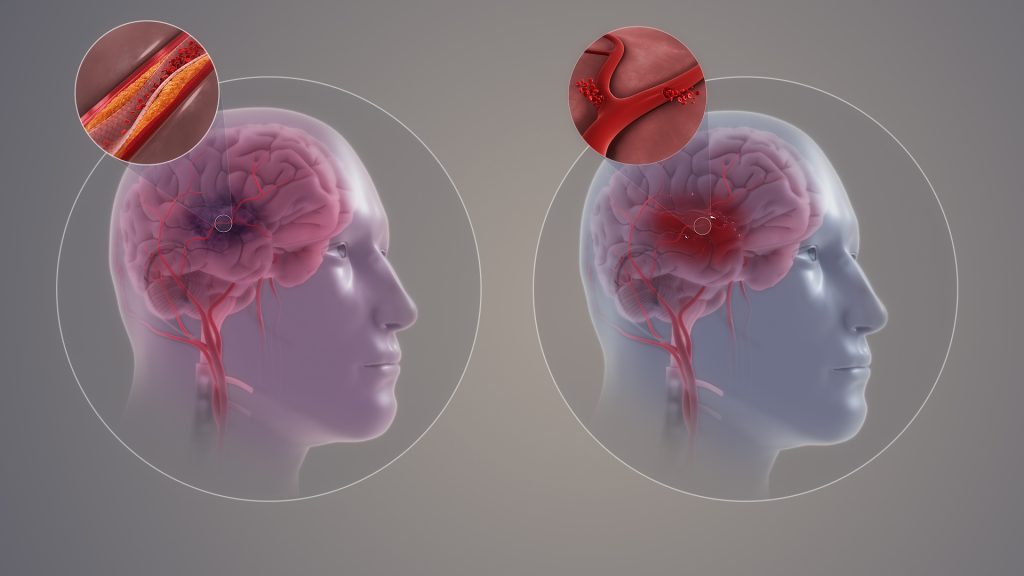
Ischaemic and haemorrhagic stroke. Credit: Scientific Animations CC4.0
Administering apaxiban to patients with cryptogenic stroke and evidence of atrial cardiopathy to prevent recurrence was no more effective than giving aspirin, a large randomised trial has found. The trial, published in JAMA, did however find a possible slight advantage in safety of apaxiban over aspirin.
Cryptogenic stroke (CS) is cerebral ischaemia of obscure or unknown origin. One third of ischaemic strokes are cryptogenic.
Atrial cardiopathy is defined as any complex of structural, architectural, contractile, or electrophysiologic changes affecting the atria with the potential to produce clinically relevant manifestations. Atrial cardiopathy is strongly associated with incident atrial fibrillation and plays a role in thromboembolism related to atrial fibrillation.
Atrial cardiopathy is associated with stroke in the absence of clinically apparent atrial fibrillation. But it was not known whether anticoagulation, which has proven benefit in atrial fibrillation, prevents stroke in patients with atrial cardiopathy and no atrial fibrillation. The Atrial Cardiopathy and Antithrombotic Drugs in Prevention After Cryptogenic Stroke (ARCADIA) trial was therefore designed to determine whether anticoagulation is superior to antiplatelet therapy for preventing recurrent stroke in such patients.
From 2018 to 2023, the researchers conducted a multicentre, double-blind, phase 3 randomised clinical trial of 1015 participants with CS and evidence of atrial cardiopathy – defined as P-wave terminal force greater than 5000μV×ms in electrocardiogram lead V1, serum N-terminal pro-B-type natriuretic peptide level greater than 250pg/mL, or left atrial diameter index of 3cm/m2 or greater on echocardiogram. Participants had no evidence of atrial fibrillation at the time of randomisation.
The participants were randomised 1:1 to receive either apaxiban (5mg or 2.5 mg) twice daily or aspirin (81mg) once daily. The primary outcome measure of stroke occurrence was identical in both arms (40 patients, 4.4%).
There were zero intracranial haemorrhage events for apaxiban vs seven for aspirin, which is known to increase the risk of these. This supports a superior safety profile for apxiban over aspirin, but given the small number of events, the authors caution that this may be a chance finding.
Study limitations included a higher than expected dropout rate due to the COVID pandemic. Additionally, few patients met the atrial cardiopathy criterion of severe left atrial enlargement, but restricting the trial participants to this criterion would have rendered the trial infeasible.
La Jolla Institute for Immunology (LJI) is working to guide the development of new tuberculosis vaccines and drug therapies. Now a team of LJI scientists has uncovered important clues to how human T cells combat Mycobacterium tuberculosis, the bacterium that causes TB. Their findings were published recently in Nature Communications.
“This research gives us a better understanding of T cell responses to different stages in tuberculosis infection and helps us figure out is there are additional diagnostic targets, vaccine targets, or drug candidates to help people with the disease,” says LJI Research Assistant Professor Cecilia Lindestam Arlehamn, PhD, who led the new research in collaboration with LJI Professors Bjoern Peters, PhD, and Alessandro Sette, Dr.Biol.Sci.
The urgent need for TB research
According to the World Health Organization, more than 1.3 million people died of TB in 2022, making it the second-leading infectious cause-of-death after COVID. “TB is a huge problem in many countries,” says Lindestam Arlehamn.
Currently, a vaccine called bacille Calmette-Guerin (BCG) protects against some severe cases of TB. Unfortunately, BCG doesn’t consistently prevent cases of pulmonary TB, which can also be deadly.
Although there are drug treatments for TB, more and more cases around the world have proven drug resistant.
To help stop TB, Lindestam Arlehamn and her colleagues are learning from T cells. Instead of targeting an entire pathogen, T cells look for specific markers, called peptides sequences, that belong to the pathogen.
When a T cell recognises a certain part of a pathogen’s peptide sequence, that area is termed an “epitope.”
Uncovering T cell epitopes gives scientists vital information on how vaccines and drug treatments might take aim at the same epitopes to stop a pathogen.
T cells take aim at a range of TB epitopes
For the new study, the researchers worked with samples from patients who were mid-treatment for active TB. These samples came from study participants in Peru, Sri Lanka, and Moldova.
By looking at T cells in patients from three different continents, the researchers hoped to capture a wide diversity of genetics and environmental factors that can affect immune system activity.
In their analysis, the LJI team uncovered 137 unique T cell epitopes. They found that 16% of these epitopes were targeted by T cells found in two or more patients. The immune system appeared to be working hard to zoom in on these epitopes.
Going forward, Lindestam Arlehamn’s laboratory will investigate which of these epitopes may be promising targets for future TB vaccines and drug therapies.
A step toward better diagnostics
The new study is also a step toward catching TB cases before they turn deadly.
Because Mycobacterium tuberculosis is an airborne bacteria, a person can be exposed without ever realizing it. Once exposed, many people go months or years without any symptoms.
This inactive, or “latent,” TB can turn into active TB if a person’s immune system weakens, for example, during pregnancy or due to an infection such as HIV.
For the new study, the researchers also compared samples from active TB patients with samples from healthy individuals.
The scientists uncovered key differences in T cell reactivity between the two groups.
“For the first time, we could distinguish people with active TB versus those that have been exposed to TB – or unexposed individuals,” says Lindestam Arlehamn.
Lindestam Arlehamn says it may be possible to develop diagnostics that detect this tell-tale T cell reactivity that marks a person’s shift from latent to active TB. “Can we use this peptide pool to look for high-risk individuals and try and follow them over time?” she says.
Contrary to popular belief, the benefits of physical activity do not outweigh the risks of cardiovascular disease associated with drinking sugar-sweetened beverages, according to a new study led by Harvard T.H. Chan School of Public Health and published in The American Journal of Clinical Nutrition.
Sugar-sweetened beverages are the largest source of added sugars in the North American diet. Their consumption is associated with a higher risk of cardiovascular disease, the world’s leading cause of death.
“The marketing strategies for these drinks often show active people drinking these beverages. It suggests that sugary drink consumption has no negative effects on health if you’re physically active. Our research aimed to assess this hypothesis,” says co-author Jean-Philippe Drouin-Chartier, professor at Université Laval’s Faculty of Pharmacy.
For the study, the scientists used two cohorts totalling around 100 000 adults, followed for about 30 years.
The data show that those who consumed sugar-sweetened beverages more than twice a week had a higher risk of cardiovascular disease, regardless of physical activity levels.
The study found that even if the recommended 150 minutes of weekly physical activity protects against cardiovascular disease, it’s not enough to counter the adverse effects of sugar-sweetened beverages.
“Physical activity reduces the risk of cardiovascular disease associated with sugar-sweetened beverages by half, but it does not fully eliminate it,” says Drouin-Chartier.
The frequency of consumption considered in the study – twice a week – is relatively low but still is significantly associated with cardiovascular disease risk.
With daily consumption, the risk of cardiovascular disease is even higher. For this reason, Drouin-Chartier underlines the importance of targeting the omnipresence of sugar-sweetened beverages in the food environment.
This category includes soft and carbonated drinks (with or without caffeine), lemonade, and fruit cocktails. The study did not specifically consider energy drinks, but they also tend to be sugar-sweetened.
For artificially sweetened drinks, often presented as an alternative solution to sugar-sweetened beverages, their consumption was not associated with higher risk of cardiovascular diseases.
“Replacing sugar-sweetened beverages by diet drinks is good, because it reduces the amount of sugar. But the best drink option remains water,” explains Drouin-Chartier.
“Our findings provide further support for public health recommendations and policies to limit people’s intake of sugar-sweetened beverages, as well as to encourage people to meet and maintain adequate physical activity levels,” added lead author Lorena Pacheco, a research scientist in the Department of Nutrition at Harvard Chan School.
Receiving the news that their child has been diagnosed with cancer is devastating for any parent, but this is even worse when they hear that, after 18 months of remission, their little one will need to battle the disease all over again.
This was the case for mom of two Arthie Ishwarlal. Back in 2021, her then two-year-old daughter, Preshthi, was diagnosed with Acute Lymphoblastic Leukaemia (ALL), a type of blood cancer that affects the bone marrow, white blood cells, red blood cells, and blood platelets. But, despite undergoing inpatient treatment, Preshthi experienced a relapse earlier this year with doctors saying that her only chance for survival is a stem cell transplant from a matching donor. Unfortunately, however, there is no match for her on the country’s stem cell registry at present.
As the world observes International Childhood Cancer Day (ICCD) on 15February, Palesa Mokomele, Head of Community Engagement and Communications at DKMS Africa explains that South Africans can potentially save Preshthi’s life. While there are currently over 73 000 donors on the South African registry, each only has a 1 in 100 000 chance of being a match for a blood cancer patient in need. But exacerbating the situation for little Preshthi is the lack of Indian donors since the best chance of a match comes from within one’s own ethnic group.”
She adds that it is not just Preshthi who needs a stem cell transplant for a second chance at life. “This is often the only treatment offering children with other blood cancers, like lymphomas, any hope of a cure.”
With leukaemia and lymphomas being two of the five most common cancers among South Africa’s youth, with the former accounting for 34% of childhood cancer cases and the latter 11%, Mokomele urges South Africans aged between 17 and 55 who are in good general health to register as donors. “In doing so, you might save a child’s life.”