Findings from clinical practice will help inform shared decision making
Human heart. Credit: Scientific Animations CC4.0
Adding the GLP-1 receptor agonist drug tirzepatide to standard care for patients with type 2 diabetes and heart disease is associated with a lower risk of a major cardiovascular event, such as a heart attack or stroke, finds a study published by The BMJ today.
Randomised trials and observational studies have shown non-inferior effects of tirzepatide compared to another GLP-1 receptor agonist, dulaglutide, for major adverse cardiovascular events (MACE) – a combined measure of heart attack, stroke, and death from any cause. But evidence on the effects of adding tirzepatide to standard care is more limited, resulting in uncertainty for both regulators and clinicians.
To address this, researchers analysed clinical practice data from two US health insurance claims databases between May 2022 and May 2025. They aimed to estimate the cardiovascular effects of adding tirzepatide to standard care for patients with type 2 diabetes, a body mass index of at least 25, and established heart disease by comparing the outcomes to sitagliptin, another diabetes drug.
Sitagliptin was chosen as a neutral placebo proxy based on several studies showing no effect on cardiovascular outcomes.
The main outcome of interest was a reduction in MACE, which was monitored from the first day of treatment up to one year, or until the individual stopped or switched treatment, or disenrolled from the health plan.
Factors including age, sex, race, body mass index, previous heart problems, other chronic conditions, and medication use were taken into account, and a technique called propensity score overlap weighting was used to balance out differences between the two groups to draw more reliable conclusions.
A total of 52,971 individuals were included in the analysis (average age 70 years; 51% female), of whom 35,353 started tirzepatide and 17,618 started sitagliptin.
At one year, the risk of MACE was 2.9% in the tirzepatide group and 4.4% in the sitagliptin group (a 32% relative reduction), and the researchers estimate that for every 70 patients starting tirzepatide, one case of MACE would be prevented.
For individual MACE components, tirzepatide was associated with a 33% lower risk of heart attack compared with sitagliptin, whereas ischaemic stroke showed no meaningful difference.
Infections requiring hospital admission were also lower with tirzepatide (one admission prevented for every 48 patients), as was infection related death (one death prevented for every 200 patients) and death from any cause (one death prevented for every 122 patients).
This is an observational study, but the researchers previously benchmarked their design, data, and analytics infrastructure against a randomised controlled trial before drawing conclusions about cause and effect.
They also acknowledge several limitations including a relatively short follow-up period, which may underestimate long term cardiovascular and safety effects, possible misclassification of treatment duration or outcomes, and findings may not apply to other healthcare systems or patients without established cardiovascular disease.
However, they conclude: “This study shows how trial-anchored evidence from clinical practice can estimate the expected cardiovascular benefit of initiating tirzepatide beyond standard background treatment and inform shared decision making.”
A linked editorial notes that while this study provides an important, transparent estimate of what initiating tirzepatide might achieve in routine care, it does not establish a mortality indication or define the best sequence for cardiometabolic therapy.
The authors say longer follow-up, randomised and pragmatic comparisons, and more studies of additive benefit on contemporary background treatment are needed. Furthermore, cardiovascular efficacy cannot benefit a population if cost, authorisation barriers, supply, and discontinuation prevent sustained treatment, they add.
As such, they conclude: “The signal is compelling; the causal and clinical placement questions remain open.”
Environmental Health Practitioners regularly test drinking and recreational water to detect contamination and help prevent diseases such as cholera and typhoid. (Photo: Unsplash)
By Christina Pitt for Spotlight
From inspecting spaza shops to monitoring water quality, Environmental Health Practitioners help prevent disease before outbreaks occur. A Public Protector investigation reveals why Gauteng municipalities are struggling to deliver these essential public health services. The investigation also helps clarify what is at stake in South Africa’s local government elections in November.
Environmental Health Practitioners (EHPs) operate as the public health system’s early warning system. They are responsible for identifying and managing environmental health risks before they become public health emergencies.
Whether inspecting food premises, monitoring water quality or investigating environmental health hazards, their work is designed to avert illness. These preventative functions form part of the municipal health services that local governments are required by law to provide and what will be at stake in the local government elections in November.
The importance of these largely invisible health services came into sharp focus when Public Protector Advocate Kholeka Gcaleka released preliminary findings of an investigation into Gauteng’s food safety system on 17 July 2026.
The probe followed a series of food poisoning incidents involving children in 2024. Among the most high-profile was the death of six children who allegedly consumed contaminated food bought from a spaza shop in Naledi, Soweto.
Rather than focusing only on the poisoning incidents themselves, the Public Protector’s office examined whether Gauteng’s municipalities were adequately delivering the municipal health services responsible for regulating food safety and hygiene standards in the informal business sector.
As the local government elections draw closer, we unpack how municipalities use environmental health services to prevent harm and protect public health, and find out what happens when that system comes under strain.
To start with, we need to understand what municipal health services are, the responsibilities assigned to municipalities by law, and how those services are intended to function.
What are municipal health services?
Food safety is just one of many municipal health services.
Professor Jaap de Visser, National Research Chair in Multilevel Government, Law and Development at the Dullah Omar Institute at the University of the Western Cape, points to the National Health Act for the full list.
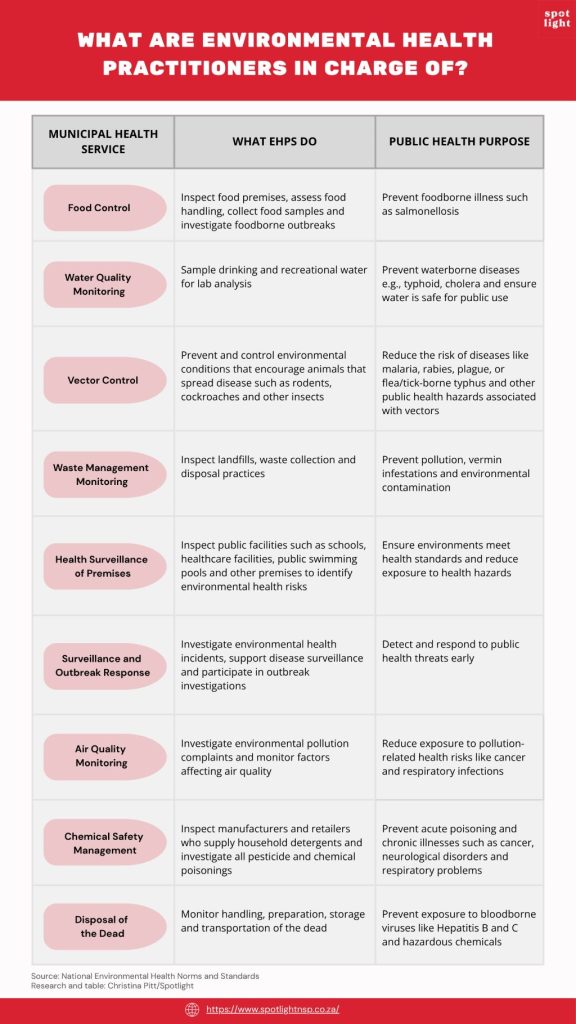
The Act defines municipal health services by naming nine preventative functions, including food control, water quality monitoring, waste management, vector control, and environmental pollution control.
For example, EHPs routinely collect drinking and recreational water samples for laboratory testing to detect contamination and reduce the risk of waterborne diseases such as cholera and typhoid.
This table below illustrates the key functions they perform to prevent disease before people become ill.
The National Environmental Health Norms and Standards requires EHPs to adopt a preventative, risk-management approach. In practice, this means rather than inspecting every premises equally, they prioritise activities and facilities that pose the greatest risk to public health.
“Higher-risk premises, for example, those handling high-risk foods, with a history of non-compliance, would be inspected more frequently and receive more intensive oversight,” explained National Department of Health spokesperson Foster Mohale. “Conversely, lower-risk premises with a strong record of compliance may be inspected less frequently, allowing EHP resources to be directed where they are most needed.”
EHPs also have enforcement powers when they identify breaches of prescribed health standards. They can issue compliance notices, requiring owners or operators to correct a problem within a specified period.
Their work also includes routine inspections, environmental health surveillance, investigating complaints, and educating communities and businesses.
Which municipality is responsible for delivering these services depends on where you live.
In metropolitan municipalities such as Johannesburg, Tshwane and Ekurhuleni, the municipality is responsible for providing municipal health services within its boundaries.
In non-metropolitan areas, the Municipal Structures Act provides that district municipalities are generally responsible, while local municipalities perform the function only where they have been authorised to do so in terms of the Act.
Although municipalities deliver these services, the National Health Act requires them to work as part of a coordinated health system. It establishes District Health Councils to support coordination between national, provincial and local government.
According to Mohale, municipal health services are intended to function as an integrated three-tier system in which national, provincial and district environmental health units work together to deliver municipal health services.
“Working together, these structures are intended to create a coordinated system in which national government sets the policy and regulatory framework, provinces provide oversight and technical support, and district structures coordinate and strengthen implementation at municipal level,” he said.
Food safety provides a useful example of how that system operates in practice.
From farm to fork
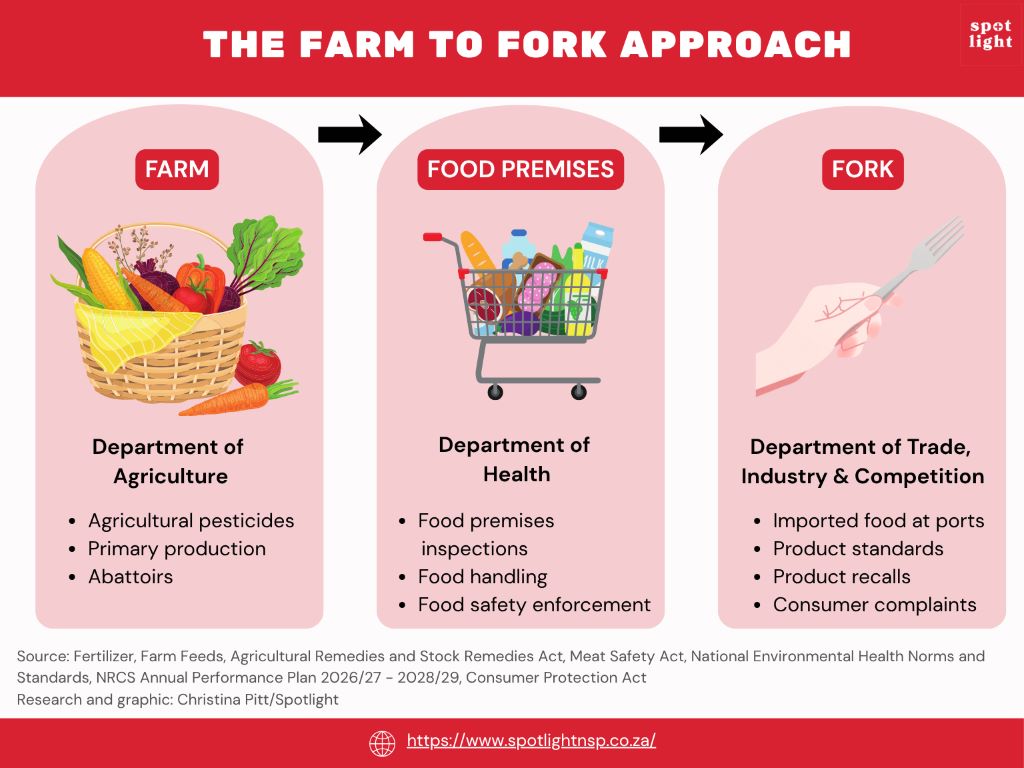
Food microbiologist and food safety expert Professor Lucia Anelich says South Africa follows a “farm to fork” approach, with different institutions responsible for different stages of the food chain.
The Department of Agriculture oversees food safety at the production stage by regulating agricultural pesticides and veterinary medicines as well as food safety in abattoirs.
Once food enters the retail environment, the Department of Health, through municipal EHPs, is responsible for inspecting food premises, checking how food is prepared and enforcing food safety requirements.
The Department of Trade, Industry and Competition provides an additional layer of oversight by inspecting certain imported food products at ports of entry, overseeing product recalls and investigating consumer complaints.
When food contamination is suspected, those responsibilities overlap as the relevant authorities work together to trace the source, remove contaminated products, and prevent further illness. The agencies involved depend on where the suspected source lies within the food chain.
The Public Protector’s Gauteng food safety investigation examined whether the preventative systems intended to identify and manage these risks before outbreaks occurred were functioning as intended.
A break in the chain
The level of coordination required for food safety is not the type of thing that happens by chance.
That is why District Health Councils are tasked with strengthening planning, oversight and coordination between national, provincial and local government.
According to Mohale, these structures are intended to provide a forum for regular engagement between stakeholders, monitor the implementation of environmental health programmes and “ensure that food safety risks are identified and managed proactively.”
Yet, the Public Protector identified a significant weakness in Gauteng’s food safety system with the absence of functioning District Health Councils.
Without them, coordination between different spheres of government becomes more difficult, weakening oversight, planning, and the implementation of municipal health services.
Delivering these services also depends on whether municipalities have enough EHPs to carry out routine inspections.
EHP employment gaps
One of the Public Protector’s clearest findings was that Gauteng municipalities lack sufficient EHPs to carry out their statutory functions.
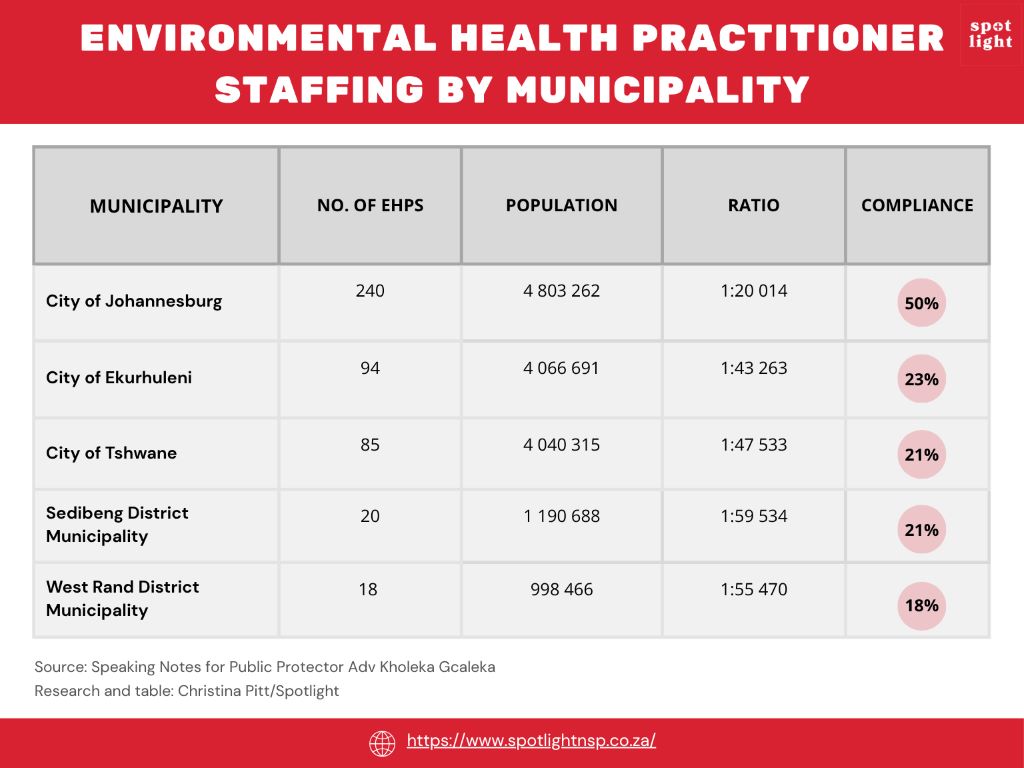
As of October 2025, every municipality fell short of the World Health Organisation (WHO) and the National Environmental Health Norms and Standards benchmark of one EHP for every 10 000 people.
Johannesburg had the largest absolute number of EHPs, with 240 practitioners serving a population of 4.8 million people. This gave it a ratio of one EHP for every 20 000 people, or 50% of the recommended benchmark.
Meanwhile, Ekurhuleni and Tshwane had fewer than one-quarter of the recommended number of EHPs.
According to City of Johannesburg spokesperson Nthatisi Modingoane, its current staffing complement is 213 EHPs, with eight funded vacancies. Despite ongoing recruitment, the City estimates that each EHP is still responsible for about 28 000 residents — almost three times the benchmark.
City of Ekurhuleni spokesperson Zweli Dlamini said the municipality now employs 98 EHPs, up from 94 during the Public Protector’s investigation. However, he acknowledged that the municipality still has a shortage of 309 EHP posts, leaving it well below the recommended staffing benchmark.
The City of Tshwane did not respond to Spotlight’s requests for updated staffing figures.
“The entire province is functioning at less than a third of the required EHP staffing capacity,” Gcaleka said about her findings, warning that the shortage threatens equitable access to environmental health services.
Anelich explained that staffing shortages are compounded by the breadth of EHPs’ responsibilities.
“EHPs are trained broadly, including water quality control and pollution monitoring — not only food,” she said.
“These people have multiple roles to play, which makes it very difficult for the system. We should have EHPs dedicated to food safety so municipalities can regulate food safety more effectively, particularly in the informal sector.”
The National Environmental Health Norms and Standards require EHPs to inspect high-risk food premises at least once every quarter. Maintaining those inspection frequencies becomes increasingly difficult when each practitioner is responsible for far more people than the recommended benchmark.
The capacity constraints extended beyond municipalities. The Public Protector found that the Department of Agriculture had filled only 27 inspector posts, which it described as insufficient to regulate agricultural pesticides effectively, weakening another part of the food safety chain.
But increasing staffing capacity depends on whether municipalities have the financial resources to create and sustain these posts.
Money troubles
The Public Protector also found that municipalities were not allocating enough funding to municipal health services, limiting their ability to recruit and retain EHPs.
Municipal health services are funded primarily through the local government equitable share. This is money allocated by National Treasury and transferred to municipalities to help provide basic services. Municipalities also use revenue from rates and taxes.
Because the equitable share is an unconditional grant, municipal councils decide how much funding is allocated to environmental health alongside their other constitutional responsibilities.
Although the National Department of Health is not responsible for funding municipal health services or employing EHPs, Mohale said it continues to support initiatives aimed at helping municipalities recruit, retain and train EHPs.
He also said the department engages with National Treasury and the Department of Cooperative Governance and Traditional Affairs to prioritise the appointment of EHPs and address staffing shortages.
The human cost
These system weaknesses had visible consequences on the ground. During blitz inspections cited by the Public Protector, EHPs repeatedly identified expired food, unlabelled products, poor hygiene, rodent infestations, and unsafe storage practices.
The Public Protector also found low levels of compliance with spaza shop licensing requirements.
Only 5% of spaza shops in Ekurhuleni were licensed or permitted, compared with 14% in Johannesburg and 30% in Tshwane, according to Gcaleka’s speaking notes. Across Gauteng, the compliance rate was 28%, meaning that for every licensed spaza shop, almost three were operating without the required license or permit.
“So many spaza shops aren’t licensed, so EHPs don’t even know where to look,” Anelich said.
“We can send EHPs into informal settlements to look for them, but that’s not a great use of resources that are already stretched.”
She also said the deaths highlighted what can happen when food safety systems fail. Adding that South Africa’s burden of foodborne disease remains poorly documented, making it difficult to understand the full scale of the problem.
A systemic failure
The Public Protector found that the problems extended beyond individual incidents.
In her speaking notes, Gcaleka says that the underlying governance weaknesses, severe staffing shortages, inadequate funding for municipal health services and capacity constraints in other parts of the food safety system were “not incidental, but systemic and far-reaching”.
She therefore made the preliminary finding that Johannesburg, Ekurhuleni, Tshwane, Sedibeng and West Rand had failed to properly enforce food safety and hygiene standards in the informal food sector.
As voters prepare to elect new local governments in November, the findings highlight a core municipal responsibility: preventing public health risks before they become public health crises.
Replacing 15 minutes of sleep or sedentary behaviour with 15 minutes of movement are each linked to a two per cent reduced risk of cancer, new research from University College London has found.
The new study, published in BMC Medicine, analysed the records of 59218 people (55% female) with an average age of 61.7 from the UK Biobank, a database of half a million volunteers taking part in medical research.
Smartwatches were used to track the movement of the daily movements of those people and, over an eight-year follow-up, some 2,385 cancers occurred in the group. Modelling was used to see how differences in daily movement was linked to cancer risk.
Previous research by other researchers has found strong evidence that higher levels of activity are linked to a lower risk of several cancers – including of the bladder, breast, bowel, kidney and stomach.
The UCL study, led by Dr John Mitchell (UCL Division of Surgery and Interventional Science), looked at areas such as how long people spent sleeping, sedentary behaviour such as watching TV, standing and then any movement and at what intensity.
They found that the more people moved, the lower their risk of cancer.
For example, replacing 15 minutes of sleep or sedentary behaviour with 15 minutes of movement were each linked to a 2% reduced risk of cancer.
Conversely, swapping 30 minutes of movement for 30 minutes of sedentary behaviour increased the risk by 8%, while swapping it for sleep increased the risk by 7%.
This was not just about doing more exercise, Dr Mitchell said, but how everyday activities like running for a bus or carrying home heavy bags of groceries can help maintain a healthy lifestyle which reduce your risk of getting cancer.
Dr Mitchell said: “We are tending towards what we call 24-hour movement guidelines where individuals have a menu of possible options which they can adapt to their lifestyle in order to help them mitigate their risk of disease over time.
“Our study showed that there’s an increased risk of cancer for those who spend a lot of time sitting down.
“We also explored what might happen if people leading active lives reduced their levels of physical activity and found that they also face a higher cancer risk.
“Based on theoretical modelling, our study showed even losing two to three minutes per day of vigorous activity, such as running for a bus, and replacing it with sitting down, sleep or light activity increased their cancer risk.
“Other examples of vigorous activity – that is, anything which elevates your heart rate and makes you sweat – include sport, rushing up the stairs and carrying home heavy grocery bags.
“The take-home message is that for people already leading physically active lives, it’s really important to maintain that level of activity as you get older.
Current NHS guidelines say adults should aim for at least 150 minutes of moderate intensity activity a week or 75 minutes of vigorous intensity activity a week.
They should also do strength activities that work all the major muscle groups (legs, hips, back, abdomen, chest, shoulders and arms) on at least two days per week.
Examples of moderate activity include very brisk walking (4mph or faster), cycling at 10mph-12mph, or badminton. Vigorous activity also includes hiking, jogging at 6mph or faster, fast cycling, basketball or tennis.
Doctors may think they’re saying “Don’t panic.” But many patients hear “Don’t bother” instead.
A new study from the University of California San Diego Rady School of Management suggests that when physicians try to reassure patients by saying their symptoms are ‘normal’, patients may actually infer that treatment isn’t necessary – and become less inclined to seek it.
Published in Nature Human Behaviour, the findings held across 14 experiments involving 9371 participants and a wide range of health conditions, from menopause and migraines to dental pain, seasonal allergies and elevated blood glucose levels.
Why ‘normal’ can send the wrong message
The idea for the research grew from first author Seyi Lawal’s interest in communication around menopause, where patients sometimes report feeling dismissed after being told disruptive symptoms are simply a normal part of aging. Could it be, she wondered, that doctors and patients were interpreting the same conversations differently?
To find out, the researchers conducted 14 studies involving members of the public and healthcare providers. Participants read realistic medical scenarios in which healthcare providers either described symptoms as ‘normal’ or did not. The researchers then measured the participants’ willingness to pursue treatment and compared it with what providers expected patients would do.
“Providers expected that normalising a patient’s symptoms would increase their treatment likelihood, or at worst have no impact, but patients actually reacted in the opposite way,” said Lawal, a doctoral student at the UC San Diego Rady School of Management.
Doctors use ‘normal’, it seems, to mean common and well understood. Patients often interpret it as meaning acceptable – or not worth treating.
Fixing the communication gap, making reassurance work
The findings come amid broader conversations about patients feeling dismissed in healthcare settings, sometimes described as “medical gaslighting.” The study identifies a communication gap that may contribute to those experiences, even when doctors are trying to help.
The good news is that miscommunication isn’t inevitable. The researchers also tested two simple ways to reduce it: pairing normalising language with an explicit recommendation for treatment, and explaining that “normal” was meant in a statistical, not normative or prescriptive, sense.
Both approaches helped close the communication gap.
“Doctors usually have a noble goal. They mean to ease anxiety, but somehow it backfires,” said senior author On Amir, professor of marketing and holder of the Wolfe Family Presidential Endowed Chair in Life Sciences Innovation and Entrepreneurship at the UC San Diego Rady School of Management. “Doctors shouldn’t stop reassuring patients. But they should make their meaning unmistakable.”
Co-author Brianna Chew, a doctoral student at the Rady School, said the same lesson applies to patients. Hearing that symptoms are “normal,” she said, shouldn’t be taken to mean they are any less serious.
The key takeaway for patients: If you’re unsure what your doctor means when they say a symptom is “normal,” don’t assume it means treatment isn’t recommended and you should just live with it. Ask.
Common symptoms can still deserve attention – and treatment.
The world-first trial of a fridge-free tetanus-diphtheria vaccine has produced encouraging results that could improve access worldwide to crucial treatments, while reducing carbon emissions.
Around half of vaccines are wasted globally each year, according to the World Health Organization. Millions of doses are lost because of temperature changes during storage and transport. Fridge-free vaccines have the potential to transform vaccine delivery by reducing this dependence on refrigeration. This would improve access in more isolated communities and cut the environmental impact by reducing vast amounts of energy that lead to emissions.
This phase I study, led by the University of Southampton and University Hospital Southampton NHS Foundation Trust, found the vaccine was well tolerated, with no vaccine-related serious adverse events. Results are published in The Lancet group’s eClinicalMedicine.
Saul Faust , Professor of Paediatric Immunology and Infectious Diseases at the University of Southampton and Director of the NIHR Clinical Research Facility in Southampton, who led the study, said: “Keeping vaccines cold from the factory to the patient is one of the biggest challenges facing immunisation programmes worldwide. Our study suggests that this vaccine can remain safe and effective without refrigeration.
“If larger studies confirm these findings, this technology could help transform the way vaccines are stored and delivered around the world.”
The research shows that SPVX02 can be stored at temperatures of up to 30°C for at least two years without losing its effectiveness. Scientists are now investigating whether it can remain stable for as long as four years. Researchers have also demonstrated that the vaccine remains stable, and fully potent, after three cycles of extreme temperature fluctuation from -20°C to +40°C.
The randomised trial, which also involved the Medicines Evaluation Unit (MEU) in Manchester, enrolled 60 healthy adults. By 28 days after vaccination, all participants receiving SPVX02 achieved protective antibody levels against both tetanus and diphtheria, demonstrating immune responses comparable to licensed vaccines.
Next steps
The eClinicalMedicine publication follows the launch of a Phase 2b trial that will further assess the vaccine in a larger group of participants. Stablepharma’s technology platform, StablevaX, can be applied to vaccines, small molecules, peptides and biologics. They are currently working with a partner to thermostabilise small molecule oncology and anti-infective products, in addition to other vaccines.
Özgür Tuncer, Stablepharma CEO and Executive Director, said: “This peer reviewed validation represents a pivotal moment for our StablevaX platform and the future of thermostable vaccines. These findings strengthen the scientific and global health case for a new generation of fridge free vaccines, particularly in regions where cold chain limitations hinder equitable access.”
Health and Social Care Minister Diana Johnson said: “This pioneering research demonstrates how British innovation is helping to tackle some of the biggest challenges in global healthcare, and providing life-saving breakthroughs for use around the world.
“Right now, people are dying of preventable diseases all over the world, not due to a lack of vaccines, but a lack of refrigeration. Fridge-free vaccines have the potential to be a game-changer for global health, especially for people in remote communities, or regions affected by conflict.
“Backed by NIHR’s world-leading research, this breakthrough shows once again how our investment in science and life sciences is driving better health outcomes, while supporting economic growth and reinforcing the UK’s position at the forefront of medical innovation.”
Stablepharma’s SPVX02 vaccine has been developed with support from Innovate UK, part of UK Research and Innovation (UKRI). It is a reformulated version of the WHO-prequalified Tetadif tetanus-diphtheria vaccine. Scientists from the UK Health Security Agency (UKHSA) provided specialist laboratory testing.
Stablepharma expects to complete the clinical development programme for SPVX02 by 2027.
A gene variant inherited by modern humans from Neanderthals causes the body’s cells to respond more strongly to growth hormone. In a study published in Current Biology, researchers at Karolinska Institutet and several international universities report that adults who carry the variant have, on average, slightly greater muscle mass.
Neanderthals were generally more robustly built than people are today. The researchers examined a variant of the growth hormone receptor that modern humans inherited from Neanderthals around 47 000 years ago. Today, the variant is found mainly in South and East Asia, and in some populations in these regions it is carried by up to 24 per cent of people.
In laboratory experiments, the researchers studied two changes unique to the Neanderthal receptor. When stimulated with growth hormone, cells carrying the Neanderthal variant grew 40 per cent more than cells with the most common modern human version of the receptor.
“It is fascinating that a gene variant inherited from Neanderthals still affects people today. But this gene is only one of many factors that influence the body’s growth and shape,” says Hugo Zeberg, who led the study and is a senior lecturer at the Department of Physiology and Pharmacology, Karolinska Institutet.
The researchers analysed data from just over 1.1 million adults. The variant was associated with an average increase in body weight of 285 grams, almost all of which was due to greater muscle mass. By contrast, no effect was seen in more than 6,000 children aged 11 or younger, suggesting that the difference may emerge later, possibly during puberty.
“As someone who does CrossFit, I found it fun to link Neanderthal genetics to muscle mass. But not even a Neanderthal growth hormone receptor can replace training,” says co-author Miriam Berreiter of the same department.
Carriers of the variant also had slightly shorter tooth roots and subtle differences in jaw shape, features that resemble those seen in Neanderthals.
Scanning electron micrograph of a T cell lymphocyte. Credit: NIH / NIAID
Researchers at Karolinska Institutet and SciLifeLab have developed a new method to analyse the condition of immune cells in the blood. The method has been tested on patients with atherosclerosis and can distinguish their immune cells from those of healthy individuals. The study is published in the journal Nature Nanotechnology.
The physical properties of immune cells, such as how the cell membrane is structured or how the mitochondria function, affect how the cells move, communicate, and respond to inflammation. These properties have previously been difficult to measure on a large scale.
Now, researchers have developed a method that measures multiple physical properties simultaneously in individual cells, across very large cell populations. The method is called spectral biophysical cytometry (SBC) and combines fluorescent nanosensors, which respond to the cells’ physical environment, with advanced flow cytometry, where thousands of cells are analysed one by one using laser light in a few minutes.
The researchers used the method to analyse immune cells in blood from 38 patients with atherosclerosis and 26 healthy control individuals.
“We show that immune cells in atherosclerosis have altered physical properties that can be measured directly in blood samples, without first needing to analyse genes or proteins,” says Erdinc Sezgin, researcher at SciLifeLab and the Department of Women’s and Children’s Health, Karolinska Institutet. “The method provides an integrated picture of the health status of the immune cells and can serve as a complement to more time-consuming and costly analyses.”
May affect disease processes
The analyses revealed clear differences in, among other things, the organisation of cell membranes and mitochondrial function, particularly in different types of T cells. These changes could also be linked to alterations in the cells’ lipid composition and which genes were active.
“This suggests that the physical properties of cells are indications of health and important in disease processes in atherosclerosis and possibly also in other diseases,” says Erdinc Sezgin.
The study is a so-called proof-of-concept study, meaning an early step demonstrating that the principle works. The next step is to investigate the method in larger patient cohorts and in other diseases.
For the past two decades, doctors have been using therapeutic hypothermia to prevent or treat brain injury in comatose survivors of cardiac arrest. The process involves cooling down the body, which slows the body’s metabolism and triggers other protective mechanisms that reduce brain damage. However, clinical trials of therapeutic hypothermia for out-of-hospital cardiac arrests have not consistently shown that the process works.
To get a clearer understanding, University of Michigan doctors and researchers led the Influence of Cooling duration on Efficacy in Cardiac Arrest Patient, or ICECAP, trial to determine if longer durations of cooling are more effective than those previously used. The largest US trial focusing on this question, ICECAP included 71 hospitals in the US between 2020-2025 and investigated adults who underwent cooling durations between six and 72 hours.
“We knew that cooling reduces brain injury, but we didn’t know how to make that work in a clinical environment,” said Robert Silbergleit, MD, Professor of Emergency Medicine.
“Most of the previous trials used limited durations of cooling, but longer durations were better in laboratory experiments. We wanted to study whether longer durations were more beneficial for adults with cardiac arrest.”
The study, published in JAMA, focused on 1158 patients, across different genders and races, whose heartbeats were restored with or without a defibrillator. It also included a range of injury severity seen in emergency departments. Patients who suffer cardiac arrests fall into two categories: those who have a sudden arrest, usually from a heart attack and those whose bodies have slowed down over time.
“The two situations created a lot of uncertainty in previous studies because those who have a sudden arrest are usually less sick and their hearts can be quickly restarted with defibrillators,” said William Meurer, MD, Professor of Emergency Medicine and Neurology.
“It was important to study both populations because sometimes doctors can give up hope for patients who had a longer period of CPR and never received a defibrillator shock.”
The study found that outcomes did not change when they underwent cooling for longer durations. Future analyses will explore whether duration of cooling was more important for some types of patients but not others. Additionally, the survival rate in the non-shockable patients was higher than in previous studies with cooling.
“Our study showed that some patients undergoing therapeutic hypothermia can wake up even after two weeks,” Meurer said. “Although it can be a difficult process to go through, it gives families and doctors hope.”
The team is conducting a similar study for paediatric cardiac arrest patients where they are looking at the benefits of cooling for up to four days.
Global patterns can guide prevention policies in homes, workplaces, and more
Hidden in plain sight, the Salazar’s pit viper melts effortlessly into the vibrant emerald tea bushes of Assam. Ramiz Ali, CC-BY 4.0 (https://creativecommons.org/licenses/by/4.0/)
Snakebites aren’t random, but instead are predictably correlated with a variety of environmental and socioeconomic factors, according to a study published August 6, 2026 in the open-access journal PLOS Neglected Tropical Diseases by Jaideep Menon of Amrita University, India and colleagues.
Snakebite is considered a neglected tropical disease, responsible for as many as 1.4 million deaths per year and disproportionately affecting rural populations in low- and middle-income countries. However, limited information is available on the environmental and socioeconomic factors influencing snakebite incidence.
In this study, Janakiram and colleagues synthesised data from 142 studies documenting over 200 000 snakebites worldwide as far back as the 1800s. This review found that snakebite is strongly related to occupation, with nearly 70% of cases occurring during outdoor work such as farming and construction, and also to timing, with most cases occurring during rainy seasons and during the evening and early night hours. Snakebite cases were also found to be correlated with factors related to poverty, such as lack of adequate footwear, poorly secured homes, and limited access to healthcare education.
These results highlight areas where targeted policies might significantly reduce the risk of snakebite, including the realms of workplace safety, rural development, housing improvement, and health education. The authors note that this dataset is limited, being mostly focused in South Asia and suffering from inconsistent reporting of variables involved in each snakebite incident, and that future studies should focus on filling these gaps to form a more comprehensive global understanding of factors related to snakebite.
The authors say: “The scoping review told us something we needed to hear: limiting ourselves to antivenom will never address the behavioural and environmental factors that put people at risk in the first place.” They add: “The inverse care law is particularly relevant to snakebite; The people most exposed to snakes – because of where they live and the work, they do – are also the people furthest from a hospital that can treat them. You cannot fix that gap with antivenom alone; antivenom sits at the wrong end of the problem.”
Koo Govender, Non-Executive Board Member and CEO of Publicis Groupe
The spirit of Christmas was alive and well at PinkDrive’s annual Christmas in July fundraiser dinner, recently held at the Indaba Hotel in Johannesburg. Twinkling fairy lights, festive décor, generous giving and heartfelt stories created an atmosphere of hope, reminding guests that the greatest gift anyone can give is the chance to save a life.
Supported by long-standing corporate partners, the themed ‘Night of Giving Back’ once again united business, cancer survivors and the community behind PinkDrive’s mission to make early cancer detection accessible to more South Africans.
Each year, this non-profit organisation (NPO) makes a measurable difference to thousands of lives. Relying on donations, corporate sponsorships and community support, it’s dedicated to the early detection of gender-related cancers in underserved communities. PinkDrives mobile units travel across the country, offering screenings such as mammograms, clinical breast examinations, pap smears, and PSA testing directly to people who might otherwise have limited access to healthcare.
The evening struck a thoughtful balance between festive celebration and meaningful reflection, honouring cancer survivors while remembering those who lost their lives to the disease. One of the most moving moments came through a testimonial video featuring women whose lives were saved thanks to PinkDrive’s mobile screening units. Their stories vividly illustrated the impact of accessible healthcare and reinforced the organisation’s commitment to taking cancer screening to communities where it is needed most.
The message was echoed by guest speaker Nicole Fuller, elite athlete and cancer survivor, who shared her personal journey following an early diagnosis that enabled her to avoid chemotherapy and radiation treatment. Inspired by her own experience, Fuller has since become the first South African to receive specialist training in cancer recovery and rehabilitation. Encouraging guests to prioritise regular screenings, she highlighted how early detection, combined with appropriate rehabilitation and physical activity, can significantly improve both recovery and long-term wellbeing.
An address by Koo Govender, Non-Executive Board Member and CEO of Publicis Groupe, spoke to the strength of PinkDrive’s leadership and the collective expertise steering its mission. Sound governance and committed partnerships, she noted, are what allow the NPO to keep expanding its reach and deepening its impact.
Closing the formal programme, PinkDrive founder and CEO Noelene Kotschan took guests back to where it all began: a single mobile screening unit, and a mission to reach those that healthcare so often overlooks. From that modest start, she traced PinkDrive’s growth into a nationally recognised force in cancer awareness and early detection. She closed with heartfelt thanks to all those whose continued support keeps that mission alive.
The fundraiser’s philanthropic spirit continued throughout the evening with raffle draws and a lively auction at the end. Guests bid enthusiastically for luxury prizes including diamond earrings and dream holiday experiences, helping to raise significant funds for PinkDrive’s awareness, education and mobile screening programmes.
To add to the Christmas spirit, spot prizes and hampers, generously sponsored by PinkDrive’s corporate partners, sent guests home with some festive spoils too. And as part of its ongoing support, Lee-Chem Laboratories, through its Mandy’s brand, ensured every guest received a generously filled Mandy’s goodie bag, adding another thoughtful touch to an evening centred on generosity, hope and community.
For Lee-Chem, that generosity runs deeper than a gesture on the night.
“You can’t put a price on the moment someone gets the all-clear because they were screened in time. That’s what keeps us partnering with PinkDrive year after year, and why we’re proud to stand with so many others who believe in that same mission,” says Bhavna Sanker, Marketing Manager at Lee-Chem Laboratories.
Because while Christmas may only appear on the calendar once a year, the spirit of giving and the opportunity to change someone’s future are always in season.