

Research shows ultrasound stimulation can reduce passive stiffness in the soleus, suggesting potential for non-invasive management of deep muscle stiffness
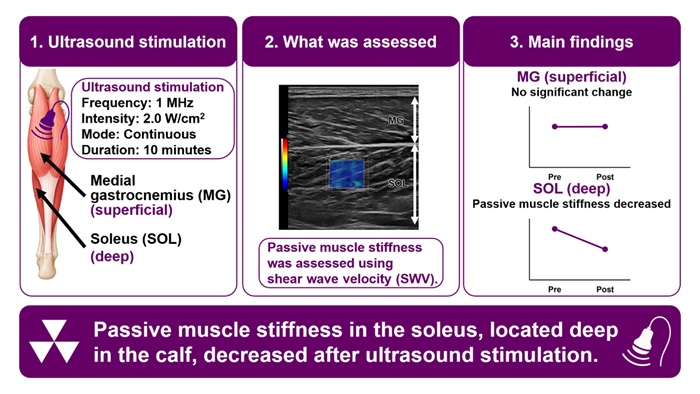
Passive muscle stiffness is a risk factor for muscle strain injuries. Stretching, heat, and vibration have been evaluated on superficial muscles, but approaches for decreasing stiffness in deeper muscles remain unclear. In a recent study, researchers from Japan showed that 10 minutes of ultrasound stimulation can reduce stiffness in a deep calf muscle called the soleus, hinting at a promising non-invasive strategy for managing deep muscle stiffness, with potential future application in sports injury prevention.
Muscle strain injuries are a common problem in sports, and injuries to the triceps surae, the calf muscle group that includes the gastrocnemius and soleus, can significantly affect athletic performance and return to play. One factor that is thought to influence a muscle’s susceptibility to strain is passive muscle stiffness, which refers to the resistance of a relaxed muscle to being stretched. A recent genetic study has strengthened the idea that stiffer muscles are more prone to injury, suggesting that passive muscle stiffness is an important risk factor. Thus, finding safe and feasible ways to reduce this stiffness might help prevent associated injuries.
Several strategies, including stretching, heat, and vibration, can significantly reduce passive muscle stiffness. However, research on these approaches has focused on muscles located close to the skin. The soleus, one of the main muscles of the triceps surae, sits deep underneath the medial and lateral gastrocnemius, which makes it a difficult target. Ultrasound stimulation is used in sports and rehabilitation and produces both heating and mechanical effects in biological tissue. As lower-frequency ultrasound can penetrate relatively deep into tissue, it raises the question: Could ultrasound actually reduce the stiffness of a deep muscle like the soleus?
To this end, a research team including Ph.D. student Tomohiro Umeda, Professor Tatsuya Hojo, and Professor Taku Wakahara from the Graduate School of Health and Sports Science at Doshisha University, Japan, examined the effects of ultrasound stimulation on calf muscle stiffness in 20 healthy adults. Their work was published in the Journal of Biomechanics.
A randomly selected leg of each participant received 10 minutes of continuous ultrasound stimulation at a frequency of 1 megahertz (MHz) and an intensity of 2.0 W/cm², while the other leg served as an untreated control. The researchers then used shear wave elastography, an imaging technique that measures how quickly mechanical waves travel through tissue, to assess muscle stiffness before and immediately after the ultrasound stimulation. Faster shear waves generally indicate stiffer tissue, so a decrease in shear wave velocity (SWV) was interpreted as a decrease in passive muscle stiffness.
The results showed a clear difference between the soleus and the medial gastrocnemius. SWV, an indicator of passive muscle stiffness, decreased significantly in the soleus after the ultrasound stimulation, while no significant change was observed in the untreated leg. In contrast, no significant change in SWV was observed in the more superficial medial gastrocnemius. Interestingly, participants who initially had stiffer soleus muscles tended to show greater reductions in stiffness following ultrasound stimulation. “Our findings suggest that ultrasound stimulation may have the potential to non-invasively decrease passive stiffness in deep muscles such as the soleus,” remarks Mr Umeda, “In the future, this approach may contribute to the development of conditioning and rehabilitation strategies for the prevention of sports-related muscle injuries.”
The different responses of the soleus and medial gastrocnemius may be related partly to their anatomical locations. The soleus is located about 2.44cm below the skin, whereas the gastrocnemius is much closer to the surface at just about 0.53cm. Moreover, differences in the muscles’ tissue composition may also contribute to their different responses, although the underlying mechanisms remain unclear. “Future research could clarify the optimal ultrasound parameters for different muscles and identify which individuals respond most effectively to ultrasound stimulation. Such knowledge could lead to more individualised conditioning and rehabilitation strategies for athletes,” concludes Mr Umeda.
Overall, the results highlight the potential of ultrasound stimulation as a non-invasive approach for managing stiffness in deep muscles that can be difficult to target with other methods. Further research will be needed to determine whether this approach can be incorporated into individualised conditioning and rehabilitation strategies and ultimately contribute to the prevention of sports-related muscle injuries.
Source: Doshisha University
