A treatment to move blood from the umbilical cord into an infant’s body may provide a safe option for preterm infants born after 28 weeks who need rapid support, suggests a study supported by the National Institutes of Health. The procedure, called umbilical cord milking, involves gently squeezing the cord between the thumb and forefinger and pushing the blood into the newborn’s abdomen.
The new findings suggest that concerns raised by a 2019 study of infants born before 28 weeks (which concluded that umbilical cord milking might increase the risk of bleeding inside the brain) do not apply to preterm infants born after 28 weeks. The current study appears in Pediatrics.
The standard procedure, delaying cord clamping while blood naturally flows into the infant’s body, takes 30 to 180 seconds. However, cord milking, takes about 20 seconds, reducing delay for infants who need immediate assistance, such as respiratory support. Both procedures allow for umbilical cord blood to reach the infant’s body before clamping, reducing the risk of anaemia and other complications seen among infants receiving immediate cord clamping and cutting.
The study was conducted by Anup Katheria, M.D., of the Sharp Mary Birch Hospital for Women & Newborns in San Diego, and colleagues in the United States, Canada and Europe. It was supported by NIH’s Eunice Kennedy Shriver National Institute of Child Health and Human Development.
More than 1000 infants were randomly assigned either to umbilical cord milking or delayed cord clamping. Rates of severe intraventricular haemorrhage and/or death did not differ significantly between the two groups (just over 1%). Moreover, the rates of overall intraventricular haemorrhage were also similar between the groups (approximately 12%). The researchers will follow all the infants in the study for two years to observe longer term outcomes.
High rates of antibiotic resistance now meant that drugs to treat common infections in children and babies are no longer effective in large parts of the world, according to findings published in Lancet South East Asia.
The University of Sydney led study found many antibiotics recommended by the World Health Organization (WHO) had less than 50% effectiveness in treating childhood infections such as pneumonia, sepsis (bloodstream infections) and meningitis. The findings show global guidelines on antibiotic use are outdated and need updates.
The most seriously affected regions are in South-East Asia and the Pacific, including neighbouring Indonesia and the Philippines, where thousands of unnecessary deaths in children resulting from antibiotic resistance occur each year.
The WHO has declared antimicrobial resistance (AMR) is one of the top 10 global public health threats facing humanity. In newborns, an estimated three million cases of sepsis occur globally each year, with up to 570 000 deaths: many of these are due to lack of effective antibiotics to treat resistant bacteria.
The findings add to mounting evidence that common bacteria responsible for sepsis and meningitis in children are often resistant to prescribed antibiotics.
The research reveals the urgent need for global antibiotic guidelines to be updated, to reflect the rapidly evolving rates of AMR. The most recent guideline from The World Health Organization was published in 2013.
The study found one antibiotic in particular, ceftriaxone, was likely to be effective in treating only one in three cases of sepsis or meningitis in newborn babies. Ceftriaxone is also widely used in Australia to treat many infections in children, such as pneumonia and urinary tract infections.
Another antibiotic, gentamicin, was found likely to be effective in treating fewer than half of all sepsis and meningitis cases in children.
Gentamicin is commonly prescribed alongside aminopenicillins, which the study showed also has low effectiveness in combating bloodstream infections in babies and children.
Lead author Dr Phoebe Williams from the University’s School of Public Health and Sydney Infectious Diseases Institute is an infectious disease specialist whose research focuses on reducing AMR in high-burden healthcare settings in Southeast Asia.
She also works as a clinician in Australia. Dr Williams says there are increasing cases of multidrug-resistant bacterial infections in children around the world.
AMR is more problematic for children than adults, as new antibiotics are less likely to be trialled on, and made available to, children.
Dr Williams says the study should be a wake-up call for the whole world, including Australia.
“We are not immune to this problem – the burden of anti-microbial resistance is on our doorstep,” she said.
“Antibiotic resistance is rising more rapidly than we realise. We urgently need new solutions to stop invasive multidrug-resistant infections and the needless deaths of thousands of children each year.”
The study analysed 6,648 bacterial isolates from 11 countries across 86 publications to review antibiotic susceptibility for common bacteria causing childhood infections.
Dr Wiliams said the best way to tackle antibiotic resistance in childhood infections is to make funding to investigate new antibiotic treatments for children and newborns a priority.
“Antibiotic clinical focus on adults and too often children and newborns are left out. That means we have very limited options and data for new treatments.”
Dr Williams is currently looking into an old antibiotic, fosfomycin, as a temporary lifeline to treat multidrug-resistant urinary tract infections in children in Australia.
She is also working with the WHO’s Paediatric Drug Optimisation Committee to ensure children have access to antibiotics to treat multidrug-resistant infections as soon as possible, to reduce deaths due to AMR among children.
“This study reveals important problems regarding the availability of effective antibiotics to treat serious infections in children,” says senior author Paul Turner, director of the Cambodia Oxford Medical Research Unit at Angkor Hospital for Children, Siem Reap and professor of paediatric microbiology at the University of Oxford, UK.
“It also highlights the ongoing need for high quality laboratory data to monitor the AMR situation, which will facilitate timely changes to be made to treatment guidelines.”
Children fall broadly into four eating categories, according to new research at Aston University, and parents feed their children differently depending on those categories.
The four categories identified by Dr Abigail Pickard and the team in the School of Psychology are ‘avid’, ‘happy’, ‘typical’, and ‘fussy’. The results, which showed specific temperaments and carer feeding patterns associated with overeating, are published in the journal Appetite.
In the UK, around a fifth of children are overweight or obese when they begin school, rising to around a third by the time they leave primary school at age 11. The team sought to identify eating behaviour patterns and how these are associated with temperament, feeding practices and food insecurity, as a way to predict which children are more at risk of becoming overweight.
Typical eaters made up 44% of the children in the study, while fussy eaters accounted for 16%. But of greatest interest to the team was that around one in five young children in the study were found to show “avid eating,” including greater enjoyment of food, faster eating speed, and weaker sensitivity to internal cues of ‘fullness’. The behaviours that distinguish children with avid eating from those who show ‘happy’ eating (17.7% of children in the study), who have similarly positive responses to food, are wanting to eat (or eating more) in response to the sight, smell or taste of palatable food, and a higher level of emotional overeating. In combination, these eating behaviours can lead to overeating and subsequent weight gain.
Dr Pickard and the team have also shown that there are significant differences in children’s temperament and caregivers’ feeding practices between each of the four eating behaviour patterns. Children with avid eating are more likely to be active and impulsive, and their caregivers are more likely to give them food to regulate their emotions or to restrict food for health reasons. Children with avid eating were also less food secure than children who showed happy or typical eating behaviours.
Principal investigator of the project, Professor Jackie Blissett, said: “Whilst feeding practices are key intervention targets to change children’s eating behaviour and child weight outcomes, there has been little evaluation of how feeding practices interact with children’s food approach behaviours to predict eating behaviour.”
She explained that despite the knowledge of the influence of feeding practices on children’s weight, current public health advice is generic and does not reflect variability in children’s appetites. Parents and caregivers can be left feeling frustrated when trying to manage their child’s food intake. By defining the four eating behaviour profiles, this research project, which is funded by the Economic and Social Research Council and co-developed by Professor Claire Farrow, Dr Clare Llewellyn, Dr Moritz Herle, Professor Emma Haycraft and Dr Helen Croker will make it easier to identify the best feeding practices for each eating pattern and provide tailored, effective advice for parents.
Dr Pickard said: “Parents can use this research to help them understand what type of eating pattern their child presents. Then based on the child’s eating profile the parent can adapt their feeding strategies to the child. For example, children in the avid eating profile may benefit more from covert restriction of food, i.e., not bringing snacks into the home or not having foods on display, to reduce the temptation to eat foods in the absence of hunger. Whereas, if a child shows fussy eating behaviour it would be more beneficial for the child to have a balanced and varied selection of foods on show to promote trying foods without pressure to eat.”
The team has planned further research investigating avid eating behaviour and will invite the caregivers and their children into the specialist eating behaviour lab at Aston University to get a better picture of what avid and typical eating behaviours look like in a real-life setting. All the findings will be integrated and the researchers will work with parents to develop feasible and helpful feeding guidelines to reduce children’s intake of palatable snack foods.
Dr Nicoline Potgieter at the Paediatric and Special Needs Dental Care Unit
The landscape of paediatric dental care in South Africa is poised for a significant transformation, marked by the launch of the nation’s first specialised Paediatric and Special Needs Dental Care Unit. This pioneering initiative, a result of the dedicated efforts of the Department of Paediatric Dentistry of the University of the Western Cape (UWC), The Provincial Government of the Western Cape (PGWC) and Rotary Club, is set to revolutionise Paediatric Dentistry in South Africa. It promises enhanced efficiency, a reduction in anxiety for young patients and a sharpened focus on providing dedicated oral health services to children and especially children with special health care needs.
Working towards the acknowledgment of Paediatric Dentistry as a specialty in South Africa, the need for a dedicated, specialised, child-friendly facility was identified – particularly in the Western Cape. This project stands as a steadfast response to establish such a paediatric dental unit, promising to positively impact service delivery to the children of the Western Cape.
Dalene Swart, President of the Rotary Club of Bellville, is passionate about this transformative initiative. She underscores the present scenario wherein young patients often undergo dental procedures under general anaesthesia.
“The establishment of a dedicated paediatric dentistry surgery unit, equipped with the latest materials and state-of-the-art equipment, not only enhances service quality but also serves as an invaluable training ground for postgraduate students,” she says.
However, the impact transcends mere smiles; it represents a pivotal advancement in South African healthcare, focused on the oral health of children. This project is expected to increase treatment capacity in the field of Paediatric Dentistry, thereby alleviating the workload of local healthcare professionals. It will also foster disease prevention and treatment programmes, bolster healthcare systems, and in time, significantly reduce the burden of disease and need for care under general anaesthesia.
Dr Nicoline Potgieter, president of the South African Association of Paediatric Dentistry and course coordinator for the Masters programme in Paediatric Dentistry at UWC, emphasises the enduring plight of the children in South Africa, who are in dire need of expert oral health care. “It is important to note, oral health directly impacts general health which directly impacts quality of life. It is our responsibility to provide the basic health care needs of our children. The technological advances incorporated into the unit, support minimally invasive techniques and preventative dentistry and the environment is focused on making the dental visit more pleasant for the child patient. Hopefully this is the first of many dedicated paediatric and special needs units across South Africa!”
This project, scheduled for full implementation by the end of October 2023, is the outcome of a collaboration between dedicated Rotary Club participants and the Tygerberg Oral Health Centre, which is a joint platform between UWC and PGWC. It seamlessly aligns with the UWC mission to train paediatric dentists as specialists in South Africa, reaffirming the institution’s commitment to community health and well-being. Similarly, it aligns with PGWC that is dedicated to high quality service rendering to all patients. Under this initiative, the first paediatric dentists will receive specialised training each year, while hundreds of children will benefit from disease prevention and interventions.
The project, funded with a capital expenditure of R1.2 million, draws support from various sources, including cash contributions from the Rotary Club of Bellville, Rotary Foundation and six other Rotary Clubs from the UK, USA and Canada. A significant portion of the funds raised was allocated to state-of-the-art essential dental equipment, consumables, and building materials.
Swart concludes by underlining that this project transcends immediate community needs for specialised paediatric dental care; it is about advancing medical care in South Africa and laying the groundwork for the long-term sustainability and transformation of dental care needs. This is why it enjoys unwavering support from local Rotarians.
A three-year clinical trial has shown that the sublingual immunotherapy (SLIT) is safe in peanut-allergic children ages one to four, with a greater likelihood of desensitisation and remission the earlier the treatment began. SLIT approach where the treatment is given as a small amount of liquid under the tongue, instead of peanut flour that is mixed with other food and then eaten like it is during oral immunotherapy, or OIT.
Published in the Journal of Allergy and Clinical Immunology, this is the first randomised, controlled trial to investigate – in this young age group – the efficacy and feasibility of SLIT.
The study included 50 peanut-allergic children between the ages of one and four, randomised to receive 4mg peanut SLIT versus placebo. Participants were randomised 1:1 to receive either peanut SLIT or placebo. Desensitization to peanut was assessed by double-blind, placebo-controlled food challenge (DBPCFC) after three years of treatment.
Findings showed that peanut SLIT can be highly effective in treating peanut-allergic toddlers with almost 80% tolerating 15 peanuts without allergic symptoms after completing the treatment. With most typical peanut-allergic reactions being caused by one peanut or less, these results would translate into strong protection against exposures to peanut. In addition, researchers showed that remission of the peanut allergy may be possible after peanut SLIT with 63% of the toddlers maintaining their protection three months after stopping the treatment. These new findings show that early intervention with peanut SLIT is promising and warrants further development.
Led by Edwin Kim, MD, associate professor of paediatrics at the UNC School of Medicine, said: “From our prior studies in older children, we were optimistic that peanut SLIT could have a similar treatment effect in toddlers.
“However, what we found was even better. The desensitisation levels we saw were higher than expected and on par with levels we normally would only expect with oral immunotherapy. Just as important, rather than wearing off quickly, we were excited to see that over 60% stayed protected three months after stopping the treatment.”
One of the presumed strengths of the SLIT approach when compared to OIT has been its overall safety and simple administration. While most treatment side effects with OIT are mild to moderate, severe reactions requiring emergency treatment do occur and there remains a critical need to develop treatments with more manageable side effects.
“Peanut OIT is currently available and being offered by increasing numbers of allergists, however we are quickly learning that in addition to its known risk of allergic reactions, the actual doing of OIT can be very difficult for many families,” said Kim. “Peanut SLIT could be a good option to consider as it may be able to provide comparable levels of protection while being safe and easier to administer.”
Compared to OIT, the SLIT approach is likely to be a safer option, Kim said, with the most common side effect consisting of oral itching. Treatments that can protect children from allergic reactions while still being safe and practical for busy families can be life-changing, and researchers are hopeful that peanut SLIT can be one of those options.
“Even with the push to introduce peanut in early childhood in order to prevent the allergy, peanut allergy remains one of the most common food allergies,” said Kim. “A result of early peanut introduction is that we are diagnosing peanut allergy at younger and younger ages making it vitally important to develop treatments that can be safe and effective at preventing allergic reactions in these young children.”
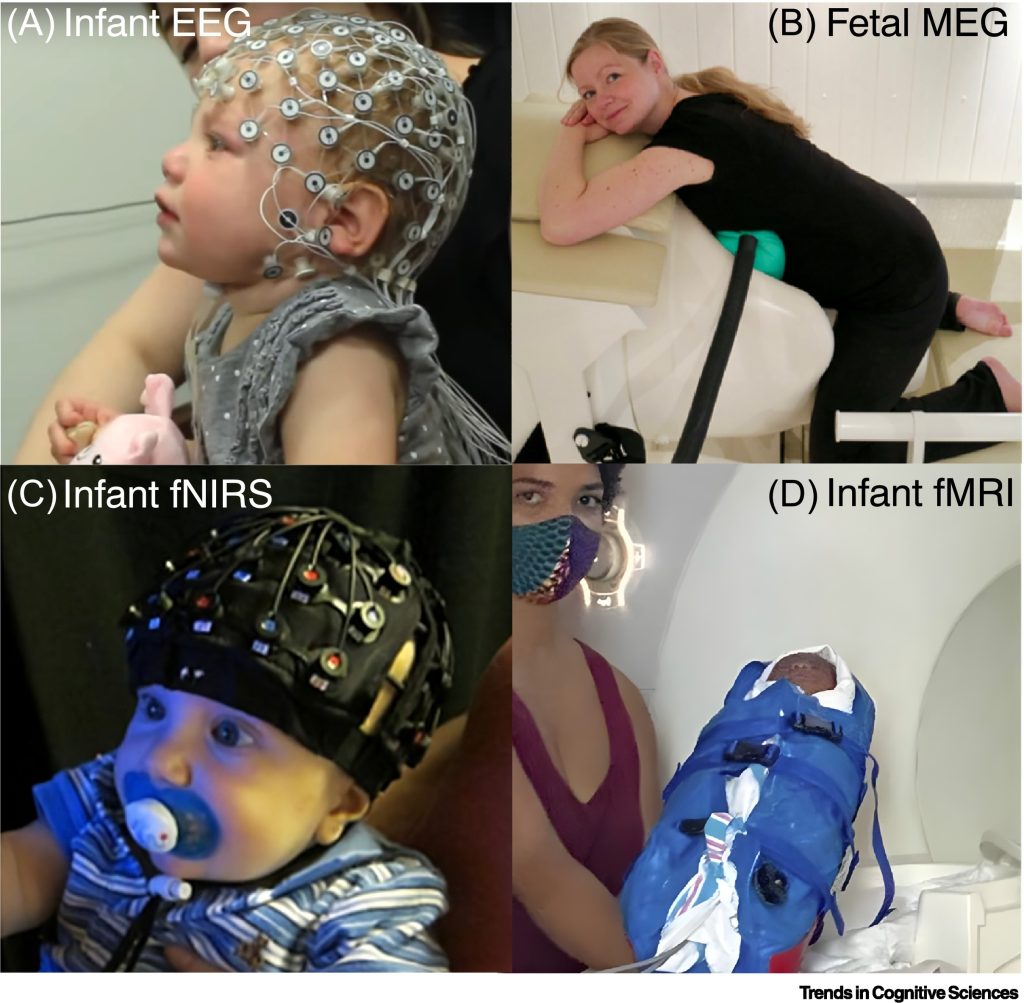
Figure I Neural measurement tools for studying the emergence of consciousness. Examples of techniques for recording brain activity and/or neuroimaging in infants and foetuses. (A) Infant electroencephalography (EEG) with a geodesic electrode net. (B) Foetal magnetoencephalography (MEG) recorded from a pregnant woman. (C) Infant functional near infrared spectroscopy (fNIRS) recording with multichannel optode cap. (D) An infant is prepared for functional magnetic resonance imaging (fMRI). Source: Bayne et al., 2023
There is evidence that some form of conscious experience is present by birth, and perhaps even in late pregnancy, an international team of researchers has found. The findings, published today in Trends in Cognitive Science, have important clinical, ethical and potentially legal implications, according to the authors.
Converging evidence from studies of functional network connectivity, attention, multimodal integration, and cortical responses to global oddballs suggests that consciousness is likely to be in place in early infancy and may even occur before birth. Over the decades, theorists have argued that consciousness emerges from anywhere from 30 to 35 weeks of pregnancy (based on EEG of the foetus’s brain) to 12 to 15 months of age (based on higher-order representational theory).
In the study, the researchers argue that by birth the infant’s developing brain is capable of conscious experiences that can leave a lasting imprint on their developing sense of self and understanding of their environment.
The team comprised neuroscientists and philosophers from Monash University, in Australia, University of Tübingen, in Germany, University of Minnesota, in the USA, and Trinity College Dublin.
Although each of us was once a baby, infant consciousness remains mysterious, because infants cannot tell us what they think or feel, explains one of the two lead authors of the paper Dr Tim Bayne, Professor of Philosophy at Monash University.
“Nearly everyone who has held a newborn infant has wondered what, if anything, it is like to be a baby. But of course we cannot remember our infancy, and consciousness researchers have disagreed on whether consciousness arises ‘early’ (at birth or shortly after) or ‘late’ – by one year of age, or even much later.”
To provide a new perspective on when consciousness first emerges, the team built upon recent advances in consciousness science. In adults, some markers from brain imaging have been found to reliably differentiate consciousness from its absence, and are increasingly applied in science and medicine. This is the first time that a review of these markers in infants has been used to assess their consciousness.
Co-author of the study, Lorina Naci, Associate Professor in the School of Psychology, who leads Trinity’s ‘Consciousness and Cognition Group, explained: “Our findings suggest that newborns can integrate sensory and developing cognitive responses into coherent conscious experiences to understand the actions of others and plan their own responses.”
The paper also sheds light into ‘what it is like’ to be a baby. We know that seeing is much more immature in babies than hearing, for example. Furthermore, this work suggests that, at any point in time, infants are aware of fewer items than adults, and can take longer to grasp what’s in front of them, but it is easier for them to process more diverse information, such as sounds from other languages.
For the management of children’s cancer symptoms, cannabis products have increased in popularity, but questions remain over their efficacy and safety. A recent review of published studies to date shows a lack of evidence to determine the dosing, safety, and efficacy of medical marijuana or cannabis-containing products for managing symptoms experienced by children with cancer. The analysis is published online in CANCER, a peer-reviewed journal of the American Cancer Society.
Although great strides have been made in treatments for childhood cancer, even leading to cures for many patients, many children still suffer from symptoms such as pain, anxiety, and weight loss related to cancer and its treatment. Over the last decade, cannabis products, both synthetic cannabinoids and natural phytocannabinoids, have gained popularity with patients and families for managing such symptoms, but paediatric oncologists are cautious to authorise cannabis for their patients given the limited data to inform dosing, product selection, and safety monitoring.
To provide insights for clinicians and parents, and to inform an upcoming clinical trial, a team led by Lauren E. Kelly, PhD, associate professor of pharmacology and therapeutics in the Rady Faculty of Health Sciences at the University of Manitoba, searched the medical literature to summarise existing knowledge about the potential benefits and harms of cannabis products in children with cancer.
The investigators identified 19 unique studies with a total of 1927 participants with cancer: eight retrospective chart reviews, seven randomised controlled trials, two open‐label studies, and two case reports. The products studied included medical-grade cannabinoids (such as the prescription drug nabilone), synthetic cannabinoids, and unspecified cannabis herbal extracts. Products were most commonly used to manage chemotherapy‐induced nausea and vomiting.
In the randomised controlled trials, patients who used cannabinoids were more likely to experience drowsiness, feeling high, dizziness, and dry mouth. Also, trial participants who received cannabinoids were almost four times more likely to drop from the study due to adverse events, compared with the control group who received placebo. Across all included studies, no serious cannabis‐related adverse events were reported.
Dr Kelly and her colleagues noted that most studies did not adequately describe the types, dosing, frequencies, and routes of administration of cannabis products, and outcomes were mixed and were reported in different ways. Therefore, researchers should develop standards for reporting cannabis exposures, cannabis‐related effects, and patient outcomes.
“It was difficult to measure benefit across studies, given a range of different outcomes and study designs; however, in interventional studies with active control groups, cannabinoids performed better in managing nausea and vomiting. Data are lacking on cannabinoids’ effects on pain, mood, sleep, and health-related quality of life,” said Dr Kelly. “Given that some children report benefits and some children experience adverse events, it is critical that more rigorous studies evaluating the effects of cannabinoids on children with cancer are conducted and shared with parents, patients, and the health care community.”
This literature review informed the design of a three-arm tolerability trial later this year.
Leukaemia has been identified as the most prevalent cancer among the country’s youth, according to the latest report from the National Cancer Registry (NCR) of South Africa (2021). However, approximately half of children with cancer remain undiagnosed, with the majority of cases only being detected during the advanced stages of the illness. This is partly attributed to a lack of awareness of the early warning signs of childhood cancer.
As the world observes Bone Marrow & Leukaemia Awareness Month until the 15th of October, Dr Candice Hendricks, Paediatric Haematologist and Medical Spokesperson for DKMS Africa shares that leukaemia can be categorised as acute leukaemias or chronic leukaemias, each with varying symptoms. “Acute leukaemias are far more common in children and can further be divided into acute lymphoblastic- (ALL) and acute myeloid leukaemia (AML). Among children, especially those aged between two and 10, Acute Lymphoblastic Leukaemia (ALL) is the most common blood cancer in this age group.
“This disease arises from genetic mutations in immature lymphocytes called lymphoblasts which are located in the bone marrow. The mutations lead to uncontrolled growth of these lymphoblasts,” she explains. “Lymphoblasts are abnormal blood stem cells that lose the ability to make mature blood cells. The uncontrolled growth of these cells in the bone marrow displaces normal blood cell development and leads to a decrease in properly functioning red blood cells, white blood cells, and platelets. Patients may potentially present with an elevated white blood cell count on blood results, however, their impaired function leaves the body vulnerable to infections.”
Aligned with the NCR, Dr Hendricks emphasises that early symptoms often go unnoticed, as they mimic common, mild conditions, causing many patients and those who care for them to overlook them. “However, the severity of these symptoms escalates rapidly with acute leukaemias and persist even after standard treatment for infections. A high index of suspicion is required in diagnosing patients, and if any symptom persists, an immediate full blood count test is necessary, followed by additional tests if irregularities are detected.”
Prominent symptoms indicating the disease include:
Blood clotting disorders or blood diathesis characterised by easy bruising from minor impacts and the appearance of small reddish spots on the skin. Other signs encompass blood in urine, as well as uncontrollable gum and nose bleeding.
Muscle and joint pain, particularly in the limbs, along with frequent limb numbness.
Fever and night sweats.
Anaemia caused by a deficiency of red blood cells, leading to constant fatigue, reduced exercise capacity, lethargy, sleepiness, and pale skin.
Recurrent infections that persist despite antibiotic treatment due to cancer cells impairing the immune system. Pathological cancer cells displace healthy leukocytes, rendering the body susceptible to various viral, bacterial, and fungal infections.
Loss of appetite and weight loss.
Enlarged lymph nodes.
Stomach pain resulting from spleen and/or liver enlargement.
In support of Bone Marrow & Leukaemia Awareness Month, DKMS Africa continues to raise awareness and funds to cover the registration costs for as many potential stem cell donors as possible. Stem cell donations offer the best chance of survival for children afflicted by high-risk leukaemia which does not respond to or recurs after standard treatment. Answer the call! If you’re aged between 17 and 55 and in good general health, please register at https://www.dkms-africa.org/register-now. Registration is entirely free and takes less than five minutes.
For further information, get in touch with DKMS Africa at 0800 12 10 82.
About DKMS DKMS is an international non-profit organisation dedicated to saving the lives of patients with blood cancer and blood disorders. Founded in Germany in 1991 by Dr. Peter Harf, DKMS and organisations of over 1,000 employees have since relentlessly pursued the aim of giving as many patients as possible a second chance at life. With over 11 million registered donors, DKMS has succeeded in doing this 100,000 times to date by providing blood stem cell donations to those in need. This accomplishment has led to DKMS becoming the global leader in the facilitation of unrelated blood stem cell transplants. The organisation has offices in Germany, the US, Poland, the UK, Chile and South Africa. In India, DKMS has founded the joint venture DKMS-BMST together with the Bangalore Medical Services Trust. International expansion and collaboration are key to helping patients worldwide because, like the organisation itself, blood cancer knows no borders.
DKMS is also heavily involved in the fields of medicine and science, with its own research unit focused on continually improving the survival and recovery rate of patients. In its high-performance laboratory, the DKMS Life Science Lab, the organisation sets worldwide standards in the typing of potential blood stem cell donors.
According to a new international study published in the New England Journal of Medicine, cleft palate surgery at the age of six months provides better conditions for speech and language development compared to surgery at 12 months.
Isolated cleft palate is a congenital condition where the palate is not closed and there is an opening between the mouth and the nose. The condition occurs in 1 to 25 per 10 000 births worldwide.
“There has previously been limited evidence for the optimal age for cleft palate surgery in children to achieve the best results”, says Anette Lohmander, professor emeritus at at Karolinska Institutet and principal investigator for the Stockholm centre in the study.
The study, by researchers from Karolinska Institutet and Karolinska University Hospital, among others, involved 558 children from 23 different centres around Europe and South America. Of these, 235 children were randomly assigned to a group to undergo surgery at six months of age and 226 children were randomly assigned to undergo surgery at twelve months of age.
Speech-language therapists/pathologists performed standardised audio-video recordings at one, three and five years of age. The researchers then evaluated the children’s babbling, velopharyngeal function, and speech.
At age five, the researchers found insufficient velopharyngeal function in 21 children (8.9%) who had surgery at six months of age compared with 34 children (15%) who had surgery at age 12 months.
Complications resulting from surgery were rare in both groups. Four serious adverse events were reported but were resolved on follow-up.
The conclusion of the study was that velopharyngeal function for speech at five years was better in the children who had undergone surgery at six months of age than in those who had undergone surgery at 12 months of age. Risks associated with earlier repair may include maxillary arch constriction and the need for secondary surgery for velopharyngeal insufficiency.
“An additional advantage of the early surgery age was a higher incidence of canonical syllables. It is a milestone in children’s language development and is established in typically developed children by the age of ten months at the latest,” says Anette Lohmander, who continues. “The children included in the study had no developmental delay or other deviant conditions. The conclusion is that when it is possible to operate on the cleft palate early, it seems to provide the best conditions for speech and language development.”
Mania is a possible but rare side effect of treatment with antidepressant medication in adults, but there is little known about its occurrence in children and adolescents. A newly published paper in JAMA Psychiatry investigated this, finding no evidence of mania/hypomania induced by antidepressants by 12 weeks after treatment initiation. However, caution is necessary in treatment for children with more severe depression or where a parent has bipolar disorder.
“In children and adolescents with unipolar depression, we did not find evidence of antidepressant-induced mania/hypomania by 12 weeks after treatment initiation”, says first author Suvi Virtanen, postdoctoral researcher at Karolinska Insitutet. “This corresponds to the timeframe for antidepressants to exert their psychotropic effect and when treatment-induced mania is expected to emerge. Hospitalisations, parental bipolar disorder, and the use of antipsychotics and antiepileptics were the most important predictors of mania/hypomania.”
Antidepressants are increasingly prescribed to paediatric patients with unipolar depression (as opposed to bipolar depression which is seldom diagnosed in childhood), but little is known about the risk of treatment-emergent mania (ie, the transition from depression into mania shortly after the initiation of antidepressant treatment). Previous research suggests paediatric patients may be particularly vulnerable to this adverse outcome. The results provide complementary information to randomised clinical trials (RCTs) from a large cohort of patients treated in a real-world setting.
The researchers conducted a register-based study on children and adolescents, aged 4–17, diagnosed with unipolar depression between 2006 and 2019. They applied the emulation of target trial framework to guide the study design and analysis, reducing the bias of observational studies and mimicking a RCT.
Antidepressant treatment was unrelated to the risk of mania/hypomania, suggesting other characteristics are more relevant when evaluating which patients may have an increased risk of switching from unipolar depression into mania. “Our model using administrative information from several national registers had a moderate predictive ability, suggesting it is possible to identify patients at high risk for mania/hypomania with a prognostic clinical prediction model. The model has potential to be improved in later work”, says senior author Zheng Chang, Principal Researcher at the Department of Medical Epidemiology and Biostatistics.