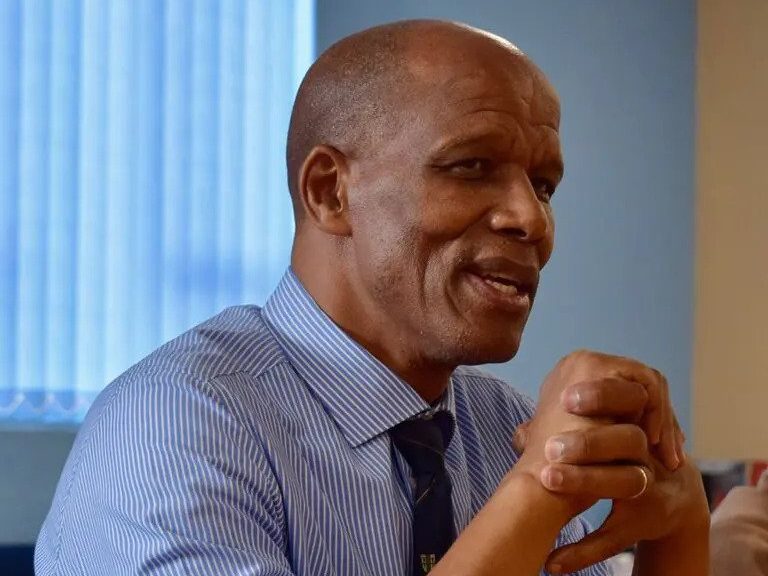
Dr Chivaugn Gordon, head of undergraduate education at UCT’s Department of Obstetrics and Gynaecology, reflects on her love of teaching future doctors about women’s health issues. PHOTO: Nasief Manie/Spotlight
With humour and wearing an occasional wig, Dr Chivaugn Gordon teaches medical students about serious women’s health issues. During hard lockdown she delighted students at the University of Cape Town (UCT) with educational videos using household items as props. For example, she created an endometrium (the inner lining of the uterus) from hair gel and red glitter, performed a biopsy on a potato, and showed a chicken hand puppet go into labour.
One video features a patient named Zoya Lockdownikoff – who is a spy – consulting with her doctor about abnormal menstrual bleeding. Gordon, in a blonde wig with round sunglasses, plays Lockdownikoff; and Gordon’s husband, Dr Adalbert Ernst, plays her doctor.
Lockdownikoff explains that the bleeding started when she “did a very complicated backflip to escape a very compromising situation” and that it’s ruining her expensive super-spy coats.
Gordon is head of undergraduate education at UCT’s Department of Obstetrics and Gynaecology, while Ernst is with the university’s Department of Anaesthesia and Perioperative Medicine.
Speaking from her yellow-walled lounge in Cape Town’s Bergvliet, Gordon says: “I became a doctor because I love working with patients. And then I realised, oh cool, I love teaching too. And now I can do these two things together.”
Interest in IPV
For Gordon a driving interest has been intimate partner violence (IPV) which she introduced into her undergraduate curriculum in 2015.
“The aim is to have graduating doctors who are able to recognise intimate partner violence. Everybody thinks that you can’t possibly be abused unless you have a black eye or a fractured arm. But actually, IPV is often more psychological. It’s often psychological abuse. So the challenge is to teach young doctors what are the red flags in someone’s behaviour, or in their clinical presentation, that might indicate IPV.”
Published online in April, Gordon delivered a talk for TEDxUCT called “Tackling IPV, one awkward dad conversation at a time”, in which she notes IPV is “a global pandemic that has been ongoing since time began”. The title refers to Gordon’s father who raised her.
According to a paper published in the journal Lancet Psychiatry last year, IPV is the most common form of violence worldwide; it is most prevalent in unequal societies, and its victims are mostly women and girls. The paper states that worldwide 27% of women and girls aged 15 and older have experienced physical or sexual IPV, but in South Africa the figure is estimated to be much higher, between 33 and 50%.
Gordon contributed to South Africa’s revised Domestic Violence Amendment Act of 2021, through UCT’s Gender Health and Justice Research Unit.
The new legislation broadens the definition of domestic violence to include (above and beyond physical and sexual abuse) emotional, verbal or psychological abuse, which is described as “a pattern of degrading, manipulating, threatening, offensive, intimidating or humiliating conduct towards a complainant that causes mental or psychological harm…including (repeated) insults, ridicule or name calling; (repeated) threats to cause emotional pain; the (repeated) exhibition of obsessive possessiveness or jealousy…”
Gordon highlights the term coercive control. “Because that underpins most serious intimate partner violence. So, somebody who is extremely controlling; they want their partner to do what they want, when they want, and how they want immediately. They normally start isolating you from friends and family so they can spin a narrative of your reality that can’t be contested by anyone else. And it also makes it more difficult to leave.”
Red flags
Gordon highlights some of the IPV red flags that doctors should look for in their patients.
“Depression, anxiety, PTSD, insomnia, [and] things like self-medicating with substances,” she says. “Because when you are living in absolute, abject terror every day of your life, it’s going to manifest in some kind of psychological manner. So, when people have been broken down and worn down and their self-esteem has been eroded it also affects the way they might interact with the healthcare professional.
“Big red flags come out in body language. Usually when someone goes to a doctor, they tell you everything about all their symptoms, because they want you to make them better. So, if you’ve got a patient who is closed off, they’re not making eye contact, they’re avoiding answering your questions, they’re just very reticent and you can’t get anything out of them…then you’ve got to think.”
Gordon stresses that IPV happens across economic strata and in all walks of life. “Every time I run this workshop, a medical student who comes from a very privileged background, from a very financially stable, loving home, comes to me, saying this is happening to her. It happens everywhere. I’ve got medical colleagues, several, who have experienced intimate partner violence. It doesn’t discriminate.”
In what is likely one of the largest treatment rollouts in South African history, well over four million people living with HIV have started taking the antiretroviral dolutegravir since its introduction around four years ago. Now, according to a recent study published in the Lancet medical journal, use of dolutegravir in South Africa is associated with more people staying on treatment and higher rates of viral suppression.
The use of a three-in-one combination of the antiretroviral drugs tenofovir, lamivudine and dolutegravir (TLD for short) for the treatment of HIV was first recommended by the World Health Organization (WHO) in 2018. A year later it was recommended in the South African treatment guidelines as first line treatment for HIV and a three-year tender was awarded. Since then, dolutegravir has largely replaced another antiretroviral called efavirenz.
Today, TLD is the recommended treatment option for most people living with HIV in the country. The 2023 National antiretroviral (ARV) guidelines also include recommendations for the use of child-friendly formulations of dolutegravir and dolutegravir containing regimens in kids. Spotlight reported on these here.
Around 4.7m people in SA taking dolutegravir
According to Foster Mohale, spokesperson for the National Department of Health, in 2019 the HIV clinical guidelines were revised to include a fixed combination dose of TLD “for all eligible people for use as the first line regimen.”
Based on this, the department set a goal that 90% of those eligible for it should receive TLD as a first line regimen. In terms of meeting this goal, Mohale says that by March 2023, just over four million (4 127 427) people were on TLD. Additionally, about 650 000 (653 884) people were on other dolutegravir based regimens. Altogether, there are thus now over 4.7 million people in the country on treatment combinations that include dolutegravir.
“Based on the March 2023 data, 90% of clients on first line regimen were on TLD. However, performance varies by province,” he says.
Of the total number of people on ART in the public health sector, 75.8% are on TLD, according to Mohale.
Trends in the roll out
While on paper the country’s transition from efavirenz to dolutegravir-based regimens seems to have been smooth, the reality on the ground has been more complex. A study published in the Lancet earlier this year looked at real-world rollout data from 2019 to 2022. The study was conducted in 59 clinics across the country and collected data from two cohorts-one cohort were first time initiators of ART and the other were transitioning from regimens that did not include dolutegravir to ones that did.
In the initiator cohort, just over 45 000 people were initiated on ART between December 2019 and February 2022. Of those, 68.9% were initiated on dolutegravir-based regimens, 31.1% on efavirenz-based regimens, and 0.1% on nevirapine-based regimens.
Those initiated on dolutegravir-based regimens were more likely to still be on treatment a year later and were also more likely to be virally suppressed than those who were initiated on the other regimens.
In December 2019, in the transition cohort, just over 180 000 people were on a non-dolutegravir first line regimen. By February 2022, 67% of them had transitioned to a dolutegravir-based regimen. These people were also more likely to be retained in care at 12 months and be virologically suppressed than those who had not switched to a dolutegravir-based regimen.
“That’s good for a number of reasons. It means that the treatment’s working, people are less likely to get unwell and also, they can’t transmit the virus onto other people,” explains Dr Jienchi Dorward, one of the study authors and an academic clinical lecturer at the University of Oxford and honorary associate scientist at the Centre for the AIDS Programme of Research in South Africa (CAPRISA).
‘Bumpy transition’
Dr Yukteshwar Sookrajh, a Senior Medical Practitioner at the eThekwini Municipality Health Unit who was also involved in the study, tells Spotlight that the rollout quickly gathered momentum.
“But initially there were some issues to navigate around drug interactions; concurrent TB infection and the use of dolutegravir in women of childbearing potential,” he says. “Once those concerns were addressed, the comfort of switching to dolutegravir was increased and we find that the majority of our patients have now safely transitioned across to dolutegravir-based regimens.”
In many ways South Africa was slow in rolling out dolutegravir compared to other African countries, according to Professor Francois Venter, the head of Ezintsha at Wits University. Reasons for this, he says, include an initial concern around the safety of dolutegravir use among pregnant women, and disruption in training due to the COVID-19 pandemic.
He says that the South African Clinicians society was alerted during the COVID-19 pandemic that many patients in the public health sector had still not been transitioned to dolutegravir. An education campaign was then launched to encourage clinicians to start or switch patients to dolutegravir.
However, as it stands now the rollout of the drug in the public sector has been a huge success, despite what Venter calls a “bumpy transition”.
Initial safety concerns
One important reason to conduct the study reported in the Lancet, according to Dorward, was a safety concern regarding the use of dolutegravir by pregnant women. An earlier study conducted in Botswana called Tsepamo found a higher prevalence of neural-tube defects (a type of birth defect) associated with dolutegravir exposure at conception than with other types of antiretroviral exposure. As more data has been gathered since, it has however become clear that dolutegravir does not in fact increase the risk of neural-tube defects.
But the Tsepamo scare did impact who was initiated and transitioned onto dolutegravir in first two years of the rollout.
“The initial concerns around neural-tube defects and the use of dolutegravir in women of childbearing potential clearly hampered rollout of dolutegravir in women – and this has been clearly demonstrated in this study,” says Sookrajh.
The Lancet study found that pregnant women and non-pregnant women were less likely to be initiated on dolutegravir than men early in the rollout, with the biggest difference between women and men aged 15 to 24 years old. This difference decreased with age and by age 55 there was no difference between men and women receiving dolutegravir.
But this changed over time and by September 2021 women were as likely to get initiated on dolutegravir as men. Spotlight previously reported that the rollout was done in two stages. In the first stage men, adolescent boys, women on reliable contraception, and older women were prioritised.
Of those who started treatment during the study period, 46.9% of the pregnant women in the cohort were initiated on dolutegravir-based regimens, while 63.9% of the non-pregnant women and 82.3% of the men in the cohort were initiated on dolutegravir-based regimens.
“In both those groups [cohorts] we found that women were less likely than men to get dolutegravir, but interestingly, this was particularly in younger women,” Dorward explains. “As time went on, the difference between men and women became much less…around June to September 2021 was a time period where we found that women and men pretty much began to equally get dolutegravir.”
Dorward says the data showed an uptick in women in the study being given dolutegravir once the South African guidelines changed to reflect that there was no longer a concern around neural-tube defects. It is thus likely that the safety concern was responsible for the lower initial uptake among young women.
He adds that the messaging around this potential risk was based on the evidence available at the time and was clearly outlined in the guideline document and training for dolutegravir use, but these did not appear to adequately allay these concerns among healthcare workers.
“The risks versus benefits needed to be messaged in a more effective way such that healthcare workers were more comfortable and confident in offering dolutegravir to women,” he says. Based on this experience Sookrajh adds that in future there needs to be more engagement with “practitioners on the ground to determine what type of messaging and supportive materials are required to facilitate better understanding of guidelines at the coal face.”
Another concern for some healthcare workers has been that dolutegravir-based regimens have been associated with greater weight gain than efavirenz-based regimens. But, as argued in a recent editorial in the Southern African Journal of HIV medicine, association is not the same as causation and it may well be that efavirenz inhibits weight gain rather than dolutegravir promoting it. People living with HIV who start taking antiretroviral medicines often gain weight as their health recovers.
New guidelines should further boost uptake
Sookrajh says that the National Department of Health’s antiretroviral (ARV) 2023 guidelines will further improve the uptake of dolutegravir in the public healthcare system.
“With the April 2023 National Department of Health ARV Guidelines, we actually find that further barriers to switching to dolutegravir have been removed and dolutegravir is clearly placed as the preferred drug of choice in almost all scenarios for both first- and second-line antiretrovirals,” he says.
“I think the new [ARV] guidelines hopefully will be a big improvement for people who are on treatment, and part of that is possible because we’re using the drug that is better. You’re less likely to get resistance with dolutegravir so we’re less worried if people don’t take treatment properly that they might get drug resistance, although we still need more research to be sure about that,” Dorward says. “And it’s still very important for people to take treatment consistently to suppress the virus and maintain their own health and prevent onward transmission.”
According to Venter, there needs to be proper resistance surveillance to detect potential dolutegravir resistance.
“We can’t take for granted we’ll never have resistance [to dolutegravir]…eventually there will be the occasional patient that does have resistance, but we need proper surveillance there,” he says. “And then we need to keep an eye on things. There are still patients getting HIV…there’s still a lot of new infections…we need to make that stop…we’ve got amazing PrEP and way too few people getting it. So, we do need to start addressing that.” (PrEP, or pre-exposure prophylaxis, refers to antiretrovirals taken to prevent HIV infection.)
Venter adds that while successful in the public health sector, the uptake of dolutegravir has been extremely slow in the private health sector for reasons unknown to him.
Several sessions at the 11th SA AIDS conference, recently held in Durban, highlighted the worrying fact that key HIV numbers such as treatment coverage are much lower in children than in adults. There is hope, however, that new treatments and new treatment guidelines might help close the gap.
In a plenary session, Dr Sandile Buthelezi, Director General of the National Department of Health, told delegates that on UNAIDS’ 95-95-95 targets, children in South Africa are at 81-65-68. This means that 81% of children living with HIV have been diagnosed, 65% of those diagnosed are on antiretroviral treatment, and 68% of those on treatment are virally suppressed. For the South African population as a whole, the numbers are at 94-76-92.
Throughout the conference, various speakers highlighted the fact that only 65% of children who have been diagnosed are on treatment as a particular concern. To close the gap and reach UNAIDS’ target of 95%, just over an additional 88 000 children would need to be initiated on treatment.
Professor Lee Fairlie, Director of Maternal and Child Health at Wits RHI, said in a presentation that only 52% of children younger than 14 living with HIV are on treatment. Fairlie also pointed out that children lagged behind substantially when it comes to viral suppression, and this is particularly challenging in the youngest age groups.
Not all bad news
But it was not all bad news at this year’s conference. One piece of good news is that new and better child-friendly antiretroviral formulations are being rolled out in South Africa. These new treatments should make it easier for children to start and stay on treatment – children often find it difficult to take medicines formulated for adults, due to factors like incorrect dosing, large pills, and bad taste.
The National Department of Health recently updated the country’s antiretroviral treatment guidelines to allow for the use of several of these new formulations and better HIV treatment regimens for children. Most notable is the introduction of a new regimen consisting of the medicines abacavir, lamivudine and dolutegravir (ALD for short).
Speaking at the conference, Dr Leon Levin, a paediatrician who has been treating infants, children, and adolescents living with HIV for almost three decades, pointed out that the availability of new paediatric formulations had a major impact on the new treatment guidelines. (Spotlight previously reported on the registration of some of these new formulations here.) Levin is also the Senior Technical Advisor in Paediatrics at the NGO Right to Care.
One such child-friendly formulation is a 120/60mg scored, dispersible tablet of abacavir and lamivudine that can be taken in patients who weigh between 3 and 25kg. It is given once daily and two generics are registered with the South African Regulatory Authority (SAHPRA). “It’s going to literally replace all the other paediatric Abacavir+3TC formulations. You can swallow it, chew it, crush it, or dissolve it in water. So [it’s] very versatile,” he said.
Also important is a paediatric formulation of the antiretroviral dolutegravir – a medicine that forms the backbone of HIV treatment in adults. According to Levin, the child-friendly version of dolutegravir is not available to everyone yet, and many clinicians still need to undergo training on how to use it. It is a 10mg dispersible, scored tablet given once daily that can be used at 3kg and higher and from four weeks of age onward. There are two generic versions of this product registered with SAHPRA.
The introduction of paediatric dolutegravir is likely to overshadow the introduction of a four-in-one formulation of abacavir, lamivudine, lopinavir/ritonavir. The four-in-one combination has to be taken twice daily, is strawberry flavoured and comes in a powder form. “Unfortunately, this product to nobody’s fault was launched at the same time as paediatric dolutegravir. Which means paediatric dolutegravir is going to take centre stage and this product unfortunately is not going to be used much,” Levin said.
Updated guidelines
Levin explained that the changes to South Africa’s treatment guidelines focused on doing two main things when it comes to children living with HIV, the first is to implement an optimised regimen – the ALD regimen and the second is to create an “enabling environment to support engagement in care and adherence”. He said that with the new guidelines, we can expect “much improved [viral] suppression, optimised regimens, improved synchronisation of clinic visits, happier patients and their families and clinicians as well”.
A big change to the guidelines is that now children who weigh 3kg and are four weeks of age should be started on the ALD regimen, instead of the abacavir, lamivudine, and lopinavir/ritonavir regimen that was previously recommended. “This is a major change. It’s a fantastic, well-tolerated regimen. It’s potent and you’re going to get around a lot of the issues you had with these younger children,” Levin said.
Once the children on this regimen get to 30kg, they will be switched to a regimen containing tenofovir, dolutegravir, and lamivudine (TLD for short). TLD is also the regimen adults living with HIV in South Africa are offered when starting treatment for the first time.
For children who are already on treatment, the new guidelines recommend that all children who are four weeks of age and older and weigh 3kg or more should be transitioned to a dolutegravir-containing regimen. For children with suppressed viral loads, the switch to ALD or TLD is straightforward, while for children without viral suppression, it can get more complicated.
Another important change is that children over five years of age are now eligible for Repeat Prescription Collection Strategies (RPCs) if they are virally suppressed and had an age-appropriate disclosure, which means that their HIV status has been explained to them in a way that is appropriate for their age, as outlined in the guidelines. For children under five, they can be given a three months supply at a time, providing they are at least six months old. Levin pointed out that whenever RCPs or a three months supply is considered for children, it is essential to look at where and how the parents may be receiving their own antiretroviral treatment so that it can be co-ordinated, and parents don’t have to go to two different places to collect the medications.
New options in the pipeline
While the paediatric formulations included in the new guidelines are a step forward, there are experimental treatments in the pipeline that may make treatment yet more convenient for children.
“There’s a rich pipeline of new combinations and drug delivery developments. Hopefully, this will further improve access, clinical and virological outcomes,” Fairlie said in a conference presentation. “Obviously, the paediatric market is extremely small and then one has to maintain enthusiasm for manufacturers to actually continue to look at the paediatric population. And so, merging of treatments and prophylaxis regimens is really what would work going forwards.”
In her presentation, she specifically referred to long-acting formulations of cabotegravir (CAB-LA) and rilpivirine (RPV). CAB-LA has already been approved by SAHPRA for HIV prevention in adults and, as Spotlight reported last week, pilot projects evaluating how to best provide the CAB-LA injection in South Africa are set to start soon. The combination of CAB-LA and rilpivirine injections has been approved for the treatment of HIV in adults by the United States Food and Drug Administration, but not yet by SAHPRA. The injections are administered every two months.
Fairlie says that currently there are several studies either ongoing or set to start soon for the use of these agents in the paediatric and adolescent age groups. In addition, there are also trials planned to test another long-acting medication called lenacapavir in adolescents and broadly neutralising antibodies (bNAbs) in children.
She also highlighted several improved delivery methods that are in the pipeline for paediatrics. These include a mechanism that doesn’t require water, like oro-dispersible tablets, also known as fast melts, which disintegrate in the mouth as well as oral films that stick to the mouth, disintegrate there, and dissolve. There are also various tablet options that are small enough for children to swallow easily. Like multi-particulates, which are small and solid, multiple-unit dosages that can take the form of granules, pellets, or beads. Mini-tablets are also a prospect – these are compressed tablets no larger than 4ml. Finally, there are novel mechanisms like long-acting oral drug delivery systems and micro-array patches. Fairlie explained that long-acting oral drugs are where a drug is stored in the centre of a capsule that has a number of “arms”, which are able to keep the capsule in the stomach and slowly dissolve and release the drug into the stomach. This allows for slow-release dosing. The “arms” tend to break down after about seven days.
Technical work on the discovery of new medicines is not commonly done in Africa, but Kelly Chibale, a professor in organic chemistry and founder of H3D at the University of Cape Town is changing this. PHOTO: Nasief Manie/Spotlight
Inside Professor Kelly Chibale’s office the bookshelves are packed with awards. On the walls, framed photographs include his class photo at Cambridge University in the United Kingdom, dated 1989.
Chibale is a professor of organic chemistry and founder of the pioneering Holistic Drug Discovery and Development Centre – H3D – at the University of Cape Town. While many important clinical trials have been conducted by Africans in Africa, the kind of drug discovery work that Chibale is doing is rare on the continent.
Chibale relays how he sees molecules everywhere – in hair, in clothes, in all of life around us. His animated voice fills the space as he speaks. “With organic chemistry, we are very visual. We look at chemical structures. If you give me a chemical structure, oh my goodness, my head starts racing about what I can do with it, or how I can change it to create new properties or new materials.”
H3D has 76 staff members investigating novel chemical compounds that could become new lifesaving medicines, with a focus on malaria, tuberculosis, and antibiotic-resistant microbial diseases.
Effectively a small biotech company embedded within the university, to date, H3D’s most notable discovery was a compound in 2012 which they named MMV390048, which had the potential to become a single-dose cure for malaria. Phase I clinical trials saw MMV390048 tested on human volunteers in South Africa and in Australia.
“In Australia, the testing model used is a volunteer infection study where human beings volunteer to be injected with the malaria parasite, which they know can be treated using available medicines,” says Chibale. “And then a section of those are given the experimental drug. And it worked beautifully there.”
‘Fail your way to success’
He adds, “People don’t realise this – there’s no medicine that will be given to people if it wasn’t tested on people first. Even me as an African. Oh man, I suffered from malaria as a child in Zambia many times. Thanks to our government then I’d be taken to a health facility and get malaria tablets, which I took and got well again. Otherwise, I would have died. Malaria kills very quickly. Now this is something I didn’t know then, something I took for granted. Only much later in life did I realise, goodness the medicine I took – someone somewhere invested in its research and development. And someone, somewhere, another human being, volunteered for that drug to be tested on them for my benefit.”
In 2017, the compound made it to Phase II clinical trials in patients with the disease, but further development was halted in 2020 when extensive further tests showed toxicity signals in rats – not rabbits though, Chibale says, adding that they had to err on the side of caution.
“In drug discovery, you have to kiss many frogs before you meet the prince,” he says. “Many drugs fail to progress. People focus on one product that makes it onto the market, right? But there are many failures that don’t even see the light of day. In this industry, you fail your way to success.”
H3D’s most notable discovery was a compound in 2012 which they named MMV390048, which had the potential to become a single-dose cure for malaria. PHOTO: Nasief Manie/Spotlight
Their work continues. In April last year at a function at Cape Town’s Vineyard Hotel, multinational pharmaceutical company Johnson & Johnson announced H3D as one of its three satellite centres for global health discovery. The other centres are in London and Singapore. At the time, Johnson & Johnson stated, “Driven by some of the leading researchers in Africa and discovery science, the satellite center [H3D] is focused on outpacing the rising threat of antimicrobial resistance by accelerating innovation against multidrug-resistance gram-negative bacteria.”
Seated at a boardroom table in his office, Chibale laughs deep from his belly. “We associate Johnson & Johnson with baby powder, but there’s much more…”
His left arm is in a sling following shoulder surgery – an injury stemming from lockdown when he slipped and fell while hiking on Table Mountain. “It happened just here, above the university,” he gestures, with his other arm.
Chibale and his wife Bertha live on the university’s campus, where he has served as warden of student residence Upper Campus Residence, formerly Smuts Hall, since 2015. Here he weathered the #rhodesmustfall and #feesmustfall protests, which saw students torch vehicles and police deploy stun grenades a stone’s throw away from his home.
Referring to his injured arm, he says at least his writing arm wasn’t hurt and that he can still type with one hand.
From a village in Zambia
Mentions of gratitude underpin the story of his journey, which starts in a village without electricity or running water in Zambia’s Mpika district. His father died when he was two months old. Laughing, he relays how hearing in his one ear is still impaired after being ambushed as a kid while stealing mangoes.
“This was a township,” he says. “So I’m climbing up a tree to steal mangoes and I was coming down. This gang, or well guys who were playful, had surrounded us. There were only about four of us, of who three managed to escape. And I was the only one left. Oh my goodness. And they took a big rock and smashed it to my ear. And then, when they saw me bleeding, they actually ran away. They were so scared of the damage they had done. Oh, that day! Anyway, so I went home and lied to my mother and said, no I went to school and tripped over a hole.”
During high school classes, thanks to an excellent teacher, he became fascinated with chemistry experiments. He went on to study organic chemistry at the University of Zambia, where he fell in love with the logical nature of organic molecules. “These things cannot be planned. I simply fell in love with organic chemistry, in the same way I fell in love with my wife Bertha,” he says.
From early on he realised education was a way out of poverty. “To get out of poverty, you either play sport or you follow education,” he says. “So I started applying for scholarships, writing letters to universities around the world. And I got rejected. I kept applying and kept on being rejected. But I didn’t give up. I kept applying.”
His first job was at Kafironda Explosives in the mining town Mufulira, on Zambia’s Copperbelt, where he made detonators, dynamite, and other explosives for use in Zambian mines. Laughing, he says this would come to haunt him later while applying for a visa to enter the United States. “There was a section on the form where you had to declare whether you’ve worked with explosives,” he says. “Of course, I said ‘yes’, and fortunately nothing happened.”
During two years at Kafironda, he continued applying for scholarships. “And I remember this,” he says. “It was January of 1989. I got a letter saying you have been shortlisted for a Cambridge Livingstone Trust Scholarship. Please present yourself for an interview on the 26th of January at the Anglo-American Corporation offices in Harare, Zimbabwe… So that was my first time out of Zambia. The first time to fly on an aeroplane.”
‘This was my turn’
Competition for the scholarship was tight, with shortlisted candidates from several African countries. “So in that year, there were six of us from Zambia, from different disciplines. I was the only scientist. And of course, I’d been failing all this time, getting rejected. But this was my turn. It was God’s appointed time for me. Actually, I was the only successful candidate.”
At Cambridge, without having completed an honours or master’s degree, Chibale enrolled for a PhD under the late organic chemist Professor Stuart Warren. “So Stuart, this amazing, incredible man, just gave me a chance. I mean there was such a gap between me and my colleagues who had all done their undergraduates at Cambridge. But in life, you can moan and complain about a disadvantage, or you can turn it into a challenge. I mean, the first three to six months were rough. Stuart would recommend to me that I sneak into first-year undergraduate classes to catch up. Stuart, he saw something in me that I didn’t even see in myself, and really gave me a chance.”
Chibale’s work at Warren’s lab, developing new synthetic methods for optically active molecules, helped secure his first post-doctoral position at the University of Liverpool, in the United Kingdom, after which he joined the Scripps Research Institute in La Jolla, California, funded through a Wellcome Trust International Prize Travelling Research Fellowship.
“That was another miracle,” he says. “I was eligible for this fellowship only because I had lived in England for three years, which was a minimum requirement. And the scholarship was so good, it even gave me an allowance for my family. I haven’t forgotten. It was 1 000 pounds per month. In those days, the pound was much stronger than the US dollar. So I went from rags to riches. In Liverpool, I was walking most of the time while in California, I actually had a car!”
Over the years, he was gaining insight into the pharmaceutical sector – the science but also the entrepreneurial side that pushes innovation, all the while longing to bring this knowledge to Africa. Peers suggested he consider South Africa, and particularly the University of Cape Town [UCT]. Around 1994, then UCT Department of Chemistry head, Professor James Bull actually made Chibale an offer to pursue postdoctoral research – which he declined. “Because I thought there was going to be a civil war in South Africa! I remember watching the release of Nelson Mandela on TV in England, quiet, just watching.”
Towards the end of 1995, inside a copy of the British scientific journal Nature, Chibale found an advertisement for a position as a lecturer in organic chemistry at UCT and applied. “It was a calling,” he says. The family moved to Cape Town.
Then in 2010 at UCT, with five post-doctoral staff, Chibale founded H3D. At the time his mentors included Dr Anthony Wood, former Pfizer senior vice-president, now head of GlaxoSmithKline’s Research and Development, who arranged for Chibale to have a four-month sabbatical with Pfizer in the United Kingdom to learn about the practicalities of innovative pharma. Thirteen years later, H3D has blossomed.
Chibale says he is a Christian as well as a soccer and boxing fan. His wife Bertha runs a Cape Town catering business called Hearts and Tarts. They have three sons.
As the interview draws to a close, he looks up at his 1989 Cambridge class photo. “You won’t believe it,” he says. “Last year I visited my college at Cambridge with my wife and second son and they pulled out a copy of my handwritten scholarship application letter, written to them from Zambia all those years back.”
This precious relic of Chibale’s journey is not in his office. He keeps it on his desk at home.
June is Men’s Health Month and while the focus is mostly on men’s attitudes about their health, it is also worth reflecting on the health sector’s attitudes toward men.
We hear many stereotypes about men and health, but how many of those are actually true?
A few years ago representatives of The Mpilo Project spoke to more than 2 000 men in KwaZulu-Natal and Mpumalanga to understand why many find it hard to engage with HIV testing and treatment. We uncovered several myths and misperceptions in the process.
One common myth is that men are stubborn and apathetic about HIV – that they aren’t listening and don’t care. While many men may indeed wear a mask of indifference, HIV leaves many of them feeling paralysed by fear and anxiety. This is why we need a health service delivery approach rooted in encouragement and reassurance, not scolding and pressure.
Another common misconception is that men are mainly just workers who need practical solutions like convenient clinic hours and quick service. The reality is that men are complex human beings who face social and emotional barriers as well as practical ones. We need solutions that address both practical and psychosocial barriers.
There is also a view that sources of support are available and that men just fail to access them, perhaps because “they don’t really want support”. In fact, many men are hungry for support but see no sources that feel safe or relatable. They experience counselling as scripted, one-directional, overly technical, and often judgmental. The key is to give men the right sources of support and to speak empathetically to their individual issues and concerns.
Finally, there is a view that healthcare providers are helping men by taking proactive approaches like provider-initiated testing and tracking-tracing. But these often leave men feeling hunted and ambushed by the health system. We need proactive approaches that leave men feeling like they still have control over their own lives and decisions and help them develop their own internal motivation to start and stay on treatment.
These and other misconceptions can lead healthcare providers to conclude that men are simply difficult if not impossible to reach. But once we understand their barriers, that picture changes dramatically.
The 11th SA AIDS Conference concluded last week and in one of the plenary sessions we had the opportunity to respond to the question: “Strategies for reaching men—are we seeing a return on investment?”
The short answer is yes!
Since 2017, the percentage of men with HIV in South Africa who know their status has increased from 78% to 94%, nearly on par with women. We can attribute that in part to approaches like HIV self-testing that have made it quick, easy, and private for men to learn their status.
We’ve also seen good progress on viral suppression, which has increased from 82% to 93%, again comparable to the rate among women – proof that men on treatment are fully capable of being adherent.
Yet only 70% of men who know they have HIV are currently on treatment – hardly any increase at all from 68% in 2017.
Given the progress we’ve seen in men testing for HIV and achieving viral suppression, the persistent gap in men on treatment suggests that something is wrong – not with men but with the HIV treatment services and support we are offering them.
The good news
The good news is that we know much more than we did a few years ago about what works. Here are three examples.
The MINA campaign aims to reach men with “the new HIV story” by featuring stories from real men living a healthy, happy life with HIV on social media, television, radio, billboards, etc. The campaign also helps men feel more welcome in the clinic, using signage and materials to send the signal to men that “this is your space too”. MINA-supported districts and facilities have seen strong growth in testing and linkage, as well as modest improvement in retention in care.
The Coach Mpilo model employs men who are thriving with HIV as coaches of men at risk of non-initiation or disengagement. Coaches provide a safe, relatable source of support and serve as living proof that HIV is not the end of the road. Piloted in 2020 and currently implemented in 18 districts, the model is achieving 97% linkage to care and 94% retention.
The B-OK bead bottles are a simple visual tool for helping people to understand the benefits of HIV treatment and viral suppression and, more importantly, to build the motivation to start and stay on treatment. Red beads are HIV; black beads are healthy cells. A mixed bottle represents most people upon diagnosis. A red bottle represents the virus multiplying uncontrolled in the absence of treatment. A black bottle with one red bead represents viral suppression achieved through treatment adherence. In an evaluation of the tool, understanding of how HIV treatment works increased from 12.5% to 92.5%.
Men are not indifferent about their health and they are not inherently poor health-seekers. If many of them are avoiding healthcare services, let’s consider that it may be because they are not getting what they need from these services.
We have seen that men do engage when we in the public health sector meet them where they are rather than where we want them to be; when we speak to their needs and priorities rather than ours; when we give them the right sources of support rather than one-size-fits-all, and when we help them build understanding and motivation rather than simply instructing.
When we invest, we see returns. Let’s keep investing in scaling what works.
*Malone is the Project Director of The Mpilo Project, PSI.
“The death of a child affects us all. Witnessing the loss of a newborn baby who has sepsis is terribly traumatic, especially so when antibiotics used to treat the child are ineffective,” says neonatologist Professor Sithembiso Velaphi.
“It’s very heavy for a mother to carry her baby, give birth, watch as her newborn gets seriously sick from infection, suffers while being pricked with drips and pumped with drugs to try and save the child – only for her to leave the hospital empty handed. It’s painful,” says Velaphi, who is the head of Paediatrics at Chris Hani Baragwanath Academic Hospital in Johannesburg.
Professor Sithembiso Velaphi, head of Paediatrics at Chris Hani Baragwanath Academic Hospital in Johannesburg. PHOTO: Kim Cloete for GARDP
Nurses and doctors feel sad and crushed too when they cannot save a newborn’s life because of antibiotic resistance to bacterial infections. “We need to prioritise the development of antibiotics to treat these babies. For us, success is seeing a baby get better and going home,” he says.
Velaphi was speaking to Spotlight about a landmark global observational study published in the journal Plos Medicine (June 8) which found that many neonates (within 60 days of birth) get life-threatening bloodstream infections, or sepsis, and are dying because the antibiotics used to treat them are not effective. This is the first global overview to assess the extent of the problem. Spotlight last year reported on interim findings from the same study.
The study, called NeoOBS, led by the Global Antibiotic Research and Development Partnership (GARDP) recruited more than 3 200 babies in 19 hospitals in 11 countries – South Africa, Kenya, Uganda, Thailand, Vietnam, India, Greece, Italy, Bangladesh, Brazil, and China.
The researchers reported great variability in mortality rates of babies with sepsis across the 19 hospitals, ranging from 1% to 27.3%.
Sepsis affects up to 3 million babies a year globally. Importantly, the study’s 80 authors estimate that 214 000 newborns die every year from sepsis that has become antibiotic resistant, and this is mostly in low- to middle-income countries (LMIC). Many survivors suffer from neurodevelopmental problems. Treatment options have become increasingly limited as about 40% of infections are reported to be resistant to standard antibiotic treatments.
Many infections acquired in hospital
Almost 60% of infection-related deaths were due to infections acquired at the 19 hospitals under review. Klebsiella pneumoniae was the most common pathogen isolated.
Of the 40 antibiotics approved for use in adults since 2000, only four have included dosing information for neonates in their labelling. Currently, 43 adult antibiotic clinical trials are recruiting patients, compared to only six trials recruiting neonates, researchers say.
New antibiotic treatments are urgently needed, especially in LMICs where almost 1 in 5 babies with sepsis died. Premature babies are particularly vulnerable to infections because of their immature immune systems.
More than 200 different antibiotic combinations were used by hospitals included in the NeoOBS study, with repeated switching of antibiotics due to high resistance to treatments. This showed a pattern of limited use of the World Health Organization’s recommended first-line treatment.
Many doctors have had to opt for last-line antibiotics such as carbapenems because of the high degree of antibiotic resistance in their units or because they were the only treatment available.
Outlining various challenges, Velaphi says the risk of infections is very high in hospital settings where there is often a shortage of nurses, beds, and space between patients making it difficult to stop the spread of infection. Chris Hani Baragwanath has an 18-bed Intensive Care Unit (ICU) that is almost always full and when the situation is desperate there is a spillover of patients into the high-care area. The pressure on the facility is huge and the influx of people from other countries has made it even more challenging, he says.
“There is a major problem of infection control, specifically related to high-risk babies – sick babies with complications who need interventions such as drips and even surgery. This increases the chances of infection. “More than 70% of all deaths ascribed to prematurity at the hospital were due to hospital-acquired multi-drug resistant infections,” he says.
The NeoSep 1 trial
The authors say the NeoOBS study has yielded “a wealth of high-quality data” needed to design trials for much-needed and appropriate treatments for sepsis in babies. Encouragingly, and building on from the observational study the first global hospital-based neonatal sepsis trial called NeoSep 1 is underway in Kenya and South Africa. Chris Hani Baragwanath is taking part in the trial together with Tygerberg Hospital in Cape Town and KEMRI, Kilifi County Hospital in Kenya. It’s planned that the trial will be expanded to other countries and regions in 2024 with the aim of recruiting 3 000 newborns.
A Personalised Randomised Controlled Trial (PRACTical) design will be used. According to GARDP and partners the design is a new way of comparing antibiotic treatments for neonatal sepsis. In addition, doctors can choose treatment regimens that are likely to work well for newborns in their specific hospital settings.
Researchers say the development pipeline for new antibiotic treatments is limited and the lack of a universal, effective standard of care creates huge challenges in conducting research to tackle neonatal sepsis. The PRACTical design has been specifically developed to address these challenges in important public health emergencies such as neonatal sepsis. (You can read more about how this type of trial works in the Lancet.)
The trial will compare the safety and efficacy of three new combinations of older antibiotics (fosfomycin-amikacin, flomoxef-amikacin, and flomoxef-fosfomycin) against the current standard of care. It will also assess and validate the doses of two antibiotics (fosfomycin and flomoxef) for use in newborns. The trial will also evaluate new combinations of generic antibiotics.
“We are hoping the trial will provide robust evidence that the antibiotic combinations are safe and effective and that this will lead to a change in both WHO and local treatment guidelines,” says Christina Obiero, Principal Investigator for the NeoSep1 trial for KEMRI at Kilifi County Hospital in a statement.
Severity and recovery scores
Principal Investigator for the NeoSep1 trial at Tygerberg Hospital, Professor Adrie Bekker tells Spotlight, “We have so few antibiotics that work effectively against these very sick babies. And even for those that we have, we are still not 100% sure how to dose these drugs to get accurate concentrations in the blood and to also make sure that the outcomes in these babies are as good as can be. This trial will help give us confidence that we are delivering more effective treatment.”
Bekker who is also Professor in the Division of Neonatology, Department of Paediatrics and Child Health at Stellenbosch University says a positive outcome of the NeoOBS study is the development of two important tools which can be used in ICUs globally.
The first is the NeoSep Severity Score which is a compilation of common symptoms and signs that can occur in a baby with clinical sepsis. The second is the NeoSep Recovery Score, which will assist clinicians in deciding if they can stop antibiotics earlier.
The tools are expected to help prevent the often excessive and inappropriate use of antibiotics for over too long a period, which compounds the problem of antibiotic resistance globally.
Diagnosis in older age groups, children, and adults, is generally easier.
“It’s sometimes difficult for a clinician to know whether a baby actually has neonatal sepsis because it can present very subtly and not always with the same symptoms,” Bekker explains.
The blood culture is the gold standard for diagnosing neonatal sepsis, but Bekker says only around 10% of blood cultures will grow an organism even if the baby has sepsis, making it very difficult to get a diagnosis. “And because it’s such an aggressive disease and a baby can die very quickly from it, clinicians tend to rather over-treat than under-treat. That is correct but, just as important as it is to start antibiotics quickly, it’s important to stop them if they are not necessary. The NeoSeps Severity score will help doctors identify babies that are at very high risk from sepsis and those that would need treatment immediately.
Velaphi says a major challenge is the time it takes for an outcome of the blood culture and the general protocol is to start antibiotics immediately. Waiting between 24 to 48 hours can be too late for a child who may have sepsis and could die. On the other hand, antibiotics may be given to children who do not have sepsis and this adds to the frequency of antibiotic resistance. “So, you are damned if you do and you are damned if you don’t.”
He says we need new diagnostic tests that are reliable and that have a high degree of sensitivity and specificity. “We need antibiotics that work to reduce mortality,” he adds.
People in South Africa who fall ill with tuberculosis (TB) often also have other health issues. HIV, which drives much of the TB epidemic in South Africa, is the most obvious co-infection, but people who fall ill with TB are also more likely to have diabetes and mental health problems than the general public.
Another issue that is often mentioned at conferences and in journal articles, but that doesn’t often make the headlines, is the complex set of links between TB and liver problems. With the World Health Organization estimating that in the region of 300 000 people fall ill with TB in South Africa every year, the scale of the issue is likely to be substantial, although we do not have particularly good data on liver problems in South Africa, and even less so on people experiencing TB and liver problems together.
Complex interactions
Broadly speaking, the link between TB and the liver can be divided into two categories. First, there are the liver-related side effects of some TB treatments, and second, there is the interaction between TB and liver conditions such as viral hepatitis. In some cases, TB itself can also cause liver problems directly.
Start with hepatitis. Dr Louisa Dunn, Think TB Provincial TB Technical Lead in KwaZulu-Natal, explains that hepatitis is a general term meaning inflammation of the liver. She says that there are many causes of hepatitis, such as infections, alcohol, or an overdose of certain medications. There is also autoimmune hepatitis, where a person’s own immune system is attacking the liver. “Even lifestyle can cause inflammation in the liver from a build-up of fatty tissue, which is more common in people who are overweight and obese,” she says.
Infection with hepatitis B virus (HBV) and hepatitis C virus (HCV) are thought to cause significant illness and death in South Africa. According to a study published in 2022, over 1.9 million people in South Africa are living with chronic HBV infection – earlier research put the number at 3.5 million. HBV can be treated and there is an effective childhood vaccine for it that has been used in South Africa since 1995.
Estimates for HCV are less certain than for HBV – an estimate of 400 000 chronic infections was quoted in an HBV and HCV investment case for South Africa. Highly effective cures for HCV infection have been developed over the last decade, although access to these cures remains limited. The Department of Health published viral hepatitis treatment guidelines in December 2019.
Given these numbers, some people in South Africa would simply, by chance, get both TB and hepatitis. But since there are common risk factors, co-infection will be higher than what one would expect purely through chance. HIV infection, for example, increases both a person’s risk of TB and HCV.
“There is no data from South Africa about viral hepatitis and TB co-infection that I am aware of,” says Dr Andrew Scheibe, a Technical Advisor for TB HIV Care and an infectious disease specialist at the University of Pretoria. He points out that people who use drugs and other groups of people who are marginalised, including people experiencing homelessness or people in prison, are at increased risk for these co-infections. The risk of HCV transmission is particularly high when people who inject drugs share needles.
In addition, as Dunn points out, TB itself can also cause hepatitis.
Hepatotoxicity
The picture is further complicated by the fact that several of the medicines used to cure TB have liver-related side effects. Drug-sensitive TB is treated with a combination of four different medicines, while drug-resistant TB is treated with anything from three to eight different medicines.
“Medications used to treat both drug-sensitive and drug-resistant TB can cause hepatitis through drug-induced liver toxicity (hepatotoxicity),” says Dunn. “The presence of other risk factors may further increase the risk of hepatitis in TB patients. These risk factors could be alcohol use, older age, malnutrition, co-infection with HIV or viral Hepatitis B, and taking other potentially hepatotoxic drugs with TB treatment.”
Wieda Human, project coordinator and communications officer at TB advocacy group TB Proof says 3 to 28% of people with TB may experience hepatotoxicity and other side effects. “Those who are already infected with the hepatitis B infection are at an increased risk for hepatotoxicity,” she says.
She refers to a study done in Ethiopia that found having hepatitis B and hepatitis C infection made having TB disease more severe. “This study also found that people with TB who have hazardous alcohol use have a 1.5 times increased risk of developing hepatitis C,” says Human.
What it means for treatment
Dunn says although it is less straightforward to treat a person with TB and hepatitis than a person with just TB, it is important to understand treatment is still available. “It involves establishing the cause for hepatitis and treating this where possible, for instance, treating a viral hepatitis [and TB] co-infection at the same time or [providing] support to reduce alcohol intake. It may involve closer monitoring and follow-up, changes to medications, including stopping treatments either permanently or temporarily, and using alternative more ‘liver-friendly’ treatment regimens,” she says.
“If the hepatitis is stable, then TB can be treated,” Scheibe says. He explains hepatitis B requires long-term treatment (there is no cure), while hepatitis C can be cured with direct-acting antivirals (recently registered in SA, but not yet on the Government Essential Medicines List, so not easily available in the public sector). He says HCV treatment may be delayed until the TB is cured.
No routine screening
South Africa’s National Strategic Plan for HIV, TB, and STIs 2023-2028 under Goal 2 sets out to reduce viral hepatitis morbidity through scale-up of prevention, diagnostic testing, and treatment. However, according to Dunn, screening for viral hepatitis infections, such as HBV, is not part of the current drug-sensitive or drug-resistant TB guidelines.
But she says everyone should be assessed for symptoms and risk factors for liver disease at the start of TB treatment – a sentiment Scheibe shares. According to them, these screenings are however performed at diagnosis of HIV infection before a person is commenced on antiretroviral treatment for HIV, as chronic hepatitis B infection has specific implications for HIV treatment.
“During [TB] treatment, it is critical that clinicians assess people for signs and symptoms that may suggest hepatitis at each visit and educate them on recognising these side effects as well,” says Dunn. “This includes loss of appetite, feeling tired and unwell, nausea, vomiting, abdominal pains, yellowing of the eyes and skin, and darkening of urine.”
Treatment guidelines for drug-induced liver injury are available here. The guidelines focus on the management of suspected drug-induced rash, kidney injury, and liver injury for patients on TB treatment and or antiretroviral treatment.
Scheibe adds that people at high risk for HCV should receive TB screening regularly due to potential exposure to TB (eg if living in closed settings with many people in contexts of high TB prevalence and /or with HIV co-infection).
Much of South Africa’s public health sector is plagued by long waiting times for surgery, a situation that was made much worse by the COVID-19 pandemic. Now, an inspiring project at Groote Schuur Hospital in Cape Town has reached the target of slashing its backlog by 1 500 elective surgeries – two months ahead of target.
At the end of March, a small team of healthcare workers completed the project called ‘Surgical Recovery’. The project ran from May 2022 and was originally planned to conclude 12 months later.
While this hasn’t cleared the entire backlog of people waiting for surgery at Groote Schuur, it has helped the hospital return to about the same waiting list level as it had before the COVID-19 pandemic, according to Professor Lydia Cairncross, the head of general surgery at Groote Schuur. (Spotlight previously reported on the human cost of surgical waiting lists and on what could be done about it.)
The surgeries took place mainly in the E4 Surgical Day Ward at Groote Schuur. Cairncross explains that ward E4 was built as a Day Ward – meaning it handles surgeries where patients don’t require an overnight stay pre- or post-surgery – with the aim of increasing daycare surgery capacity for the hospital. And for the last 12 months, it has been the host of the Surgical Recovery Project.
E4 has 16 patient beds, four recovery beds, and two theatres, which were completed just as the COVID-19 pandemic hit the country. During the third wave of the pandemic, it was used as a COVID High Care Unit.
According to Dr Shrikant Peters, a public health specialist and the medical manager of theatre and ICU services at Groote Schuur, the hospital’s CEO Dr Bhavna Patel “had the foresight to request provincial use of COVID funding to develop the space as COVID High Care, and eventually to be used long-term as an Operating Suite and High Care Ward in line with prior hospital plans”.
The Surgical Recovery Project
By the end of the third wave of the COVID-19 pandemic, according to Cairncross, there were discussions about how to catch up on the surgeries that had to be postponed because of COVID-19.
“The backlog in surgery comes on top of a pre-existing backlog. So, it’s not that the backlog was created by COVID, but it made it much, much, much worse,” she says, “In November 2021, we did an audit of how many patients were just physically waiting for surgery at the hospital. It was around 6 000 plus. We don’t actually have a baseline for pre-COVID, but we knew that we lost about 50% of our operating capacity,” Cairncross says.
“So, the idea was really to find a way to utilise this theatre space so that we could catch up with some of that backlog.”
From here, the Surgical Recovery Project for Groote Schuur was born with the ambitious target of performing 1 500 surgeries in 12 months.
Funds from the project came from three sources. Kristy Evans, head of the Groote Schuur Hospital Trust, tells Spotlight that fundraising for the project was kick-started by a R5 million donation from Gift of the Givers. The recently established Groote Schuur Hospital Trust focused on Surgical Recovery as their first project to fundraise for. An additional R1 million was raised by the Trust from over 500 corporate and private donors.
“People are always willing… [they] give what they can. We had donations from people who would transfer R10 into the account, sometimes people transfer R180 000,” Evans says.
She adds that the Project will continue into its second year, but the details regarding targets had not yet been finalised by the time of publication.
The Western Cape Provincial Department of Health also donated around R6.5 million to the project from their budget for surgical recovery post-COVID-19. According to Mark van der Heever, the provincial health spokesperson, this money was part of the R20 million that the department allocated to various surgical backlog recovery initiatives.
“[The] COVID-19 pandemic meant that elective surgical services had to be significantly de-escalated, as staff were deployed to COVID services, and this resulted in an increase in the backlog of operations. Hence, a specific practi[cal] plan to address this backlog in the short and long term has been developed,” says van der Heever. “Similar projects and initiatives across hospitals have already taken shape and also yielded success, such as at Karl Bremer Hospital, which also received a portion of the R20 million from the department. The hospital was able to perform an extra 328 procedures since August last year.”
Working around difficulties
At Groote Schuur, the project had to find a way to work around the difficulties of surgical catch-up. According to Cairncross, with any surgical catch-up, the challenges don’t just come from needing a physical space to operate in but also from having the appropriately trained staff. Not having enough trained staff in the public health sector, like theatre and surgery nurses, makes it hard to implement a surgical catch-up programme, even if there is money to do so.
To work around these difficulties, they came up with a centralised model for surgical recovery, where one theatre team of nurses could be employed on a contract rate for the 12 months. This team, led by Sister Melinda Davids, the nursing operations manager for the E4 theatre, would work Monday to Thursday in one of the E4 theatres and occasionally other theatres in the hospital for each of the 1 500 surgeries.
According to Cairncross, many surgeons, herself included, would come and operate on patients in addition to their normal surgeries and other duties. The funds, a total of about R 12.5 million, were used to pay the staff involved in the surgeries. The day-to-day operations were run by Davids and Peters.
According to Peters, the 1 500 operations occurred across all surgical specialities, ranging from cataract to cardiothoracic.
Success factors
Cairncross attributes the success of the project to the existing systems at Groote Schuur, supportive management, and the dedication of the surgical team and surgeons that gave their time to the project.
She says that because the hospital has a relatively functional system to start off with and a supportive management team, it allowed for “enough of a regulatory environment to keep things safe and above board but not to the extent where you can’t move”.
It was also about having the right person in charge of the team, she adds, gesturing to Davids.
Davids, who started her nursing career in 1989 and qualified as a theatre nurse in 2009, started working at Groote Schuur six years ago. She explains that the surgical team at E4 consisted of about 18 people. This includes herself, five scrub nurses, three anaesthetic nurses, three floor nurses, a registered nurse who assists in recovery, and a clerk. Peters adds that there are also two surgical medical officers and two anaesthetic registrars.
According to Davids, when the project started, several of the nurses had not worked in a theatre before so had to be trained and upskilled by her and some of the specialist nurses who make up the scrub nurse team. She also had to get creative about having the right equipment for each surgery, which sometimes meant she had to borrow equipment from other theatres.
“It’s been a challenge, but it’s a good challenge that’s kept me going,” she says. “We’re a good team.”
“Trust [in staff] has been fundamental to this,” says Peters, “I mean, the ability to trust junior staff to upskill themselves to become scrub nurses, to hand surgeons the right instrument when they asked for it. That’s been really heart-warming.”
‘Behind every number on the list is a patient’
When asked why it was so important to do this kind of catch-up, Cairncross says the surgeries that were postponed during the COVID-19 pandemic were ones that weren’t urgent or emergent, but those patients who were bumped still struggled physically because of the delays.
“Behind every number on the list is a patient with a story of either progressive blindness, invasive skull tumours, or tumours around the auditory canal that result in hearing loss, chronic pain from joint problems and urinary retention with recurrent infections and admissions or having a stoma bag [a colostomy bag] with them for months longer than needed,” Cairncross says. “Heart-breaking stories and often these were the patients who kept getting cancelled [on]. They would come in and if something urgent would come up, they would be cancelled or the COVID wave would come.”
She adds that at the time when the idea for Surgical Recovery came about, the morale amongst the surgical teams was at a real low. Patients would be coming to the outpatient clinics and asking, for the umpteenth time, “when am I going to have my operation?” to which the healthcare workers had to keep responding that they don’t know.
“It’s just a terrible thing and so people [staff] started to feel disempowered and disillusioned and I really think that the project helped them to at least see some progress. That there were some changes or some shift in what they were dealing with,” Cairncross says. “It hasn’t cleared our entire backlog, and a once-off project will not do that, but it has reset us pretty close to where we were pre-COVID-19.”
Peters adds that while the backlogs haven’t been fully cleared, “for every case that we’ve done in the project, it’s someone off of a waiting list”.
Health system at a ‘precipice’
While the COVID-19 pandemic caused many surgeries to be postponed and added tremendously to surgical waiting lists, it isn’t the only factor contributing to backlogs. According to Peters, the issue of a shrinking health budget for tertiary services is and will continue to add to the existing backlogs across the country.
“There’s this building backlog coming up against the shrinking budget. And that’s going to be with us for multiple years going into the future and if the clinicians aren’t protecting the budget for these patients that get missed, we’re going to focus on as we have been the emergency patients that come through the door,” he says. “But it’s always difficult for tertiary academic services because to keep up the skills of surgeons to maintain the quality of care, they do need to be managing waiting lists of booked patients. And so, I think across the country we’re going to be struggling with that across all tertiary services.”
Cairncross tells Spotlight that the project is just a temporary measure. In the long term, healthcare systems need to be fixed in order to address issues like surgical backlogs.
“The lesson, I suppose, is that these are temporising measures. We can do them, but fundamentally we need to fix the health system at a core, structural level. And we can’t work in isolation from the rest of the country because we are one health system and tertiary hospitals are only a part of that ecosystem,” she says. “The services at Groote Schuur Hospital, for example, cannot be sustained if the health systems from primary care to district health facilities, in urban and rural facilities, and across provinces are not supported and strengthened.”
The health system is at a precipice, according to Cairncross, and big academic hospitals need to be anchoring elective surgical services together with emergency services, as the problem with emergency services will only get bigger down the line if electives aren’t dealt with now.
“We know that postponed elective surgery just becomes emergency surgery over time, making cancelling elective surgery a false economy. We need to plan robust systems that ensure all types of surgical services are maintained,” she says.
“The strongest voice [in defence of the health system] is a conscious and motivated health workforce. So, where the nurses and doctors and managers are standing and defending patient services, they are supporting the health system,” she says. “I think this is an example of health workers standing up and saying, we can’t allow this deterioration in services. We’ve got to do more. We really want to tell the story, so that people can see it can be done.”
While HIV and tuberculosis (TB) rates in South Africa are slowly declining, indications are that rates of non-communicable diseases (NCDs) like hypertension and diabetes are on the rise. One response to this shift is to bring some of the strategies used in combatting HIV to NCDs.
Hypertension, more commonly known as high blood pressure, has been described as a “silent killer” because there are often no symptoms associated with having it. Hypertension is when someone’s blood pressure is consistently higher than normal, which can lead to a host of complications, including stroke, heart attack, and kidney disease. Someone’s risk of developing hypertension is influenced by a number of things, including lifestyle, genetics, age, and family history as well as conditions like diabetes. (Spotlight previously reported on the state of hypertension in South Africa.)
90-60-50
For much of the last decade, UNAIDS’s 90-90-90 targets have been central to how governments have kept track of their HIV responses. The first 90 measured the success of testing programmes, the second 90 measured the success of efforts to get people on to treatment, and the third 90 provided information on how well people are doing once on treatment.
South Africa’s National Strategic Plan (NSP) for the prevention and control of NCDs (2022-2027) sets out similar targets for hypertension and diabetes. As with HIV, the three hypertension indicators will paint a picture of how South Africa is doing on testing, getting people onto treatment, and finally how well people are doing once on treatment.
The hypertension targets are as follows:
90% of people over 18 will know whether they have raised blood pressure.
60% of people with raised blood pressure will receive interventions.
50% of people receiving interventions for hypertension will have controlled blood pressure levels.
Implementation will be key
Local experts interviewed by Spotlight agree that the NSP is a step in the right direction but are clear that much more will be needed.
Professor Brian Rayner, Emeritus Professor in the Division of Nephrology and Hypertension at the University of Cape Town, says he finds the NSP lacking in practical details of how the targets will be achieved. “I’d love for the government to have the plan for how they can achieve this and not another document actually… they need to actually say how are we going do this,” he says.
Professor Angela Woodiwiss of the School of Physiology at the University of the Witwatersrand, and member of the board of the Southern African Hypertension Society has similar concerns. She says the objectives and deliverables in the NSP are sound, but it is short on details when it comes to implementation.
Ways to address this, according to Woodiwiss, is to include “examples of cost-effective practical approaches such as the establishment of cardiovascular screening centres at all district clinics where measurements of blood pressure are done; monthly screening drives at community centres over weekends to increase accessibility to those that work during the week; [and] awareness campaigns at shopping centres”. Another suggestion is for awareness and education campaigns on hypertension to be conducted on media platforms like TV and radio.
“In order to reduce the burden of disease, this target needs to be raised. I would therefore suggest 90-80-70 as the proportions,” she adds.
Professor Andre Kengne, the director of NCD research at the South African Medical Research Council, who was also part of the planning committee for this version of the NSP, says the plan is only a starting point. “The plan says that these [NSP targets] are the entry point, so it’s going to be a catalyst,” he says. “That’s why we just need to start somewhere and then improve on that and again, I think that’s exactly the approach that the plan is taking, This is let’s start small but with the aim of actually progressing.”
Screening: 90% of people over 18 will know whether they have raised blood pressure
A major challenge with NCDs such as hypertension and diabetes is that we don’t have very good epidemiological data in South Africa. Experts referred Spotlight to data from two sources.
Kengne says that based on data collected by the NCD Risk Factor Collaboration, a global network of health scientists that provide data on NCDs, which he is part of, about 40% of adult men and about 42% of adult women in South Africa had hypertension in 2019. Only about 38.5% of men with hypertension were diagnosed at the time and 61.5% of women.
Woodiwiss cites data collected through ‘May Measure Month’ (MMM) South Africa, of where she is a principal investigator. MMM is a global campaign run by the International Society of Hypertension to raise awareness. She cites data collected from screenings conducted from 2017 to 2022.
“The proportion of hypertensive adults aware that they have hypertension ranged from 42.5 to 56.7%,” she says.
When looking at the South African population as a whole, Woodiwiss calculates that this means that only around 13.6 to 19.6% of all people over the age of 18 are aware of whether they have hypertension or not. “We, therefore, have a long way to go in order to achieve the target of 90% of all adults being aware of whether they have raised blood pressure or not,” she adds.
Whichever of the two data sources you look at, South Africa seems to fall well short of the 90% target.
To improve the country’s performance on this measure, experts interviewed by Spotlight agree that there needs to be greater awareness of hypertension (including the importance of checking your blood pressure regularly) and better opportunities for screening.
“There will be no other way of actually improving the numbers without screening people,” Kengne says.
“The current screening approach is essentially hospital-based, and it’s not even yet comprehensive. Meaning only those in contact with the health system are likely, for a proportion, to get their blood pressure measured and then eventually diagnosed with hypertension,” he explains. “The first focus is really to optimise that hospital-based screening, to make sure that everything is in place to measure the blood pressure of whoever gets in contact with the health system.”
Ultimately, Kengne suggests what is needed is to implement community-based approaches to blood pressure screening. One way to do this would be to couple HIV community screening efforts with hypertension screening. As well as to empower community healthcare workers to check blood pressure when doing household visits and then refer people with elevated blood pressure to clinics if needed.
“There need to be national awareness campaigns on TV and radio. These campaigns can be used to encourage individuals to have their blood pressure measured at free screening sites such as community centres, shopping malls, and university campuses as is done as part of the May Measure Month campaign,” Woodiwiss suggests. She adds that a celebrity ambassador would be a great asset for such campaigns.
Treatment: 60% of people with raised blood pressure will receive interventions
“About 85% of those [men] who are diagnosed [with hypertension] are on treatment. And in women it’s about 86%,” Kengne says.
He adds that this is where the NSP targets are maybe not as ambitious as they could be because when you look at the data in the context of everyone who has hypertension (not just those with diagnosed hypertension), only 33% of men and 53% of women are on treatment.
In Woodiwiss’s data, the proportion of hypertensive adults who were receiving medication for hypertension ranged from 36.1 to 49.2%.
Either way, both data sources suggest that one of the biggest challenges to getting people onto treatment is actually diagnosing them in the first place. There is a question, however, whether the health system will be able to cope with the increased treatment load should diagnosis improve.
Kengne suggests that facilities, specifically public health sector facilities, may not be able to cope with the increased demand. “We’re going to need to prepare the health system to cope with the high demand for hypertension care subsequent to increased screening,” he says.
He thinks task-shifting may be part of the solution. Task-shifting was critical to the scaling up of South Africa’s HIV treatment programme, for example, by allowing qualifying nurses to prescribe antiretroviral treatment. Similarly, more healthcare workers, including community healthcare workers, nurses, and field workers can be trained to screen for and treat hypertension.
Woodiwiss stresses the importance of education and awareness when it comes to treatment.
“To facilitate the participation of individuals in the management of their blood pressure, education, and awareness are paramount… An important aspect is to empower individuals to be part of the management of their blood pressure; to re-enforce that hypertension is a chronic problem that requires daily management; and to dispel any notions of stigmatisation due to having high blood pressure,” she says.
Another important practical step would be to reduce the pill burden on hypertension patients in the public sector, according to Rayner. While medication is relatively cheap in this sector, there has not been a move towards combining multiple blood pressure drugs into a single pill, which would make patient adherence easier.
He adds that the process of prescribing blood pressure medication in the private sector needs to be simplified. In line with the idea of task-shifting, Rayner suggests allowing nurses to prescribe medication for straightforward hypertension cases in the public sector as a cost-effective way of treating hypertension.
Control: 50% of people receiving interventions are controlled
About 43% of men in South Africa with hypertension and who are on treatment have controlled blood pressure compared to 54.6% of women, according to Kengne. “Now taken as a proportion of all those with hypertension, I mean our target of 50% controlled will narrow down to about 27% of all people with hypertension [being controlled],” he says. “Using that as the estimate among men currently only 14% of all those with hypertension are controlled and among women, 29% are controlled.”
Data from Woodiwiss suggested that “the proportion of treated individuals with controlled blood pressure ranges from 49.6 to 57.5%.”
For this target then, the country isn’t too far off the 50% target.
But Kengne stresses that blood pressure control is not straightforward. “Diagnosing, it’s not that difficult. Starting treatment it’s not difficult, but actually treating to target it’s a challenge and a number of factors can come into play. Some factors [are] linked to people with hypertension [and] some linked to healthcare providers and the health system,” he says.
For patients, issues like adherence to treatment can be difficult. He suggests using mobile technology, like text messages, to remind patients to take their medication. As well as reducing the pill burden by investing in combination medications.
From the healthcare provider side, Kengne says there needs to be monitoring of patients so that changes to the treatment plan can be made if needed so that the patient can achieve blood pressure control.
“Improving the proportion of treated individuals who have controlled blood pressure requires ongoing monitoring and regular blood pressure checks. As the vast majority of South Africans cannot afford home blood pressure monitors, easy access to blood pressure checks at community clinics, pharmacies, etc. should be provided country-wide,” Woodiwiss says. “It would be ideal if companies could all have corporate wellness days for employees.”
By Yanga Nokhepheyi, Marlise Richter, and Fatima Hassan for Spotlight
A frightful piece of information came to light recently. The pharmaceutical giant Pfizer announced its 2022 revenue at $100 billion. This is more than the combined health spending of 108 countries in 2020 according to calculations of The People’s Vaccine Campaign. The Pfizer COVID vaccine, of course, helped the dollars roll in. In fact, some reports suggest that Pfizer charged some countries $130 per dose of vaccine, while it is estimated that it costs less than $2 per dose to make. That equated to a markup of a stupefying 10 000% but we don’t know the full pricing details because the contracts are marked ‘secret’.
Figures like these make one’s eyes water.
In this pandemic, tackling the pharmaceutical sector and the perversities of its pandemic profiteering has been the focus of an international movement of health activists united under the banner of the People Vaccine Campaign. Partly because of severe resistance by governments in the global north and inaction locally, access to timely supplies of affordable and essential COVID vaccines, medicines and diagnostics has not materialised. But the struggle continues not only to tackle these structural barriers to beat COVID and future pandemics but also to help ensure implementation of Universal Health Coverage (UHC) systems. UHC means that everyone would be able to get the quality health services they need and benefit from scientific progress – irrespective of their ability to pay and without having to face financial hardship.
A Herculean task
South Africa, too, has committed to attaining UHC by 2030 as part of a set of promises made on the United Nation’s Sustainable Development Goals. South Africa’s main strategy to attain UHC is to implement a National Health Insurance (NHI) system. Unfortunately, progress has been historically slow, but in the build-up to the 2024 elections, the African National Congress (ANC) Members of Parliament (MPs) are rushing the law reform process despite an acknowledgement even from the health ministry that progress and timelines are hampered by the socio and mainly economic impacts of the pandemic. This includes a fiscus crisis with additional pandemic-related debt, and according to Dr Nicholas Crisp, Deputy Director-General in the health department responsible for NHI, “the NHI could take decades to be implemented at full scale”.
It will require a Herculean task to unify our apartheid-era two-tiered healthcare system, with the right skills, funding base, and transparency in decision-making around health policy and medicine selection. The pandemic has highlighted why all these elements are critical for healthcare for everyone.
We provide a short overview of our research below.
Law reform
Last year, the Portfolio Committee on Health in Parliament deliberated on the ‘NHI Bill’, but there were no significant changes made to it. It needs major revision. Many serious concerns and recommendations from parliamentary submissions by multiple stakeholders have gone unaddressed. The Health Justice Initiative (HJI) has focused on medicine procurement provisions in the Bill and in 2022 raised at least 17 questions that require greater attention before the law is passed. Neglecting to address the public’s submissions is not surprising seeing that ANC MPs serving on the committee were resolute in having the National Assembly adopt the Bill before the ANC Conference in December 2022. However, time ran out before the adoption of the Bill by Parliament, and the Parliamentary process is seemingly going to resume this month.
Stakeholder submissions to Parliament on the Bill (of which there were 64 000 written submissions following Parliament’s call for comment in 2019) and various commentators have warned about the ‘looming disaster’ that the Bill in its current form poses, but they are often divided on the main reasons. A tiny minority resists the principle of unified health systems and Universal Health Care for all (meaning, also for the poor). Many more groups agree that NHI is an ethical necessity but are concerned about South Africa’s disintegrating public health system, energy crisis, high levels of state corruption involving health product procurement, and the in/ability of the Department of Health to actually implement NHI in its current proposed form.
Other groups have rightfully pointed out concerns over conferring too much power on the Minister of Health, inadequate financing models, the feasibility of NHI in SA post-COVID, and the exclusion of specific categories of people from NHI. (For a curated archive of critical submissions, please see here).
Risks to medicine access
Regrettably, the provisions in the Bill on Medicine Selection, Pricing, and Procurement are ambiguous at best, and as the HJI pointed out in 2022, the entire shift of our medicine selection, procurement, and reimbursement system to “NHI reimbursement” has not been adequately thought through, potentially posing a great risk for the future of medicine selection and access in the country for all people. This requires immediate attention at the highest levels of the executive and the legislature too – and likely needs a multi-department and stakeholder technical group to urgently determine the exact trajectory of this planned process.
The World Health Organization has emphasised that UHC programmes will only be successful if there is “affordable access to safe, effective, and quality medicines and health products”. In addition, the COVID pandemic has taught us that timely and fairly priced access to essential diagnostics, therapeutics, and vaccines is key to addressing any public health emergency and improving health outcomes. We cannot safeguard public health without access to medicines – procured fairly, delivered on time, and based on expert and transparent decision-making and approval.
The cost of medicine, as elsewhere in the world where there are national health systems, remains a key concern. The Minister of Health last November in the National Assembly said that the funds for the NHI would be collected through a combination of taxes, including the reallocation of medical scheme credits paid to medical schemes, provincial health budgets to the NHI Funds, and payroll tax.
The financial feasibility of implementing the NHI is still unclear and a huge risk to the fiscus in a post-COVID economy that is dealing with a recession, load shedding, and high unemployment rates.
In late 2022, HJI argued that the Bill does not adequately consider the complexities of medicines access and that our medicines system could be severely jeopardised if poorly drafted sections in the current Bill become law. We said that government should set up a task team to urgently determine the exact trajectory of this planned process.
The Health Department’s recent response to submissions and its own recommendations on amendments to the Bill sadly does not realise the gravity of the threat to the future of medicine selection and access.
17 questions
In HJI’s 2022 analysis of the Bill, we raised 17 key questions that we believe must be addressed by lawmakers in the next version of the Bill and before NHI comes into effect. These include:
What specific measures are envisaged to enable and promote public transparency related to medicine selection, procurement, and contracting processes under the NHI?
How will the price of medicines not included in or covered by the NHI be regulated? And what role will External Reference Pricing (ERP) methodology play in the NHI and beyond?
How will the NHI Fund (e.g., the Office of Health Products Procurement, the NHI Board) negotiate with global pharmaceutical manufacturers and suppliers to procure for government and how will that process be transparent and accountable?
How will the Minister determine that the NHI is ‘fully implemented’, and what will take place in terms of what medical schemes can and cannot offer members during the transition period, and after the (undefined) date?
Has consideration been given to designing a competitive and different single medicine pricing system for SA?
Drawing on our work on medicine access during the HIV and COVID pandemic, we appreciate that there are powerful vested interests located in the multi-trillion-dollar pharmaceutical industry – this is why there is a need for legal safeguards, sound legislation, and independent and transparent institutions to ensure access to affordable medicines for all of us living here.
The pandemic showed that a lack of transparency, autonomy, and information around expert advice can bedevil open government decision-making. Secret procurement contracts for essential vaccines could become the norm even under NHI as they did in COVID, something we are fighting in our courts to open up, later this year.
Figuring out a sound system for a unified medicine access system under NHI is a formidable undertaking that requires a multi-disciplinary task team with experts from various fields, experience, and technical know-how. It is not easy to simply merge two parallel medicine procurement and selection systems. The risk is that the status quo could continue – where the rich and insured access the best medicines at a higher price.
We believe that the principles underpinning NHI for our highly regressive, unequal two-tiered healthcare system are too important for our collective health, well-being, and our Constitutional democracy to have lacklustre legal provisions and worrying gaps on the essential issues of medicine procurement and selection.
As the Bill currently stands, it will strengthen the private healthcare sector’s stranglehold on us and our fiscus. It will leave us at the mercy of advisory committees that bear no duty to be transparent in deciding which medicines you and I will be able to access under NHI.
We can and need to do better.
* Nokhepheyi and Richter are researchers and Hassan the Director of the Health Justice Initiative.