A South African-led study published in the New England Journal of Medicine has shown that two doses of the Pfizer or the Johnson and Johnson (J&J) vaccine are equally effective against severe COVID caused by the omicron variant.
The omicron variant has been shown to escape antibody neutralisation by both the Pfizer/BioNTech mRNA and the Johnson & Johnson adenovirus viral vector vaccine, the only two COVID vaccines available in South Africa. As of May 1, 44.8% of adults in South Africa had been fully vaccinated. Assessing vaccine effectiveness is critical for national vaccine programs.
Starting in October 2021, health care workers who were participating in phase 3b of the Sisonke study of the early vaccine access program were eligible to receive a second dose of the J&J vaccine. Discovery Health data was accessed for Pfizer vaccine effectiveness. Severe COVID was defined as hospitalisation or admission to an intensive care unit (ICU) or to high care.
Vaccine effectiveness was compared between the two vaccine groups according to the number of days since the second vaccine dose had been administered. However longer follow-ups were not available for the J&J group as booster had been initiated later for them.
PCR results were analysed from participants who had received two doses of the Pfizer vaccine given at least 42 days apart or two doses of the J&J vaccine given 4 to 6 months apart. Among these participants, the test positivity rate was 34%; of those with a positive PCR test, 1.6% had been admitted to a hospital and 0.5% to an ICU or to high care.
Effectiveness against hospitalisation in the J&J group, was found to be 55% within 13 days after the second dose, 74% at 14 to 27 days, and 72% at 1 to 2 months. For the Pfizer group, the vaccine’s effectiveness was 81% within 13 days after the second dose, 88% at 14 to 27 days, 70% at 1 to 2 months, 71% at 3 to 4 months, and 67% at > 5 months. Among J&J vaccine recipients, the vaccine effectiveness against ICU admission or high care was 69% at 14 to 27 days and 82% at 1 to 2 months after the second dose; among the Pfizer recipients, effectiveness against ICU admission or high care was 70% at 1 to 2 months, 73% at 3 to 4 months, and 71% at > 5 months.
Gray et al concluded, “After two doses, both vaccines were equally effective against severe disease caused by the omicron variant. These estimates of vaccine effectiveness were calculated in a South African population with a high background prevalence of SARS-CoV-2 exposure during the Covid-19 pandemic. These data provide reassurance about the continued value of the national Covid-19 vaccine program during a surge in the omicron variant.”
Investigating the state of affairs in public clinics, Spotlight’s Daniel Steyn and Vusi Mokoena investigate whether the right technology could help them out of their predicament.
“I never look forward to clinic day,” says Nomtsato Tsietsi, 74, on a Monday morning while standing in the queue at Kayamandi Clinic in Stellenbosch, which she visits up to three times a month to collect pills, consult with a doctor, and have her blood tests taken.
Tsietsi has several diseases including diabetes and hypertension (high blood pressure). “We sit there for too long, sometimes all day,” she says.
Her experience is typical for people visiting state clinics. But for about 80% of South Africans, this is the only option: for most people private healthcare is unaffordable and public clinic services are free.
Some patients in the Kayamandi clinic queue said they sometimes pay people up to R80 to stand in the queue for them. One man, who had been paid by someone to stand in the queue, said that he had been there since 5am.
For employed people, a day at the clinic typically means taking a day off work, often without pay.
The pubIic health system is beset with problems: long waiting times, insufficient record keeping, poorly maintained infrastructure, and poor service delivery.
A 2018 study of nurses and doctors in Cape Town found that of 16 essential skills, ten were not performed in more than half of the consultations. In more than 60% of consultations, nurses and doctors in Cape Town did not greet patients, and in 90% of consultations, they did not attempt to understand the patient’s perspective. In nother study, 76% of Cape Town-based doctors in primary care reported that they are suffering from burnout.
During our visit to Kayamandi Clinic, we asked patients whether they would embrace technological solutions to make the experience more efficient. They all said they would. Almost all of them are smartphone users and some said they could not understand why appointments cannot be made and managed digitally, or why they cannot communicate with health workers online rather than in person.
Innovative technology solutions for primary care exist in South Africa.Phukulisa Health Solutions, for example, offers a platform that mimics a consultation with a healthcare practitioner. Equipped with Bluetooth sensors, the platform can screen patients for a range of health issues, focused specifically on HIV, TB, diabetes, and heart diseases.
Phukulisa’s CEO Raymond Campbell says that this testing and screening platform offers a more efficient screening service with a faster turnaround time. For example, the platform has been tested at an antenatal unit in Mamelodi, where the platform provided test results within 14 minutes, opposed to the usual 23 hours.
But Campbell says there is little interest from the public sector in his technology. Instead, he is finding more success licensing the platform to players in the private sector.
There have been some attempts to use innovative computer technology in public sector clinics. In Limpopo, the deputy director-general of the health department, Dr Muthei Dombo, has the vision to create a “clinic in the cloud”.
In 2018, Dombo partnered with theMint Group to conduct a trial funded by Microsoft at Rethabile clinic. Dombo provided the team at Mint Group with several problems to solve.
The team, led by Peter Reid, developed a technology to alleviate the high rate of fraud at medicine dispensing points, the difficulty of transferring medical records between different clinics, and the long waiting times.
When a patient entered the clinic, they would register at reception. Their identity document would be scanned and a picture would be taken of the patient. At every station in the clinic visited by the patient, a camera would identify the patient and the patient’s records would pop up on the screen. When the patient left the station, the profile would automatically lock.
This ensured that only patients due for specific medication would receive that medication, thereby eliminating fraud. Because the records were all kept in the cloud, the records could easily be transferred to another clinic. Without this technology, patients need to return to the same clinic every time they need to restock their medication.
The trial also assisted with queue management. Upon entering the clinic, patients would choose a “journey” based on their reason for visiting the clinic. The system would then guide the patient from one station to the next on big screens on the wall. This made the journey more seamless while also providing visual feedback to officials at the clinic helping them to manage the queues more effectively.
The trial ended shortly before the start of the Covid pandemic. The project has not yet been restarted.
One project that has been implemented widely in the public sector is Vula Mobile. Founded by Dr William Mapham in 2014, Vula aims to bridge the gap between health workers and specialists.
There is a shortage of specialist doctors in the public sector and health workers at the primary care level often lack the information to refer patients to a relevant specialist.
With the Vula app, a nurse seeing a patient can be linked with the closest specialist. Through the built-in chat function, the nurse can provide the specialist with all the necessary info and refer the patient.
The app is available in six provinces with an emphasis on the Eastern Cape. More than 24,000 health workers are registered on the system.
But other innovators in the health space, frustrated by the public sector, are focusing on providing affordable private healthcare. This follows a growing trend in South Africa, as medical aid providers increasingly offer more affordable packages targeted to lower-income earners.
At the Kayamandi clinic during GroundUp’s visit, Mcoleseli Mlenze, a 34-year-old father who often visits the clinic for hypertension medication or when his son is sick, said that while he uses the clinic to collect medication, he has started seeing a private doctor when he is sick.
He says he cannot really afford the private doctor, which costs upwards of R350 per consultation. If there was some middle-ground where he could pay R150-R200 for a consultation at a clinic that is faster and more efficient, he would happily do so.
Others in the queue said they would pay up to R50 for a better healthcare experience.
Saul Kornik, the founder of Healthforce and the Kena App, aims to lower the cost of quality primary health care so that millions of people have access to it.
Available in almost 500 pharmacies throughout the country, Healthforce’s technology enables nurses to conduct all necessary screenings and diagnostic procedures. If and when a doctor becomes necessary, the nurse presses a button to start a video call with one of the doctors in the Healthforce network.
The nurse and patient can both see the doctor and the doctor, with the help of the nurse, can consult the patient. This reduces the amount of time that the doctor is needed, thereby reducing the cost.
The patient ends up paying on average R70 to R90 for the nurse and R115 to R250 for the doctor. If needed, the doctor can prescribe medication that the patient can purchase at the pharmacy or pick up from a government dispensary.
There are Healthforce doctors available to speak any of the 11 official languages and they are available seven days a week.
In March, Healthforce launched the Kena Health app, through which patients can have consultations with nurses, doctors and mental health practitioners via chat, voice or video. The first three consultations per year are free.
After the consultation, if necessary, the doctor can provide a script for medication and a sick note.
At Kayamandi clinic, Gcobisa Malithafa, a 30-year-old mother of a toddler told GroundUp that although she would pay a small amount for a better experience, it should not have to come to that.
Malithafa suggests that instead, the clinic’s management should consult the community on a regular basis and make immediate improvements to the running of the clinic. “This thing of having one doctor at the clinic is not right,” she says.
She is struggling to get her child immunised, having visited the clinic many times without success.
Whether they use technology or not, she says, something has to change.
Despite the greater safety and efficacy of a new short course treatment for HIV-related cryptococcal meningitis (CM), access to the treatment in South Africa will be a challenge, according to a pair of articles by Spotlight.
Following positive results of a trial, the World Health Organization last week announced new recommendations for the treatment of CM, with a single high dose of L-AmB followed by two weeks of flucytosine and fluconazole.
Using L-AmB (AmBisome) and flucytosine for the treatment of CM will be a welcome change for South Africa, which has the world’s highest burden of the condition. This shorter course with fewer side effects than the current treatment involving amphotericin-B could save lives as well as clinical resources in the public sector, but at present the treatment is hamstrung by pricing and availability uncertainty, with a course of L-AmB currently only available at a steep cost.
“Amphotericin B [deoxycholate] is a drug that doctors and nurses used to call ampho-terrible,” Amir Shroufi, Médecins Sans Frontières (MSF) Southern Africa board member told Spotlight.
He explained that “it’s a really nasty drug, doctors and nurses don’t like it because it can cause severe anaemia. It’s toxic to the kidneys, so it can cause kidney damage and even kidney failure… and the infusion line used for the drug can often become infected and it can cause inflammation of the veins where it’s going into the body.”
L-AmB is a “much better drug”, he said, with great benefits of administering it for one day as opposed to a week or two. The seriousness of CM meant hospitalisation will still be required, pointed out Dr Jacqui Miot, division director of the Wits Health Economics and Epidemiology Research office, but means that patients won’t be tethered to a drip and may be able to go home sooner.
Under the treatment regimen, a patient receives a single high dose of L-AmB on the first day of treatment, followed by a 14-day course of flucytosine and fluconazole pills.
For a 60kg patient at the recommended dosage, twelve 50mg vials of L-AmB are needed, which at Gilead’s promised access price would be R2 880. Key Oncologics’ currently charges R34 560 for 12 vials.
Even given the availability of L-AmB, Shrouifi warns that “whatever you’re doing, you have to have flucytosine. That’s your baseline, even if you’re giving liposomal amphotericin B, you have to have the flucytosine”.
Flucytosine is an old, off-patent medicine developed in the 1950s. Despite its age and its demonstrated efficacy in the landmark ACTA trial four years ago, flucytosine was only recently authorised for use in South Africa and is only slowly being rolled out.
Amir Shroufi warned that access to the life-saving medicine remains a major issue. “Doctors are not being given the tools they need to treat [CM],” he said. “The first tool they have to have is flucytosine and they still don’t have flucytosine. So, that’s the thing that needs to happen urgently, you know, tomorrow! Everyone with cryptococcal meningitis must get access to flucytosine.”
Like L-AmB, Mylan’s 250mg and 500mg flucytosine tablets were only registered recently, in December 2021. The Department of Health’s target price for a pack of 100 tablets is R1 500. Fortunately, it appears that the Clinton Health Access Initiative (CHAI) will be able to secure packs of 100 at R1 470 each for use in South Africa’s flucytosine access programme.
The next steps for rollout of flucytosine will be inclusion on the national essential medicines list and in CM treatment guidelines before tenders can be put out.
South Africa is now on the cusp of a fifth wave, experts warn, as indicators rise and new variants begin to circulate. Social media monitoring indicates a level of public apathy.
After a period of reduced cases, cases rose for three consecutive days, prompting concern. Health Department deputy director-general, Nicholas Crisp, noted possible explanations.
“It may be associated with one of the sub-variants of Omicron, certainly that is what’s dominant at the moment but it also might be just because we are all a bit lax at the moment, we don’t wear our masks so diligently,” he said.
Crisp said that they would be watching the data closely, before pronouncing on whether this was indeed the start of the fifth wave.
“We are not sure if this is the variant that’s going to do whatever is going to happen in the fifth wave, what we are seeing at the moment is what we call a flare-up,” Crisp said.
Wastewater monitoring has seen an uptick in coronavirus levels, according to the NICD’s weekly brief [PDF]. The BA.4 and BA.5 Omicron variants have been observed but it is not clear what impact they will have on the fifth wave. The Delta variant has been sequenced in wastewater, but the significance of this is still unclear.
Gauteng has reported the highest weekly incidence at 27.4 per 100 000 people, followed by Western Cape (23.4 per 100 000), and KwaZulu-Natal (13.4 per 100 000). However, testing rates are down in a number of provinces. The highest incidence is among young teenagers.
As of 25 April, 1954 new cases with a 19.3% positivity rate were recorded by the NICD.
The Health Department’s Vaccine Social Listening progamme has seen a significant drop in engagement across social media, down by 50% on Twitter, 60% on Facebook. Engagements with digital news articles are down 70%. Fears over a fifth wave have been dismissed on social media as “fear mongering” and there is a belief that “covid-19 is over”.
Business Leadership South Africa chief executive Busi Mavuso said the fifth wave will test the government’s new COVID regulations.
Writing in her weekly open letter, Mavuso noted South Africa is currently in the 30 day transition period from the end of the state of disaster on 5 April and the new National Health Act regulations.
She noted some risk, with mistakes from earlier regulations being built upon. However, increased background immunity levels was credited with the reduced impact of the Omicron wave in hospitalisation and deaths. Based on the assumption that the new wave will be less impactful, economically damaging measures can be avoided.
Mavuso added that the previous waves have proven that the country can find the best balance in managing the pandemic and the economy if there is full consultation so that the consequences of regulations can be understood and planned for. “I look forward to engaging our public sector counterparts to find that balance.”
Wits University’s Professor Shabir Madhi said that with a clear increase in cases, the country was on the cusp of a resurgence. The country will however be much better positioned with higher immunity levels and a demonstrated decoupling of infections and disease severity.
Further lockdowns would likely be unnecessary, given how past lockdowns have repeatedly failed.
The existing children of a woman who agrees to a surrogate pregnancy must be psychologically assessed before an agreement can be sanctioned. This is according to a recent ruling by Judge Brenda Neukircher at the High Court in Pretoria.
In her ruling, Judge Neukircher laid down further guidelines to be followed in surrogacy agreements which come before courts for approval. Some of the guidelines are in terms of the Constitutionally-entrenched principle of the “best interest of the child”.
Judge Neukircher ruled that, “Were it to be found that the surrogacy may have a harmful effect on their psychological well-being, this would be a factor that a court would be able to weigh up in the consideration of whether the agreement should be confirmed or not.”
Setting out the history of surrogacy laws in South Africa, Neukircher said that one provision was that a surrogate mother must have a documented history of at least one pregnancy, a “viable delivery”, and a living child of her own.
Neukircher noted the importance for the courts to consider the impact a surrogate pregnancy would have on the woman’s existing child or children. “How does a surrogate pregnancy affect the surrogate mother’s own child/children? Bearing in mind that they watch her pregnancy for nine months, know she is carrying a child and see her going to hospital to deliver a baby and then comes home without a baby in her arms. Is it important that the interest of these children be protected and, if so, how does a court do that?” she stated.
The applicants in the matter before Neukircher were financially stable. They already had a ten-month-old baby born through a previous surrogate arrangement with the same surrogate mother. The surrogate mother had previously been a surrogate for other couples and had once given birth to twins.
Neukircher said the couple had one frozen egg left and now wanted another child with the surrogate mother. “In all respects, they function as a stable family unit and I’m satisfied that they are able to care for a second child financially, emotionally, physically and educationally. Any child that will be born of this surrogacy will have his/her best interests catered to in every aspect of the (Children’s Act),” the Judge said.
Turning to the surrogate mother, Judge Neukircher said she was married and had two children of her own aged ten and seven years old. “At the time of the first surrogacy, they were six and three. Each time their mother carries a child as a surrogate, they are confronted by her pregnancy which does not end in a child being brought home to join their family. My concern was how healthy, psychologically, it is for children to go through this process?”
Neukircher said she had ordered that expert reports be compiled on the surrogate’s physical suitability to have another child, and the effect, if any, of her surrogate pregnancies on her own children.
She said the report revealed that both the surrogate’s children did not want her to have more children of her own. “Both were proud of the fact that she was helping others have a family and it seems both have adjusted to the fact that she acts as a surrogate….they do not see [the babies] as being part of their own family….they do not want their mother to bring baby home”.
She said the “invaluable report” highlighted the importance that the children of surrogate mothers needed to be prepared for the pregnancy “which goes a long way to alleviating any possible anxiety”.
The Judge said lawyers for both the commissioning parents and the surrogate mother and her husband had agreed that in not requiring such expert reports, the legislature had overlooked the “best interests” principle when it came to existing children. She said the Act laid down compliance factors for surrogacy agreements, including that a court must consider the personal circumstances and family situation of all concerned.
Going forward, Neukircher said, this must include an assessment of children already born. In this matter, she granted an order confirming the agreement.
Damage has been sustained to the roofs, floors and fencing of healthcare facilties, the KwaZulu-Natal health department said. Water shortages from infrastructure damage had forced some hospitals to divert patients elsewhere. Environmental health practitioners are monitoring clinical data for early identification of any waterborne diseases.
Health MEC Nomagugu Simelane said there had been an influx of patients due to the torrential rains.
“We can confirm that our hospitals and clinics have been seeing a higher number of trauma and emergency patients than usual, particularly in the densely populated districts,” she said.
Simelane thanked the courage and dedication of the province’s healthcare workers, noting that many had simply put in extra hours to compensate. Damage to infrastructure such as roads meant that some healthcare workers have had to sleep at the facilities, she noted. Other facilities will try and provide accommodation for them.
To cope with the strain on morgues, KZN Premier Sihle Zikalala said: “We have mobilised additional resources, including seven doctors, to ensure that post mortems are completed speedily, in order to avoid congestion and to enable those who are grieving to bury their loved ones. Our officials are constantly monitoring the situation and sending bodies to those facilities that do have space.”
“All the resources allocated for flood relief and the recovery and rebuilding process will be utilised in line with fiscal rectitude, accountability, transparency and openness. We want to emphasise the fact that, having learnt lessons of Covid-19, no amount of corruption, maladministration and fraud will be tolerated or associated with this province,” Premier Zikalala said.
More than two years since the start of the COVID pandemic. President Cyril Ramaphosa on Monday evening (4 April) announced the repeal of South Africa’s national state of disaster. A transition to new regulations to manage the pandemic will take place in coming weeks.
However, the end of the state of emergency had already been extended, a decision met with much criticism. Its end had long been called for, including experts such as Professor Shabir Madhi of Wits University.
Speaking about the extension in January, Prof Madhi told the Daily Maverick that the state of disaster regulations “have done very little when it comes to protecting people from being infected, because, had it had any impact, we wouldn’t have had 70% of the population infected with the virus at least once since the start of the pandemic.”
In the announcement, President Ramaphosa said the state of disaster and associated lockdown restrictions had been needed to properly deal with the COVID pandemic.
The state of disaster also allowed the establishment of the COVID TERs scheme, the R350 social relief of distress grant, the extension of driving licences and other necessary changes.
President Ramaphosa stated that the state of disaster and its powers were always ‘temporary and limited’, with the country now entering a new phase in the pandemic. While SARS-CoV-2 continues to circulate in the country, experience had already shown early in the fourth wave that the Omicron variant has decoupled COVID infection from rates of hospitalisation or deaths.
“Going forward, the pandemic will be managed in terms of the National Health Act. The draft Health Regulations have been published for public comment. Once the period for public comment closes on the 16th of April 2022 and the comments have been considered, the new regulations will be finalised and promulgated.
“Since the requirements for the National State of Disaster to be declared in terms of the Disaster Management Act are no longer met, Cabinet has decided to terminate the National State of Disaster with effect from midnight tonight.”
President Ramaphosa said certain provisional regulations will remain in place for a further 30 days to ensure a smooth handover to the new regulations under the National Health Act.
The transitional measure which will automatically lapse after 30 days include:
Wearing face masks must continue to be worn in an indoor public space.
Gatherings will continue to be restricted in size. Indoor and outdoor venues can accept 50% of capacity subject to vaccination or a COVID test. Gatherings of 1000 people indoors and 2000 people outdoors are permitted for the unvaccinated.
Travellers entering South Africa will need to show proof of vaccination or proof of a negative test.
The R350 SRD grant will remain in place, with the Department of Social Development finalising separate regulations allowing it to continue.
The grace period for driving licence extensions remain in place.
All other regulations fall away from midnight and the COVID alert levels will no longer apply, President Ramaphosa said. The no-fault vaccination compensation scheme will also continue operating.
In an interview with 702, CSIR senior researcher Dr Ridhwaan Suliman warned that 20% of South Africans still do not have any immunity to COVID, either from vaccination or prior infection. Since the start of the pandemic in South Africa, he has been tweeting his graphs of infections and explaining the science to the public.
Explaining the figure, he said: “It’s an extrapolation of recent research studies that show sero-prevalence levels across the country, up to about 80% currently. That means levels of immunity of people having previous infections, so natural immunity, plus acquired immunity through vaccination. So based on the 80% sero-prevalence levels, it means there’s still 20% that are susceptible… and 20% of South Africa’s population leaves 12 million people who don’t have levels of immunity or sero-prevalence currently.”
This number is however greatly increased from a previous survey conducted in January 2021, which reported a 19.1% rate.
He pointed out that this leave South Africa with a large number of people who are immune-naïve to COVID, who are therefore at risk of more severe consequences such as hospitalisation and death. However, the high levels of immunity means that, as seen in the Omicron wave, outcomes are reduced in severity.
Interviewer Bruce Whitfield asked Dr Suliman his opinion of prospective waves, as evidenced by increasing infections in countries like the US and China, and indeed, his own observations of queues starting to build up outside mobile COVID testing stations.
Dr Suliman replied that although the infections have been driven by the highly transmissible Omicron B.A.2 variant which is also dominant in South Africa, it “hasn’t resulted in a further uptick or resurgence following our fourth wave of the original Omicron strain, and so we’re currently in an ‘inter-wave’ period with low levels of transmission.”
He says that the situation is encouraging, with hospitalisations at their lowest levels seen since before the first wave in May 2020, but that this is still an inter-wave period.
Regarding when the fifth wave would be, Dr Suliman pointed out that each of the previous four waves “have been very cyclical or regular, with three months in between each wave.” Based on this, he said that he expects another wave is likely around the end of April or beginning of May.
However, he said that this should not be looked on with fear “because even with a surge in high levels of infection we do have high levels of population immunity which we hope will continue, and we will have less severe outcomes of hospitalisation and death even with those high levels.”
After a staggering increase of R24.9 billion in claims from COVID, South African life insurers are faced with little option but to implement a premium hike on policies for the unvaccinated. Death rates among unvaccinated people could remain elevated even as the pandemic eases, despite the lower severity of Omicron.
The Association for Savings and Investment SA (Asisa) provided death claims data from 1 April 2021 to 30 September 2021, a period which covered the third COVID wave (May to September). Compared to the same pre-pandemic period in 2019, there was a 53% surge in claims was reported, with a more than doubling of value of death claims. There were 565 522 claims, totalling R44.42 billion, compared to the pre-pandemic period’s 369 892 claims of R19.53 billion.
Though deaths were greatly reduced in the fourth wave, with Asisa acknowledging “anecdotal evidence” showing reduced severity from the Omicron variant, there was still “overwhelming evidence” that COVID mortality risks are far higher for the unvaccinated. Asisa’s data reflects that of the South African Medical Research Council (SAMRC), which shows a huge increase in the number of excess deaths over that period.
This information comes as the government debates easing lockdown measures even as various institutions warn of an impending fifth wave, which according to Absa bank could come as early as next month. However, Absa noted that its life claims were much reduced over the fourth wave as compared to the third, and therefore expects the fifth wave to be less severe.
Hennie de Villiers, the deputy chair of Asisa’s life and risk board committee, said that the importance of life insurance cover had been clearly demonstrated. “The reality is that most of us know at least one person who lost his or her life due to COVID. We also know of many more people who lost their income during the pandemic, highlighting the importance of having access to savings.”
He cautioned that, “While the death rate has been lower during the fourth wave than in previous waves due to vaccinations and the emergence of the Omicron variant, death claims rates have not yet returned to pre-pandemic levels. Also, less than 50% of our adult population has been vaccinated.
“There is overwhelming evidence that the risk of severe illness or death is significantly lower in those who are fully vaccinated.”
He added in a later statement that if the situation does not change and vaccinations are not embraced by the country, insurers may have “little choice but to adjust premiums in line with the higher risk presented by someone who is not vaccinated and therefore more likely to die from COVID”.
De Villiers said a “staggering” 1.59-million death claims were received in the 18 months from 1 April 2020 to 30 September, with life insurers paying out benefits of R92 billion.
Group life insurance premiums have already increased for the unvaccinated, De Villiers pointed out. Employers with mandatory vaccination policies are meanwhile benefitting from preferential rates.
When unvaccinated status is combined with age and comorbidities, premium increases, this resulted in premium increases of as much as 100% and in some cases coverage was even declined.
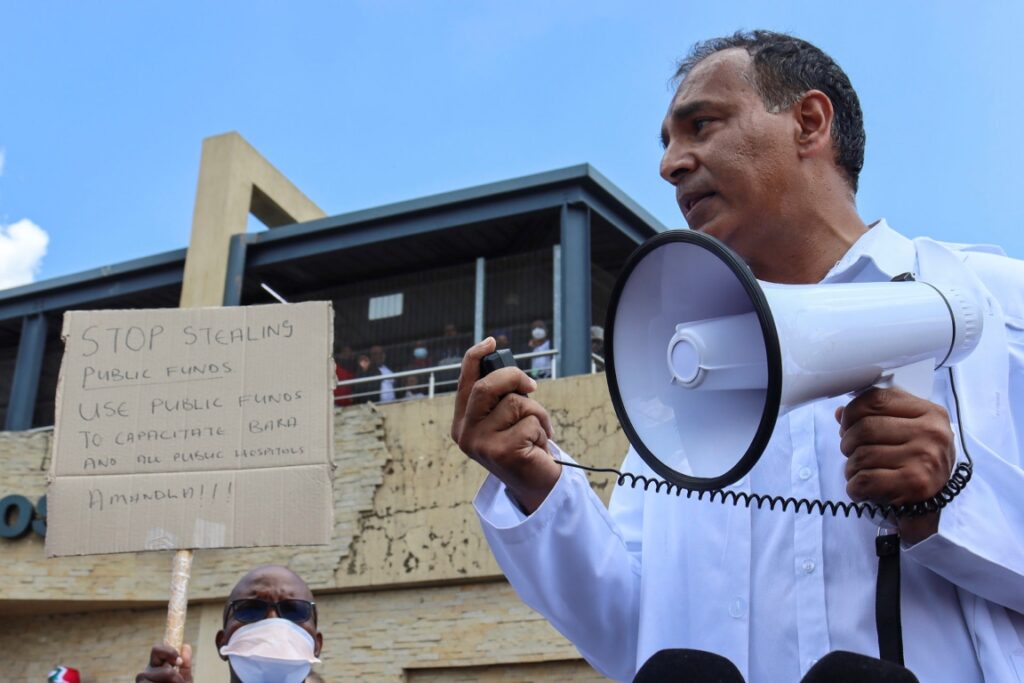
10 March 2022: Shabir Madhi addresses the crowd outside Baragwanath hospital. Credit: Nation Nyoka
Despite falling struggling staff and falling patient care at Baragwanath Hospital, the contracts of 800 support staff will not be renewed, writes Nation Nyoka for New Frame.
Budget cuts at the Gauteng Department of Health mean that it will not renew the contracts of more than 800 COVID support staff at Chris Hani Baragwanath Academic Hospital, south of Johannesburg, on 31 March.
A picket was held outside the hospital on Thursday 10 March after it emerged that suppliers hadn’t been paid for services such as bread delivery and biohazardous waste removal.
Chief executive Nkele Lesia said on 11 March that the picket was less about the COVID staff and more about staff shortages. But she offered no plan to address the inadequate number of hospital personnel. Lesia said the COVID staff knew their contracts were not going to be renewed.
“Those 800 posts may have been created for COVID-19, but it provides us an opportunity to redress this imbalance that exists with this hospital having been chronically understaffed,” said Shabir Madhi, a vaccinology professor and the dean of health sciences at the University of the Witwatersrand (Wits). “We can’t just remove the staff – we need to incorporate them into the system so that we can have this hospital better staffed to ensure better quality of patient care.”
He said the issue goes beyond staff shortages. “If we remove them, we will find that the permanent staff come under greater pressure and burn out. They are going to resign, creating a greater disaster. Poor planning on the part of the government is not an excuse to punish patients and healthcare workers.”
Gauteng member of the executive council for health Nomathemba Mokgethi said the department is unable to absorb the temporary staff because of budget constraints. But she extended her appreciation for their help and support during the waves of COVID.
A chronic situation
Madhi said neglect and the inadequate management and training of healthcare workers over the past two years will materialise as a heavier burden from chronic diseases, which have been on the back-burner as the healthcare industry prioritised COVID.
“For the next two to three years, we need to expect high levels of people ending up in hospital dying not because of COVID. With COVID, there has unquestionably been a disruption in the care of patients with other conditions because people haven’t been able to access facilities. People have been delayed in the diagnosis, and for some time they probably delayed with the treatment,” he said.
Mokgethi and her team did not offer a plan to handle diseases that have been neglected either.
Madhi said training has been hampered and Baragwanath – one of the biggest academic teaching hospitals on the Wits circuit – needs to function properly for students to learn comprehensively. “It is going to impact patient care in the years to come, so the disaster we sit upon today is just the beginning of a further rot of the system if we don’t reverse it immediately.”
Mmampapatla Ramokgopa, chairperson of the hospital’s medical advisory committee, said resilient and hard-working staff who have gone the extra mile are what has kept Baragwanath going.
“We have doctors and nurses pushing patients because there are no porters. The same with cleaning. You find nurses and doctors scrubbing the floors because there are not enough cleaners. Sometimes patients delay to get into theatres because the cleaners are not there. They dig into their pockets and make contributions to buy either bread or flour to make bread,” said Ramokgopa.
Patient care at risk
The department denied that Gauteng hospitals have run out of food, saying other types of food are being served at Baragwanath. It did admit that the hospital, along with other facilities, experienced “a short supply of bread in the recent past” and that the issue had been resolved.
Madhi said the hospital and surrounding area were compromised when the department failed to pay the service provider who removes biohazardous waste. The department said on 11 March that it had paid the relevant service providers to collect the waste and supply bread.
“The fact that we are in a province where patients are not provided something as basic as bread for two weeks speaks volumes about the incompetence and uncaringness of those responsible for the management of this facility … at the level of the province,” said Madhi.
Ramokgopa said the committee has raised these matters over time. People who have worked at the hospital for years have a collective memory of its legacy and they are eager to engage and find solutions.
National Union of Public Service and Allied Workers branch secretary Monwabisi Somi said employees are providing much-needed staff for an institution that is under strain, and the COVID workers need to be absorbed. “We’ve also got the issue of telephone lines that have not been working for some time in some units, which compromises communication. This is to the detriment of patient care,” he said.
Lerato Madyo, the provincial department’s acting chief financial officer, said its finances are healthy but it is dealing with a backlog of unprocessed invoices from previous years. The department owed service providers R4.2 billion at the end of January.
Madhi said what is happening in state healthcare facilities is compromising the future care of people in South Africa. “It is undermining our ability to provide adequate training to healthcare workers.”