Tag: blood donation

Youth Lead the Way as South Africa’s New Generation of Blood Donors Steps Up

Johannesburg, 25 June 2026 – As South Africa concludes Youth Month, the South African National Blood Service (SANBS) is celebrating a new generation of life-savers who are helping to secure the country’s blood supply through regular blood donation.

This year’s World Blood Donor Day was commemorated under the theme, “Give blood, give hope: together we save lives,” highlighting the critical role voluntary blood donors play in strengthening healthcare systems and saving lives. For SANBS, the theme has resonated strongly with a growing number of young South Africans who are choosing to become regular blood donors and make a meaningful contribution to their communities.

Recent SANBS data reveal that 43.27% of its donor panel comprises regular donors aged 16 to 30, reflecting a positive shift in donor demographics and a growing culture of volunteerism among young people.

Historically, blood donation has largely been sustained by older generations. However, SANBS has seen a notable increase in younger people showing interest in donating blood, helping to ensure a sustainable blood supply for future generations.

The organisation has also recorded encouraging growth in donor diversity, including an increase in black blood donors, contributing to a donor base that is increasingly representative of South Africa’s population.

Blood remains an essential resource in healthcare, as a stable blood supply enables hospitals and healthcare facilities to respond swiftly to emergencies and deliver life-saving treatment to patients in need. A reliable blood supply is therefore fundamental to the effective functioning of any healthcare system and the overall wellbeing of communities.

Commenting on the encouraging trend, SANBS Reputation and Communications Manager, Sifiso Khoza, said the growing participation of young people demonstrates the positive impact that youth can have on society.

“Young people have always been at the forefront of driving positive change in South Africa. We are encouraged by the growing number of youth who are choosing to become regular blood donors and embracing the opportunity to make a difference in others’ lives. Their commitment reflects the spirit of compassion, active citizenship, and hope that both World Blood Donor Month and Youth Month seek to celebrate.”

Khoza added that maintaining a stable blood supply depends on the continued support of both existing and first-time donors.

“Blood donation is one of the simplest yet most impactful ways to give back to society. Every donation has the potential to save lives, and we encourage more young South Africans to join this community of life-savers. By donating blood, they are helping to build a healthier, stronger, and more resilient South Africa.”

As Youth Month draws to a close, SANBS is calling on eligible South Africans to become regular blood donors and play their part in ensuring that blood is available for patients whenever and wherever it is needed.

To become a blood donor, individuals must be between the ages of 16 and 75 years, weigh at least 50kg, lead a safe and healthy lifestyle, and be in good general health.

One Drop of Humanity. Give Blood. Save Lives.

Stay connected with SANBS on social media:

  • X (@theSANBS)
  • Facebook (@SANBS)
  • Instagram (@thesanbs)
  • TikTok (@thesanbs)

Good Vibes. Great Music. Real Impact. Join the One Day x SANBS Community Blood Drive

The South African National Blood Service (SANBS) and J’Something Bring Blood Donation into the Culture

What if saving a life was part of your weekend plans?

On 6 June 2026, music, culture, community and purpose will come together at Artistry JHB as the South African National Blood Service (SANBS), musician and entrepreneur J’Something host One Day x SANBS Community Blood Drive a unique event designed to make giving blood more accessible, engaging and relevant to a new generation of South Africans.

Every day, blood donors help create more tomorrows for patients across the country. They make it possible for someone to celebrate another birthday, return home to their family, pursue their dreams, or simply get a second chance at life. Yet many South Africans who are eligible to donate have never taken that first step.

Through this purpose-driven partnership, SANBS and J’Something are bringing blood donation into spaces where people naturally connect, create and inspire one another. By blending culture, creativity and community impact, the One Day x SANBS Community BloodDrive aims to show that donating blood is not only life-saving it’s something everyone can be part of.

The result is more than a blood drive. It’s a day party with purpose, where every donation has the potential to save up to three lives.

Blood Drive Details:

Venue: Artistry JHB

Date: 6 June 2026

Time: 09:00 – 15:00

RSVP: tshilidzim@meropa.co.za or 076 306 1197

Please RSVP by Friday,05 June 2026

Secure your spot at the blood drive by completing the quick eligibility screening below.

Whether you’re donating blood or simply coming through to support the movement, expect good music, great energy and a community united for a meaningful cause.

Click here for the quick eligibility screening.

Be the lifeline. Give Blood. Give A Tomorrow.

SANBS Launches “Be The Lifeline” Campaign to Honour 25 Years of Saving Lives Through Blood Donation this World Blood Donor Day

Johannesburg, 1 June 2026 – As the world prepares to commemorate World Blood Donor Day on 14 June, the South African National Blood Service (SANBS) is honouring the thousands of South Africans whose selfless blood donations continue to save lives every day.

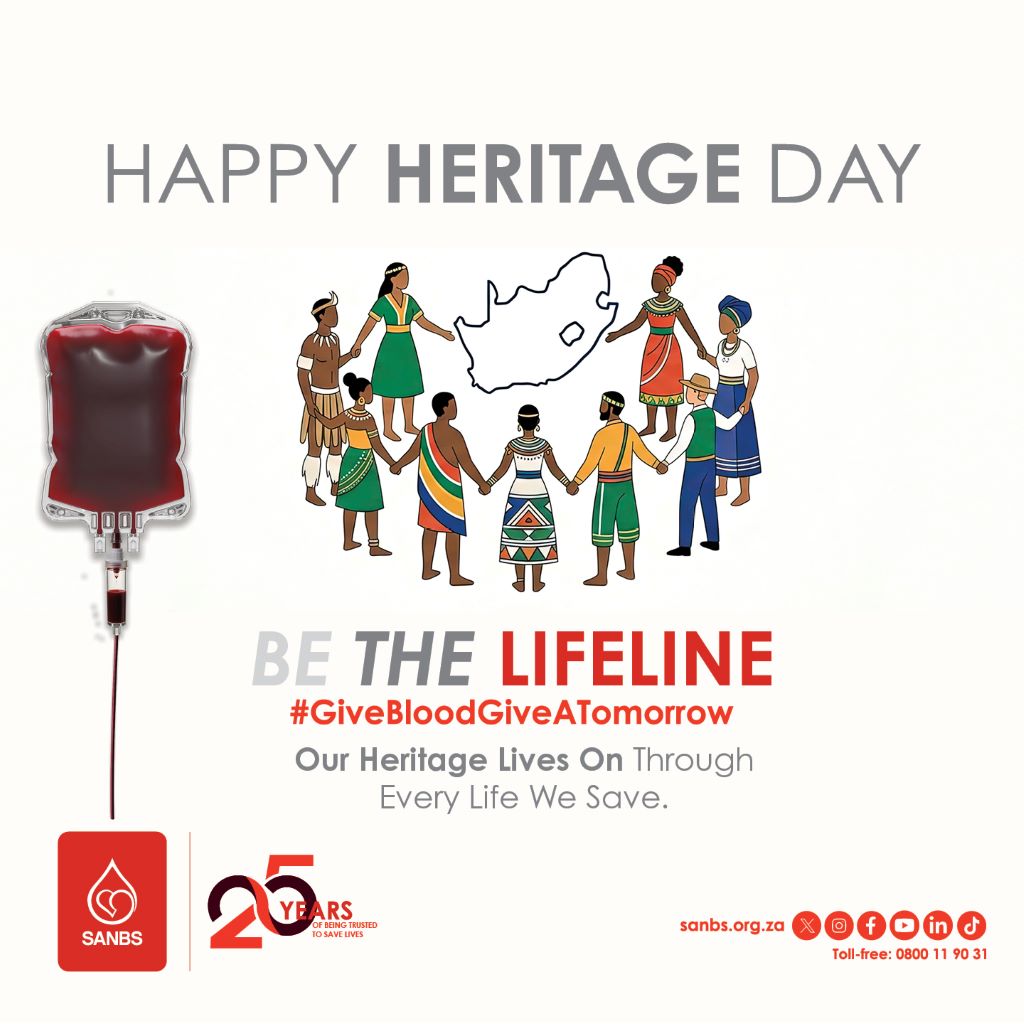
Recognising June as a globally significant month for blood donor awareness, SANBS is proud to launch its bold new campaign, “Be The Lifeline – Give Blood. Give A Tomorrow.” The campaign forms part of this year’s World Blood Donor Day observance. It marks a dual milestone: celebrating 25 years of SANBS as a trusted lifeline for the nation, while paying tribute to the ordinary South Africans who have become extraordinary lifelines for patients and families across the country.

For SANBS, the campaign is a powerful reminder that behind every unit of blood donated is a future still unfolding.

From mothers safely holding their newborn babies for the first time, to accident victims receiving urgent emergency care, cancer patients continuing treatment, and children overcoming life-threatening illnesses, blood donors are the unseen force helping to protect countless tomorrows.

A tomorrow where a young adult learns to drive and experiences independence for the first time.

A tomorrow where a small business owner opens the doors to their first coffee shop.

A tomorrow where a child nervously walks into their first day of school.

Each moment made possible because someone chose to give blood.

According to SANBS CEO, Ravi Reddy, World Blood Donor Day serves as a powerful reminder of the impact of every donation.

“For 25 years, South Africans have consistently shown extraordinary generosity through blood donation. Every donor who walks through our doors becomes part of someone else’s tomorrow,” says Reddy. SANBS Reputation and Communication Manager, Sifiso Khoza, echoed this sentiment, highlighting the life-saving power of a single donation.

“World Blood Donor Day reminds us that behind every successful transfusion is a donor who chose to help someone they may never meet,” says Khoza. “Blood donation is one of the most powerful acts of humanity because a single donation can save multiple lives.”

This year’s campaign places a strong emphasis on trust, gratitude and recognition, honouring long-standing donors who have supported SANBS over the years, while encouraging more South Africans – particularly younger generations – to become regular blood donors.

Through the “Be The Lifeline” campaign, SANBS will spotlight real stories of donors, recipients, and healthcare workers whose lives have been transformed through blood donation, reinforcing the deeply human impact behind every unit collected.

Reddy says the organisation’s 25-year milestone extends beyond reflection, serving as a tribute to the millions of South Africans who have contributed to sustaining a reliable national blood supply. “We are deeply grateful to every donor who continues to choose compassion, kindness, and community through blood donation. Their contributions have helped SANBS remain a trusted lifeline for South Africans for the past 25 years,” he says.

As part of World Blood Donor Day, SANBS is calling on all eligible South Africans to join this life-saving legacy by donating blood and helping secure millions of tomorrows for patients in need.

“Blood cannot be manufactured. It can only come from people willing to give a part of themselves to save another life,” adds Khoza. “This World Blood Donor Day, we encourage South Africans to continue being the lifeline that so many patients depend on every day.”

Research Identifies Beneficial Genetic Changes in Regular Blood Donors

Photo by Charliehelen Robinson on Pexels

Researchers at the Francis Crick Institute have identified genetic changes in blood stem cells from frequent blood donors that support the production of new, non-cancerous cells.

Understanding the differences in the mutations that accumulate in our blood stem cells as we age is important to understand how and why blood cancers develop and hopefully how to intervene before the onset of clinical symptoms.

As we age, stem cells in the bone marrow naturally accumulate mutations and with this, we see the emergence of clones, which are groups of blood cells that have a slightly different genetic makeup. Sometimes, specific clones can lead to blood cancers like leukaemia.

When people donate blood, stem cells in the bone marrow make new blood cells to replace the lost blood and this stress drives the selection of certain clones.

Blood donation impacts makeup of cell populations

In research published in Blood, the team at the Crick, in collaboration with scientists from the DKFZ in Heidelberg and the German Red Cross Blood Donation Centre, analysed blood samples taken from over 200 frequent donors – (three donations a year over 40 years, more than 120 times in total) – and sporadic control donors who had donated blood less than five times in total.

Samples from both groups showed a similar level of clonal diversity, but the makeup of the blood cell populations was different.

For example, both sample groups contained clones with changes to a gene called DNMT3A, which is known to be mutated in people who develop leukaemia. Interestingly, the changes to this gene observed in frequent donors were not in the areas known to be preleukaemic.

A balancing act

To understand this better, the Crick researchers edited DNMT3A in human stem cells in the lab. They induced the genetic changes associated with leukaemia and also the non-preleukaemic changes observed in the frequent donor group.

They grew these cells in two environments: one containing erythropoietin (EPO), a hormone that stimulates red blood cell production which is increased after each blood donation, and another containing inflammatory chemicals to replicate an infection.

The cells with the mutations commonly seen in frequent donors responded and grew in the environment containing EPO and failed to grow in the inflammatory environment. The opposite was seen in the cells with mutations known to be preleukaemic.

This suggests that the DNMT3A mutations observed in the frequent donors are mainly responding to the physiological blood loss associated with blood donation.

Finally, the team transplanted the human stem cells carrying the two types of mutations into mice. Some of these mice had blood removed and then were given EPO injections to mimic the stress associated with blood donation.

The cells with the frequent donor mutations grew normally in control conditions and promoted red blood cell production under stress, without cells becoming cancerous. In sharp contrast, the preleukaemic mutations drove a pronounced increase in white blood cells in both control or stress conditions.

The researchers believe that regular blood donation is one type of activity that selects for mutations that allow cells to respond well to blood loss, but does not select the preleukaemic mutations associated with blood cancer.

Interactions of genes and the environment

Dominique Bonnet, Group Leader of the Haematopoietic Stem Cell Laboratory at the Crick, and senior author, said: “Our work is a fascinating example of how our genes interact with the environment and as we age. Activities that put low levels of stress on blood cell production allow our blood stem cells to renew and we think this favours mutations that further promote stem cell growth rather than disease.

“Our sample size is quite modest, so we can’t say that blood donation definitely decreases the incidence of pre-leukaemic mutations and we will need to look at these results in much larger numbers of people. It might be that people who donate blood are more likely to be healthy if they’re eligible, and this is also reflected in their blood cell clones. But the insight it has given us into different populations of mutations and their effects is fascinating.”

Hector Huerga Encabo, postdoctoral fellow in the Haematopoietic Stem Cell Laboratory at the Crick, and first joint author with Darja Karpova from the DKFZ in Heidelberg, said: “We know more about preleukaemic mutations because we can see them when people are diagnosed with blood cancer.

“We had to look at a very specific group of people to spot subtle genetic differences which might actually be beneficial in the long-term. We’re now aiming to work out how these different types of mutations play a role in developing leukaemia or not, and whether they can be targeted therapeutically.”

Source: The Francis Crick Institute

Gut Bacteria Enzymes to Turn Donated A and B Blood Universal

Photo by Charliehelen Robinson on Pexels

The quest to develop universal donor blood has taken a decisive step forward. Researchers in Denmark have discovered enzymes that, when mixed with red blood cells, are able to remove specific sugars that make up the A and B antigens in the human AB0 blood groups. The results appear in Nature Microbiology.

“For the first time, the new enzyme cocktails not only remove the well-described A and B antigens, but also extended variants previously not recognised as problematic for transfusion safety. We are close to being able to produce universal blood from group B donors, while there is still work to be done to convert the more complex group A blood. Our focus is now to investigate in detail if there are additional obstacles and how we can improve our enzymes to reach the ultimate goal of universal blood production,” says Professor Maher Abou Hachem, who is the study leader at Technical University Denmark (DTU) and one of the senior scientists behind the discovery.

He states that the discovery is the result of combining the expertise of DTU researchers in enzymes from the human gut microbiota and Lund University researchers in carbohydrate-based blood groups and transfusion medicine.

High demand for donor blood

Human red blood cells carry specific complex sugars structures (antigens) that define the four AB0 blood groups A, B, AB and 0. These antigens control compatibility between donors and recipients for safe blood transfusion and organ transplantation. Donor blood is screened for disease markers and the main blood groups. It can then be stored refrigerated for up to 42 days.

The need for donor blood is high due to the elderly making up a larger proportion of the population and more patients undergoing blood-intensive medical procedures. Successfully converting A or B blood types into AB0 universal donor blood can markedly reduce the logistics and costs currently associated with storing four different blood types. In addition, the development of universal donor blood will lead to an increased supply of donor blood by reducing the waste of blood approaching its expiry date.

The reason why it is necessary to remove the A and B antigens to create universal donor blood is because they can trigger life-threatening immune reactions when transfused into non-matched recipients.

The concept of using enzymes to generate universal donor blood was introduced more than 40 years ago. Since then, higher efficiency enzymes to remove the A and B antigens were discovered, but researchers are still not able to explain or abolish all immune reactions related to the blood, and therefore these enzymes are still not used in clinical practice.

Enzymes from the gut

The research groups from DTU and Lund University have gone new ways to find enzymes that can remove both the A and B blood antigens and the sugars that block them. The research teams discovered new mixtures of enzymes from the human gut bacterium Akkermansia muciniphila that feeds by breaking down the mucus, which covers the surface of the gut. It turns out that these enzymes are exceptionally efficient, as the complex sugars at the surface of the intestinal mucosa share chemical resemblance with those found at the surface of blood cells.

“What is special about the mucosa is that bacteria, which are able to live on this material, often have tailor-made enzymes to break down mucosal sugar structures, which include blood group AB0 antigens. This hypothesis turned out to be correct,” says Maher Abou Hachem.

The researchers in this study tested 24 enzymes, which they used to process hundreds of blood samples.

“Universal blood will create a more efficient utilisation of donor blood, and also avoid giving AB0-mismatched transfusions by mistake, which can otherwise lead to potentially fatal consequences in the recipient. When we can create AB0-universal donor blood, we will simplify the logistics of transporting and administering safe blood products, while at the same time minimizing blood waste” says Professor Martin L. Olsson, the leader of the study at Lund University.

The researchers from DTU and Lund University have applied for a patent on the new enzymes and the method for enzyme treatment and expect to make further progress on this in their new joint project over the next three and a half years. If successful, the concept needs to be tested in controlled patient trials before this can be considered for commercial production and clinical use.

The initial research project is funded by the Independent Research Fund Denmark (Technology and Production Sciences, FTP), the Swedish Research Council, ALF grants from the Swedish government and county councils as well as the Knut and Alice Wallenberg Foundation and Research Fund Denmark, Natural Sciences, FNU), while the new continued project is funded by the Novo Nordisk Foundation, Interdisciplinary Synergy Programme.

The AB0 blood group antigens found on the surface of red blood cells are also found on the mucosal layer that lines the surface of the gut. Researchers have harnessed a specialised human gut bacterium and its ability to use these antigens as nutrients to discover and develop two enzyme mixtures that convert group A and B red blood cells into universal donor blood. Graphic: Mathias Jensen, postdoc at DTU.

About Akkermansia muciniphila

Akkermansia muciniphila is a bacterium found abundantly in the guts of most healthy humans. This bacterium can break down mucus in the gut and produces beneficial compounds such as the short-chain fatty acid propionate, in addition to exerting beneficial effects on body weight and metabolic markers.

Source: Technical University of Denmark

An Estimated 70% of South Africans Have Had COVID

Image by Quicknews

Writing for GroundUpDr Alex Welte unpacks the results of the latest blood donor survey, which suggests that some 70% of South Africans have had a COVID infection.

The South African National Blood Service (which handles the blood supply for eight provinces) and the Western Cape Blood Service have been testing some donors for Covid antibodies over the last year or so. This has contributed to our understanding of how many people have been infected by SARS-CoV-2 (the virus that causes Covid), and what proportion of infections lead to death. It may help us plan for future waves, though exactly how is complicated.

On the assumption that another wave towards the end of 2021 was nearly inevitable – but before we all heard about omicron – it was decided to perform more such testing in early November. The numbers are now out.

The headline results are:

  • Overall about 80% of black donors had previously had Covid, and 40% of white donors.
  • There is no meaningful variation between age groups and sexes.
  • This latest survey did not include Western Cape data.
  • The test used does not detect the antibodies produced in response to vaccination, so this really is an estimate of people who have been infected.

While blood donors are not perfectly representative of the country’s population, we can take into account differences between the racial breakdown of the donor population and the racial breakdown of the general population. This means that our face-value national estimate is that about 70% of people had been infected before the omicron wave hit.

Since then we’ve had the omicron wave. We would very much like to know how many people are infected now, but there’s really no simple way to derive this number. Researchers are now updating their models with this additional piece of data, and we may see some estimates soon.

With that caution, here is my back-of-the-envelope estimate:

  • Omicron seems to have little trouble infecting people who have been infected by other variants, though there is some protection from prior infection and vaccination.
  • By late last year, quite a bit more than half the population had already had a prior infection.
  • Hence, I estimate that about half of the omicron wave infections were in previously uninfected individuals.
  • Given the infection detection rate estimates from previous waves, and a number of plausible sources of possible variation in this rate, I estimate the detection rate at about 1 in 10.
  • Given the roughly 700 000 cases reported between mid November and mid February, we get an estimate of 7 million cases, and therefore 3.5 million new infections.
  • Given our population of about 60 million, this is roughly an additional 6%.
  • Bottom line: it’s not crazy to estimate that about three-quarters of South Africans have by now been infected. But I would not be surprised if serious models come up with even higher estimates.

A troubling result of the survey is that once more it shows the serious racial disparities in South Africa. I don’t know if this carried over to the omicron wave. Estimating the racial breakdown of infection after omicron depends in a complicated way on variations in housing, lifestyle, access to vaccination, and all the usual factors that shape daily life in our country.

Dr Welte helped design and implement the blood donor survey.

Source: GroundUp