New research from Mayo Clinic suggests that artificial intelligence (AI) could improve the diagnosis of peripartum cardiomyopathy, a potentially life-threatening and treatable condition that weakens the heart muscle of women during pregnancy or in the months after giving birth. Researchers used an AI-enabled digital stethoscope that captures electrocardiogram (ECG) data and heart sounds to identify twice as many cases of peripartum cardiomyopathy as compared to regular care, according to a news release from the American Heart Association.
Identifying a weak heart pump caused by pregnancy is important because the symptoms, such as shortness of breath when lying down, swelling of hands and feet, weight gain, and rapid heartbeat, can be confused with normal symptoms of pregnancy.
Dr Demilade Adedinsewo, a cardiologist at Mayo Clinic, shared research insights during a late-breaking science presentation at the American Heart Association’s Scientific Sessions 2023.
Women in Nigeria have the highest reported incidence of peripartum cardiomyopathy. The randomised pragmatic clinical trial enrolled 1195 women receiving pregnancy care in Nigeria. Approximately half were evaluated with AI-guided screening using the digital stethoscope, and half received usual obstetric care in addition to a clinical ECG. An echocardiogram was used to confirm when the AI-enabled digital stethoscope predicted peripartum cardiomyopathy. Overall, 4% of the pregnant and postpartum women in the intervention arm of the clinical trial had cardiomyopathy compared to 2% in the control arm, suggesting that half are likely undetected with usual care.
The investigational drug elinzanetant significantly reduces the frequency and severity of hot flashes associated with menopause while improving women’s sleep and quality of life, new UVA Health research published in JAMA shows.
The nonhormonal drug, which contains no oestrogen, was tested in two phase 3 trials, Oasis 1 and 2, at dozens of locations in the United States, Europe and Israel, including UVA Health. Postmenopausal women ages 40–65 with moderate to severe hot flashes were randomised to receive either 120mg of elinzanetant daily for 26 weeks or a placebo for 12 weeks followed by 14 weeks on elinzanetant.
The women who received elinzanetant reported rapid improvements in their symptoms and quality of life. The trials revealed statistically significant reductions in hot flash frequency and severity within the first week in both trials. At the same time, sleep quality and overall quality of life improved in both trials by week 12.
“The effectiveness for relief of hot flashes in highly symptomatic women along with improvements in sleep and mood across multiple trials and favourable safety profile of elinzanetant suggests it has potential as a non-oestrogen treatment for women with bothersome menopausal symptoms,” said researcher JoAnn V. Pinkerton, MD, UVA Health’s director of midlife health. “Elinzanetant is a dual neurokinin receptor antagonist in testing, meaning it works on two receptors in the brain to improve hot flashes, night sweats, sleep and overall mood.”
Hot Flash Treatment
Hot flashes are caused by decreased oestrogen levels during menopause and, for some women, for years after. While there are existing treatment options, such as hormone therapy, some women cannot tolerate them or do not wish to take them because of potential side effects or contraindications. Because of that, the researchers say, menopausal women need a new, effective and safe non-oestrogen alternative.
“There is a huge unmet need for new treatments for burdensome hot flashes and sweats, which have been shown to affect workplace productivity and relationships, both at work and home,” said Pinkerton, professor of obstetrics and gynaecology at the University of Virginia School of Medicine and executive director emeritus of The Menopause Society “Sleep disturbances are one of the most bothersome symptoms reported by menopausal women and can impact mood, fatigue, emotional lability, work productivity and their quality of life.”
Pinkerton and her colleagues tested elinzanetant in the double-blinded Oasis studies to see if it could safely and effectively offer a new alternative for women struggling with hot flashes.
In addition to evaluating the drug’s effect on hot flashes, sleep disruptions and quality of life, the researchers also looked for potential side effects. Headache and fatigue were the most common, and these were mild. Importantly, there were no severe side effects, which is reassuring for the drug’s safety.
“I am excited about the potential of elinzanetant to serve as a nonhormonal treatment option for women with highly bothersome menopausal symptoms who can’t or won’t take hormone therapy,” Pinkerton said. “I hope that it may become a safe and effective non-oestrogen option for menopausal women suffering from the triad of moderate to severe VMS, sleep disruption and decreased menopause-related quality of life.”
“These results suggest that certain probiotics given to mothers during pregnancy can improve their offsprings’ behaviour and may affect the metabolism of common amino acids in our diets. Probiotics may also help counteract the negative effects of prenatal stress,” said study senior author Tamar Gur, MD, PhD, at OSU.
Many studies have attested to the benefits of probiotics, which are considered safe to take during pregnancy. Researchers led by first author Jeffrey Galley, PhD found that a specific probiotic, Bifidobacterium dentium, may change how the body processes certain amino acids, such as tryptophan. During pregnancy, tryptophan helps control inflammation and brain development.
“We have strong evidence this specific probiotic helped reduce stress-related problems in both mothers and their offspring, including helping the babies gain weight and improving their social behaviour,” said Gur, who also is an associate professor of psychiatry, neuroscience and obstetrics and gynaecology at Ohio State.
Gur’s research team has studied how prenatal stress can lead to abnormal brain development and behavioural changes in offspring. So far, they’ve found that stress is linked to changes in brain inflammation and amino acid metabolism, as well as long-term reductions in social behaviour and abnormal microbiomes in offspring.
This study enhances their understanding of how gut microbes and probiotics can influence amino acid metabolism and help with behaviour and immune issues related to prenatal stress. The study also highlights the many benefits of this specific probiotic, even without the presence of stress.
“Now, we aim to understand the mechanisms behind these changes and explore ways to prevent or treat these effects,” Gur said. “Since prenatal stress is common in many pregnancies, we want to develop methods to reduce its negative effects.”
Endometriosis is a common, burdensome, chronic disease that affects 190 million women worldwide, and may cause life-altering consequences such as chronic pain, infertility and quality of life. Early diagnosis remains a major clinical and public health challenge. The average time to diagnose endometriosis is seven years after the onset of symptoms, which include abdominal pain and cramping before, during and after menstruation, among others.
“Currently, diagnosing endometriosis involves a thorough review of the patient’s medical history and physical examination,” said first author Panagiota “Yiota” Kitsantas, PhD, professor and chair of the Department of Population Health and Social Medicine, FAU Schmidt College of Medicine. “The most commonly used and accurate diagnostic methods are pelvic exams, abdominal ultrasound, MRI and laparoscopy. Laparoscopic surgery is considered the gold standard for diagnosing endometriosis by gynaecologists, but it can be expensive and carries potential risks of surgical complications. Moreover, the accuracy of laparoscopy can vary based on the surgeon’s experience and the stage of the disease.”
The authors say the ideal test for early diagnosis of endometriosis would be to use symptom-based criteria to determine who should undergo testing and then set optimal cut-points to maximise sensitivity and specificity. A test with high predictive value would accurately confirm endometriosis if positive and exclude it if negative. Although less ideal tests may not provide definitive results, they can be useful in reducing the number of patients who need to proceed to more invasive procedures, like laparoscopy.
Endometriosis involves hormonal imbalances that trigger angiogenesis, apoptosis, immune responses, and inflammation. Diagnostic tools for endometriosis have been developed to detect biomarkers, such as mRNA fragments in blood and saliva, but these have shown low accuracy.
“Non-invasive methods like MRI and transvaginal ultrasound are only effective for advanced stages of endometriosis,” said co-author Charles H. Hennekens, MD, professor at FAU Schmidt College of Medicine. “Recent research has focused on a novel noninvasive method of detecting myoelectric activity in the gastrointestinal tract as a potential diagnostic tool. Electroviscerography or EVG could detect unique myoelectric patterns associated with endometriosis, though this approach is promising but unproven.”
Currently, there is no FDA-approved non-invasive test for endometriosis, and further analytic studies leading to peer-reviewed publications are needed to refine these emerging technologies and establish effective diagnostic criteria.
“Early diagnosis of endometriosis remains a challenge, with a succession of promising approaches ultimately not bearing fruit thus far,” said Kitsantas. “Once new technologies such as EVG are more fully evaluated, they may give clinicians the post-test certainty they need to transition from symptom-based to diagnosis-based treatment.”
Living less than 500m from pesticide use prior to conception and during early pregnancy could increase the risk of stillbirths, according to new research published in the American Journal of Epidemiology.
Researchers from the University of Arizona found that during a 90-day pre-conception window and the first trimester of pregnancy, select pesticides, including organophosphates as a class, were associated with stillbirth.
“In this study, some specific ingredients stood out due to their significant associations with stillbirth risk,” said first authorMelissa Furlong, PhD, who studies the chronic health effects of environmental contaminants as an assistant professor and environmental epidemiologist at the Zuckerman College of Public Health. “These findings underscore the importance of considering individual pesticides rather than just the overall pesticide class, as specific chemical compounds may pose unique risks. It also highlights the potential for pre-pregnancy exposures to affect reproductive outcomes.”
To conduct the study, researchers linked Arizona pesticide use records for 27 different pesticides with state birth certificate data that included 1 237 750 births and 2290 stillbirths from 2006 to 2020.
They found that living within 500m of specific pyrethroid, organophosphate or carbamate pesticide applications during a 90-day pre-conception window or the first trimester was associated with an increased risk of stillbirth.
Specifically, the pesticides cyfluthrin, zeta-cypermethrin, organophosphates as a class, malathion, carbaryl and propamocarb hydrochloride were linked to increased stillborn births pre-conception. During the first trimester, fenpropathrin, permethrin, organophosphates as a class, acephate and formetanate hydrochloride were associated with stillbirths.
“Among organophosphates, acephate showed the strongest effect estimates on stillbirth, so that exposure to acephate in the first trimester was associated with a doubling of risk,” said co-author Paloma Beamer, PhD, a professor and interim associate dean at the Zuckerman College of Public Health. “Within the pyrethroid class, cyfluthrin exposure during the 90 days prior to conception almost doubled the risk of stillbirth.”
Pesticides are chemical substances used to control pests in various settings. They are commonly categorized into different classes, such as organophosphates, pyrethroids and carbamates. The primary route of exposure for most people is through diet, but household use, agricultural drift and occupational exposure are also significant pathways.
Researchers say while some pesticides may not have been directly implicated in this study, they could still pose risks to maternal and foetal health.
Pregnant women may be particularly vulnerable to the adverse effects of pesticide exposure due to physiological changes during pregnancy, such as increased metabolic rate, altered hormone levels and changes in the immune system. The developing foetus may be more susceptible to the toxic effects of pesticides during this period of rapid growth and development.
“Further research is essential to fully understand the safety profiles of various pesticides and to understand the underlying mechanisms of pesticide-induced stillbirth,” Furlong said. “This study underscores the need to develop strategies for mitigating exposure to protect maternal and foetal health.”
Scientists unveil the link between cord blood fatty acid metabolites and autism spectrum disorder symptoms in children
Source: Pixabay CC0
Autism spectrum disorder (ASD) is quite prevalent, but its underlying mechanism is not well understood. In a recent study, researchers from Japan have found a significant link between the levels of specific dihydroxy fatty acids in umbilical cord blood and ASD symptoms. Their findings, published in Psychiatry and Clinical Neurosciences, highlight the role of these metabolites in the developmental trajectory of ASD and could pave the way for early diagnostic techniques and a better understanding of ASD pathophysiology.
Although the exact causes of ASD are unclear, currently available evidence points to neuroinflammation as a major factor. Several studies in mouse models of ASD have hinted at the importance of polyunsaturated fatty acids (PUFA) and their metabolites during pregnancy in playing a key role in ASD development. PUFA metabolites regulated by the cytochrome P450 (CYP) affect foetal development in mice causing impairments closely linked to ASD symptoms. However, it is still unclear if the same is true for humans and needs further investigation.
To address this knowledge gap, a research team led by Professor Hideo Matsuzaki from the Research Center for Child Mental Development, analysed the CYP-PUFA levels in neonatal umbilical cord blood samples. Their study, sheds light on the possible causes of ASD.
Sharing the motivation behind their study, Prof. Matsuzaki explains, “CYP metabolism forms both epoxy fatty acids (EpFAs), which have anti-inflammatory effects, and dihydroxy fatty acids, or ‘diols,’ which have inflammatory properties. We hypothesized that the dynamics of CYP-PUFA metabolites during the fetal period, that is, lower EpFA levels, higher diol levels, and/or increased EpFA metabolic enzymes would influence ASD symptoms and difficulties with daily functioning in children after birth.”
To test this hypothesis, the researchers investigated the link between PUFA metabolites in umbilical cord blood and ASD scores in 200 children. The cord blood samples had been collected immediately after birth and preserved appropriately, whereas ASD symptoms and adaptive functioning were assessed when the same children were six years old, with the help of their mothers.
After careful statistical analyses of the results, the researchers identified one compound in cord blood that may have strong implications for ASD severity, namely 11,12- dihydroxyeicosatrienoic acids (diHETrE), a dihydroxy fatty acid derived from arachidonic acid. This fatty acid is found in poultry, animal organs and meat, fish, seafood, and eggs.
“The levels of diHETrE, an arachidonic acid-derived diol, in cord blood at birth significantly impacted subsequent ASD symptoms in children and were also associated with impaired adaptive functioning. These findings suggest that the dynamics of diHETrE during the foetal period is important in the developmental trajectory of children after birth,” highlights Prof Matsuzaki.
More specifically, the researchers found that higher levels of the molecule 11,12-diHETrE had an impact on social interactions, whereas low levels of 8,9-diHETrE impacted repetitive and restrictive behaviours. Moreover, this correlation was more specific for girls than for boys. This newfound knowledge could be crucial in understanding, diagnosing, and potentially preventing ASD. By measuring diHETrE levels at birth, it may be possible to predict the likelihood of ASD development in children.
“The effectiveness of early intervention for children with ASD is well established and detecting it at birth could enhance intervention and support for children with ASD,” muses Prof Matsuzaki. He also adds that inhibiting diHETrE metabolism during pregnancy might be a promising avenue for preventing ASD traits in children, although more research will be needed in this regard.
In conclusion, these findings open a promising avenue for researchers unravelling the mysteries surrounding ASD. We hope that enhanced understanding and early diagnostics will be able to improve the lives of people with ASD and their families.
A world-first study has found low-dose aspirin may treat flu-induced blood vessel inflammation, creating better blood flow to the placenta during pregnancy. Animal studies examined whether the treatment for preeclampsia could be applied to flu infections – and the results, published in Frontiers in Immunology, were very promising.
Lead researcher and RMIT Post-Doctoral Research Fellow, Dr Stella Liong, said that flu infections during pregnancy can resemble preeclampsia, a pregnancy complication that causes inflammation to the aorta and blood vessels. Low-dose aspirin is commonly taken to prevent preeclampsia, as it stops the body from creating chemicals that cause inflammation.
“When the vascular system is inflamed, it leads to poor blood flow and affects the aorta’s function,” she said. “This is especially a problem during pregnancy where good blood flow to the placenta is crucial to the development of the foetus.”
The research, led by RMIT University in collaboration with Trinity College Dublin, Ireland Professor John O’Leary and University of South Australia Professor Doug Brooks, found foetuses and placenta from mice with influenza A were smaller than those from uninfected mice.
Markers of low blood oxygenation and poor blood vessel development were also evident in the foetuses. The mice treated daily with low-dose aspirin had less inflammation and improved foetal development and offspring survival.
While the research was still awaiting human clinical trials, Liong said low-dose aspirin was already recognised as safe to take during pregnancy. The research team however recommended pregnant people seek medical advice before taking new medications.
Brooks said influenza A infections during pregnancy was a big concern as every pregnancy overlaps with part of a flu season.
“There are long term implications for both the mother and the foetus, and aspirin might provide a simple solution for preventing this influenza associated pathology,” Brooks said.
Why flu infection is dangerous during pregnancy
O’Leary said the research findings had huge implications for pregnancy and seasonal influenza virus infections for pregnant people.
“This study shines a light, for the first time, on the role of vascular inflammation associated with influenza virus and the potential dramatic effect of the disease-modifying drug aspirin, in low dosage, in pregnant women with co-morbid influenza,” O’Leary said.
While there weren’t many studies of the impacts of flu infections during pregnancy, project lead and RMIT Professor Stavros Selemidis said it was clear that pregnancy changed how the body responded to the virus.
Liong and Selemidis’ earlier breakthrough research found the flu virus during pregnancy could trigger a damaging hyperactive immune response, causing the virus to spread around the body from the lungs through the blood vessels.
“We used to think the flu virus just stayed in the lungs, but during pregnancy it escapes from the lungs to the rest of the body,” Selemidis said.
“This infection could set you up for cardiovascular disease later in life, but also set up cardiovascular disease in the offspring later in life.”
While vaccination was still the considered the best way to prevent flu infection during pregnancy, Selemidis pointed out vaccination rates were generally low in the pregnant population.
“Low vaccination rates aside, the flu shot may not generate the perfect immune response, especially if someone is pregnant or has an underlying medical condition,” he said.
“That’s why it’s useful to have a potential back up in low-dose aspirin to help prevent vascular dysfunction during pregnancy and improve foetal development.”
A new study shows that women lose more years of life after a heart attack than men. A 50-year-old woman with a large heart attack loses an average of 11 years, while an 80-year-old man with a small heart attack loses an average of 5 months of life. The results of the study, led by researchers at Karolinska Institutet and Danderyd Hospital, are published in the journal Circulation.
The new study examined 335 000 individuals with first-time myocardial infarction registered in the SWEDEHEART quality registry during the period 1991-2022. The individuals with myocardial infarction were compared with 1.6 million individuals without myocardial infarction using data from Statistics Sweden and the National Board of Health and Welfare. Using the comparator population and new statistical methods, the difference in life expectancy between heart attack individuals and comparison individuals could be calculated, providing a measure of how much life expectancy was shortened due to the disease.
“We found that there were large differences between groups. Women and young individuals lost the most life expectancy when they had a heart attack. If the cardiac function was impaired after the infarction, the effects were even greater. For example, a 50-year-old woman with impaired cardiac function loses an average of 11 years in 2022 compared to an 80-year-old man with normal cardiac function who loses an average of 5 months in life expectancy,” says first author Christian Reitan, researcher at the Department of Clinical Sciences, Danderyd Hospital, Karolinska Institut.
Parameters affecting heart attack risk
The researchers were also able to take into account differences in income, education, other illnesses and medication at the time of the illness – which helped to measure the effect of the heart attack itself when everything else was taken into account.
“The results showed that a fairly large part of the reduction in life expectancy disappeared, that is, much of the reduction in life expectancy is explained by factors other than the heart attack itself, but which may still be associated with heart attack, such as socioeconomics or other diseases such as hypertension and diabetes. Provided that the patient had preserved cardiac function, we saw that the gender difference had disappeared. We interpret this to mean that the effect of the heart attack, and thus also the care for heart attacks, is similar between the sexes and that the large reduction in life expectancy we see in women is due to differences in risk factors, other diseases and socioeconomics,” says Christian Reitan.
According to the researchers, there is a lack of individualized heart attack care in Sweden for women. The study shows that women who have a heart attack lose more years of life than men of the same age.
“If a woman had impaired cardiac function, the gender difference was large. We don’t have the data to answer why, but it raises questions about whether women get as good follow-up and treatment for heart failure as men, or whether it is simply a more serious condition for a woman. Our findings are important because they challenge existing guidelines for heart attack treatment today. By identifying high-risk groups, we can hopefully better tailor treatment to the individual. We believe that ‘years of life lost’ is a good and easy-to-understand measure of risk for both doctors and patients. It makes it easier for us to assess and communicate the seriousness of the disease,” concludes Christian Reitan.
A recently published study has compared a new surgical method, called cancer field surgery (Total Mesometrial Resection, TMMR), with the current standard treatment for primary management of cervical cancer.
The new TMMR method was developed over 20 years ago by Karolinska Institutet’s partners at the Leipzig University Hospital. Previous publications have suggested favourable results without the need for radiation therapy. Omitting radiation therapy could potentially improve quality of life for treated women.
In the study, the researchers demonstrate that TMMR is associated with improved oncological outcomes for early stages of cervical cancer. The data suggest that TMMR may replace current treatment strategies and radiation therapy could be spared for salvage treatment. This breakthrough motivates continued work in this field.
Research of this kind heavily relies on well-functioning collaborations with other researchers. Beyond providing essential data for the project, it also strengthens international cooperation, facilitating the dissemination of our findings. The researchers plan to further explore the potential of cancer field surgery in gynaecological cancer to establish the method in future treatment strategies.
Researchers from ETH Zurich and Empa have developed a hydrogel implant that can help prevent endometriosis. This innovation, which is described in Advanced Materials, also acts as a contraceptive.
A hydrogel is a gel made of a type of plastic that can bind water. Hydrogels have a variety of use cases, including contact lenses, delivering doses of medication within the body, moisturisers, water storage in soil, cleaning polluted water and as gelling and thickening agents. Now, the researchers have developed the first hydrogel implant designed for use in fallopian tubes. This innovation performs two functions: one is to act as a contraceptive, the other is to prevent the recipient from developing endometriosis in the first place or to halt the spread if they do.
Around four years ago, Inge Herrmann made a new addition to her research group at the Department of Mechanical and Process Engineering at ETH and Empa. The new member was a senior physician specialising in gynaecology who was keen to pursue clinically-inspired research. This kind of interdisciplinary collaboration was an experiment for the whole team. Their initial goal had been to turn a hydrogel into a new kind of contraceptive for women. However, after the research team began talking to the gynaecologist, they realised that implanting a hydrogel to occlude the fallopian tubes could also help prevent endometriosis.
Preventing endometriosis by occluding the fallopian tubes
Around 10 percent of women suffer from endometriosis. However, it is still unclear exactly what causes this condition. The assumption is that during menstruation, blood flows back along the fallopian tubes and into the abdominal cavity. This blood contains cells from the uterine lining (endometrium), which settle in the abdominal cavity and as a result can cause inflammation, pain and the formation of scar tissue.
The researchers found a way to create a hydrogel implant capable of successfully occluding the fallopian tubes and thus preventing retrograde menstruation. “We discovered that the implant had to be made of an extremely soft gel – similar in consistency to a jelly baby – that does not impact native tissue and is not treated and rejected as a foreign body,” explains Alexandre Anthis, lead author of the study.
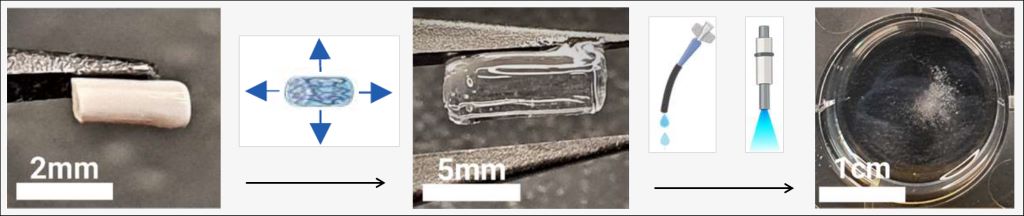
The hydrogel implant swells to around twice its original size when it comes into contact with liquid (arrow 1 left to centre) and can be easily and painlessly destroyed using UV light or a special solution (arrow 2 centre to right). (Graphic: adapted from Anthis AHC et al., Advanced Materials, 2024)
An advantage of hydrogels is that they swell when brought into contact with liquid. As a result, this new implant starts off at approximately 2mm in length. But once implanted in the fallopian tubes as part of a non-surgical procedure using a hysteroscope – an instrument for inspecting the uterine cavity – the implant swells to more than double its original size. The hydrogel then acts as a barrier to both sperm and blood. “Our hydrogel implant can be easily and quickly destroyed, either with UV light or a special solution, so that recipients don’t have to have an invasive and risky operation should they decide to reverse the procedure,” Herrmann says.