More than half of all new stem cell donors registered in South Africa in 2025 were between the ages of 17 and 25. And, according to a growing body of medical research, they are also the most valuable donors on the planet.
Research analysing more than 10 000 stem cell transplants has found that for every ten-year increase in donor age, patient survival rates two years after transplant decline by approximately 6 to 7%. Donors aged 17 to 25 consistently provide patients with the best chance of survival. A separate long-term study found that transplants from younger donors successfully engrafted up to 30 000 stem cells that continued contributing to blood production for decades, compared to a tenfold decrease in transplants from older donors. It has also been confirmed that donor age has a greater influence on transplant success than previously assumed, with younger donors associated with improved overall survival and reduced relapse risk.
The evidence is bearing out in South Africa’s own numbers. DKMS Africa’s donor base has grown from 18 801 in 2021 to more than 173 000 by the end of 2025, a ninefold increase in four years. New sign-ups in 2025 alone reached more than 60 000, nearly double the 2023 figure. The 17 to 25 age group has led that charge, growing from 19% of new donors in 2021 to 56% in 2025. Forty percent of last year’s new donors were between 17 and 21.
Context matters: every hour, someone in South Africa is diagnosed with blood cancer. For many patients, a stem cell transplant from a matched, unrelated donor is the only viable path to survival. The match they need may already be on the registry. Or it may not exist yet.
“In South Africa, finding a compatible donor depends on human leukocyte antigen (HLA) characteristics that are inherited and vary significantly across ethnic groups. Patients have the highest probability of finding a match within a registry that reflects their own background. Currently, patients from black, coloured and Indian communities face considerably lower odds than those from communities better represented in local and international registries. A registry that grows without also diversifying fails the patients who need it most. That is why more young people of diverse backgrounds need to step forward and close this gap,” says Palesa Mokomele, Head of Community Engagement and Communications at DKMS Africa.
She adds, “This Youth Month, we need every young person who has not yet registered to know that their moment is now, and every adult who has not yet registered to ask themselves honestly: what is my excuse?”
The registration process takes minutes: a free swab kit arrives by post, is completed at home, and returned. No blood is drawn. No appointment is made. A registered donor is only contacted if they prove to be a genetic match for a patient in need, and even then, the decision to proceed remains entirely theirs. Registering is the first step. Following through, if called upon, is the one that saves a life.
Getting patients to adhere to antihypertensive drugs is a major obstacle in controlling hypertension and cardiovascular risk. To find out which drugs or combinations of drugs have the best adherence rates, researchers conducted a comprehensive network meta-analysis of the five primary classes of blood pressure-lowering medications. The research, published in JAMA Network, examined short-term tolerability and side-effect profiles in data from over 700 clinical trials, and identifies significant variations in treatment discontinuation rates across different drug categories and combinations.
The most well-tolerated options were angiotensin II receptor blockers (ARBs), both alone and paired with calcium channel blockers – often showing fewer withdrawals than placebos. While most therapies successfully reduced headaches, they simultaneously increased instances of dizziness and hypotension-related symptoms. These findings suggest that specific combination therapies may offer better patient outcomes and superior symptomatic improvement compared to traditional single-drug treatments. Ultimately, the study provides a robust framework for clinicians to better manage patient-reported adverse events during the initial months of hypertension care.
Daily doses of peppermint oil have been proved to lower blood pressures for patients with mildly high readings, new research has found.
A team of University of Lancashire academics discovered a daily intake of 100 microlitres of peppermint oil, taken twice a day over 20 days, lowered the systolic blood pressure by an average of 8.5mmHg.
The findings have been published in PLOS One Journal and prove there could be a simple, inexpensive, and well‑tolerated way to help treat people with slightly raised blood pressure.
Lead author Dr Jonnie Sinclair, Reader in Sport and Health Sciences, said: “High blood pressure is one of the biggest causes of heart disease and death worldwide, and it costs a huge amount of money to treat. Although medicines are commonly used to treat it, it’s not always clear how well they work in the long-term, and they can cause unwanted side effects.”
Peppermint oil is low in calories and price so it’s proved to be a very simple and cost-effective solution to potentially treat millions of people around the world.
– Lead author Dr Jonnie Sinclair, Reader in Sport and Health Sciences
Peppermint contains substances like menthol and flavonoids and in the study, 40 18 to 65-years-olds were randomly split into two groups. One group in the pre‑hypertension and stage 1 hypertension phases took a small daily dose of oil and saw the improvement while the other took a peppermint‑flavoured placebo that did not contain the active oil and saw no real change.
Researchers measured the change in systolic blood pressure, but they also looked at body measurements, blood results, diastolic blood pressure (the bottom number in a blood pressure reading), heart rate, mental wellbeing and sleep quality.
Dr Sinclair added: “Our findings were very positive and they have significant clinical implications, especially given arterial hypertension is the most common preventable risk factor for cardiometabolic disease and the greatest single risk factor for global mortality.
“Peppermint oil is low in calories and price so it’s proved to be a very simple and cost-effective solution to potentially treat millions of people around the world.”
Tuberculosis (TB) is not a medical mystery, writes AI Diagnostics CEO, Braden van Breda. It’s a detection failure. And with technology like AI at our disposal, he believes the MedTech industry has the power to step up and fix it.
Tuberculosis bacteria. Credit: CDC
TB remains the deadliest infectious disease in the world, but it’s not killing people indiscriminately, it’s killing people in poor, developing countries.
Data from the World Health Organization makes this very clear. In 2024, most TB cases were concentrated in developing regions, especially South-East Asia, the Western Pacific, and Africa. In South Africa, an estimated 54 000 people died of TB in 2024. That’s a soccer stadium full of people wiped out by TB in a single year. Meanwhile, the Americas accounted for just 3.3% of global cases and Europe 1.9%.
The danger is that we get complacent about these numbers because we’re so used to hearing them. It’s not normal that people’s loved ones are dying from TB by the tens of thousands in some parts of the world, while in others, the incidence is low enough to be almost negligible.
Detection is the crisis
We already know what causes TB. We know how it spreads, how to diagnose it, and how to treat it. South Africa is losing this fight because the tools we currently have don’t catch cases early enough.
Since TB is easiest to treat (and least likely to spread) when it’s found early, the result compounds. Too many people are only diagnosed once they become seriously ill. By then, they’ve already infected others, and the cost and effort of accessing care often becomes a barrier in itself.
The science is there; the failure now lies in access to quality screening. The question we need to ask ourselves is whether we’re serious about bringing healthcare to people instead of forcing people to chase healthcare.
Start designing TB screening around the communities that need it most
Too much of our TB diagnostic infrastructure remains concentrated in too few facilities, and that depends on expensive equipment, medical specialists, and referral pathways.
For many people, especially in rural areas and poorer communities, getting to a hospital means losing a day’s wages, while having to pay for transport they can’t afford. The result is that people wait or don’t go at all. In 2024, only about 184 000 of the estimated 249 000 South Africans who fell ill with TB were diagnosed and started on treatment. That leaves around 65 000 people who were missed altogether.
This is why community-level screening matters so much. We can’t build specialist diagnostic centres next to every rural clinic. Even if we could, we don’t have enough specialists to run them. The answer is to put simpler, portable, and locally workable screening tools into the hands of frontline healthcare workers, especially nurses in primary care settings.
South Africa can’t wait around to be rescued
If the bottleneck is access, then innovation has to begin where access fails. That means building around the healthcare system we have, not the one we wish we had. How do we equip the nurse at the overcrowded community clinic? If we’re serious about combating TB, that’s the question we have to answer.
It’s also why South Africa can’t keep assuming that imported solutions from European or American healthcare systems will automatically fit our realities. We need tools designed for our burden of disease, clinic environments, and constraints. The countries carrying the heaviest burden should also be shaping the next generation of practical, scalable solutions.
The local MedTech sector needs to decide whether it’s serious about that responsibility. It’s one thing to produce impressive technology for conferences and investor decks, but can it be used in a crowded community clinic by a healthcare worker at the end of an 18-hour shift? If the answer is no, it’s not solving the real problem.
When a curable disease is killing tens of thousands of people, we can’t afford to sit around and wait to solve the problem. Thanks to advances in technology, the tools to close the screening gap are no longer beyond our reach. Failing to use them is inexcusable.
Every day, thousands of people worldwide suffer a heart attack, often leading to lasting damage to the heart muscle. New research from the University of Oslo suggests that targeting inflammation in the body helps protect the heart and improve recovery after a heart attack.
“In a small country like Norway alone, we see around 11 000 heart attacks every year,” says postdoctoral fellow Camilla Huse at the Research Institute for Internal Medicine, at University of Oslo and Oslo University Hospital. “Forty heart attacks every day is a lot.”
Fortunately, modern treatments are so effective that most patients survive a heart attack.
Inflammation damages the heart
However, a heart attack triggers a strong inflammatory reaction in the body. While this inflammation is part of the body’s natural response, it also causes damage to the heart muscle during a heart attack.
Such injury can lead to poorer health, a reduced quality of life and fewer working years for those affected. It also increases the risk of developing new heart diseases later in life.
So, how can we protect the heart during a heart attack?
Can anti-inflammatory medication improve heart attack treatment?
For some time, the researchers at the University of Oslo and Oslo University Hospital have been studying a medicine that blocks the effect of a substance that stimulates inflammation, a substance called IL-6. Previously, they have shown that administering this medicine in addition to established treatment for heart attacks has promising results: the patients suffered less damage to their hearts.
“This could be a new way of treating patients,” senior researcher Tuva Børresdatter Dahl says, and continues:
“To move forward with treatment, we need to understand what happens in the body when we block inflammation. Which processes inside the cells are affected by the medicine being tested? Which are not? And how does this relate to damage to the heart and to the improved recovery of the patient?”
How to investigate the effect of the treatment
The researchers conducted a study in which they examined the immune cells of 200 patients with STEMI. STEMI is a type of heart attack where the risk of serious complications is high.
The patients were randomly divided into two groups. Half of them received the anti-inflammatory medication, blocking the IL-6 signal, while the other half received a placebo, i.e. a treatment without any active ingredient.
The researchers then monitored how the treatment affected the immune cells in the blood. They also measured how much of the heart muscle was damaged.
Monocytes at the front line of our immune system
The researchers found that the treatment affects a type of immune cell called monocytes, which play an important role in all forms of inflammation.
“The monocytes are right at the front line of our immune system. They are among the first immune cells to arrive to the heart when a heart attack occurs,” Huse says.
Shortly after a heart attack, a strong inflammatory mobilisation occurs in the body, and monocytes flow to the heart muscle.
“The monocytes help to repair and clean up after a heart attack. But they can often get a little too eager. Thus, they also contribute to worsening the damage to the heart muscle after the heart attack,” she explains.
Reduced inflammation linked to better heart attack recovery
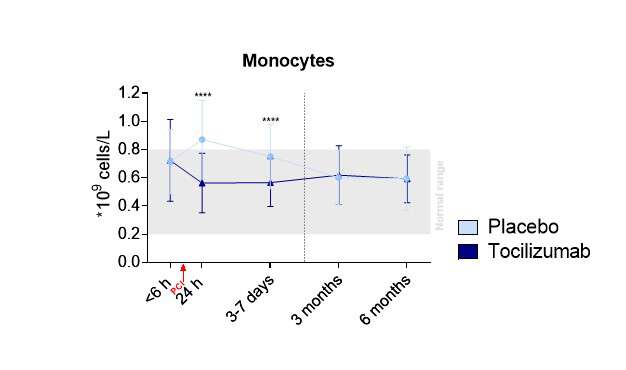
The study showed that the patients who received the anti-inflammatory medication had fewer monocytes in their blood shortly after the heart attack.
Normally, having high levels of these immune cells soon after a heart attack are linked to more heart damage and worse outcomes for the patients. Lower levels, on the other hand, are associated with less damage to the heart and better healing.
The researchers also found that the medicine made the cells in the heart muscle more resistant to damage, so that more heart cells survived the heart attack.
The study showed that patients who received the anti-inflammatory drug (dark blue) had fewer monocytes in their blood shortly after the heart attack. Illustration from the researchers.
Changing immune cell behaviour to protective
As a result of the treatment, the way the monocytes behave was also changed.
“The function of the monocytes changed, from being more harmful to becoming more protective. The “good” functions of the immune cells were strengthened,” Huse says.
“We believe that those functions are the reason why patients suffer less damage after the heart attack. The heart is helped towards recovery,” she adds.
The study also showed another important effect: mechanisms that normally draw inflammatory cells into the damaged area were prevented in the patients who received the medicine.
What could this mean for heart attack patients in the future?
The research provides new insight into how inflammation affects the heart during a heart attack, and how this treatment can protect the heart from damage following STEMI.
This creates an opportunity for anti-inflammatory drugs to become part of a standard treatment for heart attacks and give patients a better life afterwards.
“The study shows that monocytes play an important role in the development of heart attacks. We believe that affecting these cells, which the blocking of IL-6 does, is beneficial. It could be a new and important additional treatment for these patients,” Dahl points out.
Why mechanism-focused research matters
The researcher believes that more such in-depth studies are needed when new medicines are tested.
“They provide a better understanding of the mechanisms behind illness and how the medicine affects the body. It doesn’t just tell us whether a treatment has worked, but also why or why not.
“Such knowledge can make new treatment options possible. This type of research should therefore be prioritised in future clinical studies,” Dahl says.
Reference
Huse C, Murphy SL, Yang K, Balzer NR, Stokke MK, Anstensrud AK, et al. The effects of interleukin-6-receptor inhibition on monocytes in STEMI: a substudy of the ASSAIL-MI trial. EBioMedicine. 2025. doi:10.1016/j.ebiom. 2025.105960
By Julie Nybakk Kvaal, Institute of Clinical Medicine
Dihydropyridine calcium-channel blockers linked to poorer kidney outcomes in people with type 2 diabetes
Photo by Towfiqu Barbhuiya on Unsplash
Commonly prescribed blood pressure medications known as dihydropyridine calcium-channel blockers (DCCBs) may be associated with poorer kidney outcomes in people with Type 2 diabetes (T2D) and diabetic kidney disease (DKD), according to new research presented at the 63rd European Renal Association (ERA) Congress in Glasgow, Scotland.1
Kidney Outcomes Worse with DCCBs in T2D
The findings suggest that patients receiving DCCBs alongside current standard-of-care kidney-protective therapies face a significantly higher risk of major adverse kidney events compared with those treated with alternative antihypertensive medications.
DKD remains one of the leading causes of kidney failure worldwide and is driven by chronic damage to the kidney’s filtering system caused by prolonged hyperglycaemia.2 Effective blood pressure control is a cornerstone of management, particularly alongside renin-angiotensin system (RAS) inhibitors and sodium-glucose cotransporter-2 (SGLT2) inhibitors, which have transformed outcomes for patients by slowing kidney disease progression and reducing the risk of kidney failure.
Researchers analysed data from 31 031 adults with T2D treated between 2016 and 2021. All participants were receiving both RAS and SGLT2 inhibitors. Of these, 12 172 patients were also prescribed DCCBs, while 18 859 received alternative blood pressure therapies. Participants were followed for a median of approximately 3.5 years.
After adjusting for baseline demographic and clinical differences, DCCB use was associated with a 33% increased risk of major adverse kidney events compared with other antihypertensive treatments. The composite outcome included a decline of at least 40% in estimated glomerular filtration rate (eGFR) or progression to end-stage kidney disease requiring dialysis or kidney transplantation.
Lead author Dr Timna Agur noted that DCCBs are widely used as second-line blood pressure therapies in DKD, making the findings particularly relevant to current clinical practice. The researchers propose that the observed association may stem from the drugs’ effects on kidney haemodynamics. By preferentially dilating blood vessels entering the kidney’s filtering units, DCCBs may increase pressure within these structures, potentially contributing to ongoing damage despite concurrent kidney-protective therapies.
Blood Pressure Treatment Choice May Matter
Although the study was observational and cannot establish causality, the investigators emphasised that the results warrant further investigation. Prospective studies and randomised controlled trials will be needed to determine whether alternative blood pressure treatment strategies could offer greater kidney protection for patients with DKD.
References
Li J et al. Epidemiological status, development trends, and risk factors of disability-adjusted life years due to diabetic kidney disease: a systematic analysis of Global Burden of Disease Study 2021. Chin Med J. 2025;138(5):568-578.
Agur T et al. DCCB therapy and risk of CKD progression in type 2 diabetes on RASi and SGLT2i. Abstract 597. ERA Congress, 3-6 June 2026.
The plan complements national response plans launched by the Governments of the Democratic Republic of the Congo and Uganda
The Africa Centres for Disease Control and Prevention (Africa CDC) (www.AfricaCDC.org) and the World Health Organization (WHO) today launched a joint continental preparedness and response plan on the ongoing Ebola outbreak caused by the Bundibugyo virus. The plan aims to raise US$ 518 million to support African countries together with partners to prepare for, rapidly detect and respond to the outbreak.
The six-month plan, covering June to November 2026, brings together governments, partners and communities under a unified ‘One Response’ approach to strengthen outbreak response measures, including emergency coordination, disease surveillance, laboratory testing, infection prevention and control, clinical care, community engagement, research, logistics and support for essential health services.
The plan complements national response plans launched by the Governments of the Democratic Republic of the Congo and Uganda.
“Ebola moves fast. Africa must move faster. This joint plan gives the continent a clear path to act with speed and unity: to save lives, support the affected countries and protect neighbouring communities, said Africa CDC Director-General Dr Jean Kaseya. “With Member States, WHO and partners, Africa CDC is turning commitment into action and resources into response for the communities at risk.”
WHO Director-General Dr Tedros Adhanom Ghebreyesus said: “The only way to beat this outbreak is through close partnership, working together under the leadership of the affected countries in one coordinated effort, guided by a simple principle: one plan, one budget, one team.”
He added: “Containing Ebola depends on political commitment, sustained financing, and the trust and engagement of communities. This plan places communities at the centre, because without their participation, contact tracing falters, safe care is delayed, and transmission continues.”
The plan also focuses on protecting vulnerable populations, strengthening cross-border collaboration, and supporting countries to respond quickly to new cases. At a time when there are no licensed vaccines or therapeutics specifically approved for the Bundibugyo species of Ebola, the plan aims to strengthen health systems to ensure resilience even as countries respond to acute health emergencies.
Implementation of preparedness and response activities is already underway across affected and at-risk countries. Furthermore, in 10 priority countries critical measures are being strengthened to enhance public health emergency preparedness and ensure early detection and swift response
.The plan emphasizes the need to maintain support for other ongoing health emergencies, including mpox, cholera and measles, to prevent disruptions to critical response efforts and safeguard progress towards stronger, more resilient health systems.
This coordinated effort comes as response operations accelerate in the Democratic Republic of the Congo, where authorities, with support from Africa CDC, WHO and partners, are ramping up efforts to curb the spread of the virus and end the outbreak.
Africa CDC and WHO urge Member States to strengthen screening and public health measures at points of entry and enhance cross-border coordination and solidarity to support a timely, effective and evidence-based response to the outbreak.
Through the joint preparedness and response plan, the continent is mobilising its collective expertise and resources to reinforce response measures, acting as one to control the outbreak and protect communities across the region. Its successful implementation will require strong political commitment, sustained investment and close collaboration among governments, health workers, communities and partners.
Drawing on lessons learned from previous Ebola outbreaks and recent public health emergencies, the plan also provides a pathway to broadly strengthen Africa’s capacity to prevent, detect and respond to future health threats while protecting lives and livelihoods.
Paralysis on one side of the body is common after stroke. A new study in CNS Neuroscience & Therapeutics demonstrates that acupuncture can significantly improve muscle function recovery in patients who experienced a stroke, with this recovery correlating to increases in grey matter volume in certain regions of the brain related to cognitive-motor integration.
For the study, 56 patients with stroke were randomly allocated in a 2:1 ratio to receive either true-acupoint or sham-acupoint acupuncture over a 2-week period. Only the true-acupoint group showed significant improvements in motor recovery tests. Increases in grey matter volume in the right opercular inferior frontal gyrus, postcentral gyrus, and cerebellar region of the brain were positively correlated with limb motor function recovery in the true-acupoint group.
“These [brain] modulations may improve motor initiation, execution, control, and coordination, representing a potential central mechanism underlying acupuncture’s therapeutic effect,” the authors wrote.
The long-acting HIV prevention injection, lenacapavir, will become available to around half a million people in South Africa. Photo by Anna Shvets
By Marcus Low and Elri Voigt
On June 5, 2026, an HIV prevention injection will for the first time become available at some of South Africa’s public sector clinics. In this Spotlight special briefing, we pull together all you need to know about this “breakthrough” jab.
We’ve come a long way from the worst days of South Africa’s HIV epidemic, but the virus still claims over 50 000 lives per year and, even in 2026, annual new infections remain stubbornly high at over 140 000.
Reducing the rate of new infections is not an easy task. The most effective measure is to make as many as possible of the roughly eight million people who are living with the disease non-infectious. The good news is that most people with HIV become non-infectious once they are stable on antiretroviral treatment. The bad news is that the growth of South Africa’s HIV treatment programme has slowed. The pool of infectious people thus seems set to remain relatively large.
For people who are not living with HIV, the most effective form of protection over the years have been the correct use of condoms. Condoms also have the benefit that they protect against other sexually transmitted infections.
But condoms aren’t the only game in town. Voluntary medical male circumcision substantially decreases men’s risk of contracting HIV, something that also provides indirect protection for women.
And then there are antiretrovirals (ARVs) taken to prevent HIV infection. Landmark studies published in the 2010s showed that taking a tablet that contains the antiretroviral medicines tenofovir and emtricitabine could reduce someone’s risk of contracting HIV to near zero. Such tablets are commonly referred to as oral pre-exposure prophylaxis, or oral PrEP. For several years now, these HIV prevention tablets have been widely available in South Africa’s public healthcare system, although uptake has been somewhat muted. Modelling work from Thembisa, the country’s leading mathematical model on HIV and TB, suggests that only a few hundred thousand people are taking the tablets.
The long-acting revolution
One challenge with HIV prevention pills is that not everyone can, or wants to, take them every day. For some, taking ARVs, or being seen to take ARVs, still comes with an accompanying dose of stigma. For others, remembering to take a pill every day can be tricky. Ultimately, the incentives for healthy people without HIV to take prevention medicines simply aren’t as compelling and immediate as they are for people who already have the virus in their bodies.
As in some other areas of medicine, one solution to this treatment adherence challenge is simply to make it more convenient to take the treatment. Many women, for example, prefer three-monthly contraceptive injections or three-yearly implants to a regular pill. There is some evidence that similar preferences apply to HIV prevention medicines.
So-called long-acting therapies does what the name suggests – act over longer than standard periods. They could take many forms, from slow-release tablets to injections that leave a depot under the skin that slowly releases drugs into the blood stream, to small implantable devices that are typically left in the arm for several years.
The first long-acting HIV prevention option to take the world by storm was an injection. It made headlines in 2020 when a pivotal study found it to be more effective than the daily prevention pills – the difference being largely due to better adherence, rather than differences in the ARVs used. This jab, containing the antiretroviral drug cabotegravir, provides two months of protection against HIV infection at a time.
Two years later, the World Health Organization recommended the jab, called CAB-LA, for HIV prevention, and it was registered for use in South Africa. Rollout beyond an implementation science setting stalled however when the prices the drug’s manufacturer ViiV Healthcare was willing to sell it for were deemed unaffordable by the South African government.
Fortunately, a new prevention jab that provides protection for three times as long as CAB-LA was on the way. In 2024, two large studies, found an injection of the antiretroviral drug lenacapavir given every six months was almost 100% effective in preventing HIV infection. These findings would later be hailed as the journal Science’s 2024 scientific breakthrough of the year. It is this “breakthrough” that is being rolled out in South Africa from June 2026.
Two often-neglected groups in HIV research, adolescents (aged 16 and 17), and women who become pregnant while in a study, were included in clinical trials of lenacapavir. The jab was found to be safe in both populations, which means it can now be offered to adolescents and pregnant women in the South African rollout.
Lenacapavir is injected just under the skin, typically in the stomach area, where it forms a small depot that very slowly releases the drug over time. These depots can form small lumps under the skin. Though harmless and usually not visible, it will be important that people getting the jab know to expect these “subcutaneous nodules”. The other most common side effects seen in the two pivotal studies were pain at the injection site and a skin rash. These reactions and the size of the nodules appear to decrease with subsequent injections.
Prior to their first injection, people will first have to get an HIV test to ensure they aren’t already living with HIV. This is important since treating someone with HIV with just lenacapavir could result in the development of drug resistance. Together with the injection, people starting lenacapavir will also have to take some lenacapavir tablets for two days. Since the depot releases the injected drug very slowly, these tablets are needed to get the drug levels in the body up more quickly so that it can provide full protection as soon as possible. (The Department of Health has published a guideline document setting out how it should all work at the clinic.)
In addition to the lenacapavir and CAB-LA jabs, there is also a long-acting vaginal ring that contains the ARV dapivirine. The ring provides one-month of protection at a time, with a three-month version also under development. The available evidence however suggests that the dapivirine vaginal ring is not as effective at preventing HIV infection as oral PrEP or the two injectable options.
The long road to jabs at clinics
Having the scientific evidence that an injection works is of course only one step in that jab’s long journey to the point where people can get it at clinics. An essential next step was regulatory approval, which lenacapavir received from the South African Health Products Regulatory Authority in October 2025. After regulatory approval was secured, the next question became whether a sufficient supply of the product can be procured in South Africa on acceptable terms.
Lenacapavir is currently only being produced and marketed by the pharmaceutical company Gilead Sciences, who holds the critical patents on the product. In the US, lenacapavir is sold for around $28 000 per person per year. The Global Fund (the world’s largest multilateral funder of health in low- and middle-income countries) and PEPFAR (the United States President’s Emergency Plan for AIDS Relief) are however procuring limited stocks of lenacapavir at a lower price for use in some low- and middle-income countries. It is some of these Global Fund-procured jabs that will be used in the first phases of the lenacapavir rollout in South Africa.
For now, largely due to the limited stocks, the local rollout will target only around half a million people at 360 clinics in areas with high HIV rates, but the plan is to scale-up considerably in the next few years.
The South African government will likely start buying lenacapavir from generic manufacturers in 2027 or 2028. Gilead has so far issued licenses that will allow six different companies to produce lenacapavir and to sell it in 120 different countries, including South Africa.
The Gates Foundation and a partnership including UNITAID, the Clinton Health Access Initiative, and Wits RHI, have concluded separate deals with generic manufacturers that should see these generics sold for a price of no more than $40 (under R800) per person per year. This is lower than what government currently pays for oral PrEP and modelling work suggests it would be affordable for the South African government. Barring any unforeseen hiccups, the pieces are thus in place to facilitate widespread access to lenacapavir in South Africa in the coming years.
For now, none of the generic versions of lenacapavir will be produced in South Africa. Negotiations are however under way that may eventually see a local company licensed to produce the jab. Such local production is seen as important for ensuring security of supply, although it is not clear that local companies will be able to compete with Indian generic drug-makers on price.
At the time of writing, neither the lenacapavir or CAB-LA injections can be purchased at private sector pharmacies in South Africa. Oral PrEP can be purchased for around R300 for a month’s supply. The monthly dapivirine vaginal ring should cost in the region of R500 per ring. (These prices are based on the 30 April 2026 Single Exit Price database published by the health department.)
How many people will want the jabs?
One of the big unanswered questions about lenacapavir is how many people will come forward to get the jabs. We are hopeful that the Department of Health will routinely provide detailed numbers on uptake in the coming months and years.
The initial rollout is largely clinic-based, but researchers will also be assessing how well distribution works through mobile clinics. We need not stop there of course. At the height of the COVID-19 pandemic, public sector users could access SARS-CoV-2 vaccines from nurses at private sector pharmacies. With sufficient political will, the same could be done with lenacapavir. No doubt some young people will rather get their jab at the mall than at the clinic.
Those in control of the rollout will have to think carefully about how they promote and provide the jab. At its core, it is an empowering tool that can help people stay HIV-free, but as often is the case with HIV-linked products, there is a risk of stigma. In addition, even though lenacapavir is not a vaccine, some vaccine scepticism might well transfer over to lenacapavir since it is administered as an injection. As with any large healthcare intervention, one will not have to look far to find lenacapavir-related misinformation on social media.
Either way, just having the jab at clinics and hoping people will come get it might not be good enough if we’re hoping to see good uptake. Fortunately, we have several research groups and NGOs in South Africa who have world-class expertise on just this type of issue. Hopefully government will draw on this unique reservoir as they adjust and shape the lenacapavir rollout.
So what’s next
The rollout of the lenacapavir jab in South Africa will not be the end of our HIV prevention story. Two promising products in the pipeline are a new formulation of lenacapavir that looks like it could provide a full year of protection per shot and a pill containing another antiretroviral that could provide a month of protection at a time. We are keeping a close eye on the ongoing development of these products. There are also still hopes that an effective HIV cure or vaccine might one day be developed, although this is a much longer shot than better long-acting antiretroviral formulations.
In the meantime, though, twice-yearly lenacapavir is rightly dominating the headlines.
Modelling suggests that over the next 20 years, an ambitious lenacapavir rollout could reduce new HIV infections by around 20% to 30%. There can be little doubt that, like condoms and antiretroviral treatment for people living with HIV, providing lenacapavir at scale makes public health sense.
But thinking of lenacapavir mainly in terms of cost-effectiveness and public health benefits risks obscuring its more immediate and transformative human potential. For many people, especially young women, a discreet and convenient form of HIV prevention that they can control may well make the difference between contracting HIV or not.
As experts often point out, when it comes to products that can prevent HIV, choice – as in the world of contraception – is key. Some products will work for one person, but not for others. As circumstances change, a product that might have once worked may no longer be the best option. Having more than one product in the “toolkit of prevention” makes it easier to find what actually works in people’s lives.
For years, the HIV world has been flush with rhetoric about empowering young women – a group that is profoundly affected by HIV. An ambitious lenacapavir rollout might be the most concrete realisation of those ideals yet. We simply have to get it right.
Disclosure: The Gates Foundation is mentioned in this article. Spotlight receives funding from the Gates Foundation, but is editorially independent – an independence that the editors guard jealously. Spotlight is a member of the South African Press Council.
Researchers at the Terasaki Institute for Biomedical Innovation and University of Arizona College of Medicine, have developed a topical gel formulation with 4-aminopyridine (4-AP) to treat burn wounds, achieving near-complete closure in 21 days. The findings are published in the journal Biomaterials.
Burn injuries rank among the most difficult wounds to heal. The current gold standard, transplanting skin from a donor site on the patient’s own body, is limited by donor site morbidity and the need for large amounts of healthy tissue. This research offers a non-invasive alternative: a laponite-gelatin gel that delivers 4-AP directly to the wound, concentrating the drug where it is needed rather than exposing the whole body to it. Prolonged systemic use of 4-AP can cause serious side effects, including seizures, making localised delivery a critical advance.
The drug is best known under the brand name Ampyra for treating multiple sclerosis. Earlier work showed it could influence keratinocytes and fibroblasts: the two cell types central to skin repair, but systemic administration carried unacceptable risks. Embedding it in a gel resolves that problem while preserving its therapeutic potential.
“By delivering 4-AP directly to the wound site, we harness its regenerative potential while avoiding the systemic risks that have limited its use. We believe this approach could meaningfully change how burn injuries are managed clinically,” said Dr. Johnson V. John, Assistant Professor at the Terasaki Institute for Biomedical Innovation
Laboratory tests confirmed that the gel releases 4-AP at a controlled rate, is compatible with living cells, and produces more than 90% wound closure within 48 hours. In animal studies, treated wounds closed faster than controls starting at day six, reaching near-complete closure by day 21, while control wounds remained partially open. Tissue analysis showed the gel reduced inflammation, promoted re-epithelialisation and angiogenesis, and drove fibroblast-to-myofibroblast transformation. Collagen deposition increased markedly by 438% for type I and 288 percent for type III versus controls (P < 0.05 to P < 0.0002), with an improved collagen ratio signalling better-quality tissue maturation.
Because 4-AP is already FDA-approved with a well-characterised safety profile, this repurposing strategy could accelerate the path to clinical trials compared with developing an entirely new compound from scratch.
“This research exemplifies our commitment to reimagining existing therapies to address medicine’s most persistent challenges. We look forward to seeing it advance toward clinical application,” stated Xiling Shen, Acting Director of the Terasaki Institute for Biomedical Innovation.