“This One was Brought by God Himself” – the Doctor Helping People See Again in Rural KZN
By Sue Segar for Spotlight
As a young doctor working in rural KwaZulu-Natal, Hennie Hamilton lived with a Zulu family for four years, an experience which, he says, changed him forever. Twenty-three years later, he’s still working in the area as medical manager at Mosvold Hospital and doing cataract surgery on patients from five rural hospitals.
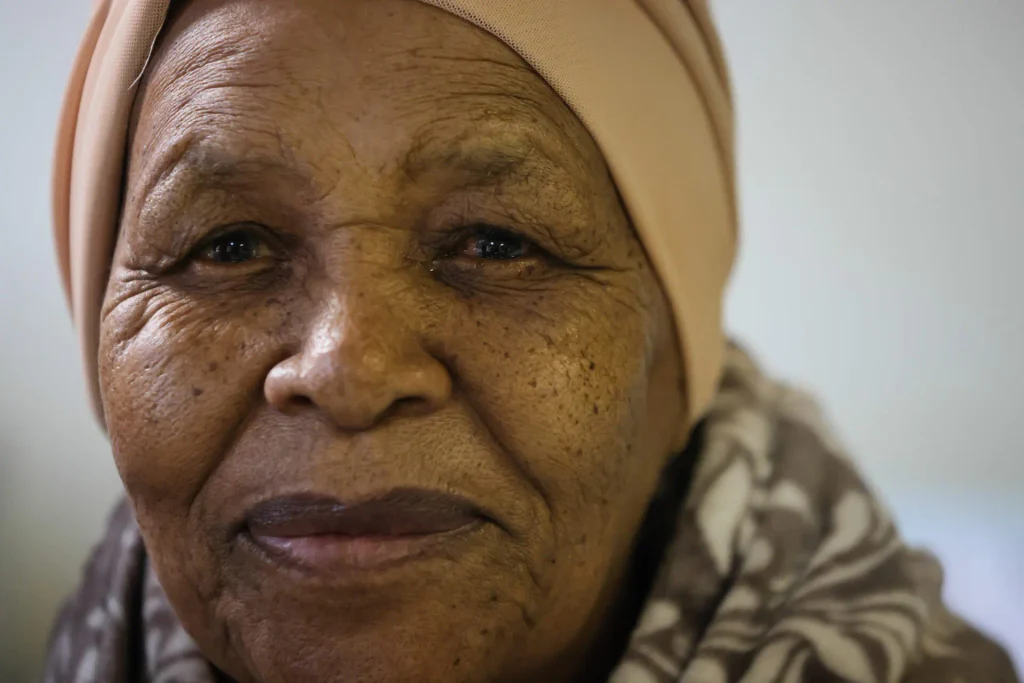
In the corner of a small ward in a rural hospital in northern KwaZulu-Natal, an elderly woman with a plastic shield covering her left eye sits up in bed. Her daughter, seated on a chair beside the bed, is holding her hand.
There’s silence, an air of quiet anticipation as a tall doctor leans over the woman and, in deep concentration, slowly removes the eye shield and the eye pad underneath it.
Next, the doctor gently eases her eye open and looks closely into her face to see her response. “Uya bona, Mama?” (Can you see, Mama?) Dr Hennie Hamilton asks the woman, keeping a hand on her shoulder.
The woman, Duduzile Phakathi from Mthubathuba, flickers her eyes. Her grip tightens on her daughter’s hand. “Yebo,” she answers, almost inaudibly, and her face breaks into a smile as she focuses, incredulously, on the tall man in front of her. “Ngiyabonga,” (Thank you) she says. The room erupts into excited chatter as mother and daughter start praying out loud, pouring blessings onto the doctor.
Eye patients from five hospitals – and further
It’s not yet 07:00, and Hamilton, medical manager at Mosvold Hospital in the mountain town of Ingwavuma, is already walking the wards. Every Monday, this quietly spoken man performs cataract surgery on patients from all over the uMkhanyakude district of KwaZulu-Natal. Besides coming from the area served by Mosvold Hospital, patients are referred to him from the other four hospitals in the district – Manguzi, Bethesda, Mseleni and Hlabisa. Tuesdays are for opening the eyes and checking the surgery has been effective.
As a shaft of morning sunlight beams into the room and onto the faces of the two women, Hamilton, dressed in a black embroidered African work tunic called a Dashiki, explains what he’s doing. He speaks with a strong Afrikaans accent, despite his English last name.
“This patient had what is known as a dense cataract and was completely blind. We operated on her right eye in June, and yesterday we did her left eye. Today, we’re opening the eye and checking whether the operation has been a success,” he says.
A cataract, he explains, is an opacity, or cloudiness, of the lens in the eye, which blocks the passage of light and causes a person’s vision to blur or dim. “It normally happens in old age. Sometimes it arises from diabetes or injuries or trauma, or it can be caused by medication. Some people are born with it, but 95 percent of the patients we see have it because of old age.”
He continues: “Most people will eventually get a cataract. The big difference in this area is that people present very late. In rural areas like this, 20 percent of the patients we operate on are already blind in both eyes. People just wait for longer before they finally come for help.”
Cataract surgery, he says, is a short, painless procedure which involves numbing the eye using eyedrops and an injection; making an incision in the cornea; creating a small “tunnel” on the white of the eye; removing the cataract lens through the tunnel; and then, by folding and inserting it through the incision, replacing the inside of the lens with an artificial lens, made from synthetic material. The incision self-seals and needs no stitches and patients experience an improvement in their vision shortly after the procedure.
“Brought by God himself”
Phakathi’s daughter, Dorothy Mbonambo, says her mother who has diabetes, has been struggling with her eyes for some time. “She was a very busy woman, who loved looking after, and selling her chickens.” But she became totally blind in February, and suddenly she couldn’t do anything for herself.
“We had to feed her, bathe her, and dress her at home, where we all live together. We did not anticipate this at all, and we had to adapt. My mother was really struggling,” says Mbonambo.
Translating for her mother, she continues: “My mother is excited that she can see again. She loves to count her money from selling chickens. It has been frustrating not to be able to do that. She can’t wait to get back to her business, to her normal life.”
Mbonambo says the family was determined to get their mother to Mosvold Hospital for the surgery. “We knew about Dr Hamilton because people talk about this man who came here when he was young, and speaks isiZulu and does the eyes and other operations too.”
Still holding her beaming mother’s hand, Mbonambo points to Hamilton, saying: “This one was brought by God himself.”
“Before, everything was blank”
Next, Hamilton walks into another ward, bigger than the last, where seven more women who had cataract surgery the day before, are recovering. Similar scenes play out as he removes the eye shields for each woman.
Primrose Gina who works as a porter at Mseleni Hospital, says she started struggling with her eyes about three years ago. As the condition of her eyes worsened, it became increasingly difficult to see, and she was told it was cataracts.
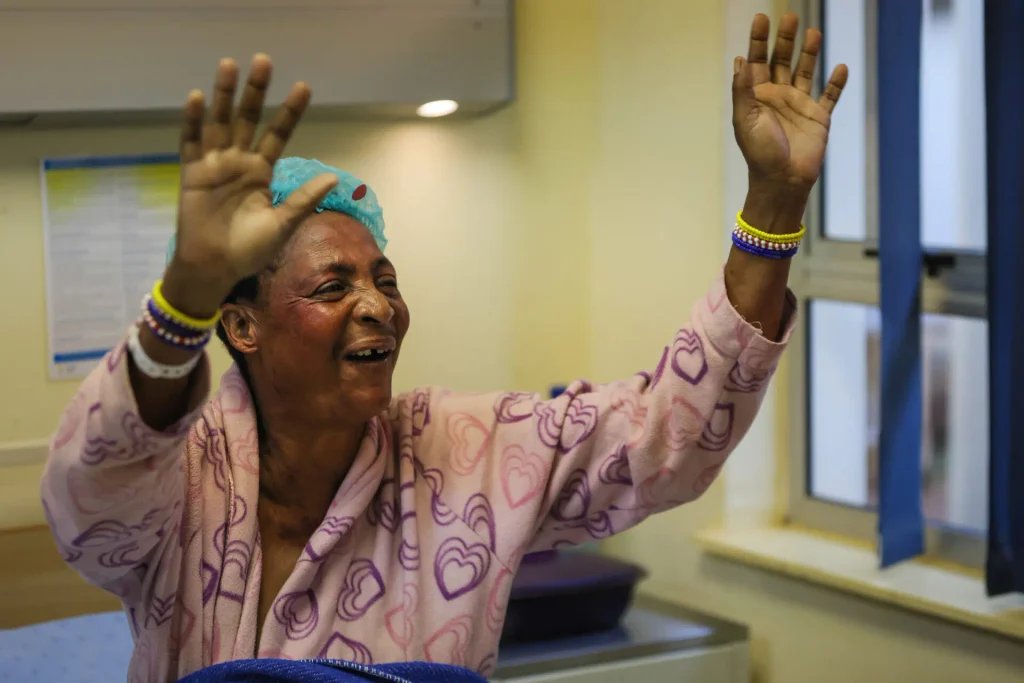
As Hamilton opens her eyes, she lets out an exhilarated shout and tells him she can see.
Gwendolin Mthethwa, a teacher from Ndumo, says her eyes still feel “cloudy” after her operation. This, Hamilton explains, is because, besides the cataract, she also has glaucoma in both eyes.
“Glaucoma is a disease of the optic nerve at the back of the eye which is caused by a build-up of fluid pressure inside the eye, causing damage to the nerve, often due to natural drainage systems being faulty.
“The difference between glaucoma and cataracts is that, with glaucoma, if the damage has happened to the nerve, we cannot reverse it,” Hamilton explains. “We can only try and prevent it from getting worse. But for a cataract, a patient can go from blindness to normal vision again.”
A busy day in the life of a medical manager
It’s nearly 08:00 and Hamilton has already seen eight eye patients. As he strides through the large female ward, the room erupts into song as nurses and some patients gather in the communal ward. “Every morning, we pray together, to connect with the Lord before we start our duties,” a nurse explains.
Next up is a meeting with the hospital’s CEO, Dr Bernard Mung’omba. As part of the hospital’s senior leadership team, Hamilton is closely involved in audits for the provincial health department and overall hospital decisions. As medical manager, he oversees medical care for patients – supervising the doctors, allied health professionals and all other departments including the pharmacy and the hospital’s social workers.
The 186-bed hospital employs 17 doctors and serves seven clinics and a community health centre in the uMkhanyakhude district. The area is characterised by poverty, with many people relying on grants and government work opportunities and living in mostly rural homesteads. Unemployment, teenage pregnancy and substance abuse are big challenges.
As a rural hospital, Hamilton says, “we do bits of everything”. “Last night, I was on call and at 23:30, was in theatre doing a caesarean section.” As medical manager, he says he plays less of a frontline than an advisory role, helping with emergencies from ectopic pregnancy to premature babies, and appendicitis. “We also deal with many diabetic and hypertensive-related emergencies like heart failure, and see many strokes, among older people,” he says.
“The spectrum is extremely wide. We’re a team of people with different strengths and we all rely on one another,” he says.
But it’s the eye operations which he says he finds most rewarding. “Ag, I love it … it gives me so much joy,” he says. “The patients often bless me. They say, ‘may God bless you’. I’m often in tears in the morning when I open their eyes.”
A long history
Mosvold Hospital was founded in 1908 by Christian missionaries and started out as a small stone rondavel. It was taken over by Scandinavian missionaries in the 1930s. The hospital is named after a Norwegian nurse, Esther Mosvold, who worked there in the 1940s, fell in love with the area, and raised money through her wealthy shipping family to expand the hospital. In 1978, the then Natal provincial government took over the hospital and the mission doctors slowly departed.
Hamilton shows us the original stone clinic next to an old chapel which, he says, resignedly, is now used for storage; and a house once lived in by missionaries, which is now the admin office. He points to a site where the provincial government is building a children’s ward and a lodge for mothers to stay while visiting children in hospital; and, on the other side of the hospital, a complex of 40 bachelor flats being built for staff at a cost of R400 million. The project should be completed next year, he says, adding it will be a “gamechanger” for Mosvold. “Mothers visiting their children in hospital currently sleep on mattresses on the floor.”
On our tour, we visit the ward where Hamilton’s eldest child was born in 2007. “It’s grown so much since then,” he says. Around us, the different departments – therapy, dental, radiography, and the pharmacy – are all bustling. In the children’s ward, manager Noziphe Gumbi says they’re seeing way fewer burn wounds this year. “We’ve really focused on outreaches to educate people on the dangers of burns among children,” she says.
Hamilton says he has seen many changes at Mosvold over the years, the biggest being the number of staff. “We’ve almost doubled the number of doctors, so we can spend much more time with patients. There was a time when there were only four doctors. Now, with 16, sometimes 17 doctors, we don’t have to run, run, run like we used to,” he says. “When I arrived, we were only white doctors, now I’m the only white doctor here which helps a lot in terms of language and knowing the people.”
A life in medicine
Hamilton was born in Johannesburg and studied medicine at Pretoria University. In 1997, he started his internship at McCord Hospital, then a mission hospital, in Durban. In 1998, he moved to Bethesda Hospital where, he learnt how to be “an all-round doctor”. He went on to complete qualifications in obstetrics and orthopaedics and trained to do cataract surgery at Edendale Hospital.
He worked at Bethesda at a time when HIV was “completely overwhelming”, he says. A large part of his work was supporting HIV patients clinically and he started a home-based care programme there. In 2003, he met his wife, Sylvia, a Swiss nurse, who, having previously worked in northern KwaZulu-Natal, had returned to start a home-based care programme at Mosvold. They married four months after meeting, and Hamilton moved to Mosvold in 2003, eventually becoming medical manager in 2015.
Why he stayed
“While I was working at McCord’s Hospital in 1997, I met another doctor, Colin Pfaff, who was working at Manguzi Hospital, who was living with a Zulu family,” Hamilton recalls. “When Colin told me about his experience, something just jumped in me. I believe it was God. I realised this was what I wanted to do.”
Less than a year later, while working at Bethesda Hospital, Hamilton moved in with the Nhlekos. “I lived in a mud hut with no running water or electricity. The house was about six kilometres from Bethesda and I’d cycle up and down the mountain to work every day. I became part of the family. In the evenings, I’d sit in the kitchen with my gogo. I learnt to speak fluent isiZulu.
“It was an amazing time, even though it was only for four years. It was the most beautiful place on earth,” he says.
Hamilton shuts his eyes and says: “This experience changed me forever. I was raised very much in an Afrikaner setting. During my high school, our family moved to a farm in the Free State. We lived completely separate from black people, eating from different plates, using separate toilets. There was always this issue of race which I just accepted.”
He continues: “Living with an isiZulu family completely changed that. They gave me a Zulu name, Sandiso, which means spreading God’s grace. People still call me ‘Mgilitsha’, the clan name for the Nhlekos. I learnt to see all people as people, to trust, and to love. It was a heart thing, the most life-changing part of my life.”
This article was first published by Spotlight – health journalism in the public interest. Sign up to the Spotlight newsletter.