Tag: oral administration

Different Liquids Can Impact the Effectiveness of Certain Drugs

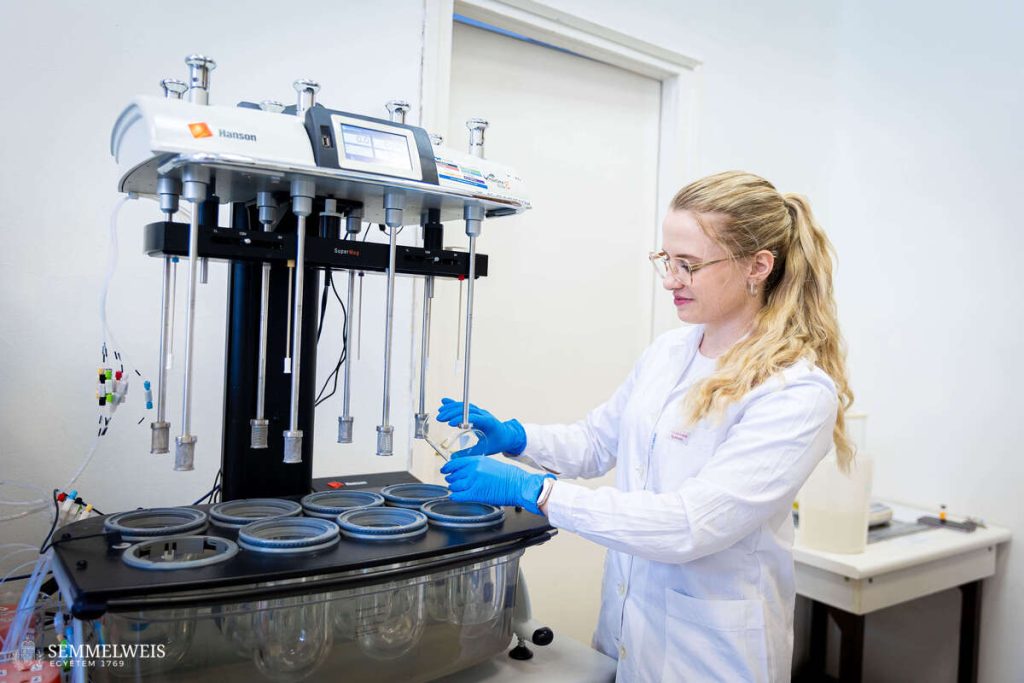
Adrienn Demeter (r), Ph.D. student at the Faculty of Pharmaceutical Sciences of Semmelweis University and first author of the study. Photo: Boglárka Zellei – Semmelweis University

Some alkaline mineral and medicinal waters may weaken the enteric coating of medications within just a few minutes, potentially reducing their effectiveness, according to a new study by Semmelweis University. The study, published in Pharmaceutics, found that if the active ingredient is released too early in the stomach rather than in the intestinal tract, it may reduce – and, in extreme cases, even eliminate – the effectiveness of certain anti-reflux, gastroprotective, psychiatric, or anti-inflammatory pain-relief medications. 

Researchers at Semmelweis University studied how different liquids could affect enteric-coated medications. The study analysed 22 commonly consumed beverages, seven of which – including several mineral and medicinal waters, tap water, filtered water, and apple juice – were examined in detail under laboratory conditions. 

Alkaline bottled waters with high mineral content caused the greatest changes in the protective coating surrounding the active ingredient-loaded particles. According to the researchers, not only the water’s alkalinity but also its high mineral and ion content may have contributed to the faster dissolution of the protective coating, an effect that was particularly pronounced in some medicinal waters. In some cases, the enteric coating began to deteriorate after just five minutes, and after 15–30 minutes of pre-soaking, more than 90 percent of the active ingredient had been released prematurely. 

Enteric-coated medications are designed so that the active ingredient is not released in the stomach but later in the intestines. This is important because some active ingredients are broken down by stomach acid, while others may irritate the stomach lining. Such coatings are commonly used on certain reflux medications, anti-inflammatory pain relievers, and digestive enzyme products.

Acidic liquids are less impactful

By contrast, more acidic liquids caused less damage to the enteric coating of the medications. In apple juice, for example, almost no premature release of the active ingredient was observed at the start of the tests, indicating that the coating remained far more stable than in alkaline waters. 

“The small drug particle does not know whether it is already in the intestine or still sitting in a glass. If the pH of the surrounding environment is similar, the coating may begin to dissolve in the same way. Healthcare professionals generally assume that medications are swallowed with plain tap water, but that is not always obvious to patients today, given the wide variety of mineral and medicinal waters available on the market,” said Dr Nikolett Kállai-Szabó, Associate Professor at the Faculty of Pharmaceutical Sciences of Semmelweis University and senior author of the study. 

The researchers also analysed the Summary of Product Characteristics (SmPCs) of 103 enteric-coated medications. In 42 cases, the instructions did not specify what liquid should be used to take the medication. Another 31 mentioned only “liquid,” while 21 referred simply to “water” without further clarification. Only nine SmPCs provided specific guidance on what beverage to take or mix the medication with, such as apple juice or another mildly acidic liquid. 

This may be particularly important for people who open hard capsules because of swallowing difficulties and mix the capsule contents with liquids, yogurt, or applesauce. Older adults, children, and patients with a temporary sore throat or swallowing difficulties are more likely to find themselves in this situation. 

“In the pharmacy, we regularly see that many patients are unaware of how much it matters what they take their medication with. This can also affect whether the treatment works as intended,” said Adrienn Demeter, PhD student at the Faculty of Pharmaceutical Sciences of Semmelweis University and first author of the study. 

The researchers emphasize that the findings do not mean mineral or medicinal waters are inherently problematic. The key takeaway is that enteric-coated medications should preferably be taken with plain tap water, and patients should consult a pharmacist or physician before opening a capsule or splitting a tablet. 

Source: Semmelweis University

New Nanoparticle-based Oral Insulin could be Ready for Human Trials Next Year

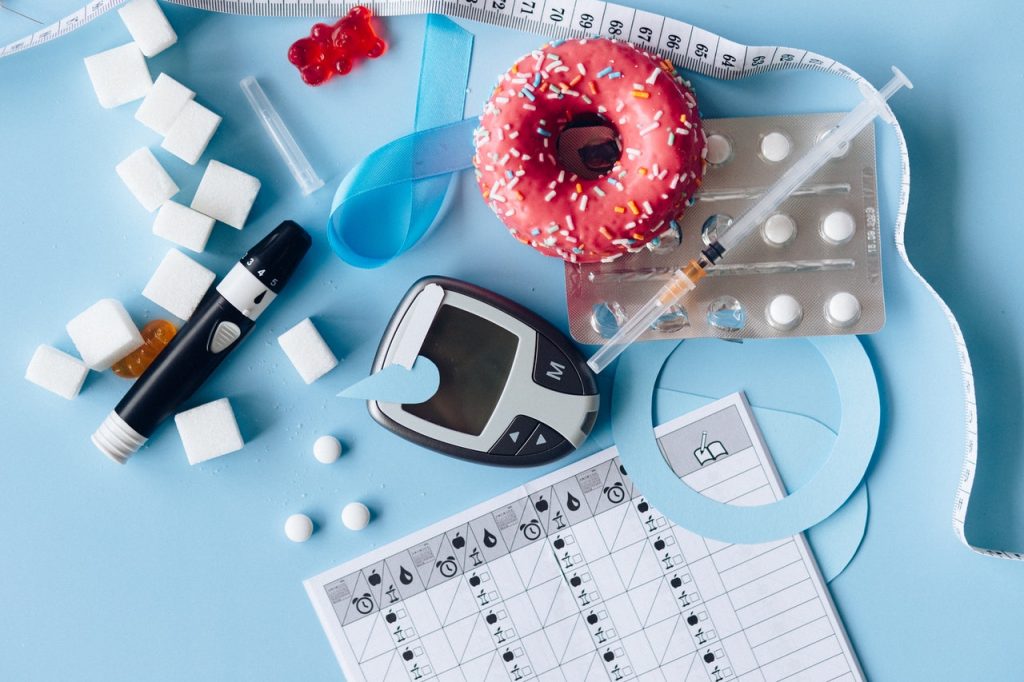
Photo by Nataliya Vaitkevich on Pexels

Scientists have developed a ‘smart’ insulin which can be taken orally. The insulin is encapsulated within tiny nano-carriers, 1/10 000th the width of a human hair. The results of its testing in baboons were recently published in Nature Nanotechnology.

“This way of taking insulin is more precise because it delivers the insulin rapidly to the areas of the body that need it most. When you take insulin with a syringe, it is spread throughout the body where it can cause unwanted side effects,” explains Professor Peter McCourt at UiT Norway’s Arctic University. He is one of the researchers behind the study.

Delivered insulin to where it’s needed

It was researchers at the University of Sydney and Sydney Local Health District who, in collaboration with UiT, discovered many years ago that it was possible to deliver medicines via nano-carriers to liver. The method has then been further developed in Australia and in Europe.

Many medicines can be taken orally, but until now people have had to inject insulin into the body. McCourt explains that the problem with insulin with a nano-carrier is that it breaks down in the stomach and thus does not get to where it is needed in the body. This has been a major challenge for developing a diabetes medicine that can be taken orally.

But now the researchers have solved this challenge.

“We have created a coating to protect the insulin from being broken down by stomach acid and digestive enzymes on its way through the digestive system, keeping it safe until it reaches its destination, namely the liver,” says McCourt, who is a liver biologist.

The coating is then broken down in the liver by enzymes that are active only when the blood sugar levels are high, releasing the insulin where it can then act in the liver, muscle, and fat to remove sugar from the blood.

“This means that when blood sugar is high, there is a rapid release of insulin, and even more importantly, when blood sugar is low, no insulin is released,” says Nicholas J. Hunt at the University of Sydney who, together with Victoria Cogger, leads the project.

He explains that this is a more practical and patient-friendly method of managing diabetes because it greatly reduces the risk of a low blood sugar event occurring, namely hypoglycaemia and allows for the controlled released of insulin depending on the patient’s needs, unlike injections where all the insulin is released in one shot.

Fewer side effects

The new method works similarly to how insulin works in healthy people. The pancreas produces insulin which first passes through the liver where a large portion of it is absorbed and maintains stable blood sugar levels. In the new insulin method, the nano-carrier releases insulin in the liver, where it can be taken up or enter the blood to circulate in the body.

When insulin is injected subcutaneously, far more of it goes to the muscles and to adipose tissues that would normally happen if it was released from the pancreas, which can lead to fat accumulation. It can also lead to hypoglycaemia.

With the new method, there will be fewer such side effects, and no need for injection – or refrigeration.

Tested on baboons

The oral insulin has been tested on nematodes, on mice and rats. And lastly, the medicine has now been tested on baboons in the National Baboon Colony in Australia.

“In order to make the oral insulin palatable we incorporated it into sugar-free chocolate, this approach was well received” says Hunt.

He says that 20 baboons have taken part in this study. When they received the medicine, their blood sugar was lowered.

The baboons were normal, healthy baboons, but the oral insulin have also been tested on mice and rats that actually have diabetes. The mice and rats did not have hypoglycaemic events, gain weight or fat accumulation in the liver overcoming current challenges with injectable and other oral insulins.

What remains now is to test the new method on humans.

Ready for use in 2-3 years

“Trials on humans will start in 2025 led by the spin out company Endo Axiom Pty Ltd. Clinical trials are performed in 3 phases; in the phase I trial we will investigate the safety of the oral insulin and critically look at the incidence of hypoglycaemia in healthy and type 1 diabetic patients. Our team is very excited to see if we can reproduce the absent hypoglycaemia results seen in baboons in humans as this would be a huge step forward. The experiments follow strict quality requirements and must be carried out in collaboration with physicians to ensure that they are safe for the test subjects” says Hunt.

Source: UiT The Arctic University of Norway

Delivering Cancer and Diabetes Drugs in Pills Instead of Injections

Source: Danilo Alvesd on Unsplash

In a new Journal of the American Chemical Society paper, researchers describe how they are developing a new way for diabetes and cancer patients to manage their conditions by enabling drugs to be delivered in pill form instead of through injections.

Some drugs for these diseases are water soluble, so transporting them through the intestines, is not feasible and makes them impossible to administer orally. However, UCR scientists have created a chemical “tag” that can be added to these drugs, allowing them to enter blood circulation via the intestines.

This tag is composed of a small peptide. “Because they are relatively small molecules, you can chemically attach them to drugs, or other molecules of interest, and use them to deliver those drugs orally,” said research leader Min Xue, UC Riverside chemistry professor.

Xue’s laboratory was testing something unrelated when the researchers observed these peptides making their way into cells.

“We did not expect to find this peptide making its way into cells. It took us by surprise,” Xue said. “We always wanted to find this kind of chemical tag, and it finally happened serendipitously.”

This observation was unexpected, Xue said, because previously, the researchers believed that this type of delivery tag needed to carry positive charges to be accepted into the negatively charged cells. Their work with this neutral peptide tag, called EPP6, shows that belief was not accurate.

Testing the peptide’s ability to move through a body, the Xue group teamed up with Kai Chen’s group in the Keck School of Medicine at the University of Southern California and fed the peptide to mice. With PET scans, the team observed the peptide accumulating in the intestines, and documented its ultimate transfer into the animals’ organs via the blood.

Having proven the tag successfully navigated the circulatory systems through oral administration, the team now plans to demonstrate that the tag can do the same thing when attached to a selection of drugs. “Quite compelling preliminary results make us think we can push this further,” Xue said.

Many drugs, including insulin, must be injected. The researchers are hopeful their next set of experiments will change that, allowing them to add this tag to a wide variety of drugs and chemicals, changing the way those molecules move through the body.

“This discovery could lift a burden on people who are already burdened with illness,” Xue said.

Source: University of California – Riverside

Body Posture, Stomach Motility Affect Oral Pill Bioavailability

Photo by danilo.alvesd on Unsplash

While oral administration of a pill or capsule is a simple and cheap route, it is also the most complex way for the human body to absorb an active pharmaceutical ingredient, due to the stomach environment’s influence on bioavailability. Using highly detailed computer simulations, researchers have now found that stomach motility and posture (leaning right, left or backwards) significantly affect bioavailability.

The rate of dissolution and gastric emptying of the dissolved active pharmaceutical ingredient (API) into the duodenum is modulated by gastric motility, physical properties of the pill, and the contents of the stomach. This results in varying rates of pill dissolution and nonuniform emptying of the drug into the duodenum and, occasionally, gastric dumping in the case of modified-release dosage. Current in vitro procedures for assessing dissolution of oral drugs do not simulate this process well.

In Physics of Fluids, researchers used a biomimetic computer simulation based on the realistic anatomy and morphology of the stomach (a ‘StomachSim’) to investigate and quantify the effect of body posture and stomach motility on drug bioavailability over the first few minutes of absoprtion.

 The simulations show that changes in posture can potentially have a significant (up to 83%) effect on the emptying rate of the API into the duodenum. A 45 degree lean to the left greatly reduced the amount of active ingredient per cycle released into the duodenum, while a lean to the right dramatically increased it over the upright case.

Similarly, the researchers found that a reduction in antral contractility associated with gastroparesis significantly reduced the dissolution of the pill as well as emptying of the API into the duodenum. The simulations show that for an equivalent motility index, the reduction in gastric emptying due to neuropathic gastroparesis is larger by a factor of about five compared to myopathic gastroparesis.

“Oral administration is surprisingly complex despite being the most common choice for drug administration,” said co-author Rajat Mittal. “When the pill reaches the stomach, the motion of the stomach walls and the flow of contents inside determine the rate at which it dissolves. The properties of the pill and the stomach contents also play a major role.

“However, current experimental or clinical procedures for assessing the dissolution of oral drugs are limited in their ability to study this, which makes it a challenge to understand how the dissolution is affected in different stomach disorders, such as gastroparesis, which slows down the emptying of the stomach.”

Together, these issues pose several challenges for the design of drug delivery.

“In this work, we demonstrate a novel computer simulation platform that offers the potential for overcoming these limitations,” said Mittal. “Our models can generate biorelevant data on drug dissolution that can provide useful and unique insights into the complex physiological processes behind the oral administration of pills.”

The researchers note that the simulation required a lot of computational time, only capturing the first few minutes of the process, and are working on faster methods to capture differences over the period of an hour.

Source: American Institute of Physics