An international, randomised, double‑blind, placebo‑controlled phase 3 study, the largest of its kind for mpox, found that tecovirimat did not improve clinical outcomes for adults with clade II mpox compared with placebo, while demonstrating a similar safety profile. Results of the STOMP/A5418 trial, published in the New England Journal of Medicine underscore both the urgent need for alternative therapeutics and the critical importance of randomised trials during public health emergencies.
This Phase 3 study randomised 412 participants (344 with laboratory‑confirmed mpox), to receive either tecovirimat or a matching placebo for 14 days. Randomisation was stratified by early versus later symptom onset and by the presence of severe pain. Participants had active skin or mucosal lesions and self‑reported daily symptoms, pain scores, and lesion status through Day 29, with confirmatory clinical assessments at scheduled visits. Biospecimens, including lesion swabs, oral and rectal swabs, and blood samples, were collected at multiple time points to assess viral DNA clearance. The primary endpoint was time to clinical resolution of all lesions, and key secondary endpoints included pain reduction, complete lesion healing, and virologic response.
Conducted across seven countries at 49 sites, the phase 3 study showed that tecovirimat did not shorten the time to lesion resolution, reduce pain, or speed viral clearance compared with placebo. These results align with interim findings released in December 2024, which led the trial’s independent Data and Safety Monitoring Board to halt further enrolment due to statistical futility.
“In the midst of a global public health emergency, the ACTG team rapidly conducted this randomized controlled trial to deliver a clear answer for patients and clinicians,” said William A. Fischer II, MD, associate professor of pulmonary and critical care medicine at the UNC School of Medicine, and director of emerging pathogens research at the UNC Institute for Global Health and Infectious Diseases. “These findings advance our understanding of mpox and help the field refocus efforts on identifying safe, effective and accessible treatment strategies, particularly for people at highest risk of severe disease.”
Although the trial did not demonstrate efficacy, tecovirimat demonstrated a favourable safety profile, with no major safety concerns identified – an important confirmation as thousands of patients worldwide have already received the drug under expanded access protocols.
“The STOMP trial provides essential evidence at a critical time and demonstrates why randomized controlled trials are an indispensable part of outbreak response,” said Joe Eron, MD, chief of infectious diseases and chair of the ACTG network. “But now we must keep going to find safe and effective treatment for people as this virus continues to circulate globally.”
The study’s conclusions are expected to influence clinical practice and public health guidance worldwide. With mpox still causing outbreaks in multiple regions, researchers emphasise that developing and evaluating new antiviral candidates remains a top priority.
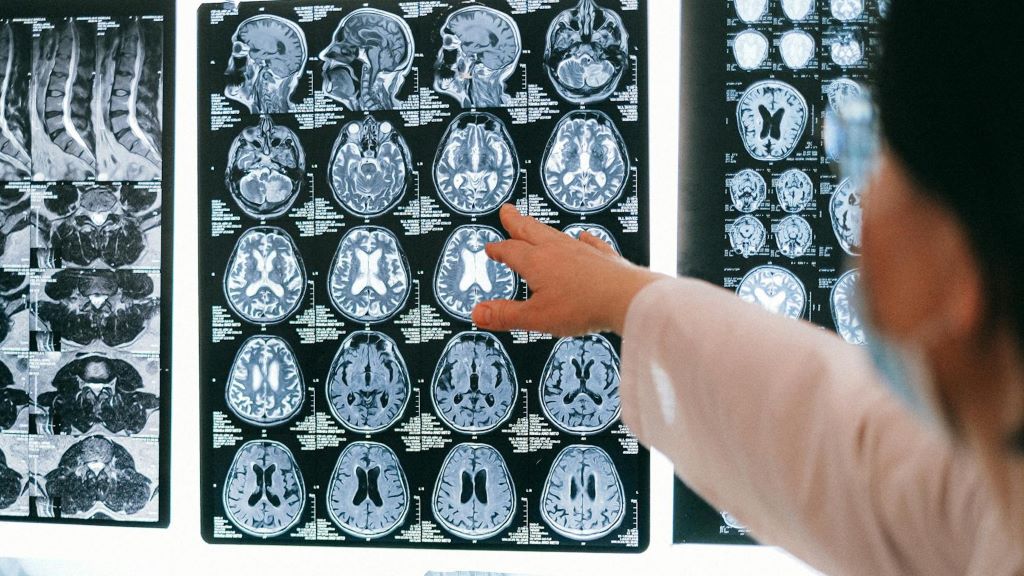
If someone living with HIV is not on antiretroviral therapy, the virus can cause inflammation in, among other places, the brain. Photo by Anna Shvets
By Biénne Huisman
Antiretroviral therapy has shifted HIV from a fatal to a chronic condition. But neuropsychiatrists say it is imperative for people living with the virus to start treatment immediately as the “duration of untreated exposure” may cause irreversible brain damage and impact long-term cognitive health.
It has been recognised for decades that cognitive impairment is a potential complication of HIV infection. Questions over how likely and how serious this potential complication is have become more urgent over time as the population of people living with HIV ages – ageing after all also increases the risk of cognitive decline.
There were around 1.75 million people over the age of 50 living with HIV in South Africa in 2024, according to Thembisa, the leading mathematical model of HIV in the country. This is just over 20% of the estimated eight million HIV positive people in the country. A study published in the Lancet medical journal also has the number at around 20% in sub-Saharan Africa.
This is a delicate field of enquiry as researchers walk a tightrope to avoid “the burden of double stigma”, while conceptualising the necessary tools to best diagnose brain problems and suitable interventions.
Within as little as two weeks
At Groote Schuur Hospital’s Neuroscience Institute, Professor John Joska, director of the University of Cape Town’s (UCT’s) HIV Mental Health Research Unit, explains that HIV can enter the brain within as little as two weeks after the initial infection – primarily through infected white blood cells, such as lymphocytes. If a person is not on antiretroviral therapy, the virus can cause inflammation in the brain and possibly also tissue damage.
“The brain is a protected compartment,” says Joska. “A theory as to how the virus, which is a protein particle, gets into the brain is through infected lymphocytes. This doesn’t directly infect nerve cells, what we call neurons. It infects other supporting tissues and cells in the brain, causing an inflammation which damages typically the white matter of the brain. Over time, that inflammation can cause loss of neurons, but indirectly.”
While antiretroviral therapy is crucial for clearing and suppressing HIV in all body compartments, including in the brain, he says that it does not reverse damage that occurred before the treatment was started.
“Today, people with HIV are living near normal lifespans,” he says. “The question is, will the fact that they’ve had HIV, with some duration of untreated exposure and potential loss of brain tissue, cause them to be at higher risk than the average person for developing dementias of old age – which really are mainly Alzheimer’s disease or vascular dementia.” It is these longer-term effects that are the main concern when it comes to the impact of HIV on the brain.
Part of the problem is that South Africa not only has an ageing population of people living with HIV, but many of these people would only have started treatment quite long after they contracted the virus. One key reason for this is the South African government’s reluctance to make antiretroviral treatment available in the early 2000s. It has been estimated that those delays resulted in over 300 000 avoidable deaths – they may also be contributing to brain health issues now and in the future.
From efavirenz to dolutegravir
Apart from HIV itself, some of the medicines used to treat the infection have also had an impact on the brain.
In 2019, the standard HIV treatment in South Africa changed from a three-drug combination containing an antiretroviral drug called efavirenz, to a combination containing the drug dolutegravir. This shift had mental health benefits, as evidenced in research lead by Joska’s fellow UCT Neuro-HIV researcher, Associate Professor Sam Nightingale.
Joska says: “The study looked at the period from 2017 to 2020 and the switch from efavirenz to dolutegravir based treatment. It was well known that efavirenz caused, certainly for the first two months, a bunch of psychotropic or psychological issues like nightmares or anxiety, even psychosis for some people. But our findings showed people who switched to dolutegravir actually do very well. They look more like people without HIV after eight months. So dolutegravir has been a huge advantage, not only because it’s robust, but because it’s neuro-protective.”
New models for HIV and cognitive impairment
A shift is underway in how experts are thinking about cognitive impairment in people with HIV. Some neuropsychiatrists, including Joska, are recommending a shift away from the 2007 HIV-Associated Neurocognitive Disorders model, arguing that its cognitive test scores do not adequately account for variables such as education and socioeconomic background, and that it can overdiagnose impairment. The argument is set out in an article, lead-authored by Nightingale, that was published in the journal Nature Reviews Neurology in 2023.
The authors argue that a label of cognitive impairment might cause a “double burden of stigma” for people living with HIV – affecting self-esteem, inciting fear and prompting further discrimination against persons already subject to stigma as it stands. To illustrate the point, they point out how, up until recently, people with HIV in the United Kingdom could not become airline pilots due to concerns over cognitive impairment. However, following a campaign by a pilot living with HIV, the United Kingdom’s Civil Aviation Authority removed the ban in 2022.
Nightingale and his colleagues argue that traditional test scores be used in conjunction with real-life symptoms and medical evidence of brain problems. It introduces the conceptual model of HIV-Associated Brain Injury, which refers specifically to damage caused by the virus. This distinguishes it from other causes of cognitive impairment such as depression, substance abuse, diabetes and cardiovascular disease. As Spotlight previously reported, HIV is also associated with an increased risk of depression, though this is at least partially driven by social factors.
Lower cognitive function associated with late diagnosis
At the 2026 Conference on Retroviruses and Opportunistic Infections hosted in Denver in the United States in late February, these issues were tabled at a discussion titled “When I’m 64: Neurodegeneration, Epigenetic Aging, and Cognition in Older People With HIV.”
Professor John Joska is the director of the University of Cape Town’s HIV Mental Health Research Unit. (Photo: Biénne Huisman/Spotlight)
In his presentation, Professor Alan Winston of Imperial College London, also a member of the International HIV-Cognition Working Group, and a frequent co-author alongside Joska and Nightingale, relayed existing research findings that on average, people living with HIV have lower cognitive function – including memory, attention span and executive function like planning – compared to people who don’t have HIV of the same age. He said that this manifests as an increased risk of lower grade early dementia.
Like Joska, Winston stressed that the most deteriorated cognitive function in people living with HIV is associated with untreated HIV and late HIV diagnosis. He reiterated that starting HIV treatment soon after diagnosis is protective, and that viral suppression is associated with better cognition. In groups of patients with HIV well controlled on dolutegravir-based HIV treatment, cognition appears similar to HIV negative groups, he said.
HIV clinicians need to pay better attention to the brain
In an impassioned presentation, Dr Shibani Mukerji, Associate Professor of Neurology at Harvard Medical School, argued that protecting the brain is an overlooked frontier in effective HIV treatment, and that clinicians need to pay more attention to it.
“By the time patients and clinicians notice cognitive decline – generally and in HIV – the damage to the brain is done and lives are affected negatively. People don’t raise cognitive concerns early enough due to stigma, fear, [and] lack of recognition of the issues. It is seen as ‘just getting old’,” she said.
Mukerji emphasised the need to prioritise brain health. “HIV doctors and treatment programmes are focused, almost exclusively, on viral load as the marker of successful treatment. They may be thinking laterally and consider TB and other infections, maybe cardiovascular disease – but they are definitely not paying enough attention to brain health. HIV doctors aren’t aware enough of brain health issues in people living with HIV, and even when they are, they often don’t feel comfortable diagnosing or managing it, so it is under recognised and under diagnosed.”
The perception that there is no way to manage or treat cognitive decline –generally and in people living with HIV – is wrong, she said, adding that optimising physical, mental and social health is critical for brain health.
“Almost half of dementia risk [in people in general] is linked to preventable causes,” she told conference delegates, along with a slide listing preventable causes including loss of hearing, social isolation, cardiovascular disease and depression.
She explained: “If someone has cognitive decline and for example you improve their hearing – if they have hearing issues – and you work on their social isolation, and treat their vascular disease, and treat their depression, you can see a marked improvement in their cognition.”
Ending her presentation with a twist of humour, Mukerji’s last slide referred to the session’s title, a reference to the Beatles song on aging “When I am 64”. She printed the song’s lyrics: “When I get older, losing my hair, many years from now…”, closing her talk by saying: “It’s okay to stand up and sing, in fact your doctor might prescribe it.”
Cyclone Gezani caused extensive damage across the region, displacing thousands and severely affecting homes, public infrastructure, and healthcare facilities
Following the devastating cyclone that struck Madagascar’s east coast, Mercy Ships (www.MercyShips.org) has joined with national disaster response efforts in Toamasina (Tamatave) through the provision of essential relief supplies, in coordination with the government’s disaster management authorities.
Cyclone Gezani caused extensive damage across the region, displacing thousands and severely affecting homes, public infrastructure, and healthcare facilities.“In moments like these, partnerships and solidarity matter most,” said Nicholas Ahadjie, Country Director of Mercy Ships in Madagascar. “We are committed to supporting the national response and ensuring that assistance reaches communities where the needs are greatest.”
As part of its own immediate response, Mercy Ships has delivered 537 bags of rice, 1000 roofing sheets, and 1000 ready-to-eat meals. These supplies arrived in Toamasina and were officially handed over to the government’s Designated Disaster Response Coordination Body for distribution to affected communities.
The roofing materials will enable families, schools, and community health facilities to begin urgent repairs. The rice will be distributed to households impacted by the storm that still have functional cooking facilities, while ready-to-eat meals will provide immediate support to individuals and displaced families.Although the Mercy Ships hospital vessel Africa Mercy®, is currently undergoing scheduled maintenance in South Africa, preparations are underway for her return to Madagascar. Sometime this May, she is expected to resume surgical services and medical training programs in collaboration with the Ministry of Health.
“Our presence in Madagascar is on-going,” added Nicholas Ahadjie. “While the ship is in maintenance, our engagement with partners continues. We stand with the Malagasy people today and remain dedicated to strengthening healthcare capacity for the future.
”For several years, Mercy Ships has partnered with Madagascar to provide free specialised surgeries, professional medical training, and infrastructure support. The recent disaster will not stop the organisation’s ongoing support for the Malagasy people as it continues to help reinforce their national health systems.Distributed by APO Group on behalf of Mercy Ships.
ABOUT MERCY SHIPS:
Mercy Ships operates hospital ships that deliver free surgeries and other healthcare services to those with little access to safe medical care. An international faith-based organisation, Mercy Ships has focused entirely on partnering with African nations for the past three decades. Working with in-country partners, Mercy Ships also provides training to local healthcare professionals and supports the construction of in-country medical infrastructure to leave a lasting impact. Each year, more than 2500 volunteer professionals from over 60 countries serve on board the world’s two largest non-governmental hospital ships, the Africa Mercy® and the Global Mercy™. Professionals such as surgeons, dentists, nurses, health trainers, cooks, and engineers dedicate their time and skills to accelerate access to safe surgical and anaesthetic care. Mercy Ships was founded in 1978 and has offices in 16 countries as well as an Africa Service Center in Dakar, Senegal. For more information, visit www.MercyShips.org and follow @MercyShips on social media.
Researchers at WashU Medicine have identified a potent pathway that begins in the brain and leads to loss of all body fat without reducing food intake. The study is reported in Nature Metabolism.
The team – led by senior author Erica L. Scheller, DDS, PhD, an associate professor in the Division of Bone and Mineral Diseases in the Department of Medicine; Xiao Zhang, PhD, a former graduate student in Scheller’s lab who is now a postdoctoral fellow at the University of Pennsylvania School of Medicine; and Sree Panicker, a graduate student in Scheller’s lab – was inspired by a unique population of fat cells located deep within the skeleton.
“About 70% of our bone marrow is filled with fat that doesn’t respond to diet or exercise,” said senior author Scheller. “We wanted to figure out why.”
The team found that these special cells, called constitutive bone marrow adipocytes, expressed high levels of proteins that inhibit fat breakdown. This causes resistance to fat loss in day-to-day settings. “We call these cells stable adipocytes,” said Zhang, the study’s first author. In mice, sustained injection of leptin, a hormone, into the brain was able to unlock the stable adipocytes by putting the body into a state of low glucose and insulin. This reduced the inhibitors of fat breakdown, causing complete loss of body fat within days, even though the mice were still eating normally.
This pathway is so powerful that the scientists caution against using it in humans until it is better understood. Stable adipocytes occur in places like the bone marrow, in the hands and feet, and around important glands. In severe wasting disorders, loss of fat within these cells is associated with bone fractures and reduced quality of life. Scheller’s team hopes to prevent this loss and preserve health in patients with severe wasting disorders by defining the mechanisms of stable fat loss. Conversely, methods to activate fat loss from stubborn adipocytes may support future treatments for obesity. This work was funded by the National Institutes of Health (NIH).
For patients with advanced melanoma without BRAF mutation who no longer respond to immune checkpoint inhibitors, treatment options remain frustratingly limited. A new study from Vanderbilt researchers led by Professor Emerita of Pharmacology Ann Richmond outlines a promising therapeutic strategy that may re-sensitise these resistant tumours to immunotherapy.
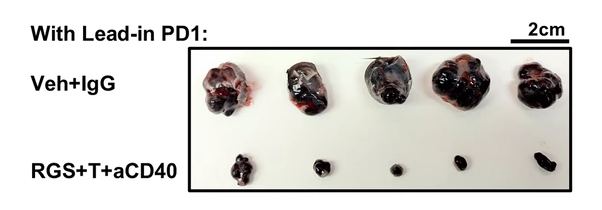
Figure 5b from the paper shows the difference between tumours treated with a just an antibody and vehicle (solution) or with trametinib and rigosertib and a CD40 agonist. Image cropped and shared from the paper by Yan et al. published in Nature Communications in 2026 in accordance with a CC BY-NC-ND 4.0 license.
The research introduces a three-drug combination that enhances immune activity and suppresses tumour-promoting immune cells by leveraging a low dose of the MEK inhibitor trametinib and multi-kinase inhibitor rigosertib alongside a CD40 agonist to shift the tumour microenvironment toward immune activation. Notably, all three agents have been either approved by the U.S. Food and Drug Administration or are currently in clinical trials, which may speed their path to patient testing.
“While agonist CD40 therapy can be helpful for treatment of melanoma, this therapy also induces the CD11b+ B regulatory cells that suppress the T cell response to tumours,” Richmond said. “We showed that combining CD40 therapy with trametinib and rigosertib prevents the induction of these B regulatory cells.”
Immune checkpoint inhibitors have become a mainstay of melanoma treatment, working by releasing the molecular “brakes” that prevent T cells from attacking cancer. But resistance to ICI is common in metastatic melanoma, especially in tumours that evolve immune-suppressive microenvironments. While CD40 agonists can activate immune cells, this therapy also unexpectedly expands CD11b+ regulatory B cells.
By combining CD40 activation with MEK and PI3K inhibition, the researchers blocked the expansion of suppressive B cells while retaining the benefits of CD40 stimulation. In preclinical mouse models of melanoma, the triple combination not only suppressed tumour growth but also restored responsiveness to checkpoint blockade.
Key findings
B cells as a resistance mechanism: CD40 therapy alone induced regulatory B cells that dampen T cell–mediated tumor immunity.
Triple combination prevents immune suppression: Co-treatment with trametinib and rigosertib blocked the agonist CD40 induction of regulatory B cells, allowing immune responses to proceed.
ICIs regain effectiveness: The drug cocktail slowed tumor progression and re-sensitized resistant melanomas to anti-PD-1 therapy.
Translational promise
Because trametinib, rigosertib, and CD40 agonists are already in human trials or approved for other indications, this therapeutic strategy may advance more quickly than approaches requiring new drug development. Richmond’s team sees potential for testing the triple therapy in clinical trials for melanoma patients who have progressed on ICI.
“This approach provides a new route to enhance antitumor immunity in patients with tumors that no longer respond to immunotherapy,” Richmond said.