After almost two decades, a new drug for Alzheimer’s disease has been approved in the US. However, some experts say it doesn’t really work — only treating amyloid plaques which are thought to cause the disease — and worry that it may cost a lot.
The amount of attention around this news reflects the importance of preventing dementia, with its devastating toll on families and patients. But millions of adults could lower their chances of needing such a drug by taking preventative measures.
That’s why a national panel of experts including the University of Michigan’s Deborah Levine, MD, MPH, recently published a guide for primary care providers on this topic as an official Scientific Statement from the American Heart Association.
People dread Alzheimer’s disease, she said. Helping people understand that they can prevent or slow future dementia by taking specific steps now could motivate them to increase their healthy behaviours for a positive effect.
The first step is to recognise that dementia risk is higher among people with seven major modifiable risk factors.
These are: depression, hypertension, physical inactivity, diabetes, obesity, hyperlipidaemia, poor diet, smoking, social isolation, excessive alcohol use, sleep disorders and hearing loss. Addressing each of these factors can, to varying extents, help reduce the risk of developing dementia, a fact backed by decades of research.
The second step is using medication, lifestyle change and other interventions to help patients reduce their dementia risk.
“Dementia is not inevitable,” said Dr Levine, a primary care provider at the University of Michigan Health, part of Michigan Medicine. “Evidence is growing that people can better maintain brain health and prevent dementia by following healthy behaviours and controlling vascular risk factors.”
These strategies can help preserve cognitive function and lower risk for heart attacks and strokes, said Dr Levine, who heads the Cognitive Health Services Research Program and sees patients at the Frankel Cardiovascular Center.
“We need to address the significant disparities that lead women, Black, Hispanic and less-educated Americans to have a much higher risk of dementia,” said Levine, a member of the U-M Institute for Healthcare Policy and Innovation.
She added that it’s never too late in life to start working on cognitive risk factor control.
“We have no treatments that will halt dementia – so it’s important to protect your brain health.”
As interest mounts in the ‘lab leak’ hypothesis for the origin of SARS-CoV-2, more scientists are starting to take it seriously, especially because of the important implications of its actual origins.
MedPage Today reported that many experts it approached for the story were hesitant to speculate on its exact implications, they agreed that further research into its origins is important to ward off future pandemics.
A natural origin’s implications
Back in 2007, scientists who were studying coronaviruses warned: “The presence of a large reservoir of SARS-CoV–like viruses in horseshoe bats… is a time bomb. The possibility of the re-emergence of SARS and other novel viruses… should not be ignored.”
On May 26 2021, in the midst of the greatest disaster the world has faced since World War II, US President Joe Biden gave US intelligence 90 days to reach a “definitive conclusion” on the origins of SARS-CoV-2.
Vincent Racaniello, PhD, professor of microbiology and immunology at Columbia University, said finding an answer is unlikely within Biden’s deadline. After all, it took 14 years to find the ancestor of the first SARS virus in wildlife.
For Prof Racaniello, this renewed concern underscores the need for better surveillance of viruses in wildlife.
“All human viruses begin in nature. There’s an overwhelming preponderance of data that shows that, so it makes sense to look in nature when we’re looking for the source of new viruses,” Prof Racaniello told MedPage Today.
As a result of human population pressure, more viruses are spilling over into humans from nature. Examples of this include Ebola, SARS-1, MERS, and bird and swine flu. Because of the evolutionary closeness of mammals and humans, they are major pathogen sources. Rodents and bats (accounting for 20% of mammals), as well as various species of birds are good places to look. However our surveillance of wildlife is spotty, so we have “very little” understanding of the viruses these types of animals harbour, and which ones could be threats to humans, Prof Racaniello warned.
“We need to do more wildlife sampling, to find out what’s out there and what’s potentially a threat,” he said. “More investment in this could have prevented the trillions of dollars that we’ve spent to take care of this pandemic.”
A lab leak’s implications
On the other hand, Richard Ebright, PhD, a molecular biologist and professor of chemistry and chemical biology at Rutgers University in New Jersey, believes the real issue lies in addressing the potential for future pandemics that could originate from lab accidents, a discussion that “needs to begin now.”
“Irrespective of whether COVID originated in a natural accident or a lab accident, the risk of a future pandemic originating in a lab accident is real,” he told MedPage Today.
Prof Ebright explained that, in the US and other countries, only voluntary biosafety guidelines exist, and these are about preventing accidental release of pathogens. While the US has legal regulations against several pathogens that could be used as biological weapons, there are no biosecurity regulations for other pathogens. In most of the world, no biosecurity regulations exist for pathogens other than smallpox, not even voluntary ones, Prof Ebright said.
In 2017, the US implemented a bio-risk policy requiring a risk-benefit analysis before federal funding can be approved for high-risk research, such as ‘gain of function’ research that could be used to increase a pathogen’s transmissibility or pathogenicity to better understand and control it, Prof Ebright said. But this bio-risk policy has been essentially ignored by federal agencies, and the other countries with bio-risk policies only apply it to smallpox.
“Discussion now, especially among policy makers and the public, needs to turn to the inadequacy of biosafety, biosecurity, and biorisk-assessment standards worldwide, and to the essentially complete absence of biosafety regulation worldwide,” he said.
The return of the lab leak hypothesis
While evidence is largely circumstantial, the basic idea is that a laboratory at the Wuhan Institute of Virology had been experimenting on a virus called RaTG13 (a coronavirus closely related to SARS-CoV-2, which infects horseshoe bats), and genetically manipulating other horseshoe bat viruses collected around China. It is thought that one of these laboratory viruses could have infected a staffer at the institute, who then transmitted it to the broader public, Dr Ebright explained.
Following the WHO’s March 30 SARS-CoV-2 origins investigation report, there was a sudden about-face and the lab leak theory began to be taken seriously. Though investigators classified a laboratory origin as “extremely unlikely”, they said the conclusion was reached on the evidence made available.
Even the Director-General of the WHO, Dr Tedros Ghebreyesus, said at the time that he did not believe the assessment of a laboratory origin was “extensive enough,” that this hypothesis “requires further investigation,” and that “this report is a very important beginning, but it is not the end.”
“At this point in time, all scientific data related to the genome sequence of SARS-CoV-2 and the epidemiology of COVID are equally consistent with a natural-accident origin or a laboratory-accident origin,” Ebright said.
While the WHO report does not propose a follow-up study for laboratory origins, it acknowledges that both “follow-up of new evidence” and “regular administrative and internal review of high-level biosafety laboratories worldwide” is needed.
In the UK, a “game-changer” method to sample cells for the detection of oesophageal cancer is being trialled in a mobile unit.
The cytosponge, a pill containing a sampling sponge, was developed at the and collects cells which are tested at a laboratory. Details on its development were published in The Lancet. In a previous trial with more than 13 000 participants receiving either the cytosponge or usual care from a GP, the odds of detecting oesophageal cancer were ten times higher than with usual care.
It is hoped the test will be much more efficient and quicker than the current detection method, requiring an endoscopy in hospital.
Prof Rebecca Fitzgerald from the University of Cambridge, which developed the test, said it was “really simple and straightforward”.
Early signs of cancer of the oesophagus are often mistaken for heartburn. It is the sixth most common cause of death from cancer worldwide.
A mobile unit will perform the test at GP surgeries at different locations around the UK.
Prof Fitzgerald, who specialises in cancer prevention, said the cytosponge “can diagnose cancer of the oesophagus really early”.
“Usually you would have to go to the hospital and get an endoscopy, with all that entails, and our idea was could you make something that was so simple you could go to a mobile unit or GP surgery,” Prof Fitzgerald said.
“The simplicity is the absolute key of this – we know the power of diagnosis is in the cells you collect.”
She added that due to COVID, “some endoscopy has been completely on hold so you might have to wait months” for the procedure, where a long, thin tube with a camera is sent down the patient’s mouth and throat.
Prof Fitzgerald explained: “You swallow the capsule on a string with water and it will go down to the top of the stomach.
“The capsule will dissolve in five to seven minutes, and as it dissolves out pops a sponge which has been compressed in that capsule. The nurse simply pulls the sponge out with the string and it will collect about a million cells on its way out.
“We put that sponge into a preservative, send it to the laboratory where it is tested to see whether there are Barrett cells or not and whether the cells look like they are turning to pre-cancer. Then we can let the patient know and if there is anything to worry about they can have an endoscopy and treatment.”
The procedure takes about 10 minutes to perform in total.
A Portuguese study has found that bacteria in urinary tract infections (UTI) can be traced back to meat through the production chain where it was prepared.
UTIs are caused by both Gram-negative and Gram-positive bacteria, as well as by certain fungi. Staphylococcus saprophyticus is a major cause of UTI in young women, reaching 20% prevalence. Understanding the epidemiology of this microorganism can help identify its origin, distribution, causes, and risk factors. Researchers from ITQB NOVA led by Maria Miragaia showed that Staphylococcus saprophyticus can originate in food, specifically in the meat-production chain. Their findings were published in the journal Emerging Infectious Diseases.
Pork is the most popular meat type in Europe. S. saprophyticus can be a contaminant of that meat, and it is also found in the environment, the gut and rectal flora of pigs, and in the human gastrointestinal tract, vagina, and perineum.
The researchers used a combination of phenotypic, genomic, and pan-genome wide association approaches, which enabled them to identify two different lineages (G and S) of S. saprophyticus. Lineage G is of food origin and transmitted to humans by contact with food products, and lineage S is of human origin. Both cause disease and may be transmitted directly or indirectly between persons within the community, with an extensive geographic distribution possible.
To find out if these bacteria causing UTIs could be related to the ones found in pork, the research group looked at S. saprophyticus from a slaughterhouse and compared them to those causing human UTIs. The team analysed bacteria collected from UTIs worldwide over two decades, and from UTIs and pork meat production chain in Portugal.
The results showed that bacteria found in the slaughterhouse (equipment, meat, colonisation of workers) were similar to human UTI bacteria and had the same antibiotic resistance profile.
Although S. saprophyticus colonisation rate in pigs was extremely low (1%), 35% of slaughterhouse samples were contaminated. The presence of an antiseptic resistance gene (qacA) by all the lineage G bacteria could be part of the explanation for the ineffective cleaning procedures that were used. “S. saprophyticus strains of animal origin (lineage G) enters the slaughterhouse through food animals, persist on the equipment, disseminate and contaminate the meat processing chain and humans. Human colonisation is a crucial step for the later occurrence of UTI,” explained first author Opeyemi Lawal.
The researchers also studied genomic data of bacteria collected from patients attending three hospitals in the Lisbon area, and found that the transmission of these pathogenic bacteria from both lineages (G and S) occurs between persons within the community. Making use of this deep-structured analysis, researchers were also able to identify putative new virulence factors for this unexplored bacterium. The team will continue to search for reservoirs of this bacterium in humans and animals, and to study the mechanisms of S. saprophyticus dissemination and disease to inform strategies against this pathogen.
“This a clear example of how food manipulation can impact in human health, and how important it is to educate consumers regarding good individual hygiene practices to avoid spreading of infectious diseases“, said Maria Miragaia, head of the Bacterial Evolution and Molecular Epidemiology Lab.
“This adds to the list of bacteria that are transmitted to humans through contact with animals and animal-derived food. But the exact mechanisms associated to the conversion from a coloniser to an infectious agent remains to be clarified”, added Henrik Westh from the Copenhagen University Hospital – Amager and Hvidovre, University of Copenhagen (Denmark).
Health Minister Dr Zweli Mkhize is in hot water over alleged procurement fraud for a R150 million COVID contract, and is widely expected to step down shortly.
President Cyril Ramaphosa is reportedly weighing up two candidates to replace Dr Mkhize as health minister.
The candidates are the former Gauteng health MEC Dr Gwen Ramokgopa, (who took over following the Life Esidimeni tragedy) and Dr Nkosazana Dlamini-Zuma, who, as Health Minister saw the overhaul of the country’s apartheid-era healthcare systems.
As an anti-Apartheid activist, Dr Ramokgopa held various leadership positions. She qualified as a medical doctor (MBChB) in 1989 and obtained her Master’s in Public Health (MPH) in 2007. She worked as a Medical Officer at the Dr George Mukhari (then Ga-Rankuwa) Hospital until 1992.
Having served once as the Gauteng health MEC in 1999, Dr Ramokgopa took on the role deputy health minister from 2010 to 2014. She succeeded Qedani Mahlangu as Gauteng health MEC following the shameful Life Esidimeni tragedy involving the deaths of at least 94 mental health patients released from private mental healthcare facilities to 27 unlicensed facilities. In a statement, she vowed to tackle waste and corruption.
Dr Nkosazana Dlamini-Zuma completed her MBChB at the University of Bristol in 1978, and took part in underground ANC activities. During Mandela’s presidency, she was appointed Minister of Health, and courted controversy by voicing support for Virodene, an ‘HIV cure’ which attracted heavy criticism and which was never approved.
She then served as Minister of Foreign Affairs from 1999 to 2009, and then Minister of Home Affairs to 2012, where she turned around a department mired by mismanagement. Despite stubborn resistance from French-speaking nations, she was elected the African Union’s (AU) Chairperson from 2012 to 2017 and was praised for focusing on gender issues. After this, she began vying for the ANC presidency as an MP. In 2019, she was appointed Minister of Cooperative Governance and Traditional Affairs.
During South Africa’s lockdown, she memorably rose to internet fame for using “zol” to refer to cannabis when giving reasons for the tobacco ban.
Researchers from the University of Michigan Rogel Cancer Center have uncovered clues as to why kidney cancers respond so differently to treatment, opening up new tailored treatment options.
Not all kidney cancers behave the same, and some have wildly differing responses to immunotherapy or other treatments – resulting in wildly different outcomes for patients.
By sequencing the RNA of individual cells within multiple benign and cancerous kidney tumors, the researchers have identified the cells from which different subtypes of kidney cancer originate, the pathways involved and how the tumor microenvironment impacts cancer development and response to treatment.
The findings, published in PNAS, could help researchers better understand renal cell carcinoma development and guide oncologists in optimising therapies for each patient.
“Single cell RNA sequencing was key to allowing us to monitor gene expression patterns in each individual cell, revealing the mechanisms at play within the tumour microenvironment that can predict overall survival,” says study author Arul Chinnaiyan, MD, PhD, director of the Michigan Center for Translational Pathology and SP Hicks Professor of Pathology at Michigan Medicine.
Researchers produced gene expression atlases for normal kidney and renal cell carcinoma samples. They predicted the putative cell of origin for more than 10 subtypes of renal cell cancer. Their analysis also uncovered pathways and interactions within the tumour microenvironment that predicted if the tumour would respond to immunotherapy. These findings could help develop biomarkers to guide kidney cancer treatment.
“By understanding the cell type where a cancer originates, it may allow us to target more precise treatments for that cancer type as well as better understand response to therapy,” Dr Chinnaiyan said.
A new measurement of heart function developed at UVA Health could improve survival for people with heart failure by identifying high-risk patients who require tailored treatments, according to a new study.
The study is the first to show a survival benefit from wireless pressure monitoring sensors implanted in the pulmonary arteries. Pulmonary artery proportional pulse pressure, or PAPP, is a new measure of heart function that can identify patients at very high risk of hospitalisation or death from systolic heart failure or pulmonary hypertension (high blood pressure in the heart and lungs).
Previous work showed that patients with low PAPPs were at much higher risk than those with higher PAPPs, so the researchers tested whether these benefits were maintained in patients undergoing implantation of pressure sensors that continuously monitor pressure in the pulmonary artery.
“We found that PAPP is a very good measure of how stiff or compliant the pulmonary arteries are. The stiffness of the pulmonary arteries determines how much resistance the right side of the heart has overcome to pump blood effectively to the lungs,” said Sula Mazimba, MD, MPH, a heart failure expert at UVA Health and the School of Medicine. “The importance of this simple measure is that it can identify patients that are at greatest risk of dying or being hospitalised. This allows us to tailor more aggressive treatments.”
Heart failure causes more than 1 million hospital admissions each year, and approximately half of patients die within five years of diagnosis.
The new study evaluated the benefits of PAPP monitoring in patients with systolic heart failure, where the left ventricle is weak, as well as those with pulmonary hypertension.
To find out if PAPP monitoring could predict outcomes in these patients, Dr Mazimba and colleagues analysed data from 550 participants in the CHAMPION clinical trial, whose participants were randomised to receive an implantable, wireless heart monitor called the CardioMEMS HF System.
They found that participants with a below-average PAPP had a significantly higher risk of hospitalisation or death compared with those with higher PAPPs. Furthermore, the monitoring reduced the risk of death for those with low PAPPs by 46% annually during two to three years of follow-up.
“The implications of this study are highly significant,” said co-investigator Kenneth Bilchick, MD, MS, a cardiologist at UVA Health. “We now have identified a specific group of patients who appear to have a marked improvement in survival with implantation of these pulmonary artery wireless monitors. As a result, the findings of the study could maximise the impact of this technology for a large number of potential candidate patients. This is an excellent example of how secondary analyses of clinical databases maintained by the National Institutes of Health can result in novel and personalised approaches to patient care.”
The researchers say further study is necessary to gauge the full potential of PAPP monitoring to improve care for patients with heart failure, but early results were encouraging.
“In the past, the function of the right chamber of the heart was often ignored and considered to be inconsequential to the overall performance of the heart, but we are now learning that this is not the case,” Dr Mazimba said. “Having tools that signal when the right side of the heart is under strain may aid clinicians to adopt timely tailored treatments for heart-failure patients.”
Researchers have discovered that a trace element, zinc, plays a previously unknown role in the regulation of blood pressure.
While the role of metals like potassium and calcium have been long known in this process, a new discovery about zinc’s critical and underappreciated role offers a potential new pathway for therapies to treat hypertension. While hypertension had been known to be associated with low zinc levels, it was not clear as to why.
The findings were published recently in Nature Communications.
The smooth muscle cells lining blood vessels regulate the speed at which the blood travels around the body. As smooth muscles contract, they narrow the artery, increasing blood pressure, and as the muscle relaxes, the artery expands and blood pressure falls. Too low a blood pressure, and the blood flow will be insufficient to sustain body tissues. If blood pressure is too high, the blood vessels risk being damaged or even ruptured.
“Fundamental discoveries going back more than 60 years have established that the levels of the calcium and potassium in the muscle surrounding blood vessels control how they expand and contract,” said lead author Ashenafi Betrie, PhD, and senior authors Scott Ayton, PhD, and Christine Wright, PhD, of the Florey Institute of Neuroscience and Mental Health and The University of Melbourne in Australia.
Specifically, the researchers explained, potassium regulates calcium in the muscle, and calcium is known to induce the narrowing of the arteries and veins that elevate blood pressure and restrict blood flow. Other cells surrounding the blood vessel, including endothelial cells and sensory nerves, also regulate the calcium and potassium within the muscle of the artery, and are themselves regulated by the levels of these metals contained within them.
“Our discovery that zinc is also important was serendipitous because we’d been researching the brain, not blood pressure,” said Dr Betrie. “We were investigating the impact of zinc-based drugs on brain function in Alzheimer’s disease when we noticed a pronounced and unexpected decrease in blood pressure in mouse models treated with the drugs.”
The investigators discovered that coordinated action by zinc within sensory nerves, endothelial cells and the muscle of arteries triggers lower calcium levels in the muscle of the blood vessel. This causes the vessel to relax, decreasing blood pressure and increasing blood flow. The scientists found that the brain and heart’s blood vessels were more sensitive to zinc than blood vessels in other areas of the body, warranting further research.
“Essentially, zinc has the opposite effect to calcium on blood flow and pressure,” said Dr Ayton. “Zinc is an important metal ion in biology and, given that calcium and potassium are famous for controlling blood flow and pressure, it’s surprising that the role of zinc hasn’t previously been appreciated.”
This research also explains the fact that the genes that control intracellular zinc levels are known to be associated with cardiovascular diseases including hypertension, and hypertension is also a known side effect of zinc deficiency.
“While there are a range of existing drugs that are available to lower blood pressure, many people develop resistance to them,” said Dr Wright, who added that a number of cardiovascular diseases, including pulmonary hypertension, are poorly treated by currently available therapies. “New zinc-based blood pressure drugs would be a huge outcome for an accidental discovery, reminding us that in research, it isn’t just about looking for something specific, but also about just looking.”
In a world first, a Gauteng woman has given birth to 10 babies. It was only last month when Malian woman Halima Cissé had set the record when she gave birth to nine children in Morocco.
Gosiame Thamara Sithole, 37, delivered her seven boys and three girls by Caesarean section at 29 weeks along last night at a Pretoria hospital, according to her husband Teboho Tsotetsi.
While such large numbers are usually a result of fertility treatment, Sithole had told the Pretoria News that her pregnancy was natural. She already has a pair of six-year-old twins.
Sithole said in an interview that she was shocked and fascinated by the pregnancy.
The retail store manager was told she had sextuplets, before that was revised to octuplets and finally decuplets because two foetuses were hidden in the fallopian tubes.
“I am shocked by my pregnancy. It was tough at the beginning. I was sick. It was hard for me. It’s still tough but I am used to it now. I don’t feel the pain anymore, but it’s still a bit tough. I just pray for God to help me deliver all my children in a healthy condition, and for me and my children to come out alive. I would be pleased about it,” Sithole said.
At first, she was dubious when the doctors informed her she was pregnant with octuplets.
“I didn’t believe it. I doubted it. I was convinced that if it was more, it would be twins or triplets, not more than that. When the doctor told me, I took time to believe it. Even when I saw the scans I didn’t believe it. But, as time went by, I realised it was indeed true. I battled to sleep at night though.”
Sithole had worried a great deal about her unborn children.
“How would they fit in the womb? Would they survive? What if they came out conjoined at the head, in the stomachs or hands? Like, what would happen? I asked myself all these questions until the doctor assured me that my womb was starting to expand inside. God made a miracle and my children stayed in the womb without any complications.”
Tsotetsi, who is unemployed, also said he was shocked when he heard the news.
“I could not believe it. I felt like one of God’s chosen children. I felt blessed to be given these kinds of blessings when many people out there need children. It’s a miracle which I appreciate. I had to go do my own research on whether a person could really conceive eight children. It was a new thing. I knew about twins, triplets and even quadruplets,” Tsotetsi said.
“But after I found out that these things do happen, and saw my wife’s medical records, I got even more excited. I can’t wait to have them in my arms.”
Professor Dini Mawela, deputy head of the school of medicine at the Sefako Makgatho Health Sciences University, said Sithole’s case was rare and usually the result of fertility treatments. Because it was a “high risk” situation, the children will spend the next few months in an incubator, she said. Termed ‘grand multiparity‘, such pregnancies can be risky, and a pregnancy with 10 babies is of course unprecedented.
“It’s quite a unique situation. I don’t know how often it happens. It’s extremely high risk (pregnancy). It’s a highly complex and high-risk situation. The danger is that, because there is not enough space in the womb for the children, the tendency is that they will be small. What would happen is that they would take them out pre-term because there is a risk if they keep them longer in there. The babies will come out small, chances of survival compromised. But all this depends on how long she carried them for.”
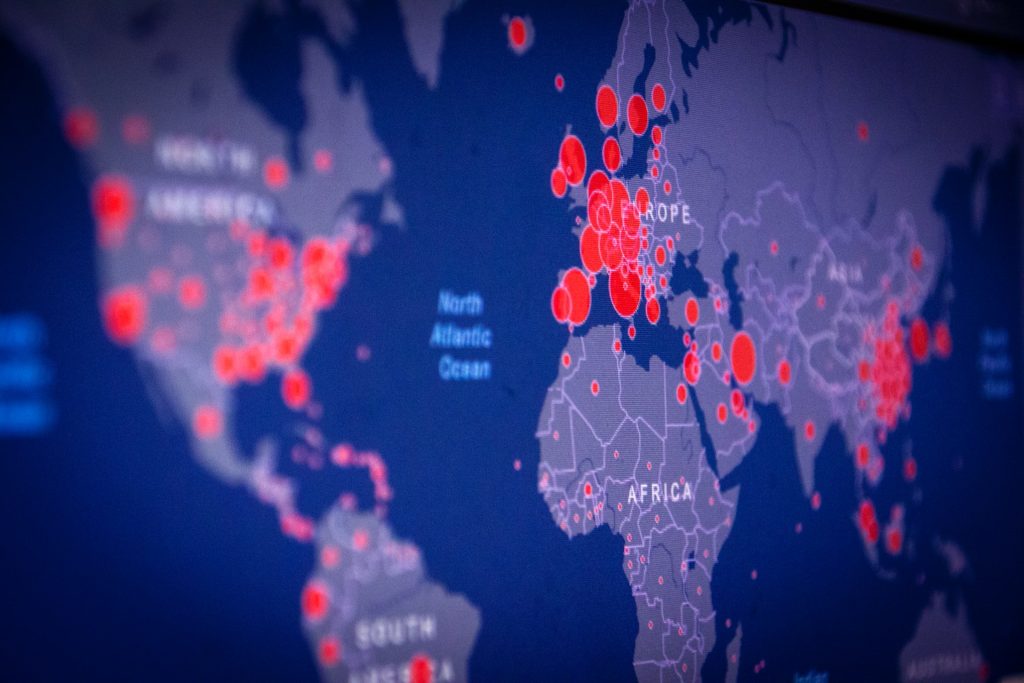
COVID cases map. Photo by Giacomo Carra on Unsplash
A surge in COVID cases in many parts of Africa could mean a continental third wave, the World Health Organization warned, posing a great threat for a continent where immunisation drives have been hamstrung by funding shortfalls and production delays for vaccine doses.
The WHO said that over the last week, test positivity had risen in 14 African countries, with eight reporting a surge of over 30% in new cases. Infections are steadily climbing in South Africa, where four of nine provinces are battling a third wave and the positivity rate was 14.2% as of Sunday. Uganda has also seen sharp increases, with hospitals overwhelmed with COVID patients and a lockdown being considered.
Weak compliance with social restrictions, increasing travel and the arrival of winter is behind the rise in cases, the WHO said. Experts also believe that new variants are also driving the numbers up.
Although Africa has reported less than 3 per cent of global coronavirus cases, the WHO said that the continent accounted for 3.7 percent of total deaths. This is likely an underestimate, given the lack of formal reporting for deaths.
“The threat of a third wave in Africa is real and rising,” said Dr Matshidiso Moeti, WHO regional director for Africa, in a statement. “It’s crucial that we swiftly get vaccines into the arms of Africans at high risk of falling seriously ill and dying of Covid-19.”
While many wealthier countries have vigorous vaccination campaigns and some are on track to fully reopen, many of Africa’s poorer countries face a huge challenge in accessing vaccines.
Out of 1.3 billion people on the continent, only 31 million have received at least one dose, Dr Moeti said, and only seven million are fully vaccinated. Just 1386 people in Kenya have received two doses of a vaccine, out of a population of 50 million.
Countries like Ghana and Rwanda have run through their first deliveries of vaccines through Covax, the global facility working to ensure the equitable distribution of vaccines.
In some countries, vaccine hesitancy has been so high that it even caused stocks of vaccines to expire. Possible contamination in Johnson & Johnson vaccine doses detected at a US manufacturing plant has resulted in yet another delay to South Africa’s immunisation programme.
Meanwhile, fake vaccines and PPE pose another problem; last November a police raid in South Africa found almost 2400 doses of fake vaccine.
The WHO warned that the surge of causes could swamp the limited capacities of healthcare systems. To stave off a full-blown crisis, Dr Moeti urged “countries that have reached a significant vaccination coverage to release doses and keep the most vulnerable Africans out of critical care.”
Only about two per cent of the population has received at least one vaccine dose, compared with the 24 per cent global figure.
“While many countries outside Africa have now vaccinated their high-priority groups and are able to even consider vaccinating their children, African countries are unable to even follow up with second doses for high-risk groups,” said Dr. Moeti. “I’m urging countries that have reached a significant vaccination coverage to release doses and keep the most vulnerable Africans out of critical care.”