There may be a link between hearing impairment and an increased risk of developing Parkinson’s according to research led by Lancaster University. This is one of the first studies to examine whether sensory impairments, such as hearing loss, might increase the risk for Parkinson’s or serve as an early warning sign.
Researchers analysed data from the UK Biobank, a biomedical database containing data from half a million participants across the UK. They looked at data from 159,395 individuals who had previously undergone a hearing test measuring their ability to detect speech in noisy environments and had no history of Parkinson’s at the time of the assessment.
Over an average follow-up period of 14.24 years, 810 participants were subsequently diagnosed with Parkinson’s disease. The analysis revealed a 57% increased risk of Parkinson’s for every 10-decibel increase in baseline hearing impairment.
Dr Megan Readman, ESRC Post Doctoral Research Fellow from Lancaster University’s Department of Psychology, led the study.
She said: “These findings are incredibly important; first, this is one of the first studies to look at how hearing impairments may increase risk for Parkinson’s or be an early warning sign of Parkinson’s.
“Secondly, as our findings suggest, hearing loss is intricately related to Parkinson’s so it may be beneficial for auditory functioning and the management of auditory impairment to be considered at the time of diagnosis and follow-up care.”
However, Dr Readman stressed that it is not clear if the link between Parkinson’s and hearing loss is causal or if there is simply a correlation.
“We do not know whether hearing loss can cause Parkinson’s, or if there is a common underlying cause for both conditions.”
The other authors included Yang Wang and Fang Wan, Sally Linkenauger, Trevor Crawford and Christopher Plack plus Ian Fairman who has Parkinson’s and hearing impairment.
Professor Plack said: “It is increasingly clear that hearing loss is not an isolated condition but is associated with several other disorders. Understanding these links is vital if we are to provide effective patient care, improving independence and quality of life for the individuals concerned.”
By identifying factors that might contribute to its onset, such as hearing impairment, researchers hope to pave the way for new strategies in prevention and care.
Dr Readman said: “Our findings suggest hearing impairment is intricately related to Parkinson’s and underscore the potential benefits of addressing auditory function in Parkinson’s diagnosis and follow-up care.”
Professor Trevor Crawford said: “This important study is the latest discovery in a decade-long series of research on neurodegenerative disorders, conducted by our team at Lancaster University in collaboration with colleagues across the UK.”
People who eat more red meat, especially processed red meat like bacon, sausage and bologna, are more likely to have a higher risk of cognitive decline and dementia when compared to those who eat very little red meat, according to a study published in the January 15, 2025, online issue of Neurology®, the medical journal of the American Academy of Neurology.
“Red meat is high in saturated fat and has been shown in previous studies to increase the risk of type 2 diabetes and heart disease, which are both linked to reduced brain health,” said study author Dong Wang, MD, ScD, of Brigham and Women’s Hospital in Boston. “Our study found processed red meat may increase the risk of cognitive decline and dementia, but the good news is that it also found that replacing it with healthier alternatives, like nuts, fish and poultry, may reduce a person’s risk.”
To examine the risk of dementia, researchers included a group of 133 771 people (65.4% female) with an average age of 49 who did not have dementia at the start of the study. They were followed up to 43 years. Of this group, 11 173 people developed dementia.
Participants completed a food diary every two to four years, listing what they ate and how often.
Researchers defined processed red meat as bacon, hot dogs, sausages, salami, bologna and other processed meat products. They defined unprocessed red meat as beef, pork, lamb and hamburger. A serving of red meat is three ounces (85gm), about the size of a deck of cards.
For processed red meat, they divided participants into three groups. The low group ate an average of fewer than 0.10 servings per day; the medium group ate between 0.10 and 0.24 servings per day; and the high group, 0.25 or more servings per day.
After adjusting for factors such as age, sex and other risk factors for cognitive decline, researchers found that participants in the high group had a 13% higher risk of developing dementia compared to those in the low group.
For unprocessed red meat, researchers compared people who ate an average of less than one half serving per day to people who ate one or more servings per day and did not find a difference in dementia risk.
To measure subjective cognitive decline, researchers looked at a different group of 43,966 participants with an average age of 78. Subjective cognitive decline is when a person reports memory and thinking problems before any decline is large enough to show up on standard tests.
The subjective cognitive decline group took surveys rating their own memory and thinking skills twice during the study.
After adjusting for factors such as age, sex and other risk factors for cognitive decline, researchers found that participants who ate an average of 0.25 servings or more per day of processed red meat had a 14% higher risk of subjective cognitive decline compared to those who ate an average of fewer than 0.10 servings per day.
They also found people who ate one or more servings of unprocessed red meat per day had a 16% higher risk of subjective cognitive decline compared to people who ate less than a half serving per day.
To measure objective cognitive function, researchers looked at a different group of 17 458 female participants with an average age of 74. Objective cognitive function is how well your brain works to remember, think and solve problems.
This group took memory and thinking tests four times during the study.
After adjusting for factors such as age, sex and other risk factors for cognitive decline, researchers found that eating higher processed red meat was associated with faster brain aging in global cognition with 1.61 years with each additional serving per day and in verbal memory with 1.69 years with each additional serving per day.
Finally, researchers found that replacing one serving per day of processed red meat with one serving per day of nuts and legumes was associated with a 19% lower risk of dementia and 1.37 fewer years of cognitive aging. Making the same substitution for fish was associated with a 28% lower risk of dementia and replacing with chicken was associated with a 16% lower risk of dementia.
“Reducing how much red meat a person eats and replacing it with other protein sources and plant-based options could be included in dietary guidelines to promote cognitive health,” said Wang. “More research is needed to assess our findings in more diverse groups.”
A limitation of the study was that it primarily looked at white health care professionals, so the results might not be the same for other race, ethnic and non-binary sex and gender populations.
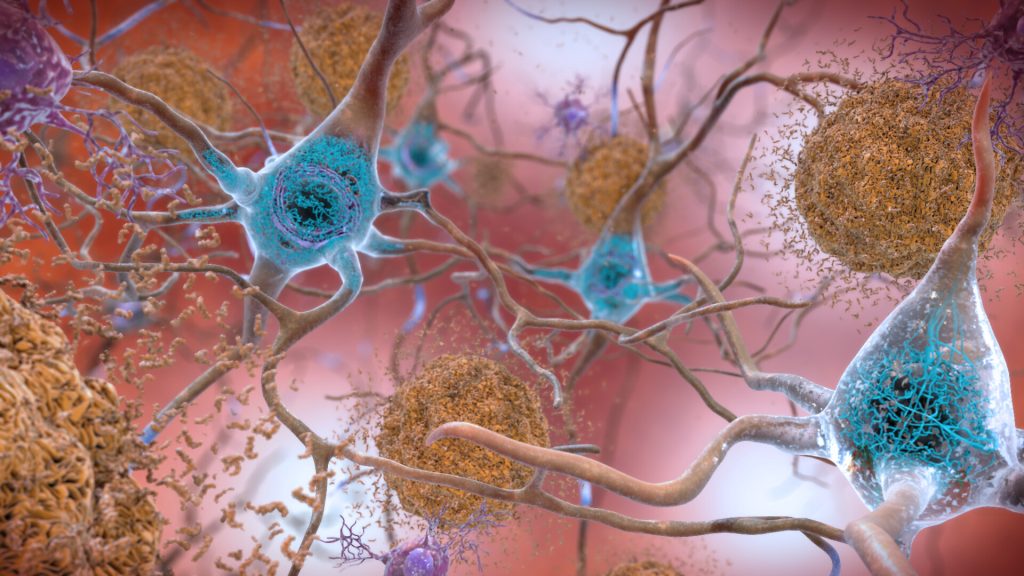
Neurons in the brain of an Alzheimer’s patient, with plaques caused by tau proteins. Credit: NIH
University of Pittsburgh researchers uncovered a surprising link between Alzheimer’s disease and herpes simplex virus-1 (HSV-1), suggesting that viral infections may play a role in the disease. The study results were published in Cell Reports.
The study also revealed how tau protein, often viewed as harmful in Alzheimer’s, might initially protect the brain from the virus but contribute to brain damage later. These findings could lead to new treatments targeting infections and the brain’s immune response.
“Our study challenges the conventional view of tau as solely harmful, showing that it may initially act as part of the brain’s immune defence,” said senior author Or Shemesh, assistant professor in the Department of Ophthalmology at Pitt. “These findings emphasise the complex interplay between infections, immune responses and neurodegeneration, offering a fresh perspective and potential new targets for therapeutic development.”
The scientists identified forms of HSV-1-related proteins in Alzheimer’s brain samples, with greater amounts of viral proteins co-localised with tangles of phosphorylated tau—one of the hallmarks of Alzheimer’s pathology—in brain regions especially vulnerable to Alzheimer’s across disease stages.
Further studies on miniature models of human brains in a Petri dish suggested that HSV-1 infection could modulate levels of brain tau protein and regulate its function, a protective mechanism that seemed to decrease post-infection death of human neurons.
While the precise mechanisms by which HSV-1 influences tau protein and contributes to Alzheimer’s disease are still unknown, Shemesh and his colleagues plan to explore those questions in future research. They aim to test potential therapeutic strategies that target viral proteins or fine-tune the brain’s immune response and investigate whether similar mechanisms are involved in other neurodegenerative diseases, such as Parkinson’s disease and amyotrophic lateral sclerosis.
Neurons in the brain of an Alzheimer’s patient, with plaques caused by tau proteins. Credit: NIH
Brain shrinkage observed in people receiving drugs for Alzheimer’s treatment actually reflects their efficacy, suggests to a new study from University College London. The researchers analysed data from a dozen different trials of amyloid-targeting immunotherapy – including lecanemab, recently approved in the UK for Alzheimer’s treatment but not yet used by the NHS.
While brain shrinkage is usually an undesirable outcome, the team found that the excess volume loss was consistent across studies and correlated with how effective the therapy was in removing amyloid and was not associated with harm.
As a result, the researchers believe that the removal of amyloid plaques, which are abundant in Alzheimer’s patients, could account for the observed brain volume changes. And, as such, the volume loss should not be a cause for concern.
To describe this phenomenon, the research team coined a new phrase: “amyloid-removal-related pseudo-atrophy” or ARPA. The team published their findings in published in Lancet Neurology.
Senior author and Director of the UCL Dementia Research Centre, Professor Nick Fox said: “Amyloid-targeting monoclonal antibodies represent a significant therapeutic breakthrough in the treatment of Alzheimer’s disease. These agents work by binding to and triggering the removal of amyloid plaques from the brain.
“One area of controversy has been the effect of these agents on brain volumes. Brain volume loss is a characteristic feature of Alzheimer’s disease, caused by progressive loss of neurons.
“Amyloid immunotherapy has consistently shown an increase in brain volume loss – leading to concerns in the media and medical literature that these drugs could be causing unrecognised toxicity to the brains of treated patients.
“However, based on the available data, we believe that this excess volume change is an anticipated consequence of the removal of pathologic amyloid plaques from the brain of patients with Alzheimer’s disease.”
In August, the Medicines and Healthcare Products Regulatory Agency (MHRA) licensed lecanemab, for use in the early stages of Alzheimer’s disease in the UK *.
The drug works by targeting beta amyloid – a protein that builds up in the brains of people with Alzheimer’s disease and is thought to be the triggering event leading to neuronal dysfunction and cell death.
The National Institute for Health and Care Excellence (NICE) that decide whether drugs should be made available on the NHS have published draft guidance advising that the benefits of lecanemab are too small to justify the cost to the NHS. However, the decision will be reviewed following a public consultation and a second independent committee meeting later this year.
Fig. 1: Chemical imaging of active gut microbes. After brief incubation with heavy water, culture medium and a drug, various chemical bonds (here C-D and C-H) in the stool sample are shown in yellow and green, their ratio in yellow-purple (left). Selected microbes are detected in the same image section with fluorescence-labelled oligonucleotide probes in cyan. The activity of the detected microbes can be determined based on the amount of C-D bonds. C: Xiaowei Ge (Boston University)
An international team of scientists have revealed that the widely prescribed Parkinson’s disease drug entacapone significantly disrupts the human gut microbiome by inducing iron deficiency. This international study, provides new insights into the often-overlooked impact of human-targeted drugs on the microbial communities that play a critical role in human health. The findings, published in Nature Microbiology, suggest however that iron supplementation can help counteract these impacts.
While it is well established that antibiotics can significantly disrupt the human gut microbiome, emerging research shows that a wide range of human-targeted drugs – particularly those used to treat neurological conditions – can also profoundly affect the microbial communities living in our bodies. Despite their intended therapeutic effects on different organs, these drugs can inadvertently disrupt the balance of gut microbes, leading to potential health consequences. Until now, most studies investigating these interactions relied either on patient cohort analyses affected by many confounding factors or on experiments using isolated gut bacteria, which do not fully capture the complexity of the human microbiome.
Investigating drug–bug interactions
The team, which included some from the University of Vienna, used a novel experimental approach. The researchers studied the effects of two drugs – entacapone and loxapine, a medication for schizophrenia – on faecal samples from healthy human donors. They incubated the samples with therapeutic concentrations of these drugs, then analysed the impact on the microbial communities using advanced molecular and imaging techniques, including heavy water labelling combined with Stimulated Raman Spectroscopy (SRS). The team discovered that loxapine and even more so entacapone severely inhibited many microbiome members, while E. coli dramatically expanded in the presence of entacapone.
“The results were even more striking when we examined microbial activity, rather than just their abundance,” explained Fatima Pereira, lead author of the study and former Postdoctoral researcher at the University of Vienna. “The heavy water-SRS method allowed us to observe the subtle yet significant changes in the gut microbiome, which are often missed in traditional abundance-based measurements.”
Entacapone induces iron starvation, favours pathogenic microbes
The researchers hypothesised that entacapone might interfere with iron availability in the gut, a crucial resource for many microbes. Their experiments confirmed that adding iron to faecal samples containing entacapone counteracted the drug’s microbiome-altering effects. Further investigation revealed that E. coli, which thrived under these conditions, carried a highly efficient iron-uptake system (enterobactin siderophore). This system allowed the bacteria to overcome iron starvation and proliferate, even in the presence of the drug.
“By showing that entacapone induces iron deficiency, we have uncovered a new mechanism of drug-induced gut dysbiosis, in which the drug selects for E. coli and other potentially pathogenic microbes well adapted to iron limiting conditions,” said Michael Wagner, scientific director of the Excellence Cluster and vice-head of the Centre for Microbiology and Environmental Systems Science (CeMESS) at the University of Vienna.
Wider implications for drug–microbiome interactions
This discovery has broader implications for understanding how other human-targeted drugs might affect the gut microbiome. Several drugs, including entacapone, contain metal-binding catechol groups, suggesting that this mechanism could be a more common pathway for drug-induced microbiome alterations.
The findings also present an opportunity to mitigate the side effects of drugs like entacapone. By ensuring sufficient iron availability to the large intestine, it may be possible to reduce dysbiosis and the gastrointestinal issues that often accompany Parkinson’s disease treatment.
“The next step is to explore how we can modify drug treatments to better support the gut microbiome,” said Wagner. “We are looking at strategies to selectively deliver iron to the large intestine, where it can benefit the microbiome without interfering with drug absorption in the small intestine.”
People diagnosed with type 2 diabetes at a younger age are at a higher risk for developing dementia than those diagnosed later in life, according to a study led by researchers at the NYU Rory Meyers College of Nursing. The findings, published in PLOS ONE, show that the increased risk is especially pronounced among adults with obesity.
“Our study suggests that there may be cognitive consequences to earlier onset type 2 diabetes, and it points to the need for strategies to prevent dementia that consider both diabetes and obesity,” said Xiang Qi, assistant professor at NYU Meyers and the study’s first author.
Type 2 diabetes is a known risk factor for dementia. Although the underlying mechanisms are not fully understood, scientists think that some of the hallmarks of diabetes, such as high blood sugar, insulin resistance, and inflammation, may encourage the development of dementia in the brain.
While type 2 diabetes was once a disease of older adults, it is increasingly prevalent among younger individuals: one in five people with type 2 diabetes worldwide is under 40 years old.
To understand how the timing of a type 2 diabetes diagnosis relates to dementia risk, the research team analyzed data from 2002 to 2016 in the Health and Retirement Study, a longitudinal study conducted by the University of Michigan Institute for Social Research. The PLOS ONE study included 1213 US adults aged 50 and over with type 2 diabetes confirmed by blood tests, without dementia at baseline. Following participants for up to 14 years, 216 (17.8%) developed dementia based on follow-up telephone interviews.
The researchers found that adults diagnosed with type 2 diabetes at younger ages were at increased risk for developing dementia, compared to those diagnosed at 70 years or older. Adults diagnosed with diabetes before age 50 were 1.9 times as likely to develop dementia as those diagnosed at 70 and older, while those diagnosed between 50–59 years were 1.72 times as likely and those diagnosed between 60–69 years were 1.7 times as likely.
Using linear trend tests, the researchers found a graded association between age at diagnosis and dementia risk: for each year younger a person is at the time of their type 2 diabetes diagnosis, their risk for developing dementia increases by 1.9%.
“While we do not know for sure why an earlier diabetes diagnosis would increase the risk for dementia, prior studies show that people diagnosed with type 2 diabetes in mid-life may experience more vascular complications, poor blood sugar control, and insulin resistance – all of which are known risk factors for cognitive impairment,” said Bei Wu, the Dean’s Professor in Global Health and vice dean for research at NYU Meyers and the study’s senior author.
In addition, obesity appeared to influence the relationship between type 2 diabetes and dementia. Individuals with obesity who were diagnosed with type 2 diabetes before age 50 had the highest dementia risk in the study.
The researchers note that this greater understanding of the connection between diabetes onset, obesity, and dementia may help inform targeted interventions to prevent dementia.
“Our study highlights the importance of one’s age at diabetes diagnosis and suggests that specifically targeting obesity – whether through diet and exercise or perhaps medication – may play a role in staving off dementia in younger adults with diabetes,” said Wu.
This is a pseudo-colored image of high-resolution gradient-echo MRI scan of a fixed cerebral hemisphere from a person with multiple sclerosis.
Credit: Govind Bhagavatheeshwaran, Daniel Reich, National Institute of Neurological Disorders and Stroke, National Institutes of Health
The question of what causes complex neurological diseases such as Alzheimer’s or multiple sclerosis continues to confound scientists and doctors, with the unknowns standing in the way of early diagnoses and effective treatments.
Even among identical twins who share the same genetic risk factors, one may develop a particular neurological disease while the other does not.
That’s because unlike diseases such as cystic fibrosis or sickle-cell anaemia, which are caused by a single gene, most neurological disorders are associated with many, sometimes hundreds, of rare genetic variants. And on their own, these variants can’t predict who will develop disease, as neurological conditions are also strongly influenced by environmental factors and vascular risks such as high blood pressure, aging, heart disease, or obesity.
But there’s one often-overlooked thread that connects most neurological diseases, says Katerina Akassoglou, PhD, a senior investigator at Gladstone Institutes: They’re marked by a toxic immune reaction caused by blood that leaks into the brain through damaged blood vessels.
“Interactions between the brain, blood vessels, and the immune system are a common thread in the development and progression of many neurological diseases that have been traditionally viewed as very different conditions,” says Akassoglou. “Knowing that leaked blood is a key driver of brain inflammation, we can now approach these diseases from a different angle.”
She and her collaborators share their insights on this topic in a commentary article published in Cell’s 50th anniversary “Focus on Neuroscience” issue.
Neutralising the Culprit
Akassoglou and her lab have long investigated how blood that leaks into the brain triggers neurologic diseases, essentially by hijacking the brain’s immune system and setting off a cascade of harmful often-irreversible effects that result in damaged neurons.
One blood protein in particular, fibrin, normally involved in blood coagulation, is responsible for setting off this detrimental cascade. The process has been observed in conditions as diverse as Alzheimer’s, traumatic brain injury, multiple sclerosis, premature birth, and even COVID-19. However, Akassoglou and her team found that the process could be prevented or interrupted by “neutralising” fibrin to deactivate its toxic properties – an approach that appears to protect against many neurological diseases when tested in animal models.
“As a first step, we know that neutralizing fibrin reduces the burden posed by vascular dysfunction,” Akassoglou says. Regardless of what initially caused the blood leaks, be it a head injury, autoimmunity, genetic mutations, brain amyloid or infection, neutralizing fibrin appears to be protective in multiple animal models of disease.
The scientists previously developed a drug, a therapeutic monoclonal antibody, that specifically targets fibrin’s inflammatory properties without affecting its essential role in blood coagulation. This fibrin-targeting immunotherapy has shown, in mice, to protect from multiple sclerosis and Alzheimer’s, and to treat neurological effects of COVID-19. A humanized version of this first-in-class fibrin immunotherapy is already in Phase 1 safety clinical trials by Therini Bio, a biotech company launched to advance discoveries from Akassoglou’s lab.
A New Era of Brain Research
In the Cell commentary, Akassoglou and her colleagues make the case that seemingly disparate neurological diseases must be viewed differently in light of new research on the blood-brain-immune interface.
They say that in the coming decade, scientific breakthroughs will emerge from collaborative networks of immunologists, neuroscientists, haematologists, geneticists, computer scientists, physicists, bioengineers, drug developers, and clinical researchers. These partnerships, forged across academia, industry, and foundations, will catalyse innovation in drug discovery and transform medical practice for neurological diseases.
“This is a new opportunity for drug discovery that goes beyond addressing genes alone or environmental factors alone,” Akassoglou says. “To usher in this new era, we must leverage new technologies and embrace an interdisciplinary approach that accounts for the important roles of immune and vascular systems in neurodegeneration.”
Over 30% of older adults take five or more medications daily, which is termed polypharmacy. It is associated with poor health outcomes like falls, medication interactions, hospitalisations and even death. Multiple chronic conditions in older adults increases the risk of polypharmacy. While polypharmacy is more common in older adults with Alzheimer’s disease and related dementias, there is little research examining the impact on symptoms, health outcomes and physical function.
Researchers from Drexel University’s College of Nursing and Health Professions recently published a study in Biological Research For Nursing examining symptoms, health outcomes and physical function over time in older adults with and without Alzheimer’s disease and related dementias and polypharmacy.
Led by Martha Coates, PhD, the research team found that individuals who are experiencing polypharmacy and have Alzheimer’s disease and related dementias experience more symptoms, falls, hospitalisations, mortality and had lower physical function – indicating that polypharmacy can also negatively impact quality of life for older adults with Alzheimer’s disease and related dementias.
“The cut-off of point of five or more medications daily has been associated with adverse health outcomes in previous research, and as the number of medications increase the risk of adverse drug events and harm increases,” said Coates.
The research team used a publicly available dataset from the National Health and Aging Trends Study – a nationally representative sample of Medicare beneficiaries in the United States from Johns Hopkins University. Since 2011, data is collected yearly to examine social, physical, technological and functional domains that are important in aging.
For this study, the research team used data from 2016 through 2019 to compare changes in symptoms, health outcomes and physical function among four groups: 1) those with Alzheimer’s disease and related dementias and polypharmacy; 2) those with Alzheimer’s disease and related dementias only; 3) those with polypharmacy only; and 4) those without either Alzheimer’s disease and related dementias or polypharmacy.
Coates explained that the researchers used analytic weights to analyse the data, which generates national estimates, making the sample of 2052 individuals representative of 12 million Medicare beneficiaries in the US, increasing the generalisability of the findings.
“We found that older adults with Alzheimer’s disease and related dementias and polypharmacy experienced more unpleasant symptoms, increased odds of falling, being hospitalised and mortality compared to those without Alzheimer’s disease and related dementias and polypharmacy,” said Coates. “They also experienced more functional decline, required more assistance with activities of daily living like eating, bathing and dressing, and were more likely to need an assistive device like a cane or walker.”
Coates noted that there are tools available to help health care providers review and manage medication regimens for older adults experiencing polypharmacy and possibly taking medications that are potentially inappropriate or no longer provide benefit. However, currently there are no specific tools like that for older adults with Alzheimer’s disease and related dementias.
The findings from this research shed light on the negative impact polypharmacy can have on older adults with Alzheimer’s disease and related dementias. But Coates added that further research is needed to develop strategies to reduce the occurrence of polypharmacy in people with Alzheimer’s disease and related dementias.
The research team anticipates this study will help guide future analysis of the impact of specific medications on health outcomes in individuals with Alzheimer’s disease and related dementias and that it provides a foundation to support intervention development for medication optimisation in older adults with Alzheimer’s disease and related dementias and polypharmacy.
Neurotransmitters at a synapse. Credit: Scientific Animations CC4.0
The treatment of certain neurodegenerative diseases and the pages of neuroscience textbooks may soon be in need of a major update. A research team has discovered that a molecule in the brain – ophthalmic acid – unexpectedly acts like a neurotransmitter similar to dopamine in regulating motor function, offering a new therapeutic target for Parkinson’s and other movement diseases.
As reported in the journal Brain, researchers observed that ophthalmic acid binds to and activates calcium-sensing receptors in the brain, reversing the movement impairments of Parkinson’s mouse models for more than 20 hours.
Parkinson’s disease (PD) symptoms, which include tremors, shaking and lack of movement, are caused by decreasing levels of dopamine in the brain as those neurons die. L-dopa, the front-line drug for treatment, acts by replacing the lost dopamine and has a duration of two to three hours. While initially successful, the effect of L-dopa fades over time, and its long-term use leads to dyskinesia – involuntary, erratic muscle movements in the patient’s face, arms, legs and torso.
“Our findings present a groundbreaking discovery that possibly opens a new door in neuroscience by challenging the more-than-60-year-old view that dopamine is the exclusive neurotransmitter in motor function control,” said co-corresponding author Amal Alachkar, School of Pharmacy & Pharmaceutical Sciences professor. “Remarkably, ophthalmic acid not only enabled movement, but also far surpassed L-dopa in sustaining positive effects. The identification of the ophthalmic acid-calcium-sensing receptor pathway, a previously unrecognised system, opens up promising new avenues for movement disorder research and therapeutic interventions, especially for Parkinson’s disease patients.”
Alachkar began her investigation into the complexities of motor function beyond the confines of dopamine more than two decades ago, when she observed robust motor activity in Parkinson’s mouse models without dopamine. In this study, the team conducted comprehensive metabolic examinations of hundreds of brain molecules to identify which are associated with motor activity in the absence of dopamine. After thorough behavioural, biochemical and pharmacological analyses, ophthalmic acid was confirmed as an alternative neurotransmitter.
“One of the critical hurdles in Parkinson’s treatment is the inability of neurotransmitters to cross the blood-brain barrier, which is why L-DOPA is administered to patients to be converted to dopamine in the brain,” Alachkar said. “We are now developing products that either release ophthalmic acid in the brain or enhance the brain’s ability to synthesise it as we continue to explore the full neurological function of this molecule.”
Almost 3 million people worldwide have multiple sclerosis (MS) – an autoimmune disease caused by the immune system mistakenly attacking the brain and central nervous system.
While treatments for MS have improved over the years, there’s still no cure. This is largely because researchers still don’t fully understand what goes wrong in the immune system to cause MS. But our latest research has revealed new insights into the way certain immune cells behave in people with MS. This discovery brings us closer to understanding why some people get MS – and may also be a crucial step in developing better treatments and even cures.
EBV typically infects people during childhood without causing any symptoms – so most early infections go unnoticed. But if the infection occurs during adolescence, it may cause glandular fever (infectious mononucleosis) which, although debilitating in the short-term, usually has no long-term effects.
Most viral infections are rapidly cleared by the body’s immune system, but EBV is cleverer than most viruses. Although the immune system controls the infection, it is unable to completely eradicate the virus as it hides inside a type of immune cell called a B cell (which normally produce antibodies that bind to and destroy invading viruses or bacteria). Once you’re infected with EBV you carry it for life – although for most people this causes no problems.
By adulthood about 95% of people are infected with EBV, but in people with MS nearly 100% are infected. Large epidemiological studies have shown that EBV infection increases the risk of developing MS over 30-fold. For people who have had glandular fever the risk is even higher. Research has also shown that in people with MS, EBV infection occurs before the very earliest stages of disease.
Many researchers now believe being infected with EBV is more than a risk factor in MS – it’s essential.
But how does EBV cause MS – and why does a common virus only cause MS in a few people? Several theories are currently being investigated.
One theory is that in some people the immune cells activated by EBV mistakenly attack parts of the brain and central nervous system. This process, called molecular mimicry, also occurs in other autoimmune diseases, such as Guillain-Barré syndrome. This could explain why drugs which prevent immune cells from entering the brain are shown to dramatically improve MS symptoms.
Research into EBV molecular mimicry in MS has mainly focused on the viral protein EBNA1. Without EBNA1 EBV cannot live in B cells, and MS patients have higher levels of antibodies towards EBNA1.
But EBV makes over 80 different proteins during its life cycle. In our latest work we investigated immune responses to these other viral proteins in people with MS.
Altered immunity
We compared the immune responses of 31 people with MS, 33 healthy people and 11 people who had recently recovered from glandular fever. We wanted to see if each group reacted to EBV infections differently.
We found that antibodies targeting EBNA1 and another viral protein called VCA were higher in people with MS compared to the other groups. People with MS were also more likely to have antibodies targeting several other viral proteins. This suggests EBV antibodies are more altered in MS than previously thought – but it isn’t certain whether these antibodies are fighting infection or if they have a role in MS disease.
Scanning electron micrograph of a T cell lymphocyte. Credit: NIH / NIAID
Antibodies aren’t the full story. Previous research has suggested another type of immune cell, called a T cell, may also play an important role as they’re found in high numbers in MS brain lesions. As such, we wanted to understand whether T cells which fight EBV were different in people with MS.
By analysing blood samples we found that, although EBV T cell numbers were similar in MS and healthy people, these cells behaved differently in people with MS. T cells from people with MS produced slightly higher amounts of an inflammatory substance called interleukin-2. The body normally produces this substance in response to injury or infection, but too much interleukin-2 can cause chronic disease.
We also looked at molecular mimicry, wondering whether EBV T-cells mistakenly target brain proteins rather than fighting the virus.
Surprisingly, we found that in both people with MS and healthy people, their EBV T cells reacted to multiple proteins found in the brain. Notably, most people had EBV T cells that targeted a protein called myelin oligodendrocyte glycoprotein, or Mog, which surrounds the nerves.
Looking at one person with MS in more detail, we found individual T cells that directly recognised both EBNA1 and Mog. This means that, rather than just fighting infection, some EBV T cells could also target nerve cells in the brain.
This widespread misdirection between EBV T cells and the brain goes some way to suggest how infection with this common virus can lead to MS. But its presence in healthy people is slightly confusing. One possible explanation could be that EBV T cells are better able to cross the blood-brain barrier (a tight-knit lining of cells that protect the brain) in people with MS. This idea is something we’re keen to explore in future research.
While there’s still much we don’t know about these misdirected EBV T cells in the brain, our latest findings provide fresh evidence for researchers and hopefully will lead to the development of new, targeted treatments for MS.