Creative artwork featuring 3D renderings of respiratory syncytial virus (RSV)—a common contagious virus that infects the human respiratory tract – colourised as follows: (the viral envelope is purple, G- glycoproteins are light blue, and F-glycoproteins are orange). F-glycoproteins allow the virus to fuse with and infect human cells. Credit: NIAID/NIH
Since their introduction last year, researchers have been monitoring the real-world impact of the new respiratory syncytial virus (RSV) vaccines. In a recent commentary in The Lancet, Angela Branche, MD, an infectious diseases researcher at the University of Rochester Medical Center (URMC), details what has been learned during the vaccine’s first season.
“The evidence is clear; individuals should get vaccinated if they have conditions that place them at risk for severe disease. For older adults and those with chronic conditions, RSV should be considered as serious as the flu, and they should get vaccinated,” said Branche.
RSV is a significant cause of severe respiratory illness among older adults, especially those with underlying health conditions. Worldwide, RSV causes millions of infections, hundreds of thousands of hospitalisations, and tens of thousands of deaths annually in adults aged 60 and older. Older people with RSV are at higher risk of severe illness compared to those with influenza or COVID.
In 2023, the FDA approved three RSV vaccines for older adults. Studies have shown these vaccines to be effective, with the Pfizer, GSK, and Moderna vaccines preventing RSV pneumonia and bronchitis in more than 80% of participants.
A recent study published in The Lancet assessed the effectiveness of RSV vaccines using data from a large electronic health record network involving the Centers for Disease Control and Prevention (CDC) and multiple US healthcare systems. The study found that RSV vaccines were 80% effective in preventing hospitalisation, ICU admission, and death among adults aged 60 and older. Vaccine effectiveness was consistent across age groups, including those 75 and older, and among immunocompromised individuals. The study did not find evidence of waning vaccine protection within the season.
The uptake of the RSV vaccine in the 2023-2024 winter season was low, however. An estimated 24% of US adults aged 60 years and older received the vaccine, compared to influenza vaccination rates, which approach 50% each year for the same group. “Providers were not sure how to apply the shared clinical decision-making recommendations in the first season, and there remains a general lack of knowledge among the medical community and the public on what constitutes a risk for severe disease and who needs to be protected,” said Branche.
Based on these findings, the US Advisory Committee on Immunization Practices (ACIP), a group of medical and public health experts that advises the CDC, updated guidelines in June 2024 to recommend RSV vaccination for all adults aged 75 and older, those 60 and older in long-term care facilities or with chronic and high-risk health conditions.
“This new data enabled the ACIP to make more definitive recommendations, which will build public confidence in the effectiveness of these vaccines and make implementation a lot easier for providers and pharmacies,” said Branche.
New research shows that vaccines that target multiple strains of the RSV virus, called bivalent vaccines, may provide longer protection. URMC infectious disease experts helped lead an international study of a bivalent RSV vaccine developed by Pfizer, the results of which were recently detailed in the New England Journal of Medicine. The vaccine effectively prevented severe RSV-related lower respiratory tract illnesses over two RSV seasons, with > 80% overall efficacy. The experimental vaccine was particularly effective in individuals aged 60-79.
In people with a rare condition called light chain amyloidosis, light chain proteins – which are a component of antibodies – mutate and build up in different organs. In new research published in The FEBS Journal, investigators have identified and characterised an antibody fragment that can bind to abnormal light chains to stabilise them and prevent their aggregation.
The findings could have an important clinical impact because the current prognosis for individuals with light chain amyloidosis is extremely poor, and current treatments, which rely on attacking the defective light chain–producing cells, are difficult to tolerate.
The results may also be applicable to other forms of amyloidosis, including Alzheimer’s disease.
“We are excited by this finding, which has potential to provide a much-needed treatment for people diagnosed with light chain amyloidosis,” said corresponding author Jillian Madine, PhD, of the University of Liverpool, in the UK.
Obesity and type 2 diabetes are risk factors for various malignancies, including pancreatic cancer, which has a high death rate. A new analysis in Diabetes/Metabolism Research and Reviews suggests that metabolic-bariatric surgery may lower the risk of developing pancreatic cancer in people with obesity, especially in those who also have type 2 diabetes.
In the systematic review and meta-analysis, investigators identified 12 relevant studies that explored the effects of metabolic-bariatric surgery on pancreatic cancer incidence, with a total of 3 711 243 adults with obesity. Surgery was associated with a 44% reduction in pancreatic cancer risk among individuals with obesity but without type 2 diabetes and a 79% risk reduction in those with both obesity and type 2 diabetes.
“Metabolic-bariatric surgery not only has beneficial effects on obesity and type 2 diabetes but also may play a crucial role in reducing the risk of pancreatic cancer in these individuals,” said corresponding author Angeliki M. Angelidi, PhD, of the Broad Institute of MIT and Harvard. “These findings underscore the need for further research to elucidate the underlying mechanisms and understand the full spectrum of health benefits of metabolic-bariatric surgery beyond weight loss.”
Research using animal models has shown that the diabetes drug dulaglutide, which is a glucagon-like peptide-1 (GLP-1) receptor agonist, may reduce symptoms of depression. A new study published in Brain and Behavior reveals the mechanisms that are likely involved.
By conducting a range of tests in mice treated with and without dulaglutide, investigators confirmed the effects of dulaglutide on depressive-like behaviours, and they identified 64 different metabolites and four major pathways in the brain associated with these effects.
Markers of depression and the antidepressant effects of dulaglutide were linked to lipid metabolism, amino acid metabolism, energy metabolism, and tryptophan metabolism.
“These primary data provide a new perspective for understanding the antidepressant-like effects of dulaglutide and may facilitate the use of dulaglutide as a potential therapeutic strategy for depression,” the authors wrote.
Rates of HIV and Hepatitis C are “extremely high” among people who inject illicit drugs, according to new research by TB HIV Care. The organisation tested over 1200 injecting drug users in Tshwane, eThekwini, Mashishing and Mbombela (formerly Nelspruit).
In Tshwane 72% tested positive for HIV and nearly 90% had antibodies for hepatitis C virus (HCV), which could indicate past or present infection.
HCV is a blood-borne virus which damages the liver. When left undiagnosed it can be fatal, though it’s usually curable if treated.
Less than half of those who tested positive for HIV in Tshwane were aware of their HIV status. As such they would not have been on treatment and could have been spreading the virus without knowing.
Survey Site
HIV Prevalence among people who inject drugs
Antibodies for Hepatitis C among people who inject drugs
Share of HIV positive people who knew their status
eThekwini
49%
75%
76%
Mashishing
45%
41%
77%
Mbombela
30%
91%
64%
Tshwane
72%
89%
48%
Results of the TB HIV Care survey of four cities.
People who inject drugs (such as heroin) are at a higher risk of contracting HIV and HCV when needles are shared – something which happens because drug users don’t have easy access to new ones.
This has long been a problem in South Africa and appears to be getting worse. Research conducted in eThekwini in 2013 found that 17% of injecting drug users were HIV-positive. According to the new research, a decade later the figure has nearly tripled to 49%.
Professor Harry Hausler, CEO of TB HIV Care and a former technical advisor to the National Department of Health on TB/HIV, believes the main reason for this “massive” uptick in blood-borne diseases among drug users is “the limited access to needle and syringe programs” in the country.
Government ignored its own solution
Research shows overwhelmingly that providing clean needles to drug users reduces the spread of HIV, not only by removing the need to share injecting equipment but often because needle programs offer other services such as health education and condoms.
A large review published in 2017 identified 133 academic studies on needle and syringe programs (commonly known as NSP). The results were “supportive of the effectiveness of NSP in reducing HIV transmission among [people who inject drugs], as well as in reducing HCV infection, although the latter to a lesser extent”.
Yet despite these formal policy commitments, there is virtually no public funding for such interventions.
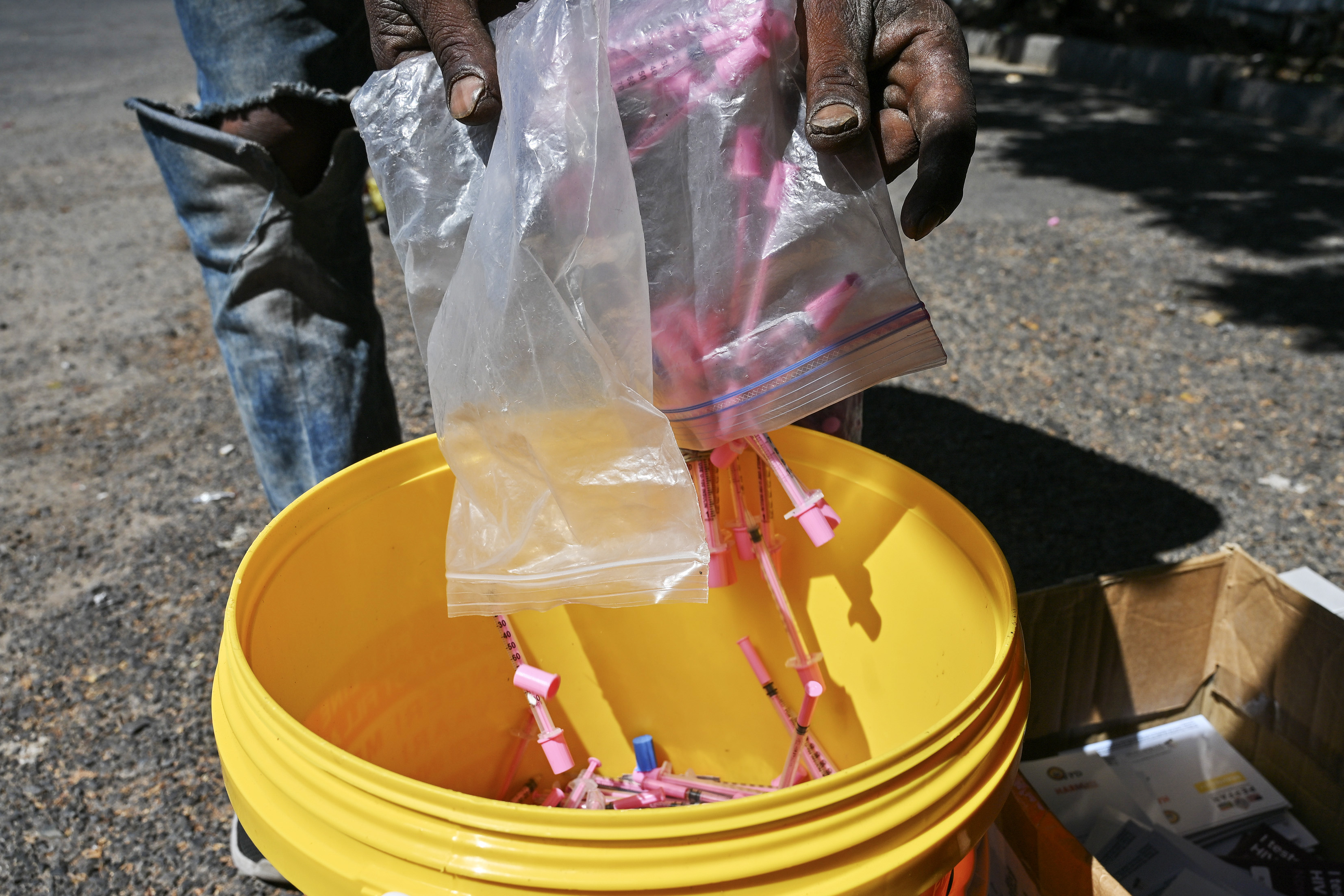
A person discards used needles in a specialised bin provided by TB HIV Care at a mobile clinic in Wynberg, Cape Town.
One exception is the Pretoria-based Community Oriented Substance Use Program, sponsored by the Tshwane Municipality. It has been left to non-profit groups, such as TB HIV Care, to provide these services. According to Hausler, the organisation currently provides clean needles to nearly 10 000 injecting drug users in Cape Town, Nelson Mandela Bay, eThekwini, Tshwane and Mbombela.
Users access needles from drop-in centres as well as mobile clinics – usually vans that get driven on set days to areas where injecting users congregate. Users discard their old needles in specialised bins provided by TB HIV Care. They will then receive a pack, which includes clean needles, alcohol swabs and sterile water.
Nurses are present at the mobile clinics so users can also get tested for HIV and HCV. They also offer ordinary medical services, such as cleaning and bandaging wounds.
Mobile clinics are also manned by psychosocial and human rights workers, and peer educators (people who were beneficiaries but now work for TB HIV Care) from whom users can get counselling or report abuses.
“We’re not just a needle provision organisation”, says Loraine Moses, who oversees quality standards for the program. “We’re a health services organisation”. Users have to register with peers and get health counselling and education before getting their needles, she says.
Beneficiaries have access to various amenities at TB HIV Care’s drop-in centres, including showers, lounging areas and washing machines.
Anthony (surname withheld), previously a heroin user for 15 years, who now volunteers for TB HIV Care, spoke to GroundUp at a drop-in centre in Cape Town.
“In the beginning, I started experimenting with friends in school [but] after my mother passed away, I found that there are those properties in [heroin] that calm you and numb pain, so that’s when I started to delve [into the drug] more.”
After ending up on the street and becoming “a slave to that drug”, he increasingly wanted to get sober. Fetching needles from a TB HIV Care site, he began speaking with one of the peers. The person told him about TB HIV Care’s opioid agonist program, which helps users to quit or reduce their heroin intake.
Opioid agonists are drugs which block heroin withdrawal. Methadone is the most widely known. Numerous clinical trials show that initiatives which offer methadone to heroin users over an extended period are more effective than rehab programs that force users to quit cold turkey.
Hausler says that TB HIV Care currently provides methadone to over 1100 people. Along with the medicine, they receive counselling and are assisted with finding shelter, and in some cases to reintegrate with their families.
Anthony says he’s been taking methadone since June last year. The program also helped him link up with a shelter and get an ID document so that he could find work.
“Being a client at TB HIV Care has helped me a lot to reintegrate back into society,” he says. “Being on the street, you lose a lot of yourself”.
A notice board at the TB HIV Care drop-in centre in central Cape Town.
Law enforcement continues to confiscate needles
Local governments have assisted TB HIV Care with some of its services. The City of Cape Town provides the HIV tests for use at mobile clinics, according to Hausler.
And yet, not only has the government failed to directly fund the sterile needle programs but in some cases it appears to work against them.
Research carried out by TB HIV Care shows that users frequently have their injecting equipment confiscated by law enforcement officers.
In Tshwane and eThekwini more than half of all people surveyed said that the authorities had seized or destroyed their needles at least once in the previous six months.
Outcome
Mashishing
Mbombela
eThekwini
Tshwane
No
57%
76%
31%
36%
Yes, In the last 6 months
18%
20%
64%
54%
Yes, but not in the last 6 months
25%
4%
5%
10%
Results of survey question: Have you ever had your needles and syringes confiscated or destroyed by a police officer/law enforcement? Source: TB HIV Care
“What’s very frustrating is that there are two arms of government,” says Hausler. “There’s health and then there’s police. And police are confiscating needles and syringes that we’ve been providing to clients – [even though what we’re doing] is a clearly endorsed health intervention.”
Hausler notes that in some cases the organisation has “really good alliances with local police”, but in other cases it is a constant battle.
“There needs to be better mainstreaming of education of officials across all government departments on the … HIV and TB response [plans],” says Hausler. “If people were really sensitised, we would not run up against as many obstacles.”
Asked for comment, Gauteng SAPS spokesperson Lieutenant Colonel Mavela Masondo told GroundUp that “possession of needles is not a criminal offence. Therefore, we cannot arrest a person [for] possession of needles, and neither can we confiscate needles”.
Note: The full report by TB HIV Care, which received assistance from the United States CDC, is not yet publicly available. A 16 page summary of some of the findings can be found here.
Professor Harry Hausler, CEO of TB HIV Care, at his office in Cape Town.
The modern complexities of the business world have meant that the cost of a bad hire can extend far beyond a salary, threatening your company’s financial health and reputation. With the rise of technology, background screening solutions can be a business’ best defense against costly hiring mistakes that may disrupt the workplace, writes Jennifer Barkhuizen, Head of Marketing at Managed Integrity Evaluation (MIE), the largest background screening and vetting company in Southern Africa, and a division of Mettus.
Hiring the wrong person can cost a lot more than just a salary. While the price tag of a bad hire isn’t always obvious, the damage to your bottom line, team morale, and reputation is undeniable. In South Africa’s competitive job market, where the cost of hiring is already high, ignoring the importance of thorough background screening can lead to financial damage.
It’s easy to focus on salary as the main expense when hiring, but the real costs go far deeper. The average cost of onboarding a new employee in South Africa equates to approximately R30 000, which increases significantly the more senior the position1. That’s just the tip of the iceberg. Factor in time spent on interviews, onboarding, and training, and those costs start climbing.
A poor hiring decision means more than just one person’s salary – it involves wasted hours training someone who doesn’t deliver, creating a ripple effect of lost productivity. While not the case in all instances, more extreme situations can see exit costs escalate, including severance packages, legal fees, or worse, disputes over wrongful dismissal that can spiral costs further.
A bad hire doesn’t just drain your wallet – it can poison the well. Think about it: a disruptive employee can damage team morale, slow down productivity, and ultimately drive good employees out the door. That’s a double whammy. Not only are you paying for the bad hire, but you’re also forking out for the damage they cause when valued staff start walking.
Then there’s the reputational fallout. What happens if you hire someone without doing proper due diligence, only to find out later they’ve lied about their qualifications or have a criminal record? These instances have been well-documented in South Africa over the past few years, and the financial cost of replacing them pales in comparison to the reputational hit. Fixing damaged trust with clients or partners can cost far more than a few months’ salary.
When it comes to hiring, there’s no room for shortcuts. A thorough background screening process isn’t just a box-ticking exercise but the first line of defense against costly mistakes. Checking for criminal records, verifying qualifications, and digging into work history are critical steps that can save you from disaster down the line.
Imagine the consequences of hiring someone with a history of violence, only to place them in a role of authority. Without a proper check, you could be exposing your employees to serious risks. Should something happen on your watch, your business is on the line, potentially facing lawsuits, compensation claims, and a PR nightmare that could leave your reputation in tatters.
In roles where financial responsibility is key, skipping a thorough check could expose your company to fraud, theft, and more. Bad hires in this scenario don’t only drain your budget – they can sink the ship.
A strong background screening policy is like insurance for your business. Having a clear, consistent process in place ensures that every new hire goes through the same process, protecting your company from both financial and reputational damage.
Consistency is key. It’s not just about avoiding bad hires, but about showing your clients, stakeholders, and employees that you take hiring seriously. Trust is built on actions and your reputation benefits when people see that you’re committed to a thorough screening process.
In the end, the true cost of a bad hire goes beyond the numbers. A robust background screening process isn’t just an extra step in the recruitment procedure, but a necessary one to safeguard your business, team, and reputation. When the stakes are this high, a bad hire isn’t just a mistake, but a business risk many simply can’t afford to take.
To avoid these costly risks, businesses should turn to trusted solutions providers who specialise in comprehensive background screening and vetting services. By investing in the right tools and expertise, businesses can protect themselves from the financial, reputational, and operational fallout of a bad hire. In today’s competitive market, a proactive approach to screening isn’t just a safety net, but a strategic advantage.
A Birmingham-led study has found that AI-powered models match ophthalmologists in diagnosing infectious keratitis, offering promise for global eye care improvements.
Infectious keratitis (IK) is a leading cause of corneal blindness worldwide. This new study finds that deep learning models showed similar levels of accuracy in identifying infection.
In a meta-analysis study published in eClinicalMedicine, Dr Darren Ting from the University of Birmingham conducted a review with a global team of researchers analysing 35 studies that utilised Deep Learning (DL) models to diagnose infectious keratitis.
AI models in the study matched the diagnostic accuracy of ophthalmologists, exhibiting a sensitivity of 89.2% and specificity of 93.2%, compared to ophthalmologists’ 82.2% sensitivity and 89.6% specificity.
The models in the study had analysed a combined total of more than 136 000 corneal images, and the authors say that the results further demonstrate the potential use of artificial intelligence in clinical settings.
Dr Darren Ting, Senior author of the study, Birmingham Health Partners (BHP) Fellow and Consultant Ophthalmologist, University of Birmingham said: “Our study shows that AI has the potential to provide fast, reliable diagnoses, which could revolutionise how we manage corneal infections globally. This is particularly promising for regions where access to specialist eye care is limited, and can help to reduce the burden of preventable blindness worldwide.”
The AI models also proved effective at differentiating between healthy eyes, infected corneas, and the various underlying causes of IK, such as bacterial or fungal infections.
While these results highlight the potential of DL in healthcare, the study’s authors emphasised the need for more diverse data and further external validation to increase the reliability of these models for clinical use.
Infectious keratitis, an inflammation of the cornea, affects millions, particularly in low- and middle-income countries where access to specialist eye care is limited. As AI technology continues to grow and play a pivotal role in medicine, it may soon become a key tool in preventing corneal blindness globally.
As described in research published in the Biotechnology Journal, investigators have developed a novel patch that can help liver tissue regenerate. The patch is a combination of decellularised liver matrix, a liver growth factor, and an anticoagulant. In lab tests with liver cells, the patch helped liver cells regain function after exposure to a toxin.
In rats, patches attached to the liver and gut promoted recovery from liver fibrosis, with notable decreases in scarring and inflammation.
“The decellularised liver matrix–based hepatic patch has demonstrated the ability to restore liver function and inhibit inflammation in fibrotic livers,” said corresponding author Yung-Te Hou, PhD, of National Taiwan University. “This approach shows great potential for treating various liver-related diseases, ranging from mild conditions such as fatty liver to severe conditions like liver cirrhosis.”
Some per- and polyfluoroalkyl substances (PFAS) are poorly degradable and are also known as “forever chemicals”. They adversely affect health and can lead to liver damage, obesity, hormonal disorders, and cancer. A research team from the Helmholtz Centre for Environmental Research (UFZ) has investigated the effects of PFAS on the brain.
Using a combination of modern molecular biology methods and the zebrafish model, the researchers revealed the mechanism of action and identified the genes involved, which are also present in humans. The test procedure developed at the UFZ could be used for the risk assessment of other neurotoxic chemicals. The study was recently published in Environmental Health Perspectives.
Because of their special properties – heat resistance, water and grease repellence, and high durability – PFAS are used in many everyday products (eg, cosmetics, outdoor clothing, and coated cookware). But it is precisely these properties that make them so problematic. “Because some PFAS are chemically stable, they accumulate in the environment and enter our bodies via air, drinking water, and food”, says UFZ toxicologist Prof Dr Tamara Tal. Even with careful consumption, it is nearly impossible to avoid this group of substances, which has been produced since the 1950s and now includes thousands of different compounds. “There is a great need for research, especially when it comes to developing fast, reliable, and cost-effective test systems for assessing the risks of PFAS exposure”, says Tal. So far, the environmental and health consequences have been difficult to assess.
In their current study, the researchers investigated how PFAS exposure affects brain development. To do this, they used the zebrafish model, which is frequently used in toxicology research. One advantage of this model is that around 70% of the genes found in zebrafish (Danio rerio) are also found in humans. The findings from the zebrafish model can therefore likely be transferred to humans. In their experiments, the researchers exposed zebrafish to two substances from the PFAS group (PFOS and PFHxS), which have a similar structure. The researchers then used molecular biological and bioinformatic methods to investigate which genes in the brains of the fish larvae exposed to PFAS were disrupted compared to the control fish, which were not exposed. “In the zebrafish exposed to PFAS, the peroxisome proliferator-activated receptor (ppar) gene group, which is also present in a slightly modified form in humans, was particularly active”, says Sebastian Gutsfeld, PhD student at the UFZ and first author of the study. “Toxicity studies have shown this to be the case as a result of exposure to PFAS – albeit in the liver. We have now also been able to demonstrate this for the brain”.
But what consequences does an altered activity of the ppar genes triggered by PFAS exposure have for brain development and behaviour of zebrafish larvae? The researchers investigated this in further studies using the zebrafish model. Using CRISPR/Cas9 ‘gene scissors’ the researchers were able to “selectively cut individual or several ppar genes and prevent them from functioning normally”, explains Gutsfeld. “We wanted to find out which ppar genes are directly linked to a change in larval behaviour triggered by PFAS exposure”. Proof of the underlying mechanism was directly provided. In contrast to genetically unaltered zebrafish, the knockdown fish in which the gene scissors were used should not show any behavioural changes after exposure to PFAS.
The two behavioural endpoints
In one series of experiments, the researchers continuously exposed zebrafish to PFOS or PFHxS during their early developmental phase between day one and day four and in another series of experiments only on day five. On the fifth day, the researchers then observed swimming behaviour. They used two different behavioural endpoints for this purpose. In one endpoint, swimming activity was measured during a prolonged dark phase. PFAS-exposed fish swam more than fish not exposed to PFAS, whether continuously exposed to PFAS during brain development or shortly before the behaviour test. Interestingly, hyperactivity was only present when the chemical was around. When the researchers removed PFOS or PFHxS, hyperactivity subsided. In the second endpoint, the startle response after a dark stimulus was measured. “In zebrafish exposed to PFOS for four days, we observed hyperactive swimming behaviour in response to the stimulus”, says Gutsfeld. In contrast, zebrafish only exposed to PFOS or PFHxS on the fifth day did not have a hyperactive startle response.
Based on these responses, the researchers conclude that PFOS exposure is associated with abnormal consequences – particularly during sensitive developmental phases of the brain. Using knockdown zebrafish, the researchers identified two genes from the ppar group that mediate the behaviour triggered by PFOS.
“Because these genes are also present in humans, it is possible that PFAS also have corresponding effects in humans”, concludes Tal. The scientists working with Tal want to investigate the neuroactive effects of other PFAS in future research projects and expand the method so that it can ultimately be used to assess the risk of chemicals in the environment, including PFAS.
Individuals at risk of anaphylaxis are often prescribed adrenaline (epinephrine) autoinjectors such as EpiPens. A recent review published in Clinical & Experimental Allergy finds that these autoinjectors, which people use to self-administer adrenaline into the muscle, can deliver high doses of adrenaline into the blood, but these levels are short-lived and may not be sufficient to save lives in cases of fatal anaphylaxis.
Anaphylaxis is an acute systemic hypersensitivity reaction to an allergen or trigger, typically associated with skin reactions, nausea/vomiting, difficulty breathing, and shock.
Investigators noted that data from animal and human studies suggest that intravenous adrenaline infusions delivered directly into the blood can prevent fatal anaphylaxis, but adrenaline autoinjectors may have little impact in such deadly cases.
“For effective management of the most severe allergic reactions, adrenaline given by continuous intravenous infusion, with appropriate fluid resuscitation, is likely to be required—how this is safely achieved in the pre-hospital setting remains to be determined,” the authors wrote. This challenge stems from the fact that fatal anaphylaxis is unpredictable and fast. Fortunately, fatality is rare, with a population incidence of 0.03–0.51 per million per year.