UP Neuroscience Symposium Highlights the Importance of Decision-making in Surgical Care
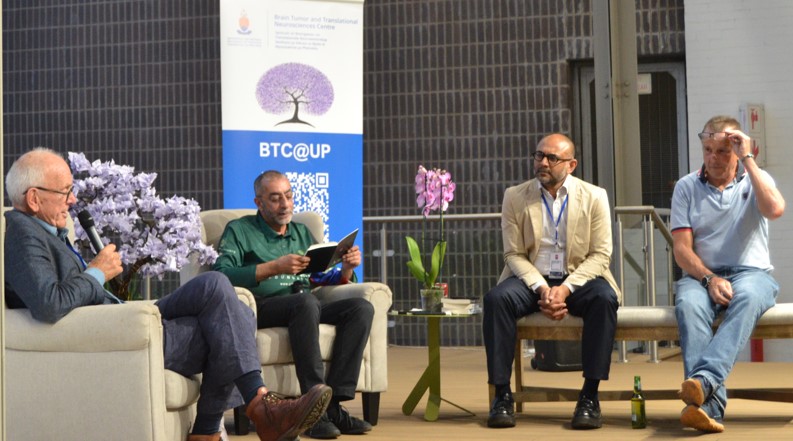
Knowing when not to operate can be as important as surgical precision in brain tumour care, British neurosurgeon and bestselling author Dr Henry Marsh told delegates at the University of Pretoria’s (UP) third annual Brain Tumour and Translational Neuroscience Centre (BTC@UP) symposium.
“It’s always easier to do something than to do nothing, because doing nothing is frightening to the doctor,” Dr Marsh said.
His observation highlights one of neurosurgery’s enduring dilemmas: while an operation may prolong a patient’s life, the quality of that life remains a crucial consideration in treatment decisions. For Dr Marsh, good surgery requires more than technical expertise. It demands sound judgement, honest communication, and an understanding of what matters most to each patient.
These principles shaped a panel discussion featuring Professor Llewellyn Padayachy, Gift of the Givers founder Dr Imtiaz Sooliman, Professor Emeritus Patrick Semple of the University of Cape Town, and Dr Marsh. The discussion explored decision-making under uncertainty and offered insights into the complexities of clinical judgement to an audience drawn from various disciplines within the neurosciences.
“We are ordinary, fallible human beings,” Dr Marsh said, reflecting on how his understanding of neurosurgery had evolved over decades of practice. “What is special about us is the work we do and the quite incredible fragility and complexity of the brain.”
Dr Marsh explained that he initially viewed neurosurgery as a discipline defined by advanced technology, exceptional dexterity, and technical ability. Experience taught him that, while these qualities are essential, they are not enough. The greater challenge is determining whether an operation will genuinely improve a patient’s quality of life.
He recalled the case of a patient with an acoustic neuroma – a benign tumour that grows on the main nerve connecting the inner ear to the brain – whose surgery was postponed after he’d suffered a heart attack. Follow-up scans showed the tumour had not grown, so the clinical team continued monitoring it. Ten years later, the tumour remained unchanged, and surgery was never needed.
The case illustrates why a diagnosis does not automatically mean that surgery must follow. A patient’s age, underlying health conditions, tumour growth, and the potential consequences of an operation must all inform the decision.
Research can help doctors establish probabilities based on groups of patients, Dr Marsh explained, but it cannot always predict what will happen to an individual. This uncertainty makes communication between doctors and patients essential. Patients need to understand not only the anticipated benefits of surgery, but also the risks and the potential impact of complications on their daily lives.
“If you’re not good at talking to patients, if you’re not good at listening to them, you won’t actually make very good decisions,” Dr Marsh stressed.
The challenge becomes more complex when patients are unconscious, and their families must help determine whether treatment should proceed. Dr Marsh argued that doctors must explain possible outcomes clearly, offer considered recommendations, and help families reflect on what the patient would want.
Improving brain tumour care through research and collaboration
At BTC@UP, the challenge of making better clinical decisions is part of a broader effort to improve brain tumour care, from early detection and precise surgery to comprehensive neurocritical care and advanced neurorehabilitation.
Prof Padayachy, who leads BTC@UP, said the centre’s specialised focus on children and adults with brain tumours was strengthening its contribution to patient care while expanding its reach across Africa and the rest of the world.
“Our specialised focus on improving early detection, delivering high-quality surgical care, and integrating multidisciplinary team care and tumour boards to improve the outcome in children and adults with brain tumours has highlighted our role as the premier entity in the country, with a growing presence continentally and internationally,” Prof Padayachy said.
His emphasis on early diagnosis and surgical precision complements Dr Marsh’s perspective on clinical judgement. Earlier detection can create opportunities for timely intervention, while precision is essential when operating on the brain, an organ where the consequences of intervention can be profound.
However, treatment does not end in the operating theatre. Comprehensive neurocritical care and advanced neurorehabilitation remain important in helping patients recover and manage the effects of brain tumours and their treatment.
The symposium explored advances in brain tumour surgery, neuro-ophthalmology, and early detection, as well as the application of artificial intelligence (AI) and virtual reality in neurorehabilitation.
Collaborative projects with international research partners, including Spanish researchers specialising in computer engineering and AI, highlighted the centre’s work at the intersection of neuroscience and emerging technologies.
For BTC@UP, the value of these developments lies in translating research into practical improvements in patient care. Technology must support more effective diagnosis, informed treatment decisions, and better recovery rather than become an end in itself.
Dr Marsh’s reflections brought the human consequences of clinical decisions into focus, while Prof Padayachy’s leadership highlighted the surgical expertise, research, and international collaboration needed to improve patient outcomes.
Together, their contributions underscored a defining principle of modern neurosurgery: progress is measured not simply by what surgeons can do, but by how effectively they determine what each patient needs.