Year: 2022

‘Striking’ Colon Cancer Trial Data gets Standing Ovation

Woman using lab equipment
Source: NCI on Unsplash

In a clinical trial, nearly every one of the 112 patients with mismatch repair-deficient (dMMR) colon cancer achieved a pathologic response with just two cycles of neoadjuvant immunotherapy, prompting a presentation panellist to describe it as “striking data” – though a note of caution was given.

Patients in the NICHE-2 single-arm study received PD-1 plus CTLA-4 blockade – nivolumab plus ipilimumab, and successfully underwent surgical resection, 98% on time, meeting the study’s primary safety endpoint, reported Myriam Chalabi, MD, at the at the European Society for Medical Oncology (ESMO) annual congress.

And with a median follow-up of 13.1 months, the disease-free survival (DFS) rate was 100%, said Dr Chalabi of the Netherlands Cancer Institute in Amsterdam. She pointed out that, by this point, the expected rate for this patient population was about 15%. The primary efficacy endpoint for the trial is DFS at 3 years, with success defined as a rate of 93% (data are expected next year).

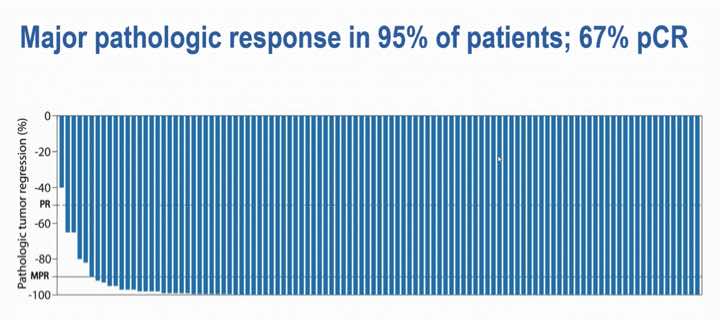
A standing ovation erupted when Dr Chalabi displayed the waterfall plot showing the depth of pathologic response with just four weeks of nivolumab plus ipilimumab.
Credit: NICHE-2 Study

Among the 107 patients evaluable for efficacy, all but one had a pathologic response, 95% had a major pathologic response (MPR), and 67% had a pathologic complete response (pCR), ie no residual viable tumour in both the primary tumour bed and lymph nodes.

“As you can appreciate, the pathologic regression observed was near-complete or complete in almost all patients,” she said.

In contrast, pathologic response rates in the range of 5% to 7% for this population have been shown in prior trials involving neoadjuvant chemotherapy, said Chalabi.

Some 10–15% of colon cancers are classified as dMMR, she explained, which are highly sensitive to immune checkpoint inhibitors, where a number of agents have been approved for the metastatic setting.

The first to comment in Q&A, Alexander Eggermont, MD, PhD, stressed the potential impact of the findings, saying that patients with dMMR tumours scheduled for resection “should be taken off the surgical program.”

“They should be sent to the medical oncologist for the first dose of ipi/nivo,” he said. “We will live the day that they will not undergo surgery anymore after these schedules – that’s the next step.”

A multicentre, single-arm study, NICHE-2 enrolled 112 patients with previously untreated non-metastatic dMMR colon cancer undergoing surgery. The first cycle of neoadjuvant treatment included ipilimumab (1mg/kg) and nivolumab (3mg/kg). The second cycle, given two weeks later, was limited to nivolumab alone. After the first dose, median time to surgery was 5.4 weeks.

The trial defined pathologic response as 50% or less residual viable tumour; MPR was defined as 10% or less residual viable tumour, and included patients with pCRs in the primary tumour but viable tumour in the lymph nodes.

The median age of patients was 60, and 58% were women. About three-fourths had high-risk stage III disease, 13% had low-risk stage III disease, and 13% had stage I/II disease. About half had radiologic high-risk disease (both T4 and N2), said Dr Chalabi, and abdominal wall involvement was common.

When asked whether randomised data would be needed to make this approach standard, Dr Chalabi pointed out the group with T4 tumours.

“I wouldn’t want to randomise those patients,” she said. “Surgeons usually would prefer to have some type of downstaging before continuing on to surgery in order to increase the chances of achieving tumour-free resection margins and also to limit the extent of surgery needed to achieve that.”

The case for randomisation is stronger in earlier disease, she said, but if recurrences can be prevented even in stages where recurrence is more rare, such as stage II tumours (about 10% at 3 years), “we’re curing 10% more patients.”

A little less than a third of patients had Lynch syndrome, and pCRs were more frequent in this subset (78% vs 58% in those with sporadic tumours). Immune-related adverse events (AEs) were reported in 61% of patients, with 4% being grade 3/4.

When the prospect of a NICHE-3 trial came up, Dr Chalabi said that it ideally would have been an international study to validate the approach. However, a subsequent trial is being developed and will likely involve nivolumab plus anti-LAG-3 relatlimab, “which is a shame,” she noted.

“If we do get similar responses with nivolumab and anti-LAG-3, then that may be an avenue to test organ-sparing approaches with that combination in this population,” she added.

Source: MedPage Today

Flu Vaccine May Reduce Ischaemic Stroke Risk

Source: Pixabay CC0

Receiving an annual flu vaccination may be linked to a reduction in risk of ischaemic stroke, according to a study which appears online in the journal Neurology.

“Studies have shown that getting the flu increases your risk of having a stroke, but research is still being collected on whether getting the flu vaccine can help protect against a stroke,” said study author Francisco J. de Abajo, MD, MPH, PhD, of the University of Alcalá in Madrid. “This observational study suggests that those who have a flu shot have a lower risk of stroke. To determine whether this is due to a protective effect of the vaccine itself or to other factors, more research is needed.”

In their study, the researchers accessed a health care database in Spain, identifying 14 322 participants aged 40 years and over with a first stroke over a 14-year period. Each person who had a stroke was matched to five people of the same age and sex who did not have a stroke.

Then the researchers looked at whether people had received the influenza vaccine at least 14 days before the stroke or before that same date for those who did not have a stroke.

A total of 41.4% of those who had a stroke had received the flu vaccine, compared to 40.5% of those who did not have a stroke – seemingly indicating that the flu jab added to risk. But those vaccinated were more likely to be older and to have other stroke risk factors such as hypertension and high cholesterol. Once these were adjusted for, the researchers found that those who received a flu shot had a 12% reduced stroke risk.

The pneumonia vaccine was also investigated for any effect on the risk of stroke, but none was found.

“These results are yet another reason for people to get their yearly flu shot, especially if they are at an increased risk of stroke,” de Abajo said. “To be able to reduce your risk of stroke by taking such a simple action is very compelling.”

Since the study was observational, it only shows an association and cannot prove a causal link. Other unmeasured factors could also mediate stroke risk,

Source: American Academy of Neurology

Obesity and Diabetes in Pregnancy may Raise Child’s ADHD Risk

Boy hanging from tree
Photo by Annie Spratt on Pexels

A recent study has found that children born to women with gestational diabetes and obesity may have twice the risk of developing attention-deficit/hyperactivity disorder (ADHD) compared to those born to mothers without obesity. The findings, published in the Journal of Clinical Endocrinology & Metabolism, also found found that in women with a healthy weight gain during pregnancy, this risk increase was not seen.

ADHD is a growing problem. According to data from 2016-2019, 6 million children aged 3–17 years have received an ADHD. Maternal obesity is a major risk factor for ADHD in children, and roughly 30% of women have obesity at their first doctor’s visit during pregnancy, rising to 47% in women with gestational diabetes. Excessive weight gain during pregnancy in this population is a risk factor for children developing ADHD.

“Our study found pregnant women with obesity and gestational diabetes had children with long-term mental health disorders such as ADHD,” said Verónica Perea, MD, PhD, of the Hospital Universitari Mutua Terrassa in Barcelona. “We did not find this association when these women gained a healthy amount of weight during pregnancy.”

Studying 1036 children born to women with gestational diabetes, the researchers found that 13% of these children were diagnosed with ADHD. When compared to mothers without obesity, the researchers found children of women with gestational diabetes and obesity were twice as likely to have ADHD compared to those born to mothers without obesity.

Notably, this association was only seen in women with gestational diabetes, obesity and excessive weight gain during pregnancy. There was no increased risk of ADHD in children of women with gestational diabetes and obesity if the amount of weight these women gained during pregnancy was within the normal range.

“It’s important for clinicians to counsel their patients on the importance of healthy weight gain during pregnancy,” Perea said.

Source: The Endocrine Society

Suffocating Cancer Cells to Quash Metastasis

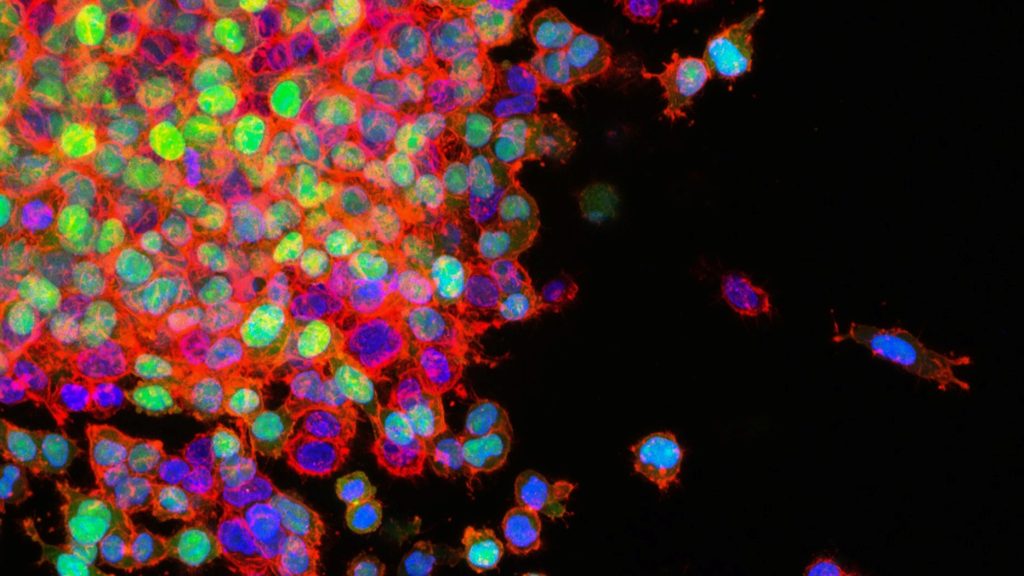
Lung cancer cells metastasising. Source: National Cancer Institute on Unsplash

Researchers have eliminated cells derived from untreatable metastatic cancer by disrupting the cellular components that are responsible for converting oxygen into chemical energy. The results are published in the Journal of the American Chemical Society.

Treatment of cancer is a a long battle because surviving cancer cells often evolve into aggressive, untreatable forms. Hence, treatment plans often involve multiple drug combinations and/or radiation therapy in order to prevent cancer relapse. To combat the variety of cancer cell types, modern drugs have been developed to target specific biochemical processes that are unique within each cell type.

However, cancer cells are highly adaptive and able to develop mechanisms to avoid the effects of the treatment. “We want to prevent such adaptation by invading the main pillar of cellular life – how cells breathe – that means take up oxygen – and thus produce chemical energy for growth,” explained David Ng, group leader at the Max Planck Institute for Polymer Research (MPI-P).

The research team produced a synthetic drug that travels into cells where it reacts to conditions found inside and triggers a chemical process. This allows the drug’s molecules to bind together and form tiny hairs that are a thousand times thinner than human hair. “These hairs are fluorescent, so you can look at them directly with a microscope as they form,” said first author Zhixuan Zhou, an Alexander von Humboldt fellow.

The scientists monitored the oxygen consumption in different cell types and found that these tiny hairs prevent all of them from converting oxygen into the energy deliver molecule ATP. The process worked even for those cells derived from untreatable metastatic cancer, with the cells dying off within four hours. After some more years of research, the scientists hope that they can develop a new method to treat up-to-now untreatable cancer.

Weil, Ng and colleagues have shown an exciting outcome under controlled laboratory culture and will continue to unravel deeper insights on the basis of how these tiny hairs prevent the conversion of oxygen to chemical energy. With further development, these objects could in the future possibly also be manipulated to control other cellular processes to address other important diseases.

Source: Max Planck Institute for Polymer Research

Weight Loss Protects against Structural Defects of Knee Osteoarthritis

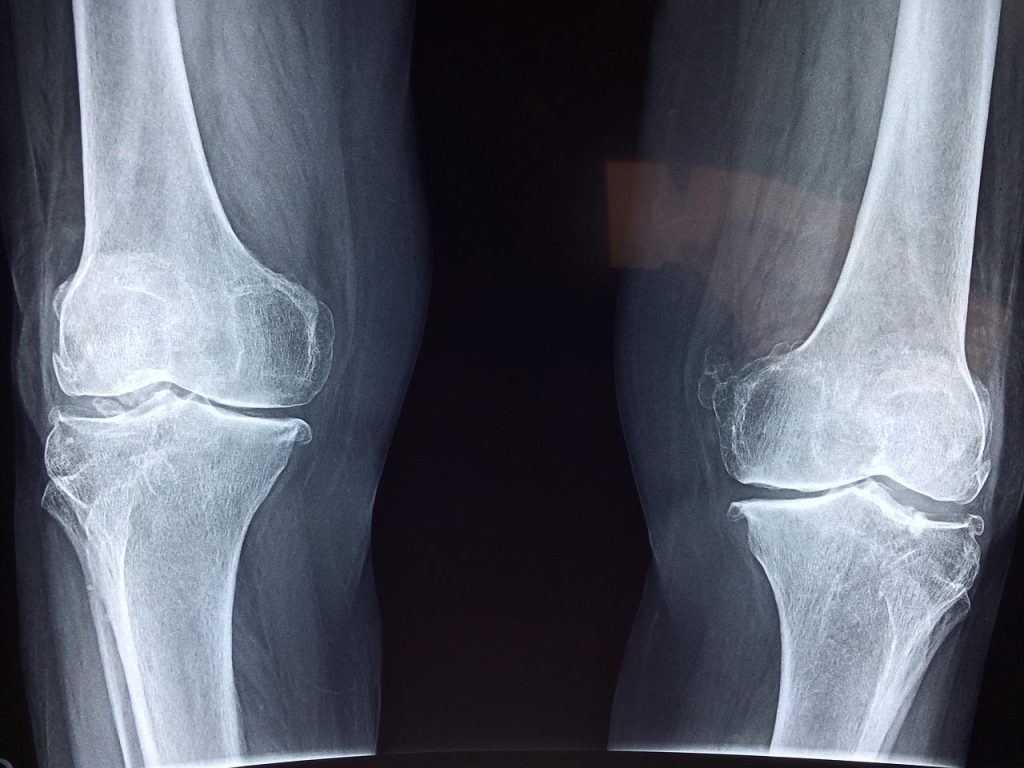
Researchers conducting long-term follow ups of adults given knee X-rays found that a decrease in body mass index (BMI) was associated with both a lower incidence of the structural defects of knee osteoarthritis. Published in Arthritis & Rheumatology, also found reduced odds of these defects progressing.

In the study radiographic analyses were conducted of adults’ knees with and without the structural defects of knee osteoarthritis at baseline and at 4 to 5 years’ follow up from adults. A total of 9683 knees (from 5774 individuals) were assessed in an ‘incidence cohort’ along with 6075 knees (from 3988 individuals) in a ‘progression cohort.’

The researchers observed that a 1-unit drop in BMI was linked to a 4.76% reduction in odds of the incidence and progression of knee osteoarthritis. A 5-unit BMI drop, which can downgrade a BMI category (eg, from overweight to normal), reduced the odds of incidence and progression by 21.65%.

“These findings could be empowering for people with or at risk of knee osteoarthritis,” said lead author Zubeyir Salis, BEng, and a PhD student for Public Health at the University of New South Wales in Australia. “The current prevailing view is that knee osteoarthritis is part of ageing and that we have no control over it. However, my analyses suggest that some people could potentially prevent, slow or delay knee osteoarthritis by losing weight.”

Source: Wiley

Extreme Temperatures will Affect Sleep as Climate Change Progresses

Sleeping woman
Photo by Cottonbro on Pexels

With heatwaves becoming increasingly common around the world, researchers examined how outdoor nighttime temperature changes affect body temperature and sleep quality. Their literature review published in the Journal of Sleep Research, the researchers suggest that high, uncomfortable temperatures can disrupt sleep by interfering with the body’s normal thermoregulation ability.

A recent study found that on average in Europe, the number of days with extreme heat (ie >99% percenticle) has tripled since 1950. Even temperatures on extremely hot days have increased by 2.3 °C throughout the same period. In the future, these heatwaves will be more frequent and of longer duration. Of particular concern is that nighttime temperatures will increase more than daytime ones – and high nighttime temperatures are associated with increased mortality risk.

The authors, from the European Insomnia Network, note that there are certain groups such as older adults, children, pregnant women, and individuals with psychiatric conditions, who may be especially vulnerable to the sleep disruptive effects of heatwaves. They also offer several coping methods adapted from elements of cognitive behavioural therapy for insomnia. 

“This paper is considered to be important and timely to disseminate expert recommendations to the research and clinical community as well as to the general population,” the authors wrote. “Nevertheless, it points out several areas of research which are still lacking, especially for specific populations. Even more important, literature evidence is still scarce.”

Source: Wiley

Not Just Reactive: Dermatology’s Role to Fight Climate Change

In addition to the skin-related impacts of climate change, the field of dermatology also has to address its own contribution to global warming. A commentary in the International Journal of Dermatology stresses the need for dermatologists to engage more meaningfully on key climate issues and to move beyond discussions of the skin-related impacts of climate change.

The article follows a 2021 editorial published en masse by 233 international medical journals that called for emergency action to limit global warming and adverse health effects related to climate change.

The authors of this new commentary note that they and other dermatologists are professionally charged with diagnosing, treating, researching, and mitigating the health harms from climate change but also must consider that healthcare is among the most carbon-intensive service sectors worldwide.

They point out that significant reductions in carbon emissions are readily achieved in dermatology by increased use of telehealth services and virtual medical meetings and residency interviews. Also, dermatologists should prioritise funding for climate-health research to improve healthcare sustainability and decarbonise the profession.

“Our research, advocacy, and policies must be ambitious in scope, reaching beyond cutaneous disease to integrate the impact of climate change on social determinants of health and support resiliency and social justice invulnerable populations,” the authors wrote. “We have an ethical imperative to act. The time is now for dermatologists and our medical societies to collectively rise to meet this crisis.”

Source: Wiley

Can Good Dental Health Protect against Dementia?

Dentist checking teeth
Image by Caroline LM on Unsplash

A major analysis of all relevant published studies indicates that poor periodontal health and tooth loss may increase the risk of both cognitive decline and dementia. The finding, published in the Journal of the American Geriatrics Society, affirms a long-suspected connection between dental and cognitive health.

The analysis included 47 studies. Poor periodontal health, reflected by having periodontitis, tooth loss, deep periodontal pockets, or alveolar bone loss, was linked to a 23% increase in risk for cognitive decline and a 21% higher risk of dementia. Tooth loss on its own was associated with a 23% higher odds of cognitive decline and a 13% higher risk of dementia. The overall quality of evidence was low, however.

“From a clinical perspective, our findings emphasise the importance of monitoring and management of periodontal health in the context of dementia prevention, although available evidence is not yet sufficient to point out clear ways for early identification of at-risk individuals, and the most efficient measures to prevent cognitive deterioration,” the authors wrote.

Source: Wiley

Cardiovascular Risk Factors in Compromised Bone Health

Source: Mat Napo on Unsplash

New research published in the Journal of Bone and Mineral Research identified a number of risk factors for cardiovascular disease in adults with compromised bone health, such as osteoporosis or a fragility fracture. Male sex was associated with a 61% increase in cardiovascular risk in the case of osteoporosis.

The prospective cohort study used data from a UK primary care database. Major adverse cardiovascular events (MACE, a composite outcome for the occurrence of either myocardial infarction [MI], stroke, or CVD death) were identified in patients aged 50 years or older at high or imminent fracture risk identified in three different cohorts (not mutually exclusive): recently diagnosed with osteoporosis (OST, n = 65 295), incident fragility fracture (IFX, n = 67 065), and starting oral bisphosphonates (OBP, n = 145 959). About 1.90%, 4.39%, and 2.38% of the participants in OST, IFX, and OBP cohorts, respectively, experienced MACE events. IFX was the cohort with the higher risk: MACE incidence rates (cases/1000 person-years) were 19.63 (18.54–20.73) in OST, 52.64 (50.7–54.5) in IFX, and 26.26 (25.41–27.12) in OBP cohorts.

The researchers found that risk factors for MACE in the three cohorts included male sex, older age, smoking, alcohol consumption, atrial fibrillation, use of anti-hypertensive medications, history of heart attack or stroke, established cardiovascular disease, low kidney function, high systolic blood pressure, elevated cholesterol level, and use of multiple concomitant medicines. 

 “Although there are some calculators to produce risk estimates of cardiovascular disease, these are not targeted at those at high risk of fracture,” said corresponding author Daniel Prieto-Alhambra, MD, PhD, of the University of Oxford. “To our knowledge, this is the first study to identify cardiovascular disease risk factors for osteoporotic individuals using data that is routinely collected and readily available.”

Source: Wiley

Oxygen Responses Control How T Cells Respond to TB

Tuberculosis bacteria
Tuberculosis bacteria. Credit: CDC

A new publication in Nature Communications explains how T cell protection against tuberculosis is controlled by their oxygen responses.

In 2021, 10 million people fell ill and 1.5 million died of Tuberculosis (TB), caused by infection with the intracellular Mycobacterium tuberculosis bacteria. Proper CD4 T cell responses are critical for the control of M. tuberculosis infection by activating intracellular bacterial killing.

Professor Martin Rottenberg and PhD student Ruining Liu at the Karolinska Institutet, explained how they discovered that hypoxia-inducible factors (HIF-1 and HIF-2) control T cell metabolism as well as activation and differentiation in response to hypoxia or during inflammation.

“We showed that genetically modified mice, in which HIF-1 expression T cells was stabilised by genetic manipulation, were highly susceptible to the infection with M. tuberculosis and did not respond to vaccination. CD4 T cells from these mice were profoundly weakened in their early responses to mycobacteria-specific antigens, said Prof Rottenberg. “By impairing and or controlling HIF-1 stabilisation in T cells, responses to vaccines and protection against infections might be improved”.

The studies were carried out on mouse models of M. tuberculosis infection. The mice used were genetically modified to either lack or overexpress HIF-1 in T cells.

“The infection with M. tuberculosis, and the immune responses it generates in man, is fairly mimicked in the mouse infection. Our next step is to identify the molecular targets HIF-1 in T cells that account for their impaired activation, which could be targeted for improving T cell responses,” Prof Rottenberg concluded.

Source: Karolinska Institutet