Tag: immunotherapy

Losing the Y Chromosome to Age Drives Bladder Cancers but Improves Immunotherapy

Chromosomes. Credit: NIH

As men age, some of their cells lose their Y chromosome and this loss hampers the body’s ability to fight cancer, according to new research from Cedars-Sinai Cancer. The study, published in Nature, found that loss of the Y chromosome helps cancer cells evade the immune system, resulting in aggressive bladder cancer. Somehow, this also renders the disease more responsive to immune checkpoint inhibitors.

Based on their research, investigators are developing a test for loss of the Y chromosome in tumours with the goal of helping clinicians tailor immune checkpoint inhibitor treatment for male patients with bladder cancer.

“This study for the first time makes a connection that has never been made before between loss of the Y chromosome and the immune system’s response to cancer,” said corresponding author Dan Theodorescu, MD, PhD, who initiated the research. “We discovered that loss of the Y chromosome allows bladder cancer cells to elude the immune system and grow very aggressively.”

Lead collaborators on the study also included Johanna Schafer, a postdoctoral fellow, and Zihai Li, MD, PhD, medical oncologist and immunologist, both at The Ohio State University Comprehensive Cancer Center-James Cancer Hospital and Solove Research Institute.

In men, loss of the Y chromosome has been observed in several cancer types, including 10%–40% of bladder cancers. Loss of the Y chromosome also has been associated with heart disease and Alzheimer’s disease.

The Y chromosome contains the blueprints for certain genes. Based on the way these genes are expressed in normal cells in the bladder lining, investigators developed a scoring system to measure loss of the Y chromosome in cancers.  

The investigators then reviewed data on two groups of men. One group had muscle invasive bladder cancer and had their bladders removed, but were not treated with an immune checkpoint inhibitor. The other group participated in a clinical trial and were treated with an immune checkpoint inhibitor. They found that patients with loss of the Y chromosome had poorer prognosis in the first group and much better overall survival rates in the latter.

To determine why this happens, investigators next compared growth rates of bladder cancer cells from laboratory mice.

Cancer cells were grown in vitro and not exposed to immune cells. The researchers also grew the diseased cells in mice that were missing T-cells. In both cases, tumours with and without the Y chromosome grew at the same rate.

In mice with intact immune systems, tumours lacking the Y chromosome grew at a much faster rate than did tumours with the intact Y chromosome.

“The fact that we only see a difference in growth rate when the immune system is in play is the key to the ‘loss-of-Y’ effect in bladder cancer,” Theodorescu said. “These results imply that when cells lose the Y chromosome, they exhaust T-cells. And without T-cells to fight the cancer, the tumor grows aggressively.”

Based on their results derived from human patients and laboratory mice, Theodorescu and his team also concluded that tumours missing the Y chromosome, while more aggressive, were also more vulnerable and responsive to immune checkpoint inhibitors. This therapy, one of the two mainstay bladder cancer treatments available to patients today, reverses T-cell exhaustion and allows the body’s immune system to fight the cancer.

“Fortunately, this aggressive cancer has an Achilles’ heel, in that it is more sensitive than cancers with an intact Y chromosome to immune checkpoint inhibitors,” said co-first author Hany Abdel-Hafiz, PhD, associate professor at Cedars-Sinai Cancer.

Preliminary data not yet published shows that loss of the Y chromosome also renders prostate cancers more aggressive, Theodorescu said.

“Our investigators postulate that loss of the Y chromosome is an adaptive strategy that tumour cells have developed to evade the immune system and survive in multiple organs,” said Shlomo Melmed, MB, ChB, dean of the Medical Faculty at Cedars-Sinai. “This exciting advance adds to our basic understanding of cancer biology and could have far-reaching implications for cancer treatment going forward.”

Further work is needed to help investigators understand the genetic connection between loss of the Y chromosome and T-cell exhaustion.

“If we could understand those mechanics, we could prevent T-cell exhaustion,” Theodorescu said. “T-cell exhaustion can be partially reversed with checkpoint inhibitors, but if we could stop it from happening in the first place, there is much potential to improve outcomes for patients.”

While women do not have a Y chromosome, Theodorescu said these findings could have implications for them as well. The Y chromosome contains a set of related genes, called paralogue genes, on the X chromosome, and these might play a role in both women and in men. Additional research is needed to determine what that role might be.

“Awareness of the significance of Y chromosome loss will stimulate discussions about the importance of considering sex as a variable in all scientific research in human biology,” Theodorescu said. “The fundamental new knowledge we provide here may explain why certain cancers are worse in either men or women, and how best to treat them. It also illustrates that the Y chromosome does more than determine human biologic sex.”

Source: Cedars-Sinai Medical Center

Some Antihypertensives might Boost the Effectiveness of Cancer Immunotherapy

Photo by CDC on Unsplash

A study reported in the latest issue of Nature has shown that some molecules previously used to treat hypertension might also help the immune system to better target cancer cells. The researchers believe that these findings could eventually be applied to significantly improve the effectiveness and applicability of cancer immunotherapy.

“Immunotherapy today can effectively fight only 30% to 40% of cancers,” said Benoît Van den Eynde, at the Ludwig Institute for Cancer Research, co-director of the de Duve Institute and professor of Tumour Immunology at the University of Oxford. “Many cancers are resistant, largely because their T lymphocytes are not reactive enough. We discovered that drugs once used to treat hypertension could have a very interesting effect in combating these forms of immunotherapy-resistant cancers.”

T lymphocytes are active components in the immune system, recognising and destroying cells that appear foreign. Cancer cells, however, are not foreign and are therefore often not recognised and attacked by T lymphocytes. But about thirty years ago, Thierry Boon and his colleagues at the former Brussels Branch of the Ludwig Institute for Cancer Research at the de Duve Institute discovered specific markers on the surface of cancer cells – tumour antigens – that can be recognised by T cells that then destroy the cancerous cells.

This work paved the way for cancer immunotherapy, a treatment approach that helps T cells destroy cancerous cells. Thanks to T cells’ specificity and memory of tumour antigens, immunotherapy makes it possible to treat advanced cancers with some success. It is now used worldwide. However, such therapies are not equally effective in all patients or against all types of cancer.

In the current study, a team led by Jingjing Zhu in Van den Eynde’s laboratory shows that anti-hypertensive drug-molecules known as α2-adrenergic receptor (α2AR) agonists also influence the behaviour of macrophages. While doing that job, macrophages also alert T cells of any abnormalities they encounter, presenting suspicious antigens to the cells to trigger a possible immune response.

Zhu, Van den Eynde and colleagues discovered that alongside their known hypotensive and anaesthetic effects, α2AR agonists can also stimulate macrophages in their role as sentinels, making T cells more reactive and more effective at rejecting cancer cells. The effect extended, most notably, to cancer models that are resistant to standard immunotherapy. This suggests the new approach could boost the efficacy of clinical immunotherapy, even for the many types of cancer that are largely unresponsive to such interventions.

These findings also present a rationale for the development of new molecules that might be used in combination with immunotherapy to improve its efficacy.

“One could imagine using existing blood pressure-lowering drugs,” said Van den Eynde. “But that would be quite risky, owing to the undesired effects and the toxicity of these drugs at the necessary doses. Another approach would be to develop new molecules that would act in the same way on macrophages but would not have the unwanted toxic effects. We have already made significant progress in this direction.”

Source: Ludwig Cancer Research

Osteoporosis Drug Zolendronate Could also Help Fight Breast Cancer

Killer T cells about to destroy a cancer cell.

Triple-negative breast cancer (TNBC) is the most aggressive and deadly form of breast cancer with limited treatment options and a high probability of recurrence. Researchers from the University of Frieburg discovered that coordinated differentiation and changes in the metabolism of breast cancer stem cells make them invisible for the immune system. Counteracting the metabolic change with the drug zolendronate could make immunotherapy using gamma delta T cells more efficient against TNBC. The research team was led by Prof Dr Susana Minguet and published in Cancer Immunology Research.

TNBC cells hide from gamma delta T cells

Gamma delta T cells recognise and kill cells that produce stress-induced molecules and phosphoantigens, a common characteristic of cancer cells. Because gamma delta T cells work differently to other types of T cells, they are being investigated as an alternative to existing immunotherapies. In the current study, the researchers tested the effect of gamma delta T cells on TNBC using isolated cancer cells and a recently developed mouse model that closely replicates the tumour properties found in human patients.

While the gamma delta T cells worked well against isolated breast cancer stem cells from patients, they had a much weaker effect in the mouse model. This was due to adaptations of the cancer cells that let them stay unnoticed by the immune system, the researchers found. These adaptations included the downregulation of the so-called mevalonate pathway: a metabolic pathway that leads to the production of phosphoantigens – one of the classes of molecules that gamma T cells recognise. This escape mechanism likely also happens in patients with TNBC: analysis of public patient databases showed that reduced expression of key molecules of the mevalonate pathway correlate with a worse prognosis.

The immune evasion of TNBC cells is reversible

This newly discovered escape mechanism can be counteracted by the drug zolendronate, which is FDA-approved for the treatment of osteoporosis and bone metastasis. When the researchers treated the escapist cells with zolendronate, the gamma T cells became a lot more efficient in clearing the cancer. “Our findings explain why current clinical trials using gamma delta T cells are not resulting in the expected success,” Minguet summarises. “We found a possible pharmacological-based approach to revert immune escape, which paves the way for novel combinatorial immunotherapies for triple negative breast cancer.”

Source: University of Freiburg

Vitamin D may be Necessary for Effective Immunotherapy in Skin Cancer

3D structure of a melanoma cell derived by ion abrasion scanning electron microscopy. Credit: Sriram Subramaniam/ National Cancer Institute

Vitamin D has many effects on the body, including regulation of the immune system. New research indicates that for patients with advanced skin cancer, it may be important to maintain normal vitamin D levels when receiving immunotherapy in the form of immune checkpoint inhibitors. The findings are published in CANCER.

To see whether levels of vitamin D might impact the effectiveness of immune checkpoint inhibitors, investigators analysed the blood of 200 patients with advanced melanoma both before and every 12 weeks during immunotherapy treatment.

A favourable response rate to immune checkpoint inhibitors was observed in 56.0% of patients in the group with normal baseline vitamin D levels or normal levels obtained with vitamin D supplementation, compared with 36.2% in the group with low vitamin D levels without supplementation. Progression‐free survival in these groups was 11.25 and 5.75 months, respectively.

“Of course, vitamin D is not itself an anti-cancer drug, but its normal serum level is needed for the proper functioning of the immune system, including the response that anti-cancer drugs like immune checkpoint inhibitors affect,” said lead author Łukasz Galus, MD, of Poznan University of Medical Sciences, in Poland. “In our opinion, after appropriately randomised confirmation of our results, the assessment of vitamin D levels and its supplementation could be considered in the management of melanoma.”

Source: Wiley

Towards Treating Dangerous Immunotherapy Side Effects

Photo by Tima Miroshnichenko on Pexels

While immunotherapy has been shown to greatly improve survival rates for certain types of cancer, in some cases, it can lead to a dangerous over-activation of the immune system. In a recent review published in Journal for ImmunoTherapy of Cancer, potential therapies have been identified, which might make it possible to continue with immunotherapy even when facing severe side effects.

The rare immunotherapy side effect of over-activation was only clinically recognised during regular clinical use rather than in clinical trials or animal experiments. To better understand this over-activation, Lisa LiuMarco Gerling, and colleagues analysed data from all published international reports on this issue after cancer immunotherapy. Their findings indicate that potentially life-threatening inflammation may occur more frequently than previously thought, and might be treatable with existing drugs such as steroids or anti-inflammatory therapies commonly used for rheumatoid arthritis.

“It will be exciting to follow up on the main findings of our systematic review, says Marco Gerling at the Department of Biosciences and Nutrition, Karolinska Institutet and lead author.

“We believe that inhibition of a specific inflammatory molecule, interleukin-6, could allow patients to continue immunotherapy despite strong, systemic activation of the immune system”, he continues. “But we need more data to support the regular use of interleukin-6 inhibitors. We also want to thank Narcisa Hannerz and Sabine Gillsund from Karolinska University Library for their invaluable help with finding articles for this review.“

Source: Karolinska Institutet

Promising Results for Immunotherapy Drug Nivolumab in Advanced Skin Cancer

Female scientist in laboratory
Photo by Gustavo Fring on Pexels

A phase II clinical trial has demonstrated that patients with advanced cutaneous squamous cell carcinoma can benefit from the immune checkpoint inhibitor nivolumab. The findings were published in the journal CANCER

Two other immune checkpoint inhibitors, cemiplimab and pembrolizumab, have been approved by the US Food and Drug Administration for the treatment of advanced cutaneous squamous cell carcinoma in recent years. This new study is the first to report clinical trial results for nivolumab. 

The single-arm trial included 24 patients who received nivolumab at 3mg/kg every two weeks until they experienced cancer progression, developed unacceptable toxicity, or had received 12 months of treatment.  

During the trial, 14 patients (58.3%) benefited from the treatment, with their cancers demonstrating a response. Treatment-related adverse events of any grade occurred in 21 patients (87.5%) and, for and grade ≥ 3, in six patients (25%). One patient discontinued nivolumab due to toxicities. Prior radiotherapy exposure was associated with a worse response. 

“This is the first study to investigate nivolumab in this patient population, and it provides further evidence supporting the use of immune checkpoint blockers as standard therapies in cutaneous squamous cell carcinoma,” said lead author Rodrigo R. Munhoz, MD, of the Hospital Sírio-Libanês, in Brazil. 

An accompanying editorial notes that although the trial was small, its results were similar to those reported with pembrolizumab and cemiplimab. “In addition to providing more assurance to the clinical activity of different [immune checkpoint] inhibitors in this disease, this replicated data may permit a more widespread utilisation of these agents in managing a common disease with global implications,” the authors wrote. 

Source: Wiley

Why Lung Cancer Doesn’t Respond Well to Immunotherapy

A new MIT study explains why dendritic cells (green) in lymph nodes that drain from the lungs fail to stimulate killer T cells (white) to attack lung tumours.
Credits: MIT/ Courtesy of the researchers

Immunotherapy works well against some types of cancer, but it has shown mixed success against lung cancer. A new study from MIT helps to shed light on why the immune system mounts such a lacklustre response to lung cancer, even after treatment with immunotherapy drugs. In a study of mice, the researchers found that bacteria naturally found in the lungs help to create an environment that suppresses T-cell activation in the lymph nodes near the lungs.

The researchers did not find that kind of immune-suppressive environment in lymph nodes near tumours growing near the skin of mice. They hope that their findings could help lead to the development of new ways to rev up the immune response to lung tumours.

“There is a functional difference between the T-cell responses that are mounted in the different lymph nodes. We’re hoping to identify a way to counteract that suppressive response, so that we can reactivate the lung-tumour-targeting T cells,” says Stefani Spranger, the Howard S. and Linda B. Stern Career Development Assistant Professor of Biology, a member of MIT’s Koch Institute for Integrative Cancer Research, and the senior author of the new study.

MIT graduate student Maria Zagorulya is the lead author of the paper, which appears today in the journal Immunity.

Failure to attack

For many years, scientists have known that cancer cells can send out immunosuppressive signals, which leads to a phenomenon known as T cell exhaustion. The goal of cancer immunotherapy is to rejuvenate those T cells so they can begin attacking tumours again.

One type of drug commonly used for immunotherapy involves checkpoint inhibitors, which remove the brakes on exhausted T cells and help reactivate them. This approach has worked well with cancers such as melanoma, but not as well with lung cancer.

Spranger’s recent work has offered one possible explanation for this: She found that some T cells stop working even before they reach a tumour, because of a failure to become activated early in their development. In a 2021 paper, she identified populations of dysfunctional T cells that can be distinguished from normal T cells by a pattern of gene expression that prevents them from attacking cancer cells when they enter a tumour.

“Despite the fact that these T cells are proliferating, and they’re infiltrating the tumour, they were never licensed to kill,” Spranger says.

In the new study, her team delved further into this activation failure, which occurs in the lymph nodes, which filter fluids that drain from nearby tissues. The lymph nodes are where ‘killer T cells’ encounter dendritic cells, which present antigens (tumour proteins) and help to activate the T cells.

To explore why some killer T cells fail to be properly activated, Spranger’s team studied mice that had tumours implanted either in the lungs or in the flank. All of the tumours were genetically identical.

The researchers found that T cells in lymph nodes that drain from the lung tumours did encounter dendritic cells and recognise the tumour antigens displayed by those cells. However, these T cells failed to become fully activated, as a result of inhibition by another population of T cells called regulatory T cells.

These regulatory T cells became strongly activated in lymph nodes that drain from the lungs, but not in lymph nodes near tumours located in the flank, the researchers found. Regulatory T cells are normally responsible for making sure that the immune system doesn’t attack the body’s own cells. However, the researchers found that these T cells also interfere with dendritic cells’ ability to activate killer T cells that target lung tumours.

The researchers also discovered how these regulatory T cells suppress dendritic cells: by removing stimulatory proteins from the surface of dendritic cells, which prevents them from being able to turn on killer T cell activity.

Microbial influence

Further studies revealed that the activation of regulatory T cells is driven by high levels of interferon gamma in the lymph nodes that drain from the lungs. This signalling molecule is produced in response to the presence of commensal bacterial – bacteria that normally live in the lungs without causing infection.

The researchers have not yet identified the types of bacteria that induce this response or the cells that produce the interferon gamma, but they showed that when they treated mice with an antibody that blocks interferon gamma, they could restore killer T cells’ activity.

Interferon gamma has a variety of effects on immune signalling, and blocking it can dampen the overall immune response against a tumour, so using it to stimulate killer T cells would not be a good strategy to use in patients, Spranger says. Her lab is now exploring other ways to help stimulate the killer T cell response, such as inhibiting the regulatory T cells that suppress the killer T cell response or blocking the signals from the commensal bacteria, once the researchers identify them.

Reprinted with permission of MIT News

New Immunotherapy Sees 73% Success Rate in Multiple Myeloma Patients

Woman using lab equipment
Source: NCI on Unsplash

A new immunotherapy to kill bone marrow cancer cells was successful in as many as 73% of patients in two clinical trials, according to Mount Sinai researchers. The new bispecific antibody therapy binds to both T cells and multiple myeloma cells and directs the T cells to kill multiple myeloma cells. The researchers described this strategy as “bringing your army right to the enemy.”

The success of the off-the-shelf immunotherapy, called talquetamab, was even seen in patients whose cancer resisted previous therapies. It uses a different target than other approved therapies: a receptor expressed on the surface of cancer cells known as GPRC5D.

Talquetamab was tested in phase 1 and phase 2 trials. The phase 1 trial, reported in NEJM, established two recommended doses that were tested in the phase 2 trial. The results of the phase 2 trial were reported at the American Society of Hematology annual meeting. The study participants had all received at least three different therapies without achieving lasting remission, suggesting talquetamab could offer new hope for patients with hard-to-treat multiple myeloma.

“This means that almost three-quarters of these patients are looking at a new lease on life,” said lead author of the studies, Ajai Chari, MD, Director of Clinical Research in the Multiple Myeloma Program at The Tisch Cancer Institute. “Talquetamab induced a substantial response among patients with heavily pretreated, relapsed, or refractory multiple myeloma, the second-most-common blood cancer. It is the first bispecific agent targeting the protein GPRC5d in multiple myeloma patients.”

Nearly all patients with myeloma who receive standard therapies continually relapse. Patients who relapse or become resistant to all approved multiple myeloma therapies have a poor prognosis, so additional treatments are urgently needed. This study, while an early-phase trial designed to detect tolerability and find a safe dose, is an important step in meeting that need.

This international Phase 1 clinical trial enrolled 232 patients between January 2018 and November 2021. Patients received a variety of doses of the therapy either intravenously or subcutaneously; future studies will focus on doses only administered subcutaneously either weekly or every other week

The efficacy and safety findings in the phase 1 study were validated in the phase 2 trial presented at ASH. The phase 2 trial included 143 patients treated on a weekly dose and 145 patients treated at a higher biweekly dose.

The overall response rate in these two groups was about 73%, Dr Chari said. The response rate was maintained throughout various subgroups examined, with the exception of patients with a rare form of multiple myeloma that also extends to organs and soft tissues. More than 30% of patients in both groups had a complete response (no detection of myeloma-specific markers) or better, and nearly 60% had a “very good partial response” or better (indicating the cancer was substantially reduced but not necessarily down to zero).

The median time to a measurable response was approximately 1.2 months in both dosing groups and the median duration of response to date is 9.3 months with weekly dosing. Researchers are continuing to collect data on the duration of response in the group receiving 0.8 mg/kg every other week and for patients in both dosing groups who had a complete response or better.

Side effects were relatively frequent, but typically mild. About three-quarters of patients experienced a common side effect of immunotherapy – cytokine release syndrome, a constellation of symptoms including fever. About 60% experienced skin-related side effects such as rash, about half reported taste changes, and about half reported nail disorders. Only 5–6% of patients stopped treatment due to side effects.

The response rate observed in the study, which Dr Chari explained is higher than that for most currently accessible therapies, suggests talquetamab could offer a viable option for patients whose myeloma has stopped responding to most available therapies, offering a chance to extend life and benefit from other new and future therapies as they are developed.

Source: Mount Sinai Hospital

A Shot of Vitamin C Gives Dendritic Cells a Potent Cancer-fighting Boost

Vitamin C pills and orange
Photo by Diana Polekhina on Unsplash

New research published in Nucleic Acids Research has shown that vitamin C improves the immunogenic properties of dendritic cells, activating genes involved in the immune response. This discovery could help the development of potent new dendritic cell-based immunotherapies.

Since the onset of anticancer cell therapies, many types of immune cells have been used. The best-known of these cell therapies use lymphocytes, as in the highly successful CAR-T therapies. Recently, researchers have to turned to dendritic cells, known as the ‘master regulators of the immune system‘, for their ability to uptake and present antigens to the T-lymphocytes and induce an antigen-specific potent immune activation. This approach entails loading dendritic cells with specific antigens to create immune memory to make dendritic cell (DC)-vaccines.

To study dendritic cells in the lab, researchers differentiate them from monocytes using a particular set of molecular signalling. This differentiation is accomplished through a complex set of gene activation processes in the nucleus, mostly thanks to the activity of the chromatin remodelling machinery spearheaded by the TET family of demethylases, proteins that act upon the DNA epigenetic marks.

Vitamin C was already known to interact with several TET proteins to enhance its activity, but the specific mechanism was still poorly understood in human cells. In this study, a team lead by Dr Esteban Ballestar hypothesised that treating monocytes in vitro while differentiating into dendritic cells, would help the resulting cells be more mature and active.

The results obtained show that vitamin C treatment triggers an extensive demethylation at NF- kB/p65 binding sites compared with non-treated cells, promoting the activity of genes involved in antigen presentation and immune response activation. Vitamin C was also found to increase the communication of the resulting dendritic cells with other components of the immune system and stimulates the proliferation of antigen-specific T cells.

The researchers proved that vitamin C-stimulated dendritic cells loaded with antigens specific for the SARS-CoV-2 virus were able to activate T cells in vitro more efficiently than non-treated cells.

Overall, these new findings support the hypothesis that treating monocyte-derived dendritic cells with vitamin C may help generate more effective DC-vaccines. After consolidating these results in preclinical models and, hopefully, in clinical trials, a new generation of cell therapies based on dendritic cells may be used in the clinic to fight cancer more efficiently.

Source: Josep Carreras Leukaemia Research Institute

‘Striking’ Colon Cancer Trial Data gets Standing Ovation

Woman using lab equipment
Source: NCI on Unsplash

In a clinical trial, nearly every one of the 112 patients with mismatch repair-deficient (dMMR) colon cancer achieved a pathologic response with just two cycles of neoadjuvant immunotherapy, prompting a presentation panellist to describe it as “striking data” – though a note of caution was given.

Patients in the NICHE-2 single-arm study received PD-1 plus CTLA-4 blockade – nivolumab plus ipilimumab, and successfully underwent surgical resection, 98% on time, meeting the study’s primary safety endpoint, reported Myriam Chalabi, MD, at the at the European Society for Medical Oncology (ESMO) annual congress.

And with a median follow-up of 13.1 months, the disease-free survival (DFS) rate was 100%, said Dr Chalabi of the Netherlands Cancer Institute in Amsterdam. She pointed out that, by this point, the expected rate for this patient population was about 15%. The primary efficacy endpoint for the trial is DFS at 3 years, with success defined as a rate of 93% (data are expected next year).

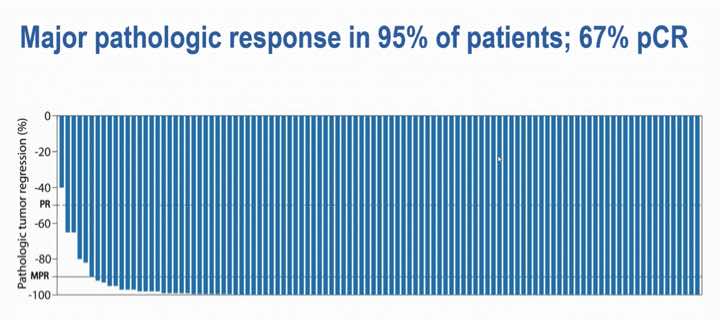
A standing ovation erupted when Dr Chalabi displayed the waterfall plot showing the depth of pathologic response with just four weeks of nivolumab plus ipilimumab.

Credit: NICHE-2 Study

Among the 107 patients evaluable for efficacy, all but one had a pathologic response, 95% had a major pathologic response (MPR), and 67% had a pathologic complete response (pCR), ie no residual viable tumour in both the primary tumour bed and lymph nodes.

“As you can appreciate, the pathologic regression observed was near-complete or complete in almost all patients,” she said.

In contrast, pathologic response rates in the range of 5% to 7% for this population have been shown in prior trials involving neoadjuvant chemotherapy, said Chalabi.

Some 10–15% of colon cancers are classified as dMMR, she explained, which are highly sensitive to immune checkpoint inhibitors, where a number of agents have been approved for the metastatic setting.

The first to comment in Q&A, Alexander Eggermont, MD, PhD, stressed the potential impact of the findings, saying that patients with dMMR tumours scheduled for resection “should be taken off the surgical program.”

“They should be sent to the medical oncologist for the first dose of ipi/nivo,” he said. “We will live the day that they will not undergo surgery anymore after these schedules – that’s the next step.”

A multicentre, single-arm study, NICHE-2 enrolled 112 patients with previously untreated non-metastatic dMMR colon cancer undergoing surgery. The first cycle of neoadjuvant treatment included ipilimumab (1mg/kg) and nivolumab (3mg/kg). The second cycle, given two weeks later, was limited to nivolumab alone. After the first dose, median time to surgery was 5.4 weeks.

The trial defined pathologic response as 50% or less residual viable tumour; MPR was defined as 10% or less residual viable tumour, and included patients with pCRs in the primary tumour but viable tumour in the lymph nodes.

The median age of patients was 60, and 58% were women. About three-fourths had high-risk stage III disease, 13% had low-risk stage III disease, and 13% had stage I/II disease. About half had radiologic high-risk disease (both T4 and N2), said Dr Chalabi, and abdominal wall involvement was common.

When asked whether randomised data would be needed to make this approach standard, Dr Chalabi pointed out the group with T4 tumours.

“I wouldn’t want to randomise those patients,” she said. “Surgeons usually would prefer to have some type of downstaging before continuing on to surgery in order to increase the chances of achieving tumour-free resection margins and also to limit the extent of surgery needed to achieve that.”

The case for randomisation is stronger in earlier disease, she said, but if recurrences can be prevented even in stages where recurrence is more rare, such as stage II tumours (about 10% at 3 years), “we’re curing 10% more patients.”

A little less than a third of patients had Lynch syndrome, and pCRs were more frequent in this subset (78% vs 58% in those with sporadic tumours). Immune-related adverse events (AEs) were reported in 61% of patients, with 4% being grade 3/4.

When the prospect of a NICHE-3 trial came up, Dr Chalabi said that it ideally would have been an international study to validate the approach. However, a subsequent trial is being developed and will likely involve nivolumab plus anti-LAG-3 relatlimab, “which is a shame,” she noted.

“If we do get similar responses with nivolumab and anti-LAG-3, then that may be an avenue to test organ-sparing approaches with that combination in this population,” she added.

Source: MedPage Today