Three short films tell the powerful stories of professionals whose resilience, purpose and commitment are creating lasting impact in their communities.
Photo by Thirdman : https://www.pexels.com/photo/medical-professionals-looking-at-the-screen-of-the-cellphone-5327867/
Profmed, South Africa’s medical aid for professionals, has launched BeRemarkable, a documentary series that shines a spotlight on the people and personal stories behind some of the country’s most respected professions.
Now streaming on the Profmed YouTube channel, the three-part series follows the journeys of Profmed members who have overcome significant personal challenges and gone on to make a meaningful difference in the lives of others and their communities.
“These films are a reminder that behind every profession is a person with a unique story,” says Craig Comrie, CEO at Profmed. “We wanted to highlight members whose influence extends beyond their careers and into the communities and lives they’ve helped shape.”
THE THREE STORIES
Flight Path | Dr Ryan Jacobs
After severe epilepsy and brain surgery ended his ambitions of becoming a pilot, Dr Ryan Jacobs found a new calling in medicine.
Now training as a specialist neurosurgeon at Tygerberg Hospital, Ryan’s story reflects how personal adversity can shape purpose.
Flight Path explores his journey from patient to healthcare professional, and the experiences that inspired him to pursue a career helping others navigate life-changing medical challenges.
Back to Water | Suzanne “Suzie” Hüsselmann
A devastating bodyboarding accident changed Suzanne “Suzie” Hüsselmann’s life in an instant. The long recovery that followed brought both physical and emotional challenges, but also strengthened her connection to the ocean and inspired a new sense of purpose.
Today, Suzie is the founder of Surf4Life, an initiative that uses surfing to support young people from underserved communities in Cape Town. Through the programme, participants develop confidence, resilience and life skills while building a deeper connection with the ocean.
Back to Water explores how a life-altering experience inspired Suzie to create opportunities for others through the sport that played an important role in her own recovery.
Into Focus | Tharien Schoeman
A patient who had been waiting years for cataract surgery left a lasting impression on Tharien Schoeman. What began as a single encounter grew into a broader mission to help more people access the treatment they need.
Today, her work has helped restore sight to hundreds of South Africans, giving many the opportunity to regain their independence and reconnect with daily life.
Into Focus tells the story of how one person’s determination can create meaningful change for others.
ABOUT BEREMARKABLE
BeRemarkable is a three-part documentary series showcasing the stories of Profmed members who have overcome personal challenges and gone on to make a positive impact in their communities.
Filmed across South Africa, the series features first-hand accounts from Dr Ryan Jacobs, Suzanne “Suzie” Hüsselmann and Tharien Schoeman, exploring the moments that shaped their journeys and inspired their work.
The full series is now available on the Profmed YouTube channel@profmedsa.
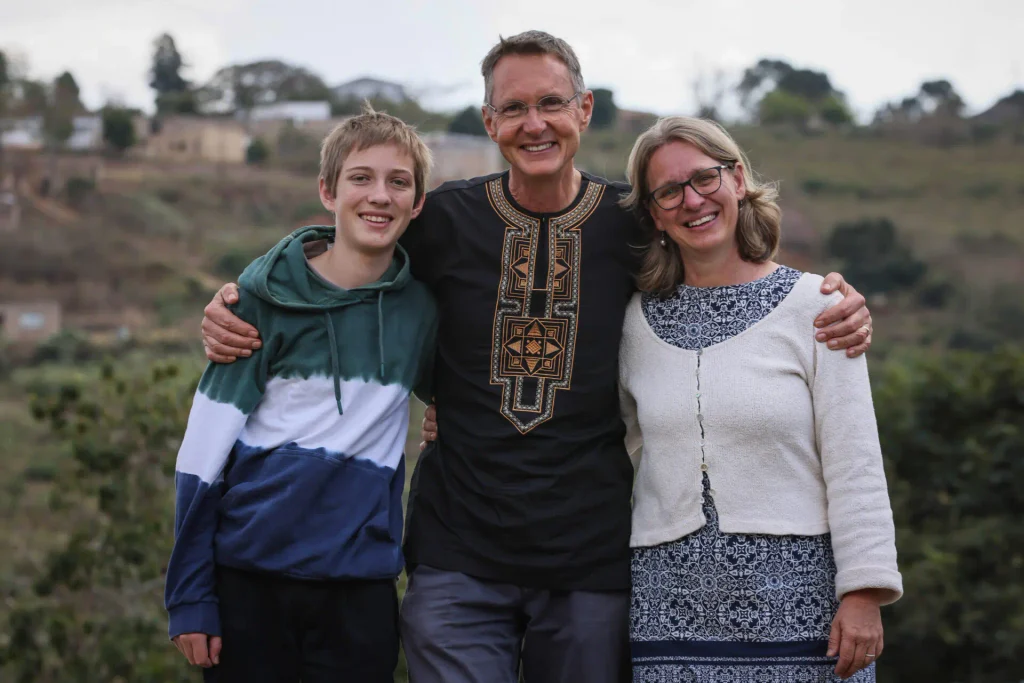
Dr Hennie Hamilton with his wife Sylivia and son near their home in Ingwavuma in northern KwaZulu-Natal. (Photo: Halden Krog/Spotlight)
By Sue Segar for Spotlight
As a young doctor working in rural KwaZulu-Natal, Hennie Hamilton lived with a Zulu family for four years, an experience which, he says, changed him forever. Twenty-three years later, he’s still working in the area as medical manager at Mosvold Hospital and doing cataract surgery on patients from five rural hospitals.
In the corner of a small ward in a rural hospital in northern KwaZulu-Natal, an elderly woman with a plastic shield covering her left eye sits up in bed. Her daughter, seated on a chair beside the bed, is holding her hand.
There’s silence, an air of quiet anticipation as a tall doctor leans over the woman and, in deep concentration, slowly removes the eye shield and the eye pad underneath it.
Next, the doctor gently eases her eye open and looks closely into her face to see her response. “Uya bona, Mama?” (Can you see, Mama?) Dr Hennie Hamilton asks the woman, keeping a hand on her shoulder.
The woman, Duduzile Phakathi from Mthubathuba, flickers her eyes. Her grip tightens on her daughter’s hand. “Yebo,” she answers, almost inaudibly, and her face breaks into a smile as she focuses, incredulously, on the tall man in front of her. “Ngiyabonga,” (Thank you) she says. The room erupts into excited chatter as mother and daughter start praying out loud, pouring blessings onto the doctor.
Eye patients from five hospitals – and further
It’s not yet 07:00, and Hamilton, medical manager at Mosvold Hospital in the mountain town of Ingwavuma, is already walking the wards. Every Monday, this quietly spoken man performs cataract surgery on patients from all over the uMkhanyakude district of KwaZulu-Natal. Besides coming from the area served by Mosvold Hospital, patients are referred to him from the other four hospitals in the district – Manguzi, Bethesda, Mseleni and Hlabisa. Tuesdays are for opening the eyes and checking the surgery has been effective.
After losing her sight to cataracts, Duduzile Phakati is overjoyed to see again and get back to caring for her chickens. (Photo: Halden Krog/Spotlight)
As a shaft of morning sunlight beams into the room and onto the faces of the two women, Hamilton, dressed in a black embroidered African work tunic called a Dashiki, explains what he’s doing. He speaks with a strong Afrikaans accent, despite his English last name.
“This patient had what is known as a dense cataract and was completely blind. We operated on her right eye in June, and yesterday we did her left eye. Today, we’re opening the eye and checking whether the operation has been a success,” he says.
A cataract, he explains, is an opacity, or cloudiness, of the lens in the eye, which blocks the passage of light and causes a person’s vision to blur or dim. “It normally happens in old age. Sometimes it arises from diabetes or injuries or trauma, or it can be caused by medication. Some people are born with it, but 95 percent of the patients we see have it because of old age.”
He continues: “Most people will eventually get a cataract. The big difference in this area is that people present very late. In rural areas like this, 20 percent of the patients we operate on are already blind in both eyes. People just wait for longer before they finally come for help.”
Cataract surgery, he says, is a short, painless procedure which involves numbing the eye using eyedrops and an injection; making an incision in the cornea; creating a small “tunnel” on the white of the eye; removing the cataract lens through the tunnel; and then, by folding and inserting it through the incision, replacing the inside of the lens with an artificial lens, made from synthetic material. The incision self-seals and needs no stitches and patients experience an improvement in their vision shortly after the procedure.
“Brought by God himself”
Phakathi’s daughter, Dorothy Mbonambo, says her mother who has diabetes, has been struggling with her eyes for some time. “She was a very busy woman, who loved looking after, and selling her chickens.” But she became totally blind in February, and suddenly she couldn’t do anything for herself.
“We had to feed her, bathe her, and dress her at home, where we all live together. We did not anticipate this at all, and we had to adapt. My mother was really struggling,” says Mbonambo.
Translating for her mother, she continues: “My mother is excited that she can see again. She loves to count her money from selling chickens. It has been frustrating not to be able to do that. She can’t wait to get back to her business, to her normal life.”
Mbonambo says the family was determined to get their mother to Mosvold Hospital for the surgery. “We knew about Dr Hamilton because people talk about this man who came here when he was young, and speaks isiZulu and does the eyes and other operations too.”
Still holding her beaming mother’s hand, Mbonambo points to Hamilton, saying: “This one was brought by God himself.”
“Before, everything was blank”
Next, Hamilton walks into another ward, bigger than the last, where seven more women who had cataract surgery the day before, are recovering. Similar scenes play out as he removes the eye shields for each woman.
Primrose Gina who works as a porter at Mseleni Hospital, says she started struggling with her eyes about three years ago. As the condition of her eyes worsened, it became increasingly difficult to see, and she was told it was cataracts.
After three years of struggling with her vision, Primrose Gina celebrates a new beginning following cataract surgery. (Photo: Halden Krog/Spotlight)
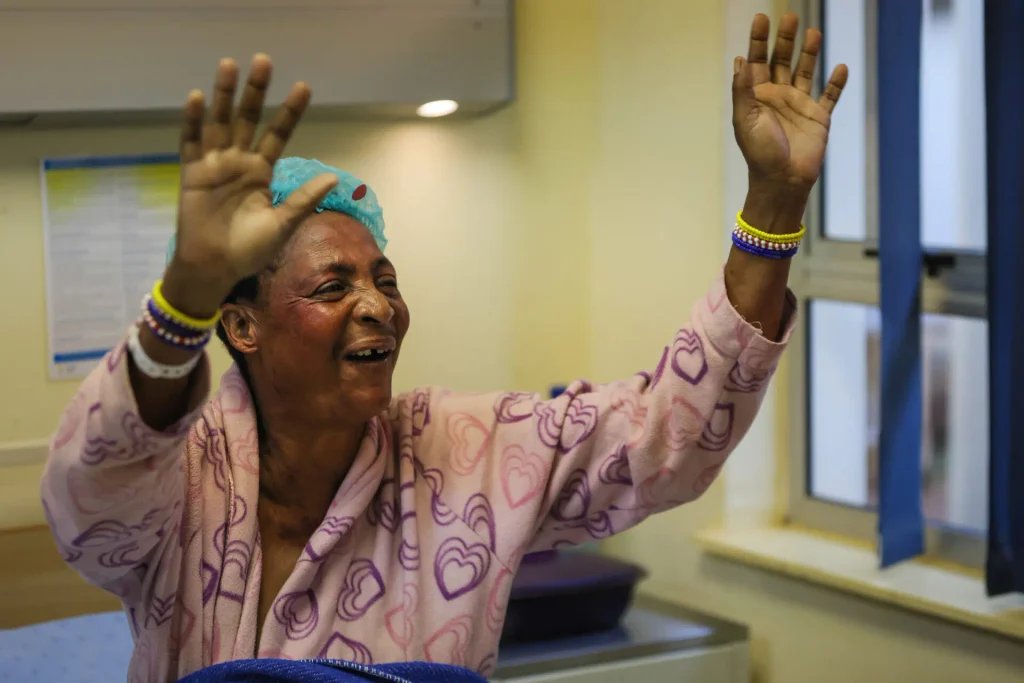
As Hamilton opens her eyes, she lets out an exhilarated shout and tells him she can see.
Gwendolin Mthethwa, a teacher from Ndumo, says her eyes still feel “cloudy” after her operation. This, Hamilton explains, is because, besides the cataract, she also has glaucoma in both eyes.
“Glaucoma is a disease of the optic nerve at the back of the eye which is caused by a build-up of fluid pressure inside the eye, causing damage to the nerve, often due to natural drainage systems being faulty.
“The difference between glaucoma and cataracts is that, with glaucoma, if the damage has happened to the nerve, we cannot reverse it,” Hamilton explains. “We can only try and prevent it from getting worse. But for a cataract, a patient can go from blindness to normal vision again.”
A busy day in the life of a medical manager
It’s nearly 08:00 and Hamilton has already seen eight eye patients. As he strides through the large female ward, the room erupts into song as nurses and some patients gather in the communal ward. “Every morning, we pray together, to connect with the Lord before we start our duties,” a nurse explains.
Next up is a meeting with the hospital’s CEO, Dr Bernard Mung’omba. As part of the hospital’s senior leadership team, Hamilton is closely involved in audits for the provincial health department and overall hospital decisions. As medical manager, he oversees medical care for patients – supervising the doctors, allied health professionals and all other departments including the pharmacy and the hospital’s social workers.
The 186-bed hospital employs 17 doctors and serves seven clinics and a community health centre in the uMkhanyakhude district. The area is characterised by poverty, with many people relying on grants and government work opportunities and living in mostly rural homesteads. Unemployment, teenage pregnancy and substance abuse are big challenges.
As a rural hospital, Hamilton says, “we do bits of everything”. “Last night, I was on call and at 23:30, was in theatre doing a caesarean section.” As medical manager, he says he plays less of a frontline than an advisory role, helping with emergencies from ectopic pregnancy to premature babies, and appendicitis. “We also deal with many diabetic and hypertensive-related emergencies like heart failure, and see many strokes, among older people,” he says.
“The spectrum is extremely wide. We’re a team of people with different strengths and we all rely on one another,” he says.
But it’s the eye operations which he says he finds most rewarding. “Ag, I love it … it gives me so much joy,” he says. “The patients often bless me. They say, ‘may God bless you’. I’m often in tears in the morning when I open their eyes.”
A long history
Mosvold Hospital was founded in 1908 by Christian missionaries and started out as a small stone rondavel. It was taken over by Scandinavian missionaries in the 1930s. The hospital is named after a Norwegian nurse, Esther Mosvold, who worked there in the 1940s, fell in love with the area, and raised money through her wealthy shipping family to expand the hospital. In 1978, the then Natal provincial government took over the hospital and the mission doctors slowly departed.
Hamilton shows us the original stone clinic next to an old chapel which, he says, resignedly, is now used for storage; and a house once lived in by missionaries, which is now the admin office. He points to a site where the provincial government is building a children’s ward and a lodge for mothers to stay while visiting children in hospital; and, on the other side of the hospital, a complex of 40 bachelor flats being built for staff at a cost of R400 million. The project should be completed next year, he says, adding it will be a “gamechanger” for Mosvold. “Mothers visiting their children in hospital currently sleep on mattresses on the floor.”
On our tour, we visit the ward where Hamilton’s eldest child was born in 2007. “It’s grown so much since then,” he says. Around us, the different departments – therapy, dental, radiography, and the pharmacy – are all bustling. In the children’s ward, manager Noziphe Gumbi says they’re seeing way fewer burn wounds this year. “We’ve really focused on outreaches to educate people on the dangers of burns among children,” she says.
Hamilton says he has seen many changes at Mosvold over the years, the biggest being the number of staff. “We’ve almost doubled the number of doctors, so we can spend much more time with patients. There was a time when there were only four doctors. Now, with 16, sometimes 17 doctors, we don’t have to run, run, run like we used to,” he says. “When I arrived, we were only white doctors, now I’m the only white doctor here which helps a lot in terms of language and knowing the people.”
A life in medicine
Hamilton was born in Johannesburg and studied medicine at Pretoria University. In 1997, he started his internship at McCord Hospital, then a mission hospital, in Durban. In 1998, he moved to Bethesda Hospital where, he learnt how to be “an all-round doctor”. He went on to complete qualifications in obstetrics and orthopaedics and trained to do cataract surgery at Edendale Hospital.
He worked at Bethesda at a time when HIV was “completely overwhelming”, he says. A large part of his work was supporting HIV patients clinically and he started a home-based care programme there. In 2003, he met his wife, Sylvia, a Swiss nurse, who, having previously worked in northern KwaZulu-Natal, had returned to start a home-based care programme at Mosvold. They married four months after meeting, and Hamilton moved to Mosvold in 2003, eventually becoming medical manager in 2015.
Why he stayed
“While I was working at McCord’s Hospital in 1997, I met another doctor, Colin Pfaff, who was working at Manguzi Hospital, who was living with a Zulu family,” Hamilton recalls. “When Colin told me about his experience, something just jumped in me. I believe it was God. I realised this was what I wanted to do.”
Less than a year later, while working at Bethesda Hospital, Hamilton moved in with the Nhlekos. “I lived in a mud hut with no running water or electricity. The house was about six kilometres from Bethesda and I’d cycle up and down the mountain to work every day. I became part of the family. In the evenings, I’d sit in the kitchen with my gogo. I learnt to speak fluent isiZulu.
“It was an amazing time, even though it was only for four years. It was the most beautiful place on earth,” he says.
Hamilton shuts his eyes and says: “This experience changed me forever. I was raised very much in an Afrikaner setting. During my high school, our family moved to a farm in the Free State. We lived completely separate from black people, eating from different plates, using separate toilets. There was always this issue of race which I just accepted.”
He continues: “Living with an isiZulu family completely changed that. They gave me a Zulu name, Sandiso, which means spreading God’s grace. People still call me ‘Mgilitsha’, the clan name for the Nhlekos. I learnt to see all people as people, to trust, and to love. It was a heart thing, the most life-changing part of my life.”
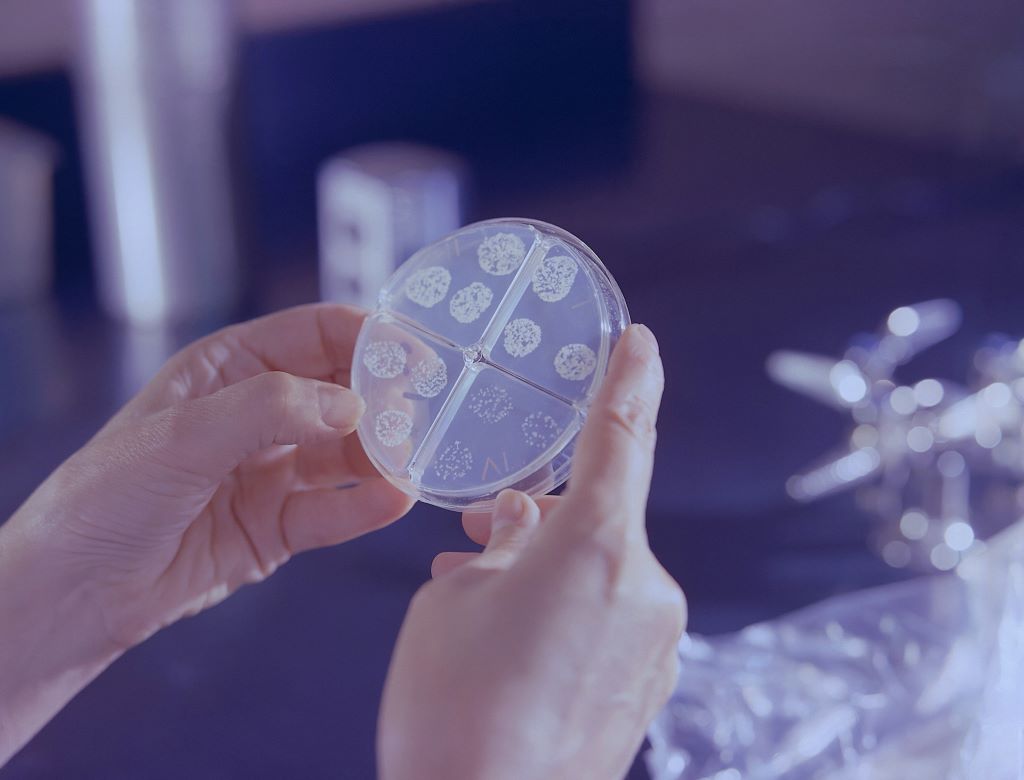
Mycobacterium tuberculosis drug susceptibility test. Photo by CDC on Unsplash
By Elri Voigt
Being a researcher who studies tuberculosis in the lab is one thing, having the TB bug in your lungs is quite another. Spotlight sat down with two of a relatively small number of people who have experienced both.
One morning in April, Constance Schreuder, a senior medical technologist at a large research group at the University of Cape Town, was called into the campus’s occupational health office. “I was thinking, did I do something wrong?” she recalls.
When she got to the office, she says the doctor immediately opened the window behind him. She wondered “what is going on now?”.
The doctor told her that she has tested positive for the very illness she’s been studying at the South African Tuberculosis Vaccine Initiative (SATVI) for over two decades.
Part of Schreuder’s job involves working with post-mortem samples and tissues, as well as clinical trial samples sent from different TB research sites.
“We always protect ourselves by wearing the correct PPE [personal protective equipment]. So, we’re always safety first,” she says. “I was actually exposed [to TB] in the office where I sit. After all the years that I’ve been working in the lab.”
TB, caused by Mycobacterium tuberculosis, is typically spread when someone with the bacterium in their lungs coughs it up and those droplets are inhaled by others. The droplets are just the right size to hang suspended in the air, allowing TB to survive in a room for several hours.
Schreuder was confused by the diagnosis because she didn’t, and still does not, feel ill at all. She had been tested two months prior as a precaution after a PhD student in the lab had been diagnosed with TB and gotten very sick.
Her initial test results looked good. She had produced a sputum sample, a thick phlegm from the lungs, which was sent to the lab for molecular testing (using the GeneXpert platform). The test came back negative for TB DNA. She had also had a chest X-ray done, which showed no signs of TB in her lungs.
It was another test result that raised the alarm. In addition to the GeneXpert test, her sputum sample had been sent to be cultured. This involves putting the sample into a special tube, called a Mycobacteria Growth Indicator Tube (MGIT), and attempting to grow the bacteria if any is present. If TB bacteria has grown after around 50 days, then it means the TB bug was present in the sample. In Schreuder’s case, the TB bacteria did grow, although the bacterial count was low, a result in-keeping with her lack of symptoms.
Although she was sceptical of the result and wondered about a potential laboratory error, Schreuder’s thoughts immediately went to her close contacts – her 81-year-old mom who she sees on weekends, her pregnant daughter who lives nearby, and her son who lives with her. What did this mean for them, she wondered.
No one else from the office who had been tested showed any sign of TB disease, although Schreuder says that not everyone’s sputum sample had been cultured due to the cost of the test.
Only about one in ten people who are exposed to the bacterium will become sick with TB. In most people, the immune system contains and eventually starves the bacterium to death. In others, however, the bug survives inside the body and eventually causes illness, weeks, months, or even years later.
A silent form of TB
Schreuder very likely has what is called asymptomatic TB. This is a state where the bug is active in someone’s body, but it is not, or not yet, resulting in symptoms. There are many unknowns about this state, how much it actually contributes to TB transmission and how best to test for and treat it.
While there is much uncertainty about the prevalence of asymptomatic TB, some rough numbers exist. South Africa’s first National TB prevalence survey found that just over half of the participants with TB that was confirmed through molecular testing, did not report having any TB symptoms.
Schreuder says that she knew about TB symptoms but was under the impression that people had to show at least some symptoms if they were ill.
She says she was issued with a sick note, was told by the doctor at the occupational health office to go to a public healthcare sector clinic to get treatment, and that she was booked off for the next 14 days. People who are ill with TB generally become non-infectious after having taken TB treatment for around two weeks.
South Africa’s TB treatment guidelines does not recommend different treatment courses based on whether or not someone has symptoms. That means that Schreuder has to take the full six-month course of TB treatment.
‘I thought it was something very serious’
Schreuder’s experience is one side of the coin, the other side is a story from the same lab, one that may seem more familiar.
Tatenda Bvudzijena, an energetic young student, says he came to do his PhD at the SATVI lab because of the world class research that he felt he could learn a lot from. He shares an office space with several staff members at SATVI, including Schreuder. It was his TB diagnosis that had prompted the staff to get tested.
Bvudzijena describes himself as hard-working, so it was very unusual when he started feeling too tired to complete laboratory work near the end of 2025. He was finishing up the second year of his PhD at the time. He says he tried taking some vitamin B, but it didn’t help. Then he started to develop some of the typical symptoms of TB, persistent cough and weight-loss. The cough didn’t go away after he treated it with over-the-counter medicines.
“I had those coughing symptoms, then they disappear for a while, then it comes back again. It’s oscillating…coming back, stopping, coming back again,” he says.
Bvudzijena says a private sector doctor told him he might have asthma, but none of the medication he was prescribed – anti-inflammatories, cough syrup, antibiotics, and asthma pills – worked.
Meanwhile, he kept getting sicker.
“That’s when I was like, ‘no, this is not helping’. By that time, I had chest pains and I was losing a lot of weight,” Bvudzijena says. “I just remember back then I used to wear like a size 32 jeans…then I was wearing size 28…I was less than 55kg, but I used to be like 70kg,” he recalls.
He says he was starting to panic since the pain in his chest felt sharp. Gesturing to an area underneath his ribs on his left, he says: “I thought it was something very serious.” He adds: “At first I thought, maybe I could be having lung cancer, because I used to vape.”
Then, one Monday morning in February, Bvudzijena went to see another private sector doctor. This time he was immediately sent to get a TB test and a chest X-ray. “Your chest X-ray is showing symptoms suggestive of TB”, the doctor told him two days later.
Bvudzijena says he was both scared and relieved. He was relieved because TB can be cured and he did not have something incurable but also scared because seeing his own chest X-rays, he realised he was quite sick with TB.
Bvudzijena has to take the same six months course of treatment as Schreuder.
What taking TB treatment is like
In South Africa, “typical” or drug susceptible pulmonary (of the lungs) TB in adults is treated with a six-month treatment course – consisting of four drugs for two months and then two drugs for the next four months.
TB is mostly treated in the public healthcare sector, so even if someone has medical aid or access to private sector healthcare, they might still go to public sector facilities to get treatment.
TB treatment and diagnosis is covered under the minimum prescribed benefits for medical aid members. According to a notice by the Council for Medical Schemes, TB treatment can be made available to members of medical aid schemes through public sector clinics, but they should be given the option of getting their treatment through the private sector. Whether they can get treatment in the private sector is likely to depend on whether they can find a private sector doctor comfortable with treating TB and a pharmacy that stocks TB medicines.
Still showing no symptoms of TB when she started treatment, Schreuder says she was surprised to learn from the package insert that came with the medicine that the pills must be taken on an empty stomach. The initial two months is five tablets per day (dosage depends on a person’s weight), she explains grimacing.
She has had some side effects. At first, it was only constipation and her urine turning orange, a side effect of rifampicin, one of the four antibiotics used to treat drug-susceptible TB. But by the second month of taking the medication, she also started experiencing muscle and joint pains as well as burning feet.
Schreuder will start on the less intensive four remaining months of the course soon, when the regimen drops from four down to two antibiotics. But she worries about what the drugs might be doing to her body.
With TB already taking its toll on Bvudzijena, he says he started treatment knowing that he had to be serious about taking it as prescribed.
“I was in that situation whereby you know you’re very sick and based on the chest X-rays I was seeing, this [TB disease] was intensive. So like I had to take meds, I had to,” he says, tapping his finger on the table for emphasis.
He says he was surprised by the size of the tablets, eyes wide as he describes them. “They’re big! I’ve never seen something like that. It was my first time seeing a pill for TB,” he says.
For Bvudzijena, the side effects have been relatively mild, a runny stomach and a skin rash, as well as joint pain when he started the two-drug phase of treatment.
He says he started feeling better soon after starting treatment, got his appetite back, and his TB symptoms disappeared completely.
Two clinics, two different treatment experiences
But before they could start taking their treatment, Bvudzijena and Schreuder had to get access to the drugs, which was easier said than done.
Bvudzijena, upon getting his chest X-ray, says he was told nothing other than he needed to go to Groote Schuur Hospital. So he went, only to find that because Groote Schuur Hospital’s waiting rooms employ a triage system – where patients who are in the most critical condition are seen first – he’d likely have to wait several hours.
So, he left and later went to a doctor at another private hospital and got referred to see a specialist at that hospital. He says the specialist would have only been able to see him a week later. At his wits end, he went to campus health, who put him in touch with a nurse at a nearby public sector clinic.
Once at that clinic, he says he was well taken care of, got given a little green card, identifying him as a TB patient. This card is his ticket to travelling through the clinic quickly and not having “to wait in a long queue wearing a mask”.
“My only problem was from being diagnosed to getting help,” he says.
Schreuder, after being booked off, had Googled the nearest public sector clinic that offers TB treatment. The next day, on a rainy Friday, she drove from her home in Cape Town’s Northern Suburbs to a clinic in the Durbanville area. She wore a clean mask she had found in a bag, a remnant of the COVID-19 pandemic.
“I actually was there 06:30 in the morning because I wanted to just get it over with and start with this medication because they say if you drink it for 14 days, then you’re not infectious anymore,” she says.
At the clinic, she says she was taken to a separate room to wait by herself, as it turns out for five hours. Eventually she says she was helped by a nurse, who filled out her paperwork and took another sputum sample.
Another hour later, she says she left with six packs of TB medication, enough for the first month of treatment. But she had to stop at a private sector pharmacy on the way home because the clinic was out of vitamin B6, which she had been told to take to help with the potential side effect of “pins and needles in your hands and feet”.
Her frustrations with the system would mount. At a subsequent clinic visit Schreuder discovered that her phone number hadn’t been captured, meaning she hadn’t received the test results from her second sputum test. When she asked for her TB medicines to be dispensed to her ahead of time since she was already at the clinic, she says she was told the medicines were out of stock.
When she arrived for her next appointment at 12:00 on a Friday in May, she says the clinic seemed empty. When she eventually found a nurse, she claims the nurse told her she was only working until 12:00, and that the rest of the staff had left to attend a party for someone who had resigned, and that Schreuder must come back on Monday. A frustrated Schreuder says she didn’t accept this and eventually the nurse agreed to give her the medication.
“What’s worrying for me,” says Schreuder, “is, I said to her, ‘I work in this clinical trial lab where we want to find a cure for TB. But are we going to reach a TB free world if it [the health system] works like this?’.”
What needs to change?
Both Bvudzijena and Schreuder say it needs to be made easier for people with TB to start and collect TB treatment. They suggest that private sector pharmacies could be a convenient alternative to public sector clinics. Bvudzijena adds that stable patients could also collect their medication from selected community pharmacies or other collection points closer to home, reducing unnecessary travel and long waiting times.
He also touched on the need for better, clearer information for people who have just been diagnosed with TB about where they need to go, what documents they might need and how to start treatment.
“When you’ve just been told you have TB, you’re already worried,” he says. “The last thing you need is to be sent from one place to another without knowing where to get help.” He adds that there needs to be better coordination between private healthcare providers and public clinics.
Both touched on the stigma associated with a TB diagnosis. Schreuder says she received support from family members but otherwise it felt like people were simply checking that she had been cleared to go back to work. Bvudzijena says overall the reaction to his diagnosis was mixed. Some people like his roommates and friends were supportive, but not everyone was so understanding. “It was tough,” he says.
Change in perspective
Bvudzijena says that getting sick with TB changed his perspective on the research he’s involved with.
“What I realise now, after having TB, is that this research is about so much more than science. My work is focused on improving TB diagnosis so people can be diagnosed earlier, while many of my colleagues are working on better treatments and vaccines. After going through TB myself, I know how much that work can mean to someone who’s sick. It’s really going to change people’s lives,” he says.
To Schreuder, the experience has also been eye-opening but in a different way. She recounts some of the stories she heard while waiting at the clinic, a woman who has arrived at 05:30 but hours later still hadn’t been helped because her file was missing. A man who is afraid he’ll lose his job if he waits any longer. Patients sent to wait outside on cold benches and concrete floors, some looking very ill. Data from community-led monitoring group Ritshidze suggests that long waiting times is a common problem.
“I can fight my own battles, but what about all those that are too afraid to say something?” Schreuder asks.