A team of researchers at the Icahn School of Medicine at Mount Sinai has uncovered why children with the same leukaemia-causing gene mutation can have dramatically different outcomes: it depends on when in development the mutation first occurs.
The study, led by Elvin Wagenblast, PhD, Assistant Professor of Oncological Sciences, and Pediatrics, at the Icahn School of Medicine at Mount Sinai, was published in Cancer Discovery. It shows that leukemia beginning before birth is often more aggressive, grows faster, and is harder to treat. This adds a missing dimension to precision medicine for childhood leukaemia.
Dr. Wagenblast and his team at the Wagenblast Lab set out to answer a central question about how a normal blood stem cell can become cancerous. They applied cutting-edge CRISPR/Cas9 genome-editing approaches in human primary blood stem cells to model different developmental stages of acute myeloid leukaemia, one of the most aggressive types of blood cancer.
Using CRISPR technology, the team induced the NUP98::NSD1 fusion oncoprotein, a cancer-promoting protein created when two genes abnormally fuse, into human blood stem cells from multiple developmental stages, ranging from prenatal to postnatal, adolescence, and adulthood. This approach created the first humanised experimental model that tracks how the same mutation behaves differently depending on when in life it arises.
The results were striking: stem cells produced during prenatal development transformed easily into leukaemia, creating a highly aggressive and more primitive form of leukaemia. Stem cells produced postnatally became increasingly resistant to transformation and required additional mutations to become cancerous. Prenatal-origin leukaemia stem cells, which are abnormal blood stem cells that arise before birth and can cause certain childhood leukaemias, were more dormant (quiescent) and relied heavily on certain energy sources specific to the cancer state, which were not seen in the leukaemias that originated later in life. Although these prenatal leukaemia stem cells were more dormant, this quiescent state makes them harder to eliminate with standard treatments, helping explain why prenatal-origin leukaemias behave more aggressively, despite identical genetics.
By analysing single-cell gene expression data from their models, the investigators identified a prenatal gene signature that predicts whether a child’s leukaemia likely began before birth. In patients, this signature strongly correlated with significantly worse clinical outcomes.
“This work tells us that age matters at the cellular level,” said Dr Wagenblast. “The same mutation behaves very differently depending on when it happens. Understanding this gives us a new way to identify the highest-risk patients and to tailor therapies that go beyond standard genetic classifications.”
The team tested therapies against the most aggressive leukaemia stem cells and discovered that these cells were especially vulnerable to venetoclax, a Food and Drug Administration-approved drug already used in the clinic. Venetoclax-based combinations, including with standard chemotherapy, significantly reduced aggressiveness in the experimental models.
“These findings give clinicians mechanistic support to use venetoclax combinations in NUP98-rearranged acute myeloid leukaemia, particularly in younger patients whose disease likely started before birth,” said Dr Wagenblast.
Understanding when leukaemia begins may help doctors choose more effective therapies earlier, reducing trial-and-error approaches and preventing resistance and relapse later on.
Conceptually, the study shifts how scientists understand childhood cancer. The developmental timing of the first mutation is not a minor detail. It fundamentally shapes disease biology, treatment resistance, and relapse risk.
The research opens the door to new diagnostic tools that can identify prenatal-origin leukaemias, venetoclax-based combination therapies that more precisely target vulnerable leukaemia stem cells, and clinical trials that incorporate developmental timing into risk assessment.
Next, the team plans to develop therapies that more directly target the metabolic program unique to prenatal-origin leukaemias, with the goal of selectively eliminating leukaemia stem cells while sparing healthy blood stem cells.
As of this month, South African medical aid scheme contributions have increased by between 6–9% – nearly triple the Council for Medical Schemes’ recommended 3.3% guideline. While lower than last year’s double-digit surge, the underlying problem remains: premiums keep climbing while benefit coverage keeps shrinking, exposing cracks in private healthcare that are becoming impossible to ignore.
“We’re watching private healthcare price ordinary South Africans out of the market, one annual increase at a time,” says Lungile Kasapato, CEO of PPO Serve, a healthcare management company that has been implementing value-based care in South Africa for more than a decade. “Medical schemes are caught in an impossible position – unable to control what providers charge, they’re left managing what they cover. The result is diminishing benefits, rising co-payments, and mounting out-of-pocket costs for members.”
The root of the problem lies in how healthcare is paid for. Fee-for-service, the dominant reimbursement model, rewards volume over outcomes. More tests, more procedures, more bed days – each generates revenue regardless of whether they actually improve patient health. This narrow focus fragments care and drives costs up while keeping value low.
“No amount of funding can fix a payment model that drives the wrong incentives,” Kasapato explains. “Real change requires rethinking not just what we pay for, but how we pay for it.”
Value-based care offers a fundamentally different approach: putting patients at the centre, rewarding proactive care, and linking payment directly to health outcomes. PPO Serve’s The Value Care Team demonstrates what this looks like in practice. GP-led multidisciplinary teams receive monthly, risk-adjusted payments based on patient complexity, supporting holistic care and linking meaningful incentives to measurable results. Rather than maximising billable services, providers focus on optimising patients’ overall health.
For members, this means care is no longer limited by rigid benefit caps or pre-authorisation hurdles, but structured around what genuinely enhances the efficient delivery of their care. A dedicated care coordinator guides patients through decisions made collaboratively by their GP and allied health professionals, with each team member sharing accountability for better outcomes.
But scaling models like this requires medical schemes and public funders to step up. “The challenge isn’t proving value-based care works – it’s embedding it in an infrastructure built for an entirely different system,” says Kasapato. “Claims processing, scheme administration, provider networks – every layer of private healthcare is designed with fee-for-service in mind. Transitioning to outcome-based payment means rebuilding that system and accepting the upfront investment and friction that comes with structural change. The alternative is stark: a private healthcare market that collapses under its own cost pressures, pricing out members faster than schemes can adjust. South Africa is already on that trajectory.”
“If we’re serious about universal health coverage and the long-term sustainability of the private sector, we can’t keep treating symptoms while ignoring causes,” says Kasapato. “Value-based care models are already demonstrating what’s possible. The question isn’t whether transformation is worth the investment – it’s whether we can afford to delay it any longer. The more organisations that embrace a strategic purchasing role, the greater the potential for meaningful change, not just for medical schemes but for South Africa’s healthcare system and the millions who rely on it.”
Why the Health Promotion Levy can no longer be delayed
Johannesburg, 19 January 2026:When Petrus Cockrell wakes up each morning, the first thing he reaches for is his wheelchair. Diabetes took both his legs before he turned 50. It robbed him of his mobility, his job and the simple joy of walking beside his dog.1 Petrus is one of millions of South Africans living with a disease that did not need to progress this far. Behind every statistic is someone like him, a parent, a worker, a caregiver whose life has been cut short or forever altered by a preventable illness.
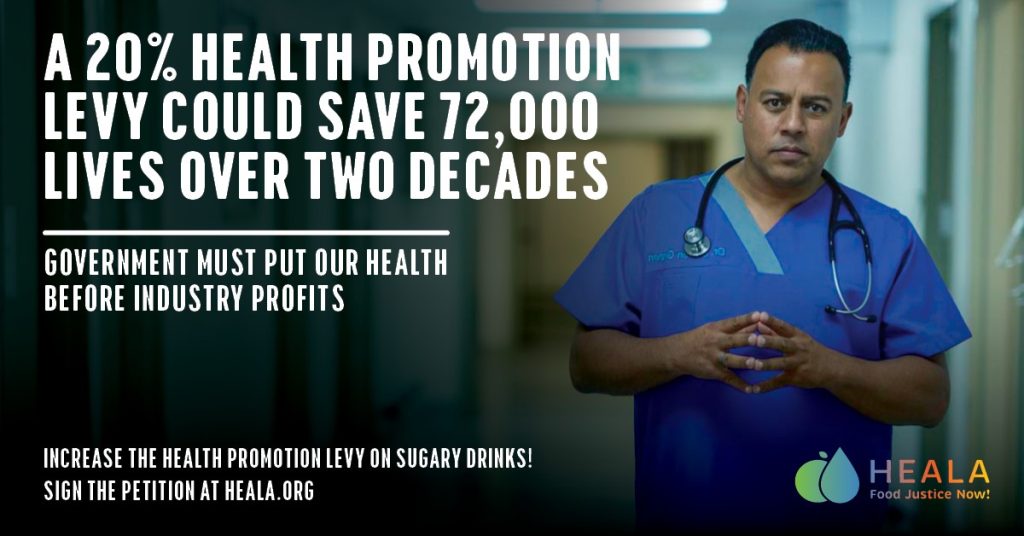
With the National Budget Speech scheduled for February, the Healthy Living Alliance (HEALA) is calling on government to increase the Health Promotion Levy (HPL) on sugary drinks from 11% to 20%, a life-saving decision backed by evidence.
The HPL is part of South Africa’s broader package of health taxes, alongside tobacco and alcohol excise duties, which have long been used to protect the public from preventable harm.
“Every amputation, every blindness diagnosis, every child who loses a parent to diabetes is a reminder that we have waited too long,” says Nzama Mbalati, CEO of HEALA. “The HPL is not a standalone experiment; it is a proven health tax. Government has used health taxes successfully for decades. Strengthening the HPL simply extends that legacy to protect South Africans from excessive sugar consumption.”
The urgency of this demand is underscored by modelling from PRICELESS SA (University of the Witwatersrand). The data indicates that increasing the HPL to 20% could prevent 619 000 new diabetes cases, save approximately 72 000 lives, prevent 85 000 strokes and save South Africa R23.9 billion in healthcare costs over 25 years.2
“We treat people every day for conditions that should never have progressed this far. The HPL is not just a tax, it is a protective shield for millions of South Africans,” says medical doctor and health advocate Dr Darren Green, featured in HEALA’s upcoming campaign. “Strengthening it means fewer amputations, fewer patients on dialysis and fewer children growing up without parents. Very few interventions deliver such measurable health benefits, especially for communities already carrying the heaviest burden.”
As tariff disputes and import pressures dominate sugar industry news, HEALA emphasises that tariffs and the HPL must not be conflated. Tariffs are trade instruments designed to stabilise industries. The HPL is a public health instrument designed to save lives.
“We cannot allow tariff debates to derail a health tax that works,” Mbalati adds. “Just as we use tobacco and alcohol taxes to protect South Africans from harm, the HPL is a critical part of our national health tax framework. Strengthening it is a public health necessity, not an industry target.”
HEALA’s documentary series continues to reveal the human cost of diabetes. Alphinah, who lost both legs and her eyesight; Mpho, who believed sugar was harmless until he lost his leg at 45 and now Petrus, each offering a powerful reminder that these outcomes were preventable. Their message is clear: if they had known sooner, their lives would look different. Government now has the power to prevent thousands more from walking the same path.
HEALA calls on the public to stand with Petrus and millions of others by demanding decisive government action. As the Budget Speech approaches and the Health Promotion Levy faces growing pressure from industry interference, South Africans are urged to sign the petition supporting the increase of the HPL to 20% before the Minister of Finance takes the podium in February. Sign the petition at www.heala.org.
References:
HEALA Diabetes Documentary Series (2025).
PRICELESS SA. The Cost of Not Setting the Sugar-Sweetened Beverage Tax at 20%. (2025).
For years, the federal government advised Americans to limit red meat and foods high in saturated fats. However, new federal dietary guidelines elevate protein, dairy and healthy fats to the top of a redesigned food pyramid — a shift that has drawn mixed reactions from nutrition experts.
The new food pyramid continues to emphasise fruits and vegetables and avoiding added sugar, but it also encourages Americans to cook with butter or beef tallow and increase their protein intake. The recommendations are now for adults to consume 1.2 to 1.6 grams of protein per kilogram of body weight, up from the previous guideline of 0.8 grams. Protein is recommended from both animal sources, such as red meat, and plant-based options.
Experts said the new guidelines’ emphasis on avoiding processed foods and added sugar are sound. But some worry that encouraging more fats will conflict with existing guidelines on limiting fat to 10% of one’s daily calories — and that some Americans may not need additional protein.
“These guidelines represent a significant shift, but they raise as many questions as they answer,” said Darin Detwiler, a food policy expert and assistant teaching professor at Northeastern University. “My concern is not the emphasis on ‘real food’ (over ultra-processed options). It’s how the scientific evidence and public health context were interpreted.”
“The message is simple: eat real food,” says the letter from U.S Department of Agriculture Secretary Brooke L. Rollins and U.S. Department of Health and Human Services Secretary Robert F. Kennedy Jr. “To Make America Healthy Again, we must return to the basics. American households must prioritise diets built on whole, nutrient-dense foods — protein, dairy, vegetables, fruits, healthy fats and whole grains. Paired with a dramatic reduction in highly processed foods laden with refined carbohydrates, added sugars, excess sodium, unhealthy fats, and chemical additives, this approach can change the health trajectory for so many Americans.”
They also continue to encourage Americans to avoid added sugar and processed food, saying that the United States “is in a health emergency” due to chronic disease from poor diet.
The new 10-page document is a dramatic reduction from the length of the previous guidelines, something that Jing-Ke Weng, a plant biochemist and professor of chemistry & chemical biology and bioengineering at Northeastern, said is an improvement.
“It’s a simplified version of things,” Weng said. “It has basically encouraged people to not have highly processed foods and reduce added sugar. There is some controversy to it — it’s encouraging saturated fats like tallow or butter — but it’s still under the cap of less than 10 percent of recommended consumption of daily calorie intake.”
“My understanding is that most Americans already meet basic protein needs,” Detwiler said. “There is limited evidence that higher protein improves health for the general population. For people who are strength training or trying to preserve muscle in older age, higher protein can be useful. But this should not be the default for everyone without nuance.”
Similarly, Detwiler said the guidance on encouraging the consumption of red meat and full-fat dairy, along with cooking with beef tallow and butter, is contradictory, given the suggested cap on saturated fats.
Research also shows saturated fats are linked to higher LDL cholesterol, which is a casual factor for cardiovascular disease, said Detwiler. This is not factored into the guidelines that he said could cause more long-term health consequences.
“Encouraging red meat and full-fat dairy without clear guidance on portion size or population risk profiles is not supported by the bulk of cardiovascular research,” he said. “Mixed messaging on saturated fat can lead consumers to misinterpret what constitutes a heart-healthy diet. In public health nutrition, clear evidence, consistency, and practical guidance matter.”
The new guidelines also note that people should eat what’s right for them, depending on factors like age and physical activity level.
Janice Maras, registered dietitian, director in the Dietary Assessment Center and associate teaching professor of public health and health sciences at Northeastern, emphasised this as well, saying people should focus more on getting vegetables, whole grains and adequate proteins while minimising ultra-processed foods.
“My approach to dietary guidance emphasises quality, variety, and personalisation rather than focusing on a single graphic,” she said. “Protein and dairy are important but needs vary across life stages and individual health contexts — more is not always better. Protein should come from a variety of sources, including both animal and plant foods, and dairy choices can reasonably differ depending on age and growth or maintenance needs. Helping people understand food quality and read labels is more important than emphasising one specific pyramid.”
This story is republished courtesy of Northeastern Global News news.northeastern.edu.
With several important developments on the horizon, 2026 is set to be another eventful year in healthcare. Photo by Sergey Mikheev on Unsplash
19th January 2026 | By Marcus Low
From the limited rollout of a new HIV prevention jab to developments with new weight loss medicines, to high-stakes court cases relating to National Health Insurance (NHI), 2026 is set to be another tumultuous year in healthcare. Here are nine stories that Spotlight will keep a close eye on.
1. How will things go with the local rollout of a new HIV prevention jab?
Given the high rates of HIV in South Africa, the biggest HIV story this year is likely to be the rollout of a new HIV prevention jab at around 360 (roughly 10%) of South Africa’s public sector clinics. The jab, which contains the antiretroviral medicine lenacapavir, provides six months of protection against HIV infection at a time. It could be a gamechanger for people who, for whatever reason, struggle to take daily prevention pills. We will be tracking how and to who the jab is made available and whether uptake meets expectations.
As we reported last year, work is also underway on a new lenacapavir formulation that could provide 12 months of protection per shot. We’ll be scouring journals and conference programmes for new data on this formulation.
2. Will we see better access to weight loss medicines?
The class of diabetes and weight loss drugs called GLP1-RAs have taken the world by storm in recent years. Until recently, drugs like semaglutide (brand names Ozempic or Wegovy) and tirzepatide (brand names Zepbound or Mounjaro) were only available as injections. The GLP1-RA market is, however, set to be upended by the introduction of some of these medicines in pill form. The United States Food and Drug Administration (FDA) recently registered a semaglutide pill for use for weight loss. Another weight loss pill called orforglipron is also expected to be registered this year. One big question is when these pills will be registered and made available in South Africa and at what price.
Another important GLP1-RA development this year will be the expiration of a key patent on semaglutide in India. This will open the door to generic manufacturers bringing their own versions of semaglutide to market – something that usually leads to substantial price reductions. We will be keeping a close eye on how this situation plays out and analysing what the implications are for people in South Africa.
3. Might we see earlier than expected findings from pivotal TB vaccine trials?
The one TB vaccine we have is over a hundred years old and only provides limited protection for kids. Several experimental vaccines are, however, currently being evaluated in late-stage clinical trials. Arguably, the most notable of these is the M72 vaccine, which is being assessed in a massive phase 3 study, partly conducted in South Africa.
While timelines suggest most of the key TB vaccine studies will not yet have anything to report this year, it is possible that we might see a surprise or two. Findings are sometimes reported early if it becomes apparent ahead of schedule that a medicine or vaccine is clearly working, or clearly not working, as the case may be. Whether or not we see findings this year, it is important to start thinking about what a rollout might look like in our health system should results be as good as hoped. The M72 vaccine had around 50% efficacy in phase 2 trials, so there is reason for optimism.
4. Will we see a concrete plan to address public sector healthcare worker shortages?
Arguably, the most important dynamic in South Africa’s public healthcare system today is that provincial health departments are not employing enough healthcare workers across multiple categories. One reason for this is simply that budgets have generally shrunk over the last decade – obviously corruption and mismanagement in several provincial departments have made things even worse. There was a glimmer of hope in last year’s budget in which we saw a meaningful upturn in health funding for the first time in years, but that was at best a good first step toward recovery. As we enter 2026, our understanding is that all of the nine provinces are still facing severe healthcare worker shortages.
More money for health in the next budget will certainly help, but there is a broader sense that government doesn’t really have a big picture vision for how to address the crisis. We do have a 2030 Human Resources for Health Strategy, but as with many such strategies, it seems to have so far gone largely unimplemented.
5. Will enablers be held accountable for corruption such as that at Thembisa Hospital?
One of last year’s big media moments was a Special Investigating Unit (SIU) press conference in which they described the extensive corruption said to have taken place at Thembisa Hospital. One snag, however, is that while the SIU can recoup funds and take matters to the Special Tribunal, the SIU does not conduct criminal prosecutions – though they can refer matters to the National Prosecuting Authority (NPA) for prosecution. Whether we will see successful NPA prosecutions relating to the Thembisa Hospital corruption is one of the year’s top questions.
Unfortunately, even when the SIU does sterling work and delivers cases to the NPA on a plate, there is no guarantee that the NPA will do its job. One depressing example is that of Buthelezi EMS. Last year, the Special Tribunal ordered Buthelezi EMS (and other companies with similar names) to pay over half-a-billion Rand back to the state. The SIU also referred a related matter to the NPA in 2024 for prosecution, but Spotlight understands that the NPA has rather mind-bogglingly decided to drop the matter.
6. Which, if any, senior health leaders will lose their jobs this year?
While we won’t have national or provincial elections this year, that is no guarantee that we won’t see any health leaders losing their jobs. Over the last two decades, there have after all been many examples of people being ousted between elections, be it for purely political reasons or due to corruption scandals.
Possibly the political leader in the health sector at greatest risk is KwaZulu-Natal MEC for Health, Nomagugu Simelane. Should the currently governing coalition of political parties in the province crumble, as it seems it might do, chances are several new MECs will be deployed, including for the health portfolio.
There is also an outside chance that the country’s top health official, Dr Sandile Buthelezi, Director-General for Health in the National Department of Health, might be forced to step down. As reported by AmaBhungane, Buthelezi played a central role in an “irregular” R836-million oxygen procurement process and is also “at the centre of aHawks investigation into allegations that he solicited a R500 000 bribe”. Our understanding is that Buthelezi has not been charged and that in the absence of charges he will stay in the job.
7. What will happen in the landmark NHI court cases?
Despite a new call for dialogue from Finance Minister Enoch Godongwana, chances for a political settlement over National Health Insurance (NHI) remains very low. The bottom line remains that Health Minister Dr Aaron Motsoaledi refuses to yield an inch on the version of NHI described in the Act and President Cyril Ramaphosa is not willing to force the matter.
Instead, it seems the battle over NHI will this year be fought mainly in the courts. At our count, there are at least eight cases challenging the NHI Act, parts of the Act, or the process resulting in the Act. A first development to look out for is whether or not some of the cases will be combined and heard together. In case you missed it, last year we published a two-part series in which we tried to pin down the issues on which these court cases are likely to turn (see part 1 and part 2).
While we will cover the NHI court cases in some depth, we will also try to foster constructive discussions on health reforms on our opinion pages and in our analysis. In our view, it is dangerously limiting to reduce the debate over South Africa’s healthcare reforms to a simple binary of whether one is for or against NHI.
8. What will be left of the FDA, NIH, and CDC by the end of 2026?
It used to be the case that United States Food and Drug Administration (FDA) decisions and health advice from the United States Centres for Disease Control and Prevention (CDC) carried a lot of weight around the world. In recent months, however, there have been increasing signs of political interference at these institutions and a turn away from evidence-based policy making. It seems inevitable that we will see more of the same in 2026 and the credibility of both the CDC and probably also the FDA will be further diminished.
Similarly, the US National Institutes for Health (NIH) has been the world’s leading funder of health research for many years. But as with the CDC, the work of the NIH has been overly politicised over the last year and its reputation for rigour and scientific excellence has already been severely degraded. As with the FDA and CDC, the outlook is bleak.
9. How well will SA and other countries recover from last year’s US aid cuts?
With the dust settling after last year’s severe and abrupt cuts to US healthcare aid and US funding for medical research, the longer-term impacts of those cuts in South Africa and neighbouring countries should become clearer this year. Among others, we will get the first reliable estimates of key HIV and TB indicators for 2025 (reliable figures for a specific year are typically only published in the subsequent year). New HIV estimates from the Thembisa mathematical model (Spotlight’s preferred source for HIV estimates) should be out around the middle of the year, while new World Health Organization (WHO) TB estimates are usually released in November.
Last year Motsoaledi was widely criticised by activists for underplaying the seriousness of the cuts for South Africa’s HIV response and the scale of specialised services and capacity that was destroyed here. Eventually some extra funds were made available in response to the cuts, but it amounted to only a small fraction of what was lost. The harsh reality is that in some places the aftermath of the aid cuts will be felt for years to come.
At an international level, we are also not convinced that a clear roadmap has been set out for building back better after US withdrawal, though we’d be happy to be proven wrong. What is clear though is that entities like the WHO and UNAIDS are facing unprecedented financial and political pressures – it seems possible that UNAIDS will no longer exist a year from now. Much reform has already been undertaken at the WHO. By the end of the year, we should have some sense of whether things have stabilised and whether a coalition of willing nations is truly committed to keeping the WHO and multilateralism in health alive.
We have outlined only nine health issues in the above, but there are of course many more questions that we could have added to this list. Some of those include:
Whether we will see meaningful improvement in the South African government’s response to non-communicable diseases such as diabetes, cancers, and mental health conditions.
How well implementation of South Africa’s latest TB recovery plan is going, and in particular how we are doing against the target of testing five million people in 12 months.
How climate change will impact people’s health and whether the South African government is prepared for it.
Whether South Africa will see real progress in addressing antimicrobial resistance. After adopting a good policy a few years ago, it appears momentum has been lost.
Whether the state will start taking xenophobia in the healthcare system and around clinics and hospitals more seriously, as a recent court judgment requires it to do.
Whether we will see legislation introduced amending the Patents Act in line with a policy adopted by government in 2018 and whether we’ll see progress on the much-delayed State Liability Bill, which should have relevance for the state’s vulnerability to medico-legal claims.
Whether we will see concrete steps forward with the new electronic health records and data systems government is developing.
What progress we might see with the local production of vaccines and pharmaceuticals – one of the areas in which we are quite optimistic, despite the lack of coherent and enabling government policy.
What impact AI will, or will not, have in our healthcare system this year.
Are there issues not mentioned here that you think Spotlight should cover in 2026? Let us know by commenting below this article or by tagging us on BlueSky.