Africa is home to more human genetic diversity than anywhere else on Earth. The average African genome shows nearly a million more genetic variants than the average non-African genome. But this wealth of data remains largely unexplored, with African populations historically underrepresented in research. Less than 3% of global genomic datasets and genome-wide association studies include participants of African descent.
Renowned African researchers have released a new book to explain what we know about the continent’s remarkable genetic diversity, showcase on-the-ground research being carried out today and set out a roadmap for future discoveries.
Genomics in Africa is designed to support the next generation of African scientists, providing vital information for researchers, funders and policymakers working to advance genomics and precision medicine in the continent.
It is co-edited by Professor Segun Fatumo of Queen Mary University of London, and Dr Tinashe Chikowore of Harvard Medical School, who believe there is an urgent need to invest in African genomics research.
Professor Fatumo says: “Genetic research on the African continent could create more effective precision medicine, improve global drug development, and help scientists understand everything from our evolutionary history to why some people develop particular diseases.”
While there is a lot we don’t know about human evolution and background, it is accepted that early Homo sapiens evolved in Africa approximately 300 000 years ago. Over millennia, we spread across the continent and settled all over it.
At some point between 50 000 and 70 000 years ago, a small band of people left Africa. This might have been a single tribe or group of tribes, and it likely had only a few thousand people of childbearing age.
There have been other migrations, but this particular one – known as the Southern Route or Southern Dispersal – is believed to be the founder population which colonised the rest of the world and interbred with archaic humans such as Neanderthals and Denisovans.
The small size of this founder population means all modern humans with ancestry outside Africa share a high degree of genetic similarity.
While we can’t know exactly how many people in total were living on the African continent at that time, we do know that the population the group left was much larger and much more genetically diverse. This means many gene variants not present in the handful of people who left Africa have been passed down and are thriving in people of African genetic heritage.
Ambroise Wonkam (Professor of Medical Genetics at Johns Hopkins School of Medicine and current President of the African Society of Human Genetics) said of the work: “Increasing the number of sequenced African genomes will refine tools for predicting disease-related variants, improve diagnoses, and enhance precision medicine.
“Ultimately, investing in African genomics promotes both scientific innovation and health equity worldwide.”
Professor Segun Fatumo and Dr Tinashe Chikowore suggest that further research into African genomics could also develop and improve treatments of inherited diseases which predominantly affect African populations, such as sickle cell disease.
African researchers are currently exploring research into infectious diseases, cardiometabolic traits, cancer, mental health traits and medicine sensitivities – but the authors argue more investment both in research and infrastructure is needed to unlock the potential of these studies.
They propose a ten-year strategic roadmap for research leaders, funders, and governments planning future genomic initiatives on the continent.
“Research into these areas is essential to ensure that people with African genetic heritage can experience the full benefit of precision medicine and gene therapies,” Professor Fatumo explains. “Genetic variation could mean they react differently to treatments or medicines developed for the population outside Africa, so for true health equity there is an urgent case to expand on current scientific knowledge.”
A new study at The University of Texas at Arlington could help substantially reduce the amount of radiation heart patients receive during imaging procedures without sacrificing diagnostic accuracy.
The study, led by Mingwu Jin (professor of physics), will focus on computed tomography angiography (CTA), an advanced imaging test that noninvasively assesses coronary artery disease. CTA combines a CT scan with iodine contrast dye injected into a patient’s vein to create 3D images of blood vessels and surrounding tissues. Doctors can use CTA to detect aneurysms, narrowed or damaged blood vessels, blood clots, tumours and other conditions.
The project is funded by a three-year, $579 745 grant from the National Heart, Lung, and Blood Institute. The project is titled “Deep leaRning-bAsed reConstruction (DRAC) for Multi-Phase Cardiac CT Angiography.”
Multi-phase coronary CTA (MP-CCTA) captures images at multiple points during the heartbeat, providing doctors with more information and helping reduce blurring caused by the heart’s movement. The drawback is that collecting images across multiple phases exposes patients to more radiation than a single-phase scan. Dr Jin’s research aims to substantially reduce that radiation exposure while preserving the quality and diagnostic value of the images.
“Lowering the radiation dose in medical imaging has been vigorously pursued due to imaging prevalence and potential cancer risk of ionising radiation,” Jin said. “Although notable progress has been made by developing advanced reconstruction methods, the dose reduction potential is far from its limit.”
CT scans use reconstruction methods to turn raw data collected during a scan into images doctors can interpret. One advanced approach is model-based iterative reconstruction (MBIR). Another is 4D reconstruction, which adds the dimension of time to standard 3D imaging. In cardiac imaging, this technique can capture clear views of fast-moving heart valves and coronary arteries while reducing motion artefacts.
Jin said that recent breakthroughs in deep learning provide an unprecedented opportunity to substantially lower radiation doses by combining MBIR with information learned from a large database of high-quality MP-CCTA images. The resulting 4D DRAC method would reconstruct a patient’s images using not only data from that individual scan, but also information learned from a much larger collection of images.
Jin said the project could substantially lower the radiation dose needed for MP-CCTA, potentially improving its use in detecting the narrowing of coronary arteries and monitoring the progression of high-risk plaque. He said the 4D DRAC methods could also be applied to other dynamic CT scans.
To test the hypothesis, Jin and his team will:
Build a synthetic patient library using computational human models based on retrospectively collected MP-CCTA data from real patients.
Develop 3D and 4D deep-learning methods that combine CT imaging physics with features learned from the high-quality patient data.
Determine the lowest radiation dose that can be used without compromising diagnostic accuracy. The team will evaluate diagnostic accuracy using a computer model designed to mimic how a radiologist assesses an image, then validate the results through a small-scale study involving human observers.
The Mayo Clinic in Rochester, Minnesota, will provide MP-CCTA patient data for the study.
“This award reflects the high quality of Dr Jin’s research and the strength of his proposed ideas,” said Alex Weiss (professor of physics and former department chair). “I know a great deal of work goes into preparing a successful proposal of this kind. This is a significant achievement for Dr Jin and a major benefit to our department.”
Graduate students Noor Rasel and Darnisha Langlais will work with Jin on the project. The grant will also allow Jin to hire undergraduate students in the summers, providing them with research opportunities to apply AI techniques to medical imaging.
Tuberculosis is mainly diagnosed and treated in the public healthcare system, but the private sector should also be able to deal with it.
Tuberculosis (TB) remains one of the leading causes of death in the country, claiming around 50 000 lives a year. Caused by a tenacious bug called Mycobacterium tuberculosis, it has plagued mankind for centuries.
In response, South Africa’s public healthcare system has devoted a lot of resources to TB and many public sector doctors, nurses, pharmacists, and community healthcare workers have years of experience with the illness. The country was ahead of the rest of the world in rolling out new molecular TB tests in the early 2010s. In the last decade South Africa introduced new treatments for drug-resistant forms of TB, before most other countries did so. Much important TB research has also been conducted at clinical sites in the country, like the recent BEAT-TB study published in the New England Journal of Medicine.
But what about the private healthcare sector? Indications are that it has not become similarly expert at combatting the age-old bug, even though people who use mainly private sector healthcare services also get TB. Spotlight recently reported on a PhD student who became ill with TB and was diagnosed in the private sector but received treatment in the public sector. That was not an isolated case. Up to 29% of TB patients across 13 high TB burden countries, which included South Africa, engaged with the private healthcare system when their symptoms first started, according to a 2017 study. In South Africa’s first TB prevalence survey, of the 1 726 participants surveyed who had TB symptoms and sought out care, 139 (8.1%) first sought care in the private sector.
However, finding information on TB care in the private sector has proven to be a challenge, and what Spotlight was able to find is at times contradictory and confusing.
Most cases of TB could be treated in the private sector
Let’s start with the basics. Does the private sector diagnose and treat TB at all?
Here a distinction between types of TB is important. Well over 90% of people who develop TB in South Africa have “normal” drug-susceptible TB, that is to say TB that can be successfully treated with the standard set of antibiotics. A much smaller group, fewer than one in 10, have drug-resistant forms of TB. Drug-susceptible TB can be treated in the private sector, while drug-resistant TB appears to be exclusively treated in the public sector.
“[T]here is a common misconception that tuberculosis (TB) can only be treated in the public healthcare sector,” Dr Noluthando Nematswerani, Chief Clinical Officer at Discovery Health, tells Spotlight. She says that there are many healthcare providers that can diagnose and treat TB in the private sector, since TB is part of the standard training medical doctors receive in South Africa. “Discovery Health does not maintain a dedicated network of healthcare professionals who exclusively treat TB, as TB care falls within the scope of practice of suitably trained medical practitioners across multiple disciplines,” she says.
Treating TB is covered under the prescribed minimum benefits – a list of benefits medical aid schemes is required by law to provide to their members, regardless of what plan they are on. According to the Council for Medical Aid Schemes, TB treatment can be made available to members of medical aid schemes through public sector clinics, but they should be given the option of getting their treatment through the private sector.
Medical aid schemes are prohibited by the Medical Schemes Act from saying that “they do not cover the costs of diagnosing, treating and/or the care of TB and that you can only get this cover in the public sector”. A member of a medical aid scheme may only be referred to a public sector facility if that scheme has a designated service providers arrangement with that facility. And a medical aid scheme cannot refuse to cover TB treatment.
“In line with these regulations, members across all Discovery Health Medical Scheme plans have access to comprehensive evidence-based TB care which includes consultations with the relevant healthcare professionals, the necessary diagnostic and follow-up laboratory and radiology investigations, and clinically appropriate medications for the effective management and care of TB,” says Nematswerani.
However, while the option is there for doctors in the private healthcare sector to diagnose and treat drug-susceptible TB, the majority of TB cases in the country are tested for and treated in the public healthcare sector, says Dr Francesca Conradie, a leading TB researcher. At the moment, drug susceptible TB in adults is treated with a six-month treatment course – consisting of four drugs for two months and then two drugs for the remaining four months.
Drug-resistant TB is likely only treated in the public sector
The picture for drug-resistant TB looks quite different. Conradie points out that some of the medications used to treat drug-resistant TB are only available in the public sector. This means patients with drug-resistant TB need to be referred to a public sector facility to get treatment.
While there does not appear to be any outright legal or regulatory prohibition on private sector pharmacies supplying these drugs (in fact, they have listed single exit prices), by all appearances these medicines are not available in the private sector.
The Council for Medical Aid Schemes does not plainly say that drug-resistant TB (sometimes subdivided into MDR-TB, pre-XDR-TB, or XDR-TB) cannot be treated in the private sector at all. It does however state: “Complex cases such as MDR-TB are often referred to specialised public TB hospitals or clinics, as the required drugs and monitoring may be unavailable or too expensive in private settings”.
“Discovery Health Medical Scheme members have cover for MDR-TB, including consultations, diagnostics and hospitalisations. However, there are limits in access to certain MDR-TB medicines in the private sector as they are only available in the public health sector. These medications would be funded as per the Scheme’s policy if they were made available in the private sector,” says Nematswerani.
How this works for Discovery members, Nematswerani explains, is those who have been diagnosed with drug-resistant TB will be referred by their private sector doctor to a designated public healthcare facility that offers the treatment under the National Department of Health’s MDR-TB programme.
“When designated facilities submit claims for MDR-TB services, Discovery Health assesses and Discovery Health Medical Scheme funds eligible claims in line with applicable Prescribed Minimum Benefit (PMB) requirements,” she says. “For example, members have received MDR-TB treatment at Nkqubela TB Hospital, a specialised facility near East London. All eligible claims submitted by the facility since 2025 have been funded in full by Discovery Health Medical Scheme under PMB requirements.”
Drug-resistant forms of TB are treated with anything from three to seven drugs and treatment can last anything from six to 24 months. Two of the drugs bedaquiline and pretomanid, which form the backbone of the drug-resistant treatment regimen, are monitored closely and can only be accessed through the National Department of Health in public sector facilities. This is according to Professor Keertan Dheda, Head of Pulmonology at Groote Schuur Hospital and the University of Cape Town. The reason for this, Dheda says is to “ensure antibiotic stewardship and so that we do not get acceleration of antimicrobial resistance to specific drugs through inappropriate prescription of such drugs used for DR-TB”.
“It’s because they [the drugs in the current DR-TB regimen] are pearls of great price,” explains Conradie, adding the restriction is to try and safeguard some of the drugs in the current drug-resistant TB regimen, particularly bedaquiline, against the development of resistance for as long as possible. Another reason is that drug-resistant TB patients need to be monitored quite closely for potential side effects, something Conradie says the public sector is well-equipped for.
Finding confirmation on the degree to which the private sector can or cannot access bedaquiline and pretomanid directly has proven challenging. When Spotlight asked about this, spokesperson for the National Department of Health Foster Mohale indicated that the department does not have information on these issues and that our questions could be better handled or addressed by the pharmaceutical industry and the private sector.
Spotlight contacted all the pharmaceutical companies that were listed on the South African Health Regulatory Authority’s website as having registered the DR-TB drugs bedaquiline, pretomanid, and delamanid.
“Viatris in South Africa is the Marketing Authorisation Holder (MAH) for pretomanid and delamanid, both registered for drug-resistant TB, available to the public sector through the national tender and to the private sector upon request,” says a spokesperson for the pharmaceutical company Viatris. “Drug-resistant TB treatment is predominantly coordinated through the public health system, where patient follow-up, pharmacovigilance and reporting mechanisms are established.”
Bedaquiline, from the pharmaceutical company Johnson & Johnson, is available in South Africa, including through the country’s private healthcare sector, a spokesperson for the company told Spotlight.
Two other companies responded that they are not directly involved in supplying the drugs and were only involved in the registration process.
Private sector prices for bedaquiline and pretomanid are listed in South Africa’s single Exit Price database, something that usually indicates at least some intent from the manufacturers to supply it to the private sector. UKZN pharmaceutical sciences expert, Dr Andy Gray, tells Spotlight that there is no legal reason for not making these medicines available in the private sector, but access is often constrained. “That the manufacturers have taken the trouble to submit a launch Single Exit Price to the National Department of Health Pharmaceutical Economic Evaluations unit is important, and indicates a willingness to supply a private market, even if availability is limited because demand is almost non-existent,” he adds.
Gaps in knowledge of TB in the private sector
Putting aside the complexities of drug-resistant TB, the option for testing and treatment of drug-susceptible TB in the private sector clearly exists on paper. Yet it is not clear how widely such care is actually available, and when it is, whether it is always up to scratch. Our impression is that it is a bit of a lottery as to whether or not your private sector GP has knowledge of TB.
“There are many gaps in knowledge amongst general practitioners, not only for TB,” says Dheda. “Unlike other countries where there are regular licensing exams that are undertaken, we have decided to use a different approach in South Africa and updating one’s knowledge in a particular field is achieved through their own reading and conference attendance, and through the CPD system where they need to accrue a certain number of points showing that they have attended continuing medical education meetings.”
From the limited information available, it appears that the private sector’s approach to testing for and treating TB is underdeveloped. A likely reason for this is because most TB cases are treated in the public sector, so there is little opportunity or need to develop these skills. A few recent studies on TB care in the private sector have shown that there are significant gaps in and among general practitioners in the private sector. “South Africa’s leading role in prioritising TB in policy and practice possibly contributes to its strong public sector performance,” notes a commentary in the South African Medical Journal. “However, it is unclear to what degree recent advancements in TB screening and care recommendations have permeated the private sector.”
One 2022 study looked at the quality of TB and HIV care in the private sector. The researchers used specially trained staff who would go to a general practitioner with one of three sets of symptoms and histories – all indicating possible or confirmed TB. Case one had typical TB symptoms and was HIV-positive; case two had a TB-specified laboratory report and was HIV-negative; and the third case had a history of incomplete TB treatment and was HIV-positive.
Among the 511 interactions the trained staff had with 212 general practitioners in KwaZulu-Natal and the Western Cape, TB was more likely to be ideally managed as per the study framework – meaning the patient was referred to the public sector or given the relevant tests – if the patient had a diagnosis of TB already or a history of TB. The researchers also found that the private sector GPs in their study did not perform as well as public sector doctors in South Africa.
Some of the public health experts we interviewed were sceptical about the private sector’s ability to provide TB care.
Some patients think they’ll get better TB care in the private sector but in reality, it’s been shown that quality of care is actually far poorer when compared to the public sector, Professor Renier Coetzee tells Spotlight. Coetzee is an associate professor at the School of Public Health at the University of the Western Cape.
Conradie has a similar view. Because of personal experience with family members not getting timely TB diagnosis or appropriate treatment, and anecdotes from other doctors and researchers stating similar scenarios, she tells Spotlight that she is not convinced that TB should be treated in the private sector at all.
Dheda disagrees with the idea that drug-susceptible TB shouldn’t be treated in the private sector. “Both the public and the private sectors prioritises patient care and wellbeing and improving outcomes in patients no matter what the disease. The same should apply for TB,” he says.
Strengthening TB care in the private sector
Strengthening these gaps in TB testing and treatment in the private sector is possible in theory, but according to Conradie will require significant investment by medical aid schemes to better equip general practitioners and private sector clinics. She advocates for strengthening referral pathways for the private sector to get TB patients linked to care in the public system. As well as strengthening education on TB for the private sector by improving awareness of how TB presents and how it should be diagnosed.
One way to potentially strengthen the TB response in the private sector is through stronger partnerships with the public sector, particularly around testing for TB. This 2025 pilot study conducted in KwaZulu-Natal linked 158 General Practitioners to free public sector TB testing using an existing medical referral application (Vula). 61 of the doctors (38.6%) submitted at least one sputum sample collected at their practise to be tested for TB. As a result, 107 people who had TB were identified and almost all were linked to care in the public sector. This showed, according to the researchers, a workable public-private mix model for TB management in a high TB burden setting, but more research is needed in this area.
But how this is playing out in reality, is not clear.
The role of pharmacists
A reoccurring theme in our research for this article is the notion that TB treatment in general could be improved by leveraging pharmacies – both private and public – to make it easier for people to get their medicines.
“More pharmacies in each locality should be designated to carry TB treatment,” says Dheda. “From my experience, often TB treatment is only available at certain designated private pharmacies, and it is not easy to find.”
This experience is echoed by private sector pharmacists interviewed for a recently completed master’s thesis. The thesis has not yet been published, but the author, Brenda Knipe, a pharmacist and master’s student at the University of the Western Cape’s School of Pharmacy shared some general findings with Spotlight.
Her observations are based on interviews with 14 pharmacists from seven provinces (KwaZulu-Natal and the Northern Cape were not included), working in private hospitals or community pharmacies. She says how often pharmacists reported TB patients varied. Some saw many TB patients who come to them to get their treatment, while others never or rarely did.
For those pharmacists interviewed by Knipe who needed to refer patients to the public sector for treatment, some relied on informal networks based on contacts they’ve made in the public sector. This was due to a reported lack of clear guidelines on how or where to refer patients. Knipe says these networks were essentially based on “who you know”. The pharmacists who didn’t have these contacts or informal networks expressed uncertainty about what to do to assist their patients.
The pharmacists, according to Knipe, were eager for more consistent training and continuing professional development on TB so they can assist patients better.
The pharmacists in the study who had to provide TB patients with treatment, according to Knipe, reported sometimes having difficulties in finding stock of drug-susceptible TB treatment. Most community pharmacies don’t normally keep a supply of TB drugs. If a patient does come to the pharmacy with a doctor’s script for TB medicines, the drugs have to be ordered from suppliers. If the drugs are in stock, the pharmacists would then order the full course for that patient, dispense one month’s supply and keep the rest at the pharmacy specifically for that patient.
However, not all the suppliers keep a lot of stock of the drugs on hand, likely due to low demand for TB medicines in the private sector, resulting in some pharmacists in the study reporting that at times they had to phone several suppliers before finding stock. The pharmacists interviewed who were working in private hospitals also had some difficulties sourcing stock of TB medicines, according to Knipe.
Nematswerani points out that Discovery has had similar challenges.
“Discovery Health continues to see a decline in the availability of TB medicines within the private healthcare sector. This is largely attributable to the relatively small number of TB cases managed privately,” she says. “South Africa has a well-established public-sector TB treatment and monitoring programme, and many private healthcare practitioners refer patients to public healthcare facilities for ongoing treatment and follow-up. As a result, demand for TB medicines in the private sector has progressively decreased, contributing to their limited availability through private healthcare channels.”
Thousands of heart patients could be treated without having a metal stent permanently implanted in their arteries – according to research from the University of East Anglia (UEA).
A major analysis of more than 7800 patients found that a newer treatment using drug-coated balloons performed just as well as conventional stents at preventing heart attacks and cardiovascular deaths.
These balloons are removed after treatment, and the findings suggest this approach could offer a safe alternative to permanent stents.
But the team warned that some patients treated with drug-coated balloons may be more likely to need a repeat procedure in the future.
The findings are published in The Lancet’s eClinicalMedicine.
Researchers reviewed data from 10 randomised clinical trials involving 7,832 patients with coronary artery disease.
Lead researcher Dr Natasha Corballis, from UEA’s Norwich Medical School, said: “Drug-releasing stents are tiny mesh tubes inserted into blocked arteries. They are currently the standard treatment for many patients undergoing a common operation to open blocked heart arteries, known as angioplasty.
“But drug-coated balloons offer an alternative approach. Unlike a stent, which remains in the artery permanently, the drug-coated balloon is removed after treatment. As it is inflated, it releases medicine into the artery wall to help prevent the vessel becoming narrowed again.
“Our work shows that there is no meaningful difference between these two treatments when it came to the most serious outcomes.
“Patients treated with drug-coated balloons were no more likely to die from cardiovascular causes than those receiving stents. Rates of heart attack were also virtually identical between the two groups.”
The findings remained unchanged even when researchers excluded studies focusing only on small coronary arteries, where drug-coated balloons already have an established evidence base.
But the study also revealed a potential drawback.
Dr Corballis said: “When we looked at larger arteries, patients treated with drug-coated balloons were more likely to require a repeat procedure to reopen the artery – a measure known as revascularisation.”
Even so, the researchers urged caution over that result, noting there was considerable variation between studies and that the finding appeared heavily influenced by a single clinical trial.
The findings add to growing interest in the so-called “leave nothing behind” strategy, which aims to restore blood flow without implanting a permanent device inside the artery.
Senior author, Prof Vassilios Vassiliou, also from UEA’s Norwich Medical School, said: “This approach could reduce some longer-term complications associated with stents, while preserving future treatment options if patients develop further disease.”
The researchers concluded that larger clinical trials with longer follow-up periods are needed to determine whether drug-coated balloon treatment is equally effective in larger vessels and more complicated coronary lesions.
This research was led by UEA in collaboration with the Norfolk and Norwich University Hospital NHS Foundation Trust.
For patients battling neurodegenerative diseases like ALS, Parkinson’s, Alzheimer’s and other dementias, delivering disease-fighting antibody drugs directly to the brain has proven to be a difficult task. The blood–brain barrier prevents infection crossing into the brain, with fatal outcomes. Unfortunately, this protective feature also prevents us from getting drugs into the brain. Only about 1 in 10 000 antibodies injected into patients actually make it to the brain, with these cellular fighters trapped in the blood rather than escaping through cracks in the blood vessels into the brain.
Now, researchers have mapped out a new transit process to enable drugs to reach the brain which uses extracellular vesicles – which are like tiny bubbles naturally produced by cells in our bodies. Researchers at the University of Ottawa showed that extracellular vesicles find a way to squeeze through blood vessels into the brain, allowing them to deliver drugs there. As a next step, they wanted to find ways to improve the ability of antibodies in the brain to eliminate the pathological proteins that cause neurodegenerative diseases.
“Normal antibodies can attach themselves to the disease-causing proteins in these diseases, but they can’t eliminate them and so aren’t as potent as they could be,” explains Dr Derrick Gibbings (Professor, Department of Cellular and Molecular Medicine, University of Ottawa).
Autophagy is the body’s natural recycling plant, collecting waste from the cell and breaking it up into the small pieces that can be re-used to build other things useful to cells. This allows the body to break them down and reuse things. Dr Gibbings’ team engineered antibodies which attach themselves to disease-causing proteins with a baggage tag that directs these disease-causing proteins into the autophagy garbage disposal system to eliminate whatever the antibodies bind.
“It’s a natural cleaning out process that is normally activated when your cells are stressed or deprived of nutrients. In cells and mouse models we showed that using autophagy improved elimination of the proteins which cause Alzheimer’s, Dementia and Amyotrophic Lateral Sclerosis greatly and mice showed improvements in their symptoms of disease,” says Gibbings. This research, led by a research associate in Dr Gibbings’ lab, Huishan Guo, is published in the journal Nature Biomedical Engineering.
While this discovery is cause for optimism, Dr Gibbings reminds us this is a first step. Treating mice is one step, but an important one, on the road toward clinical trials and showing benefits in patients.
“There is a lot of enthusiasm for antibodies like these in industry, with many of the major pharma and biotech companies having invested billions of dollars in this space,” says Dr Gibbings, a member of the Eric Poulin Centre for Neuromuscular Disease. “Many of these antibodies have been tried in patients in clinical trials but have shown minimal benefits to patients so far. We hope our new strategy to get these antibodies into the brain and eliminate their targets may be a key to making these drugs work for patients.”
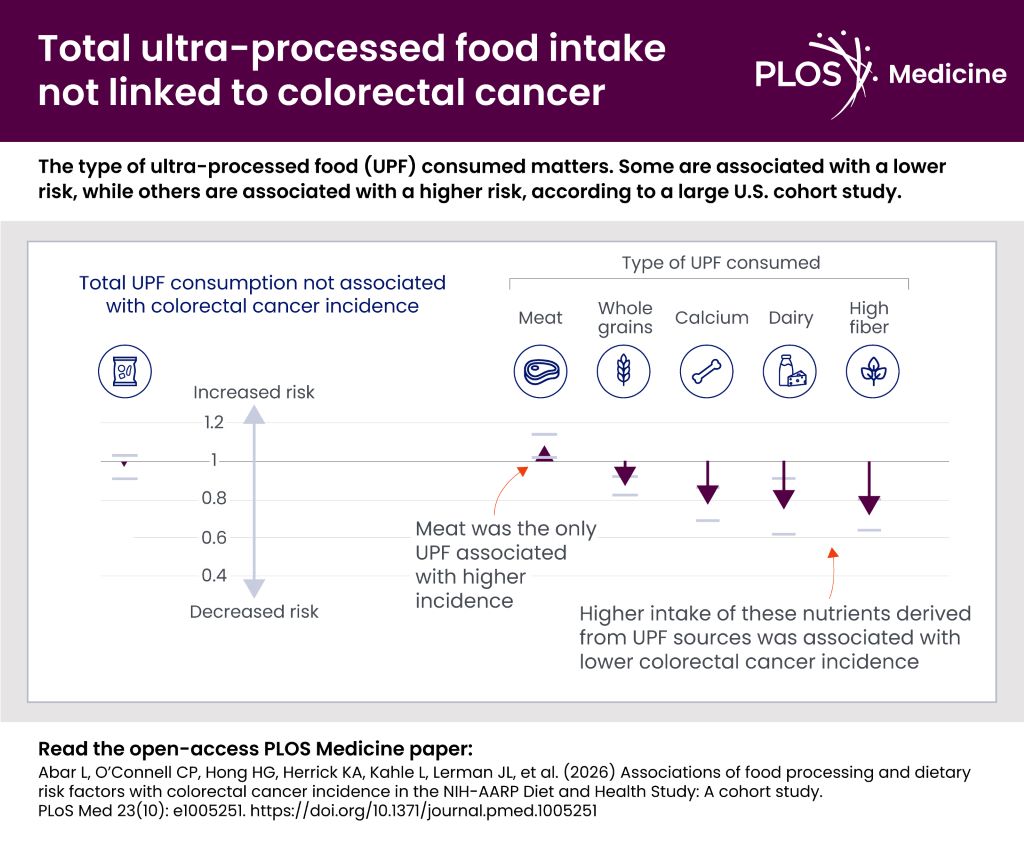
Total ultra-processed food intake not linked to colorectal cancer in large US cohort study
Overall ultra-processed food (UPF) consumption was not associated with increased colorectal cancer (CRC) incidence in a cohort of more than 400 000 US adults, according to a study published on 15 October by Erikka Loftfield of the National Cancer Institute, US, and colleagues in the open access journal PLOS Medicine.
Ultra-processed foods account for more than half of energy intake among US adults and have attracted growing attention due to potential links to chronic diseases, including colorectal cancer. However, UPFs represent a wide range of foods. Some, like whole grain and dairy products, are associated with a lower risk of CRC while others, like processed meats, are associated with a higher risk.
To better understand these relationships, researchers analysed data from 461 682 adults aged 50 to 71 years enrolled in the NIH-AARP Diet and Health Study between 1995 and 1996. Participants recorded their eating habits using a food frequency questionnaire that researchers used to estimate UPF intake. Participants were then followed until 2018, a median of 18.8 years.
The study found no association between overall UPF intake and CRC incidence. However, findings differed by type of food. Higher intake of whole grains, fibre, dairy products, and calcium derived from UPF sources was associated with lower CRC incidence, whereas meat from UPF sources was associated with higher incidence. Researchers also found that replacing 10% of gram weight from UPF intake with minimally processed foods was associated with a 2% lower CRC incidence.
The researchers caution against generalising these findings to younger, more diverse populations. The study cohort included primarily older, white Americans and only measured UPF intake once at baseline. As a result, the findings cannot account for changing eating habits or the increasing availability in UPFs, potentially leading to an underestimation of actual UPF intake.
The study suggests that UPFs should not be treated as a monolith and reinforce current dietary guidance emphasising whole grains, fibre, dairy, and calcium while limiting processed meat intake to reduce the risk of CRC.
Loftfield adds, “In this large population of older US adults, we did not observe an association between total ultra-processed food (UPF) intake and colorectal cancer incidence; however, when we looked at food groups, like whole grains, dairy, and meat, by UPF or non-UPF source, we found that associations were in line with current dietary guidance for colorectal cancer prevention such that higher whole grain and dairy but lower meat intakes were associated with lower colorectal cancer incidence.”