
Intensive Blood Pressure Reduction after Ischaemic Stroke Increases Disability

Credit: American Heart Association

The largest ever randomised controlled trial of intensive blood pressure lowering after thrombectomy in ischaemic stroke patients found that it led to deterioration in surrounding brain tissue and higher rates of disability, compared to less intensive treatment.

The results of the ENCHANTED2/MT trial were presented in a late-breaking session at the World Stroke Congress and simultaneously published in The Lancet. The trial was stopped early due to the significance of the findings.

Professor Craig Anderson, Director of Global Brain Health at The George Institute for Global Health, said the rapid emergence of this effect suggested the more aggressive approach was compromising the return of blood flow to the affected area.

“Our study provides a strong indication that this increasingly common treatment strategy should now be avoided in clinical practice,” he said.

Endovascular thrombectomy is an increasingly used non-surgical treatment for ischaemic stroke, in which x-ray guided microcatheters are inserted into the blood clot to dissolve it.

“A potential downside of this now widely used and effective treatment is that the rapid return of blood supply to an area that has been deprived of oxygen for a while can cause tissue damage known as reperfusion injury,” said Professor Anderson.

“This has resulted in a shift in medical practice towards more intensive lowering of blood pressure after clot removal to try and minimise this damage, but without evidence to support the benefits versus potential harms.”

To this end, researchers recruited 816 adults with acute ischaemic stroke who had elevated blood pressure after clot removal from 44 centres in China between July 2020 and March 2022. They had an average age of 67 and just over a third were female.

Of these, 407 were assigned to more-intensive (target < 120mmHg) and 409 to the less-intensive (target 140–180mmHg) systolic blood pressure control, with the target to be achieved within one hour of entering the study and sustained for 72 hours.

Researchers looked at how well the patients in both groups recovered according to a standard measure of disability, ranging from 0–1 for a good outcome without or with symptoms but no disability, scores of 2–5 reflecting increasing disability levels, and 6 being death.

Patients in the more-intensively treated group had significantly worse scores on the scale compared to those allocated to those treated less intensively.

Compared to the less-intensive group, they had more early brain tissue deterioration and major disability at 90 days but there were no significant differences in brain bleeds, mortality, or serious adverse events.

Patients who had their blood pressure more intensively controlled also rated their quality of life as significantly worse due to limitations on their physical abilities resulting from their stroke.

Prof Anderson said that after scouring the medical literature the research team had been unable to find strong enough evidence to recommend the ideal target for blood pressure control after blood clot removal in patients with acute ischaemic stroke.

“While our study has now shown intensive blood pressure control to a systolic target of less than 120mmHg to be harmful, the optimal level of control is yet to be defined,” he said.

Source: George Institute for Global Health

Antibodies can Prevent Bacteria from Infiltrating Cells

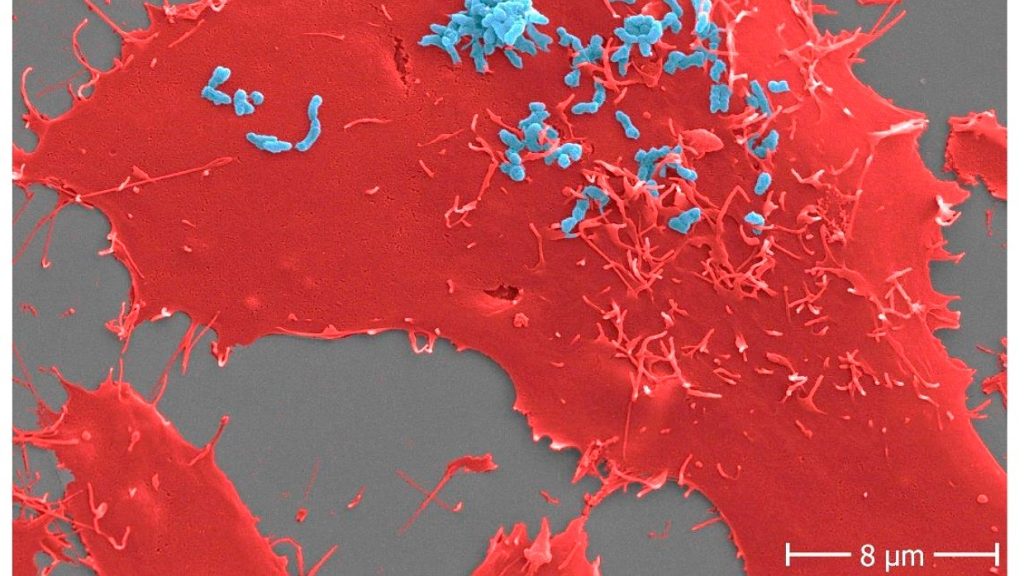
Adhesion of Bartonella henselae to human cells. B. henselae  (strain Marseille) bacteria (light blue) in an early stage infection process (30 min) to human HeLa-229 cells (red). Adhesion to host cells is mediated by specific interactions between B. henselae  surface proteins and components of the host extracellular matrix including molecules such as fibronectin or collagen. Scale bar: 8 μm.

Using Bartonella henselae bacteria, the cause of cat scratch disease, researchers have demonstrated for the first time that antibodies can prevent certain surface proteins of bacterial pathogens from entering host cells. The findings are important for the development of new drugs against highly resistant infectious agents.

Infections pose a significant threat to human health, especially when pathogens manage to colonise the organism and subsequently cause severe infections. The first step in such an infection always consists of the pathogens attaching themselves to the host cells’ surface. From here, the infections spread, resulting, for example, in infections of deeper tissue layers and organs.

A group of scientists surrounding Prof. Volkhard Kempf from Frankfurt University Hospital’s Institute of Microbiology and Hospital Hygiene has now succeeded in blocking this adhesion mechanism in a bacterium, thereby preventing the infection of host cells. For this purpose, the researchers examined the pathogen Bartonella henselae, usually causing cat scratch disease. Transmitted by cats, the disease mainly affects young children, whose symptoms include swollen and hardened lymph nodes around the site of infection, usually after a scratch or bite injury caused by infected cats.

Bartonella bacteria infect so-called endothelial cells, which line the blood vessels. Via their surface protein Bartonella adhesin A (BadA), they attach themselves to a protein (fibronectin) of the so-called “extracellular matrix,” a network of protein fibers that lie on top of the endothelial cells.

Breaking BadA

To determine which parts of the BadA protein are important in the bacterial adhesion process, the researchers equipped Bartonella bacteria with various genetically modified BadA variants, among others, and then analysed the extent to which these variants were still able to bind fibronectin. Once it was clear which BadA segments were responsible for the binding, the team produced antibodies against them, demonstrating for the first time that such antibodies can prevent infection by such bacteria.

Prof. Volkhard Kempf explains: “Bartonella henselae is not a very dangerous pathogen, and in most cases, cat scratch disease does not require any specific medical treatment. However, for us Bartonella henselae is a very important model organism for far more dangerous pathogens such as Acinetobacter baumannii, a serious pathogen that usually causes wound infection or pneumonia and often shows resistance to several last-choice antibiotics. The BadA protein of Bartonella henselae belongs to the so-called ‘trimeric autotransporter adhesins’, which are also responsible for adhesion to human cells in Acinetobacter and a number of other pathogens. A drug-induced blocking of these adhesins is therefore a promising novel and future approach to combat dangerous bacterial infections.”

The researchers published their findings in Diagnostics.

Source: Goethe University Frankfurt

Intermittent Fasting does not Impact Female Sex Hormones

Bathroom scale
Photo by I Yunmai on Unsplash

Intermittent fasting has been shown to be an effective way to lose weight, but critics have worried that the practice may have a negative impact on women’s reproductive hormones. Now, researchers bring new evidence to the table in a study published in Obesity.

The researchers, led by Krista Varady, University of Illinois Chicago professor of nutrition, followed a group of pre- and post-menopausal obese women for a period of eight weeks on the ‘warrior diet’ method of intermittent fasting.

The warrior diet prescribes a time-restricted feeding window of four hours per day, during which dieters can eat without counting calories before resuming a water fast until the next day.

They measured the differences in hormone levels, obtained by analysing blood sample data, in groups of dieters who stuck to four- and six-hour feeding windows against a control group that followed no diet restrictions.

Varady and her team found that levels of sex-binding globulin hormone, a protein that carries reproductive hormones throughout the body, was unchanged in the dieters after eight weeks. The same held true for both testosterone and androstenedione, a steroid hormone that the body uses to produce both testosterone and oestrogen.

However, dehydroepiandrosterone or DHEA, a hormone that fertility clinics prescribe to improve ovarian function and egg quality, was significantly lower in both pre-menopausal and post-menopausal women at the end of the trial, dropping by about 14%.

While the drop in DHEA levels was the most significant finding of the study, in both pre- and post-menopausal women, DHEA levels remained within the normal range by the end of the eight-week period.

“This suggests that in pre-menopausal women, the minor drop in DHEA levels has to be weighed against the proven fertility benefits of lower body mass,” Varady said. “The drop in DHEA levels in post-menopausal women could be concerning because menopause already causes a dramatic drop in estrogen, and DHEA is a primary component of estrogen. However, a survey of the participants reported no negative side effects associated with low estrogen post-menopause, such as sexual dysfunction or skin changes.”

As an added benefit, since high DHEA has been linked to breast cancer risk, Varady said a moderate drop in levels might be helpful in reducing that risk for both pre- and post-menopausal women.

The study measured levels of oestradiol, oestrone and progesterone as well, but only in post-menopausal women, due to the changing levels of these hormones throughout pre-menopausal women’s menstrual cycles. Among post-menopausal women, there was no change in these hormones at the end of eight weeks.

Women in both the four-hour and six-hour dieting groups experienced weight loss of 3% to 4% of their baseline weight throughout the course of the study, compared with the control group, which had almost no weight loss. The dieters also saw a drop in insulin resistance and in biomarkers of oxidative stress.

Perimenopausal women, who are typically in their 40s, were excluded from the study.

Still, Varady said, “I think this is a great first step. We’ve observed thousands of pre- and post-menopausal women through different alternate-day fasting and time-restricted eating strategies. All it’s doing is making people eat less. By shortening that eating window, you’re just naturally cutting calories. Much of the negative information on intermittent fasting reported has come from studies on mice or rats. We need more studies to look at the effects of intermittent fasting on humans.”

Source: University of Illinois Chicago

Axial Spondyloarthritis Association of South Africa wins Excellence Award at EULAR PARE Assembly 2022

Maranda Van Dam, Chairperson of ASASA (left) accepting award, with Souzi Makri President of PARE (middle) and Nikos Sleeks, ELEANA Greece (right)

Maranda van Dam, Chairman of the Axial Spondyloarthritis Association of South Africa (ASASA) won an award of excellence at the EULAR PARE (People with Arthritis/Rheumatism across Europe) Congress 2022, for work performed by ASASA around axial spondyloarthritis (AxSpA) in South Africa. The PARE congress took place from 20 – 22 October 2022, in Brussels, and included a Representation Committee consisting of members of the PARE, of which van Dam is an associate.

The award was based on strides made by ASASA towards improving the quality of life of people living with AxSpa, as well as training done to build awareness in the medical fraternity around AxSpA in the country. With 36 posters entered into the awards by organisations across the globe, ASASA came out tops.

When asked about the award, van Dam said, “This was a real honour to represent South Africa at PARE. 2022 is also the first year that an African country was invited to attend PARE. Winning this award sheds light on our country and our unique problems. The delay to diagnosis of 10.8 years is just unacceptable. The access to the correct medication in both the private and public sector is also not sufficient for a debilitating, progressive disease that can lead to disability if left untreated.”

ASASA estimates that there are approximately 160 000 people suffering from the AxSpA in South Africa, with many of these sufferers undiagnosed. ASASA has made significant strides this year in the training of over 100 General Practitioners and over 250 optometrists around AxSpA diagnosis and the effects it can have on other parts of the body, like the eyes. In addition, ASASA, along with other partners, assisted in gathering data from South African respondents in the first ever live patient survey, called the International Map of Axial Spondyloarthritis (IMAS) survey, which is run by the Axial Spondyloarthritis International Federation that surveys people diagnosed with AxSpA and assesses the impact and burden that AxSpA has on the lives of patients, from their perspective.

Van Dam concluded, “There is still a lot we can do in South Africa and ASASA is busy growing its team of volunteers to help to build awareness around AxSpA in the country. We aim to continue to build support structures for patients in the country, as well as continually working with the medical fraternity, assisting with early diagnosis and access to treatment.”

A New Pacemaker that Works with Light, not Electricity

Pacemakers regulate the heartbeats of people with chronic heart diseases like atrial fibrillation and other forms of arrhythmia. However, pacemaker implantation is an invasive procedure, and the lifesaving pacing the devices provide can be extremely painful. Pacemakers also can only be used to treat a few specific types of disease.

In Science Advances, researchers describe their new pacemaker design that uses light and optogenetics that could be implanted with a less invasive procedure, also causing less pain in operation. As well as triggering cardiac neurons with light, the new design can also be powered by light, removing the need for a battery which has to be surgically replaced.

The study was helmed by researchers in the Gutruf Lab, led by biomedical engineering assistant professor and Craig M. Berge Faculty Fellow Philipp Gutruf.

Currently available pacemakers work by implanting one or two leads, or points of contact, into the heart with hooks or screws. If the sensors on these leads detect a dangerous irregularity, they send an electrical shock through the heart to reset the beat.

“All of the cells inside the heart get hit at one time, including the pain receptors, and that’s what makes pacing or defibrillation painful,” Gutruf said. “It affects the heart muscle as a whole.”

The device Gutruf’s team has developed, yet to be tested in humans, would use a digitally created mesh that would send much more targeted signals.

Modifying cardiac neurons to respond to light

Optogenetics modifies cells, usually neurons, to make them responsive to light. This technique only targets cardiomyocytes, the cells of the muscle that trigger contraction and make up the beat of the heart. This precision will not only reduce pain for pacemaker patients by bypassing the heart’s pain receptors, it will also allow the pacemaker to respond to different kinds of irregularities in more appropriate ways. For example, during atrial fibrillation, the upper and lower chambers of the heart beat asynchronously, and a pacemaker’s role is to get the two parts back in line.

“Whereas right now, we have to shock the whole heart to do this, these new devices can do much more precise targeting, making defibrillation both more effective and less painful,” said Igor Efimov, professor of biomedical engineering and medicine at Northwestern University, where the devices were lab-tested. “This technology could make life easier for patients all over the world, while also helping scientists and physicians learn more about how to monitor and treat the disease.”

To ensure the light signals can reach many different parts of the heart, the team created a design that involves encompassing the organ, rather than implanting leads that provide limited points of contact.

The new pacemaker model consists of four petallike structures made of thin, flexible film, which contain light sources and a recording electrode. The petals, specially designed to accommodate the way the heart changes shape as it beats, fold up around the sides of the organ to envelop it, like a flower closing up at night.

“Current pacemakers record basically a simple threshold, and they will tell you, ‘This is going into arrhythmia, now shock!'” Gutruf said. “But this device has a computer on board where you can input different algorithms that allow you to pace in a more sophisticated way. It’s made for research.”

Because the system uses light to affect the heart, rather than electrical signals, the device can continue recording information even when the pacemaker needs to defibrillate. In current pacemakers, the electrical signal from the defibrillation can interfere with recording capabilities, leaving physicians with an incomplete picture of cardiac episodes. Additionally, the device does not require a battery, which could save pacemaker patients from needing to replace the battery in their device every five to seven years, as is currently the norm.

Gutruf’s team collaborated with researchers at Northwestern University on the project. While the current version of the device has been successfully demonstrated in animal models, the researchers look forward to furthering their work, which could improve the quality of life for millions of people.

Source: University of Arizona

Women with Autism have a Greater Mental Illness Risk

Mirror symbolising schizophrenia
Source: Vince Fleming on Unsplash

Autistic young men and women are more affected by psychiatric conditions and have an increased risk of hospitalisation as a result of their mental illness. Autistic women are particularly vulnerable, as shown in a study published in JAMA Psychiatry.

Autistic people have an increased risk of suffering from mental illness. Current data indicates that autistic women are more vulnerable than autistic men, but few studies have been able to establish that there are sex differences.

The researchers, from Karolinska Institutet, conducted a register-based cohort study with more than 1.3 million people in Sweden who were followed from the age of 16 to 24 between 2001 and 2013. Just over 20 000 of these were diagnosed with autism.

“We saw an increased risk of eleven different psychiatric conditions, including depression, anxiety disorders, self-harm and difficulty sleeping,” says Miriam Martini, a doctoral student in psychiatric epidemiology at Karolinska Institutet and first author of the study.  

High hospitalisation rates 

Something that Miriam Martini finds particularly worrying is that 32 out of 100 autistic women had been hospitalised as a result of their mental illness, compared with 19 out of 100 autistic men. For non-autistic people, the corresponding figure was less than five out of 100.   

The study focuses on young adults who are at a crucial time in their life when many mental health problems increase, while the transition to adulthood often means poorer access to care, says Miriam Martini.   

“Healthcare for young adults needs to be expanded, especially for autistic women, so that mental illness can be detected in time to avoid worsening of symptoms resulting in hospitalization,” says Miriam Martini.  

The reason why autistic women are more affected by mental illness than autistic men is not clear, but in the study, the researchers point to several possible factors. Previous research has shown that autistic women to a greater extent use compensatory behaviours to camouflage their autism, which may be due to the fact that women generally tend to adapt to the expectations of those around them. This delays diagnosis and the provision of assistance, which can negatively affect their mental health.  

Overlooked by the healthcare system 

Another possible explanation may be that it could be difficult to detect autism in women using diagnostic criteria.  

“It may be that autism manifests differently in women than in men, which means that women are not detected using today’s diagnostic criteria. This is something we need to do more research on,” says Miriam Martini.  

Source: Karolinska Institutet

High BMI in Adolescent Males Predicts AF Risk

Photo by Towfiqu Barbhuiya on Pexels

A recent analysis of Swedish military conscripts found that increased body mass index (BMI) in adolescent men is strongly linked developing early atrial fibrillation (AF) as well as with subsequent worse clinical outcomes after being diagnosed with AF.

The study, published in the Journal of the American Heart Association, included 1 704 467 young men (average age of 18.3 years) enrolled in compulsory military service in Sweden from 1969 through 2005. During a median follow-up of 32 years, 36 693 cases of atrial fibrillation were recorded, at an average age of 52.4 years at diagnosis. Compared with men with a baseline BMI of 18.5–<20.0 kg/m2, men with a BMI of 20.0–<22.5 kg/m2 had a 1.06-times higher risk of developing atrial fibrillation and those with a BMI of 40.0–50.0 kg/ m2 had a 3.72-times higher risk.

In men diagnosed with atrial fibrillation who were followed for a median of approximately 6 years, investigators identified 3767 deaths, 3251 cases of heart failure, and 921 cases of ischaemic stroke. Compared with those with a baseline BMI of <20 kg/m2, those with a baseline BMI of >30 kg/m2 had 2.86-times, 3.42-times, and 2.34-times higher risks of these outcomes, respectively.

“Whether screening for atrial fibrillation in early adulthood among individuals with long-standing obesity and more robust follow-up and initiation of anticoagulants in people with long-standing obesity and atrial fibrillation may improve survival needs to be addressed in future randomised trials” said corresponding author Demir Djekic, MD, PhD, of Sahlgrenska University Hospital/Östra, in Sweden.

Source: Wiley

Body Self-perception is Based on The Brain’s Guesswork

Photo by Bruce Christianson on Unsplash

Researchers at Karolinska Institutet in Sweden have found that the perception of one’s own body is largely based on the brain making guesses that are based on probability theory, instead of direct sensory input. The researchers detailed their findings in a study recently published in the journal eLife.

The researchers posit that the way humans perceive their bodies is largely governed by probability assessments based on past experiences, combined with sensory information such as sight and touch, for example.

“The experience of one’s own body is a statistical estimate of reality based on sensory information, sensory uncertainty, and previous experiences that can be summarised in a mathematical model”, explains Henrik Ehrsson, professor at the Department of Neuroscience, Karolinska Institutet.

Why are these results important?

“The results clarify the computational functions that govern the perception of one’s own body. This perception thus arises, not only as a result of a “direct” interpretation of signals from sight, touch sense, and proprioception as the textbooks say, but rather is based on active “guesses” that the brain constantly makes based on probability theory and the information that can be extracted from the patterns of sensory signals”, says Henrik Ehrsson.

“When we varied the degree of time delay between the visual and tactile impressions in small steps, or blurred the image in the augmented reality glasses to increase uncertainty, the illusion changed in a way that can be described by equations and curves: increased delay gave a weaker feeling of the rubber hand as its own, while increased uncertainty (blurriness) made the illusion stronger”, says Marie Chancel, corresponding author of the study.

Based on the experiments, the researchers came up with a statistical explanatory model for the brain’s perceptual awareness of its own body.

Changes in body ownership

The next step is to try to understand how the statistical model that determines own-bodily awareness is implemented by neural networks in the brain. In a preliminary study, the researchers have shown that neural activity in posterior parietal cortex follows the Bayesian model well in experiments where they measure brain activity with functional magnetic resonance imaging. The researchers also want to investigate how their model can explain changes in bodily awareness in various psychiatric and neurological conditions, such as Schizophrenia and Anorexia.

Source: Karolinska Institutet

Best Evidence Yet That Lowering Blood Pressure Cuts Dementia Risk

Old man
Source: JD Mason on Unsplash

A global study of over 28 000 people has provided the strongest evidence to date that lowering blood pressure in later life can cut the risk of dementia. The study, which included five randomised controlled trials, was published in the European Heart Journal, and constitutes the highest grade of evidence for this preventative association.

Dr Ruth Peters, Program Lead for Dementia in The George Institute’s Global Brain Health Initiative, said that with no significant dementia treatment breakthroughs being made, reducing the risk of developing the disease would be a welcome step forward.

“Given population ageing and the substantial costs of caring for people with dementia, even a small reduction could have considerable global impact,” she said.

“Our study suggests that using readily available treatments to lower blood pressure is currently one of our ‘best bets’ to tackle this insidious disease.”

Dementia is fast becoming a global epidemic, currently affecting an estimated 50 million people worldwide. This number is projected to triple by 2050 mainly from ageing populations.

Current estimates put the cost at US$20–$40 000 per person with the condition each year.

Dr Peters explained that while many trials have looked at the health benefits of lowering blood pressure, few included dementia outcomes and even fewer were placebo-controlled.

“Most trials were stopped early because of the significant impact of blood pressure lowering on cardiovascular events, which tend to occur earlier than signs of dementia,” she said.

To examine the relationship between blood pressure and dementia more closely, researchers analysed five double-blind placebo-controlled randomised trials that used different blood pressure lowering treatments and followed patients until the development of dementia. A total of 28 008 individuals with an average age of 69 and a history of hypertension from 20 countries were included. Across these studies, the mid-range of follow up was just over four years.

“We found there was a significant effect of treatment in lowering the odds of dementia associated with a sustained reduction in blood pressure in this older population,” said Dr Peters.

“Our results imply a broadly linear relationship between blood pressure reduction and lower risk of dementia, regardless of which type of treatment was used.”

Researchers hope the results will help in designing public health measures to slow the advance of dementia as well as informing treatment, where there may be hesitancy in how far to lower blood pressure in older age.

“Our study provides the highest grade of available evidence to show that blood pressure lowering treatment over several years reduces the risk of dementia, and we did not see any evidence of harm,” said Dr Peters.

“But what we still don’t know is whether additional blood pressure lowering in people who already have it well-controlled or starting treatment earlier in life would reduce the long-term risk of dementia,” she added.

Source: George Institute for Global Health

Training the Immune System to Accept Haemophilia A Treatment

Source: CC0

Haemophilia A, the most common severe form of haemophilia, affects almost exclusively males and can usually be with factor VII injections, but not for all sufferers, as the immune system may treat the factor as an intruder. New research has uncovered an important immune mechanism that targets B cells, which is crucial in making the the therapy effective. The study is published online in the Journal of Clinical Investigation.

Haemophilia A patients have a defect in factor VIII, a protein key for clotting. Most patients therefore receive an intravenous injection of the functional clotting factor every few days as treatment. But frequently, and especially at the start of treatment, the immune system recognises the injected agent as foreign to the body and attacks it. This is the most serious complication of haemophilia treatment because factor VIII can then no longer work.

In these cases, immune tolerance therapy, which was also developed at the University Hospital Bonn (UKB) more than 40 years ago, often helps. This involves regularly injecting the haemophilia sufferers with a high dose of factor VIII over several months, letting the immune system learn to tolerate it. The underlying immune mechanisms are unknown. “However, this doesn’t always work,” explains Prof Dr Johannes Oldenburg at the UKB. “In about 30 percent of patients, tolerance induction does not lead to success. So your body’s own defences continue to attack and destroy the factor VIII protein, which means that factor VIII cannot be used for treatment. We wanted to know the reason for this.”

To this end, the team looked at two cell types in the immune system, B cells and regulatory T cells. B cells recognise foreign molecules in the body and produce antibodies against them, which switch off the function of the molecule. For factor VIII, this means that it is no longer effective in haemophilia treatment.

Brake in the immune system

Regulatory T cells moderate the strength and duration of the immune response. The researchers have now found a new type of Treg cell that can act specifically against certain B cells rather than the overall immune response. “We were able to show that immunotolerance therapy results in the generation of regulatory T cells that exclusively induce B cells against factor VIII to commit suicide,” says Dr Janine Becker-Gotot of the Institute of Molecular Medicine and Experimental Immunology (IMMEI) at UKB. “These T cells have a sensor that allows them to recognise and attach to the corresponding B cells. In addition, they have the ability to push the self-destruct button on the surface of B cells.”

This button is a molecule called PD-1 which, on activation, leads to apoptosis. Every active B cell has this button. “Our experiments enabled us for the first time to detect regulatory T cells that can activate this self-destruct button only in very specific B cells, in order to specifically prevent unwanted immune responses,” explains IMMEI Director Prof Dr Christian Kurts.

The more PD-1 buttons the B cells against factor VIII carry on their surface, the easier it is for them to be driven to suicide by immune tolerance therapy. “The amount of PD-1 varies from person to person,” Becker-Gotot explains. “If it’s very low to begin with, there’s a good chance that many inhibitor-producing B cells will survive and continue to neutralise the injected factor VIII.”

Test to show in whom immunotolerance therapy is useful

Interestingly, B cells also produce more PD-1 once they come into contact with regulatory T cells. “We can now test how strong this reaction is,” the researcher says. “If PD-1 levels go up shortly after starting immune tolerance therapy and then stay up, that’s a clear sign that the treatment is going to be successful.” The team is currently developing a blood test that can be used to detect whether or not immune tolerance therapy is working in patients during the prolonged treatment.

“Our findings have great basic scientific value,” explains Prof Kurts. “And not just for haemophilia, but also for other congenital disorders where missing proteins are replaced therapeutically. In the long term, they could also be used to develop new treatments.”

Source: University of Bonn