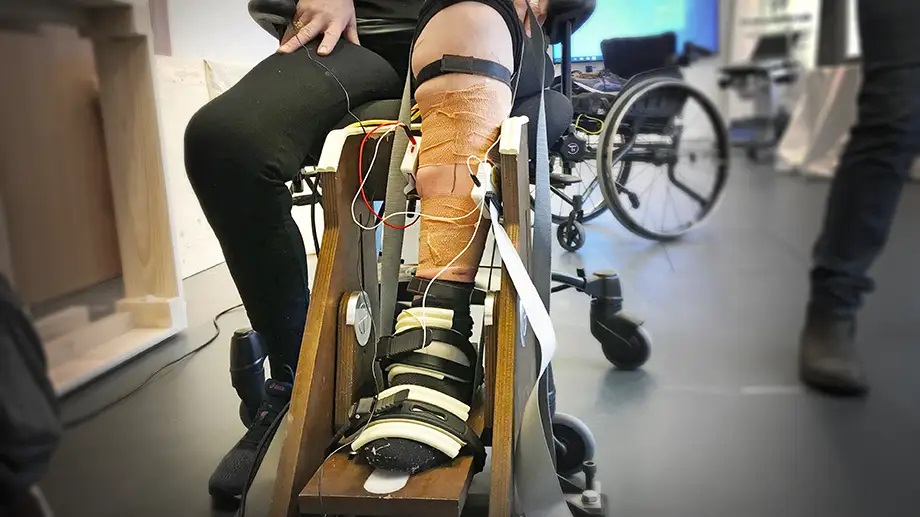
One of the study participants exerts force with their calf muscles while sensors measure electrical activity. (Photo: Ruoli Wang)
Even when people with incomplete spinal cord injuries can walk, everyday functions like standing, balancing or producing steady force may remain difficult. A new study shows why.
Using surface skin electrical sensors, a research team in Sweden identified previously unseen changes in motor coordination that result from incomplete spinal cord injuries (SCI). The study is the first to examine how individual motor units (nerve to muscle connections that create movement) work together in people with SCI.
“Our study reveals, at the cellular level, how the central nervous system adapts to the injury to control movement,” says Ruoli Wang, associate professor in biomechanics at Promobilia MoveAbility Lab, KTH Royal Institute of Technology. She says the researchers’ approach was completely non-invasive.
The study’s lead author, PhD student Zhihao Duan, says the researchers found the nervous system struggles to spread signals smoothly across muscles at low levels of exertion after the injury. And it appears to overcompensate at higher levels of exertion, sending “louder”, less refined signals.
Effect on motor units
Muscles move through hundreds or thousands of motor units, each turning on and off precisely to create smooth force. Composed of a single motor neuron and its connecting muscle fibres, these motor units respond to shared signals from the nervous system, much like different sections of musicians led by an orchestra conductor. That shared input is what allows them to act in coordinated patterns.
To explore how well these units coordinate under the control of the central nervous system, the team examined 25 people (including 10 control participants). They used high-density electromyography (HD-EMG) to measure electrical activity in the functionally similar calf muscles – soleus and gastrocnemius – while volunteers pushed lightly or moderately against a device.
Duan says that at 20% effort, fewer of the motor units in the two calf muscles were working in a shared, coordinated way compared with people without injury. As a result, their movements were shaky and unstable. “They were much less being driven by the same coordinated signal from the nervous system.” he says.
At a higher level of effort (50%) the SCI group showed stronger lowfrequency synchronization between the two muscles. The body loses flexibility and precision in control of the movement. “This could be a sign of the nervous system compensating by sending louder, less refined signals,” Duan says.
Unique insights
“One interesting finding is that after spinal cord injury the nervous system becomes more rigid and less able to change its approach as the muscles work harder. A healthy nervous system on the other hand is able to adapt its strategy as force demands, to adjust the shared neural drive level,” Wang says.
Although the study was limited by a small sample size and challenges in identifying enough motor units per muscle from the skin surface, Wang says the results offer unique insight into how SCI reshapes motor control.
“This finding may open the door to a new rehabilitation biomarker, helping clinicians and researchers design new neurorehabilitation strategies to re-tune the spinal cord control and to restore coordinated neural input,” she says.
An anterior cruciate ligament injury is a serious knee injury that often affects young, physically active people. On April 30, Dzan Rizvanovic will defend his thesis “Anterior cruciate ligament reconstruction: rationale for graft choice and treatment of associated injuries” in which he has investigated how treatment choice affects outcomes after ACL reconstruction.
“An anterior cruciate ligament injury (ACL injury) is a serious knee injury that primarily affects young and physically active individuals and can have long-term consequences for knee function, work capacity, and quality of life. Each year, a large number of patients in Sweden undergo surgical reconstruction of the injured ligament (ACL reconstruction), and this is the focus of my thesis”, says Dzan Rizvanovic, doctoral student at the Sports Medicine research group at the Department of Molecular Medicine and Surgery, Karolinska Institutet and specialist in orthopaedic surgery at Capio Artro Clinic.
“Using data from the Swedish Knee Ligament Registry, we studied tens of thousands of patients to investigate which factors are associated with different treatment strategies, and how these in turn relate to patients’ perceived knee function and the need for further surgery (revision). The thesis also has a particular focus on how the surgical volume of both the surgeon and the clinic is associated with treatment choices and outcomes”.
Which are the most important results?
“The main findings show that treatment strategies in ACL reconstruction are not solely related to the patient’s injury, but also to organizational factors. Surgeons and clinics with higher surgical volume are more likely to use different types of grafts (tendons used to replace the injured ligament), which may increase the opportunity for individualized treatment. They also repair meniscal injuries more frequently, a strategy that has been shown to be beneficial for long-term knee health. The management of cartilage injuries is also partly influenced by surgical volume”.
“Patients operated on by high-volume surgeons report better knee function two years after surgery and experience shorter waiting times from injury to surgery as well as shorter operative times. In contrast, the need for additional ACL reconstruction in the same knee is more related to patient- and injury-factors than to surgical volume”.
“The thesis also shows that graft choice influences subjective knee function at two years after surgery, particularly among females, which is an important finding”.
How can this new knowledge contribute to the improvement of people’s health?
“This knowledge can contribute to more equitable and individualised care. By clarifying how surgical experience and surgical volume are associated with treatment decisions and outcomes, healthcare systems can better organise resources and create conditions for strengthened competence and improved decision-making in ACL reconstruction”.
“The results can also be used in the dialogue between patient and surgeon to select the treatment that best matches the individual’s needs and circumstances, which in the long term may improve knee function and increase quality of life in this young and working-age population”.
“Furthermore, the results from this thesis highlight the need for discussion regarding clearer national guidelines for referral pathways, minimum surgical volume requirements, and follow-up of treatment outcomes. It is also important that reporting to national quality registers is complete and made mandatory in order to enable transparency and continuous quality improvement”.
What are your future ambitions?
“I hope to continue combining research with my clinical work to drive development forward and contribute to ensuring that patients with knee and sports-related injuries receive the best possible treatment. I also aim to contribute to a more equitable organization of healthcare, in which access to the right expertise at the right time does not depend on where in the country a patient lives”, says Dzan Rizvanovic.
Dissertation
The dissertation seminar will be held on Thursday, April 30th 2026 at 09:00, CIFU, Capio Artro Clinic, Valhallavägen 91, lecture hall house R. The doctoral thesis has been supervised by Anders Stålman.
Thesis
Rizvanovic, Dzan (2026). Anterior cruciate ligament reconstruction : rationale for graft choice and treatment of associated injuries. Karolinska Institutet. Thesis. https://doi.org/10.69622/31333828.v1
One in ten emergency patients with visible blood in their urine die within three months of presenting at A&E, new research has found. The WASHOUT study, presented Monday 16 March at the European Association of Urology Congress (EAU26) in London, found that a scan within 48 hours could reduce this risk.
Such a scan also ensured patients with cancer were diagnosed significantly faster. Around 1 in 4 people who presented at A&E with visible blood in their urine had an underlying cancer, with the most common being bladder cancer, the study found.
Around 25 000 people visit UK A&E departments each year because they have blood in their urine. Currently, patients receive different care depending on which hospital they visit or even which doctor they see. This is because there are no guidelines built on real-world evidence for doctors to follow. Based on global figures, only around half (53%) of patients receive a scan and a third (35%) receive surgery, with others discharged home or admitted to the ward to watch how their symptoms progress, says the WASHOUT study.
The WASHOUT study drew on global data to show that rapid action is critical for better patient outcomes. A CT scan or cystoscopy to look inside the bladder within 48 hours of arriving at A&E should determine the most appropriate next steps – such as whether the person should be treated for bladder cancer. Patients who didn’t receive investigative tests or appropriate treatment were 2.5% more likely to die within the next three months compared to those who did. They also spent more time in hospital and were more likely to be readmitted with the same problem within three months.
For patients with an underlying cancer, those who received investigative tests within the first 48 hours of admission were diagnosed within one day on average. In contrast, patients who were discharged without investigation faced a significantly longer wait, with diagnosis taking on average three weeks.
The research team is now taking steps to incorporate their findings into clinical guidelines, to help hospital staff provide the best treatment for these patients.
The study looked at data from more than 8500 people across 380 hospitals around the world and followed their journey for 90 days after arriving at A&E with blood in their urine. It also considered other factors that might have affected results, including age, frailty and other underlying conditions.
Nikita Bhatt, consultant urologist at St Vincent’s University Hospital, Dublin, led the research being presented at EAU26. She said: “This is the largest study exploring how we should treat people who present at A&E with blood in their urine. It’s a common problem affecting thousands of people around the world, and these patients are usually very unwell. But too often they fall through the gaps because it isn’t obviously tied to a specific disease. Our findings show how important it is that doctors take the necessary steps to identify the cause of the problem. For patients, the message is clear: if you have visible blood in your urine, don’t ignore it. See your doctor as soon as you can. If it doesn’t clear up, keep pushing until you find an answer. I hope our study gives patients the encouragement to do that.”
Jacqueline Emeks, a patient advocate on the WASHOUT study, who was diagnosed with a kidney infection and sepsis after arriving at A&E with visible blood in their urine, agrees: “These findings highlight that blood in the urine should trigger immediate action. It’s not something to watch and wait. For patients, this should mean quicker triage, earlier investigations and faster treatment, translating into safer care, fewer delays, and a better chance of avoiding severe illness or long-term harm. Patients know their bodies and deserve to be taken seriously. Blood in urine is a red flag until proven otherwise.”
Prof Dr Joost Boormans, a member of the EAU Scientific Congress Office and a urologist at the Erasmus University Medical Center, Rotterdam, said: “This is an important study highlighting the scale of the problem that emergency blood in the urine presents, both for patients and our already over-stretched healthcare systems. It’s difficult to draw strong conclusions about specific conditions because blood in the urine can be caused by many things, including cancer, and this group of patients is very diverse. But this study shows that timely investigative tests can accelerate diagnosis and reduce patients’ risk of readmission and long hospital stays, both being significantly high as shown in the WASHOUT study. As urologists in emergency care, we should be aware of these numbers and do more to get an immediate diagnosis for people with blood in urine, to reduce the burden on our healthcare systems and give our patients the best outcomes.”
Every day in South Africa, 30 people are shot dead. Another 43 are shot and survive. That is more than one person shot every 20 minutes, around the clock, every single day of the year.
Those numbers are staggering, but they don’t begin to convey the cascade of harm that extends beyond the bodies that take the bullets.
Consider this experience of Professor Sithombo Maqungo, head of orthopaedic trauma at Groote Schuur Hospital. A grandmother admitted with a fractured hip is scheduled for urgent surgery on Friday morning. As she is being prepped for theatre, a gunshot victim is rushed in, bleeding out. He dies, but the grandmother’s surgery is postponed as the weekend’s trauma cases overwhelm the unit. By Monday, her condition has deteriorated — blood clots, pressure sores, pneumonia. She dies. Her death certificate will not record “gunshot wound” as the cause. But she is, without question, a victim of gun violence.
This is the ripple effect of gun violence. One shooting does not claim one life. It consumes blood supplies, monopolises theatre time, depletes Intensive Care Unit beds, exhausts healthcare teams, and drives skilled professionals — paramedics, nurses, surgeons — out of a system that can no longer support them.
South Africa’s healthcare system is treating gun violence, it is not preventing it. And that distinction matters enormously.
Young men are the primary victims and perpetrators of gun violence, but women are increasingly killed with guns. After declining, following the Firearms Control Act of 2000, gun-related femicide has surged — rising 84% between 2017 and 2020/21. By 2020/21, firearms accounted for more than one-third of all femicides, the highest proportion recorded.
Failures in firearm oversight and the growth in licensed guns have contributed to this reversal.
South Africa’s own evidence shows that regulation works. When the Act was properly enforced between 2000 and 2010 — guided by a five-pillar strategy that tightened regulations and reduced the availability of firearms — gun deaths halved, from 34 people shot dead daily to 18, while a woman died at the hands of an intimate partner every eight hours rather than every six hours because fewer women were shot and killed.
As oversight weakened through under-resourcing, corruption and policy drift, deaths rose again.
Today, licence applications are 66% higher than in 2016, with a record 166,603 new applications in 2024/25 alone — expanding the pool of legally held guns that leak into criminal hands or are used to commit crimes.
Illegal guns don’t come from nowhere
A common misconception is that tightening firearm laws is pointless because most crime guns are unlicensed. But illegal guns do not appear from nowhere: virtually every firearm in criminal circulation was once legally manufactured and legally owned before it was lost, stolen, or sold into the illegal market. In South Africa, civilians are by far the biggest source of this leakage. Over the past 20 years, civilians have lost or had stolen an average of seven guns for every one lost or stolen by the police, according to South African Police Service annual reports. In 2024/25 alone, civilians reported the loss or theft of 7,895 firearms — 22 a day — and this is almost certainly an underestimate, since some owners do not report losses for fear of being charged with negligence (police reported the loss/ theft of 572 service guns in this time).
Legal guns are also used directly to commit crimes, particularly in domestic violence, where murder-suicides involving licensed firearms are well documented.
Controlling legal gun ownership is not separate from addressing gun crime — it is the primary mechanism for doing so.
The public health approach
A key question in response to South Africa’s gun violence crisis is why gun violence remains outside the core public health frameworks — and what would change if it were treated as the preventable health crisis it is.
A public health approach treats guns the way we treat other products that harm health — like alcohol and tobacco — moving the response upstream from treating wounds to preventing them by tightening controls over availability.
It would give healthcare workers, overwhelmed by the relentless flood of trauma, the ability to recognise that gunshot wounds are not inevitable but a preventable crisis dependent on political will and policy intervention.
It would create concrete opportunities for the health system to play a proactive role in prevention — screening for firearm access during domestic violence consultations to support gun removal from high-risk situations; linking young gunshot victims in surgical wards with gang exit programmes; using admission and forensic pathology data to identify violence hotspots and inform targeted policing.
It would make the true costs of gun violence visible to policymakers and the public — revealing how much is spent managing a preventable crisis on limited resources and overstretched facilities that could instead go towards primary healthcare, cancer treatment, or diabetes care. And crucially, it grounds the debate in evidence rather than ideology — vital in a post-truth world where beliefs, opinions, and hearsay are routinely presented as fact.
This approach would also recognise that firearms are a product sold for profit that harms people’s health. Just as taxes on alcohol and tobacco reflect their social costs and reduce consumption, firearms, ammunition and shooting activities should be subject to equivalent measures. This would generate revenue that could fund the very health services overwhelmed by the consequences of gun violence.
This sharpens the policy response too. South Africa’s Firearms Control Amendment Bill, currently at Nedlac, proposes strengthening limits on who can own firearms, the type and number of firearms and ammunition rounds that can be held, and for which purposes.
Treating gun violence as a public health crisis strengthens the case for these reforms: it positions the Bill not as a security measure but as a health measure, demanding the same urgent political commitment we would expect for any leading cause of preventable death and injury.
International framework
None of this can happen in isolation. South Africa needs international frameworks, evidence, and solidarity — and that is where the World Health Organisation (WHO) comes in.
On 10 February 2026, the Global Coalition for WHO Action on Gun Violence launched with more than 100 organisations across 40 countries, including a range of South African organisations spanning healthcare, child and women’s rights, legal advocacy, violence prevention, and research. The coalition’s formation was accompanied by a stark finding: not one of the World Health Assembly’s 3,200-plus adopted resolutions explicitly mentions firearms.
This is a profound gap. The WHO sets global standards that shape national health policy across 194 member states. When it fails to treat gun violence as a health priority, countries like South Africa are left without the international frameworks, evidence, and technical guidance they need to act.
The WHO has done this before, with other contested, politically sensitive issues — tobacco, HIV/AIDS, alcohol, violence against women — each time moving them from marginal concerns into mainstream public health priorities with measurable results. A resolution on road safety catalysed legislative reform in more than 100 countries. The Framework Convention on Tobacco Control contributed to lasting reductions in global tobacco use. The same is possible for gun violence.
The coalition is calling on the WHO to take ten key actions, including strengthening guidance on gun-related healthcare and supporting countries to use health systems as sites of gun violence prevention. South Africa — with some of the highest rates of gun violence in the world and a documented track record of evidence-based intervention — is uniquely placed not just to support this coalition, but to lead it by sponsoring a World Health Assembly resolution on firearm violence.
Our health professionals are close to breaking point. The surgeon who cannot cope with the relentless toll and resigns — leaving already stretched colleagues even more depleted. The paramedics who quit working in a war zone they never enlisted in. The medical students who leave the profession early, unable to bear the accumulated trauma of what they witness.
Gun violence is not inevitable. It is preventable. Treating it as a public health crisis is the only rational response to the evidence we already have.
Claire Taylor is from Gun Free South Africa, and Dean Peacock is from the Global Coalition for WHO Action. Views expressed are not necessarily those of GroundUp.
New oxygen-delivering technology can prevent amputations
Photo by Photomix Company on Pexels
As ageing populations and rising diabetes rates drive an increase in chronic wounds, more patients face the risk of amputations. UC Riverside researchers have developed an oxygen-delivering gel capable of healing injuries that might otherwise progress to limb loss.
Injuries that fail to heal for more than a month are considered chronic wounds. They affect an estimated 12 million people annually worldwide, and around 4.5 million in the U.S. Of these, about one in five patients will ultimately require a life-altering amputation.
The new gel, tested in animal models, targets what researchers believe is a root cause of many chronic wounds: a lack of oxygen in the deepest layers of the damaged tissue. Without sufficient oxygen, wounds languish in a prolonged state of inflammation, allowing bacteria to flourish and tissue to deteriorate rather than regenerate.
“Chronic wounds don’t heal by themselves,” said Iman Noshadi, UCR associate professor of bioengineering who led the research team. “There are four stages to healing chronic wounds: inflammation, vascularisation where tissue starts making blood vessels, remodelling, and regeneration or healing. In any of these stages, lack of a stable, consistent oxygen supply is a big problem,” he said.
When oxygen from the air or bloodstream cannot penetrate far enough into injured tissue the result is hypoxia, which derails normal healing. The researchers’ approach to preventing hypoxia with a gel is detailed in a paper published in Nature Communications Materials.
The soft, flexible gel contains water as well as a choline-based liquid that is antibacterial, nontoxic, and biocompatible. When paired with a small battery similar to those used in hearing aids, the gel becomes a tiny electrochemical machine splitting water molecules to generate a slow, steady stream of oxygen.
Unlike treatments that deliver oxygen only at the surface, the gel conforms to the unique shape of each wound, filling crevices where oxygen levels are often lowest and infection risk is highest. Before it sets, the material moulds precisely to the contours of the damaged tissue.
Equally important, the oxygen delivery is continuous. Vascularization can take weeks, so brief bursts of oxygen are not enough. The new system can provide sustained oxygen levels for up to a month, helping transform a nonhealing wound into one that behaves like a normal injury.
In tests on diabetic and older mice, chosen because their wounds closely resemble chronic wounds in older humans, untreated injuries failed to heal and were often fatal. With the oxygen-generating patch applied and replaced weekly, wounds closed in about 23 days, and the animals survived.
“We could make this patch as a product where the gel may need to be renewed periodically,” said Prince David Okoro, UCR bioengineering doctoral candidate in Noshadi’s lab and paper co-author.
The gel’s chemistry offers an added benefit. Choline, a key component, has properties that help modulate the immune system and calm excessive inflammation. Chronic wounds are often overwhelmed by reactive oxygen species, which are unstable molecules that damage cells and prolong inflammation. By increasing stable oxygen while helping rein in this immune overreaction, the gel restores balance rather than triggering further stress.
“There are bandages that absorb fluid, and some that release antimicrobial agents,” said Okoro. “But none of them really address hypoxia, which is the fundamental problem. We’re tackling that directly.”
The implications of this project extend beyond wound care. Oxygen and nutrient deprivations are major challenges in attempts to grow replacement tissues or organs, which is one of the primary goals of the Noshadi laboratory.
“When the thickness of a tissue increases, it’s hard to diffuse that tissue with what it needs, so cells start dying,” Noshadi said. “This project can be seen as a bridge to creating and sustaining larger organs for people in need of them.”
There are some factors causing the prevalence of chronic wounds that cannot be solved with a gel. In addition to climbing rates of diabetes and aging populations, UCR bioengineer and paper co-author Baishali Kanjilal notes other factors.
“Our sedentary lifestyles are causing our immune responses to decrease,” she said. “It’s hard to get to societal roots of our problems. But this innovation represents a chance to reduce amputations, improve quality of life, and give the body what it needs to heal itself.”
Researchers are developing emergency injectable bandages that could decrease bleeding time by as much as 70% and revolutionise the future of trauma care.
Photo by Mat Napo on Unsplash
A massive number of traumatic injury deaths are the result of uncontrolled bleeding.
“Severe blood loss can rapidly lead to haemorrhagic shock,” said Dr Akhilesh Gaharwar, a biomedical engineering professor at Texas A&M University. “Many patients die within one to two hours of injury. This critical period is often referred to as the ‘golden hour.'”
Thanks to funding from the U.S. Department of Defense and the National Science Foundation, Gaharwar and his fellow researchers in the biomedical engineering department have found a way to extend this golden hour – using clay.
Gaharwar, Dr Duncan Maitland and Dr Taylor Ware are developing a suite of injectable haemostatic bandages – biomedical materials that stop bleeding and promote blood to clot faster. Their research is specifically targeting deep internal bleeding where traditional methods like compression are not possible.
“Under normal circumstances, human blood clots within six to seven minutes,” said Gaharwar. “Using these haemostatic dressings, we are able to reduce the clotting time to one to two minutes.”
The goal is a lifesaving device simple enough that a critically injured person could apply it to themselves immediately after injury.
“For a self-applied or in-the-field-applied device, you can’t use the fancy mechanics and apparatus that you would have in the operating room,” said Ware. “There can’t be any special tools. You have to have something that just works and works quickly.”
The research hinges on a class of materials that have been used for wound treatment for thousands of years. Certain naturally occurring clay minerals contain silicate-based particles that can accelerate blood coagulation. The exact mechanics of this effect are still an active area of investigation.
“These clay particles were being used as a haemostat in ancient civilisations in China, Mesopotamia, Egypt, India, Greece and Rome, likely owing to their absorbency and tissue adherent properties” said Gaharwar. “Ancient peoples would make a paste out of water and clay particles and apply it to wounds to stop bleeding faster.”
Fascinated by the particle’s blood clotting properties, Gaharwar began to explore the potential uses of a synthetic particle, which would avoid the potential risk of infection that comes with natural clays.
The challenge is getting this particle to the injury site and keeping it there. High blood flow washes powders and pastes away. Not only does this fail to stop the bleeding, it risks killing the patient in another way. The nanosilicate particles are small enough to easily travel through blood vessels to non-injured areas of the body, causing life-threatening blood clots and embolism.
With the help of Maitland’s lab, the researchers combined the nanosilicate particles with an expanding foam. While completely stable in its applicator device, the particle-laced foam reacts to body heat. Once injected into a wound site, it expands to fill up the entire space, sealing severed blood vessels and holding the blood-clotting nanosilicate exactly where it needs to be. Since the foam forms a single piece, there is no risk of particles breaking away and traveling to form dangerous blood clots in other areas of the body.
In Ware’s lab, the researchers took an entirely different approach: micro-ribbons. This biomaterial is delivered in the form of multiple ribbon-like structures, each covered in coagulation-promoting nanosilicate particles.
Like the foam, the micro-ribbons exploit the patient’s body heat to trigger a reaction once in place. Each ribbon is made of two different materials, only one of which reacts to body temperature. Once in contact with the patient’s body, one side of the ribbon contracts, causing it to curl. As multiple ribbons curl at the injury site, they tangle together to form a single foam-like structure. Even if a single ribbon were able to escape, its size prevents it from traveling through blood vessels, keeping the blood-clotting nanosilicate exactly where it needs to be.
The combined expertise of all three research labs may be responsible for the future of trauma care.
“If these materials get into the first aid kits in an ambulance as well as a soldier’s backpack, they can save a lot of lives,” said Gaharwar. “If you can save 30-40% of haemorrhagic shock victims, that is a big achievement.”
Trauma patients urgently requiring a breathing tube are more likely to survive if the tube is inserted before arriving at hospital compared to insertion afterwards, suggests a modelling study led by researchers at University College London and the Severn Major Trauma Network.
The researchers found that prehospital emergency intubation of high-risk trauma patients could improve 30-day survival by 10.3%, and could save 170 lives each year in the UK.
The findings of the new artificial intelligence (AI)-supported analysis, published in The Lancet Respiratory Medicine, provide\s the strongest evidence yet that prehospital emergency anaesthesia with intubation saves lives when delivered to those who need it most.
Trauma is a leading cause of death worldwide, with rates in South Africa 5–9 times higher than the global average. But there is a lack of high-quality evidence on the best time to start certain types of care for major trauma patients, such as the insertion of breathing tubes.
Prehospital intubation needs to be administered by an advanced critical care team, specially trained and equipped to administer the anaesthesia required to facilitate the insertion of breathing tubes. In the UK, that is currently provided only by the air ambulance services.
The researchers say their findings could inform policy discussions on funding specialist prehospital critical care teams, which could include public funding for air ambulances or funding additional training for ground ambulance teams, so that more high-risk major trauma patients can have breathing tubes inserted before arrival at hospital.
Joint first author Dr Amy Nelson (UCL Queen Square Institute of Neurology and King’s College London) said: “The airway is a top priority in major trauma, but the question of whether we should intubate before hospital arrival is unsettled because we cannot ethically conduct a randomised trial.
“Emergency care decisions made before hospital admission depend on the combination of many measurements taken under pressure. We used these measurements to answer the question in steps: we first built a machine learning model to identify high-risk patients, then we modelled the impact of early intubation in this group, which showed us that prehospital intubation saves lives.”
For the study, researchers analysed data from 6467 trauma patients treated at Southmead Hospital Major Trauma Centre, Bristol.
The researchers used AI-assisted modelling to predict both who would need intubation and who would likely survive – to isolate the impact that intubation had from other factors such as the injury severity. To facilitate their analysis, they developed a new machine learning model, called ‘Intub-8’, which predicted outcomes based on eight routinely collected prehospital measurements.
The researchers found that among high-risk patients who were identified by the model as needing intubation (229 patients), those who received it before arriving at hospital were 10.3% more likely to survive (within a 30-day period) compared with those who did not.
By scaling up their findings relative to national trauma incidence, the researchers estimate that if every trauma patient who needed prehospital intubation was given it, 170 lives could be saved each year in the UK – roughly one life saved every other day.
Additionally, they conducted a cost-effectiveness analysis, finding that cost savings would be in the range of £101 million annually for the UK, due to reduced costs of further care and lives saved.
Professor Parashkev Nachev (UCL Queen Square Institute of Neurology), joint senior author, said: “In medicine, action and inaction are not morally asymmetric. When we cannot have randomised controlled trial evidence for an intervention, we must use the best available alternative: causal inference from real-world data, assisted by artificial intelligence, the only technology with the power to address the complexity of biological systems.”
Associate Professor Julian Thompson, joint senior author and Clinical Director of the Severn Major Trauma Network, said: “Until now, advanced air ambulance services across the world who respond to critically injured patients have struggled to conduct studies that assess the benefit and cost effectiveness of their life-saving interventions. The use of AI in this study has allowed us to analyse existing data in a totally new way. This reveals the huge impact that advanced care provides when delivered before arrival in hospital.
“These findings may have a huge impact on how UK and international health services look after the most severely injured patients in our societies.”
The authors note that the findings are specific to a mixed rural-urban UK setting where highly trained physician-paramedic teams perform all prehospital intubation. The survival benefit may differ in other healthcare systems or national contexts, and further research is needed to examine long-term outcomes and potential complications.
The new device sprays mist to treat deep wound infections without causing kidney damage
Hongmin Sun demonstrating the new device.
A University of Missouri researcher has unveiled a safer, smarter way to fight drug-resistant infections. Hongmin Sun, an associate professor in the School of Medicine, demonstrated that a spray-mist device can deliver last-resort antibiotics directly into infected tissue without the harmful side effects often caused by delivery via the bloodstream.
In a recent study, researchers worked with an industry partner to use a needle-free device to treat methicillin-resistant Staphylococcus aureus (MRSA), a dangerous bacterium that has become resistant to many common antibiotics.
The device successfully delivered the common last-resort antibiotic vancomycin deep into infected tissue without typical side effects such as kidney damage. Unlike topical creams or ointments that are easily wiped away or bloodstream delivery that risks organ damage, the spray-mist technology pushed the medicine through the skin to successfully treat the infection.
Sun collaborated with former Mizzou researcher Lakshmi Pulakat, now a professor of medicine at Tufts University, and Droplette Inc. to use the patented device for antibiotic delivery. The findings pave the way for future clinical trials as researchers seek FDA approval.
The team is hopeful the spray-mist device might one day be used in wound care in challenging settings.
“Whether it’s people with diabetic foot ulcers or soldiers hurt in battle, we wanted to come up with a new approach to treat these severely infected wounds in a more targeted way,” Sun said. “This can be a game-changing therapy for treating those with severely infected wounds.”
Pulakat said the technology is an example of compassionate care.
“This method of delivering last-resort antibiotics could prevent countless amputations and help save lives,” she said. “Dr. Sun is an internationally recognized expert in the field of pathogenic microbiology, and our collaboration with an industry partner has helped make this translational research possible.”
Humans’ exposure to high temperature burn injuries may have played an important role in our evolutionary development, shaping how our bodies heal, fight infection, and sometimes fail under extreme injury, according to new research.
For more than one million years, the control of fire has powered human success, from cooking and heating to technology and industry, driving genetic and cultural evolution and setting us apart from all other species. But this relationship has also exposed humans to high temperature injuries at a scale unmatched in the natural world.
Humans burn themselves – and survive burns – with a frequency likely much greater than any other animal. Most animals avoid fire completely, while in contrast, humans live alongside fire and most humans will experience minor burns throughout their lives.
A new study published in BioEssays, led by Imperial College London researchers, suggests that this increased exposure to burn injuries may have driven notable genetic adaptations which differentiated humans from other primates and mammals. This may also explain both beneficial and maladaptive responses to severe burn injury.
Burn injuries exist on a spectrum of severity, with most small injuries healing on their own while severe burns can lead to lifelong disability or death. Burns damage the skin, the body’s main protective barrier against infection, sometimes over large areas of the body. The longer the skin is damaged, the greater the risk that bacteria can enter the body and cause overwhelming infection.
The researchers argue that natural selection would have favoured traits that helped humans survive small to moderate burns. These may include faster inflammation, faster wound closure (to prevent infection) and stronger pain signals.
However, while these traits are helpful for less severe injuries, they can become harmful for large burns, which may explain why modern humans can experience extreme inflammation, scarring, and organ failure from major burns.
Using comparative genomic data across primates, the researchers found examples of genes associated with burn injury responses which show signs of accelerated evolution in humans. These genes are involved in wound closure, inflammation and immune system response – likely helping to rapidly close wounds and fight infection; a major complication after burn injury, particularly before the widespread use of antibiotics.
These findings support the theory that exposure to burn injuries may have been a notable force on the evolution of humans.
Dr Joshua Cuddihy, lead author for the study, and Honorary Clinical Lecturer in Imperial’s Department of Surgery and Cancer, said: “Burns are a uniquely human injury. No other species lives alongside high temperatures and the regular risk of burning in the way humans do.
“The control of fire is deeply embedded in human life — from a preference for hot food and boiled liquids to the technologies that shape the modern world. As a result, unlike any other species, most humans will burn themselves repeatedly over their lifetime, a pattern that likely extends back over a million years to our earliest use of fire.
“Our research suggests that natural selection favoured traits that improved survival after smaller, more frequent burn injuries. However, those same adaptations may have come with evolutionary trade-offs, helping to explain why humans remain particularly vulnerable to the complications of severe burns.”
The control of fire has powered human success for more than one million years
The study’s novel perspective on human evolution, which could reshape our understanding of modern burn care and human biology, was made possible through interdisciplinary collaboration between clinicians and researchers.
Professor Armand Leroi, Professor of Evolutionary Developmental Biology in Imperial’s Department of Life Sciences, said: “What makes this theory of burn selection so exciting to an evolutionary biologist is that it presents a new form of natural selection – one, moreover, that depends on culture. It is part of the story of what makes us human, and a part that we really did not have any inkling of before.”
Yuemin Li, PhD student at Queen Mary University of London, said: “Our study provides compelling evidence that humans have unique adaptive mutations in several key genes associated with burn injury response.
“These findings could allow us to explore in future research how genetic variations in different groups impact burn injury response, potentially explaining why some patients heal well or poorly after a burn.”
Unlike other wounds from cuts or bites which would have also led to infections, the increased lifetime risk of burns experienced by humans and their hominin ancestors is unique as they are the only species to regularly experience burn injuries and survive them.
The researchers’ findings could change how we study burn injuries, design treatments, and interpret complications of burns. It may also explain why translating results on burn injuries from animal models to humans is often ineffective.
Declan Collins, Consultant in Plastic and Reconstructive Surgery at Chelsea and Westminster Hospital NHS Foundation Trust, said: “Understanding the evolutionary drivers that cause genetic change is an important step in burn research that will influence the way in which we look at scar formation and wound healing.
“The genetic basis for scarring variation in humans and response to tissue injury is still poorly understood, and this work will provide new angles for future research.”
The face is privileged when it comes to scarring after injury. A Stanford Medicine study in mice not only discovers why but also finds a drug that helps skin from other sites regenerate.
Tweaking a pattern of wound healing established millions of years ago may enable scar-free injury repair after surgery or trauma, Stanford Medicine researchers have found. If results from their study, which was conducted in mice, translate to humans, it may be possible to avoid or even treat the formation of scars anywhere on or within the body.
Scarring is more than a cosmetic problem. Scars can interfere with normal tissue function and cause chronic pain, disease and even death. It’s estimated that about 45% of deaths in the United States are due to some type of fibrosis – usually of vital organs like the lungs, liver or heart.
Scars on the skin’s surface, while rarely fatal, are stiffer and weaker than normal skin and they lack sweat glands or hair follicles, making it difficult to compensate for temperature changes.
Surgeons have known for decades that facial wounds heal with less scarring than injuries on other parts of the body. This phenomenon makes evolutionary sense: Rapid healing of body wounds prevents death from blood loss, infection or impaired mobility, but healing of the face requires that the skin maintain its ability to function well.
“The face is the prime real estate of the body,” said professor of surgery Michael Longaker, MD. “We need to see and hear and breathe and eat. In contrast, injuries on the body must heal quickly. The resulting scar may not look or function like normal tissue, but you will likely still survive to procreate.”
Exactly how this discrepancy happens has remained a mystery, although there were some clues.
“The face and scalp are developmentally unique,” said professor of surgery Derrick Wan, MD. “Tissue from the neck up is derived from a type of cell in the early embryo called a neural crest cell. In this study we identified specific healing pathways in scar-forming cells called fibroblasts that originate from the neural crest and found that they drive a more regenerative type of healing.”
Activating this pathway in even a subset of fibroblasts around small wounds on the abdomen or backs of mice caused them to heal with much less scarring – similar to untreated facial or scalp wounds.
Longaker, the Deane P. and Louise Mitchell Professor in the School of Medicine, and Wan, the Johnson & Johnson Distinguished Professor in Surgery II, are the senior authors of the study, which was published January 22 in Cell. Plastic surgery resident Michelle Griffin, MD, PhD, and clinical and postdoctoral scholar Dayan Li, MD, PhD, are the lead authors of the research.
“Many of the authors on this paper are fellow physician scientists,” said Li, who is board certified in dermatology. “This project was inspired by what we’ve observed in our patients – facial wounds in general heal with less scarring. We wanted to understand, mechanistically, why this is.”
Proteins determine scarring
Li and his colleagues used laboratory mice to investigate differences in wound healing at various sites on the animals’ bodies. They anesthetised the mice before creating small skin wounds on the face, scalp, back and abdomen. The wounds were stabilised by suturing small plastic rings around them to prevent differences in mechanical forces as the animals moved. Mice were given pain relief during the healing process.
After 14 days, the wounds on the face and scalp expressed lower levels of proteins known to be involved in scar formation as compared with those on the abdomen or back of the animals. The sizes of the scars were also smaller.
The researchers then transplanted skin from the face, scalp, back and abdomen of mice onto the backs of control mice. After the transplants had engrafted, they repeated the experiment on the transplanted skin. As before, wounds in the skin transplanted from the faces of the donor mice expressed lower levels of scarring-associated proteins.
Additionally, Li and his colleagues isolated fibroblasts from skin samples from the four body sites in the donor mice and injected them into the backs of control mice. They observed reduced levels of scarring-associated proteins on the recipient animals’ backs injected with fibroblasts from the donor animals’ faces as compared with fibroblasts from the scalp, back or abdomen.
Now that we understand this pathway and the implications of the differences among fibroblasts that arise from different types of stem cells, we may be able to improve wound healing after surgeries or trauma.”
–Derrick Wan
“We found you don’t need to change or manipulate all fibroblasts within the tissue to have a positive outcome,” Li said. “When we injected fibroblasts that we had genetically altered to more closely resemble facial fibroblasts, we saw that the back incisions healed very much like facial incisions, with reduced scarring, even when the transplanted fibroblasts made up only 10% to 15% of the total number of surrounding fibroblasts. Changing just a few cells can trigger a cascade of events that can cause big changes in healing.”
A less-fibrotic wound healing
Digging deeper, the researchers identified changes in gene expression between facial fibroblasts and those from other parts of the body and followed these clues to identify a signaling pathway involving a protein called ROBO2 that maintains facial fibroblasts in a less-fibrotic state. They also saw something interesting in the genomes of fibroblasts making ROBO2.
“In general, the DNA of the ROBO2-positive cells is less transcriptionally active, or less available for binding by proteins required for gene expression,” Li said. “These fibroblasts more closely resemble their progenitors, the neural crest cells, and they might be more able to become the many cell types required for skin regeneration.”
In contrast, the DNA in fibroblasts from other sites of the body allows free access to genes like collagen that are involved in the creation of scar tissue.
“It seems that, in order to scar, the cells must be able to express these pro-fibrotic genes,” Longaker said. “And this is the default pathway for much of the body.”
ROBO2 doesn’t act alone. It triggers a signalling pathway that results in the inhibition of another protein called EP300 that facilitates gene expression. EP300 plays an important role in some cancers, and clinical trials of a small drug molecule that can inhibit its activity are underway. Li and his colleagues found that using this pre-existing small molecule to block EP300 activity in fibroblasts prone to scarring caused back wounds to heal like facial wounds.
“Now that we understand this pathway and the implications of the differences among fibroblasts that arise from different types of stem cells, we may be able to improve wound healing after surgeries or trauma,” Wan said.
The findings are likely to extend to internal scarring as well, Longaker said. “There’s not a million ways to form a scar,” he said. “This and previous other findings in my lab suggest there are common mechanisms and culprits regardless of the tissue type, and they strongly suggest there is a unifying way to treat or prevent scarring.”