Photo by Sora Shimazaki: https://www.pexels.com/photo/diverse-anonymous-colleagues-shaking-hands-at-table-with-coffee-and-folders-5673475/
As various players in South Africa’s health arena give input into the National Health Insurance, and the form it should take, they are agreed on one thing: its goal to achieve quality universal healthcare for all South Africans.
The recent COVID-19 vaccine rollout is a good foretaste of what is possible for South Africa’s healthcare system through the power of cross-sectoral collaboration – and a great case study for health systems strengthening in other countries too.
The rollout saw the public and private sectors, trade unions and community organisations pooling their resources and expertise to get the vaccines to South Africans as fast as possible, and the campaign showed that the country has the resources and expertise to provide a better, more equitable healthcare service.
The question is how we take these lessons and embed them in a healthcare system that serves all of a country’s citizens, and does so in a sustainable way, while adhering to best practice standards.
The clear answer is through the power of partnership – which has been demonstrated to work both here and in the rest of the developing world. Promoting public-private partnerships (PPPs), can accelerate access and distribution of innovative medications. By working together, government, originator companies, and funders can ensure that patients benefit from the latest advancements in healthcare.
Rwanda, for instance, has made significant progress in managing non-communicable diseases (NCDs) through community-based health insurance schemes. Brazil has successfully implemented a comprehensive primary healthcare approach. These countries have prioritised prevention, early detection, and treatment of NCDs, which can be adapted to the South African context.
Locally implemented initiatives under the global Making More Health (MMH) programme include training community health workers to provide primary care services, supporting local entrepreneurs in developing innovative healthcare solutions, and partnering with NGOs to improve access to healthcare in rural areas. These initiatives have helped address complex healthcare issues by empowering local communities and leveraging local resources.
MMH is a social initiative from Boehringer Ingelheim in collaboration with Ashoka, which combines business and social values to unleash innovation and achieve economic and social progress in healthcare. The objective of this long-term initiative is to source social innovation around the world, to explore unconventional partnerships and business models, and to encourage Boehringer Ingelheim employees.
We must also turn our attention to NCDs, which are a major health threat. The WHO estimates that globally, they are responsible for 74% of all deaths. Research into South Africa’s NCD states can play a crucial role in health systems strengthening by identifying the most prevalent diseases, understanding their risk factors, and informing evidence-based policies and interventions. This would help target resources more effectively and improve health outcomes.
This requires robust health data, hosted on a digital infrastructure, which would promote data-sharing among healthcare providers, and encourage the use of standardised data collection methods. This would help create a more accurate picture of the population’s health needs and enable better decision-making across the entire health ecosystem.
We also need to make sure we retain our world-class doctors, and address our critical nursing shortage – it’s estimated we need about 26 000 additional nurses to fill the gap. Without sufficient personnel to deliver healthcare, all the best intentions in the world will not deliver universal health coverage.
We must invest in improving the working conditions and incentives for healthcare professionals in the public sector, strengthen primary healthcare services, and promote collaboration between public and private providers. This would help to ensure that the expertise and experience of these professionals is effectively employed to benefit the broader population.
Moreover, increased collaboration with innovator companies in the private sector, many of whom are already involved in initiatives to strengthen the health system, would ensure patients receive the right treatment while expanding reach across the entire population. This would help tackle inefficiencies, streamline processes, and enable better resource allocation.
The fundamentals of health system strengthening in South Africa include adequate financing, a well-trained and motivated healthcare workforce, efficient supply chain management, and strong governance and leadership. Addressing these gaps – through partnership and collaboration – would help build a more resilient and responsive healthcare system and ensure that South African citizens have access to better healthcare.
As the National Health Insurance (NHI) Bill makes its way through the approval process in the National Council of Provinces (NCOP), many actors in various sectors have called on the South African government to carefully consider the concerns raised regarding the proposed bill.
Stressing this point as one of the panellists in the Kwa-Zulu Natal leg of the Frank Dialogue on NHI hosted by media anchor and Leadership magazine editor, Prof JJ Tabane, and his team, recently in Umhlanga, Dr Katlego Mothudi, Board of Healthcare Funders (BHF) MD, acknowledged that both the public and the private sectors were not perfect, but cited that destroying the private sector was not going to accelerate the attainment of the global agenda of Universal Health Coverage. Strengthening a health system requires reform of six pillars; and the National Health Insurance formed part of the finance pillar only. He further noted that the private sector was a national asset to contribute to the success of health reform.
Other participants in the dialogue were the Minister of Health, Dr Joe Phaahla, Dr Kgosi Letlape (former Health Professions Council of SA and SA Medical Association chair), Zwelinzima Vavi (SA Federation of Trade Unions chair), Dr Nicholas Crisp (Department of Health Deputy-Director: NHI), and Nozibele Tshobeni (Sizwe Hosmed Acting PO).
The primary aim of these events has been to facilitate a constructive and inclusive discourse among various professionals in the sector, with the Minister of Health, regarding the proposed NHI Bill.
Emphasising the importance of overcoming several issues before the Bill could be successfully rolled out, Prof Tabane acknowledged that the health crisis in South Africa was of significant concern, rendering the implementation of universal health coverage (UHC) a necessity.
Asked about the future role of medical schemes under NHI, Crisp reiterated that NHI was not about scrapping medical aids, but about the right of all South Africans to access affordable healthcare: “The bill does not abolish or repeal the National Health Act. It merely goes about a different way of financing – a single fund to care for the majority of the health benefits that we need as a nation to strive.
However, Dr Mothudi disagreed with Crisp and highlighting that a multi-payer system was a better model given the south African context that has load of fraud and corruption. “Why not a multi-payer system, as originally proposed in the first NHI Green Paper?” he asked.
“Between now and that point,” Crisp explained, “we need the medical schemes to continue what they are doing but to do it more effectively than they are doing at present. They criticised us in the Health Market Inquiry, saying we did not provide leadership. Now we are providing leadership – we want to have a multilateral negotiating forum, we want to set prices, want to introduce other related measures:
A moot point made by Sizwe Hosmed’s Ms Tshobeni in her concluding remarks was that while she agreed that NHI was “overall, a good idea”, pushing the Bill through was putting the cart before the horse: “How we are going about it is really the problem.
“We are not that far apart in our discussions on this, but where we are drifting apart can be answered by the question ‘why are we here?’” asked Dr Mothudi.
“Going on blaming apartheid etc is not good. The Medical Schemes Act, for example, was promulgated in 1998 – post-apartheid. So, we must take responsibility for these challenges. Secondly, Government must provide stewardship, being responsible for the lives and healthcare of every citizen. Right now, we only have one Department of Health, not one for the public and one for the private sector.”
Also noted was that the private sector “does not run itself”. The National Health Act is there to guide practitioners and establishments how they should behave, while the Medical Schemes Act is enforced by the Council for Medical Schemes under stewardship of Department of Health.
While many views were expressed about the pros and cons of NHI, among the most common once again were, as already mentioned, the wisdom of a single payer system. Contributing his views on this, the BHF’s Dr Mothudi revived the originally drafted concept of a multipayer system for the fund: “A multipayer system was proposed in the first NHI Green Paper but was thrown out! A multipayer system would work in the same way as it did during the COVID vaccination campaign. When standing in the vaccination queue you wouldn’t know who was paying for the service for the person in front of you – employer, medical aid, or government?
“The pricing and service for the vaccine and procedure,” he said, “was set the same for all and for everyone.”
The National Health Insurance (NHI) will further widen the inequality gap, put even more pressure on the already overburdened taxpayer and lead to an outflow of medical expertise should it be implemented. AfriForum has detailed these and other consequences of the NHI in a new research report.
In its report, the organisation details, among other things, the ideological basis of the NHI, the place it occupies in the ANC’s National Democratic Revolution (NDR), the economic consequences of the centralisation of health financing and the vagueness in the bill itself. Furthermore, the report provides an overview of centralised health systems in a number of other countries and how they compare or contrast with the economic and policy environment in South Africa.
One of the biggest issues with the NHI Bill is its funding. According to the report, four possible sources of income are currently being investigated that will have a negative impact on taxpayers – including payroll tax. This option entails that the government will require employers to recover a portion of their employees’ salaries which will then be remitted to the government – this on top of the deductions that are already recovered from employees’ salaries. South Africa’s marginal income tax is already higher than that of most other countries such as Canada, the USA and Namibia. Although this is the same as Australia, Switzerland and South Korea’s marginal income tax, South Africa has little in terms of service delivery to show for it.
The research finds in almost all the areas of investigation that NHI will be harmful to the economy and negative for the well-being of most South Africans and concludes that the bill should be rejected by parliament and opposed by the health sector.
According to Louis Boshoff, Campaign Officer at AfriForum, this report appears at a critical time where the parliamentary battle over the NHI Bill rages on and many misconceptions about it are circulating. “NHI is easily summarized incorrectly with slogans such as ‘free health care for all’, but the report takes a step back to obtain a more sober and objective picture, namely that the policy is expensive, unmotivated and unworkable,” says Boshoff.
The full report is available at www.jougesondheid.co.za, where the latest information on NHI is posted.
By Matshidiso Lencoasa and Dominic Brown for Spotlight
In the context of weak economic growth, lower-than-expected tax revenues, and the implementation of measures to reduce public spending, there is “rising panic” ahead of this year’s Medium Term Budget Policy Statement (MTBPS). The concern for health care provision is palpable as anticipated budget cuts threaten the country’s already fragile and understaffed public healthcare system. There is only one nurse for every 224 patients in the public health system, and over 5 000 nursing posts remain unfilled (something primarily attributed to funding constraints).
In times of poor economic performance, difficult policy choices and trade-offs arise, and it may be tempting for fiscal policymakers to slash public health spending. However, without meaningful consideration of the impact of these decisions on our people and our constitutional right to access healthcare, the MTBPS risks exacerbating the hardships faced in our country.
Austerity context
South Africa’s economic outlook has been riddled with challenges permeating our healthcare system. Over the past decade, the country’s economic growth has underperformed, falling in real terms from 2.3% in 2013 to 0.1% in 2023. National Treasury has responded to this with cuts to social spending, including healthcare. Public health is receiving fewer resources in real terms, and our government spends more on debt-servicing (R340.5 billion in the 2023/24 Budget) than on healthcare (R259.2 billion in the 2023/24 Budget). Moreover, healthcare’s allocation of R259 billion in 2023/24 was the same as last year’s allocation, meaning that the value of resources allocated to healthcare this year is eroded by Consumer Price Index (CPI) inflation, which was projected to be 4.9% at the time of the Budget Speech in February this year.
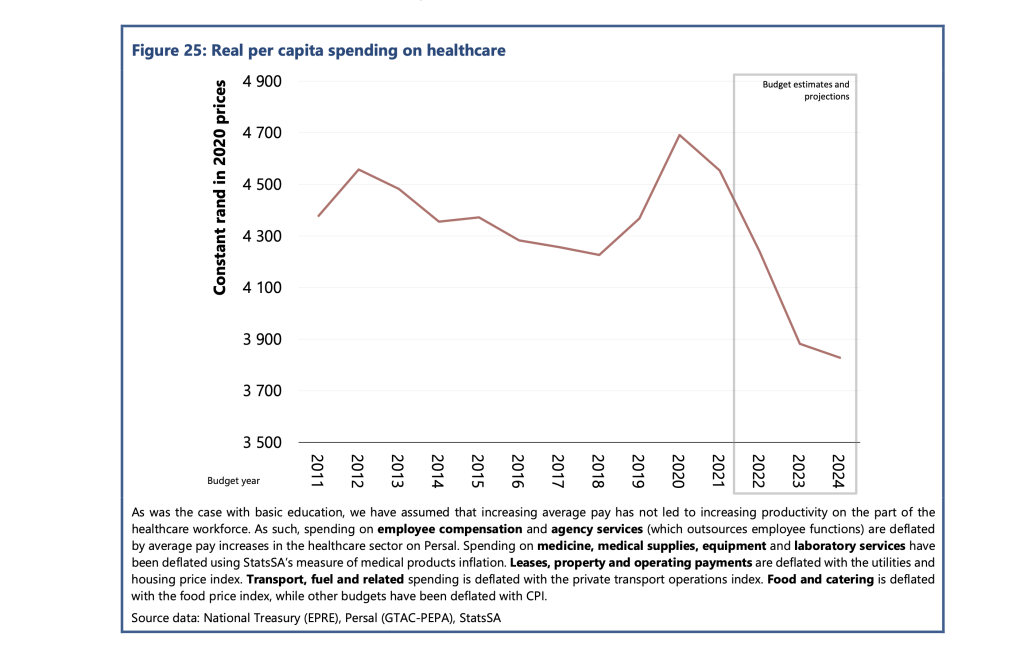
According to the Public Economy Project, the spending per healthcare user fell from approximately R4 600 in 2012 to R4 300 in 2018. PHOTO: Sourced from the Public Economy Project (PEP) Public services, government employment and the budget
Worse, this allocation needed to account for the rising demand projected for public healthcare services. Currently, about 84% of the population relies on the public health care system. This figure is projected to increase in response to population growth and rising unemployment making medical aid inaccessible for many in the country.
According to the Public Economy Project, after accounting for inflation and population growth, the spending per healthcare user fell from approximately R4600 in 2012 to R4300 in 2018. Based on current budget estimates, it is projected that real per capita public health spending will fall below R3 900 by 2024/25.
Implications for health care staffing
Although the 2023/24 budget proposed a measly 1.5% nominal increase to the public sector wage bill, President Cyril Ramaphosa approved a 3.8% increase for this year. However, Treasury’s cost containment measures have stipulated a hiring freeze for the rest of the 2023/24 financial year and no further allocations towards personnel expenditure. This is despite the Department of Health’s 2030 Human Resources for Health Strategy quantifying that 96 586 additional health workers are required to bolster the healthcare of all provinces to the same standard as the third-ranked province by 2025. This requires an additional cost of nearly R40 billion in total.
The real-life implications for South Africans are dire. Chris Hani Baragwanath Hospital – the largest hospital in Africa and the third largest hospital globally – faces significant staff shortages, cancelling almost 900 surgeries in 2022. The underpaid and overworked Chris Hani Baragwanath Hospital nurses have reported “pooling funds to buy patients bread.” Doctors at Nelson Mandela Bay’s Livingstone Tertiary Hospital have attributed “suboptimal, undignified patient care” to budget shortages and forecast higher medico-legal claims, which National Treasury described as a “sub-national risk”. However, budget measures that impede public health care’s ability to address staff shortages exacerbate the likelihood of errors by overstretched staff, worsening the medico-legal claims bill for health departments.
Gender and budget cuts
Health budget cuts disproportionately burden women. This burden is evident in the inordinate risk and prevalence of HIV that women face in the country. It is exacerbated by women’s higher and differentiated health needs (including those for reproductive and maternal health). Women-led households are 40% poorer, and unemployment is most prevalent among women. These socioeconomic factors make women more dependent on the public health system.
Budget cuts and underspending clearly have implications for gender equity in the country.
Furthermore, the Department of Health has recognised the healthcare workforce as a critical driver of inclusive economic growth and a means to create decent work for women, especially in rural and underserved communities. Over 90% of nurses in our public health system are women, and in our society of unequal gendered norms, it is also women who carry the care work burden in the home. Many will likely interpret any proposed MTBPS cuts without factoring gender equity implications as an under-appreciation of women’s labour in making a fragile healthcare system and society work.
A case for human rights budgeting
Although improving the country’s economic outlook is imperative, without consideration of the power that fiscal policy has in advancing human rights in the country, there is a likelihood of tabling an MTBPS that impedes the realisation of constitutionally guaranteed human rights in the country.
More than ever, our health system requires inculcation of human rights impact assessments as recommended by the UN Committee on Economic, Social and Cultural Rights, to which South Africa is a party. These assessments could compel policymakers to outline how the resources allocated will protect the right to access healthcare for all in the country, especially when budget cuts are considered. Including these considerations in budget policy may further advance meaningful public participation processes in fiscal policy.
Furthermore, a gender-responsive MTBPS is long overdue and a powerful means to protect the most vulnerable people in the country from reduced social investment. The health budget could be tagged to identify programmes with gender as a principal or significant objective and areas which would need to be protected and consideration of the gendered experience of healthcare to prevent fiscal policy from worsening gender inequities in the country. Budget policymakers should further promote the collection of gender-disaggregated data and establish indicators and benchmarks on gender and other socio-economic factors to advance a more equitable funding allocation.
Lastly, authentic public engagement will allow National Treasury and budget policymakers to solicit and table more equitable fiscal expansion alternatives. Increased public consultation could include extending the pre-budget consultations with the public.
Moreover, civil society organisations like the Institute of Economic Justice and the Alternative Information and Development Centre (AIDC) have proposed alternative approaches to fiscal constraints that could ensure sufficient resources to protect our frail public health system from threats to resource availability. These alternatives should be explored.
One strategy proposed is strengthening the country’s capacity to halt the significant revenue losses owing to to corporate tax abuses, including illicit financial flows (IFF) and base erosion and profit shifting (BEPS). IFF refers to the cross-border movement of illegally sourced funds while BEPS refers to when multinational companies shift the profits generated in South Africa to another jurisdiction that has lower or zero tax rates in order to minimise their tax burden.
The Financial Intelligence Centre estimates that between $15 billion and $25 billion is shifted out of our country to tax havens yearly. We call for greater urgency towards implementing publicly disclosed beneficial ownership registries based on country-by-country reporting and the automatic exchange of information, strengthening capital and exchange controls, and increasing South African Revenues Services (SARS) capacity to investigate corporations suspected to be involved in IFF and BEPS. These essential measures can contribute to curbing profit shifting, resulting in more than R100 billion in revenue each year.
The upcoming MTBPS will find National Treasury in a challenging position where various trade-offs will likely be made. In this harsh economic climate, if something has to give, it cannot be the constitutional right to health care for all in this country.
*Lencoasa is a Budget Researcher at SECTION27 and Steering Committee Member of the Budget Justice Coalition. Brown is Director of the Alternative Information and Development Centre and member of the Budget Justice Coalition.
Over the last decade, the National Health Department has rolled out a range of electronic surveillance systems to monitor medicine stocks throughout the country’s healthcare facilities. Many healthcare workers feel the new systems are making a positive impact, but stockouts persist due to a host of ongoing supply challenges.
“My problem with the clinic is that I get there as early as 7am and leave around 3pm. I [went] to the clinic to collect my hypertension tablets. We get into a long queue only to be told that they don’t have hypertension tablets. Not having my tablets poses a danger to my life. I get dizzy and I am unable to work. I [asked] for the day off from work to come [that day], then [had] to ask for another day off to do the same thing,” says a Klerksdorp resident interviewed by the community healthcare monitoring group Ritshidze.
According to a recent report from Ritshidze, between May and June this year, there were over 400 unique medicine stockouts reported in just 72 healthcare facilities across the North West province. In roughly the same period, doctors in the Eastern Cape reportedly struggled to treat patients with bone marrow cancer due to province-wide shortages of crucial chemotherapy drugs. And in August, Africa’s largest hospital, Chris Hani Baragwanath, allegedly faced a stockout of adrenaline for two days.
Though the problem is not exclusive to South Africa, recent news about medicine stockouts paints a gloomy picture of the country’s capacity to manage essential medicines. But the National Health Department’s Khadija Jamaloodien says these reports shouldn’t overshadow a broader trend. Instead, she argues that the health department has made significant strides to improve medicines availability through a series of national drug stock surveillance programs. (You can see Jamaloodien’s full and very informative response here.)
But what are these systems, and are they as effective as the health department claims?
Health department ramps up surveillance
In November 2013 a nation-wide survey of hospitals and clinics conducted by the Stop Stockouts Project found that more than 1 in 5 had experienced stockouts of ARVs or TB drugs in the previous three months alone. The National Health Department appeared to have little understanding of the severity of the problem – in April, 2014 they claimed that in the last 12 months there had been only a few stockouts of ARVs, restricted to two provinces.
As media attention on shortages grew, the department began to prioritise the issue and developed an extensive surveillance system to better monitor medicine levels throughout the country’s public healthcare facilities. One key program is RxSolution, a computer-based stock management system that pharmacists and nurses use to record the quantities of drugs that have been ordered, received and dispensed at their facilities.
The software was rolled out incrementally at hospitals from 2014 and is now used in healthcare facilities across the country. The data feeds back to a series of national, provincial and district-level dashboards which show medicine levels across facilities.
The central software platform that hosts these dashboards is called the National Surveillance Centre. According to Jamaloodien the platform “allows stakeholders at national and provincial levels to quantify or predict challenges in medicine supply…”.
Additionally, RxSolution generates reports which advise hospital staff on how much of a particular drug they need to order to prevent shortages or overstocking, and which medicines are due to expire.
A similar online tool is the Stock Visibility System, which is used to measure medicine levels at primary healthcare facilities across the country. Unlike RxSolution, it’s accessed on a cell phone app and the data is stored in the cloud (RxSolution requires an in-house server). Healthcare workers scan medicines using the app to capture stocks.
By October, 2021 3826 healthcare facilities had used the Stock Visibility System, RxSolution or other online systems to track drug stocks (roughly 90% of all public hospitals and clinics according to our calculations).
SA better at managing ARVs – trends unclear for other drugs
Evidently, shortages remain, but according to Jamaloodien, these systems have made a positive impact: “Good surveillance systems are one factor in a multifactor situation but do play an important role in reducing stockouts. This can be seen in the downward trend of major stockouts since introducing the surveillance systems…”
Verifying this is difficult however as the health department wasn’t able to provide data over a long period, and independent research has historically focused only on TB drugs or ARVs. Shortages of the latter do appear to have become less common. In 2013, a national survey found that 19% of healthcare facilities had a stockout of ARVs in the past three months. By contrast, interviews that were done with healthcare workers this year suggest that, depending on the quarter, only 5% to 9% could recall shortages of HIV medicines in the past three months.
Whether the surveillance systems played any role in this decline, and whether the same trend holds for stockouts of other drugs, is unclear.
Healthcare workers say software reduces stockouts
A paper published in June assessed the attitudes of 114 users of the National Surveillance Centre. These individuals, mostly managers and pharmacists at different levels in provincial health systems, are responsible for monitoring drug stocks and reporting shortages. Two-thirds of them said the introduction of the National Surveillance Centre in 2016 had improved medicines availability, as having so much data on drug stocks allowed them to be more proactive – for instance by redistributing stocks from facilities that contained an excess of a particular medicine to those with shortages.
Prior to the rollout of this system, many of these individuals had monitored medicine stocks by physically going to facilities or waiting for healthcare workers to notify them of a stockout.
Another paper published in May found positive attitudes toward the Stock Visibility System among healthcare workers who used the system at clinics in Kwazulu-Natal (mostly nurses and pharmacists). Almost three-quarters of the 206 surveyed staff felt that the phone app had improved stock management at their facility, though it had reportedly increased their workload.
This lines up with a national survey in 2017 which found that 87% of healthcare staff reported that the Stock Visibility System had reduced the frequency of stockouts.
Mncengeli Sibanda, a pharmacy expert at Sefako Makgatho Health Sciences University, says the application has clear benefits: “In the past we’d have to count stocks physically and write it by hand, now it’s captured electronically, limiting capture errors and allowing stock counts to be done more regularly…And at a national level, they can intervene [to prevent shortages] because they have data on stock levels at [most] clinics”.
Loadshedding hinders rollout
RxSolution – which is PC-based – appears to have been similarly well-received among some healthcare workers. Phelelani Dludla, the acting clinical manager of Benedictine hospital in Nongoma in KwaZulu-Natal, says that when the system was introduced at Benedictine in 2019 “it would assist us in making orders before we ran out of stock”. He explains that: “it would tell us [which] stocks would run out and so we’d…reorder them a week earlier than our usual routine”.
Dludla adds that it also assisted in reducing waste: “it helped with finding out which drugs we should cut down on in terms of spending, because they were frequently expiring and being sent back”.
But particularly for rural hospitals like Benedictine, infrastructural problems can pose obstacles. Dludla says that since 2021, network problems caused by loadshedding have prevented the use of RxSolution throughout the hospital. Today, the software is only used in the pharmacy. Sibanda explains that “ideally RxSolutions should be [in each section of the hospital], but there have been challenges”. Aside from loadshedding “some hospitals can’t get a computer into each and every ward,” he says.
Monitoring suppliers
The National Health Department has also been monitoring drug suppliers. Jamaloodien says that companies that are awarded national tenders to provide medicines are “contractually bound to [provide] up-to-date production pipeline data for products that they supply. The mandatory six-month pipeline window allows for proactive prediction and management of looming supply challenges.”
Policies like this have good international precedent. Preliminary evidence found that Canada managed to reduce drug stockouts by forcing pharmaceutical companies to notify them of any supply interruptions. To work, they need to be implemented effectively however, and the National Health Department has previously complained that companies weren’t routinely notifying them of supply interruptions.
Yet if the health department has generally been making such positive strides toward reducing shortages, why are there still so many stockouts?
Global shortages
Part of the problem is international, says Andy Gray, a pharmacy expert at the University of KwaZulu-Natal: “globally, there is a problem with the security of supply in the pharmaceutical industry. For example there are a number of older cancer drugs that are out of stock in the US at the moment, and the UK has had persistent problems with antibiotics.”
Indeed, last week the European Union announced details of a “solidarity mechanism” in which member states who face drug shortages can now request donations from other European countries if they have exhausted all other options. This was after Europe faced repeated shortages of key medicines over its winter.
If a single factory runs into a problem, this can disrupt global supply, including in South Africa, where locally made drugs usually require active ingredients from abroad. Indeed, a 2020 paper found that pharmacists in Gauteng’s hospitals were often left waiting for medicine orders for months after the delivery deadline and many believed that this was due to contracted suppliers facing shortages of active pharmaceutical ingredients.
Local dynamics also play a role however. Problems have historically included the failure of provinces to pay contracted suppliers on time, staff shortages at clinics (which force overworked nurses to be in charge of stock management) and delays in the awarding of pharmaceutical tenders.
Split tenders to reduce vulnerability of supply
According to Gray, another issue is the overreliance on individual companies: “all too often the contract [to supply a particular drug] is awarded to a single supplier”. The conditions of pharmaceutical tenders often stipulate that if the company can’t meet its contractual obligations, the government can turn to alternative suppliers. But that’s easier said than done, says Gray: “If that single supplier is unable to meet demand…the alternative suppliers in the country simply don’t have the volumes to substitute…especially if there’s no prior warning that there is going to be a problem in supply”.
Jamaloodien argues that: “many contracts are currently awarded with…quantities split among suppliers”. However, doing so more frequently would present its own problems, as requiring several companies to produce small amounts of drugs “can invite higher prices because the price is largely related to economies of scale”. In other words, it’s cheaper for one company to supply all the drugs.
Gray acknowledges this but argues that the trade-off needs to be made more often in certain cases: “Vital medicines for which there are no alternatives are being given to maybe one or two suppliers”. The vulnerability this creates can come at enormous cost to patients.
He urges: “for vital medicines we need more split tenders”.
Disclosure: Spotlight editor Marcus Low was a member of the Stop Stockouts Project steering committee for several years in the mid-2010s. Also, Ritshidze is mentioned in this article. Spotlight is published by SECTION27 and the Treatment Action Campaign (TAC) and TAC is a Ritshidze member organisation. Spotlight is however editorially independent – an independence that the editors guard jealously. Spotlight is a member of the South African Press Council and subject to the Press Code.
Diagram by the United States-based National Institute of Allergy and Infectious Diseases showing the medicine options for drug-resistant tuberculosis. (Via Flickr, CC BY 2.0 Deed)
The South African government and pharmaceutical company Johnson & Johnson (J&J) have agreed to a lower price for bedaquiline, a medicine used to treat drug-resistant tuberculosis (DR-TB) in South Africa.
This comes off the back of mounting pressure from activists and amid an ongoing investigation by the Competition Commission, looking into J&J’s pricing of the drug.
An estimated 14 000 people in South Africa fell ill with DR-TB in 2019. Bedaquiline is one of the main drugs used to treat DR-TB. Before bedaquiline became available, treatment for DR-TB would consist of up to two years of injections with serious side effects. The bedaquiline-containing regimen has no injectables, far fewer side effects and is typically six months.
Bedaquiline has been provided by the South African government since 2018.
In July, J&J agreed to sell bedaquiline to lower and middle-income countries through the Stop TB Partnership’s Global Drug Facility for $130 (R2470) per six-month regime, but South Africa does not make use of this facility due to national procurement policies.
Instead, about the same time that J&J made this announcement, the National Health Department agreed to pay J&J R5500 for the drug.
The Competition Commission announced in September that it will be investigating Johnson & Johnson’s pricing of the drug. The commission assisted the Department of Health in renegotiating the price, says department spokesperson Foster Mohale.
This week the department sent out a circular indicating that it will be paying R3,148 for bedaquiline.
Bedaquiline is prescribed to 7000 to 8000 people a year, Mohale told GroundUp. Mohale says the new price amounts to a 40% saving on bedaquiline for the next two years.
Candice Sehoma, Access Campaign Advocacy Advisor for Medicines Sans Frontiere (MSF), told GroundUp that the “momentous” cost saving is a “big achievement”. Sehoma says it is a sign that the global campaign to ensure accessible and affordable treatment for TB is yielding results.
MSF has estimated that bedaquiline could be manufactured and sold for profit for as little as $102 (R1940).
Fatima Hassan, director of the Health Justice Initiative, says that while the price drop is a victory, it is important to ensure that this does not happen again.
“The significant price reduction emphasises why price scrutiny is significant,” Hassan told GroundUp.
Alleged “evergreening”
J&J’s patent for bedaquiline expired in July 2023, but J&J had already applied for a new patent for a slightly different version of bedaquiline, which was granted. This meant their patent protection continued in South Africa after the original patent expired.
This amounts to “evergreening”, says Hassan. Evergreening, as explained in this article in The Conversation, “is achieved by seeking extra patents on variations of the original drug – new forms of release, new dosages, new combinations or variations, or new forms”.
The Competition Commission will be looking into J&J’s alleged “evergreening” as part of its investigation.
After making its agreement with the Global Drug Facility, J&J has announced it will not be enforcing the new patent – a move that will allow generic versions of the product to enter the market and further lower the price.
GroundUp sent questions to J&J but received no response.
By Robert Appelbaum & Prelisha Singh, Partners at Webber Wentzel
In Africa, dysfunctional governments are often unable to allocate sufficient funds for essential aspects of healthcare. This results in a shortage of new primary and specialised hospitals, little local pharmaceutical and medical device manufacture and the inability to train doctors beyond undergraduate level, creating a shortage of medical specialists.
In a recent seminar hosted by Invest Africa and moderated by Webber Wentzel, panelists Silven Chikengezha, Liza Eustace, Jen Pedersen, Jasen Smallbone and Dr Sue Tager, shared their insights on how to tackle the problems of financing healthcare in Africa, and building a pipeline of medical professionals who remain in Africa.
Funding
From the perspective of the IFC, the obvious need for greenfield hospitals in Africa is not sufficient to attract funding. To be attractive, projects need to meet certain criteria.
The first is that it must have a sponsor with experience in construction and operations. The second is that it has to have the potential to grow. It takes at least three years for a hospital to start making returns. Primary care is an identified area of potential growth on the continent, but it offers low margins so it needs to build up volumes. If the hospital is a primary healthcare facility that addresses an identified need in the local community, it is more likely to attract reliable footfall. But there is very little revenue in basic services like treating TB, AIDS and giving vaccination, so the facility should offer a range of affordable treatments.
The third criterion for any hospital project seeking funding is that it should have, or will be able to attract suitably qualified staff. Doctors like to work in complementary practice groups, so the hospital should be able to offer an attractive environment for medical professionals.
The next important issue is the certainty of cash flow. Although government-sourced revenue for the hospital can provide a steady income stream, governments can be slow payers. It is important to look at each government’s history of making timely payments. Commercial banks will also consider the affordability of the hospital’s services, given that a very small proportion of Africa’s population has medical insurance. In some countries, governments require employers to pay their employees’ medical bills, which provides a level of comfort to the banks. Technology can help to improve affordability, for example, innovations such as monitors that track the temperature of heat-sensitive medicines in transit, which reduces wastage.
A fifth critical issue for funders is the way the funding is structured. If a large hospital project is structured with 60-70% debt from its initial stages, it is likely to struggle to meet interest payments. It is better to start with a smaller facility that is scaleable, and structure the funding so that there is more equity than debt in the early years.
ABSA noted that they would seek strong equity holders before considering debt, and they will look carefully at who the main equity funders are. This is an area where the IFC and other Development Finance Institutions (DFIs) can play a role because they are usually willing to take the “first loss” risk, which encourages commercial banks to extend debt. Commercial banks take comfort from developers with strong balance sheets.
An emerging source of funding for healthcare projects in Africa (as well as other projects, such as in energy, water and education) are social impact bonds, in which an institutional funder will lend money to an implementer that can correctly manage a project that meets a need – often a need identified by the government. Corporates should be pooling their available funds to create scaleable projects that will make an impact.
If healthcare financing is intended to support existing service providers in Africa, it has to adapt to the capacity of what are often very small- to medium-sized businesses. These businesses, which may be anything from manufacturers of medical devices to providers of digi-health services, need far less than USD 20 million, so they tend to be ignored. But funding is essential to help established businesses build scale. This is another area where DFIs and commercial banks working together can help, as the DFI can provide the first loss facility which allows commercial banks to take risk on smaller clients.
Public-private partnerships
The pandemic made it clear that perceived obstacles between public and private entities in providing healthcare together could be overcome if there was the right will and people in the room.
Speakers discussed the Wits Donald Gordon Medical Centre as an example of a successful PPP, which could be replicated elsewhere. The Donald Gordon offers treatment to the private sector, and the derived profits are used to train medical students from Wits University, which is the public partner. The centre also performs liver transplants for all patients, both public and private. Mediclinic has a share in Donald Gordon but does not receive dividends. All profits are recycled back into the hospital.
A PPP model for the provision of healthcare needs partners who have similar levels of sophistication and can work together. Governments have to appreciate that the role of the private sector is not merely to bring money so that the government can continue running things the way they have always done. Private sector partners should be allowed to introduce the levels of efficiency in delivery that are typically found in the private sector.
It is often enlightening for us at Spotlight to ask how and why certain services differ in the ways they do between the private and public healthcare sectors.
Take something as simple as needing medical help when you have a flu that just won’t go away. As a private sector patient, I’d call my GP’s office and make an appointment. Providing I get there on time, chances are I would at most be asked to wait for 10 or 20 minutes in a comfortable waiting room. By contrast, at many public healthcare facilities, you are not able to make an appointment, and often have to wait for long hours in a poorly ventilated and overcrowded waiting area and will likely end up seeing a nurse rather than a GP.
Some aspects of such differences are understandable, albeit deeply problematic. The shortage of doctors is much more acute in the public sector than in the private sector. There is a moral imperative to address this imbalance, but as previously argued, the current NHI plans are just one way to address it.
Why some public healthcare facilities still do not use appointment systems is harder to explain. Even if some users prefer to queue rather than to have appointments, it is odd that all facilities do not at least have hybrid systems with some appointments and some queueing. Having appointment systems is not rocket science and doesn’t have to cost millions.
There are, of course, other examples. As a private healthcare user, it is relatively trivial for me to get a six-month chronic medication script from my GP and to arrange for the medicines to be delivered to my home. Though there has been significant progress in this direction in the public sector, many people still find it hard to get scripts and collect their medicines.
Of course, differences in available resources are a large part of what is going on here, but it is not the whole story. As a private healthcare user, my needs, my preferences, and my time are generally respected in a way that seems rare in the public sector. To be clear, there are many committed healthcare workers in the public sector who show exemplary respect for their patients, but at a systemic level, as in the decision not to have appointment systems or not to allow for extended medicine refills, people’s time and needs are being disregarded.
Apart from the risk of corruption and mismanagement, much of the middle-class resistance to NHI may well have to do with the fear that people who can now access private healthcare services will become subject to precisely this kind of systemic indifference to their needs. And indeed, while the rhetoric around NHI has often been about ideals like the need for greater social solidarity, we haven’t really seen a vision presented of NHI as offering better, more respectful, and more personalised healthcare.
But, with a bit of flexibility, this could change.
Consider annual checkups. Rather than asking public sector patients to go to overcrowded clinics with long queues for tests, why not give public sector users the option of getting their basic screening tests for HIV, TB, hypertension, and diabetes done at private sector pharmacies along the lines of Discovery Health’s Annual Health Checkup. Of course, data systems will have to be developed to support this and it will have to be budgeted for, but the extra convenience will no doubt make a big difference for many and could help with early detection of these diseases. (We previously wrote about the idea of such an expanded annual checkup programme here.)
Getting the state to pay for such checkups at private sector pharmacies is not exactly NHI as set out in the bill, but the idea certainly shares some DNA.
To be fair, there are at least some exceptions that show such innovation is possible. Maybe most notably, these days many public sector patients can collect their chronic medicines at private pharmacies or other pickup points. Though still a work in progress, the evolution of the public sector medicines distribution system shows that we need not wait for the NHI Bill before taking steps to make things easier and more convenient for users.
In addition, with the NHI pilot projects we have seen at least some awareness that there is a need to try new things and learn from them. Unfortunately, on the whole the NHI pilot projects didn’t meaningfully pilot the key aspects of NHI, and where they did, as with GP contracting, it didn’t go well. And here one gets to the rub. From the outside one gets the impression that those who wanted to run pilots we could actually learn from lost out to those who consider the pilots just another step toward building political support for NHI.
As for the NHI Bill itself, the fact that the ANC and much of the portfolio committee on health, has been intent on reducing almost all discussion on the Bill to a simple for or against shows a clear disdain for meaningful engagement. Indeed, whatever its merits, the ANC’s version of NHI has become fundamentally associated with an overdose of ideology and an absence of curiosity and critical thinking.
But we don’t have to buy into the ANC’s sclerotic thinking.
There are many possible ways to reform and improve our healthcare system. Some will be affordable, some won’t. Either way, it would be foolish to simply turn our backs and pretend they are not there.
The Department of Health has averted a standoff with nurses in the public sector with a last-minute agreement to pay nurses a temporary allowance to buy uniforms.
Nurses threatened to work in their own clothes if the department failed to provide them either with uniforms or with an allowance by 1 October. This plan was put on hold pending negotiations between unions and the health department.
Since 2005, nurses received an annual allowance to buy their uniforms. But this ended on 31 March this year after a new agreement was signed by the Public Health and Social Development Sectoral Bargaining Council. Under the new agreement, nurses would be provided with uniforms.
As a result, nurses did not get the usual allowance in April this year. Instead, they were supposed to be provided with uniforms by 1 October 2023.
The agreement stated that in the first year, the department must provide nurses with four sets of uniforms, one pair of shoes, and one jersey. In the second year, it must provide three sets of uniforms, one belt, and one jacket.
But then, at a last-minute meeting of the bargaining council in September, the department told unions that it would be unable to meet the 1 October deadline. It proposed to put on hold the supply of uniforms until 2024.
Spokesperson for the Democratic Nursing Association of South Africa (DENOSA) Sibongiseni Delihlazo said labour unions said that if the department was unable to supply the uniform by 1 October, they must pay nurses an allowance as previously.
If the department failed to provide uniforms or pay an allowance, DENOSA said, its 84,000 members would embark on an indefinite protest action by wearing their own clothes at work from 1 October.
Following the last-minute bargaining council meeting in September, a new agreement was signed on 4 October.
The bargaining council resolved that a temporary uniform allowance of R3,153 be paid to all qualifying nurses by 30 November 2023. The health department also agreed to provide nurses with uniforms by 1 September 2024.
If the department fails to provide the uniforms by 1 September 2024, “the uniform allowance shall continue, considering the applicable inflation rate annually, as pronounced by the National Treasury in February”, the agreement read.
For National Health Insurance to succeed in South Africa, a meaningful collaboration needs to take place between private and public health care so as to speed up the implementation of the initiative and overcome major obstacles.
This was the opinion of the five panellists who on the first day of the Hospital Association of South Africa conference in Cape Town spoke of how best the NHI could be rolled out by calling on private health care for assistance.
“’It’s fundamental to the economic growth that we so desperately need in South Africa, and a productive nation needs access to health care. So we do need to address the inequalities, we need to address the gap and do not need to preserve the status quo,” said Professor Roseanne Harris, of Discovery Health.
But a concern she raised is the risk of the introduction of a single funding model reliant on taxes, and the introduction of a monopoly market.
“And one of the implications of the bill is centralisation (of health care). There is a need for planning to ensure that it won’t have an unintended consequence of impacting service delivery and impacting on the rights of the healthcare personnel,” she added.
Harris said that both the private sector and public sector needed to go through a consultative process and that sustainable critical milestones needed to be put in place to hold the process to account.
Another panellist at the event Dr Simon Strachan of the South African Private Practitioners Forum (SAPPF), pointed out that the COVID pandemic showed how public and private health care could collaborate successfully. Here service agreements between the two entities were met and were focused solely on fighting the pandemic.
“So to create the way forward, what we need to be able to do is to have a very clear understanding of what it is we’re trying to achieve, that there is robust trust, and that there is a groundwork for sustainable collaboration,” he explained.
An urgent need for this collaboration he said was the recent introduction of Section 33 of the NHI bill, which in its present form would have health care professionals working for the state at a fee the state sets, with benefits not included.
A second issue he said was the need for a successful funding model that will be acceptable to all South Africans.
Economist Nicola Theron of FTI consulting told the audience that structures already in place and used in the private sector could make for a smoother transition for the NHI. In particular when it comes to issues like the pricing of medicines.
“We are now at a point with the current NHI that there are talks about the lowest possible price at a reasonable return for healthcare providers. There is no indication of what return means,” she said.
“But what we have is an existing system of pricing which has been developed over time, and which should form the basis of pricing going forward,” said Theron.
By not getting the pricing right could lead to investment leaving South Africa, she warned. She suggested in turn that it would be a better model to have multiple buyers that will stimulate competition.
Dr Ali Hamdulay, CEO, Metropolitan Health, said that a way forward would be to implement the suggestions that came out of the Health Marketing Inquiry that took a hard look at both the public and private health care systems, outlining the problems with both.
“So effectively by addressing the recommendations of the Health Market Inquiry you’re actually foster an environment of culture and direction to work towards universal health care,” said Hamdulay.
Barry Childs, of Insight Actuaries, said that while fundraising mechanisms in the public sector needed to be improved, the introduction of the NHI offers a great opportunity to reform the healthcare system.
“As much as we talk about the need for reform of the private sector side, there’s been no meaningful reform of the public sector for many decades. And the NHI is a wonderful opportunity for them to introduce some better, more responsive financing mechanisms.” he said.
But for NHI to ultimately provide the services it promises, Childs said South Africa’s economy needed to improve, and more jobs to be created.