

Is It Anxiety or OCD? 2 Psychology Experts Explain the Difference

Emily Upton, UNSW Sydney; Black Dog Institute and Kayla Steele, UNSW Sydney
Anxiety itself is not a mental illness. It’s a normal, adaptive emotion that helps us respond to perceived threats.
Anxiety is the automatic reaction that makes you jump back when you think you’ve seen a snake while bushwalking – before realising it’s a stick.
It’s also (inconveniently) the sweaty palms and shaky voice you notice before a presentation or a first date, or the circling thoughts that keep you awake at 3am.
Most of us have ways to cope with anxious thoughts and feelings that can give us more of a sense of control. This could be checking and double-checking we’ve got the room right for our presentation, or seeking reassurance from someone we love.
But when might these behaviours fit a diagnosis of an anxiety disorder? And when could they actually be a sign of obsessive compulsive disorder (OCD)?
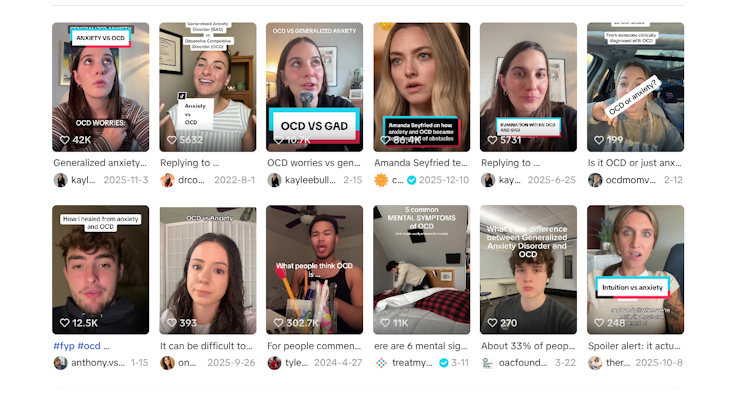
As clinical psychologists, we find these questions come up a lot, perhaps spurred by a recent surge of interest in OCD on social media. So what’s the difference between anxiety and OCD? And how are they treated?
When is anxiety something more serious?
“Normal” anxiety can become an anxiety disorder when fears or worry are persistent, intense and start interfering with everyday life.
About one in three people will experience an anxiety disorder at some point in their lifetime.
Among the most common are social anxiety disorder (fear in social situations), panic disorder (frequent panic attacks, and fears you’ll have another) and generalised anxiety disorder (persistent and excessive worry).
These disorders have slightly different symptoms. But all share excessive and persistent fear or worry that causes distress or leads people to avoid important parts of life including work, study or social activities.
So, what about OCD?
Although OCD involves anxiety, it is actually considered a separate disorder in the diagnostic manual used by mental health professionals.
It is possible to have both – around half to three-quarters of individuals with OCD also meet criteria for one or more anxiety disorders as well.
OCD involves obsessions, compulsions, or both. These cause significant distress or interfere with daily functioning.
Obsessions are intrusive, unwanted thoughts, images or urges. This could mean an intense fear your food is contaminated, suddenly visualising hurting someone, or a feeling that keeps entering your mind that you’ve made a serious mistake.
Compulsions are the repetitive behaviours (or mental rituals) people feel driven to perform to ease that distress, such as checking, repeating phrases, excessive hand-washing or seeking reassurance.
Many of us will occasionally experience unwanted thoughts or go back to check the oven is actually off. Keeping things tidy or being particular about routines can simply be habits that don’t cause distress.
But what makes OCD different is its severity and impact.
If obsessions or compulsions take up large amounts of time, cause you significant distress, or interfere with daily life, it may be a sign of OCD.
You can’t “spot” OCD from behaviour alone. OCD can also be invisible because many compulsions happen mentally, such as repeating phrases or counting. People with OCD may also try to hide their symptoms out of shame.
Are OCD and anxiety treated differently?
While anxiety disorders and OCD share some similarities, including repetitive distressing thoughts, the patterns and beliefs driving them are different. This means the way they’re treated will also differ.
Cognitive behavioural therapy (CBT) is one of the most effective treatments for both anxiety disorders and OCD.
For OCD, treatment often involves a specialised form of CBT called exposure and response prevention (ERP). It involves gradually facing situations that trigger distressing thoughts while resisting the urge to perform compulsions.
For example, someone with contamination fears might gradually reduce the number of times they wash their hands before eating. Over time, people learn the feared outcome does not occur, that they can tolerate their discomfort without the ritual, and that the anxiety passes on its own.
Treatment for anxiety disorders focuses on the specific fear. For generalised anxiety, for example, it involves understanding patterns of worry, challenging beliefs that keep worries going, and developing more helpful ways to respond to problems, such as brainstorming solutions and taking small actions.
Antidepressant medication (particularly selective serotonin re-uptake inhibitors, or SSRIs) can be an effective component of treatment for both anxiety disorders and OCD. A combined treatment approach of medication (SSRIs) and therapy (CBT) often leads to the best treatment outcomes, especially for severe OCD.
A final note
While it’s great mental health is being discussed more openly online and stigma is reducing, social media can also blur the line between personal experience and evidence-based information.
If something you’ve seen online has sparked curiosity about your mental health, the best next step is to talk with a qualified professional who can help you understand what you’re experiencing and what support might help.
For more information and resources about anxiety and OCD, visit the Black Dog Institute or Beyond Blue, and ReachOut or Headspace for young people.
There are lots of evidence-based online treatment programs for anxiety disorders and OCD you can access for free or low-cost, such as This Way Up, MyNewWay or Mindspot.
There are also online treatments for kids and teens with OCD and anxiety.
You can also ask your GP about a Mental Health Care Plan for Medicare-rebated psychology sessions.
Emily Upton, PhD Candidate in Psychology, UNSW Sydney; Black Dog Institute and Kayla Steele, Postdoctoral Research Fellow and Clinical Psychologist, UNSW Sydney
This article is republished from The Conversation under a Creative Commons license. Read the original article.

