

Tag: cold temperatures

Kids Do Feel the Cold. So Why Won’t They Wear a Jumper?

Zachary Kadolf/Unsplash

Joshua Pate, University of Technology Sydney

It happens just when you need to leave. Bags are packed. Shoes are on. Then your child decides a jumper is impossible.

You say, “put your jumper on”.

They say, “I’m not cold”.

Do kids really not feel the cold like adults do? Or are they just expressing their independence? And when should you insist?

A clue from pain research

I study how children experience pain, and pain research offers one clue about this jumper battle.

A child may scrape their knee during a game and barely notice until the game stops. The scrape was there throughout, but chasing a friend or reaching the next base kept winning their attention.

Cold can slip into the background in a similar way. A child’s fingers may be cooling while the playground remains far more compelling. Then the game ends.

Their attention returns to their hands at around the same time their moving muscles stop producing so much heat. Suddenly, the jumper may seem like a better idea.

So “I’m not cold” can mean, “I can feel it and I’m comfortable”.

It can also mean, “the jumper feels worse” or “I want to keep playing”. Sometimes it means, “I am four years old and this has become a matter of principle”.

Similarly, when parents ask, “but aren’t you cold?” we’re often asking several questions at once.

Will you still be warm when you stop running? What if the wind picks up? How about later, when we’re standing still on the sideline at the soccer field?

Children report the present moment, and parents factor in the forecast.

What cold actually feels like

Your skin contains sensory nerve endings that respond as its temperature changes.

One cool-sensitive channel, called TRPM8, helps convert cooling at the skin into electrical activity in sensory nerves.

This is the same channel that menthol activates, which is why mint can make your mouth feel cool even when there’s no real temperature change.

And as you know with mint, a strong cooling sensation can sometimes become uncomfortable or even painful. Other factors such as wind, wetness, contact with cold surfaces, movement, and how much time we’re outside can all influence how we experience temperature.

For example, a parent who is standing still in a playground, clutching a coffee, may be acutely aware of the gap in their coat where the icy wind is sneaking in.

But children tend to run, climb and jump in bursts – and moving muscles produce heat.

Children also differ from adults in body size, body composition, metabolism and how their circulation responds to cold.

One 2024 laboratory study, done indoors, looked at children aged six to nine. It found their sedentary metabolic rates (how much energy you’re burning when you’re resting) were around 39% higher compared to adults in the study.

Their skin was also warmer over parts of their torso, and the skin on their hands recovered temperature and bloodflow faster than adults after being exposed to the cold.

So it’s not that kids don’t feel cold at all, but they may have a quite different experience from an adult standing in the same air.

Bodies prepare for what comes next

We often learn about thermoregulation – how the body maintains its core temperature – as though the body were simply a thermostat. The body detects a temperature change, then bloodflow changes, and sweating or shivering bring it back towards the middle.

But our movement and behaviour also play an important role in maintaining this balance. When we’re cold we may walk into sunshine, curl up, or add a layer; when we’re hot we take one off. A child who keeps running may already be generating the warmth they need.

Bodies also prepare for expected demands. Researchers use the term allostasis to describe this wider process of how the body maintains stability through change.

Some adjustments happen automatically. For example, before we exercise, our heart rate and breathing begin adjusting for the work ahead. Others involve choices, such as moving into the sun, seeking shelter or reaching for warmer clothing.

But young children outsource some of this forecasting to adults.

Kids supply the live report from inside their body. We add the weather forecast and the schedule. We pack snacks for hunger that has yet to arrive, spare clothes for puddles yet to be found, and jumpers too.

What the jumper itself feels like

A jumper creates its own sensations. It may feel scratchy, bulky or restrictive. It can make climbing harder, then become hot and sweaty as soon as the child starts running.

Tags, seams and some fabrics can feel intensely unpleasant, especially for children with tactile sensitivities. Clothing tags and light touch, for example, can cause marked discomfort for some autistic children.

A child may genuinely prefer mildly cold skin over an irritating texture.

So it’s worth asking whether “aren’t you cold?” is the right question. Others may work better:

are you comfortable?

will you be running or sitting still?

would you rather wear the jumper or carry it?

These questions help children connect what they feel now with what they may need later.

When should parents insist?

Parents should be firmer when a child is very young, wet, unwell, exposed to strong wind or likely to remain outside for a long time.

Persistent shivering or numbness means it is time to get warm. Increasing clumsiness, unusual drowsiness, confusion or reduced responsiveness can indicate hypothermia, where the body’s core temperature has fallen dangerously low. Hypothermia is a medical emergency.

But for ordinary winter outings, flexible layers allow the plan to change. A jumper can be carried, added when activity slows, and removed when the child warms up again.

Your child reports the weather inside their body. You keep an eye on the weather outside it. A jumper in the bag lets your child feel heard, lets you keep the forecast in view, and lets everyone finally get out the door.

Joshua Pate, Associate Professor of Physiotherapy, University of Technology Sydney

This article is republished from The Conversation under a Creative Commons license. Read the original article.
How Body’s ‘Cold Sensor’ Works – and Why Menthol Tricks it

First-ever molecular snapshots show the body’s “cold sensor” in action, with implications for treating pain, migraines, and dry eye

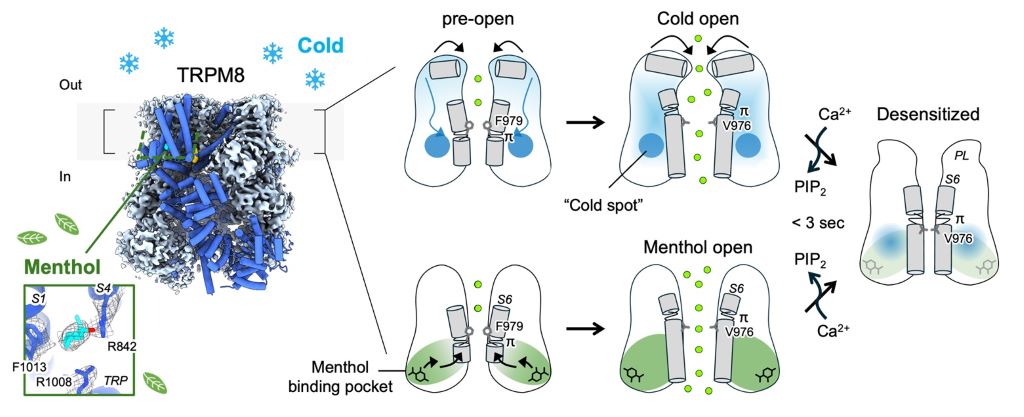
Using cryo-electron microscopy, researchers captured multiple conformational snapshots of the cold sensing channel, TRPM8, as it transitions from closed to open.

When you step outside on a winter morning or pop a mint into your mouth, a tiny molecular sensor in your body springs into action, alerting your brain to the sensation of cold. Scientists have now captured the first detailed images of this sensor at work, revealing exactly how it detects both actual cold and the perceived cool of menthol, a compound derived from mint plants. The research was presented at the 70th Biophysical Society Annual Meeting in San Francisco from February 21–25, 2026.

The study focused on a protein channel called TRPM8. “Imagine TRPM8 as a microscopic thermometer inside your body,” said Hyuk-Joon Lee, a postdoctoral fellow from Seok-Yong Lee’s laboratory at Duke University. “It’s the primary sensor that tells your brain when it’s cold. We’ve known for a long time that this happens, but we didn’t know how. Now we can see it.”

TRPM8 sits in the membranes of sensory neurons innervating the skin, oral cavity, and eyes. It responds to cold temperatures – roughly between 8°C and 28°C – by opening up and allowing ions to flow into the cell, which triggers a nerve signal to the brain. It’s also the reason menthol, eucalyptus, and certain other compounds produce that characteristic cooling sensation.

“Menthol is like a trick,” Lee explained. “It attaches to a specific part of the channel and triggers it to open, just like cold temperature would. So even though menthol isn’t actually freezing anything, your body gets the same signal as if it were touching ice.”

Using cryo-electron microscopy – a technique that images flash-frozen proteins with an electron beam – Lee and colleagues captured multiple conformational snapshots of TRPM8 as it transitions from closed to open. They discovered that cold and menthol activate the channel through shared yet distinct allosteric networks: cold primarily triggers changes in the pore region (the part that actually opens to let ions through), while menthol binds a different part of the protein and induces shape changes that propagate to the pore.

“When cold is combined with menthol, the response is enhanced synergistically,” Lee said. “We used this combination to capture the channel in its open state – something that hadn’t been achieved with cold by itself.”

The findings have medical implications. When TRPM8 doesn’t function properly, it has been linked to conditions including chronic pain, migraines, dry eye and certain cancers. Acoltremon, a drug that activates TRPM8, is an FDA-approved eye drop for dry eye disease. As a menthol analogue, it works by activating the cooling pathway to stimulate tear production and soothe irritated eyes.

The researchers also identified what they call a “cold spot” – a specific region of the protein that is uniquely important for sensing temperature and helps prevent the channel from becoming desensitised during prolonged cold exposure.

“Previously, it was unclear how cold activates this channel at the structural level,” Lee said. “Now we can see that cold triggers specific structural changes in the pore region. This gives us a foundation for developing new treatments that target this pathway.”

The work offers the first molecular definition of how cold and chemical stimuli are integrated to create the sensation of coolness – answering a fundamental question in sensory biology that has puzzled scientists for decades.

Source: Biophysical Society

Researchers Uncover Protein that Enables Sensation of Cold

Photo by Ian Keefe on Unsplash

University of Michigan researchers have identified the protein that enables mammals to sense cold, filling a long-standing knowledge gap in the field of sensory biology. The findings, published in Nature Neuroscience, could help unravel how we sense and suffer from cold temperature in the winter, and why some patients experience cold differently under particular disease conditions.

“The field started uncovering these temperature sensors over 20 years ago, with the discovery of a heat-sensing protein called TRPV1,” said neuroscientist Shawn Xu, a professor at the U-M Life Sciences Institute and a senior author of the new research.

“Various studies have found the proteins that sense hot, warm, even cool temperatures – but we’ve been unable to confirm what senses temperatures below about 60 degrees Fahrenheit (15.5°C).”

In a 2019 study, researchers in Xu’s lab discovered the first cold-sensing receptor protein in Caenorhabditis elegans, a species of millimetre-long worms that the lab studies as a model system for understanding sensory responses.

Because the gene that encodes the C. elegans protein is evolutionarily conserved across many species, including mice and humans, that finding provided a starting point for verifying the cold sensor in mammals: a protein called GluK2 (short for Glutamate ionotropic receptor kainate type subunit 2).

For this latest study, a team of researchers from the Life Sciences Institute and the U-M College of Literature, Science, and the Arts tested their hypothesis in mice that were missing the GluK2 gene, and thus could not produce any GluK2 proteins. Through a series of experiments to test the animals’ behavioural reactions to temperature and other mechanical stimuli, the team found that the mice responded normally to hot, warm and cool temperatures, but showed no response to noxious cold.

GluK2 is primarily found on neurons in the brain, where it receives chemical signals to facilitate communication between neurons. But it is also expressed in sensory neurons in the peripheral nervous system.

“We now know that this protein serves a totally different function in the peripheral nervous system, processing temperature cues instead of chemical signals to sense cold,” said Bo Duan, U-M associate professor of molecular, cellular, and developmental biology and co-senior author of the study.

While GluK2 is best known for its role in the brain, Xu speculates that this temperature-sensing role may have been one of the protein’s original purposes. The GluK2 gene has relatives across the evolutionary tree, going all the way back to single-cell bacteria.

“A bacterium has no brain, so why would it evolve a way to receive chemical signals from other neurons? But it would have great need to sense its environment, and perhaps both temperature and chemicals,” said Xu, who is also a professor of molecular and integrative physiology at the U-M Medical School. “So I think temperature sensing may be an ancient function, at least for some of these glutamate receptors, that was eventually co-opted as organisms evolved more complex nervous systems.”

In addition to filling a gap in the temperature-sensing puzzle, Xu believes the new finding could have implications for human health and well-being. Cancer patients receiving chemotherapy, for example, often experience painful reactions to cold.

“This discovery of GluK2 as a cold sensor in mammals opens new paths to better understand why humans experience painful reactions to cold, and even perhaps offers a potential therapeutic target for treating that pain in patients whose cold sensation is overstimulated,” Xu said.

Source: University of Michigan