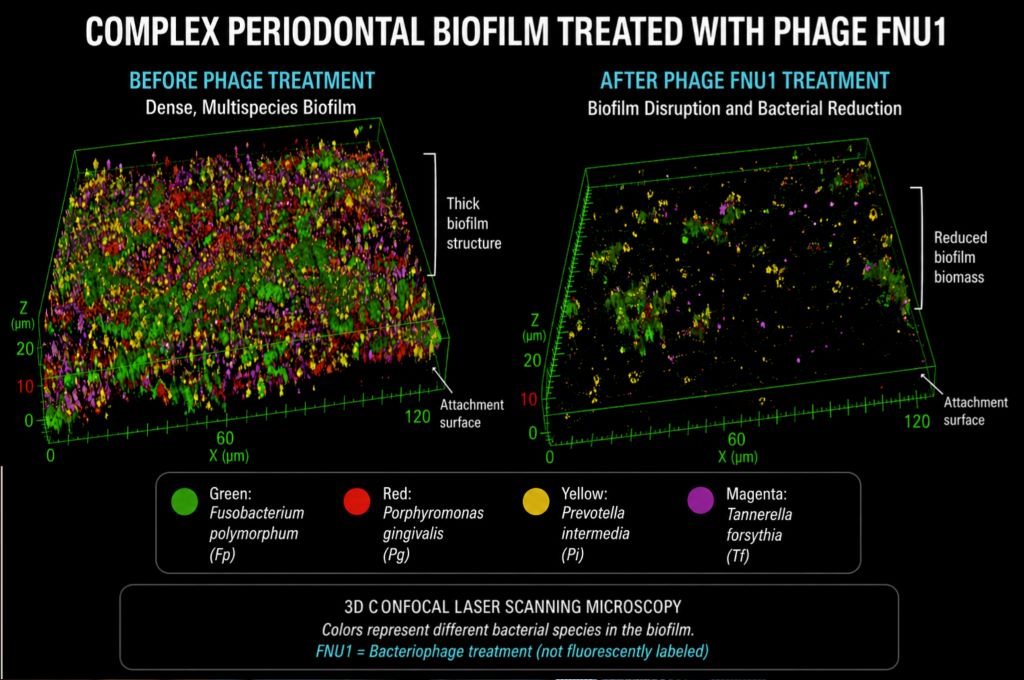
Scientists have shown that a naturally occurring virus can dismantle complex bacterial communities responsible for severe gum disease, offering a potential alternative to traditional antibiotics.
In the first study to demonstrate this effect, La Trobe University researchers found the FNU1 virus selectively attacked Fusobacterium polymorphum, a bacterial species that helps other disease-causing bacteria to stick together and thrive.
The virus reduced total bacterial levels by 94 per cent, leaving only about six per cent of the original disease-causing plaque intact.
Despite targeting just one bacterial species, the treatment dramatically reduced the size and density of the plaque, with levels of three other bacteria linked to gum disease falling by more than 85 per cent.
Dr Mwila Kabwe, lead author and Post Doctoral Research Fellow at La Trobe’s Holsworth Biomedical Research Centre, said the findings were important given gum disease affects more than half the world’s population and remains a leading cause of tooth loss.
The research focused on bacteriophages or phages, viruses that infect bacteria but are harmless to humans.
“Current treatments for gum disease don’t directly target the bacterial imbalance that drives the disease, and the dense layers of bacteria that form around teeth can be resistant to antibiotics,” Dr Kabwe said.
“By targeting one of the key bacteria that holds these disease-causing communities together, we were able to destabilise the entire plaque community.
“The findings suggest phages could offer a more precise way to treat gum disease while preserving healthy bacteria.”
While the laboratory findings are promising, further research is needed before phage-based treatments could be used in dental practice.
The study forms part of Dr Kabwe’s early career-research investigating how phages could be used to target harmful bacteria linked to oral disease and other chronic health conditions.
A targeted approach using bacteriophages to disarm harmful microbes without disrupting the broader gut ecosystem
Credit: CC0
A research team at McMaster University has developed a targeted approach to treating inflammatory bowel disease (IBD) using bacteriophages, viruses that infect specific bacteria, to disarm harmful microbes without disrupting the broader gut ecosystem.
The study, published in Science Translational Medicine and featured on the cover of the journal, brings together researchers from the Faculty of Engineering and the Faculty of Health Sciences, combining expertise in microbiome science and targeted antimicrobials to tackle a complex challenge in gut health.
Although current treatments for IBD can be effective, they can fail long-term or require escalating doses, increasing the risk of serious side effects.
IBD is shaped by a combination of genetics, immune responses and the gut microbiome. The research team focused on a group of bacteria known as adherent-invasive Escherichia coli (AIEC), which have been linked to inflammation in some people with Crohn’s disease. These bacteria can be difficult to identify and selectively target, making them an important test case for more precise microbiome-based therapies.
“One challenge is that AIEC are defined by what they do, not simply by how they appear in a microbiome analysis,” says Elena Verdu, professor in the Department of Medicine, director of the Farncombe Family Digestive Health Research Institute, and an executive member of NexusHealth.
“To identify them, we need to test their behaviour, such as their ability to adhere to and invade intestinal cells and persist in immune cells.”
Working with E. coli strains isolated from patients with Crohn’s disease, the team used controlled experimental models to isolate how AIEC contribute to inflammation and explore ways to neutralise their harmful behaviour without damaging beneficial bacteria.
To target AIEC without collateral damage, the team turned to bacteriophages, or phages, which are naturally occurring viruses that infect bacteria with remarkable precision.
“Phages work like a lock-and-key system – each phage targets only certain bacteria. That precision gives us a way to intervene without wiping out the entire microbiome,” explains Zeinab Hosseinidoust, associate professor in the Department of Chemical Engineering and the School of Biomedical Engineering and a member of the Michael G. DeGroote Institute for Infectious Disease Research (IIDR).
The team identified and characterised phages that selectively target AIEC strains isolated from patients with IBD and found that this approach significantly reduced gut inflammation.
The phages did not eliminate the bacteria entirely. Instead, they altered their behaviour by supressing a molecular “grappling hook” that helps AIEC attach to the gut lining and trigger immune responses. When that virulence mechanism was turned off, inflammation subsided.
“The bacteria were still there, but they lost the traits that drive inflammation,” says Hosseinidoust.
“We like to think of it as knocking out a few teeth. The bacteria can’t do as much damage anymore.”
The researchers also found that phage therapy enhanced the effectiveness of a commonly used steroid treatment for IBD. When combined with the phage, a lower-than-standard dose produced benefits comparable to higher doses of the drug alone.
While phages have previously been shown to increase the effectiveness of antibiotics, this is the first time a positive collaboration between phage and a non-antibiotic drug has been reported.
The findings point to a precision-medicine approach for IBD. The bacterial function targeted by the phage can be measured in stool samples and was found to be higher in a subset of patients with Crohn’s disease, suggesting a potential way to identify those who could benefit most from this therapy.
“If we can identify which patients carry the harmful bacterial function, we could, in the future, intervene with a targeted therapy designed specifically to turn down that activity,” says Verdu.
“This is what personalised medicine should look like: matching the right biological tool to the right patient,” says Hosseinidoust.
Next steps for the team include evaluating broader collections of bacterial strains from IBD patients and developing combinations of phages – work that brings the approach closer to human trials.
Researchers in Austria have discovered a new approach to treating atopic dermatitis: bacteriophages, which colonise the skin as viral components of the microbiome and can drive the development of innovative atopic dermatitis therapies. The research results were recently published in the scientific journalScience Advances.
Until now, the importance of bacteriophages in the human body has been known primarily from analyses of the intestine. In the search for innovative therapeutic measures for atopic dermatitis (AD), the MedUni Vienna research team led by Wolfgang Weninger, Head of the Department of Dermatology, has now investigated the interaction of phages and bacteria in the skin for the first time. After all, it has long been known that the progression of AD is accompanied by massive changes in the skin microbiome. The microbiome is the sum of all microorganisms on the skin and has been primarily investigated for its bacterial constituents. It has been unknown whether viruses also contribute to the nature of the bacterial microbiome in healthy and diseased skin. Phages are viruses of different types and functions whose sole aim is to infect bacteria, thereby either destroying them – or stimulating them to multiply.
New phages identified
“In our study, we discovered previously unknown phages in the microbiome of the skin samples of AD patients, which help certain bacteria to grow faster in different ways,” note first authors Karin Pfisterer and Matthias Wielscher from the Department of Dermatology at MedUni Vienna. The resulting shift in the balance between phages and bacteria was not detected in the comparative samples from healthy individuals and may be one explanation for the overpopulation of the skin microbiome with bacteria called Staphylococcus aureus found in AD. These findings contribute significantly to a better understanding of the skin bioflora in AD patients and pave the way for the development of new targeted therapeutic interventions: By identifying and culturing phages specialised for Staphylococcus aureus, a promising new option is available.
Specialists for targeted therapy
Bacteriophages are found not only in the body, but in every habitat populated by bacteria. There are a staggering 1031 different phage species. One of their characteristics is that they prove to be extremely specific when it comes to choosing their target of infection: most phages specialise in a particular genus, and in many cases in only a single species of bacteria. While that makes it a challenge for scientists to identify the type of phage needed for a particular purpose, it also enables them to use them in a targeted manner. Bacterial viruses do not make any difference between antibiotic-resistant and other bacteria, thus they are being researched as possible weapon in the fight against multi-resistant pathogens. Further studies are now planned to confirm phage therapy for topical use in atopic dermatitis.
Using bacteriophages, viruses which prey on bacteria, is an emerging alternative to antibiotic use but with limited evidence. Now, with a new paper published in Clinical Infectious Diseases, collaborators report 20 new case studies on the use of the experimental treatment in Mycobacterium infections, with successes in more than half of the patients.
This is the largest ever set of published case studies for bacteriophage (or ‘phage’) therapy, giving unprecedented detail on their use to treat dire infections while laying the groundwork for a future clinical trial.
“Some of those are spectacular outcomes, and others are complicated,” said Professor Graham Hatfull at the University of Pittsburgh. “But when we do 20 cases, it becomes much more compelling that the phages are contributing to favourable outcomes – and in patients who have no other alternatives.”
The patients in the study had an infection from one or more strains of Mycobacterium, a group of bacteria that can cause deadly, treatment-resistant infections in those with compromised immune systems or cystic fibrosis. In 2019, Prof Hatfull led a team showing the first successful use of phages to treat one of these infections.
“For clinicians, these are really a nightmare: They’re not as common as some other types of infections, but they’re amongst some of the most difficult to treat with antibiotics,” said Prof Hatfull. “And especially when you take these antibiotics over extended periods of time, they’re toxic or not very well-tolerated.”
Since 2019, Prof Hatfull and his lab have fielded requests from more than 200 clinicians looking for treatments for their patients, working with them to find phages that could be effective against the particular strain of bacteria infecting each patient.
This newest paper, with collaborators from 20 institutions, dramatically expands the body of published evidence on the effectiveness of the therapy.
“These are incredibly brave physicians, jumping off the ledge to do an experimental therapy to try to help patients who have no other options,” said Prof Hatfull. “And each of these collaborations represents a marker that can move the field forward.”
Going on patient health and presence of Mycobacterium in samples, the team found that the therapy was successful in 11 out of 20 cases. No patients showed any adverse reactions to the treatment.
In another five patients the results of the therapy were inconclusive, and four patients showed no improvement. According to Prof Hatfull, even these apparent failures are key to making the therapy available to more patients. “In some ways, those are the most interesting cases,” he said. “Understanding why they didn’t work is going to be important.”
Several unexpected patterns emerged from the case studies. In 11 cases, researchers were unable to find more than one kind of phage that could kill the patient’s infection, even though standard practice would be to inject a cocktail of different viruses so the bacteria would be less likely to evolve resistance.
“If you’d asked me whether that was a good idea three years ago, I would have had a fit,” Prof Hatfull said. “But we just didn’t observe resistance, and we didn’t see a failure of treatment from resistance even when using only a single phage.”
Additionally, the team saw that some patients’ immune systems attacked the viruses, but only in a few cases did that render the virus ineffective. And in some instances, the treatment was still successful despite such an immune reaction. The study paints an encouraging picture for the therapy, said Prof Hatfull, opening up the possibility for new phage regimens that clinicians could use to maximise the treatment’s chance of success.
Along with the study’s significance to patients facing Mycobacterium infections, it also represents a substantial advance for the wider field of phage therapy. One concern is that researchers may be only publishing case studies of successful phage therapy.
“A series of consecutive case studies, where we’re not cherry-picking, is a much more transparent way of looking to see what works and what doesn’t,” said Prof Hatfull. “This adds considerable weight to the sense that the therapy is safe.”
This is still a very early stage in the development of phage therapy, and phages have not even begun to be tailored for treatment, Prof Hatfull said.