Tag: 26/3/26

ER Triage for Children’s Behavioural Health Too Often Wrong, Shows Bias

Photo by Camilo Jimenez on Unsplash

In emergency medicine, triage differentiates patients who require immediate attention from those who can safely wait for care. When it comes to children’s mental or behavioural health, however, triage scores were found to be inaccurate in two-thirds of the cases when compared to the level of care the child actually received during their emergency visit, according to a new study published in JAMA Network Open. Under-triage, or assignment of a lower severity score than the level of care that was needed, was more likely for children who were Black, Hispanic, and those who preferred Spanish compared to English.

“Our study was the first to examine rates of mis-triage in paediatric emergency departments when children present for mental or behavioural health concerns,” said lead author Jennifer Hoffmann, MD, MS, emergency medicine physician and researcher at Ann & Robert H. Lurie Children’s Hospital of Chicago and Assistant Professor of Pediatrics at Northwestern University Feinberg School of Medicine. “When triage determination is wrong, there might be a risk to patient and staff safety, or resources might be diverted from kids in greater need. Especially with the ongoing youth mental health crisis, and as we continue to see more and more children with these issues in the emergency department, our ability to accurately distinguish levels of urgency upon arrival becomes even more critical. We need to refine triage tools to be more accurate and equitable so that they will work for all children who walk through our doors seeking care.”

Dr Hoffmann and colleagues analysed 74 564 visits for mental or behavioural health complaints among children 5-17 years of age presenting to one of 15 U.S. emergency departments participating in the Pediatric Emergency Care Applied Research Network (PECARN) Registry. The study focused on the Emergency Severity Index (ESI), the triage system used in over 90% of U.S. emergency departments.

The most frequently presenting primary mental health diagnosis groups were depressive disorders (25% of visits) and suicide or self-injury (23% of visits). Aggressive behavior occurred in 24% of the visits.

Over-triage, which involves assigning a higher severity triage score than the level of care the child received throughout their emergency visit, was found in more than half (57%) of visits, while under-triage occurred in approximately 1 in 12 visits (8%). Over-triage was more likely during visits by younger patients and Black patients compared to White patients. Under-triage was more likely among visits by Black and Hispanic patients compared to White patients, as well as in visits with a language preference of Spanish relative to English.

“The main message for parents is to advocate for your child. If you are worried that your child is at risk of harming themselves or others while they are waiting, tell the nurse immediately,” Dr. Hoffmann advised.

“Underlying drivers for inequities in triage may include implicit bias, which refers to unconscious stereotypes or attitudes,” said Dr Hoffmann. “Clinicians need education on recognizing their own biases, in order to avoid undue influence on the care they provide. Using automated tools or artificial intelligence (AI) to augment the nurse’s assignment of triage scores might help achieve a more objective assessment, although these strategies require further testing. We also need to make interpretation services in the emergency department more readily accessible to families who prefer a language other than English. Ultimately, accurate and equitable triage systems are needed to match children with the right care at the right time, particularly during times of resource strain.”

Source: EurekAlert!
Why do Some Viruses Linger for Years?

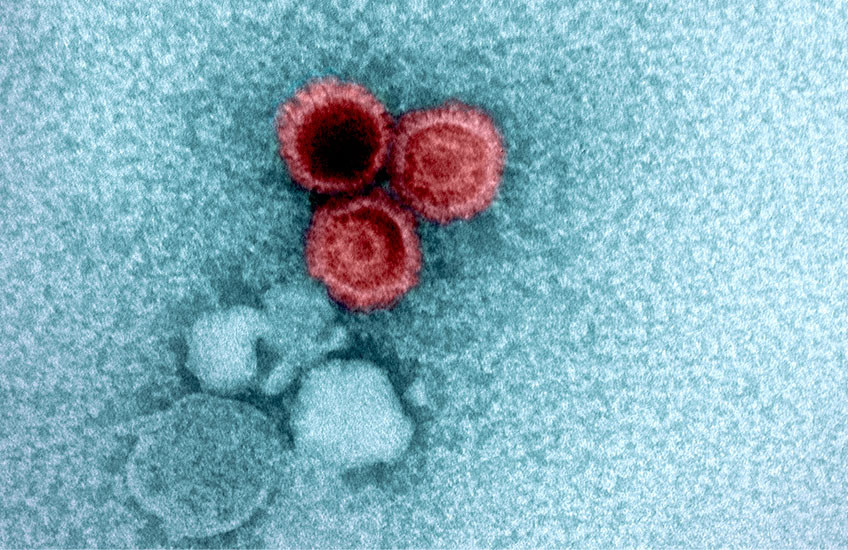
An electron micrograph showing three Epstein-Barr virions in red. Image: NIAID

Some viruses are cleared by the immune system within days, while others lurk in our bodies for a lifetime and reemerge later to cause new problems. How and why viral levels in the body change over time – and the health impacts of these changes – are only just starting to become clear.

A team led by scientists at Harvard Medical School, Massachusetts General Hospital, Brigham and Women’s Hospital, and the Broad Institute of MIT and Harvard recently reported the largest analysis to date of the human DNA virome – the collection of viruses in the body that have DNA as their genetic material.

The researchers tracked the viral load – the amount of viral DNA – for several common viruses in blood and saliva from over 900 000 individuals. They saw large variations in viral load from person to person depending on age, sex, lifestyle, and other factors, and discovered dozens of genetic factors strongly associated with viral load.

The team concluded that genetics plays a role in determining whether the effects of these viruses extend well beyond an initial infection.

“We’re getting to the point now where we can use human genetics to try to answer fundamental questions about pathology resulting from viruses,” including whether a virus is likely to play a role in causing cancer or other diseases later in life, said first author Nolan Kamitaki, research fellow in genetics in the Blavatnik Institute at HMS.

The findings published March 25 in Nature.

Unexpected patterns emerge

Study co-senior author Po-Ru Loh, HMS associate professor of medicine at Brigham and Women’s and an associate member at the Broad Institute, is broadly interested in the scientific information that can be mined from population-level datasets of DNA sequences that are readily available to researchers.

It turns out that these datasets capture information about the genomic material that people inherit, he said, as well as the makeup of their oral microbiomes, viruses hiding in their bodies, and acquired mutations in their DNA. Sometimes, scientists can link this information to downstream health consequences.

Recently, for example, Loh and Kamitaki analyzed whole-genome sequences from saliva samples collected from more than 12,500 individuals to investigate how genetics shapes the oral microbiome.

In their new study, the researchers analyzed whole-genome sequencing data from individuals in three biobanks: the UK Biobank, the National Institutes of Health’s All of Us Research Program, and Simmons Foundation Powering Autism Research for Knowledge. They tested blood and saliva samples for the viral loads of Epstein-Barr virus, two other human herpesviruses (HHV-6 and HHV-7), Merkel cell polyomavirus, as well as three common anelloviruses that are present in about 90% of people throughout life without causing disease.

They found that each virus had a markedly different trajectory over a lifetime. The viruses appeared most rapidly during the first several years of life, likely following primary infection. However, Epstein-Barr virus became more prevalent with age, while HHV-6 became less prevalent after childhood, possibly indicating more control by the immune system over time. The prevalence of HHV-7 similarly decreased sharply in middle age.

The team also found that Epstein-Barr viral load went up in the winter and down in the summer, while HHV-7 viral load showed the opposite pattern. Smoking was strongly associated with a higher Epstein-Barr viral load, nearly double in heavy smokers compared with nonsmokers, whereas smoking was associated with a lower HHV-7 viral load.

Notably, men consistently had a higher viral load in their blood and saliva than women across all seven viruses.

The role of genetics revealed

The researchers determined that many of the genetic factors most strongly linked to viral load were related to how the immune system responds to viruses and how infected cells dodge immune attacks.

Thus, the findings highlight the immune system’s role in controlling viral load in the body, showing how much immune responses can vary over time and between people.

“It’s amazing how much DNA can teach us about dynamic biological processes and the ways in which our habits, our genes, and our biology shape those processes,” said co-senior author Steven McCarroll, the Dorothy and Milton Flier Professor of Biomedical Science and Genetics at HMS and director of genomic neurobiology for the Stanley Center for Psychiatric Research at the Broad Institute.

The researchers identified the largest number of genetic associations for Epstein-Barr virus – which is thought to be a leading cause of multiple sclerosis and a risk factor for certain cancers – so they dug a little deeper. Their analysis revealed that the lifetime viral load for Epstein-Barr didn’t influence the risk of developing multiple sclerosis. Instead, the body’s immune response to Epstein-Barr is likely what increases the risk of the disease.

The researchers did find evidence that high Epstein-Barr viral load is a casual risk factor for Hodgkin lymphoma, a finding that needs further study in cell and animal models in the lab, they said.

“This finding is an example of why virus research in large genetic biobanks is important,” Kamitaki said.

Source: Harvard Medical School

Simple Antiseptic Can Reduce Newborn Infections

Photo by Christian Bowen on Unsplash


A new Cochrane review finds that chlorhexidine likely cuts umbilical cord infection rates by about 29% in low- and middle- income countries, and may reduce newborn deaths.

Umbilical cord care is a key part of newborn hygiene that helps prevent infection and promotes healthy healing. According to the World Health Organization (WHO), approximately 2.3 million newborn babies died in 2023, with the highest burden in low- and middle-income countries (LMICs). 

Cord care practice varies widely around the world, shaped by local culture, healthcare infrastructure and available resources.  

In settings with adequate obstetric care and low neonatal mortality, current WHO guidelines recommend dry cord care, involving keeping the stump clean and dry without antiseptics. In settings with higher neonatal mortality, the guidelines recommend daily application of 4% chlorhexidine for a week.

Antiseptic cord care offers protection

The researchers systematically reviewed 18 randomised controlled trials involving 143 150 newborns to evaluate whether applying antiseptics to the umbilical cord stump reduces infection, death, or delays cord separation compared to no treatment. The review covered antiseptics including 4.0% chlorhexidine (CHX), 70% alcohol, silver sulfadiazine, and povidone iodine.

The findings show that applying chlorhexidine to newborns’ umbilical cords likely reduces the number of infections from around 87 to 62 per 1000 newborns and the numbers of deaths may fall from around 18 to 15 per 1000 newborns in LMICs. Chlorhexidine likely also delays the time it takes for the cord stump to fall off by one to two days.

Only one study from a high-income country evaluated chlorhexidine. Evidence for preventing the bacterial infection omphalitis and its effect on cord separation was very uncertain, meaning conclusions cannot be drawn for these settings at this time. 

“In many parts of the world, newborns are still born into environments where hygiene conditions are poor. Simple and accessible cord-care interventions can significantly reduce infections in these settings, which is critical given the large share of neonatal deaths linked to infection.”

– Dr Aamer Imdad, University of Iowa 

Evidence for alcohol use in LMICs was very uncertain for both infection prevention and cord separation time. In high-income countries, moderate-certainty evidence suggests alcohol delays cord separation by approximately 1.6 days, but no studies reported on mortality or omphalitis in these settings.

Umbilical cord care should be contextualised to local settings

Dry cord care remains the recommended approach in countries with adequate obstetric care and low neonatal mortality. The authors explain that in many places, clean and dry cord care may be sufficient, while in others antiseptic approaches can reduce infection risk. The key is choosing interventions that match the realities families and health systems face.

“Our findings broadly support current World Health Organization guidance, but they also underline an important point: these interventions are not necessarily universal solutions. The benefits depend strongly on the context in which babies are born. What works best depends on local circumstances.”

– Professor Zulfiqar Ahmed Bhutta, Centre for Global Child Health in Canada and Aga Khan University in Pakistan

Many studies did not share individual patient data, which the authors say would have helped answer some remaining questions more clearly. Greater and timely data sharing could greatly strengthen transparency and in-depth scientific analysis for policy.  

By Mia Parkinson

Read the review here

Source: Cochrane

Children with Obesity Are at Risk of Illness Despite Normal Test Results

AI image created with Gencraft

Children living with obesity but showing no signs of metabolic complications still have a significantly increased risk of developing type 2 diabetes, high blood pressure, and abnormal blood lipid levels later in life. A new study from the Karolinska Institutet, published in JAMA Pediatrics, also shows that these children benefit greatly from obesity treatment.

“There has been a debate about whether children with normal blood and liver values and normal blood pressure might not need treatment for their obesity. Our study shows that this assumption is incorrect,” says Claude Marcus, professor at the Department of Clinical Science, Intervention and Technology, Karolinska Institutet.

The study included just over 7200 children aged 7–17 who had begun obesity treatment in Sweden and were followed up until age 30. The researchers compared children with so-called metabolically healthy obesity (MHO), children with obesity and impaired cardio-metabolic risk markers (MUO), and peers from the general population.

A clearly increased risk

By age 30, 9% of the children with MHO had developed type 2 diabetes, compared with 17% of those with MUO and 0.5% in the control group. Similar patterns were observed for high blood pressure (11% in the MHO group, 18% in the MUO group, and 4% in the control group) and abnormal blood lipids (5 and 13%, respectively, compared to 1% in the general population).

“Even children with obesity who show no signs of cardiometabolic impact have a clearly increased risk of future diseases. This means that normal blood pressure and the absence of abnormal blood test results are not sufficient protection against future morbidity,” says Emilia Hagman, associate professor at the Department of Clinical Science, Intervention and Technology, Karolinska Institutet, and the paper’s corresponding author.

All children need treatment

All children in the study received support for healthier lifestyle habits, and the researchers also investigated whether the treatment response affected the risk of future illness in the different groups. A good treatment response during childhood was linked to a reduced risk of all the diseases studied. The effect was equally significant in both the MHO and MUO groups.

“Our results suggest that all children with obesity need treatment, even if they appear completely healthy upon examination,” says Claude Marcus.

The study is based on data from the national quality registry BORIS and several Swedish health data registries. The research was funded by, among others, the Center for Innovative Medicine, the Ollie and Elof Ericsson Foundation, and the Freemason Foundation for Children’s Welfare. Several of the researchers report compensation from companies unrelated to this work. See the scientific article for a complete list of conflicts of interest.

Source: Karolinska Institutet

Well Over Three Million People in SA Develop Depression Every Year, Researchers Estimate

It is estimated that around seven in 10 adults in South Africa have ever had depression at some point in their lifetime. Photo by Alex Green on Pexels

By Marcus Low

Around 3.8 million people in South Africa developed depression in 2024, estimate leading local researchers in a major new modelling study.


The prevalence of depression among people aged 15 and older in South Africa has dropped slightly from an estimated 5.1% in 2002 to 4.5% in 2024. While a decrease, this nevertheless means that over two million people in the country had depression in mid-2024.

When taken as a whole, there were an estimated 3.84 million new episodes of depression in South Africa in 2024. Since some people may have had more than one episode, the number of people who developed depression over the year will be slightly lower.

The estimates are from mathematical modelling published as a preprint earlier in March on medRxiv. While Spotlight doesn’t usually report on studies that haven’t yet been peer-reviewed, we made an exception because the estimates fill an important gap in our understanding of depression in South Africa and because of the stature of the authors. The new modelling drew on several nationally representative surveys of depression conducted in South Africa since 2002.

The researchers estimate that around seven in 10 adults in South Africa have ever had depression at some point in their lifetime.

“Previous studies have suggested that only 10-15% of the population ever experiences depression, but our study suggests a much higher proportion, 70%,” Dr Leigh Johnson, the lead scientist on the study, told Spotlight.

“Most of these people experience a single episode of depression and have no recurrences. The common belief is that depression is a frequently recurring condition, but this is true for only a minority of people who experience depression,” he said. Johnson is from the Centre of Integrated Data and Epidemiological Research at the University of Cape Town (UCT) and is also responsible for Thembisa, the leading mathematical model of HIV in South Africa.

The new modelling also suggests some interesting nuances regarding who is most at risk of depression. In mid-2024, prevalence in women was at 5.3%, well above the estimated 3.6% in men. Older people were significantly more likely to suffer from depression than young people.

Living with HIV has long been known to increase the risk of depression, but the modelling suggests that this effect has weakened over time as HIV treatment became more widely available. In 2010, 7.1% of people with HIV had depression compared to 4.9% in the general population. By 2024, 5.9% of people with HIV had depression, compared to 4.5% of the general population. In other words, the gap decreased from 2.2 percentage points to 1.4.

Increasing, but still very low antidepressant usage

While rates of depression have been relatively stable, the researchers estimate that antidepressant usage rates have almost tripled, from around 1% of the population using antidepressants in 2008, to 2.8% in 2024. In Europe, Australia, Canada, and the United States, rates are between 4% and 16%.

The proportion of women taking antidepressants is more than four times higher than in men – a difference that cannot fully be explained by the higher rates of depression in women. Social factors like stigma are likely playing a role.

The differences between the private and public sectors are stark. Around 11% of medical scheme members are estimated to be taking antidepressants, compared to 0.9% in the rest of the population. “Levels of antidepressant use in the uninsured population are very low, despite a substantially greater prevalence of depression in people of lower socioeconomic status”, the researchers point out.

“Our study shows quite extreme inequality in access to antidepressant treatment in South Africa, with rates of antidepressant use in the private sector being about 12 times those in the public sector. Levels of antidepressant use in the private sector are quite similar to those in high-income countries, but in South Africa’s uninsured population there are major barriers to accessing mental healthcare,” said Johnson.

One such barrier, say the researchers, is regulatory obstacles that prevent nurses from prescribing antidepressants. This problem is made worse by the fact that South Africa has shortages of public sector psychiatrists and medical doctors.

“The study highlights the burden of depression in our country, the vast treatment gap, and stark inequities in access between the public and the private sectors despite on-paper availability of treatments we have known work to mitigate the effects of depression for decades,” the study’s principal investigator Professor Lara Fairall told Spotlight.

“There was a clear call to review regulatory barriers to wider access to antidepressants in the 2023 National Mental Health Policy Framework and Strategic Plan, but it has not been followed by definitive action,” she says.

“Unlocking these barriers requires clarity of mandate by multiple state and para-statal bodies including the National Department of Health, the South African Health Products Regulatory Authority and the South African Nursing Council, but the study is a reminder that failure to do so leaves millions of people vulnerable with desperate consequences for themselves, their families and the economy,” says Fairall who works as a health systems researcher at King’s College London and leads the Knowledge Translation Unit at UCT.

Republished from Spotlight under a Creative Commons licence.

Read the original article.

Could a New Type of Weight‑loss Pill Shake up the Market? Here’s What to Know About Orforglipron

Photo by Sweet Life on Unsplash

Martin Whyte, University of Surrey

A new type of daily pill has proven more effective for weight loss and blood sugar control than its currently available counterparts, according to a recent trial. The drug, known as orforglipron, could be a game-changer in the rapidly expanding oral weight-loss drug market.

The advent of the injectable weight-loss drug semaglutide (known better by its brand names Wegovy and Ozempic) marked a distinct shift in the weight-loss drugs market when it became available just a few years ago.

Semaglutide is a class of glucagon-like peptide-1 (GLP-1) medication. These drugs mimic the gut hormone GLP-1, which is released soon after eating. This hormone signals fullness to the brain, slowing digestion and stimulating the release of insulin. By replicating the action of this hormone, GLP-1 drugs have proven highly effective at managing type 2 diabetes and promoting weight loss.

Although semaglutide is widely used, a key issue with the drug is that it needs to be injected into the belly, thighs or back of the arm. This can make it difficult for patients with needle phobia or who don’t want to self-inject due to the inconvenience.

Another logistical issue with injectable GLP-1 drugs is that they require refrigeration throughout the supply chain. This can pose a challenge in low- and middle-income countries.

It’s for these reasons that researchers and developers have started investigating the efficacy of oral versions of semaglutide.

Based on current research, it appears that oral semaglutide is very effective. However, it must be taken on an empty stomach – and users must wait 30 minutes before eating or drinking.

Alongside being expensive to produce, it also has poor bioavailability compared with injectable semaglutide. This means only about 1% of the ingested drug is absorbed and able to exert its effects.

But a recent phase 3 clinical trial has shown that a new type of oral weight-loss pill may have overcome these issues – proving to be more effective than the current oral semaglutide products on the market.

Oral weight-loss pill

The recent 52-week phase 3 trial involved 1,698 adults with type 2 diabetes across six countries. It set out to compare current oral semaglutide products against orforglipron, which is also taken as a daily tablet.

The primary measure researchers were looking for was a reduction in HbA1c. This blood test reflecting average blood sugar levels over three months is the standard indicator of diabetes control. Diabetes is present if HbA1c is 6.5% or more.

From a baseline average HbA1c of 8.3%, it was found that after 52 weeks, orforglipron was able to reduce this value by an average of 1.71–1.91%. In comparison, oral semaglutide only reduced HbA1c by 1.47%.

Not only did orforglipron meet the trial’s goals of proving it was as effective to oral semaglutide, it proved it was superior for lowering blood sugar. The participants who took orforglipron also lost more weight – an average of 6.1kg-8.2kg, compared with 5.3kg in those taking semaglutide.

However, a key issue highlighted by the trial was one of tolerability.

GLP-1 drugs can cause gastrointestinal side-effects such as nausea, vomiting, diarrhoea and constipation. In this latest trial, around 59% of participants on orforglipron reported such symptoms, compared with 37–45% on semaglutide.

The reason for this difference may be the more prominent, daily peak drug concentrations with orforglipron. The consequence was that around 10% of orforglipron participants discontinued treatment due to adverse effects. Just 4-5% of those taking semaglutide discontinued treatment.

Future studies may want to look at how orforglipron compares with injectable semaglutide. Photo by Haberdoedas on Unsplash

No head-to-head trials have been done of injectable GLP-1 versus orforglipron. However, the weight loss seen in this study of people with type 2 diabetes is broadly comparable with that previously observed with injectable GLP-1.

Market implications

The trial’s results show that orforglipron, which was developed by Eli Lilly, can be considered one of semaglutide’s most credible challengers.

Another remarkable thing about orforglipron is that it belongs to a new category of drugs called small-molecule drugs. This means it’s a synthetic chemical compound small enough to be absorbed directly through the gut wall. There, it’s able to act on GLP-1 receptors, even though it isn’t of a similar structure to a GLP-1 hormone.

Oral semaglutide, on the other hand, is a peptide drug. This means the structure of its amino acids (one of the building blocks of protein) closely resembles that of the natural GLP-1 hormone.

As a small-molecule drug, orforglipron is cheaper and simpler to manufacture than peptide-based drugs such as semaglutide.

And as with oral semaglutide, it requires no refrigeration. This gives it a logistical advantage over injectable GLP-1 formulations – a potentially important consideration for expanding access in low- and middle-income countries, where cold chain infrastructure is unreliable.

It remains to be seen, however, how orforglipron will perform against oral semaglutide in the broader market.

Although this latest trial has shown it is superior for controlling blood sugar and aiding weight loss, its higher rate of side-effects and treatment discontinuation may temper enthusiasm. In a crowded and competitive market, long-term adherence – shaped as much by tolerability as by efficacy – is probably a critical differentiator.

Orforglipron is still undergoing trials in patients with obesity but without diabetes.

Martin Whyte, Associate Professor of Metabolic Medicine, University of Surrey

This article is republished from The Conversation under a Creative Commons license. Read the original article.