

Tag: 18/10/26

Variations in the Human Vocal Tract Could Have Influenced Our Language Diversity

Vocal tracts and the sounds they produce vary, resulting in distinct sounds in speaking groups
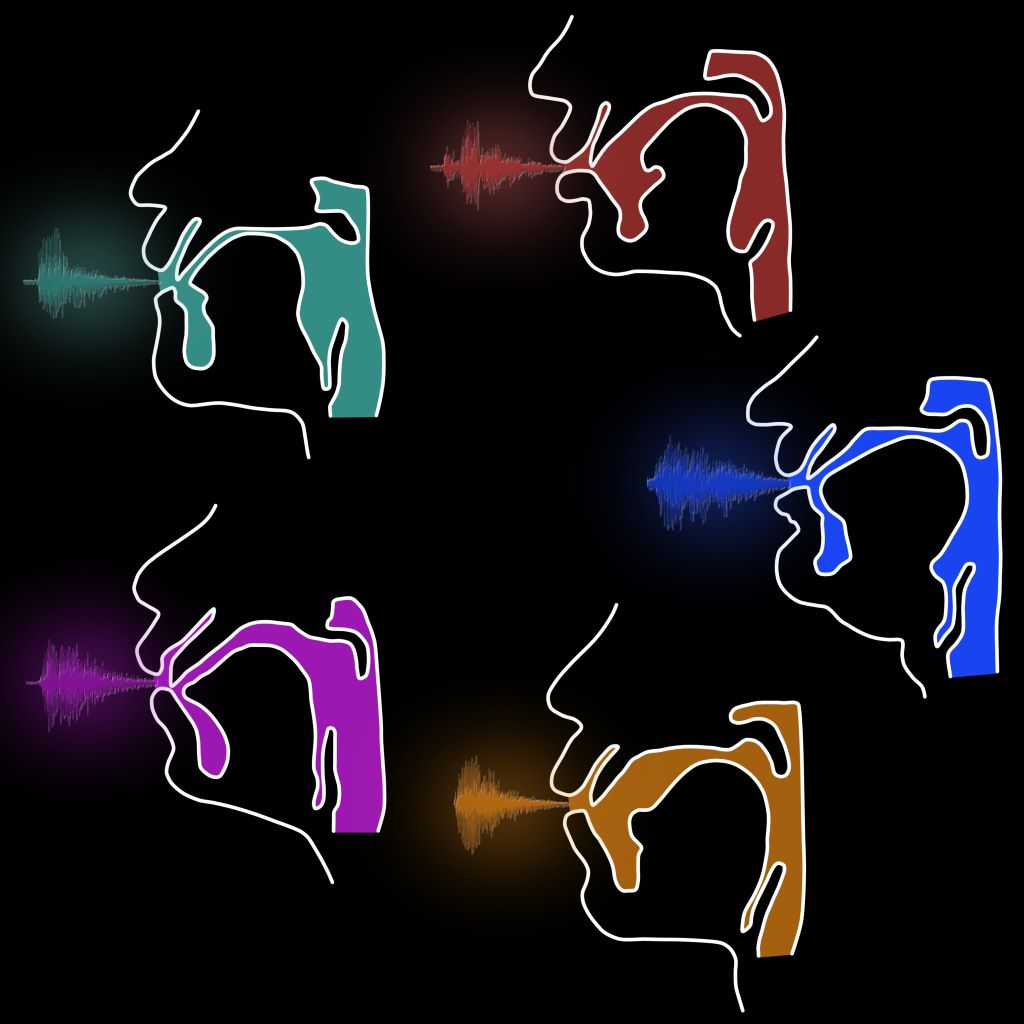
Vocal tract outlines for the five vowels [i], [e], [a], [o] and [u] in the midsagittal plane producing a vowel sound. Each colour represents a different vowel and speaker, showcasing markedly different vocal tract and tongue configurations across speakers and vowels.
Image credit: Tiena Danner and Christoph Zollikofer (CC-BY 4.0)

The anatomical differences in our vocal tracts could be one of the sources of our Tower of Babel – the vast difference in languages spoken around the world, according to a study published October 13th in the open access journal PLOS Biology by Steven Moran and Tiena Danner from the University of Neuchâtel, Switzerland, and colleagues.

Many variations exist in the human voice. People vary in the size and shape of the tissues in the head and neck and also shape that anatomy differently to produce similar sounds. Developmental and cultural factors will shape the way people speak. To better understand how anatomical and articulatory variation might affect how a speaker sounds, the authors of this study analysed data from 32 speakers (16 male and 16 female) from the USC 75-Speaker Speech MRI Database, an open-source collection of real-time Magnetic Resonance Imaging (rtMRI) conducted during speech tasks, focusing on American English vowels (i, e, a, o and u).

The authors found that the subjects had widely different vocal tracts and used very different ranges of motion in those tracts to produce the same sound. Those ranges of motion, or articulatory differences, were a result of each person’s specific vocal anatomy, and produced both the correct sound and an individual acoustic difference. Finally, by combining the rtMRI results with multilingual speech data, they showed that the amount of variation within other languages such as Basque or Hindi was similar to the variation present in American English, suggesting that within each language, there’s a basic level of speaker variation as a result of vocal tract anatomy.

While the sample size of vocal tracts was small, and the authors compared variations in only a few language families, the authors propose a biocultural model of how spoken sounds might vary and diversity between peoples, where variation of pronunciation within a group feeds into the development of a language difference between groups, eventually producing two groups that can’t understand each other.

The authors add, “We often think of differences in pronunciation between speakers of a language as noise to be normalized away in linguistic analysis. However, the results of our study suggest the opposite: that the variation between individuals may be an important source of information in understanding the evolution of spoken languages.

“An exciting aspect of our study is that it provides researchers with a null model for studying the phonetic evolution of spoken languages. If the differences between the world’s 7000 or so languages reflect variation already present in the anatomical differences between speakers, we now have a baseline against which we can identify sociocultural or historical factors that have driven language diversification.

“Every person has a slightly different vocal tract and speakers compensate for these differences to remain mutually intelligible. Nevertheless, our anatomical differences leave systematic acoustic signatures in the sounds we produce. Remarkably, we find that the same patterns of phonetic variation between individuals are also reflected in the difference between languages.

“Our results suggest that the seeds of phonetic differences between languages are already present in the variation between individual speakers. Spoken language evolution is driven by the biological diversity within populations and the sociocultural forces that shape how languages change.”

Provided by PLOS

Teens’ Body Dissatisfaction Linked to Childhood Body Fat Levels

A longitudinal study of more than 13 000 children in the UK found that higher childhood body mass index and fat mass were associated with greater body dissatisfaction at age 14 in both sexes

Photo by Patrick Fore on Unsplash

Children who follow higher trajectories of body mass index (BMI) and fat mass index across childhood report greater body dissatisfaction at age 14, in both boys and girls, according to a new study published October 14, 2026, in the open access journal PLOS One by Dr Madelaine Davies Kellock, a Research Fellow at University College London, UK, and colleagues.

Body dissatisfaction has been rising among young people over recent decades and is linked to later depression and eating disorders. Prior research using BMI has suggested weight relates to body dissatisfaction differently in girls and boys, but BMI cannot distinguish fat mass from fat-free mass, which includes muscle, bone and other tissues. Fat mass and fat-free mass may relate to dissatisfaction differently than BMI, particularly given the social desirability of muscularity in boys.

Researchers used data from 13 025 participants in the UK Millennium Cohort Study, which provided measurements of height and weight from age 3, and body composition from ages 7 to 14. For the new analysis, children were grouped into low, moderate and high trajectories of BMI, fat mass index, and fat-free mass index based on that data. At age 14, body dissatisfaction was measured using a self-reported questionnaire.

Children with moderate or high BMI trajectories had higher dissatisfaction scores than those with low trajectories (adjusted mean difference 0.32 and 0.71, on a 0-6 scale), with similar results for fat mass index (0.33 and 0.73), and no evidence these associations differed by sex. The researchers expected higher fat-free mass index, which includes muscle as well as other non-fat tissue, to relate to lower dissatisfaction in boys; instead, boys with high fat-free mass had greater dissatisfaction than those with low fat-free mass (adjusted mean difference 0.31), and the association was larger in girls (0.36 moderate, 0.79 high).

Because the study was observational, it could not establish that body composition causes body dissatisfaction. It was also limited by the single question measurement of body dissatisfaction and the fact that children from more disadvantaged families were more likely to have missing data.

The authors conclude that both girls and boys with higher childhood adiposity are at risk of body dissatisfaction in adolescence and say the findings could help shape ways to target body dissatisfaction.

The authors add: “Body dissatisfaction is often thought of as something that mainly affects girls, but our findings suggest that both girls and boys with higher BMI or fat mass index trajectories in childhood have higher levels of body dissatisfaction in adolescence.

Our findings for fat-free mass index were quite surprising. We did not find that higher fat-free mass index was associated with lower body dissatisfaction in boys, but as we found a smaller association compared to girls, this might suggest that some aspects of fat-free mass are less of a risk factor for body dissatisfaction in boys. There are lots of reasons why someone might have high fat-free mass, so it’s likely that this group includes people with quite different physical characteristics, including high levels of lean muscle mass, as well as those with increased bone and muscle mass partly as a consequence of having high fat mass. This could mask the role that aspects such as muscle mass might play in how young people experience their bodies.

There is now good evidence that body dissatisfaction in adolescence is associated with subsequent poorer mental health. The association between adiposity and body dissatisfaction might emerge because young people with higher weight experience more negative events, such as stigmatising comments and bullying. Therefore, it is important that we think carefully about how we talk about weight and body size with young people, including in schools.”

Provided by PLOS

Myopia Surge Could be Caused by Focus Strain in Low Light

For years, rising rates of myopia have been widely attributed to increased screen time, especially among children and young adults. But new research from scientists at the SUNY College of Optometry suggests the story may be more complicated – and more human.

In a new study published in Cell Reports, researchers propose that myopia may be driven less by screens themselves and more by a common indoor visual habit: prolonged close-up focus in low-light environments, which limits how much light reaches the retina.

The research offers a new hypothesis that could help explain a long-standing puzzle in vision science – why so many seemingly different factors, from near work and dim indoor lighting to treatments like atropine drops, multifocal lenses, and time spent outdoors, all appear to influence myopia progression.

“Myopia has reached near-epidemic levels worldwide, yet we still don’t fully understand why,” said Jose-Manuel Alonso, MD, PhD, SUNY Distinguished Professor and senior author of the study. “Our findings suggest that a common underlying factor may be how much light reaches the retina during sustained near work – particularly indoors.”

A different way of thinking about near work

Myopia affects nearly 50 percent of young adults in the United States and Europe and close to 90 percent in parts of East Asia. While genetics play an important role, rapid increases over just a few generations suggest environmental factors are also critical.

Scientists have long known that:

  • Spending more time outdoors appears to protect against myopia
  • Extended near work is associated with increased risk
  • Treatments as different as atropine eye drops, multifocal lenses, and contrast-reducing optics can slow progression

What has been unclear is why these diverse approaches work.

SUNY Optometry researchers propose a unifying explanation centred on the pupil – the eye’s natural “aperture,” similar to a camera diaphragm.

“In bright outdoor light, the pupil constricts to protect the eye while still allowing ample light to reach the retina,” explains Urusha Maharjan, SUNY Optometry doctoral student who conducted the study. “When people focus on close objects indoors, such as phones, tablets, or books, the pupil can also constrict, not because of brightness, but to sharpen the image. In dim lighting, this combination may significantly reduce retinal illumination.”

According to the researchers’ hypothesis, reduced retinal stimulation over long periods may weaken specific neural pathways involved in visual processing, contributing to myopia development and progression.

Explaining what we already observe

The proposed mechanism may help explain several well-known observations:

  • Why outdoor time is protective: bright light keeps retinal stimulation high
  • Why atropine may slow myopia: it limits pupil constriction, allowing more light into the eye
  • Why certain lenses help: they reduce the need for strong close-up focusing
  • Why prolonged indoor near work under low light may be particularly problematic

Importantly, the study does not claim that screens directly cause myopia, that light alone explains the condition, or that genetics are unimportant. Rather, it offers a testable hypothesis that reframes how visual habits, lighting, and eye focusing interact.

“This is not a final answer,” Alonso emphasised. “It’s a hypothesis grounded in measurable physiology that brings together many pieces of existing evidence. More research is needed, but it gives us a new way to think about prevention and treatment.”

Implications for families and clinicians

While the findings do not change clinical guidelines overnight, they may help inform future research, public health strategies, and conversations around children’s visual habits – especially as digital devices become a constant part of daily life.

The study was conducted by Urusha Maharjan in the laboratories of Jose-Manuel Alonso at SUNY College of Optometry.

Source: SUNY College of Optometry

Tshikululu and Dr Sophia AI Pilot AI-assisted Care for Underserved Communities

Millions of South Africans still struggle to access consistent, quality primary healthcare. Language barriers, distance from facilities and a shortage of trained health workers are just a few of the factors impacting the standard of care. Tshikululu Social Investments and Dr Sophia AI are addressing this gap through a new partnership to advance health equity across South Africa.

Dr Sophia AI is an Australian-developed, clinically governed decision support platform that helps clinics deliver consistent, high-quality care at the point of consultation. Through this partnership, small and medium healthcare practices in South Africa will gain access to AI-assisted clinical support that strengthens the care they provide. As these practices grow, more communities gain reliable access to primary healthcare.

The technology is intended to support — not replace — healthcare professionals. It guides structured assessments, helps identify potential risks and drug interactions, and supports clinical documentation, while clinicians remain responsible for reviewing and approving recommendations. The platform is built around explainability, traceability and clinician oversight, with an audit trail designed to support clinical governance and accountability.

A pilot is already under way with nurses working in community-based primary healthcare settings in the Western Cape. This is this first phase in testing how Dr Sophia AI can strengthen healthcare systems, and small businesses, in under-resourced communities.

The pilot will focus on localising Dr Sophia AI for South African community healthcare settings. This includes embedding South Africa’s Essential Medicines Lists and relevant clinical guidelines, refining the platform for local care pathways and testing its language capabilities in the context of how patients and healthcare professionals communicate in practice. The pilot will also gauge how the platform can grow revenue streams in small businesses by streamlining operations. Insights from the pilot will be used to continually refine the platform for the local context and inform its potential wider deployment.

Alongside the pilot, Tshikululu and Dr Sophia AI are designing a funding model that could complement traditional grant funding by linking commercial growth to social impact. The concept would see a percentage of future revenue generated through Dr Sophia AI’s commercial deployment directed towards a grant fund. This fund will be channelled towards initiatives that expand access to quality healthcare and support SMME growth, with Tshikululu bringing its experience in social investment and fund management to the model.

Dr Sophia AI complies with American FDA Clinical Decision Support Software requirements and is registered in Australia as Software as a Medical Device, Class I, Clinical Decision Support Software; providing an internationally recognised regulatory foundation for its use as clinical decision-support technology. Its South African deployment will equally align with applicable POPIA, SAHPRA and HPCSA requirements.

“Where you live, the language you speak or the availability of healthcare professionals in your community should not determine the quality of healthcare you can access,” says Leanne Emery-Hunter, CEO of Tshikululu Social Investments. “This pilot is about taking an established AI-assisted clinical platform and embedding it in the South African context — our clinical guidelines, our languages and the realities of frontline healthcare delivery.”

The partners are looking to engage funders, healthcare organisations, corporates and other potential partners interested in helping to shape and participate in the model. The ambition is to explore whether commercial adoption of the technology can create an ongoing source of funding that, in turn, supports grant-funded healthcare initiatives in underserved communities.

“Healthcare is deeply local, but the challenge of delivering consistent, high-quality care is global,” says Julia McCann, GM, Dr Sophia AI. “Our ambition is to build technology that can support healthcare professionals across very different health systems, languages and communities. South Africa is an important opportunity to demonstrate how a global platform can be meaningfully localised — combining international clinical capability with the guidelines, languages and realities of care on the ground.”

The partnership reflects a broader approach to social investment. It brings together technology, commercial and social-sector partners to develop new approaches to persistent social challenges and explore funding mechanisms that can complement traditional grant-making.

“This is the kind of social innovation we want to enable,” says Emery-Hunter. “It brings together technology, frontline expertise and a new approach to funding around a very practical question: how do we get better healthcare closer to people who have historically had the least access to it? We believe that will require collaboration, continuous learning and new ways of thinking about how social impact is funded.”

Tshikululu and Dr Sophia AI welcome conversations with organisations interested in partnering on the next phase of the initiative and helping to shape how the model could contribute to more equitable access to quality healthcare.