The Bacillus Calmette-Guérin (BCG) for tuberculosis vaccine has a number additional beneficial effects, and is currently a recommended therapy for non–muscle-invasive bladder cancer. In a new study published in JAMA Network Open, treatment with the BCG vaccine was associated with a reduced risk of Alzheimer’s disease and related dementias.
Although previous research has suggested a link between the BCG vaccine and a lower risk of dementia, studies were limited by size, study design, or analytical methods. To conduct a more robust study, researchers followed 6467 individuals for up to 15 years after they were diagnosed with non–muscle-invasive bladder cancer.
The group included 3388 patients who underwent BCG vaccine treatment and 3079 who served as controls, matched by factors such as age, sex, and medical co-morbidities.
During follow-up, 202 patients in the BCG vaccine group and 262 in the control group developed Alzheimer’s disease and related dementias. The incidence was 8.8 per 1000 person-years and 12.1 per 1000 person-years in the respective groups.
Analyses revealed that treatment with the BCG vaccine was associated with a 20% lower risk of Alzheimer’s disease and related dementias. The protective association was greater in patients aged 70 years or older. Additionally, during follow-up, 751 patients in the BCG vaccine group and 973 in the control group died. Thus, treatment with BCG vaccine was associated with a 25% lower risk of death.
Study leader Marc Weinberg, MD, Ph.D., an Instructor in Psychiatry at MGH, said: “A vaccine like BCG, if proven effective, is a perfect example of a cost-effective, population-health–based solution to a devastating illness like Alzheimer’s disease. We are shifting our focus towards studying the potential benefits of BCG vaccination of older adults in Alzheimer’s disease–related clinical trials.”
If a causal link is found, it will be important to understand the mechanisms involved. Weinberg and his colleagues note that the BCG vaccine’s effects on the immune system may play a role.
Researchers at Karolinska Institutet have found further links between Epstein–Barr virus and multiple sclerosis. A study published in Science Advances shows that some individuals have antibodies against the virus that mistakenly attack a protein in the brain and spinal cord.
Many years ago, the Epstein–Barr virus (EBV), which infects most people early in life and then usually lies dormant was linked to multiple sclerosis (MS) but the reason remained a mystery. Increasing evidence, including two papers published in Science and Nature last year, suggests that EBV infection precedes MS and that antibodies against the virus may be involved. However, the molecular mechanisms seem to vary between patients and remain largely unknown.
“MS is an incredibly complex disease, but our study provides an important piece in the puzzle and could explain why some people develop the disease,” says Olivia Thomas, postdoctoral researcher at the Department of Clinical Neuroscience, Karolinska Institutet and shared first author of the paper. “We have discovered that certain antibodies against the Epstein-Barr virus, which would normally fight the infection, can mistakenly target the brain and spinal cord and cause damage.”
The researchers analysed blood samples from more than 700 patients with MS and 700 healthy controls. They found that antibodies that bind to a certain protein in the Epstein-Barr virus, EBNA1, can also bind to a similar protein in the brain and spinal cord called CRYAB, whose role is to prevent protein aggregation during conditions of cellular stress such as inflammation. These misdirected, cross-reactive antibodies may damage the nervous system and cause severe symptoms in MS patients, including problems with balance, mobility and fatigue. The antibodies were present in about 23 percent of MS patients and 7% of control individuals.
“This shows that, whilst these antibody responses are not required for disease development, they may be involved in disease in up to a quarter of MS patients,” says Olivia Thomas. “This also demonstrates the high variation between patients, highlighting the need for personalised therapies. Current therapies are effective at reducing relapses in MS but unfortunately, none can prevent disease progression.”
“We are now expanding our research to investigate how T cells fight EBV infection and how these immune cells may damage the nervous system in multiple sclerosis and contribute to disease progression,” says joint first author of the paper Mattias Bronge, affiliated researcher at the Department of Clinical Neuroscience, Karolinska Institutet.
Women are about twice as likely as men to be diagnosed with Alzheimer’s disease. Some of that is age: women outlive men in most countries, and advanced age is the strongest risk factor for Alzheimer’s. But not all of it explains the excess risk.
One such factor may be stress may be one such reason. A study published in Brain shows that the effect stress has on the brain differs by sex, at least in mice. In stressful situations, levels of the Alzheimer’s protein amyloid beta rises sharply in the brains of females but not males. In addition, the researchers identified a molecular pathway that is active in brain cells from female mice but not male mice, and showed that it accounts for the divergent responses to stress.
The findings, from researchers at Washington University School of Medicine in St. Louis, add to a growing collection of evidence that sex matters in health and disease. From cancer to heart disease to arthritis, scientists have found differences between males and females that could potentially affect how men and women respond to efforts to prevent or treat chronic diseases.
“How women respond to stress versus how men respond to stress is an important area of research that has implications for not just Alzheimer’s disease but other conditions, too,” said co-corresponding author Carla M. Yuede, PhD, an associate professor of psychiatry. “In recent years, the National Institutes of Health (NIH) has prioritized understanding sex differences in medicine. Stress is one area in which you can clearly see a difference between males and females. This study shows that reducing stress may be more beneficial for women than men, in terms of lowering the risk of Alzheimer’s disease.”
Stress falls into the category of socioeconomic risk factors, along with factors such as depression and social isolation, that together account for an estimated 8% of the risk of developing Alzheimer’s. That risk calculation, however, doesn’t take sex into account. Women consistently report higher levels of stress than men, and it affects them differently.
Corresponding author John Cirrito, PhD, an associate professor of neurology; Yuede; and first author Hannah Edwards, a graduate student in Cirrito’s lab, reasoned that stress also may affect women’s brains differently than men’s, and these differences may help explain the sex imbalance in Alzheimer’s disease.
To find out, they measured levels of amyloid beta in the brains of mice every hour for 22 hours, beginning eight hours before the mice experienced stress. The experience was equally stressful for male and female mice, as measured by the levels of stress hormones in their blood. But the responses in their brains were not the same.
In female mice, amyloid beta levels rose significantly within the first two hours and stayed elevated through the end of the monitoring period. In male mice, brain amyloid levels did not change overall, although about 20% of them did show a delayed and weak rise in amyloid levels.
Further experiments revealed that the difference comes down to a cellular stress response pathway in brain cells. Stress causes the release of a hormone known as corticotropin releasing factor. Neurons from female rodents take up the stress hormone, triggering a cascade of events that results in increasing levels of amyloid beta in the brain. In contrast, neurons from male rodents lack the ability to take up the stress hormone. It is not known whether there are similar sex differences in how human neurons take up stress hormones.
“There’s a fundamental biological difference between males and females in how they respond to stress at the cellular level, in both mice and people,” Cirrito said. “We don’t think that stress is the sole factor driving the sex difference in Alzheimer’s disease. There are many other differences between men and women – in hormones, lifestyle, other diseases they have – that undoubtedly contribute in some way. But that stress is driving one aspect of this sex difference I think is very likely.”
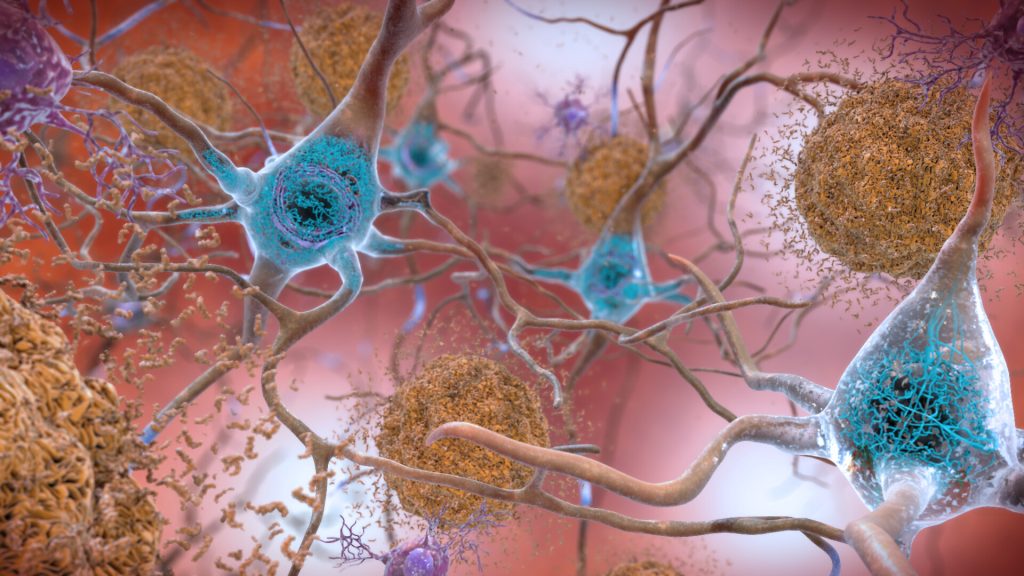
Neurons in the brain of an Alzheimer’s patient, with amyloid plaques caused by tau proteins. Credit: NIH
In a preliminary trial, a new ‘gene silencing’ treatment has been able to safely and successfully lower levels of the harmful tau protein known to cause the disease. This success, published in Nature Medicine, demonstrates that a ‘gene silencing’ approach could work in dementia and Alzheimer’s disease.
The approach uses a drug called BIIB080 (/IONIS-MAPTRx), which is an antisense oligonucleaotide (used to stop RNA producing a protein), to ‘silence’ the gene coding for the tau protein – known as the microtubule-associated protein tau (MAPT) gene. This prevents the gene from being translated into the protein in a doseable and reversible way. It also reduces production of that protein, altering the course of disease.
Further trials will be needed in larger groups of patients to determine whether this leads to clinical benefit, but the phase 1 results are the first indication that this method has a biological effect.
There are currently no treatments targeting tau. The drugs aducanumab and lecanemab – recently approved for use in some situations by the FDA – target a separate disease mechanism in AD, the accumulation of amyloid plaques.
The phase 1 trial enrolled 46 patients with an average age of 66, and looked at the safety of BIIB080, what it does in the body, and how well it targets the MAPT gene. The trial compared three doses of the drug, given by intrathecal injection (an injection into the nervous system via the spinal canal), with the placebo.
Results show that the drug was well tolerated, with all patients completing the treatment period and over 90% completing the post-treatment period.
Patients in both the treatment and placebo groups experienced either mild or moderate side effects – the most common being a headache after injection of the drug. However, no serious adverse events were seen in patients given the drug.
The research team also looked at two forms of the tau protein in the central nervous system (CNS) – a reliable indicator of disease – over the duration of the study.
They found a greater than 50% reduction in levels of total tau and phosphor tau concentration in the CNS after 24 weeks in the two treatment groups that received the highest dose of the drug.
Consultant neurologist Dr Catherine Mummery, who led the study, said: “We will need further research to understand the extent to which the drug can slow progression of physical symptoms of disease and evaluate the drug in older and larger groups of people and in more diverse populations.
“But the results are a significant step forward in demonstrating that we can successfully target tau with a gene silencing drug to slow – or possibly even reverse – Alzheimer’s disease, and other diseases caused by tau accumulation in the future.”
An early sign of Alzheimer’s disease is sleep disturbance – many people eventually diagnosed with Alzheimer’s start experiencing difficulty falling and staying asleep years before the emergence of cognitive problems such as memory loss and confusion. In a vicious circle, Alzheimer’s disease disrupts sleep, and poor sleep accelerates harmful changes to the brain.
Now, researchers at Washington University School of Medicine in St. Louis have identified a possible way to help break that cycle. Published in Annals of Neurology, a small, two-night study has shown that people who took a sleeping pill before bed experienced a drop in the levels of key Alzheimer’s proteins – a good sign, since higher levels of such proteins tracks with worsening disease. The study, which involved a sleeping aid known as suvorexant that is already approved by the Food and Drug Administration (FDA) for insomnia, hints at the potential of sleep medications to slow or stop the progression of Alzheimer’s disease, although much more work is needed to confirm the viability of such an approach.
“This is a small, proof-of-concept study. It would be premature for people who are worried about developing Alzheimer’s to interpret it as a reason to start taking suvorexant every night,” said senior author Brendan Lucey, MD, an associate professor of neurology and director of Washington University’s Sleep Medicine Center. “We don’t yet know whether long-term use is effective in staving off cognitive decline, and if it is, at what dose and for whom. Still, these results are very encouraging. This drug is already available and proven safe, and now we have evidence that it affects the levels of proteins that are critical for driving Alzheimer’s disease.”
Suvorexant belongs to a class of insomnia medications known as dual orexin receptor antagonists. Orexin is a natural biomolecule that promotes wakefulness. When orexin is blocked, people fall asleep. Three orexin inhibitors have been approved by the FDA, and more are in the pipeline.
Alzheimer’s disease begins when plaques of the protein amyloid beta start building up in the brain. After years of amyloid accumulation, a second brain protein, tau, begins to form tangles that are toxic to neurons. People with Alzheimer’s disease start experiencing cognitive symptoms such as memory loss around the time tau tangles become detectable.
Lucey and colleagues were among the first to show in people that poor sleep is linked to higher levels of both amyloid and tau in the brain. The question remains as to whether good sleep has the opposite effect – a reduction in amyloid and tau levels, and a halt in or reversal of the progress of Alzheimer’s disease – but mouse studies with orexin inhibitors have been promising.
As a first step to assess the effect of orexin inhibitors on people, Lucey and colleagues recruited 38 participants ages 45 to 65 and with no cognitive impairments to undergo a two-night sleep study. The participants were given a lower dose (10 mg) of suvorexant (13 people), a higher dose (20 mg) of suvorexant (12 people) or a placebo (13 people) at 9 p.m. and then went to sleep in a clinical research unit at Washington University. Researchers withdrew a small amount of cerebrospinal fluid via spinal tap every two hours for 36 hours, starting one hour before the sleeping aid or placebo was administered, to measure how amyloid and tau levels changed over the next day and a half.
Amyloid levels dropped 10% to 20% in the cerebrospinal fluid of people who had received the high dose of suvorexant compared to people who had received placebo, and the levels of a key form of tau known as hyperphosphorylated tau dropped 10% to 15%, compared to people who had received placebo. Both differences are statistically significant. There was not a significant difference between the people who received a low dose of suvorexant and those who received the placebo.
By 24 hours after the first dose, hyperphosphorylated tau levels in the high-dose group had risen, while amyloid levels remained low compared to the placebo group. A second dose of suvorexant, administered on the second night, sent the levels of both proteins down again for people in the high-dose group.
“If we can lower amyloid every day, we think the accumulation of amyloid plaques in the brain will decrease over time,” Lucey said. “And hyperphosphorylated tau is very important in the development of Alzheimer’s disease, because it’s associated with forming tau tangles that kill neurons. If you can reduce tau phosphorylation, potentially there would be less tangle formation and less neuronal death.”
The study is preliminary, since it only looked at the effect of two doses of the drug in a small group of participants. Lucey has studies underway to assess the longer-term effects of orexin inhibitors in people at higher risk of dementia.
“Future studies need to have people taking these drugs for months, at least, and measuring the effect on amyloid and tau over time,” Lucey said. “We’re also going to be studying participants who are older and may still be cognitively healthy, but who already have some amyloid plaques in their brains. This study involved healthy middle-aged participants; the results may be different in an older population.
“I’m hopeful that we will eventually develop drugs that take advantage of the link between sleep and Alzheimer’s to prevent cognitive decline,” he continued. “We’re not quite there yet. At this point, the best advice I can give is to get a good night’s sleep if you can, and if you can’t, to see a sleep specialist and get your sleep problems treated.”
In virtually all persons with amyotrophic lateral sclerosis (ALS) and in up to half of all cases of Alzheimer’s disease (AD) and frontotemporal dementia, a protein called TDP-43 is lost from its normal location in the nucleus of the cell. In turn, this triggers the loss of stathmin-2, a protein crucial to regeneration of neurons and the maintenance of their connections to muscle fibres.
Writing in Science, a team of scientists demonstrate that stathmin-2 loss can be rescued using designer DNA drugs that restore normal processing of protein-encoding RNA.
“With mouse models we engineered to misprocess their stathmin-2 encoding RNAs, like in these human diseases, we show that administration of one of these designer DNA drugs into the fluid that surrounds the brain and spinal cord restores normal stathmin-2 levels throughout the nervous system,” said senior study author Don Cleveland, PhD, Distinguished Professor of Medicine, Neurosciences and Cellular and Molecular Medicine at University of California San Diego School of Medicine.
Cleveland is broadly credited with developing the concept of designer DNA drugs, which act to either turn on or turn off genes associated with many degenerative diseases of the aging human nervous system, including ALS, AD, Huntington’s disease and cancer.
Several designer DNA drugs are currently in clinical trials for multiple diseases. One such drug has been approved to treat a childhood neurodegenerative disease called spinal muscular atrophy.
The new study builds upon ongoing research by Cleveland and others regarding the role and loss of TDP-43, a protein associated with ALS, AD and other neurodegenerative disorders. In ALS, TDP-43 loss impacts the motor neurons that innervate and trigger contraction of skeletal muscles, causing them to degenerate, eventually resulting in paralysis.
“In almost all of instances of ALS, there is aggregation of TDP-43, a protein that functions in maturation of the RNA intermediates that encode many proteins. Reduced TDP-43 activity causes misassembly of the RNA-encoding stathmin-2, a protein required for maintenance of the connection of motor neurons to muscle,” said Cleveland.
“Without stathmin-2, motor neurons disconnect from muscle, driving paralysis that is characteristic of ALS. What we have now found is that we can mimic TDP-43 function with a designer DNA drug, thereby restoring correct stathmin-2 RNA and protein level in the mammalian nervous system.”
Specifically, the researchers edited genes in mice to contain human STMN2 gene sequences and then injected antisense oligonucleotides – small DNA or RNA pieces that can bind to specific RNA molecules, blocking their ability to make a protein or changing how their final RNAs are assembled – into cerebral spinal fluid. The injections corrected STMN2 pre-mRNA misprocessing and restored stathmin-2 protein expression fully independent of TDP-43 function.
“Our findings lay the foundation for a clinical trial to delay paralysis in ALS by maintaining stathmin-2 protein levels in patients using our designer DNA drug,” Cleveland said.
A large representative study found that individuals with newly diagnosed atrial fibrillation had a modestly elevated risk of developing dementia. The Journal of the American Heart Associationstudy found that this risk was higher in younger adults and those without chronic kidney disease, but did not substantially vary across sex, race, or ethnicity.
In this study of nearly 200 000 adults, incidence rates for dementia over a median follow-up of 3.3 years were 2.79 versus 2.04 per 100 person-years in individuals with versus without atrial fibrillation, respectively. (This means that over one year, there would be an average of 2.79 dementia diagnoses among 100 people with atrial fibrillation and 2.04 diagnoses among 100 people without atrial fibrillation. This translates to 279 per 10 000 and 204 per 10 000.)
After adjustments, atrial fibrillation was associated with a 13% higher risk of dementia. Adults aged <65 years had a 65% higher risk compared with older adults, those without chronic kidney disease had a 14% higher risk than those with chronic kidney disease.
“These data highlight a possible link between atrial fibrillation and risk of subsequent dementia in certain populations. Further studies are needed to understand the mechanisms to explain this association, which may inform the use of treatments for atrial fibrillation,” said corresponding author Nisha Bansal, MD, MAS, of the University of Washington School of Medicine.
Adding to the growing body of evidence on sleep disturbances and cognitive impairment, new research published in the American Journal of Preventive Medicine, finds significant links between three measures of sleep disturbance and the risk for developing dementia over a 10-year period. Difficulties falling asleep were linked to higher risk, but not falling asleep again after waking.
The results associate sleep-initiation insomnia (trouble falling asleep within 30 min) and sleep medication use with higher dementia risk. An additional, surprising finding was that people who reported having sleep-maintenance insomnia (trouble falling back to sleep after waking) were less likely to develop dementia over the course of the study.
“We expected sleep-initiation insomnia and sleep medication usage to increase dementia risk, but we were surprised to find sleep-maintenance insomnia decreased dementia risk,” explained lead investigator Roger Wong, PhD, MPH, MSW, an Assistant Professor in the Department of Public Health and Preventive Medicine, SUNY Upstate Medical University. “The motivation behind this research was prompted on a personal level. My father has been experiencing chronic sleep disturbances since the COVID pandemic began, and I was concerned how this would affect his cognition in the future. After reading the existing literature, I was surprised to see mixed findings on the sleep-dementia relationship, so I decided to investigate this topic.”
This research is novel because it is the first to examine how long-term sleep disturbance measures are associated with dementia risk using a nationally representative US older adult sample. Previous research has associated REM sleep behavior, sleep deprivation (less than five hours of sleep), and the use of short-acting benzodiazepines with cognitive decline. Their results for sleep-maintenance insomnia support other recent studies using smaller, separate data samples.
This study used 10 annual waves (2011–2020) of prospective data from the National Health and Aging Trends Study (NHATS), a longitudinal panel study that surveys a nationally representative sample of Medicare beneficiaries aged 65 years and older within the USA. This study included only people who were dementia-free at baseline in 2011.
While the mechanism for decreased dementia risk among those with sleep-maintenance insomnia is still unknown, the investigators theorise that greater engagement in activities that preserve or increase cognitive reserve may thereby decrease dementia risk.
Recent evidence indicates there is a higher prevalence of sleep disturbances among older adults than among other age groups. This could be attributed to a variety of factors including anxiety about the COVID pandemic or warmer nights as a consequence of climate change.
“Older adults are losing sleep over a wide variety of concerns. More research is needed to better understand its causes and manifestations and limit the long-term consequences,” added Dr Wong. “Our findings highlight the importance of considering sleep disturbance history when assessing the dementia risk profile for older adults. Future research is needed to examine other sleep disturbance measures using a national longitudinal sample, whether these sleep-dementia findings hold true for specific dementia subtypes, and how certain sociodemographic characteristics may interact with sleep disturbances to influence dementia risk.”
A new study published in the Journal of Experimental Medicine provides a strategy for finding treatments optimally tailored for women and men to prevent cognitive decline in aging as well as progression of neurodegenerative diseases by leveraging sex differences in the brain.
Ageing is associated with cognitive decline and brain atrophy, and is a major neurodegenerative disease risk. Studying sex differences in brain aging and neurodegenerative diseases can reveal new candidate treatment targets tailored for women and men.
One new approach to identifying neuroprotective treatments lies in understanding the role of sex chromosome gene expression in the brain as sex hormones wane during the ageing process.
UCLA researchers Dr Rhonda Voskuhl, Professor, and Dr Yuichiro Itoh, Associate Researcher, in the Department of Neurology, have created a roadmap to identify novel neuroprotective treatments tailored for women and men that leverage known sex differences in brain aging and neurodegenerative diseases.
Previously, research pursuing treatments for neurodegenerative diseases ignored sex differences in the brain and pooled data together from males and females, taking a “one size fits all” approach. This could dilute out robust effects that exist in one sex but not the other at the clinical research level and fail to capitalize on known disease modifiers in the discovery of new treatment targets at the basic research level.
In their study Voskuhl and Itoh write that known sex differences in the brain as well as the effect of higher expression of certain X chromosome genes in females (XX) compared to males (XY) can be assessed for their role in neurodegeneration during aging, a stage of life characterised by loss of potentially neuroprotective hormones in females (namely oestrogen in menopause) and males (testosterone in andropause). The study offers a roadmap for disentangling the contribution of these sex-specific factors, which can yield treatments optimized and targeted for each sex.
In the future, this roadmap can be used by researchers to discover targets on the X chromosome gene for development of modulatory treatments that prevent neurodegeneration and promote neural repair during brain aging.
“Given the aging population and lack of treatments to prevent cognitive decline during health and to reduce the risk for developing neurodegenerative diseases, it is now imperative to apply new strategies to identify neuroprotective treatments,” said Voskuhl. “Leveraging what is known about sex differences in multiple sclerosis, Alzheimer’s disease, and Parkinson’s disease can reveal candidate treatment targets tailored for women and men affected by these conditions. Sex chromosome effects remain understudied and represent a promising frontier for discovery, particularly in the context of declining levels of sex hormones during menopause and andropause.”
One early indicator of Parkinson’s disease (PD) is isolated REM-sleep behaviour disorder. Researchers have shown that a greater concentration of α-synuclein aggregates can be detected in the stool samples of patients. In the scientific journal npj Parkinson’s Disease, they now present a method for detecting these aggregates.
There are two forms of PD. In 70% of cases, it originates in the central nervous system. However, in around 30% of cases it originates in the nervous system of the intestine (“enteric nervous system”). The latter form is referred to as “body-first Parkinson’s disease” (for short: body-first PD) and the characteristic deposits of aggregates of the body’s own α-synuclein protein are formed in the neurons in the intestine.
A preliminary form of body-first PD is the so-called isolated REM-sleep behaviour disorder (for short: iBRD). It causes in part complex movements during REM-sleep insofar as the patient experiences vivid and disturbing dreams. These movements can endanger the sufferer themselves or others.
A research team headed by Professor Erdem Gültekin Tamgüney from the Institute of Physical Biology at HHU now reports that it is possible to detect an elevated level of α-synuclein aggregates in the stool samples of patients. To achieve this, the team used a new surface-based fluorescence intensity distribution analysis (sFIDA) to detect and quantify individual particles of α-synuclein aggregates.
Professor Tamgüney: “We are the first to prove the presence of α-synuclein aggregates in stool samples. Our results show a significantly higher level of α-synuclein aggregates in iRBD patients compared with healthy individuals or patients with Parkinson’s. These findings could lead to a non-invasive diagnostic tool for prodromal synucleinopathies — including Parkinson’s — which could in turn enable therapies to be initiated at an early stage before symptoms occur.” However, more research is required before the process can find its way into clinical practice, for example investigation into why the level is lower in Parkinson’s patients.
The study was conducted in a collaboration to establish a biobank with stool samples from patients and control subjects, and to develop the test procedure and conduct the tests on the samples, and to eventually commercialise the technique.
Background
In body-first PD, the deposits of fibrils of the body’s own α-synuclein protein, which are characteristic of Parkinson’s, are first formed in the neurons of the enteric nervous system, which serves the gastrointestinal tract. The aggregates then spread to the central nervous system in a way similar to prions, i.e. an existing aggregate combines individual α-synuclein proteins in its vicinity into further aggregates in a nucleation process; these aggregates then spread further through the body.
The influence of what happens in the gastrointestinal tract on the brain is referred to as the “gut-brain axis.” The gastrointestinal tract is exposed to the environment and it is possible that harmful substances such as chemicals, bacteria or viruses ingested directly with food or via interaction with the microbiome of the gastrointestinal tract may trigger the pathological formation of α-synuclein aggregates.