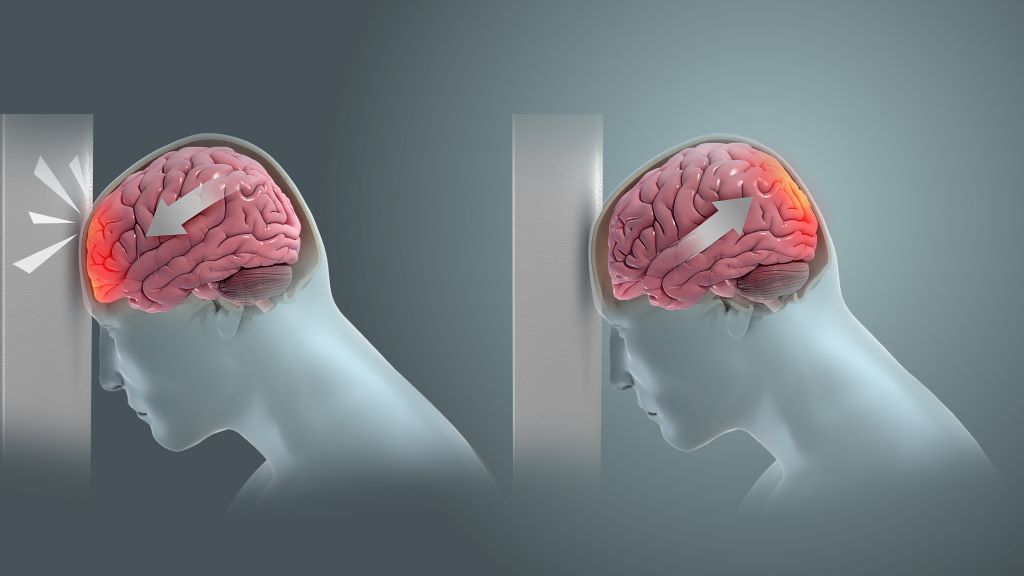
Coup and contrecoup brain injury. Credit: Scientific Animations CC4.0
Important brain structures that are key for signalling in the brain are narrower and less dense in females, and more likely to be damaged by brain injuries, such as concussion. Long-term cognitive deficits occur when the signals between brain structures weaken due to the injury. These structural differences in male and female brains might explain why females are more prone to concussions and experience longer recovery from the injury than their male counterparts, according to a University of Pennsylvania-led preclinical study published in Acta Neuropathologica.
Each year, approximately 50 million individuals worldwide suffer a concussion, also referred to as mild traumatic brain injury (TBI). For more than 15% of individuals who suffer persisting cognitive dysfunction, which includes difficulty concentrating, learning and remembering new information, and making decisions.
Although males make up the majority of emergency department visits for concussion, this has been primarily attributed to their greater exposure to activities with a risk of head impacts compared to females. In contrast, it has recently been observed that female athletes have a higher rate of concussion and appear to have worse outcomes than their male counterparts participating in the same sport.
“Clinicians have observed for a long time that females suffer from concussion at higher rates than males in the same sports, and that they take longer to recover cognitive function, but couldn’t explain the underlying mechanisms of this phenomenon,” said senior author Douglas Smith, MD, a professor of Neurosurgery and director of Penn’s Center for Brain Injury and Repair. “The variances in brain structures of females and males not only illuminate why this disparity exists, but also exposes biomarkers, such as axon protein fragments, that can be measured in the blood to determine injury severity, monitor recovery, and eventually help identify and develop treatments that help patients repair these damaged structures and restore cognitive function.”
Axons connect neurons, allowing communication across the brain. These axons form bundles that make up white matter in the brain and play a large role in learning and communication between different brain regions. Axons are delicate structures and are vulnerable to damage from concussion.
Communication between axons in the brain is powered by sodium channels that serve as the brain’s electric grid. When axons are damaged, these sodium channels are also impaired, which causes loss of signaling in the brain. The loss of signaling causes the cognitive impairment experienced by individuals after concussion.
In this study, researchers used large animal models of concussion to identify differences in brains of males and females after a concussion. They found that females had a higher population of smaller axons, which researchers demonstrated are more vulnerable to injury. They also reported that in these models, females had greater loss of sodium channels after concussion.
“The differences in brain structure not only tell us a lot about how brain injury affects males and females differently but could offer insights in other brain conditions that impact axons, like Alzheimer’s and Parkinson’s disease,” said Smith. “If female brains are more vulnerable to damage from concussion, they might also be more vulnerable to neurodegeneration, and it’s worth further research to understand how sex influences the structure and functions of the brain.”
There are viruses out there that nobody has on their radar, but they suddenly appear and, like SARS-CoV-2, can trigger major epidemics. They only have a slight genetic difference from before, the exchange of genetic material between different virus species can lead to the sudden emergence of threatening pathogens with significantly altered characteristics. This is suggested by current genetic analyses carried out by an international team of researchers. Virologists from the German Cancer Research Center (DKFZ) were in charge of the large-scale study which appears in PLOS Pathogens.
“Using a new computer-assisted analysis method, we discovered 40 previously unknown nidoviruses in various vertebrates from fish to rodents, including 13 coronaviruses,” reports DKFZ group leader Stefan Seitz. With the help of high-performance computers, the research team, which also includes Chris Lauber’s working group from the Helmholtz Center for Infection Research in Hanover, has sifted through almost 300 000 data sets. According to virologist Seitz, the fact that we can now analyse such huge amounts of data in one go opens up completely new perspectives.
Virus research is still in its relative infancy. Only a fraction of all viruses occurring in nature are known, especially those that cause diseases in humans, domestic animals and crops. The new method therefore promises a quantum leap in knowledge with regard to the natural virus reservoir. Stefan Seitz and his colleagues sent genetic data from vertebrates stored in scientific databases through their high-performance computers with new questions. They searched for virus-infected animals in order to obtain and study viral genetic material on a large scale. The main focus was on so-called nidoviruses, which include the coronavirus family.
Nidoviruses, whose genetic material consists of RNA (ribonucleic acid), are widespread in vertebrates. This species-rich group of viruses has some common characteristics that distinguish them from all other RNA viruses and document their relationship. Otherwise, however, nidoviruses are very different from each other, i.e. in terms of the size of their genome.
One discovery is particularly interesting with regard to the emergence of new viruses: In host animals that are simultaneously infected with different viruses, a recombination of viral genes can occur during virus replication. “Apparently, the nidoviruses we discovered in fish frequently exchange genetic material between different virus species, even across family boundaries,” says Stefan Seitz. And when distant relatives “crossbreed,” this can lead to the emergence of viruses with completely new properties. According to Seitz, such evolutionary leaps can affect the aggressiveness and dangerousness of the viruses, but also their attachment to certain host animals.
“A genetic exchange, as we have found in fish viruses, will probably also occur in mammalian viruses,” explains Stefan Seitz. Bats, which — like shrews — are often infected with a large number of different viruses, are considered a true melting pot. The SARS-CoV-2 coronavirus probably also developed in bats and jumped from there to humans.
After gene exchange between nidoviruses, the spike protein with which the viruses dock onto their host cells often changes. Chris Lauber, first author of the study, was able to show this by means of family tree analyses. Modifying this anchor molecule can significantly change the properties of the viruses to their advantage – by increasing their infectiousness or enabling them to switch hosts. A change of host, especially from animals to humans, can greatly facilitate the spread of the virus, as the corona pandemic has emphatically demonstrated. Viral “game changers” can suddenly appear at any time, becoming a massive threat and – if push comes to shove – triggering a pandemic. The starting point can be a single double-infected host animal.
The new high-performance computer process could help to prevent the spread of new viruses. It enables a systematic search for virus variants that are potentially dangerous for humans, explains Stefan Seitz. And the DKFZ researcher sees another important possible application with regard to his special field of research, virus-associated carcinogenesis: “I could imagine that we could use the new High Performance Computing (HPC) to systematically examine cancer patients or immunocompromised people for viruses. We know that cancer can be triggered by viruses, the best-known example being human papillomaviruses. But we are probably only seeing the tip of the iceberg so far. The HPC method offers the opportunity to track down viruses that, previously undetected, nestle in the human organism and increase the risk of malignant tumours.”
May 16 is International Celiac Day. Celiac disease is a chronic autoimmune condition that occurs in around 1% of the world’s population. It is triggered by the consumption of gluten proteins from wheat, barley, rye and some oats. A gluten-free diet protects celiac patients from severe intestinal damage. Together with colleagues, chemist Dr Veronica Dodero from Bielefeld University was able to determine new details on how certain gluten-derived molecules trigger leaky gut syndrome in celiac disease.
The key finding of the study: a particular protein fragment formed in active celiac disease forms nanosized structures, the so-called oligomers, and accumulates in a gut epithelial cell model. The technical name of the molecule is 33-mer deamidated gliadin peptide (DGP). The study team has now discovered that the presence of DGP oligomers may open the tightly closed gut lining, leading to the leaky gut syndrome. The study has now been published in the journal Angewandte Chemie.
Wheat peptides causing leaky gut
Gluten proteins cannot be completely broken down by the gut. This can lead to the formation of large gluten fragments (peptides) in our gut. In cases of active coeliac disease, researchers discovered that the enzyme tissue transglutaminase 2 (tTG2) present in humans modifies a specific gluten peptide, resulting in the formation of the 33-mer DGP. This usually happens in a part of our gut called the lamina propria. However, recent research has shown that this process can also occur in the gut lining.
‘Our interdisciplinary team characterized the formation of 33-mer DGP oligomers through high-resolution microscopy and biophysical techniques. We discovered the increased permeability in a gut cell model when DGP accumulates, reports Dr. Maria Georgina Herrera, the first author of the study. She is researcher at the University of Buenos Aires in Argentina and was a postdoctoral fellow at Bielefeld.
When the intestinal barrier is weakened
Leaky gut syndrome occurs when the lining of the intestine becomes permeable, allowing harmful substances to enter the bloodstream, leading to inflammatory responses and different diseases. In celiac disease, there’s debate about the early stages of increased permeability. The mainstream theory suggests that chronic inflammation in coeliac disease leads to a leaky gut. However, there is a second theory that proposes that gluten’s effects on gut lining cells are the primary cause. In this view, gluten directly damages the cells of the intestinal lining, making them permeable, which triggers chronic inflammation and potentially leads to celiac disease in predisposed people.
However, since gluten is consumed daily, what molecular triggers lead to the leaky gut in celiac disease patients? If 33-merDGP oligomers are formed, they may damage the epithelial cell network, allowing gluten peptides, bacteria, and other toxins to pass massively into the bloodstream, leading to inflammation and, in celiac disease, autoimmunity.
‘Our findings reinforce the medical hypothesis that impairment of the epithelial barrier promoted by gluten peptides is a cause and not a result of the immune response in celiac patients,’ says the lead author of the study, Dr Veronica Dodero from the Bielefeld Faculty of Chemistry.
The relationship between 33-mer DGP and Celiac Disease
Human leukocyte antigens (HLAs) are proteins found on the surface of cells in the body. They play a crucial role in the immune system by helping it distinguish between self (the body’s own cells) and non-self (foreign substances like bacteria or viruses). In celiac disease, two specific HLA proteins, namely HLA-DQ2 and HLA-DQ8, are strongly associated with the condition. The 33-mer DGP fits perfectly with HLA-DQ2 or HLA-DQ8 and triggers an immune response, leading to inflammation and small intestine villous atrophy. This strong interaction turns the DGP into what scientists call a superantigen. For those affected, a gluten-free diet is the only lifelong therapy.
A study by the University of Cambridge, UK, and Fudan University, China, has found that a single dose of the measles jab is up to 2.6 times more likely to be completely ineffective in children born by C-section, compared to those born naturally.
Failure of the vaccine means that the child’s immune system does not produce antibodies to fight against measles infection, so they remain susceptible to the disease.
A second measles jab was found to induce a robust immunity against measles in C-section children.
Measles is a highly infectious disease, and even low vaccine failure rates can significantly increase the risk of an outbreak.
A potential reason for this effect is linked to the development of the infant’s gut microbiome — the vast collection of microbes that naturally live inside the gut. Other studies have shown that vaginal birth transfers a greater variety of microbes from mother to baby, which can boost the immune system.
“We’ve discovered that the way we’re born – either by C-section or natural birth – has long-term consequences on our immunity to diseases as we grow up,” said Professor Henrik Salje in the University of Cambridge?’s Department of Genetics, joint senior author of the report.
He added: “We know that a lot of children don’t end up having their second measles jab, which is dangerous for them as individuals and for the wider population.
“Infants born by C-section are the ones we really want to be following up to make sure they get their second measles jab, because their first jab is much more likely to fail.”
At least 95% of the population needs to be fully vaccinated to keep measles under control but the UK is well below this, despite the Measles, Mumps and Rubella (MMR) vaccine being available through the NHS Routine Childhood Immunisation Programme.
An increasing number of women around the world are choosing to give birth by caesarean section: in the UK a third of all births are by C-section, in Brazil and Turkey over half of all children are born this way.
“With a C-section birth, children aren’t exposed to the mother’s microbiome in the same way as with a vaginal birth. We think this means they take longer to catch up in developing their gut microbiome, and with it, the ability of the immune system to be primed by vaccines against diseases including measles,” said Salje.
To get their results, the researchers used data from previous studies of over 1500 children in Hunan, China, which included blood samples taken every few weeks from birth to the age of 12. This allowed them to see how levels of measles antibodies in the blood change over the first few years of life, including following vaccination.
They found that 12% of children born via caesarean section had no immune response to their first measles vaccination, as compared to 5% of children born by vaginal delivery. This means that many of the children born by C-section did still mount an immune response following their first vaccination.
Two doses of the measles jab are needed for the body to mount a long-lasting immune response and protect against measles. According to the World Health Organization, in 2022 only 83% of the world’s children had received one dose of measles vaccine by their first birthday – the lowest since 2008.
Salje said: “Vaccine hesitancy is really problematic, and measles is top of the list of diseases we’re worried about because it’s so infectious.”
Measles is one of the world’s most contagious diseases, spread by coughs and sneezes. It starts with cold-like symptoms and a rash, and can lead to serious complications including blindness, seizures, and death.
Before the measles vaccine was introduced in 1963, there were major measles epidemics every few years causing an estimated 2.6 million deaths each year.
The research was funded by the National Natural Science Foundation of China.
Skin cell (keratinocyte). This normal human skin cell was treated with a growth factor that triggered the formation of specialised protein structures that enable the cell to move. We depend on cell movement for such basic functions as wound healing and launching an immune response. Credit: Torsten Wittmann, University of California, San Francisco
Millions of people worldwide suffer from unpredictable drug toxicities every year. In particular, drug eruptions which manifest through symptoms such as redness, blisters, and itching on the skin, are quite common. Severe drug eruptions can become life-threatening and can have long-lasting consequences.
Previous studies have identified specific variants of certain genes as potential causal agents of drug eruptions. Scientists believe that the genes encoding the human leukocyte antigen (HLA), a protein expressed on the surface of leucocytes known to play an important role in the immune system, are involved in the onset of drug eruption. But current theories cannot explain why HLA-related drug eruptions typically manifest on the skin rather than in multiple organs throughout the body.
To address this knowledge gap, a research team including Lecturer Shigeki Aoki, Kousei Ito, and Akira Kazaoka from the Graduate School of Medical and Pharmaceutical Sciences, Chiba University, conducted an in-depth study on the link between HLA and drug eruptions. Their findings were published in PNAS Nexus.
The researchers first conducted a series of experiments on mice keratinocytes. These keratinocytes, the most common type of skin cell, were engineered to express a specific variant of the HLA gene called HLA-B*57:01, which specifically bind to the antiviral drug abacavir. Then, they validated these findings in genetically modified mice expressing HLA-B*57:01, that were exposed to abacavir.
The researchers found that HLA-B*57:01-expressing keratinocytes that were exposed to abacavir exhibited endoplasmic reticulum (ER) stress responses, such as immediate release of calcium into the cytosol and elevated expression of heat shock protein 70 (HSP70). They also observed an increased production of cytokines and immune cell migration. Abacavir exposure triggered HLA misfolding in the ER, leading to ER stress. Moreover, the researchers observed that the ER stress could be reduced by using 4-phenylbutyrate (4-PB). By alleviating this stress, they managed to suppress the onset of severe drug eruption symptoms. This newfound knowledge could form the basis for innovative treatment options for management of drug eruptions.
HLAs – secondary players for the immune system
But how does this new information contrast with what was already known about HLA? “HLA molecules are an integral component of our immune system, that typically present foreign antigens to white blood cells, which judge these antigens as self or non-self. In this established role, HLAs are usually secondary players,” explains Dr Aoki. “However, our research highlights a novel function of the HLA molecule within skin cells. We revealed that a specific HLA genotype in keratinocytes can recognise certain drugs as foreign, triggering an endoplasmic reticulum stress response.”
Taken together, the findings of this study uncover a new role of HLA proteins in sensing and responding to potential threats in skin cells. Thus, their functions may extend well beyond mere antigen presentation for the immune system. Moreover, considering that the variant of HLA possessed by an individual can be determined through genetic testing, this study could help develop preventive measures and diagnostics against severe adverse drug reactions.
According to Dr Aoki, this is in line with current research directions and trends in medical science.
“In 10 years, we anticipate entering the ‘whole genome era,’ where personalised medicine based on individual genomes will become a standard practice,” he comments. He further adds, “Building on the findings of this study, we believe that a comprehensive understanding of the mechanism underlying HLA-dependent adverse drug reactions will enable the delivery of safe medical care, allowing patients to avoid unnecessary suffering due to side effects.”
Future research might minimise the occurrence of drug eruptions and save people from potentially fatal adverse drug reactions.
Clinicians often have to make split-second decisions about which antibiotics to give a patient when a life-threatening infection is suspected. By taking advantage of a shortage of a common antibiotic, researchers at U-M found that antibiotic selection may have unintended consequences for patient outcomes.
Beginning in 2015, a 15-month national shortage of a commonly prescribed antibiotic, piperacillin/tazobactam (Zosyn), provided a unique opportunity to compare rates of death in hospitalised patients with sepsis who were administered two different types of antibiotics – one that spares the gut microbiome and one that profoundly alters it.
Piperacillin/tazobactam is a broad-spectrum antibiotic that is commonly administered for sepsis, a life-threatening complication from infection. In its absence, clinicians commonly instead use another antibiotic, cefepime, which has similar activity against common sepsis pathogens but, unlike piperacillin/tazobactam, has minimal effects on anaerobic gut bacteria. The results, published in JAMA Internal Medicine, were surprising.
“We saw this Zosyn shortage as a one-of-a-kind opportunity to ask whether this antibiotic, which we know depletes the gut of anaerobic bacteria, makes a difference in terms of patient outcomes,” said Robert Dickson, MD of the Department of Medicine’s Division of Pulmonary & Critical Care Medicine and Deputy Director of the Weil Institute for Critical Care Research & Innovation.
In health, the gut microbiome is largely populated by anaerobic bacteria that rarely cause disease. Prior work by the study team has revealed that even a single dose of piperacillin/tazobactam kills most of these anaerobic gut bacteria, which play important roles in the body’s metabolism, immunity, and prevention of infections.
Dickson, Rishi Chanderraj, MD of the Division of Infectious Disease, Michael Sjoding, MD of the Division of Pulmonary & Critical Care Medicine and their multidisciplinary team at U-M and the VA Ann Arbor used patient record data to look at outcomes in 7569 patients. The team compared 4523 patients who were treated were piperacillin/tazobactam with 3046 patients who received cefepime.
They found marked differences: treatment with piperacillin-tazobactam was associated with a 5 percent increase in 90-day mortality, more days on a ventilator, and more time with organ failure.
“These are powerful antibiotics that are administered to patients every day in every hospital nationwide,” said Chanderraj. “Clinicians use them because they are trying to treat every possible pathogen that might be causing their patients’ illness. But our results suggest that their effects on the microbiome might also have important effects on patient outcomes.”
The study builds on previous work by the researchers that suggested critically ill patients may do worse when given antibiotics that deplete the gut of anaerobes. They have also seen similar effects when studying animal models.
“Our prior work suggested that there might be harm with piperacillin/tazobactam, but it was an observational study that had some limitations,” said Sjoding, the study’s senior author. “That’s why the drug shortage was such an amazing opportunity. It created an almost perfect natural experiment that let us test the difference between these two drugs on patient outcomes in a very rigorous manner.”
A recent clinical trial pitted these two antibiotics against each other and compared side effects and mortality after two weeks. That trial did not find any differences in the short term – a finding that the U-M team also observed in their analysis.
“When we looked at two-week outcomes in our study, we didn’t find differences either,” said Chanderraj. “But the differences at three months were dramatic.”
Overall, the new findings suggest that treatment with piperacillin/tazobactam instead of cefepime may contribute to one additional death per every 20 septic patients treated.
“A 5% mortality difference has enormous implications because sepsis is so common,” said Dickson. “Every day, thousands of clinicians are deciding which of these drugs to use in septic patients.”
Physicians should give more thought about whether anti-anaerobic antibiotics are warranted before prescribing them, added Chanderraj. “We need to think about antibiotics like chemotherapy. In the right context, treatment can be lifesaving, but in the wrong context, it can be quite harmful.”
At present, there is no specific active substance against hepatitis E. As the disease kills 70 000 people every year, researchers are actively searching for one. Researchers in Germany may have found what they’re looking for. The team showed that the compound K11777 prevents host cells from helping the virus out of its shell by cleaving the viral capsid, rendering it incapable of infecting cells.
“The compound is already being tested in clinical trials against other viruses such as Sars-Cov-2,” says lead author Mara Klöhn. “There’s still a lot of work to be done to find out whether it can be used as an active substance against hepatitis E, but it’s a first step.”
The team from the Department of Molecular and Medical Virology at Ruhr University Bochum, published their findings in the journal Hepatology.
In order to infect an organ, viruses need the help of the host cells.
“An effective approach is therefore to identify targets in the host that can be manipulated by drugs so that they no longer perform this helper function,” explains Mara Klöhn.
The researchers became aware of the compound K11777 in a roundabout way: during a control study conducted as part of cell culture studies on the hepatitis C virus with a known active ingredient, they discovered that this active ingredient was also effective against hepatitis E. “However, the drug wasn’t using the same pathway as with the hepatitis C virus, because the hepatitis E virus doesn’t have the target structure that this active substance attacks,” explains Mara Klöhn. This suggested that the drug may have an effect on host cells instead.
The research team narrowed down the possible target structures and turned their attention to cathepsins, which can process proteins, i.e. cleave them.
K11777 inhibits many cathepsin types, ie blocks their function. In vitro tests with human liver cells showed that the compound actually prevents infection with hepatitis E viruses.
“In follow-up experiments, we proved our hypothesis that the compound prevents cathepsin L from cleaving and opening up the viral capsid,” says Mara Klöhn. “This means that the virus can no longer infect host cells.”
Hepatitis E
The hepatitis E virus (HEV) is the main cause of acute viral hepatitis. Approximately 70 000 people die from the disease every year. After the first documented epidemic outbreak between 1955 and 1956, more than 50 years passed before researchers began to address the issue in depth. Acute infections usually clear up spontaneously in patients with an intact immune system. In patients with a reduced or suppressed immune system, such as organ transplant recipients or people infected with HIV, HEV can become chronic. HEV also poses a serious threat to pregnant women. There aren’t any vaccines nor specific active substances against the virus.
President Cyril Ramaphosa at signing ceremony of the NHI Bill at the Union Buildings in Pretoria.
Speech by Cyril Ramaphosa, article from Spotlight
President Cyril Ramaphosa yesterday signed into law the National Health Insurance (NHI) Bill, which is the ANC-led government’s plan for universal health coverage, just 14 days before the country heads to the polls.
The NHI aims to unify the country’s fragmented health system, Ramaphosa said at the signing ceremony at the Union Buildings in Pretoria on Wednesday.
However, he also noted that processes are yet to be established and that the Act’s implementation will be incremental rather than a massive overnight overhaul.
Here are 8 noteworthy quotes from the President’s speech:
“[T]he NHI is a commitment to eradicating the stark inequalities that have long determined who receives adequate healthcare and who suffers from neglect”.
“[T]he NHI takes a bold stride towards a society where no individual must bear an untenable financial burden while seeking medical attention”.
“The real challenge in implementing the NHI lies not in the lack of funds, but in the misallocation of resources that currently favours the private health sector at the expense of public health needs.”
“The financial hurdles facing the NHI can be navigated with careful planning, strategic resource allocation and a steadfast commitment to achieving equity.”
“The NHI recognises the respective strengths and capabilities of the public and private health care systems. It aims to ensure that they complement and reinforce each other.”
“The NHI is an important instrument to tackle poverty. The rising cost of health care makes families poorer. By contrast, health care provided through the NHI frees up resources in poor families for other essential needs.”
“Following the signing of this Bill, we will be establishing the systems and putting in place the necessary governance structures to implement the NHI based on the primary health care approach.”
“The implementation of the NHI will be done in a phased approach, with key milestones in each phase, rather than an overnight event.”
Here is Ramaphosa’s full prepared speech:
REMARKS BY PRESIDENT CYRIL RAMAPOSA ON THE SIGNING OF THE NATIONAL HEALTH INSURANCE (NHI) BILL, UNION BUILDINGS, TSHWANE, 15 MAY 2024
Minister of Health, Dr Joe Phaahla, MECs of Health, Senior Officials, Representatives of the health fraternity, Representatives of civil society, Representatives of labour, Members of Parliament’s Portfolio and Select Committees, Public representatives, Members of the media, Distinguished Guests, Ladies and Gentlemen,
We are gathered here today to witness the signing into law of the National Health Insurance Bill, a pivotal moment in the transformation of our country.
It is a milestone in South Africa’s ongoing quest for a more just society.
This transformational health care initiative gives further effect to our constitutional commitment to progressively realise access to health care services for all its citizens.
At its essence, the NHI is a commitment to eradicate the stark inequalities that have long determined who receives adequate healthcare and who suffers from neglect.
By putting in place a system that ensures equal access to health care regardless of a person’s social and economic circumstances, the NHI takes a bold stride towards a society where no individual must bear an untenable financial burden while seeking medical attention.
This vision is not just about social justice. It is also about efficiency and quality.
The provision of health care in this country is currently fragmented, unsustainable and unacceptable.
The public sector serves a large majority of the population, but faces budget constraints. The private sector serves a fraction of society at a far higher cost without a proportional improvement in health outcomes.
Addressing this imbalance requires a radical reimagining of resource allocation and a steadfast commitment to universal healthcare, a commitment we made to the United Nations.
The real challenge in implementing the NHI lies not in the lack of funds, but in the misallocation of resources that currently favours the private health sector at the expense of public health needs.
The NHI Bill presents an innovative approach to funding universal healthcare based on social solidarity.
It proposes a comprehensive strategy that combines various financial resources, including both additional funding and reallocating funds already in the health system.
This approach ensures contributions from a broader spectrum of society, emphasising the shared responsibility and mutual benefits envisioned by the NHI.
The financial hurdles facing the NHI can be navigated with careful planning, strategic resource allocation and a steadfast commitment to achieving equity.
The NHI carries the potential to transform the healthcare landscape, making the dream of quality, accessible care a reality for all its citizens.
The NHI Fund will procure services from public and private service providers to ensure all South Africans have access to quality health care.
The NHI recognises the respective strengths and capabilities of the public and private health care systems. It aims to ensure that they complement and reinforce each other.
Through more effective collaboration between the public and private sectors, we can ensure that the whole is greater than the sum of its parts.
The effective implementation of the NHI depends on the collective will of the South African people.
We all need to embrace a future where healthcare is a shared national treasure, reflective of the dignity and value we accord to every South African life.
Preparations for the implementation of NHI necessarily require a focused drive to improve the quality of health care.
We have already begun implementing a national quality improvement plan in public and private health care facilities, and are now seeing vast improvement.
In signing this Bill, we are signalling our determination to advance the constitutional right to access health care as articulated in Section 27 of the Constitution.
The passage of the Bill sets the foundation for ending a parallel inequitable health system where those without means are relegated to poor health care.
Under the NHI, access to quality care will be determined by need not by ability to pay. This will produce better health outcomes and prevent avoidable deaths.
The NHI is an important instrument to tackle poverty.
The rising cost of health care makes families poorer.
By contrast, health care provided through the NHI frees up resources in poor families for other essential needs.
The NHI will make health care in the country as a whole more affordable.
The way health care services will be paid for is meant to contain comprehensive health care costs and to ensure the available resources are more efficiently used.
Through the NHI, we plan to improve the effectiveness of health care provision by requiring all health facilities to achieve minimum quality health standards and be accredited.
Following the signing of this Bill, we will be establishing the systems and putting in place the necessary governance structures to implement the NHI based on the primary health care approach.
The implementation of the NHI will be done in a phased approach, with key milestones in each phase, rather than an overnight event.
There has been much debate about this Bill. Some people have expressed concern. Many others have expressed support.
What we need to remember is that South Africa is a constitutional democracy.
The Parliament that adopted this legislation was democratically-elected and its Members carried an electoral mandate to establish a National Health Insurance.
South Africa is also a country governed by the rule of law in which no person may be unduly deprived of their rights.
We are a country that has been built on dialogue and partnership, on working together to overcome differences in pursuit of a better life for all its people.
The NHI is an opportunity to make a break with the inequality and inefficiency that has long characterised our approach to the health of the South African people.
Let us work together, in a spirit of cooperation and solidarity, to make the NHI work.
In the stomach, so-called parietal cells are responsible for acid production. They react not only to the body’s own messenger molecules, but also to bitter-tasting food constituents such as caffeine. In a study published in the Journal of Agricultural and Food Chemistry, researchers tested bitter compounds on a human gastric cell line. Their results help to clarify the molecular regulatory mechanisms by which bitter substances influence gastric acid production.
It is known that taste receptors for bitter substances are not only found on the tongue, but also on the surface of other tissues and cells. These include the parietal cells of the stomach, which secrete protons into the stomach – ie, produce gastric acid. Recent studies have already shown that the bitter taste receptors found in parietal cells are involved in the regulation of gastric acid release. However, the underlying molecular signaling pathways are not yet fully understood.
Gastric cells as a test system
To further clarify the molecular interaction between bitter substances, bitter taste receptors, and gastric acid production, a research team led by Veronika Somoza, Director of the Leibniz Institute in Freising, has carried out a study on a cellular test system. This involves human parietal HGT-1 cells, which are able to secrete protons and, like taste cells, have bitter taste receptors.
Veronika Somoza’s team initially developed a working hypothesis based on the results of previous studies and the findings on signal transduction pathways in taste cells. According to this hypothesis, bitter tasting food constituents stimulate bitter taste receptors that are embedded in the cell membrane. This releases calcium ions inside the cells, leading to ion channel opening. This, in turn, allows sodium ions to flow into the gastric cells from the outside, ultimately contributing to the release of protons.
Hypothesis confirmed
First author Phil Richter explains: “We have successfully tested this mechanism with the two bitter substances caffeine and l-arginine. As expected from previous results, both food constituents were shown to stimulate gastric cell proton secretion in our test system.” The PhD student adds: “For the first time, we were able to demonstrate that the transient receptor potential channelsM4 and M5 are involved in the signaling cascade not only in taste cells but also in gastric cells and ensure an influx of sodium ions into the cells.”
Senior Scientist Gaby Andersen says: “By using knock-out experiments, in which we specifically switched off one type of bitter taste receptor in the cells, we were also able to show for the first time that there is a link between bitter taste receptors and the activation of the ion channels.” The scientist emphasizes that the results not only contribute to a better understanding of the role of taste receptors in the stomach but would also show that HGT-1 cells could be suitable as a replacement model for taste cells.
The research team agrees that the results will provide new insights into the regulation of gastric acid production and thus lead to innovative approaches in treating gastric diseases in the long term. However, further studies are needed to deepen knowledge of the molecular regulatory mechanisms and intracellular signaling pathways.
Contact with nature can lift our well-being by affecting emotions, influencing thoughts, reducing stress and improving physical health, as shown by studies. Even brief exposure to nature can help. One well-known study found that hospital patients recovered faster if their room included a window view of a natural setting.
Knowing more about nature’s effects on our bodies could not only help our well-being, but could also improve how we care for land, preserve ecosystems and design cities, homes and parks. Yet studies on the benefits of contact with nature have typically focused primarily on how seeing nature affects us. There has been less focus on what the nose knows. That is something a group of researchers set out to change, publishing their approach in Science Advances.
“We are immersed in a world of odorants, and we have a sophisticated olfactory system that processes them, with resulting impacts on our emotions and behaviour,” said Gregory Bratman, a University of Washington assistant professor of environmental and forest sciences. “But compared to research on the benefits of seeing nature, we don’t know nearly as much about how the impacts of nature’s scents and olfactory cues affect us.”
Bratman and colleagues from around the world outline ways to expand research into how odours and scents from natural settings impact our health and well-being. The interdisciplinary group of experts in olfaction, psychology, ecology, public health, atmospheric science and other fields are based at institutions in the US., the UK, Taiwan, Germany, Poland and Cyprus.
At its core, the human sense of smell, or olfaction, is a complex chemical detection system in constant operation. The nose is packed with hundreds of olfactory receptors, which are sophisticated chemical sensors. Together, they can detect more than one trillion scents, and that information gets delivered directly to the nervous system for our minds to interpret – consciously or otherwise.
The natural world releases a steady stream of chemical compounds to keep our olfactory system busy. Plants in particular exude volatile organic compounds, or VOCs, that can persist in the air for hours or days. VOCs perform many functions for plants, such as repelling herbivores or attracting pollinators. Some researchers have studied the impact of exposures to plant VOCs on people.
“We know bits and pieces of the overall picture,” said Bratman. “But there is so much more to learn. We are proposing a framework, informed by important research from many others, on how to investigate the intimate links between olfaction, nature and human well-being.”
Nature’s smell-mediated impacts likely come through different routes, according to the authors. Some chemical compounds, including a subset of those from the invisible realm of plant VOCs, may be acting on us without our conscious knowledge. In these cases, olfactory receptors in the nose could be initiating a “subthreshold” response to molecules that people are largely unaware of. Bratman and his co-authors are calling for vastly expanded research on when, where and how these undetected biochemical processes related to natural VOCs may affect us.
Other olfactory cues are picked up consciously, but scientists still don’t fully understand all their impacts on our health and well-being. Some scents, for example, may have “universal” interpretations to humans — something that nearly always smells pleasant, like a sweet-smelling flower. Other scents are closely tied to specific memories, or have associations and interpretations that vary by culture and personal experience, as research by co-author Asifa Majid of the University of Oxford has shown.
“Understanding how olfaction mediates our relationships with the natural world and the benefits we receive from it are multi-disciplinary undertakings,” said Bratman. “It involves insights from olfactory function research, Indigenous knowledge, Western psychology, anthropology, atmospheric chemistry, forest ecology, Shinrin-yoku – or ‘forest bathing’ – neuroscience, and more.”
Investigation into the potential links between our sense of smell and positive experiences with nature includes research by co-author Cecilia Bembibre at University College London, which shows that the cultural significance of smells, including those from nature, can be passed down in communities to each new generation. Co-author Jieling Xiao at Birmingham City University has delved into the associations people have with scents in built environments and urban gardens.
Other co-authors have shown that nature leaves its signature in the very air we breathe. Forests, for example, release a complex chemical milieux into the air. Research by co-author Jonathan Williams at the Max Planck Institute for Chemistry and the Cyprus Institute shows how natural VOCs can react and mix in the atmosphere, with repercussions for olfactory environments.
The authors are also calling for more studies to investigate how human activity alters nature’s olfactory footprint — both by pollution, which can modify or destroy odorants in the air, and by reducing habitats that release beneficial scents.
“Human activity is modifying the environment so quickly in some cases that we’re learning about these benefits while we’re simultaneously making them more difficult for people to access,” said Bratman. “As research illuminates more of these links, our hope is that we can make more informed decisions about our impacts on the natural world and the volatile organic compounds that come from it. As we say in the paper, we live within the chemical contexts that nature creates. Understanding this more can contribute to human well-being and advance efforts to protect the natural world.”