Day: June 15, 2026

Repurposing a Parkinson’s Drug for Treatment-resistant Depression Appears Promising

Photo by Sydney Sims on Unsplash

For many people who suffer from depression, the condition is not just about feeling down, but also about a loss of motivation and difficulty finding pleasure in activities they used to enjoy. A study conducted in Sweden at Lund University and Region Skåne shows that a medicine used to treat Parkinson’s disease can be used as an add-on therapy to alleviate these symptoms in some patients with treatment-resistant depression.


The study has been published in Nature Medicine.

Researchers at Lund University and the psychiatric services in Region Skåne have identified a potential new therapy for the condition associated with depression that involves a reduced ability to feel joy, pleasure or motivation – known as anhedonia. Those affected may lose interest in things that they previously found meaningful or rewarding. 
 
The study is an example of what is known as drug repurposing, whereby an already approved medicine is used to treat a different condition. In this study, the researchers investigated pramipexole, which has long been used to treat Parkinson’s disease, as an add-on therapy for depression with marked anhedonia. 
 
“Anhedonia is one of the most debilitating symptoms of depression, and something on which current antidepressant therapies often have only a limited effect. Our findings suggest that pramipexole could be an important new therapy option for this patient group,” says Daniel Lindqvist, a researcher at Lund University and senior consultant in psychiatry at Region Skåne. 

All participants in the study had marked anhedonia. Patients were given either pramipexole or a placebo as an add-on to their ongoing medication for nine weeks.
 
“Those treated with pramipexole for anhedonia showed a more pronounced improvement compared with the placebo group. The effect persisted during a six-month follow-up period among those patients who chose to continue treatment,” says Daniel Lindqvist.
 
The researchers used advanced brain imaging techniques (7 Tesla fMRI) to investigate the possible biological mechanisms underlying the effect, and activity monitors to assess whether the therapy affected patients’ everyday movement and activity levels. 


“We found that pramipexole was linked to a positive effect on the brain’s reward system and increased physical activity in everyday life. This supports the theory that the drug affects the dopamine system, which plays a key role in motivation and reward processing,” says Filip Ventorp, a postdoc at Lund University and resident physician at Region Skåne.
 
Most patients experienced no major issues with the treatment, and few patients dropped out during the randomized controlled trial. Common side effects included sleep problems, nausea and dizziness, but these could usually be managed by adjusting the dose. Even those who chose to continue with the follow-up phase of the study for a further six months generally responded well to the therapy.
 
“Efficacy and safety were maintained over time during the follow-up phase, which is particularly relevant in cases of long-term and treatment-resistant depression. Although most participants in our study tolerated the drug well, it is important to monitor any side effects, such as impaired impulse control and daytime fatigue,” says Marie Asp, a psychiatric researcher at Lund University and senior consultant in psychiatry at Region Skåne.

 På svenska

By Tove Smeds – published 12 June 2026
Study Finds No Link Between Newborn Upper Lip Frenulum and Breastfeeding Difficulties

Photo by Tim Bish on Unsplash

A joint study by the University of Oulu and Oulu University Hospital in Finland suggests that a newborn’s upper lip frenulum is unlikely to be a major cause of breastfeeding difficulties.

The study, published in JAMA Network Open, followed 264 mother–infant pairs at Oulu University Hospital between 2023 and 2024. Researchers assessed the anatomy and mobility of the upper lip frenulum in healthy, full-term infants and compared the findings with mothers’ reported breastfeeding experiences.

Overall, 86% of mothers reported experiencing breastfeeding difficulties during the first days of breastfeeding. However, based on data collected in the six-month follow-up questionnaire, the researchers found no association between the anatomical characteristics of the upper lip frenulum and breastfeeding problems. The thickness of the frenulum, its attachment site, or other structural features did not increase the risk of breastfeeding difficulties.

Instead, previous breastfeeding experience appeared to be beneficial for breastfeeding. Breastfeeding problems were reported less frequently among mothers with experience of breastfeeding previous children.

According to the researchers, an upper lip frenulum that interferes with breastfeeding is a rare finding. Nevertheless, the number of lip-tie release procedures has increased in several countries in recent years, despite limited evidence supporting their benefits.

“Breastfeeding difficulties in newborns should always be assessed comprehensively,” said paediatrician and neonatologist Outi Aikio. “Based on our findings, we found no evidence to support upper lip frenulum surgery in healthy, full-term infants. Instead, I would emphasise the importance of high-quality breastfeeding support, particularly in the early weeks after birth, when breastfeeding challenges are common.”

Source: University of Oulo

Research article: Niemelä L, Lohi V, Aitamurto S, Lehtinen A, Aikio O. Upper Lip Frenulum Findings and Breastfeeding Problems in Healthy Newborns. JAMA Netw Open. 2026;9(5):e2613308.

‘Wait and See’: Three Words Costing Postmenopausal Women Their Hair

More than half of postmenopausal women have clinically measurable hair loss. The most common response is to tell them to do nothing

Photo by Kateryna Hliznitsova on Unsplash

52% of postmenopausal women experience female-pattern hair loss, according to peer-reviewed research published in Menopause, the journal of the North American Menopause Society. Hot flushes – one of the symptoms that owns many public conversations about menopause – affect a larger proportion of women, but the disparity is not in the data. It is in how medicine responds to them. At more than one in two women, female-pattern hair loss is routinely absent from clinical consultations, rarely investigated at first presentation, and almost universally met with the same advice: give it time.

Why timing matters

During and after menopause, declining oestrogen levels and shifts in androgen balance cause susceptible hair follicles to gradually shrink. Each hair grows finer and shorter, with a briefer growth period per cycle. Left long enough without intervention, some follicles reach a point of no return, and the damage becomes irreversible.

“When we say irreversible, we mean that the follicle has become so damaged or inactive that it can no longer reliably regenerate a healthy terminal hair on its own,” says Dr Kashmal Kalan, Medical Director at Alvi Armani South Africa. “Medical therapies may help stabilise surrounding hair at that stage, but they may not recover what has already been lost,” says Dr Kalan.

For many women, that window closes not because they made an informed decision, but because nobody told them they had options. The advice they received – that gradual thinning is normal, that stress is a likely factor, that it may settle with time – sounded measured.

The cost of being dismissed

When the condition is classified as cosmetic, clinical urgency disappears. The patient is reassured rather than assessed, even though menopausal thinning is frequently a visible signal of systemic change. Hormonal shifts, nutritional deficiencies, thyroid dysfunction, and inflammatory or metabolic factors are all documented contributors, and none of them are cosmetic.

The consequences reach well beyond the scalp. Research published in the British Journal of Dermatology found that over 60% of women with hair loss actively avoided social interactions because of it. A separate study in the Journal of Cosmetic Dermatology found that affected women reported significantly higher social anxiety, lower self-esteem, and reduced life satisfaction compared to men experiencing the same condition. What begins on the scalp moves into how a woman presents professionally, how she engages socially, and how she sees herself.

A clinical framework built for men, applied to women

The protocols widely used to assess and treat this condition were largely developed around male patients. Defined hairline recession, concentrated donor areas, and linear progression are all considered male presentations. As a result, women have largely been assessed within a framework built for someone else.

“Applying male-based protocols to women can absolutely compromise outcomes. Female hair restoration requires an understanding of female-specific patterns of loss, progression risk, and the long-term hormonal picture. Preservation of softness, natural density gradients, and age-appropriate framing are considerations with no real equivalent in the male framework. In experienced hands, those distinctions are built into every stage of assessment and planning – not treated as secondary.”

What rigorous care looks like

At Alvi Armani, the first step is not a treatment recommendation – it is a diagnosis. A comprehensive workup, including blood investigations, is conducted before any intervention is discussed, because in menopausal women the drivers are rarely singular and what is visible on the scalp is seldom the whole picture.

“Not every patient is an immediate candidate for surgical restoration and recognising this is itself part of responsible practice. Medical stabilisation, non-surgical therapies, and hormonal management in collaboration with relevant specialists all form part of the treatment landscape – guided by individual diagnosis, not assumption,” Dr Kalan concludes.

“If any of this sounds familiar – the gradual changes, the concerns dismissed, the years of quietly adapting – it is worth knowing that the window is not necessarily closed. But it is also not standing still. Hair loss during menopause is extremely common – but common does not mean insignificant, and it does not mean inevitable.”

Supermarket Receipts Show Trends in Menstrual Pain Relief

An analysis of 211 million supermarket transactions found that more than a quarter of customers buying menstrual products bought pain relief at the same time.

Photo by Sora Shimazaki on Pexels

More than a quarter of women buying menstrual products also purchase pain relief at the same time – and those in lower-income areas are significantly less likely to do so – according to a new study published this week in the open-access journal PLOS Digital Health by Dr. Victoria Sivill of the University of Bristol, UK, and colleagues, which used supermarket loyalty card data to map menstrual pain disparities across England.

Menstrual pain is a common concern affecting many individuals globally. Existing research highlights its negative impact on daily activities, including school and work attendance.

In the new study, researchers analysed anonymised loyalty card data from a major UK health and beauty retailer, encompassing 211 million transactions by 3.4 million individuals between 2006 and 2015. They analysed how often shoppers purchased menstrual products at the same time as pain relief, and how that compared to a customer’s baseline rate of buying pain relief.

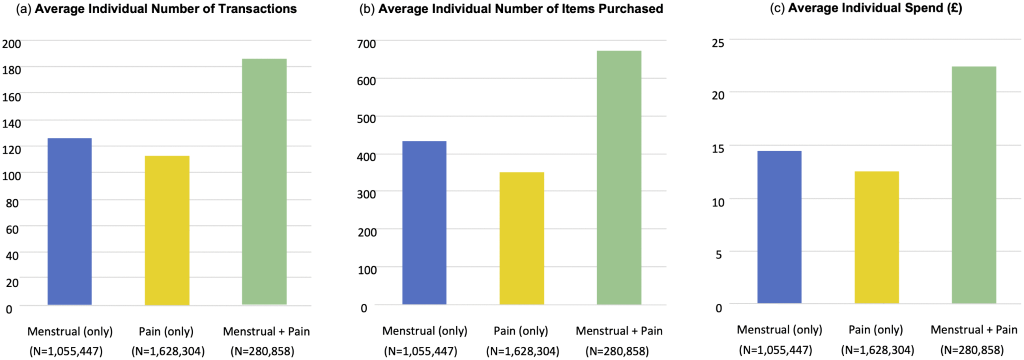
The analysis found that 26.7% of customers who purchased menstrual products also bought pain relief in the same transaction. These customers were nearly four times more likely to buy pain relief while buying menstrual products compared to other shopping trips. As a validation of the approach, the most common interval between consecutive menstrual purchases across the dataset was exactly 28 days – consistent with the average menstrual cycle.

Regional income emerged as the strongest predictor of menstrual pain purchases: customers in the lowest-income areas were 32% less likely to purchase pain relief at the same time as menstrual products compared to those in the highest-income areas. The authors note that lower rates of pain relief purchases in deprived areas likely reflect an inability to afford over-the-counter medication rather than lower rates of menstrual pain itself

“The study highlights the need for greater awareness and policy interventions to address the high prevalence of menstrual pain as well as socioeconomic dimensions of menstrual pain,” the authors say. “Public health initiatives should incorporate menstrual pain relief as part of broader efforts to improve health equity.”

 Co-author Dr James Goulding notes: “It is wonderful that smart data research in the UK is able to bring issues which may have once been overlooked in scientific settings – such as the sheer scale and impact of menstrual pain – to light. This is well overdue.”

Co-author Dr Anya Skatova adds: “Like many women, I was aware of how common menstrual pain is, but the scale of painkiller purchases alongside menstrual products was still striking. Using shopping data, we can see just how widespread the need for pain relief really is. This kind of evidence helps make menstrual pain visible at a population level and provides a strong foundation for systemic change in how it is recognised, treated, and prioritised in public health.” 

Provided by PLOS

Press Preview: https://plos.io/42wSl1W

In your coverage please use this URL to provide access to the freely available article in PLOS Digital Health: https://plos.io/4wzrwbh

Contact: Anya Skatova, anya.skatova@bristol.ac.uk; James Goulding, james.goulding@nottingham.ac.uk 

Image Caption: Fig 1. Average (mean) individual summary statistics for Menstrual, Pain and Menstrual Pain customer sets via analysis of transactional logs between 30th April 2006 to 16th April 2015. 

Image Credit: Sivill et al, PLOS Digital Health, 2026

High-Resolution Image Link: https://plos.io/4ujYPxl

Citation: Sivill V, Ljevar V, Goulding J, Skatova A (2026) What can shopping transactional data reveal about relative prevalence of menstrual pain and period poverty in England? PLOS Digit Health 5(5): e0001308. https://doi.org/10.1371/journal.pdig.0001308