Day: June 10, 2026

Head Cooling May Temporarily Relieve Depression Symptoms

People who wore a cooling cap for 30 minutes experienced multiple changes that could affect their mental health, according to a pilot study by Penn State researchers


Co-authors Owen Griffith, standing, and Maddie McLaughlin demonstrate the head cooling cap used in the study.  Credit: Jaydyn Isiminger / Penn State. Creative Commons

Wearing a cooling cap for 30 minutes may improve a person’s sense of well-being, according to a new study by Penn State researchers.

In a recent publication in Acta Psychologica, the researchers demonstrated that head cooling may reduce depressive symptoms and alter the types of brain waves people produce. While no medical recommendations can be derived from this small, exploratory study, the results indicate head cooling may provide mental health benefits for the general population.

The work was inspired by lead author and Penn State Professor of Kinesiology Semyon Slobounov’s prior research, which found that athletes with concussions heal faster and experience fewer symptoms when their head is regularly cooled.

“A person’s mood is tied to their cognition and general brain function,” said Owen Griffith, assistant teaching professor of kinesiology at Penn State and co-author of the study. “In this study, results suggested that people enjoy the sensation of head cooling. This, in turn, improved their mood, which altered their brain activity.”

The researchers recruited 24 college students between the ages of 18 and 26. At the beginning of the study, all participants completed questionnaires that measured their mental health and cognitive abilities and underwent an electroencephalogram (EEG) to measure brain activity.

Following the EEG, participants spent 30 minutes sitting in a dimly lit room listening to ocean sounds. Half of participants wore a fitted cooling cap, which uses liquid circulating close to the head to maintain a temperature of 33 degrees Fahrenheit. The other participants wore nothing on their heads. Immediately after the cooling or sitting session, participants repeated the questionnaires and EEG.

Participants repeated the same sitting or cooling session without testing every day for one week. The day after the last session, participants repeated the questionnaires and EEG again. This design allowed the researchers to observe both the short- and longer-term effects of head cooling.

“The brain produces different types of waves that are associated with different levels of excitement or brain activation,” said Laura Cooney, co-author of the study who graduated from Penn State’s Schreyer Honor College in 2025 and based her undergraduate thesis on the research. “Alpha waves are associated with calmness. More specifically, they are indicative of less brain activity overall, so this finding suggests that there was an immediate calming effect of head cooling.”

People in the head cooling group displayed an increase in alpha brain waves during the EEG immediately following the first cooling session. They experienced a 4% increase in alpha waves while participants whose heads were not cooled displayed a .5% decrease in alpha waves.

In contrast, there was no significant difference in the alpha wave levels of the sitting and cooling groups when measured on the day after the final cooling session, suggesting cooling does not have a longer-term impact on brain wave activity, the researchers said.

Over the course of the week, both groups of participants reported a decrease in depression symptoms, but individuals in the head cooling group reported a larger decrease than those in the sitting group.

“The reduction of depression symptoms among healthy people suggests that this might be a promising treatment,” Griffith said.

The researchers said they had hypothesised head cooling affected people through changes in neural electrical activity, but the EEGs did not show evidence of that. Now, the researchers suspect the effects are psychosomatic, meaning that mental and emotional factors, rather than physiological changes, are causing people’s reduced depression symptoms and increased alpha brain wave activity.

“Anecdotally, most people who come into the lab agree that head cooling is relaxing and enjoyable,” Griffith said. “This may not be surprising. A cold compress or a bag of ice have been home treatments for migraines for many years.”

Overall, the study suggests that widespread head cooling could be useful, the researchers said.

“Head cooling shows some potential as an acute calming therapy,” Cooney said. “Not as a replacement for any current therapy, but as another tool in the toolbox.”

Slobounov, senior author of the study, agreed.

Our previous research demonstrated that head cooling is useful for athletes recovering from concussions,” Slobounov said. “This research suggests it may be more useful to a wide group of people. It is low risk, does not involve any drugs or chemicals, and people enjoy it.”

Other Penn State researchers who contributed to this work include Zach Napora, graduate student in kinesiology and first author of the publication, Maddie McLaughlin, graduate student in kinesiology, and Elle McNally, 2025 graduate in biobehavioral health and current physician assistant graduate student.

Source: Penn State University

No Worsening in Children’s Asthma when Living With Cats

Photo by Prince Abid on Unsplash

Children with asthma and allergies who live with one or more cats do not experience worse asthma outcomes than children without cats at home. This is according to a comprehensive Swedish registry study from Karolinska Institutet, published in Frontiers in Allergy.

Many families with asthmatic children are advised to avoid keeping furry pets in the home. At the same time, previous studies on how cats as pets affect children with asthma and allergies have often been small and produced conflicting results.

The new study covers over 30 000 children in Sweden aged 4–17 with diagnosed asthma and allergies. The researchers followed the children for two years, comparing those living in households with cats with those who did not. Data on cat ownership was obtained from the national cat register and combined with data from several Swedish health and quality registers.

“We found no evidence that living with cats worsens asthma in children who already have asthma and allergies,” says Resthie R. Putri, postdoctoral researcher at the Department of Medical Epidemiology and Biostatistics, Karolinska Institutet. “Unfortunately, however, we had no information on the specific allergies the children had, so we do not know whether they were allergic to cats or not.” 

Individual advice is needed

The researchers analysed asthma exacerbations leading to emergency care, asthma severity based on medication use, asthma control, and lung function in the children. Children living with one or more cats experienced similar asthma outcomes to those without a cat. Nor could the number of cats in the home, or the age or sex of the cat, be linked to differences in asthma outcomes.

One strength of the study is the large number of participants from across Sweden. However, differences between countries may limit the applicability of the results to other contexts. As the Cat Register is relatively new, some cat exposure may not have been captured in the study. Furthermore, there was no information on how long the children had been exposed to cats for, or how much time the cats spent indoors. The researchers also cannot rule out the possibility that families with children suffering from more severe allergies may have chosen not to keep a cat.

“Clinical advice always needs to be tailored to the individual, and our study can contribute to the evidence base in discussions with families about pets and asthma,” says Catarina Almqvist Malmros, professor at the Department of Medical Epidemiology and Biostatistics, Karolinska Institutet, and paediatrician at Astrid Lindgren Children’s Hospital.

Will continue to follow the children

The researchers now plan to continue studying how different types of allergies may affect the outcome, and whether it makes a difference if the child is allergic to cats. They also plan to follow the children for a longer period to see how cat ownership may affect asthma over time.

Source: Karolinska Institutet

Tobacco Firms Used Cigarette-selling Tactics to Globally Market Ultra-processed Foods, Study Shows

Photo by Erik Mclean

A new study from the University of Kansas details how US tobacco corporations expanded into global food markets from the mid-1980s to the mid-2000s, using strategies honed through cigarette sales to market ultra-processed foods, which are industrially processed and contain ingredients and additives that maximise their appeal. The research appears in the American Journal of Public Health.

“We’d previously published on US tobacco company activities in relation to the US food system,” said lead author Tera Fazzino, associate professor of psychology at the University of Kansas. “In that prior study, I noted that tobacco-owned food company activities extended far beyond the United States. They had an extensive international business development strategy. Given the global conversation about ultra-processed and hyperpalatable foods saturating food systems, it felt important to investigate that international dimension. This study contributes to understanding the origin and nature of these foods and how they became widespread globally.”

For two decades, tobacco firms heavily invested in food companies, applying marketing, distribution and product-engineering strategies developed in the tobacco business.

“The scale was massive,” said Fazzino, who also serves as associate scientist at the KU Life Span Institute’s Cofrin Logan Center for Addiction Research and Treatment. “For Philip Morris, its food business, for a substantial period of time, generated sales comparable to its tobacco business – roughly a 50–50 split. A significant portion of those food revenues came from international markets.”

Meanwhile, Fazzino said, R.J. Reynolds had closer to 30% of its portfolio in food sales.

“But it also maintained a very large international food presence,” she said. “In many of the regions where these companies operated, their food subsidiaries were among the largest players in those markets at the time.”

Fazzino’s co-authors were KU graduate students Sydney Kong and Gayeon Lee, along with undergraduate research assistant Madison Stewart.

The researchers found that tobacco companies applied their long-established business strategies directly to their food operations.

“On the business development side, they aggressively expanded and acquired local companies to build infrastructure within regions,” Fazzino said. “This allowed them to distribute their primary products efficiently. They also created coordinated product distribution and sales systems that integrated both tobacco and food operations.”

On the product-development side, tobacco companies used strategies similar to those previously applied to cigarettes.

“For example, they manipulated product size,” Fazzino said. “Just as they had introduced ‘king-size’ cigarettes to increase consumption occasions, they later used similar size strategies in food products – king-size sugary drinks, cookies and other items.”

Fazzino said tobacco firms also developed products that maintained “full flavour” while being marketed as lighter or healthier.

“In tobacco, this meant ‘low-tar’ or ‘low-nicotine’ cigarettes,” she said. “In food, it meant ‘low-fat’ or ‘light’ versions of products designed to appeal to health-conscious consumers while retaining strong flavour profiles.”

The researchers found that different tobacco firms developed their food businesses in different geographic areas, even if their marketing and product-formulation strategies were similar. According to Fazzino, the data indicate tobacco companies held leading market shares in multiple regions.

“Philip Morris expanded rapidly into Canada, where it held leading market positions in many product categories as early as the late 1980s,” she said. “Its entry into the Canadian market was swift and aggressive. The company also expanded significantly into Europe and secondarily into parts of Asia and the Asia-Pacific region. R.J. Reynolds primarily focused on Central and South America, and Mexico, and also expanded into parts of Europe and Asia. Collectively, this meant that from the late 1980s through the mid-2000s, large portions of the globe were covered by one or both companies.”

The public health implications of increased ultra-processed and hyperpalatable foods in the world’s food supply are substantial, Fazzino said.

“Globally, there is ongoing discussion among scientists, policymakers and citizens about the shift toward ultra-processed and hyperpalatable foods,” she said. “There is now strong evidence that these foods carry significant health risks. Their risk profile parallels other major contributors to morbidity and mortality, including smoking. As these products were disseminated internationally using highly refined and efficient business strategies, the potential for global health harm was significant.”

Fazzino cited rising rates of obesity and related metabolic and cardiometabolic diseases in many parts of the world.

“These increases have paralleled shifts in food systems toward more ultra-processed and hyperpalatable foods,” she said.

Although tobacco companies divested from food businesses in the early to mid-2000s, Fazzino said their influence in disseminating ultra-processed foods globally leaves a lasting legacy.

“The food companies continued operating under profit-maximizing models that had already proven successful for other addictive products,” she said. “It’s likely other food companies observed these strategies and adopted similar approaches. As a result, these practices appear to have spread across the global food industry.”

According to Fazzino, today at least 70% of the US food supply is composed of hyperpalatable foods, and their presence globally is elevated. The KU researcher said policymakers could apply lessons from tobacco regulation, including labelling, marketing restrictions and litigation.

“However, food presents unique challenges because people must eat,” Fazzino said. “In food systems saturated with ultra-processed and hyperpalatable products, such as in the US, stronger regulation of the nutrient profiles and properties that drive addictive qualities may be necessary. In contrast, South American countries, which have not experienced saturation of their food supplies, have implemented warning labels and other measures with demonstrated public health benefits.”

Source: University of Kansas

New Cholesterol Guidelines Aim to Stop Heart Disease Earlier

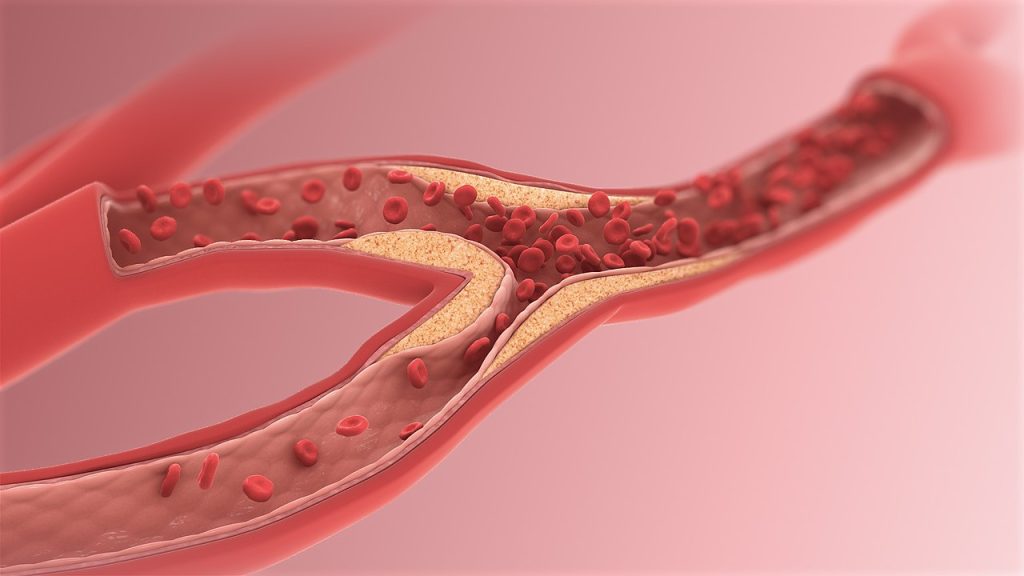
Image by Scientific Animations, CC4.0

Doctors should consider treating high cholesterol much earlier and more aggressively than they have in the past, according to a new perspective by Weill Cornell Medicine, New York-Presbyterian and Yale School of Medicine investigators. The updated 2026 cholesterol management guidelines from the American College of Cardiology and the American Heart Association encourage doctors to identify risk earlier and intervene before heart attacks and strokes happen. Heart disease remains the leading cause of death in the United States.

The perspective, published May 19 in the Journal of the American College of Cardiology, highlights the role and potential for primary care clinicians to implement the guidelines, while also acknowledging the challenges they may face.

“Primary care clinicians are really the backbone of patient care, especially when it comes to cardiovascular prevention. Due to our longitudinal relationships with patients we are uniquely positioned to reinforce healthy behaviours related to diet, exercise, sleep and smoking,” said Dr Madeline R. Sterling, associate professor of medicine at Weill Cornell and an internist at NewYork-Presbyterian/Weill Cornell Medical Center, and lead author of the perspective. Dr Sterling also served as the Inaugural Chair of the Primary Care Science Committee at the American Heart Association. “Primary care clinicians can screen patients earlier, assess lifetime cardiovascular risk and consider additional risk factors to enhance their management of dyslipidaemia.”

Dr. Erica S. Spatz, associate professor of cardiology and epidemiology at Yale School of Medicine, also co-authored the perspective.

In the past, treatment decisions often focused on whether someone was likely to have a heart attack or stroke within the next 10 years. However, even younger adults with moderately elevated cholesterol may benefit from earlier intervention if they carry other hidden risks, the authors said.

To better identify those risks, the new guidelines recommend that doctors look beyond standard cholesterol tests and use newer tools including measuring lipoprotein(a), or Lp(a), a genetically inherited cholesterol-related particle linked to heart disease, as well as coronary artery calcium (CAC) scans that can detect silent plaque buildup in the heart’s arteries.

Overall, the guidelines recommend a more aggressive approach to lipid management, including a focus on the cumulative damage cholesterol can cause over a lifetime. This may include starting a statin medication earlier along with lifestyle changes.

But implementing these recommendations may be challenging in practice, Dr Sterling said

Primary care clinicians often must address competing medical concerns during office visits, which tend to be short. Explaining lifetime cardiovascular risk, advanced cholesterol testing and preventive medications can require detailed conversations that need to occur over time and in concert with cardiologists and other specialists.

Experts also worry that without careful implementation, these advances could widen existing health disparities. Some advanced tests and newer cholesterol-lowering medications may not be covered by insurance or readily available in all communities.

Drs Sterling and Spatz say successful adoption will likely require better insurance coverage, improved electronic health record tools, patient education efforts, and stronger collaboration between primary care clinicians and specialists, including research and implementation efforts.

The guidelines also promote team-based care, where nurses, pharmacists and specialists help patients manage medications and reach cholesterol targets.

Ultimately, a multi-pronged approach will be necessary for the guideline recommendations to be consistently translated into practice, Dr Sterling said.

Source: Weill Cornell Medicine

The Science and Challenge Behind Replacing MRI Machines

Moving a Magnetic Resonance Imaging (MRI) machine is not as simple as out with the old and in with the new. It is an engineering feat – part physics, part choreography. It is not just a machine, it is an entire system that needs structural support and specialised housing.

The MRI machine being hoisted into its new position.

Some Quite Interesting (QI) facts about moving an MRI machine

MRI machines are marvels of engineering, with their powerful magnets requiring precise handling and specialised support. The magnet, which is the heart of the MRI, can weigh several tonnes and must remain cold, often near absolute zero, maintained by liquid helium or other cooling methods.

‘When replacing an MRI machine, the process is carefully orchestrated, starting with meticulous planning and structural assessments,’ explains Tinus van Rooyen, Business Project Manager at SCP Radiology. The date of the move is carefully selected to coordinate the team of engineers, crane operators and logistics professionals.

‘It is far more complex than moving almost any other piece of hospital or healthcare equipment. Which is why,’ says van Rooyen, ‘removing our old MRI machine and replacing it is not quite ‘all in a day’s work’. And our practice is doing it across multiple sites over the coming months.’

The new MRI machines contain less than 1% of the scarce and non-renewable resource, helium, than that of a conventional MRI machine, improving operational efficiency and long-term sustainability. ‘The newer MRI systems use sealed magnets that, although having to be kept at a temperature of 4 Kelvin (-269.15° Celsius), require very little helium and no refilling over their lifetime’, explains van Rooyen. ‘The improvements in technology in the new machines also ensure improved image quality.’

What is an MRI machine?

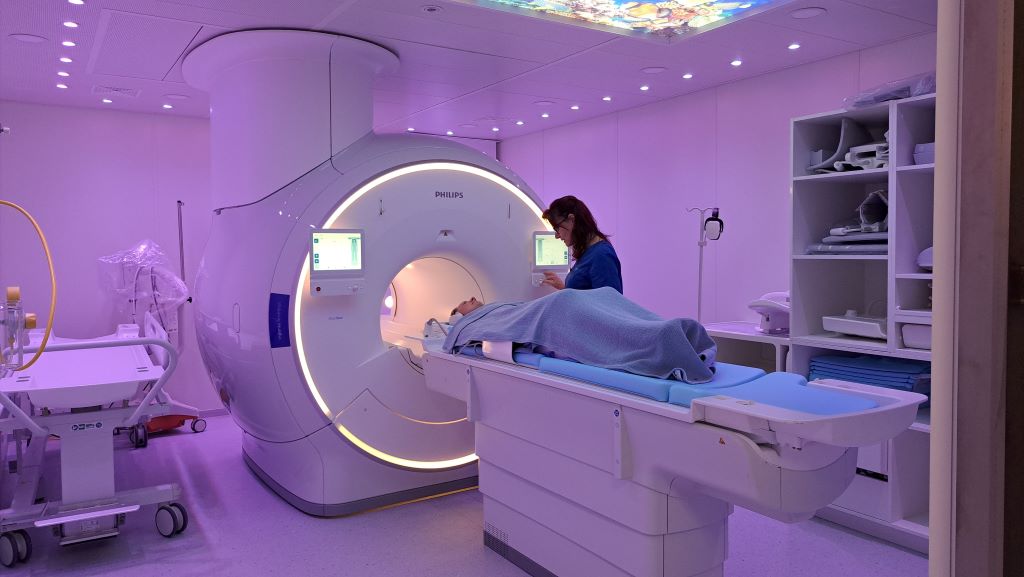
MRI ready for its first patient.

The powerful magnetic field and radio waves create detailed images of the body, enabling radiologists to look at soft tissues like the brain, spine, joints and organs in extraordinary detail and without using any radiation. ‘Everything is controlled by advanced computer systems, which convert signals into detailed scans. If an MRI is listening for whispers from the body, a Faraday cage – using copper or aluminium – shields the room to ensure it’s completely silent, so these can be heard clearly.’

How heavy is an MRI machine?

Heavier than most people expect. A low helium MRI machine weighs in at around 3.3 tonnes (3 300kg) – about the weight of an elephant and is significantly less than the conventional machines. The magnet alone is about 60 000 times stronger than Earth’s magnetic field when it’s fully operational and can weigh several tonnes. It’s unsurprising that installing one is a major engineering exercise.

Why would an MRI machine be replaced – what is the usual lifespan of a machine?

The lifespan of an MRI is approximately 10 – 15 years. Replacing ageing equipment ensures access to the latest technology, including improved image quality and an enhanced patient experience. Machines can also reach End of Support (EOS). ‘This means manufacturers no longer support and maintain the unit and parts are unavailable,’ says van Rooyen. ‘It therefore becomes unreliable to keep it running. Patient care is paramount, as is minimising potential downtime and ensuring continuity of service.’

What happens when a machine is replaced?

The old one needs to be ramped down (gradually reducing the strength of the scanner’s main magnetic field to zero in a controlled way). It is then disconnected and removed.

Installation of new unit is basically a reverse of the ramping down process. Once the unit is in place, the magnet is cooled to a superconducting state, then ramped up by gradually increasing the electrical current in the magnet coils, causing the magnetic field to slowly rise. After the magnet has reached its specified strength, the magnetic field is then aligned to make it as uniform as possible, ahead of the unit being calibrated and tested.  The entire process can take up to eight weeks. Careful planning ensures continuity of service, with alternative arrangements in place where necessary.

What are the challenges and logistics during the move?

The MRI machine at the SCP Radiology branch at Mediclinic Louis Leipoldt is housed on the first floor. The challenges included building a platform outside the building, moving and lifting the units, with the external wall being removed to create access. The equipment manufacturers oversee the installation but it required a team of riggers to assist with taking out the old unit, then lifting and installing the new unit off the delivery vehicle using a crane, onto a platform and then into the building. Additional contractors are responsible for preparing the room – this includes copper cladding, drywalling, reinforced flooring (if required), painting, joinery, etc.

‘The installation of each MRI unit is unique and depends on a number of factors. In the case of this new one at Louis Leipoldt, we had to partly close off a section of the road for the unloading and lifting. Getting the MRI into the building is a display in itself. Powerful cranes are used to lift the machine, hoisting it through a specially constructed opening. Every step demands precision to avoid damaging the magnet or the building and the installation requires coordinated planning with multiple stakeholders to ensure that the project is executed safely and efficiently,’ explains Heinie Matthysen, SCP’s Facilities Manager.

‘Everything is planned in minute detail by our facilities manager,’ says van Rooyen, ‘however, we also have to factor in the Cape Town weather that has a mind of its own’.

So, you can’t install an MRI in any room?

No, there are key requirements for the machine to work effectively and safely. These include a Faraday cage, which serves two purposes: To keep external radiofrequency signals out (so that they do not interfere with the MRI) and keep MRI radiofrequency signals in (to prevent these signals from affecting other equipment).

Copper (which this cage is made of, although aluminium can also be used) is an excellent conductor of electricity, highly effective at blocking electromagnetic waves, durable and relatively easy to install as sheets or mesh.

‘The room is engineered around the scanner. Without shielding and safety systems, the images would be unreliable and the risks much higher, ‘says van Rooyen.

The three facilities having their MRI machines replaced are:

  • SCP Radiology Louis Leipoldt (at Mediclinic Louis Leipoldt in Bellville): 16 April to 3 June
  • SCP Radiology Vredenburg (at Life West Coast Private Hospital in Vredenburg):

27 June to 3 August

  • SCP Radiology Worcester (at Mediclinic Worcester in Worcester): Timelines TBC