Tag: workload

Scheduling Surgeons: Researchers Identify Factors for Hospital Efficiency

Booking operating rooms with surgical precision starts with more accurate predictions of how surgeons spend their time

Photo by Piron Guillaume on Unsplash

Researchers at the University of Massachusetts Amherst have analysed nearly 86 500 surgeries at Baystate Medical Center to identify the top factors that influence inefficiencies in surgeon schedules. Having an efficiently organised surgical schedule has the potential to lower costs and reduce surgeon burnout, which would also improve patient outcomes.

As shortfalls in the availability of surgeons grow, the ability to meet surgical demands will only worsen, with implications for both healthcare delivery and costs.
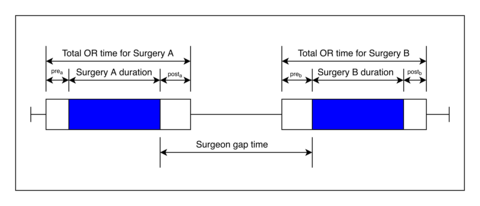
This illustrates the timeline of two surgeries performed by the same surgeon. The blue area represents the duration of the actual surgery itself, while the white blocks represent pre- and post-surgery activity.  Surgeon gap time is the time interval between two operations where the surgeon is not actively working.

“The most expensive part in this process of getting a surgery is the surgeon,” says Muge Capan, assistant professor in the Riccio College of Engineering at UMass Amherst and an author of the new paper published in the Journal of the American Medical Informatics Association. “Surgeons are highly skilled and they perform high-risk tasks. When we think about utilising a resource, we don’t want them to sit idle – but we also don’t want to overutilise them because these are not machines, these are people. Finding that right balance is a challenging problem.”

However, to efficiently schedule, hospitals need to predict how long a procedure will take. This includes the surgery itself as well as many other factors that surround an operation – has the surgeon recovered from their previous operation? Is the room clean? Is the proper equipment in place? “There is a lot of uncertainty there at the system level,” says Capan.

Currently, surgeries are scheduled in blocks, which is not compatible with the unpredictable nature of a hospital. “If you’re scheduling tennis lessons, it works because a tennis lesson is exactly one hour,” says Capan. “You block the court for one hour, you play, you leave, next group. But blocks don’t make sense for surgeries, because they’re so uncertain.” As a result, operating rooms (ORs) can sit empty since any block of time less than two-and-a-half hours is unusable for most surgeries.

In the pursuit of engineering a better schedule, Capan and her team collaborated with surgeons to predict their schedule by focusing on the person, not the operating room.

Surgeons are highly skilled and they perform high-risk tasks… we don’t want them to sit idle – but we also don’t want to overutilise them because these are not machines, these are people. Finding that right balance is a challenging problem.

Muge Capan, assistant professor in the Riccio College of Engineering at UMass Amherst

“There’s so much research on the operating room itself – what happens between the time a patient leaves the OR to the time the next patient enters the OR,” says Jonathan Akhagbosu, first author on the paper and UMass Amherst industrial engineering Ph.D. candidate. “But we wanted to look at it from a surgeon’s point of view: What happens between when a surgeon finishes one case and proceeds to the next case?”

The researchers named this time between operations “gap time.” In their study, they used machine learning to analyse three years of medical records from Baystate Medical Center in Springfield to determine the characteristics of a surgery that can predict these gaps in a surgeon’s schedule. 

A selection of the top factors associated with larger gap times are: if the surgeon’s previous or following case is an emergency, the preceding surgery is related to the chest (thorax), the following procedure is on the heart, or the surgery is highly demanding. 

Also, the last factor on the list – the assessment of how taxing an operation is on the surgeon – the researchers used mathematical models to create a new measurement called surgical case demand. Cases fall into one of three tiers. Type 1 consists of short, scheduled procedures of low-severity illness and elective surgeries, such as the removal of fatty lumps from the skin (lipoma excision) or simple dental rehabilitation. Type 2 events are more demanding, such as a mastectomy or knee replacement. And type 3 surgeries are the most onerous: the condition is more severe and they happen during off-hour times. Examples include emergency brain or abdominal operations and spine procedures.

It’s also worth noting that eye (ophthalmology) and orthopedic surgeries were associated with shorter gap times.

Capan envisions that predicting schedules can help recapture some of this lost time. “If there’s going be a gap, let’s figure out if that gap is long enough that I could squeeze in something else,” says Capan. “This is called ‘collectible time’ in the literature. Collectible time means it’s a useful gap. So what we learned about gap time could potentially help us understand collectible time.”

By Julia Westbrook 

Source: University of Massachusetts

Online ‘FoMO’ can Cause Employees to Burn Out

Photo by Vitaly Gariev on Unsplash

Fear of missing out (FoMO) is a key risk factor for employee mental health and, along with information overload, may increase burnout, according to new research.

Researchers from the University of Nottingham’s Schools of Psychology and Medicine analysed survey data from 142 employees to investigate the ‘dark side’ of digital working and found that employees who are worried about missing out on information and are overloaded by it are more likely to suffer stress and burnout. The results have been published today in SAGE Open.

The digital workplace is now recognised as a key strategic asset in organisations that enables worker productivity and flexibility in context of hybrid working. However, the potential downsides in terms of worker well-being also need to be considered, especially given the proliferation of digital communication channels and tools since Covid.

Elizabeth Marsh, PhD student from the School of Psychology

This new study connects to previous work which revealed that employees who are more mindful in the digital workplace are better protected against stress, anxiety and overload.

In this research FoMO is defined as anxiety about missing out on both important information and updates, as well as opportunities for relationships and interactions. FoMO has long been a term used in relation to social media, and now this new research shows it is an effect that is being felt in the workplace.

The participants in the study were surveyed about their experiences of the dark side effects of the digital workplace which were identified as; stress, overload, anxiety and fear of missing out and how these affected their wellbeing.

The results showed that among the dark side effects, those relating to information – both feeling overloaded by it and fearing missing out on it – proved particularly detrimental for well-being both directly and by elevating overall stress related to digital working.

Elizabeth adds: “The glut of information flowing through channels such as email, intranets or collaboration tools can lead workers to worry about missing out on it as well as succumbing to overload as they strive to keep up. To help people cope with information overwhelm, serious and sustained attention should be given to both optimising information management and supporting information literacy.”

The research makes some practical suggestions for employers which include investing in practices to optimise the amount and flow of information to employees. The findings could also be used by HR departments to consider policy and training options that would support the end-users of the digital workplace to better access, manage and consume information in a way that is conducive to well-being as well as productivity.

Consideration of the digital workplace in work and job design is essential to not only employee productivity but also well-being in modern organisations. Where this is lacking, elevated stress and burnout as well as poorer mental health may result. Our findings indicate the information ecosystem as an important area for attention both inside organisations and among the research community.

Professor Alexa Spence, School of Psychology

Source: University of Nottingham

‘Switching Off’ Over The Holidays is a Good Idea

Photo by Tim Gouw on Pexels

Not properly ‘switching off’ and disconnecting from work-related electronic communications can be more than just annoying, it can damage your health, research shows.

Researchers from the University of South Australia surveyed more than 2200 academics and professional staff across 40 Australian universities, and found that employees who responded to work emails and texts out of hours had greater odds of experiencing burnout, psychological distress, and poor physical health.

Researchers found that in 2021:

  • 26% of employees felt that they had to respond to work-related texts, calls, and emails from supervisors during their leisure time;
  • 57% said that they’d sent work-related digital communications to other colleagues in the evenings;
  • 50% reported that they often receive work-related texts, calls and emails from colleagues on the weekend;
  • 36% reported that it was the norm to respond immediately to digital communication in their organisation.

UniSA researcher Dr Amy Zadow says that the expectations for employees to be available 24-7 is putting pressure on workers.

“Since COVID, the digitalisation of work has really skyrocketed, blurring work boundaries, and paving the path for people to be contactable at all hours,” Dr Zadow said.

“But being available to work both day and night limits the opportunity for people to recover – doing things such as exercise and catching up with friends and family – and when there is no recovery period you can start to burn out.

“Our research shows that high levels of out-of-hours work digital communication can have a significant impact on your physical and mental wellbeing, affecting work-family relationships, causing psychological distress, and poor physical health.

“Conversely, workers who kept their work boundaries in check experienced less stress and pressure.”

The study found that those who were expected to respond to after-hours work communications on the weekends reported higher levels of psychological distress (56% vs 42%); emotional exhaustion (61% vs 42%); and poor physical health (28% compared to 10%).

UniSA’s Professor Kurt Lushington said that dealing with work-related stress is becoming increasingly important.

“Managing out-of-hours communications can be challenging, but organisations do have the power to discourage ‘work creep’,” Prof Lushington said.

“Setting up policies, practices and procedures to protect psychological health by developing a strong Psychosocial Safety Climate is likely to limit damaging out-of-hours digital communication. And, on a broader scale, this is already being considered in various Enterprise Bargaining Agreements and National Employment Standards.

“The starting place is measuring work demand so that an organisation can mitigate the risk in the first place. Once they do this, they can develop protective actions that can prevent the development or continuations of harmful workplace norms.

“At the end of the workday, everyone should have the right to disconnect.”

Source: University of South Australia

Recurrence Risk of Heart Attack is Increased by Long Hours

Photo of neon-lit heart by Leon Collett, via Unsplash.

For heart attack survivors, the risk of recurrent coronary heart disease is increased by working long hours.

Heart attack survivors who working 55+ hours per week were at higher risk of recurrent coronary heart disease (CHD) events (ie, myocardial infarction [MI] or unstable angina) over 6 years compared with people working a more standard 35-40 hours a week (adjusted HR 1.67). This included adjustment for sociodemographics, lifestyle-related risk factors, clinical risk factors, work environment factors, and personality factors.

“These results showed a linear risk increase after 40 h/week and a stronger effect after the first 4 years of follow-up and when long working hours are combined with job strain,” wrote Xavier Trudel, PhD, of CHU de Québec-Laval University Research Centre in Quebec City, and colleagues. 
The researchers suggested secondary interventions in curbing working hours among patients at risk of CHD recurrence.

In an accompanying editorial, Jian Li, MD, PhD, of UCLA, and Johannes Siegrist, PhD, of Heinrich-Heine-University, concurred: A “short standardized assessment of working time and stressful working conditions among economically active cardiac patients would enrich physicians’ awareness of patients’ needs and inform medical decision making.”

“With the transformation of the modern work due to technological advances and economic globalisation, an increase in work load and an extension of irregular, nonstandard forms of employment, including working from home, were reported, aggravating the control and prevention of long working hours,” Drs Li and Siegrist wrote.

They urged cardiac rehabilitation programmes to offer “training skills of coping with stressful demands and of strengthening resilience and relaxation” and involving occupational health services to develop return-to-work plans.

When cardiac disease patients return to work, their workplaces will need to adopt tailored, programs to retain the workers and manage disease, Drs Li and Siegrist added.

The prospective cohort study included 967 MI survivors under age 60, of whom 205 had a recurrent CHD event over follow-up averaging 5.9 years.Men and people in their 40s and 50s were most likely to be working long hours after an MI. Job strain, defined as a combination of high psychological demands and low decision latitude at work, was measured with a questionnaire.

Work hours for each participant were assessed only once, at about 6 weeks after returning to work. “Some patients could have changed exposure during follow-up, leading to potential nondifferential misclassification and to an underestimation of the true effect,” Trudel’s group acknowledged.

The observational study was limited by only one tenth of participants being women, limiting generalisability, and by unknown confounding variables.

“In conclusion, the study by Trudel et al. provides a new piece of research evidence that work-related factors play an important role in CHD prognosis,” Drs Li and Siegrist wrote. “Occupational health services are urgently needed to be incorporated into cardiac rehabilitation programs and secondary prevention of CHD.”

Source: MedPage Today

Journal article information: Trudel X, et al “Long working hours and risk of recurrent coronary events” J Am Coll Cardiol 2021; DOI: 10.1016/j.jacc.2021.02.012.

Editorial information: Li J, Siegrist J “Occupational risks of recurrent coronary heart disease” J Am Coll Cardiol 2021; DOI: 10.1016/j.jacc.2021.02.020.