Tag: voice

World Voice Day: UP Researchers Develop Low-cost Voice Screening Device for SA
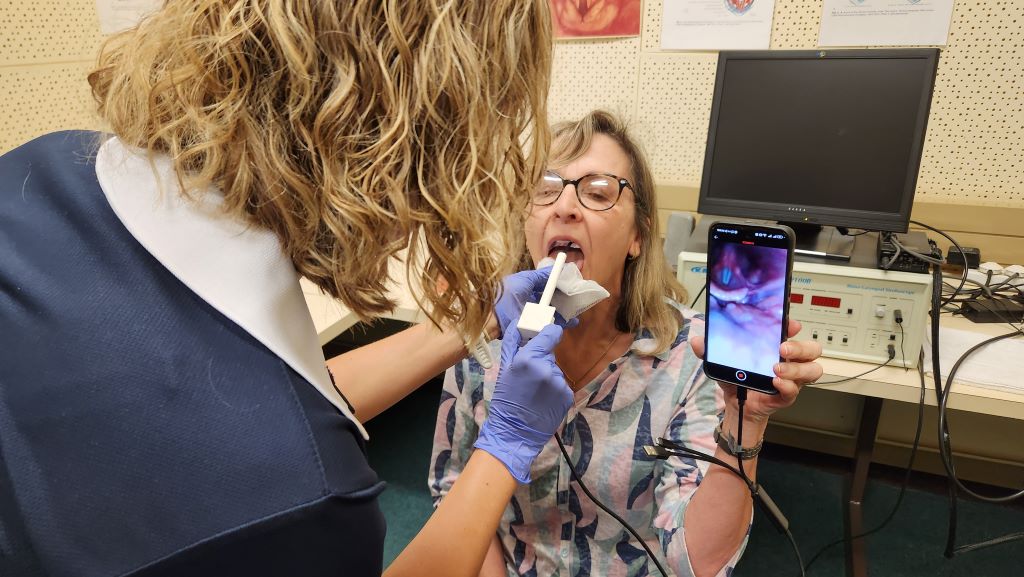
Dr Maria du Toit takes a close-up look at vocal cords, capturing high-resolution images and video using widely available mobile technology. Traditionally, this type of examination requires expensive equipment and specialist doctors, making it difficult to access in many parts of South Africa

Ahead of World Voice Day on 16 April, researchers at the University of Pretoria (UP) are inviting the public to take part in free voice checks using a new, locally developed device that could significantly expand access to vocal health services across South Africa.

The groundbreaking, low-cost, smartphone-compatible device, which is currently being tested as part of ongoing research, enables clinicians and trained users to take a close-up look at the voice user’s vocal cords by capturing high-resolution images and video using widely available mobile technology. Traditionally, this type of examination – known as laryngoscopy – requires expensive equipment and specialist doctors, making it difficult to access in many parts of South Africa.

“Your voice is something you use every day – whether for work, social interactions, or simply being heard. Yet many people ignore early warning signs of vocal problems,” says Professor Jeannie van der Linde, who is leading the research team and is Head of UP’s Department of Speech-Language Pathology and Audiology in the Faculty of Humanities.

Voice disorders are more common than many people realise. Prof Van der Linde adds: “International estimates suggest that up to one in five people will experience a voice problem at some point in their lives, with higher risk for those who rely heavily on their voices for work, such as teachers, healthcare workers and call centre agents. Despite this, access to specialised diagnostic services remains limited, particularly outside major urban centres.”

The research and device are part of a broader effort to rethink how vocal health services are delivered in South Africa. “Our aim was to develop a solution that is more portable, more affordable and easier to integrate into different healthcare contexts,” says Dr Maria du Toit, a Lecturer in Speech-Language Pathology and member of the research team.

“Many people ignore early signs like hoarseness or vocal fatigue, often because they don’t have easy access to assessment services,” Dr Du Toit says. “If we can identify these issues earlier, we can intervene sooner and potentially prevent more significant problems from developing.

The development of the device forms part of ongoing efforts within the department to explore how mobile anddigital technologies can be used to increase the availability of vocal health assessment and care.

Dr Roxanne Malan, a postdoctoral fellow, speech therapist and research team member, highlights the importance of designing technology that balances functionality with affordability and ease of use. “We wanted to ensure that the device is not only clinically useful but also practical in a range of settings, including those withlimited resources,” she says. “The goal is to make vocal health screening more widely available without compromising on quality.”

The technology, which has not been named yet, is being developed at UP and is currently undergoing testing to compare its performance with gold-standard laryngoscopy. “We started feasibility testing in June 2025 and preliminary tests have been very positive, demonstrating that the device is usable and produces high-quality images of the relevant structures,” Dr Malan says. “It consists of a low-cost, off-the-shelf borescope – typically used industrially – adapted with a 3D-printed handle to ensure optimal placement of the scope in the patient’s mouth, as well as the correct angle for visualisation. We have also assessed its safety for human use and its ability to be properly disinfected.”

In addition to testing the device, the World Voice Day initiative seeks to increase general awareness about theimportance of vocal health. “Your voice is central to how you communicate, work and engage with others,” Dr DuToit says. “Taking care of it should be seen as an essential part of overall health, not something to think aboutonly when there is a problem.”

Dr Malan says the team’s vision is for the scope to be readily available as a screening device in public hospitalsand clinics all over South Africa and other low- and middle-income countries. “But we still foresee numerousphases of testing to ensure that it can be used by a range of healthcare professionals, and that it makes asignificant difference in the target healthcare sectors. We will name and launch it at a stage when this has beendone.”

Dr Du Toit says members of the public can support the research by booking their free voice health check. “Byattending, you’re not only taking care of your own vocal health – you’re helping researchers develop solutionsthat could make voice care more easily available to thousands of people who currently don’t have access tothese services.”

Event details: Members of the public are invited to take part in free voice checks on World Voice Day, 16 April 2026, at the Department of Speech-Language Pathology and Audiology at the University of Pretoria’s Hatfield Campus.

Participants will have the opportunity to learn more about their vocal health and contribute to research that aims to make voice care more accessible across South Africa.

Who should consider a voice check?

This free check is especially recommended for:

● Teachers and lecturers

● Singers and performers

● Healthcare workers

● Clergy and public speakers

● Call centre workers

● Anyone who uses their voice extensively

You should also consider attending if you:

● frequently experience hoarseness or voice changes;

● feel your voice tires easily;

● have ongoing throat discomfort when speaking; and/or

● simply want reassurance that your voice is healthy.

To register, visit: https://forms.gle/imqeHnpGveQaEuDD6


Recognising a Voice is Easier with a Face

To recognise a famous voice, human brains use the same centre that is activated when the speaker’s face is presented, according to the results of an innovative neuroscience study which asked participants to identify US presidents.

The new study, published in the Journal of Neurophysiology, suggests that voice and face recognition are linked even more intimately than previously thought. It offers an intriguing possibility that visual and auditory information relevant to identifying someone feeds into a common brain centre, allowing for more robust, well-rounded recognition by integrating separate modes of sensation.

“From behavioural research, we know that people can identify a familiar voice faster and more accurately when they can associate it with the speaker’s face, but we never had a good explanation of why that happens,” said senior author Taylor Abel, MD, associate professor of neurological surgery at the University of Pittsburgh School of Medicine. “In the visual cortex, specifically in the part that typically processes faces, we also see electrical activity in response to famous people’s voices, highlighting how deeply the two systems are interlinked.”

Even though the interplay between the auditory and the visual brain processing systems has been widely acknowledged and investigated by various teams of neuroscientists all over the world, those systems were traditionally thought to be structurally and spatially distinct.

Few studies have attempted to directly measure activity from the brain centre – which primarily consolidates and processes visual information – to determine whether this centre is also engaged when participants are exposed to famous voice stimuli.

Researchers recruited epilepsy patients who had been implanted with electrodes measuring brain activity to determine the source of their seizures.

Abel and his team showed five participants photographs of three US presidents – Bill Clinton, George W. Bush and Barack Obama – or played short recordings of their voices, and asked participants to identify them.

Recordings of the electrical activity from the region of the brain responsible for processing visual cues (the fusiform gyri) showed that the same region became active when participants heard familiar voices, though that response was lower in magnitude and slightly delayed.

“This is important because it shows that auditory and visual areas interact very early when we identify people, and that they don’t work in isolation,” said Abel. “In addition to enriching our understanding of the basic functioning of the brain, our study explains the mechanisms behind disorders where voice or face recognition is compromised, such as in some dementias or related disorders.”

Source: University of Pittsburgh

Is That A Girl’s Voice or A Boy’s?

Phot by Ben Wicks on Unsplash

Researchers have found that it is possible to distinguish a girl’s voice from a boy’s from as young as five years old, but identification requires the listener to perceive the size of the speaker, providing a clue to their likely age. 

Perceiving gender in children’s voices is of special interest to researchers, because in children, a girl’s voice and a boy’s are very similar before the age of puberty. Adult male and female voices are fairly easy to distinguish due to acoustic differences.

With children, gender perception is much more complicated because gender differences in speech may emerge before sex-related anatomical differences between speakers. This suggests listeners may need to consider speaker age when guessing speaker gender and the perception of gender may depend on acoustic information besides anatomical differences between boys and girls.

In the Journal of the Acoustical Society of America, researchers reported developing a database of speech samples from children ages five to 18 to answer two questions: What types of changes occur in children’s voices as they become adults, and how do listeners adjust to the enormous variability in acoustic patterns across speakers?

Listeners assess a speaker’s gender, age, height, and other physical characteristics based primarily on the speaker’s voice pitch and on the resonance (formant frequencies) of their voice.

“Resonance is related to speaker height — think violin versus cello — and is a reliable indicator of overall body size,” said co-author Santiago Barreda, from the University of California, Davis. “Apart from these basic cues, there are other more subtle cues related to behaviour and the way a person ‘chooses’ to speak, rather than strictly depending on the speaker’s anatomy.”
When co-authors Barreda and Peter Assmann presented listeners with both syllables and sentences from different speakers, gender identification improved for sentences. They said this supports the stylistic elements of speech that highlight gender differences and are better conveyed in sentences.

They made two other important findings. First, listeners can reliably identify the gender of individual children as young as five.

“This is well before there are any anatomical differences between speakers and before there are any reliable differences in pitch or resonance,” said Barreda. “Based on this, we conclude that when the gender of individual children can be readily identified, it is because of differences in their behavior, in their manner of speaking, rather than because of their anatomy.”

Second, they found identification of gender of speakers must take place along with the identification of age and likely physical size.

“Essentially, there is too much uncertainty in the speech signal to treat age, gender, and size as independent decisions,” he said. “One way to resolve this is to consider, for example, what do 11-year-old boys sound like, rather than what do males sound like and what do 11-year-olds sound like, as if these were independent questions.”

Their findings suggest that “perception of gender can depend on subtle cues based on behaviour and not anatomy,” said Barreda. “In other words, gender information in speech can be largely based on performance rather than on physical differences between male and female speakers. If gendered speech followed necessarily from speaker anatomy, there would be no basis to reliably identify the gender of little girls and boys.”

This study supports the notion that gender (as opposed to sex) is largely performative in nature, which has long been argued on theoretical grounds.

Source: American Institute of Physics