

Tag: t cells

T Cells Unnecessary for COVID Recovery

Infected cell covered with SARS-CoV-2 viruses (yellow). Source: NIAID

New research with monkeys reveals that primates do not need T cells for the recovery of from acute COVID infections.

T cell depletion was also found not to induce severe disease, and T cells do not explain the natural resistance of rhesus macaques to severe COVID. Furthermore, it was found that strongly T cell-depleted macaques still develop potent memory responses to a second infection.

The findings, published in mBio, an open-access journal of the American Society for Microbiology, have implications for the development of second-generation vaccines and therapeutics.

Lead study author Kim Hasenkrug, PhD, senior investigator in the Laboratory of Persistent Viral Diseases, National Institutes of Health, explained: “We started this study early in the pandemic, trying to figure out how to make a good model to study the disease in humans using animals. The monkeys turned out to be more resistant to the disease than we expected, so we wanted to try to figure out why that was and try to gain some insights into the disease in humans as well. We now know that the antibody response is the most critical response for protection by vaccination, not the T cell response.”

In the new study, the researchers used classic reagents known to deplete CD4+ and CD8+ T cells in rhesus macaques. CD8+ T cells attack infected cells and kill them, and CD4+ T cells are helper T cells that set off the immune response by recognising pathogens and secreting cytokines, which signal other immune cells to act, including CD8+ T cells and antibody-producing B cells.

One week after depleting the macaques of CD4+ T cells, CD8+ T cells, or both at the same time, the researchers infected the animals with SARS-CoV-2. “We depleted, we infected them and then we continued the depletions during the first week of infection to make sure the animals were well depleted. Then we studied their blood to see how they were responding in terms of their T cells and B cells,” said Hasenkrug. Nasal swabs and bronchoalveolar lavages were performed over six weeks to measure virus in the nose, mouth and lungs, along with rectal swabs to check for virus shedding in the gut. After six weeks, the monkeys were re-challenged with SARS-CoV-2 and virus and blood samples collected, which let the researchers evaluate immune memory responses. “If there is a memory response, you get a much quicker immune response and control of the virus. That is how vaccinations work. Once your body has seen a viral pathogen, the next time it sees it, you can get a much faster and stronger immune response,” said Dr Hasenkrug.

Unexpected response

Even with T cell depletion, the monkeys were still able to mount a good memory response against the virus. “We found we got really good memory responses regardless of whether we depleted T cells or not. Basically, we found very strong virus neutralising antibodies, and they are the most important antibodies in controlling the infection. That was unexpected by most immunologists, virologists and vaccinologists,” said Dr Hasenkrug.

“The other thing that happens during a memory response is that antibodies mature, becoming stronger and more potent at binding the viral pathogen. We saw indications of this through what’s called ‘class switching’,” said Dr Hasenkrug.

‘Class switching’ was also not expected in these monkeys with depleted T cells. “We don’t have a firm explanation as to why that happened, but we think it involves some sort of compensatory response, which you can see in our study. For example, when we depleted CD8+ T cells, we saw stronger CD4+ T cell or B cells responses in some animals. When the animals are missing something, they will try to make up for it by making more of something else.”

Dr Hasenkrug doesn’t know why the T cells turned out to be not very important, but this may be a good thing, since people who fail to mount sufficient T cell responses still have opportunities to recover.

“This implies that the innate immune response is critical for initial control of the virus, rather than the adaptive immune responses we studied,” said Hasenkrug.

Source: American Society for Microbiology

Journal information: Hasenkrug, K.J., et al. (2021) Recovery from Acute SARS-CoV-2 Infection and Development of Anamnestic Immune Responses in T Cell-Depleted Rhesus Macaques. mBio. doi.org/10.1128/mBio.01503-21.
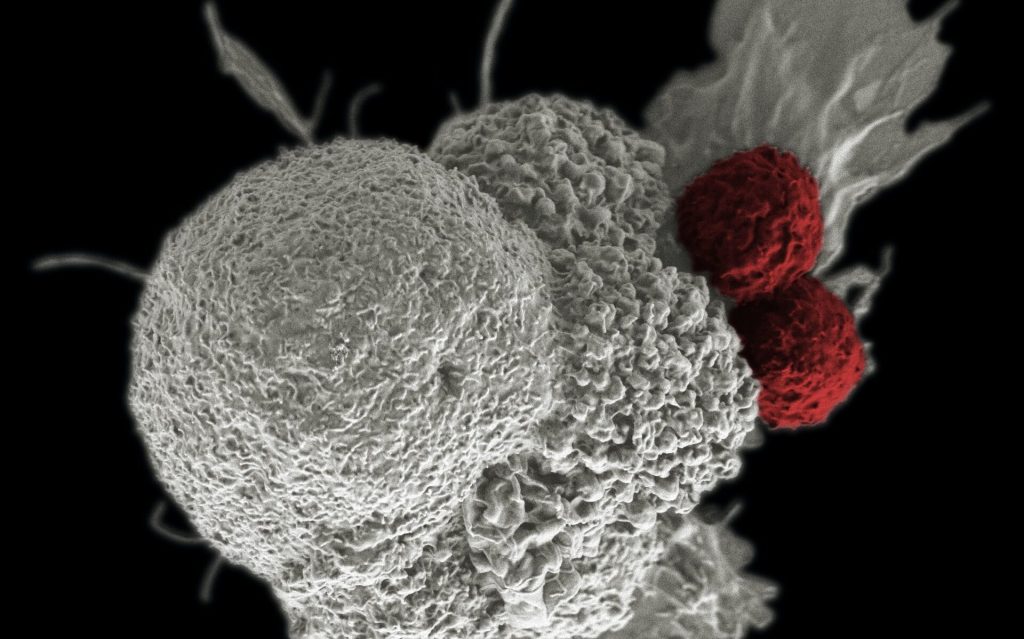
Unleashing the Immune System to Attack Cancers

Shown here is a pseudo-colored scanning electron micrograph of an oral squamous cancer cell (white) being attacked by two cytotoxic T cells (red), part of a natural immune response. Photo by National Cancer Institute on Unsplash

A potential treatment has been identified, that could boost the immune system’s ability to find and destroy cancer cells, by impeding certain cells which regulate the immune system, which in turn can unleash other immune cells to attack tumours in cancer patients.

“A patient’s immune system is more than able to detect and remove cancer cells and immunotherapy has recently emerged as a novel therapy for many different types of cancers,” explained study leader Nullin Divecha, Professor of Cell Signalling at the University of Southampton. “However, cancer cells can generate a microenvironment within the tumour that stops the immune system from working thereby limiting the general use and success of immunotherapy,” he continued.

One of a number of types of T cells, Teffector cells (Teffs) carry out the task of detection and removal of cancer cells . How well Teff cells work in detecting and removing cancer cells is partly governed by other T cells called T-regulatory cells, or Tregs for short. Tregs physically interact with the Teff cells, producing molecules which dampen the functioning of the Teff cells.

Prof Divecha added, “Tregs carry out an important function in the human body because without them, the immune system can run out of control and attack normal cells of the body. However, in cancer patients we need to give the Teff cells more freedom to carry out their job.”

Molecules released by tumour cells exacerbate the problem by attracting and gathering Tregs, reducing the activity and function of Teff cells even further. Though there are mechanisms to inhibit Treg cells, since Treg and Teff cells are very similar, Teff cells are also generally inhibited.

In this new study, published in PNAS, scientists from the University of Southampton and the National Institute of Molecular Genetics in Milan showed that inhibition of a family of enzymes in cells called PIP4K could be the answer to how to restrict Tregs without affecting Teffs.

The research team isolated Tregs from healthy donors and used genetic technology to suppress the production of the PIP4K proteins. They saw that loss of PIP4Ks from Treg cells stopped their growth and response to immune signals, in turn stopping them from impeding Teff cell growth and function.

Importantly, the loss of the same enzymes in Teff cells did not limit their activity.

“This was surprising because PIP4Ks are in both types of T cells in similar concentrations but our study shows that they seem to have a more important function for Tregs than Teffectors,” said Dr. Alessandro Poli who carried out the experimental research.

Scientists must next develop molecules in order to inhibition of PIP4K as a potential therapy for patients. “Towards this end we show that treatment with a drug like inhibitor of PIP4K could enable the immune system to function more strongly and be better equipped to destroy tumour cells.”

Source: EurekAlert!

CD40 Agonists Before Therapy Kick Off T Cell Response

Giving a CD40 immune-stimulating drug to early-stage pancreatic cancer patients helped kick off a T cell attack on the tumour’s stubborn microenvironment before surgery and other treatments, according to a new study.

Altering the tumour microenvironment to host more T cells using a CD40 agonist earlier could help slow cancer progression and prevent metastasis.

The data was presented by Katelyn T Byrne, PhD, an instructor of Medicine in the division of Hematology-Oncology in the Perelman School of Medicine at the University of Pennsylvania, during a plenary session at the American Association for Cancer Research annual meeting.

“Many patients with early-stage disease undergo surgery and adjuvant chemotherapy. But it’s often not enough to slow or stop the cancer,” Dr Byrne said. “Our data supports the idea that you can do interventions up front to activate a targeted immune response at the tumor site–which was unheard of five years ago for pancreatic cancer–even before you take it out.”

CD40 is a tumour necrosis factor receptor superfamily member expressed broadly on antigen-presenting cells (APC) such as dendritic cells, B cells, and monocytes as well as many non-immune cells and a range of tumours.

CD40 agonists serve to accelerate the immune system by activating antigen-presenting cells, such as dendritic cells, to “prime” T cells and also through enhancement of destruction of the tumour site through non-immune system means. This has been investigated mostly in combination with other therapies for pancreatic cancer patients. This is the first study showing the drug drove immune response in early-stage patients both at the tumour site and systemically, mirroring mouse study findings.

Prior to surgery, 16 patients were treated with selicrelumab. Of those, 15 underwent surgery and received adjuvant chemotherapy and a CD40 agonist. Data collected from those patients’ tumours and responses were compared to data from controls (CD40 not received before surgery) treated at Oregon Health and Science University and Dana Farber Cancer Institute.

Multiplex imaging of immune responses revealed that in patients who received the CD40 agonist before surgery, 82% of tumours were T cell enriched, compared to 37% of untreated tumors and 23% chemotherapy or chemoradiation-treated tumours.

Selicrelumab tumours also had less tumour-associated fibrosis, which are tissue bundles inhibiting T cell and drug entry, and antigen-presenting cells known as dendritic cells were more mature.

Disease-free survival was 13.8 months in the treatment group, and median overall survival was 23.4 months, with eight patients alive at a median of 20 months after surgery.

“This is a first step in building a backbone for immunotherapy interventions in pancreatic cancer,” Dr Byrne said.

On the strength of these findings, researchers are pursuing combining CD40 with other therapies to help further boost immune response in pre-surgery pancreatic cancer patients.

“We’re starting to turn the tide. This latest study adds to growing evidence that therapies such as CD40 before surgery can trigger an immune response in patients, which is the biggest hurdle we’ve faced,” said senior author Robert H Vonderheide, MD, DPhil, and Director, Abramson Cancer Center (ACC), University of Pennsylvania. “We’re excited to see how the next-generation of CD40 trials will take us even closer to better treatments.”

Source: News-Medical.Net

Study Discovers How Melanoma Cells Hide From Immune System

Melanomas in some patients do not respond well to immunotherapy treatments, and now researchers have discovered that a defect in STING gene expression in melanoma cells helps them escape immune cell surveillance.

Cancer cells use a variety of recently discovered mechanisms to avoid detection and destruction by immune cells, including defective detection and destruction of T cells, losses in expression of critical proteins on tumour cells and defective cell signaling in both immune and tumor cells.

The interferon signaling pathway is an important signaling pathway in interactions between tumour and immune cells. This pathway increases expression of molecules allowing tumour cells to be targeted by immune cells. One of the interferon signaling pathway’s key molecules is STING, which is activated by the protein cGAS.

Previously Moffitt researchers showed that STING activity is suppressed and altered in a subset of melanomas, rendering tumour cells invisible to the immune system.

Using a process called epigenetic modification to turn genes on or off with methylation groups, the researchers sought to improve the understanding of alterations in STING signaling in melanoma and find out how STING expression is suppressed. 

The researchers performed a series of laboratory experiments and discovered that the DNA regulatory region of the STING gene is highly modified by methylation groups resulting in loss of STING gene expression in certain melanoma cell lines. Importantly, they confirmed these findings in patient clinical samples of early and late-stage melanomas and showed similar methylation events and loss of expression of the upstream STING regulator cGAS.

The researchers demonstrated the possibility of reactivating STING and/or cGAS expression with a demethylating drug or genetic approaches. These successfully reactivated STING activity, resulting in increased interferon levels when triggered by STING agonist drugs that enabled the melanoma cells to now be recognised and targeted by immune cells.

“These studies show the critical importance of an intact STING pathway in melanomas for optimal T cell immunotherapy success, and how to overcome a notable STING defect in melanoma cases of gene hypermethylation by a combination therapy,” said senior author James J. Mulé, PhD, and Associate Center Director, Translational Science, H. Lee Moffitt Cancer Center & Research Institute.”Unless patients’ melanomas are pre-screened for intact versus defective STING, it is not at all surprising that clinical trials of STING agonists have, to date, uniformly failed.”

Source:
News-Medical.Net

Journal information: Falahat, R., et al. (2021) Epigenetic reprogramming of tumor cell–intrinsic STING function sculpts antigenicity and T cell recognition of melanoma. Proceedings of the National Academy of Sciences. doi.org/10.1073/pnas.2013598118.