Tag: osteoarthritis

Scientists Regenerate Joint Cartilage in Mice by Blocking an Ageing Protein
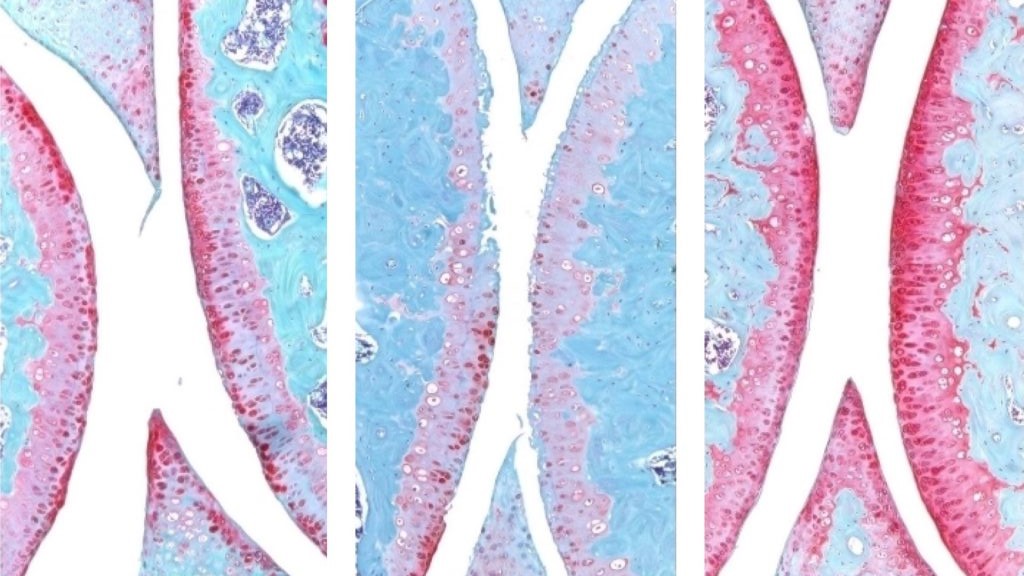
The knee joint of a young mouse (left), aged mouse (middle) and treated aged mouse (right). The red indicates cartilage. Credit: Nidhi Bhutani

An injection that blocks the activity of a protein involved in ageing reverses naturally occurring cartilage loss in the knee joints of old mice, a Stanford Medicine-led study has found. The treatment also prevented the development of arthritis after knee injuries mirroring the ACL tears often experienced by athletes or recreational exercisers. An oral version of the treatment is already in clinical trials with the goal of treating age-related muscle weakness.

Samples of human tissue from knee replacement surgeries – which include both the extracellular scaffolding, or matrix, in the joint as well as cartilage-generating chondrocyte cells – also responded to the treatment by making new, functional cartilage.

The study results suggest it may be possible to regenerate cartilage lost to ageing or arthritis with an oral drug or local injection, rendering knee and hip replacement unnecessary.

The treatment directly targets the cause of osteoarthritis, a disease for which no drug can slow down or reverse its progress; the primary treatments for osteoarthritis are pain control and surgical replacement of the affected joints.

The protein, 15-PGDH – termed a gerozyme due to its increase in prevalence as the body ages – is a master regulator of ageing. Gerozymes, identified by the same researchers in 2023, also drive the loss of tissue function. They are a major force behind age-related loss of muscle strength in mice. Blocking the function of 15-PGDH with a small molecule results in an increase in old animals’ muscle mass and endurance. Conversely, expressing15-PGDH in young mice causes their muscles to shrink and weaken. The gerozyme has also been implicated in the regeneration of bone, nerve and blood cells.

In each of these tissues, regeneration is due to increases in the proliferation and specialisation of tissue-specific stem cells. However, chondrocytes change their patterns of gene expression to assume a more youthful state without the involvement of stem cells. 

“This is a new way of regenerating adult tissue, and it has significant clinical promise for treating arthritis due to ageing or injury,” said Helen Blau, PhD, professor of microbiology and immunology. “We were looking for stem cells, but they are clearly not involved. It’s very exciting.”

Blau, who directs the Baxter Laboratory for Stem Cell Biology and Nidhi Bhutani, PhD, associate professor of orthopaedic surgery, are the senior authors of the research, which was published online in Science.

‘Dramatic regeneration’

“Millions of people suffer from joint pain and swelling as they age,” Bhutani said. “It is a huge unmet medical need. Until now, there has been no drug that directly treats the cause of cartilage loss. But this gerozyme inhibitor causes a dramatic regeneration of cartilage beyond that reported in response to any other drug or intervention.”

There are three main types of cartilage in the human body. One, elastic cartilage, is soft and flexible and forms structures like the outer ear. A second, fibrocartilage, is dense and tough, absorbing shock in areas such as between the spinal vertebrae. The third, hyaline cartilage, is smooth and glossy, providing a low-friction surface for lubrication and flexibility in joints like the ankles, hips, shoulders and parts of the knee. Hyaline cartilage, also known as articular cartilage, is the cartilage most commonly affected by osteoarthritis.

Osteoarthritis occurs when a joint is stressed by ageing, injury or obesity. The chondrocytes begin to release pro-inflammatory molecules and to break down collagen, which is the primary structural protein of cartilage. When collagen is lost, the cartilage thins and softens; the accompanying inflammation causes the joint swelling and pain that are hallmarks of the disease. Under normal circumstances, articular cartilage rarely regenerates. Although some populations of putative stem or progenitor cells capable of generating cartilage have been identified in bone, attempts to identify similar populations of cells in the articular cartilage have been unsuccessful.

Previous research from Blau’s lab has shown that a molecule called prostaglandin E2 is essential to muscle stem cell function. 15-PGDH degrades prostaglandin E2. Inhibiting 15-PGDH activity, or increasing levels of prostaglandin E2, supports the regeneration of damaged muscle, nerve, bone, colon, liver and blood cells in young mice.

Blau, Bhutani and their colleagues wondered if 15-PGDH might also play a role in ageing cartilage and joints. They wanted to find out if a similar pathway contributes to cartilage loss from ageing or in response to injury. When they compared the amount of 15-PGDH in the knee cartilage in young versus old mice, they saw that, as in other tissues, levels of the gerozyme increased about two-fold with age.

They next experimented with injecting old animals with a small molecule drug that inhibits 15-PGDH activity – first into the abdomen, which affects the entire body, then directly into the joint. In each case, the knee cartilage, which was markedly thinner and less functional in older animals as compared with younger mice, thickened across the joint surface. Further experiments confirmed that the chondrocytes in the joint were generating hyaline, or articular, cartilage, rather than less-functional fibrocartilage.

“Cartilage regeneration to such an extent in aged mice took us by surprise,” Bhutani said. “The effect was remarkable.”

Addressing ACL tears

Similar results were observed in animals with knee injuries like the ACL tears that frequently occur in people participating in sports such as soccer, basketball and skiing that require sudden pivoting, stopping or jumping. While the tears can be surgically repaired, about 50% of people develop osteoarthritis in the injured joint within about 15 years.

The researchers found that a series of injections twice a week for four weeks of the gerozyme inhibitor after injury dramatically reduced the chance that osteoarthritis develops in the mice. Animals treated with a control drug had levels of 15-PGDH that were twice as high as in their uninjured peers, and they developed osteoarthritis within four weeks.

The animals treated with the gerozyme inhibitor also moved more typically and put more weight on the paw of the affected leg than did untreated animals.

“Interestingly, prostaglandin E2 has been implicated in inflammation and pain,” Blau said. “But this research shows that, at normal biological levels, small increases in prostaglandin E2 can promote regeneration.”

A closer investigation of the chondrocytes in the joints of old mice and young mice showed that old chondrocytes expressed more detrimental genes involved in inflammation and the conversion of hyaline cartilage to unwanted bone, and fewer genes involved in cartilage development.

The researchers were also able to pinpoint subcategories of old chondrocytes that change their patterns of gene expression after treatment. One, which expresses 15-PGDH and genes involved in cartilage degradation, decreased in prevalence from 8% to 3% after treatment. Another, which does not express 15-PGDH but does express genes involved in the production of fibrocartilage, also decreased in prevalence: from 16% to 8% after treatment. A third population, which does not make 15-PGDH and which expresses genes involved in hyaline cartilage formation and the maintenance of the extracellular matrix necessary for its function, increased in prevalence after treatment from 22% to 42%. The findings indicate an overall shift in gene expression after treatment to a more youthful cartilage composition – without the involvement of stem or progenitor cells.

Finally, the researchers studied human cartilage tissue removed from patients with osteoarthritis undergoing total knee replacements. Tissue treated with the 15-PGDH inhibitor for one week exhibited lower levels of 15-PGDH-expressing chondrocytes and lowered cartilage degradation and fibrocartilage genes than control tissue and began to regenerate articular cartilage.

“The mechanism is quite striking and really shifted our perspective about how tissue regeneration can occur,” Bhutani said. “It’s clear that a large pool of already existing cells in cartilage are changing their gene expression patterns. And by targeting these cells for regeneration, we may have an opportunity to have a bigger overall impact clinically.”

Blau added, “Phase 1 clinical trials of a 15-PGDH inhibitor for muscle weakness have shown that it is safe and active in healthy volunteers. Our hope is that a similar trial will be launched soon to test its effect in cartilage regeneration. We are very excited about this potential breakthrough. Imagine regrowing existing cartilage and avoiding joint replacement.”

Source: Stanford University

Obesity Found to be a Leading Cause of Knee Osteoarthritis

Photo by Towfiqu barbhuiya

New research from the University of Sydney reveals that obesity, having a knee injury and occupational risks such as shift work and lifting heavy loads are primary causes of knee osteoarthritis.

The study also found that following a mediterranean diet, drinking green tea and eating dark bread could reduce the risk of developing knee osteoarthritis.

Published in Osteoarthritis and Cartilage, the study was led by Associate Professor Christina Abdel Shaheed and Dr Vicky Duong.

Using data from 131 studies conducted between 1988 to 2024, the researchers examined over 150 risk factors in participants ranging from 20 to 80 years old to determine which were associated with an increased risk of developing knee osteoarthritis. 

“Our research found that while factors such as eating ultra-processed foods and being overweight increase the risk, addressing lifestyle factors – such as losing weight or adopting a better diet – could significantly improve people’s health,” Associate Professor Abdel Shaheed said.

Co-author Professor David Hunter, a researcher at the Kolling Institute and Professor of Medicine at the University of Sydney, said: “Women were twice as likely to develop the condition than men, and older age was only mildly associated with increased risk.”

Reducing the risk of knee osteoarthritis

Dr Duong, lead author and post-doctoral researcher at the Kolling Institute, said: “Eliminating obesity and knee injuries combined could potentially reduce the risk of developing knee osteoarthritis by 14 percent across the population.

“We urge governments and the healthcare sector to take this seriously and to implement policy reforms that address occupational risks, subsidise knee injury prevention programs, and promote healthy eating and physical activity to reduce obesity.”

Source: University of Sydney

Researchers Develop New Test for Early Osteoarthritis Diagnosis

Photo by Mehmet Turgut Kirkgoz on Unsplash

Diagnosing osteoarthritis often occurs in the late stages when cartilage degradation is severe, making it difficult to distinguish it from other types of arthritis and to determine the best treatment plan. In work published in the Journal of Orthopaedic Research, investigators have developed and tested a new diagnostic test that uses two markers found in the synovial fluid of patients’ joints.

After assessing levels of cartilage oligomeric matrix protein and interleukin‐8, the team came up with an algorithm based on the ratio of these two markers and validated its efficacy in differentiating osteoarthritis from inflammatory arthritis in 171 human knee synovial fluid specimens.

“This study addresses an unmet need for objective diagnosis of osteoarthritis to improve clinical decision-making and patient outcomes,” said corresponding author Daniel Keter, BA, of CD Diagnostics, A Division of Zimmer Biomet.

Source: Wiley

Patients with Osteoarthritis are Often Prescribed NSAIDs Despite Contraindications

Photo by Towfiqu barbhuiya

A new study published in the journal Osteoarthritis and Cartilage has found that people with newly diagnosed osteoarthritis (OA) of the knee or hip with contraindications to or precautions for NSAIDs still continue to be prescribed these drugs. Additionally they had higher use of opioids and slightly lower physical therapy (PT) use within the first year of OA diagnosis, both of which are not consistent with treatment guidelines for OA.

“We found individuals with contraindications to NSAIDs were still commonly prescribed them, placing them at risk for NSAID-related adverse events,” explains corresponding author Tuhina Neogi, MD, PhD, the Alan S. Cohen Professor of Rheumatology and professor of medicine at the school. “Additionally, they were not more likely to receive safer alternatives like PT despite its widespread recommendation as first-line intervention.”

The researchers used population-based register data to identify adults residing in Sweden (between 2004-13) without a previous knee or hip OA diagnosis. Among this group, between 2014-18, they identified people with knee or hip OA diagnosis and presence of contraindications to or precautions for oral NSAIDs at the time of OA diagnosis. They then estimated the risk of: 1) regular oral NSAID use; 2) regular opioid use; 3) PT during the first year after diagnosis among those with versus without contraindications or precautions.

Despite having contraindications to NSAIDs, 21% of those in the study were regular users of NSAIDs within the first year of their OA diagnosis. Similarly, 21% of those with precautions for using NSAIDs were also regular users. They also found a higher proportion of persons with contraindications were regular users of opioids than those without a contraindication or precaution, while a slightly lower proportion received PT.

Neogi stresses that more options for effective and safe management of OA symptoms are urgently needed, and greater work is required in narrowing and ultimately closing the evidence-knowledge-practice gap.

Source: Boston University

Promising Results for Epilepsy Drug in Slowing Osteoarthritis

Source: CC0

Yale researchers report in the journal Nature that they have identified a drug target that may alleviate joint degeneration associated with osteoarthritis.

The most common therapies for the degenerative disease have been pain relievers and lifestyle changes, to reduce pain and stiffness, but there is a pressing need for therapies that can prevent joint breakdown that occurs in osteoarthritis, which occurs as a result of the breakdown of cartilage in the joints.

Sodium channels found in cell membranes produce electrical impulses in “excitable” cells within muscles, the nervous system, and the heart. And in previous research, Yale’s Stephen G. Waxman identified the key role of one particular sodium channel, called Nav1.7, in the transmission of pain signals.

Now, the labs of Chuan-Ju Liu, professor of orthopaedics, and Waxman, professor neurology, neuroscience and pharmacology, have found that the same Nav1.7 channels are also present in non-excitable cells that produce collagen and help maintain the joints in the body. These channels can be targeted by existing drugs to block them.

In the new study, the researchers deleted Nav1.7 genes from these collagen-producing cells and significantly reduced joint damage in two osteoarthritis models in mice.

They also demonstrated that drugs used to block Nav1.7 – including carbamazepine, a sodium channel blocker currently used to treat epilepsy and trigeminal neuralgia – also provided substantial protection from joint damage in the mice.

“The function of sodium channels in non-excitable cells has been a mystery,” Waxman said.

“This new study provides a window on how small numbers of sodium channels can powerfully regulate the behaviour of non-excitable cells.”

“The findings open new avenues for disease-modifying treatments,” added Wenyu Fu, a research scientist in the Liu laboratory and first author of the study.

Source: Yale University

Can Weight Loss Drugs Reduce Mortality Risk in Knee or Hip Osteoarthritis?

Source: Pixabay CC0

Besides its significant impact on disability, symptomatic OA is associated with an increased risk of all-cause mortality. Current guidelines advise weight loss to improve function and reduce pain but there is little data on whether it also reduces mortality risk.

New research published in Arthritis & Rheumatology suggests that for people overweight or with obesity and also knee or hip osteoarthritis, a slow-to-moderate – but not fast – rate of weight loss caused by anti-obesity medications may lower their risk of premature death.

Researchers enrolled 6524 participants with knee or hip osteoarthritis who were taking orlistat, sibutramine, or rimonabant to the study. The five-year death rate was 5.3%, 4.0%, and 5.4% for the “weight gain/stable”, “slow-to-moderate weight loss,” and “fast weight loss” groups, respectively. Compared with the “weight gain/stable” group,” the risk of death was 28% lower for the “slow-to-moderate weight loss” group and only 1% lower for the “fast weight loss” arm.

“A slow-to-moderate rate of weight loss induced by anti-obesity medications may lower the risk of death in overweight/obese people with knee/hip osteoarthritis”, said first author Jie Wei, PhD, of Xiangya Hospital, Central South University, in China.

Source: Wiley

A Common Drug may be an Effective Treatment for Hand Osteoarthritis

Source: Pixabay

Relief could be on the way for people with painful hand osteoarthritis after a new study found an affordable existing drug can help. Until now there has been no effective treatment.

Published in The Lancet, the paper investigated methotrexate, a low-cost, effective treatment for inflammatory joint conditions such as rheumatoid arthritis and psoriatic arthritis. It has been widely used in Australia and globally since the early 1980s.

Researchers led by Monash University and Alfred Health found that methotrexate reduced symptoms in those with hand osteoarthritis (OA). A 20mg weekly oral dose over six months had a moderate effect in reducing pain and stiffness in patients with symptomatic hand OA.

Hand OA is a disabling condition that causes pain and affects function, impeding daily activities such as dressing and eating. It can significantly reduce quality of life. About one in two women and one in four men will experience symptoms from hand OA by the time they turn 85.

About half will have inflamed joints, which cause pain and are associated with significant joint damage. Despite the high prevalence and disease burden, there are no effective medications.

Senior author Professor Flavia Cicuttini said that the study identified the role of inflammation in hand OA and the potential benefit of targeting patients who experience painful hand OA.

“In our study, as with most studies of osteoarthritis, both the placebo group and methotrexate groups’ pain improved in the first month or so,” Professor Cicuttini said.

“However, pain levels stayed the same in the placebo group but continued to decrease in the methotrexate group at three and six months, when they were still decreasing. The pain improvement in the methotrexate group was twice as much as in the placebo group.

“Based on these results, use of methotrexate can be considered in the management of hand osteoarthritis with an inflammatory pattern. This provides clinicians with a treatment option for this group, which tends to get more joint damage.”

Professor Cicuttini said in patients with hand OA and inflammation, the effects of methotrexate were present at about three months and by six months it was very clear if it worked.

“At that time patients and their doctors can decide whether to continue or stop it,” she said. “This is very similar to what we currently do with other forms of inflammatory arthritis.”

The randomised, double-blind, placebo-controlled trial of 97 people with hand OA and MRI-detected inflammation assessed whether 20mg of methotrexate weekly reduced pain and improved function compared to placebo in patients with symptomatic hand OA and synovitis (inflammation) over six months.

Professor Cicuttini said the results could provide relief for people with hand OA inflammation, which was particularly common in women as they experienced menopause.

“Further trials are needed to establish whether the effect of methotrexate extends beyond six months, for how long we need to treat patients, and whether methotrexate reduces joint damage in patients with hand osteoarthritis and associated inflammation,” she said.

Professor Cicuttini now plans to conduct an extension trial to address these questions, in particular whether women who develop hand OA around menopause and often have severe pain and joint damage may benefit.

Source: Monash University

In Osteoarthritis, Molecular Changes Weaken Protective Films

Photo by Towfiqu barbhuiya: https://www.pexels.com/photo/person-feeling-pain-in-the-knee-11349880/

Although osteoarthritis has been extensively studied through a medical perspective, the molecular changes associated with osteoarthritis remain unclear. New research published in Biointerphases suggests that there may be an optimum concentration and size of molecules in the synovial fluid needed to form the protective film in joints.

Osteoarthritis is the most common degenerative joint disease, affecting 22% of adults over 40 globally. The cartilage in the joints, in concert with the synovial fluid, provides a smooth surface to support weight-bearing movements. The fluid contains several molecules, including hyaluronan (HA) and phospholipids. Since the cartilage environment cannot be quickly healed or repaired, researchers have tried to diagnose the early stages of joint disease by monitoring the molecular weight and concentration of HA.

“Although we know that in healthy joints there is very low friction, it is unclear which other molecules are involved and how they change during osteoarthritis,” said Rosa Espinosa-Marzal (EIRH), professor of environmental engineering & science, and materials science & engineering. “During the early stages of osteoarthritis, cartilage starts degrading, and previous research has shown that the molecular composition of the synovial fluid changes. We wanted to see if the two changes are related to each other.”

In a healthy joint, the molecular weight of HA varies between 2–20 MDa with a concentration ranging from 1–4 mg/mL. Studies have shown that in diseased joints, HA is broken down resulting in a lower molecular weight and its concentration is also reduced by 10x. Based on these observations, made by other researchers, the study looked at how the concentration and molecular weight of HA influences the structure of healthy and diseased joints.

To do so, the researchers combined vesicles with high and low molecular weight HA. Using neutron scattering and light scattering, they discovered that the molecular weight of HA can vastly change the structure of the vesicles. Lower molecular weight HA, which mimics osteoarthritis-diseased joints, results in larger vesicle size. Changes in HA’s molecular weight also changed the thickness of the phospholipid layers in the joints.

The researchers also studied how these differences can influence the formation of a protective film; in joints this film is responsible for the very low friction we need for unhindered motion. Once again, they used a combination of techniques, quartz crystal microbalance and atomic force microscopy, to examine how these molecules assemble on gold surfaces.

“The formation of a film is possible only when there is an optimal concentration of HA and phospholipids. Even though the gold surfaces have very little in common with cartilage, our studies indicate that there could also be an optimum concentration under biological conditions,” Espinosa-Marzal said. “This is an important observation because we can use the concentration changes as a diagnostic tool.”

The researchers are now testing this theory using cartilage. They are also interested in studying the other molecular components that are found in joints to build a more comprehensive model of the changes that are associated with osteoarthritis.

Source: Carl R. Woese Institute for Genomic Biology, University of Illinois at Urbana-Champaign

iNova Launches New Supplement To Reduce Symptoms Of Osteoarthritis

A new joint health supplement has been launched in South Africa by iNOVA Pharmaceuticals which supports healthy joints and helps reduce the symptoms of osteoarthritis such as joint pain and stiffness1. Unlike other osteoarthritis supplements on the market, POSTEON™ has been shown to start working in as little as five days1.

According to scientifically based research, the ingredients in Posteon™ may help reduce the symptoms of osteoarthritis such as joint pain and stiffness, as well as improving range of motion and mobility1.

Boswellia serrata gum resin extract has traditionally been used to relieve symptoms of osteoarthritis. Taken once a day, Posteon™ contains 100mg of 3-O-Acetyl-11-keto-beta- boswellic acid (AKBA), the most active compound of Boswellia extract which is an inhibitor of 5-lipoxygenase (5-LOX). This is a key enzyme in the biosynthesis of leukotrienes from arachidonic acid in the cellular inflammatory cascade1.

It also contains 300mg of Avocado soy unsaponifiables (ASU), a dietary supplement consisting of one-third avocado oil and two-thirds soybean oil. Studies have found that ASU can reduce the production/action of various joint inflammatory substances which can prevent the destruction of joint cartilage and also help in its repair1.

Osteoarthritis is the most common form of arthritis2 and affects between 55.1% and as many as 82.7% of adults aged over 65 years in South Africa3. Globally, the prevalence of osteoarthritis is increasing, and is expected to continue to escalate4.

POSTEON™, which is now available at leading pharmacies, may reduce these symptoms1 which can significantly impact day-to-day functioning2.

References:

  1. Posteon PI. June 2022
  2. Centers for Disease Control and Prevention (CDC). Osteoarthritis (OA) (2022) at https://www.cdc.gov/arthritis/basics/osteoarthritis.htm# (website accessed on 4 May 2023).
  3. Usenbo, A et al. Prevalence of Arthritis in Africa: A Systematic Review and Meta-Analysis. A Systematic Review of Arthritis Prevalence in Africa (2015) at https://www.ncbi.nlm.nih.gov/pmc/articles/PMC4524637/ (website accessed on 4 May 2023).
  4. Osteoarthritis Research Society International (OARSI) Osteoarthritis: A Serious Disease, Submitted to the U.S. Food and Drug Administration (2016) at https://oarsi.org/oarsi-white-paper-oa-serious-disease (website accessed on 4 May 2023).

DISCLAIMER: This editorial has been commissioned and brought to you by iNova Pharmaceuticals.

Content in this editorial is for general information only and is not intended to provide medical or other professional advice. For more information on your medical condition and treatment options, speak to your healthcare professional.

Changes in Hyaluronic Acid Properties Drive Osteoarthritis

Source: CC0

The composition of synovial fluid changes significantly in osteoarthritis: The concentration and molecular weight of hyaluronic acid tends to decrease and is commonly used to diagnose the disease. An international group of researchers explored the disease-driven breakdown of hyaluronan and the mechanistic implications of these changes on the lubrication and subsequent wear of joints.

“One of the most important properties of the synovial fluid is its viscosity,” said Rosa Maria Espinosa-Marzal, co-author of the study published in the journal Biointerphases. “Viscosity is a measure of the internal frictional force between adjacent layers of a fluid in relative motion, or, more simply, a fluid’s resistance to flow. Large, high molecular weight polymers such as hyaluronic acid play a significant role in maintaining a high viscosity of the synovial fluid, which helps maintain a fluid film and reduces friction between articulating surfaces during motion.”

Through analysis with neutron and light scattering, the team determined that the structure of the lipid-hyaluronic-acid complexes in the bulk solution is a function of concentration and its molecular weight.

The researchers found the hyaluronic acid’s concentration and molecular weight both play a role in how the lubricant reacts with different surfaces.

“Our results show low molecular weight hyaluronic acid, which mimics osteoarthritis-diseased joints, hinders the adsorption of the hyaluronic-acid-lipid complex,” said Espinosa-Marzal, of the University of Illinois Urbana-Champaign. “The lack of the formation of an amorphous film on the surface may reflect a consequence of osteoarthritis, since this film should help reduce friction and wear.”

Their hypothesis is that this film’s absence may increase wear of the cartilage surface. In contrast, high molecular weight hyaluronic-acid-lipid complexes form an amorphous film, which presumably helps maintain the mechanical integrity and longevity of efficient lubrication in healthy cartilage.

Studies on hyaluronic acid itself and hyaluronic-acid-lipid complexes “do not entirely support hyaluronic acid’s role in providing high lubricity to the cartilage’s articular surface, which is still a bit controversial,” Espinosa-Marzal said. “Our results indicate that for low molecular weight hyaluronic acid, this is likely the case.”

By exploring the complex interplay between phospholipid and hyaluronic acid self-assembly, and the role of molecular weight on surface affinity, “our study illuminates a mechanism whereby the ‘vicious circle’ of osteoarthritis can be explained,” said co-author Mark Rutland, from KTH Royal Institute of Technology.

Source: American Institute of Physics