

Tag: cartilage

Scientists Regenerate Joint Cartilage in Mice by Blocking an Ageing Protein
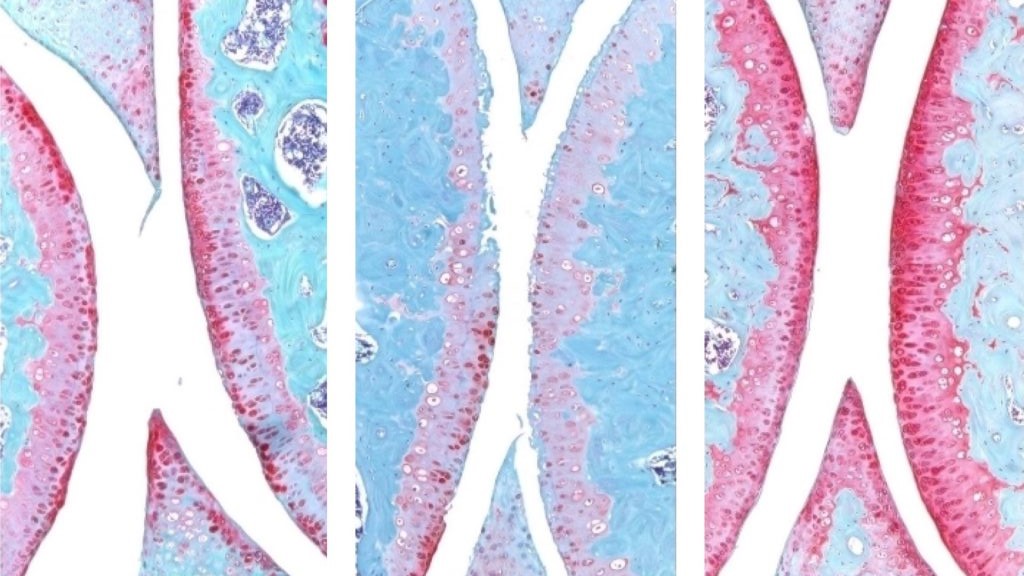
The knee joint of a young mouse (left), aged mouse (middle) and treated aged mouse (right). The red indicates cartilage. Credit: Nidhi Bhutani

An injection that blocks the activity of a protein involved in ageing reverses naturally occurring cartilage loss in the knee joints of old mice, a Stanford Medicine-led study has found. The treatment also prevented the development of arthritis after knee injuries mirroring the ACL tears often experienced by athletes or recreational exercisers. An oral version of the treatment is already in clinical trials with the goal of treating age-related muscle weakness.

Samples of human tissue from knee replacement surgeries – which include both the extracellular scaffolding, or matrix, in the joint as well as cartilage-generating chondrocyte cells – also responded to the treatment by making new, functional cartilage.

The study results suggest it may be possible to regenerate cartilage lost to ageing or arthritis with an oral drug or local injection, rendering knee and hip replacement unnecessary.

The treatment directly targets the cause of osteoarthritis, a disease for which no drug can slow down or reverse its progress; the primary treatments for osteoarthritis are pain control and surgical replacement of the affected joints.

The protein, 15-PGDH – termed a gerozyme due to its increase in prevalence as the body ages – is a master regulator of ageing. Gerozymes, identified by the same researchers in 2023, also drive the loss of tissue function. They are a major force behind age-related loss of muscle strength in mice. Blocking the function of 15-PGDH with a small molecule results in an increase in old animals’ muscle mass and endurance. Conversely, expressing15-PGDH in young mice causes their muscles to shrink and weaken. The gerozyme has also been implicated in the regeneration of bone, nerve and blood cells.

In each of these tissues, regeneration is due to increases in the proliferation and specialisation of tissue-specific stem cells. However, chondrocytes change their patterns of gene expression to assume a more youthful state without the involvement of stem cells. 

“This is a new way of regenerating adult tissue, and it has significant clinical promise for treating arthritis due to ageing or injury,” said Helen Blau, PhD, professor of microbiology and immunology. “We were looking for stem cells, but they are clearly not involved. It’s very exciting.”

Blau, who directs the Baxter Laboratory for Stem Cell Biology and Nidhi Bhutani, PhD, associate professor of orthopaedic surgery, are the senior authors of the research, which was published online in Science.

‘Dramatic regeneration’

“Millions of people suffer from joint pain and swelling as they age,” Bhutani said. “It is a huge unmet medical need. Until now, there has been no drug that directly treats the cause of cartilage loss. But this gerozyme inhibitor causes a dramatic regeneration of cartilage beyond that reported in response to any other drug or intervention.”

There are three main types of cartilage in the human body. One, elastic cartilage, is soft and flexible and forms structures like the outer ear. A second, fibrocartilage, is dense and tough, absorbing shock in areas such as between the spinal vertebrae. The third, hyaline cartilage, is smooth and glossy, providing a low-friction surface for lubrication and flexibility in joints like the ankles, hips, shoulders and parts of the knee. Hyaline cartilage, also known as articular cartilage, is the cartilage most commonly affected by osteoarthritis.

Osteoarthritis occurs when a joint is stressed by ageing, injury or obesity. The chondrocytes begin to release pro-inflammatory molecules and to break down collagen, which is the primary structural protein of cartilage. When collagen is lost, the cartilage thins and softens; the accompanying inflammation causes the joint swelling and pain that are hallmarks of the disease. Under normal circumstances, articular cartilage rarely regenerates. Although some populations of putative stem or progenitor cells capable of generating cartilage have been identified in bone, attempts to identify similar populations of cells in the articular cartilage have been unsuccessful.

Previous research from Blau’s lab has shown that a molecule called prostaglandin E2 is essential to muscle stem cell function. 15-PGDH degrades prostaglandin E2. Inhibiting 15-PGDH activity, or increasing levels of prostaglandin E2, supports the regeneration of damaged muscle, nerve, bone, colon, liver and blood cells in young mice.

Blau, Bhutani and their colleagues wondered if 15-PGDH might also play a role in ageing cartilage and joints. They wanted to find out if a similar pathway contributes to cartilage loss from ageing or in response to injury. When they compared the amount of 15-PGDH in the knee cartilage in young versus old mice, they saw that, as in other tissues, levels of the gerozyme increased about two-fold with age.

They next experimented with injecting old animals with a small molecule drug that inhibits 15-PGDH activity – first into the abdomen, which affects the entire body, then directly into the joint. In each case, the knee cartilage, which was markedly thinner and less functional in older animals as compared with younger mice, thickened across the joint surface. Further experiments confirmed that the chondrocytes in the joint were generating hyaline, or articular, cartilage, rather than less-functional fibrocartilage.

“Cartilage regeneration to such an extent in aged mice took us by surprise,” Bhutani said. “The effect was remarkable.”

Addressing ACL tears

Similar results were observed in animals with knee injuries like the ACL tears that frequently occur in people participating in sports such as soccer, basketball and skiing that require sudden pivoting, stopping or jumping. While the tears can be surgically repaired, about 50% of people develop osteoarthritis in the injured joint within about 15 years.

The researchers found that a series of injections twice a week for four weeks of the gerozyme inhibitor after injury dramatically reduced the chance that osteoarthritis develops in the mice. Animals treated with a control drug had levels of 15-PGDH that were twice as high as in their uninjured peers, and they developed osteoarthritis within four weeks.

The animals treated with the gerozyme inhibitor also moved more typically and put more weight on the paw of the affected leg than did untreated animals.

“Interestingly, prostaglandin E2 has been implicated in inflammation and pain,” Blau said. “But this research shows that, at normal biological levels, small increases in prostaglandin E2 can promote regeneration.”

A closer investigation of the chondrocytes in the joints of old mice and young mice showed that old chondrocytes expressed more detrimental genes involved in inflammation and the conversion of hyaline cartilage to unwanted bone, and fewer genes involved in cartilage development.

The researchers were also able to pinpoint subcategories of old chondrocytes that change their patterns of gene expression after treatment. One, which expresses 15-PGDH and genes involved in cartilage degradation, decreased in prevalence from 8% to 3% after treatment. Another, which does not express 15-PGDH but does express genes involved in the production of fibrocartilage, also decreased in prevalence: from 16% to 8% after treatment. A third population, which does not make 15-PGDH and which expresses genes involved in hyaline cartilage formation and the maintenance of the extracellular matrix necessary for its function, increased in prevalence after treatment from 22% to 42%. The findings indicate an overall shift in gene expression after treatment to a more youthful cartilage composition – without the involvement of stem or progenitor cells.

Finally, the researchers studied human cartilage tissue removed from patients with osteoarthritis undergoing total knee replacements. Tissue treated with the 15-PGDH inhibitor for one week exhibited lower levels of 15-PGDH-expressing chondrocytes and lowered cartilage degradation and fibrocartilage genes than control tissue and began to regenerate articular cartilage.

“The mechanism is quite striking and really shifted our perspective about how tissue regeneration can occur,” Bhutani said. “It’s clear that a large pool of already existing cells in cartilage are changing their gene expression patterns. And by targeting these cells for regeneration, we may have an opportunity to have a bigger overall impact clinically.”

Blau added, “Phase 1 clinical trials of a 15-PGDH inhibitor for muscle weakness have shown that it is safe and active in healthy volunteers. Our hope is that a similar trial will be launched soon to test its effect in cartilage regeneration. We are very excited about this potential breakthrough. Imagine regrowing existing cartilage and avoiding joint replacement.”

Source: Stanford University

Engineered Cartilage from Nasal Septum Cells helps Treat Complex Knee Injuries

Researchers grow cartilage replacements from cells of the nasal septum to repair cartilage injuries in the knee. (Photo: University of Basel, Christian Flierl)

An unlucky fall while skiing or playing football can spell the end of sports activities. Damage to articular cartilage does not heal by itself and increases the risk of osteoarthritis. Researchers at the University of Basel and the University Hospital Basel have now shown that even complex cartilage injuries can be repaired with replacement cartilage engineered from cells taken from the nasal septum.

A team at the Department of Biomedicine led by Professor Ivan Martin, Dr Marcus Mumme and Professor Andrea Barbero has been developing this method for several years. It involves extracting the cells from a tiny piece of the patient’s nasal septum cartilage and then allowing them to multiply in the laboratory on a scaffold made of soft fibres. Finally, the newly grown cartilage is cut into the required shape and implanted into the knee joint.

Earlier studies have already shown promising results. “Nasal septum cartilage cells have particular characteristics that are ideally suited to cartilage regeneration,” explains Professor Martin. For example, it has emerged that these cells can counteract inflammation in the joints.

More mature cartilage shows better results

In a clinical trial involving 98 participants at clinics in four countries, the researchers compared two experimental approaches. One group received cartilage grafts that had matured in the lab for only two days before implantation – similar to other cartilage replacement products. For the other group, the grafts were allowed to mature for two weeks. During this time, the tissue acquires characteristics similar to native cartilage.

For 24 months after the procedure, the participants self-assessed their well-being and the functionality of the treated knee through questionnaires. The results, published in the scientific journal Science Translational Medicine, showed a clear improvement in both groups. However, patients who received more mature engineered cartilage continued to improve even in the second year following the procedure, overtaking the group with less mature cartilage grafts.

Magnetic resonance imaging (MRI) further revealed that the more mature cartilage grafts resulted in better tissue composition at the site of the implant, and even of the neighbouring cartilage. “The longer period of prior maturation is worthwhile,” emphasizes Anke Wixmerten, co-lead author of the study. The additional maturation time of the implant, she points out, only requires a slight increase in effort and manufacturing costs, and gives much better results.

Particularly suited to larger and more complex cartilage injuries

“It is noteworthy that patients with larger injuries benefit from cartilage grafts with longer prior maturation periods,” says Professor Barbero. This also applies, he says, to cases in which previous cartilage treatments with other techniques have been unsuccessful.

“Our study did not include a direct comparison with current treatments,” admits Professor Martin. “However, if we look at the results from standard questionnaires, patients treated with our approach achieved far higher long-term scores in joint functionality and quality of life.”

Based on these and earlier findings, the researchers now plan to test this method for treating osteoarthritis – an inflammatory disease that causes joint cartilage degeneration, resulting in chronic pain and disability.

Two large-scale clinical studies, funded by the Swiss National Science Foundation and the EU research framework programme Horizon Europe, are about to begin. These studies will explore the technique’s effectiveness in treating a specific form of osteoarthritis affecting the kneecaps (ie, patellofemoral osteoarthritis). The activities will further develop in Basel the field of cellular therapies, strategically defined as a priority area for research and innovation at the University of Basel and University Hospital Basel.

Source: University of Basel

Discovery of New Skeletal Tissue Holds Promise for Regenerative Medicine

“Lipocartilage” is a type of supportive skeletal tissue, that consists of densely packed, bubble-like cells containing fat. This image shows a scan of mouse ear lipocartilage stained with a green fluorescent dye. Charlie Dunlop School of Biological Sciences

An international research team led by the University of California, Irvine has discovered a new type of skeletal tissue that offers great potential for advancing regenerative medicine and tissue engineering.

Most cartilage relies on an external extracellular matrix for strength, but “lipocartilage,” which is found in the ears, nose and throat of mammals, is uniquely packed with fat-filled cells called “lipochondrocytes” that provide super-stable internal support, enabling the tissue to remain soft and springy – similar to bubbled packaging material.

The study, published in the journal Science, describes how lipocartilage cells create and maintain their own lipid reservoirs, remaining constant in size. Unlike ordinary adipocyte fat cells, lipochondrocytes never shrink or expand in response to food availability.

“Lipocartilage’s resilience and stability provide a compliant, elastic quality that’s perfect for flexible body parts such as earlobes or the tip of the nose, opening exciting possibilities in regenerative medicine and tissue engineering, particularly for facial defects or injuries,” said corresponding author Maksim Plikus, UC Irvine professor of developmental and cell biology. “Currently, cartilage reconstruction often requires harvesting tissue from the patient’s rib – a painful and invasive procedure. In the future, patient-specific lipochondrocytes could be derived from stem cells, purified and used to manufacture living cartilage tailored to individual needs. With the help of 3D printing, these engineered tissues could be shaped to fit precisely, offering new solutions for treating birth defects, trauma and various cartilage diseases.”

Dr Franz Leydig first recognised lipochondrocytes in 1854, when he noted the presence of fat droplets in the cartilage of rat ears, a finding that was largely forgotten until now. With modern biochemical tools and advanced imaging methods, UC Irvine researchers comprehensively characterised lipocartilage’s molecular biology, metabolism and structural role in skeletal tissues.

They also uncovered the genetic process that suppresses the activity of enzymes that break down fats and reduce the absorption of new fat molecules, effectively locking lipochondrocytes’s lipid reserves in place. When stripped of its lipids, the lipocartilage becomes stiff and brittle, highlighting the importance of its fat-filled cells in maintaining the tissue’s combination of durability and flexibility. In addition, the team noted that in some mammals, such as bats, lipochondrocytes assemble into intricate shapes, like parallel ridges in their oversized ears, which may enhance hearing acuity by modulating sound waves.

“The discovery of the unique lipid biology of lipocartilage challenges long-standing assumptions in biomechanics and opens doors to countless research opportunities,” said the study’s lead author, Raul Ramos, a postdoctoral researcher in the Plikus laboratory for developmental and regenerative biology. “Future directions include gaining an understanding of how lipochondrocytes maintain their stability over time and the molecular programs that govern their form and function, as well as insights into the mechanisms of cellular aging. Our findings underscore the versatility of lipids beyond metabolism and suggest new ways to harness their properties in tissue engineering and medicine.”

Source: University of California – Irvine

‘Feed-forward’ Loop in Cartilage Cells Worsens Osteoarthritis


An unfortunate ‘feed-forward’ loop in cartilage cells appears to exacerbate arthritis, according to researchers Duke University and Washington University in Saint Louis.

Cartilage resists compressive forces, enhances bone resilience, and provides support on bony areas where there is a need for flexibility. In osteoarthritis, the most common form of arthritis,  the cartilage breaks down, allowing painful bone-on-bone contact. Osteoarthritis is the and affects millions of people worldwide with joint pain and stiffness. It is most commonly found in the knees, hips and spine.  

Chondrocytes build and maintain cartilage, with force-sensitive ion channels on their surface, which are called Piezo1 and Piezo2. Piezo channels respond to mechanical loads on the joint by sending signals into the cell that can change gene activity.

In osteoarthritis, degeneration and malfunction of chondrocytes, which are unable to repair themselves by division, contributes to the progressive breakdown of cartilage. Osteoarthritis is als marked by chronic, low-grade inflammation, driven by interleukin-1 alpha, a signalling molecule. Taking cartilage cells from pigs and from human joints removed for replacement surgeries, the researchers investigated the way inflammation affects chondrocytes.

The researchers found that interleukin signaling causes the chondrocytes to produce more Piezo channels, in turn increasing their sensitivity to pressure and resulting in what the researchers term a harmful ‘feed-forward’ loop that leads to further cartilage breakdown.

“Interleukin reprograms the chondrocytes so that they’re more sensitive to mechanical trauma,” Liedtke said. “The feed-forward cycle slowly grinds them down and the cell cannot be replaced.”

Liedtke likened healthy chondrocyte to “a tennis ball”, a bouncy sphere which is kept stiff by its internal matrix of actin fibres. But as these cells lose their ability to replace actin fibres, “they get softer, more squishy.”

However, more Piezo channels were created as the chondrocytes became squishier.

“Overexpressed Piezo channels render the inflamed chondrocyte hypersensitive to mechanical microtrauma, thus increasing the risk of mechanically-induced chondrocyte injury and subsequent progression of osteoarthritis,” said  first and co-corresponding author and biomedical engineer, Whasil Lee, who moved from the Liedtke-Lab to open her own laboratory at the University of Rochester

“It’s cartilage reprogramming itself to do more damage,” Liedtke said.

To confirm this relationship, the researchers blocked the activity of the Piezo channels and observed that the ‘squishiness’ of chondrocytes was reverted.

“We have known that mechanical loading of the joint is essential for maintaining cartilage health,” Guilak said. “In this study, we have uncovered a mechanism by which excessive loading under inflammatory conditions can create a situation that can lead to progressive cartilage degeneration.”

“We’re always looking for feed-forward mechanisms as facilitators of chronic disease,” Liedtke said. “Here we found one, which opens the door for us to come up with disease-modifying treatments, currently non-existent for osteoarthritis.”

Source: Duke University

Journal information: “Inflammatory Signaling Sensitizes Piezo1 Mechanotransduction in Articular Chondrocytes as a Pathogenic Feed-Forward Mechanism in Osteoarthritis,” Whasil Lee, et al. PNAS, March 22, 2021, DOI: 10.1073/pnas.2001611118